Chauri Chaura Incident 1922: The Day Gandhi Stopped the Non-Cooperation Movement
On 4 February 1922 a crowd at Chauri Chaura in Gorakhpur burned down a police station, killing 22 policemen. Within eight days Gandhi suspended the Non-Cooperation Movement at Bardoli. UPSC notes on causes, consequences and historiographical debates.
The Non-Cooperation Movement of 1920 to 1922 was the first nationwide mass mobilisation under Mahatma Gandhi. Lawyers gave up practice. Students walked out of government colleges. Foreign cloth piled up for public burning. Picketing of liquor shops shut down government revenue in dozens of districts. By early 1922 the colonial administration was genuinely worried.
Then on 4 February 1922, in a small market town called Chauri Chaura in Gorakhpur district of the United Provinces, a crowd of volunteers and farmers attacked a police station after the police opened fire on their procession. Twenty-two policemen and three civilians died in the burning station. Within eight days Gandhi suspended the movement at Bardoli. The Indian National Congress lost its single best chance to push the British out a generation earlier than 1947.
This article reads the Chauri Chaura incident the way the UPSC mains examiner wants it read. It walks through the build-up to 4 February, the events of that day, Gandhi’s controversial decision at Bardoli, and the long historiographical argument that followed.
Quick Facts
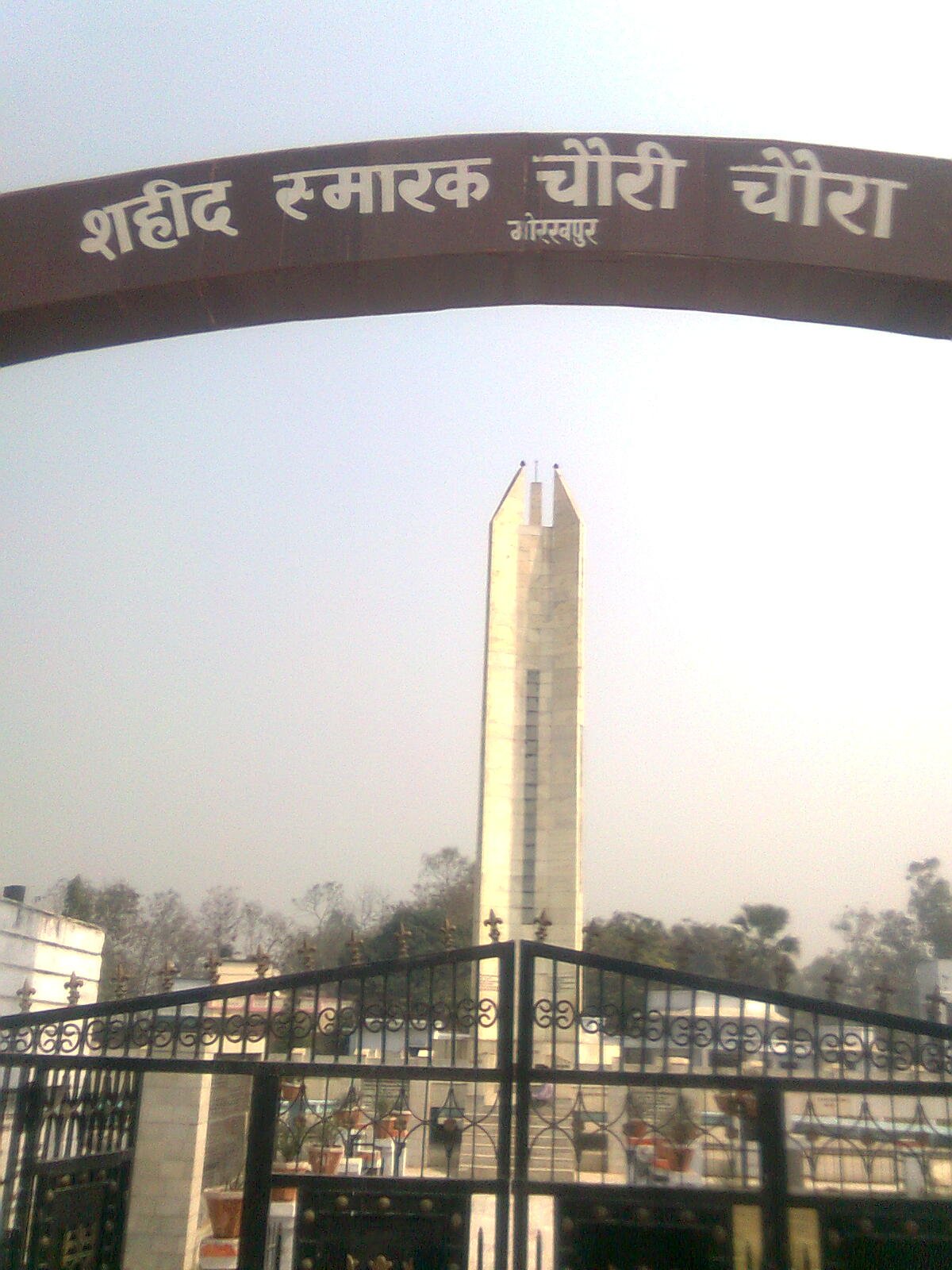
- Date: 4 February 1922
- Place: Chauri Chaura, Gorakhpur district, United Provinces (present-day Uttar Pradesh)
- Movement: Non-Cooperation Movement, launched by Gandhi in 1920
- Trigger: Police firing on a Volunteer Corps procession
- Casualties: 22 policemen and 3 civilians killed; police station burned to the ground
- Gandhi’s Response: Five-day penance fast starting 5 February
- Bardoli Resolution: Passed by Congress Working Committee on 12 February 1922
- Movement Status: Formally suspended at Bardoli
- Gandhi Arrested: 10 March 1922 under Section 124-A
- Sentence: Six years’ imprisonment, later released early on health grounds in 1924
- Initial Verdict: 172 sentenced to death by Sessions Court (Gorakhpur)
- Final Verdict: 19 hanged and 110 transported for life after Allahabad High Court appeal
- Memorial: Shahid Smarak inaugurated at the site in 1973
What Happened on 4 February 1922
On the morning of 4 February 1922 a procession of around 2,500 to 3,000 Non-Cooperation volunteers and local farmers gathered at the Chauri Chaura bazaar. The immediate grievance was the high price of meat and rising kerosene prices. The longer grievance was a clash with the local police three days earlier. On 1 February, the head constable Gupteshwar Singh had beaten up Bhagwan Ahir, a volunteer leader who was leading a temperance picket. Bhagwan Ahir had complained at the local thana, but no action was taken.
The procession marched past the police station around 1:30 pm. The Daroga, the station house officer, ordered the police to open fire to disperse the crowd. The volunteers shouted slogans and refused to leave. The first volleys killed three protesters and wounded several others.
What happened next surprised everyone. The crowd surged back, surrounded the police station, and set it on fire. Twenty-two policemen and one chowkidar were trapped inside. The thana building, then a thatched-roof structure with a brick verandah, burned to the ground. By dusk, three civilians, twenty-two policemen and a chowkidar had died.
Background and Historical Context
The Non-Cooperation Movement had been launched in September 1920 at the Calcutta Special Session of the Congress and formally ratified at Nagpur in December 1920. Its programme had three core pillars. The first was a boycott of government schools, colleges, courts and legislative councils. The second was a boycott of foreign goods. The third was the building of an alternative national infrastructure, including national schools, panchayat courts and khadi production.
Why Did Things Turn Violent
The standard textbook answer is that Chauri Chaura was a stray act of mob violence that Gandhi, with his strict ahimsa code, could not tolerate. The reality is more textured.
The historian Shahid Amin, in his book Event, Metaphor, Memory: Chauri Chaura 1922 to 1992, documents the local grievances in detail. The Gorakhpur villages around Chauri Chaura had a long history of conflict with local police. Sugar prices had collapsed during the war years. Cloth prices had spiked. The Daroga at Chauri Chaura had a personal reputation for extorting bribes. The Volunteer Corps that had grown up under the Non-Cooperation Movement had become the only effective check on local police excess.
When Bhagwan Ahir was beaten and humiliated on 1 February, the Volunteer Corps decided to march to the station and demand action. The 4 February procession was not a random gathering. It was a disciplined Volunteer Corps demonstration. When the police fired, the crowd interpreted it as continued police brutality, not as the legitimate use of authority. The burning of the station was popular justice in a particular regional idiom.
Gandhi’s Five-Day Fast and the Bardoli Resolution
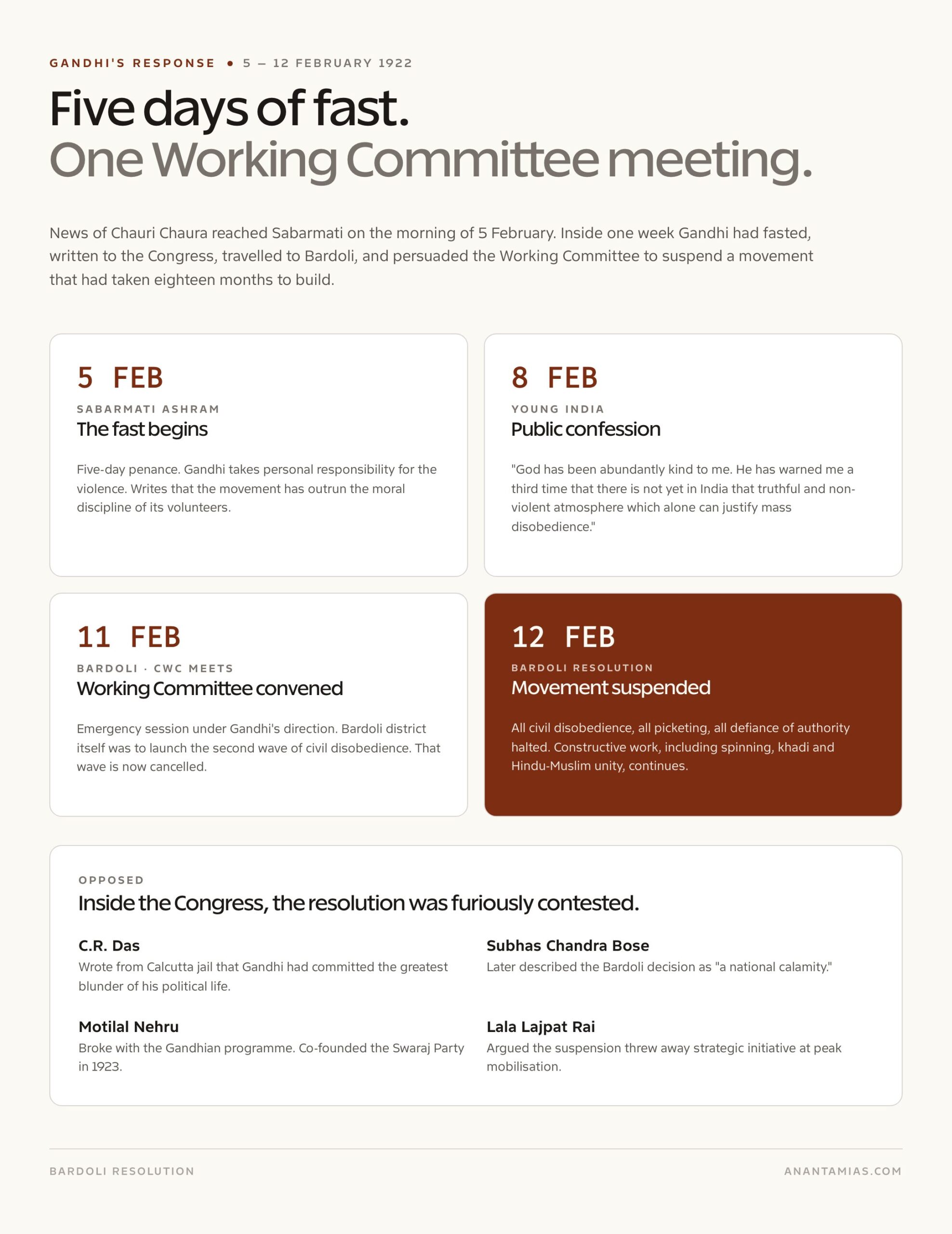
News of Chauri Chaura reached Gandhi on 5 February. He was at the Sabarmati Ashram, preparing to launch a fresh phase of mass civil disobedience starting from Bardoli in Gujarat. The Bardoli campaign was meant to be the second wave of the Non-Cooperation Movement, an open challenge to the salt monopoly and the land revenue system.
Gandhi was shaken. He began a five-day penance fast the next day. He wrote to the Congress Working Committee that the movement had outrun the moral discipline of its volunteers. He convened an emergency Working Committee meeting at Bardoli on 11 and 12 February 1922. The Working Committee passed what is now called the Bardoli Resolution. The resolution suspended all civil disobedience, all picketing and all defiance of authority. Constructive work, including spinning, khadi and Hindu-Muslim unity, would continue.
The reaction within the Congress was furious. Motilal Nehru, C.R. Das, Lala Lajpat Rai and Subhas Chandra Bose all opposed the suspension. C.R. Das, writing from his cell at Calcutta, said Gandhi had committed the greatest blunder of his political life. Subhas Bose later described the Bardoli decision as “a national calamity.” Motilal Nehru and C.R. Das eventually broke with the Gandhian programme and founded the Swaraj Party to enter legislative councils.
Detailed Analysis: Was the Bardoli Decision Right
Three positions exist on the Bardoli question and a UPSC mains answer needs to lay them out.
The first is the Gandhian position. Gandhi believed that a movement of millions could not afford a single act of mass violence without conceding the moral basis of swaraj. He held that a violent freedom movement would produce a violent independent India. He drew a direct line from Chauri Chaura to the long-term communal violence he feared. The Bardoli suspension preserved the moral capital of the movement for future use.
The second is the Bose-Bipan Chandra critique. The movement had built up extraordinary pressure on the colonial state. Government college enrolment was down. Revenue collection was failing in several districts. Foreign cloth imports had collapsed. To suspend the movement at the moment of maximum pressure, on the basis of a single incident, was to throw away the strategic initiative. Indian historians from the 1930s to the 1970s broadly took this view.
The third is the subaltern critique, associated with Shahid Amin and the Subaltern Studies collective. This reading argues that Gandhi’s decision was driven by a class anxiety about losing control of the movement to peasant volunteers. Chauri Chaura showed that ordinary villagers had stopped waiting for Congress permission to act. The Bardoli decision was an attempt to return mass politics to the supervision of the educated middle-class leadership.
All three readings are defensible. A balanced mains answer typically argues that the Gandhian moral argument and the Bose strategic critique are both partly correct, while the subaltern reading explains a class anxiety that was real but not decisive.
The Trial and the Allahabad Verdict
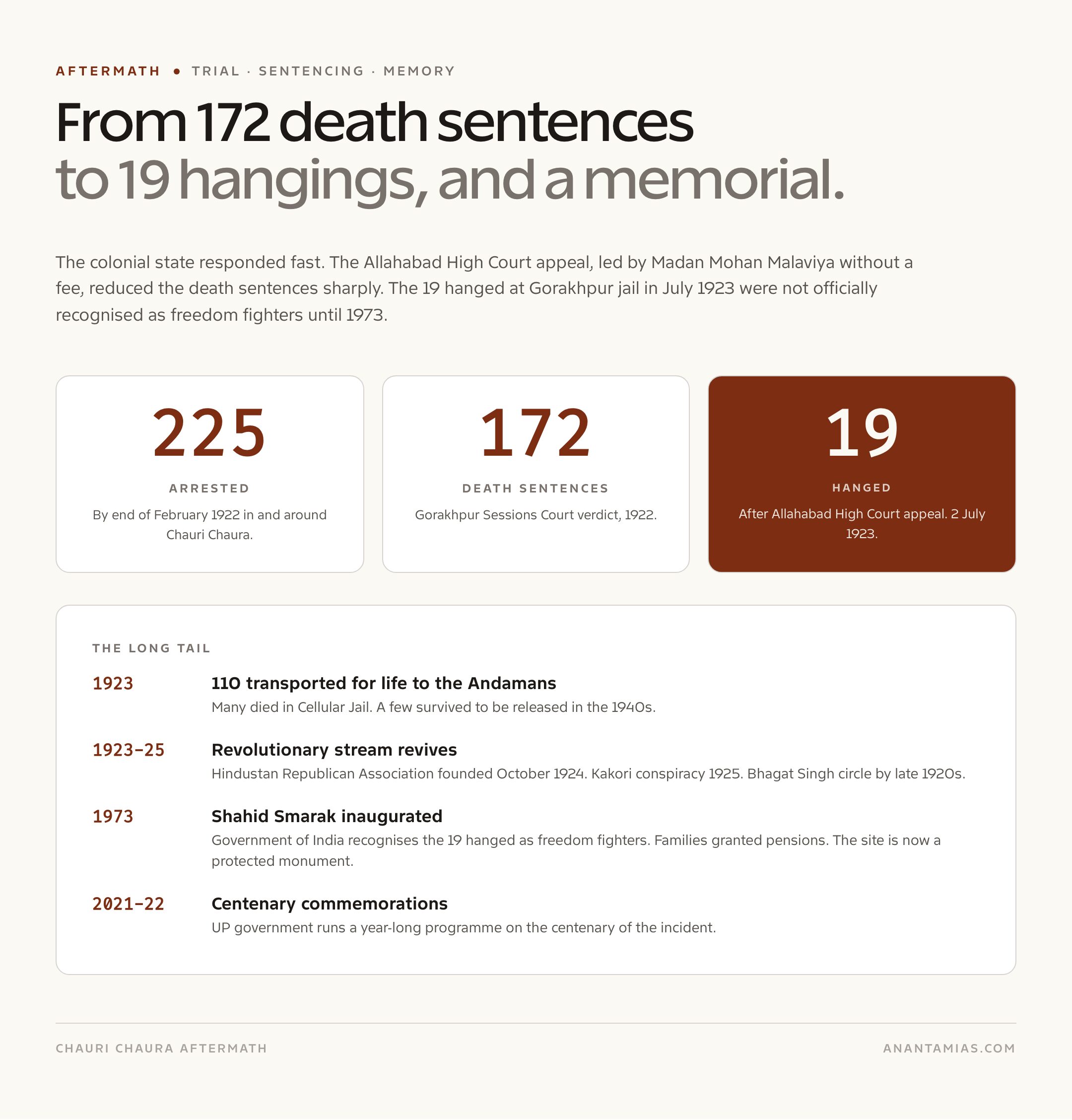
The colonial administration acted quickly. By the end of February 1922, 225 villagers had been arrested. The Sessions Court at Gorakhpur, in a marathon trial through 1922, sentenced 172 of the accused to death. The sentences were extraordinary by colonial standards. The Allahabad High Court heard the appeal in April 1923 under Justice Theodore Piggott. The court reduced the death sentences drastically. Finally, 19 of the accused were hanged on 2 July 1923. 110 were transported to the Andamans for life. The remainder received shorter sentences.
The defence team was led by Madan Mohan Malaviya, who took the brief without fee. Pandit Govind Ballabh Pant assisted him. The appeal was one of the earliest large-scale political defence cases in Indian legal history and trained a generation of nationalist lawyers.
Comparative: Chauri Chaura and Later Mass Movements
The Chauri Chaura precedent shaped every later Gandhian mass movement. The Salt Satyagraha of 1930 was tightly choreographed precisely because Gandhi had learned from Chauri Chaura. The Salt March used a small, disciplined group of seventy-eight ashramites in the initial march, with mass participation building only after the Dandi point. The 1942 Quit India Movement was a different story. Gandhi expected mass violence after his arrest and accepted it as a price worth paying, since the strategic moment had finally come.
This is the deeper point. After Chauri Chaura, Gandhi treated the moral question of mass non-violence as situational, not absolute. He suspended one movement and accepted another. The change is more important than the consistency.
Challenges and the Long Aftermath
The suspension of Non-Cooperation had several consequences.
The Congress split into the Swarajists and the No-Changers. The Swarajists, led by Motilal Nehru and C.R. Das, entered legislative councils from 1923 to wreck them from within. The No-Changers, led by Vallabhbhai Patel and Rajendra Prasad, focused on constructive village work. The party would not reunite until the late 1920s.
The Khilafat alliance collapsed. The Ottoman Caliphate was abolished by Kemal Atatürk in March 1924. The Khilafat issue lost its base. The Hindu-Muslim political bridge built during 1920 to 1922 weakened. Communal riots increased through 1923 to 1925 in cities including Multan, Amritsar and Aligarh.
Revolutionary politics revived. The 19 Chauri Chaura hangings of 1923 produced a wave of revolutionary recruitment. The Hindustan Republican Association was founded in October 1924, the Kakori conspiracy followed in 1925, and the Bhagat Singh circle emerged in the late 1920s. The Bardoli suspension had not made the freedom struggle non-violent. It had simply pushed the violent stream underground.
Prelims Pointers
- Chauri Chaura is in Gorakhpur district of present-day Uttar Pradesh.
- The incident occurred on 4 February 1922.
- 22 policemen and 3 civilians died.
- Gandhi suspended the Non-Cooperation Movement at the Bardoli session of the Congress Working Committee on 12 February 1922.
- Bardoli is in Gujarat, not in Uttar Pradesh; the resolution was named after the meeting place.
- Gandhi undertook a five-day penance fast starting 5 February 1922.
- Gandhi was arrested on 10 March 1922 and sentenced to six years’ imprisonment.
- The trial of 225 accused was held at Gorakhpur Sessions Court.
- 19 of the accused were hanged on 2 July 1923 after Allahabad High Court appeal.
- The defence appeal was led by Madan Mohan Malaviya and Govind Ballabh Pant.
- The Shahid Smarak memorial was inaugurated at Chauri Chaura in 1973.
Mains Questions
- “Gandhi’s decision to suspend the Non-Cooperation Movement after the Chauri Chaura incident was the greatest mistake of his political life.” Critically examine. (GS Paper I, 15 marks)
- Discuss the role of peasant volunteers in the Non-Cooperation Movement with special reference to the events at Chauri Chaura on 4 February 1922. (GS Paper I, 15 marks)
- The Chauri Chaura incident transformed both the Indian National Congress and the Indian revolutionary movement. Analyse. (GS Paper I, 10 marks)
- “The Bardoli Resolution of 1922 was less a moral verdict than a class verdict.” Discuss in light of the subaltern reading of the Non-Cooperation Movement. (Essay / GS Paper I, 10 marks)
Legacy and Way Forward
The Government of India built the Shahid Smarak at Chauri Chaura in 1973. The site is now a Class-A protected monument under the Archaeological Survey of India. The Government of Uttar Pradesh observes a Chauri Chaura Centenary day every 4 February and ran a year-long centenary programme in 2021 and 2022.
The bigger task is historiographical. The 19 villagers hanged in 1923 were treated for decades as common criminals rather than as freedom fighters. The Government of India officially recognised them as freedom fighters only in 1973, fifty years after the hangings. Their families received freedom fighter pensions soon after. The full list of 19 names has been published by the Uttar Pradesh State Archives and is now part of the standard reference set on the Non-Cooperation Movement.
Reading the Chauri Chaura incident alongside the broader career of Mahatma Gandhi makes clear how non-violent mass politics evolved through the 1920s and 1930s. The arc that runs from 1922 through the Simon Commission protests of 1928 and on to the Salt March of 1930 is, in a real sense, a long argument the Congress was having with itself about how to organise mass action without losing control of it. Comparing Gandhi’s choices to the parallel revolutionary stream represented by Bhagat Singh is one of the most productive exercises a mains aspirant can do.
Frequently Asked Questions
What happened at Chauri Chaura on 4 February 1922?
A procession of around 2,500 to 3,000 Non-Cooperation Movement volunteers and local farmers marched past the Chauri Chaura police station in Gorakhpur district. The police opened fire and killed three protesters. The crowd surrounded the station and set it on fire. Twenty-two policemen and a chowkidar died in the burning building. The incident is one of the most studied moments in the history of the Indian freedom struggle.
Why did Gandhi suspend the Non-Cooperation Movement?
Gandhi believed that mass non-violence was the only legitimate basis for the Indian freedom struggle. He held that a movement that could not control episodes like Chauri Chaura had outrun the moral discipline of its volunteers. He undertook a five-day penance fast from 5 February and convened the Congress Working Committee at Bardoli, which passed a resolution suspending all civil disobedience on 12 February 1922.
What was the Bardoli Resolution?
The Bardoli Resolution was the Congress Working Committee resolution passed at Bardoli in Gujarat on 12 February 1922. It formally suspended all civil disobedience, picketing and defiance of authority associated with the Non-Cooperation Movement. It permitted the continuation of constructive work, including spinning, khadi production and Hindu-Muslim unity activities.
Who opposed the Bardoli Resolution?
Senior Congress leaders including Motilal Nehru, C.R. Das, Lala Lajpat Rai and Subhas Chandra Bose opposed the suspension. C.R. Das, writing from his Calcutta jail cell, described it as the greatest blunder of Gandhi’s political life. The disagreement led to the formation of the Swaraj Party in 1923 by Motilal Nehru and C.R. Das.
How many people were sentenced for the Chauri Chaura incident?
The Gorakhpur Sessions Court sentenced 172 accused to death in 1922. The Allahabad High Court, hearing the appeal in 1923, reduced the sentences substantially. Finally, 19 accused were hanged on 2 July 1923. 110 were transported for life to the Andaman Islands. The remaining accused received shorter sentences or were acquitted.
Who defended the Chauri Chaura accused?
Madan Mohan Malaviya led the defence team without taking a fee. Pandit Govind Ballabh Pant assisted him. The case was one of the earliest large-scale political defence trials in Indian legal history and trained a generation of nationalist lawyers in mass political defence work.
What is the Shahid Smarak at Chauri Chaura?
The Shahid Smarak is the memorial built by the Government of India in 1973 at the site of the burned police station in Chauri Chaura. It commemorates the 19 villagers hanged in 1923 and is now a Class-A protected monument under the Archaeological Survey of India. The site hosts annual commemorations on 4 February.
How did Chauri Chaura affect later freedom movements?
The Chauri Chaura experience shaped every subsequent Gandhian movement. The Salt Satyagraha of 1930 used a small disciplined initial march to maintain non-violent control. The Civil Disobedience Movement was structured around district-level Congress committees. The 1942 Quit India Movement, by contrast, accepted that mass violence might occur once Gandhi was arrested. The lesson Gandhi drew from Chauri Chaura was about the timing and design of mass movements, not about avoiding mass action altogether.
Is Chauri Chaura on the UPSC syllabus?
Yes. Chauri Chaura is a high-value topic for both prelims and mains. Prelims questions on the date, the location, the casualty figures and the Bardoli resolution have appeared in multiple cycles. Mains questions on the rationale for the suspension and on the role of peasant volunteers appear regularly in GS Paper I.