Corporate Governance and Business Ethics: Boards, Fiduciary Duty and the Indian Promoter Problem (UPSC Ethics — GS IV)
Corporate governance is named in the GS IV syllabus and usually skipped. Its central Indian question is not managers against owners — it is dominant promoters against everyone else.
The GS IV syllabus names corporate governance explicitly, alongside ethical concerns and dilemmas in government and private institutions. It is also the clause candidates most reliably skip, on the assumption that a paper about civil-service values has little to do with boardrooms. That assumption fails in both directions: the state regulates companies, and a great deal of what officials now confront — procurement fraud, environmental violation, financial collapse with public consequences — originates inside firms.
The subject also rewards precision, because its central question in India is not the one the textbooks pose. The classical problem of corporate governance assumes ownership is spread thinly across many shareholders while control sits with professional managers. Most large Indian companies are not shaped that way at all, and the ethical fault lines run somewhere else entirely.
What Corporate Governance Is For
Corporate governance is the system of rules, practices and structures by which a company is directed and held accountable — to its shareholders, and depending on the theory you accept, to a wider set of interests.
The problem it exists to solve is the agency problem. Where the people who own an enterprise are not the people who run it, the managers have information the owners lack, and interests that need not coincide with theirs. A manager may prefer empire-building to profitability, or short-term results that flatter their tenure over long-term health. Governance mechanisms — boards, audits, disclosure, shareholder voting — are devices to constrain that gap.
Three obligations do the ethical work.
Fiduciary duty. A director does not merely have a contract; they hold a position of trust and must act in the company’s interest rather than their own. In India this is codified: Section 166 of the Companies Act, 2013 requires directors to act in good faith to promote the company’s objects, in the best interests of the company, its employees, shareholders, the community and the environment.
Conflict of interest. The requirement is not to avoid ever having a competing interest, which is impossible, but to disclose it and withdraw from the decision. This is structurally identical to the public-service rule described in conflict of interest in public administration.
Disclosure. Governance depends on outsiders being able to see enough to judge. Accurate reporting is therefore not an administrative chore but the precondition of every other accountability mechanism — the point developed in the ethics of automation, where misattributing job cuts to AI corrupts the information investors and policymakers rely on.
Shareholder Primacy Against Stakeholder Theory
The foundational dispute in business ethics is about what a firm is for.
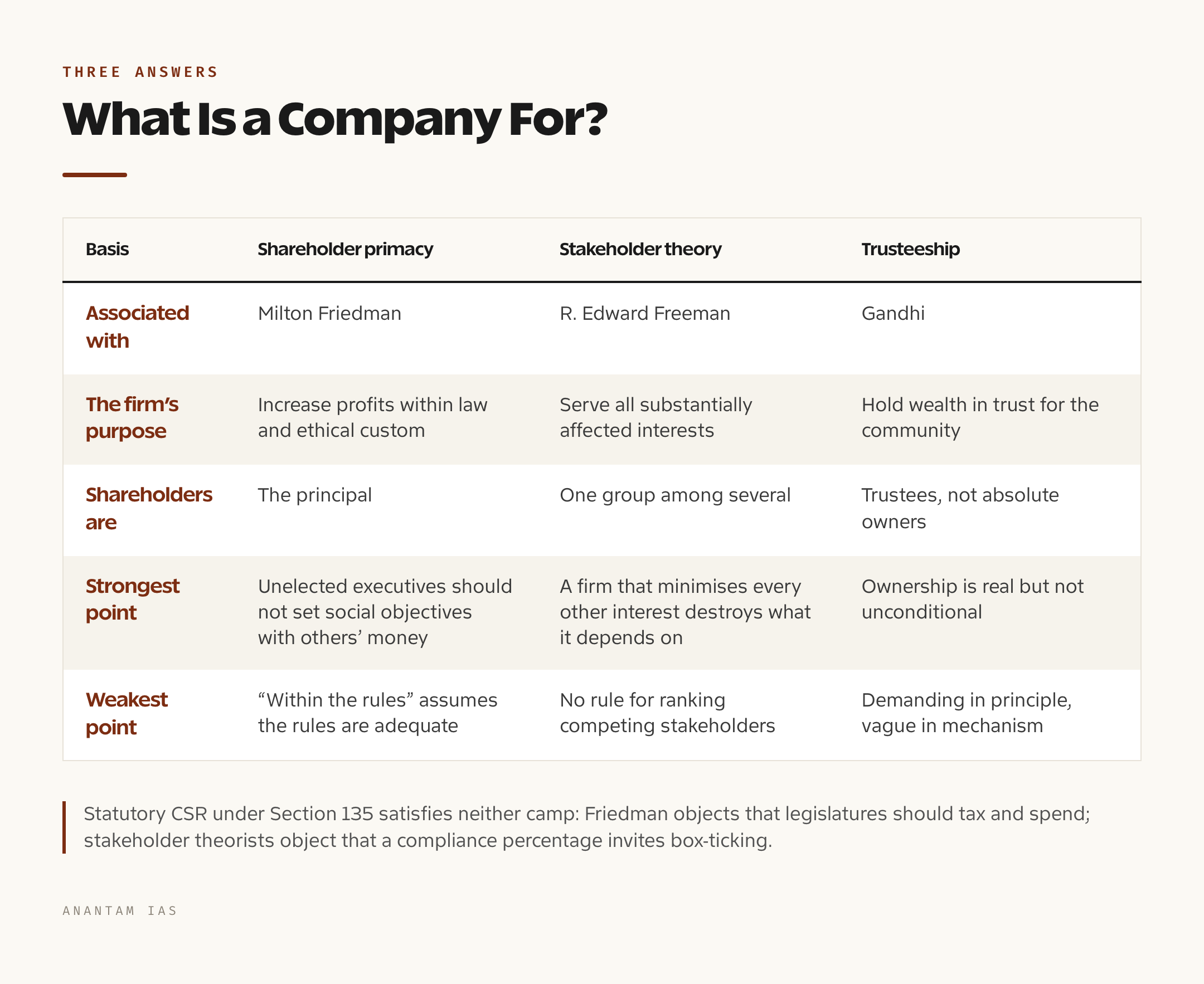
Shareholder primacy, argued most sharply by Milton Friedman, holds that the social responsibility of business is to increase its profits within the rules of the game — law and ethical custom. The argument is not that managers may do anything: it is that they are agents spending other people’s money, and that diverting it to causes they personally favour is a kind of taxation without authority. Social objectives, on this view, are properly set by legislatures answerable to voters, not by executives answerable to nobody.
Stakeholder theory, associated with R. Edward Freeman, holds that a company owes obligations to everyone whose interests are substantially affected — employees, customers, suppliers, creditors, the community, the environment — and that shareholders are one group among these rather than the sole principal. Its case is partly moral and partly practical: a firm that treats every other interest as a cost to be minimised tends to destroy the relationships it depends on.
Trusteeship, Gandhi’s contribution, sits interestingly between them. Ownership is real but held in trust for the community that made its accumulation possible, so the owner’s discretion is genuine yet not absolute. It is more demanding than stakeholder theory in principle and vaguer in mechanism, and it is developed further in Gandhian philosophy.
The honest assessment is that shareholder primacy is stronger than its caricature — the objection about unelected executives choosing social objectives has real force — and weaker than its defenders claim, because “within the rules of the game” quietly assumes the rules are adequate, which is exactly what is disputed where regulation lags.
India’s Agency Problem Is a Different Problem
This is the point that separates a strong answer from a generic one.
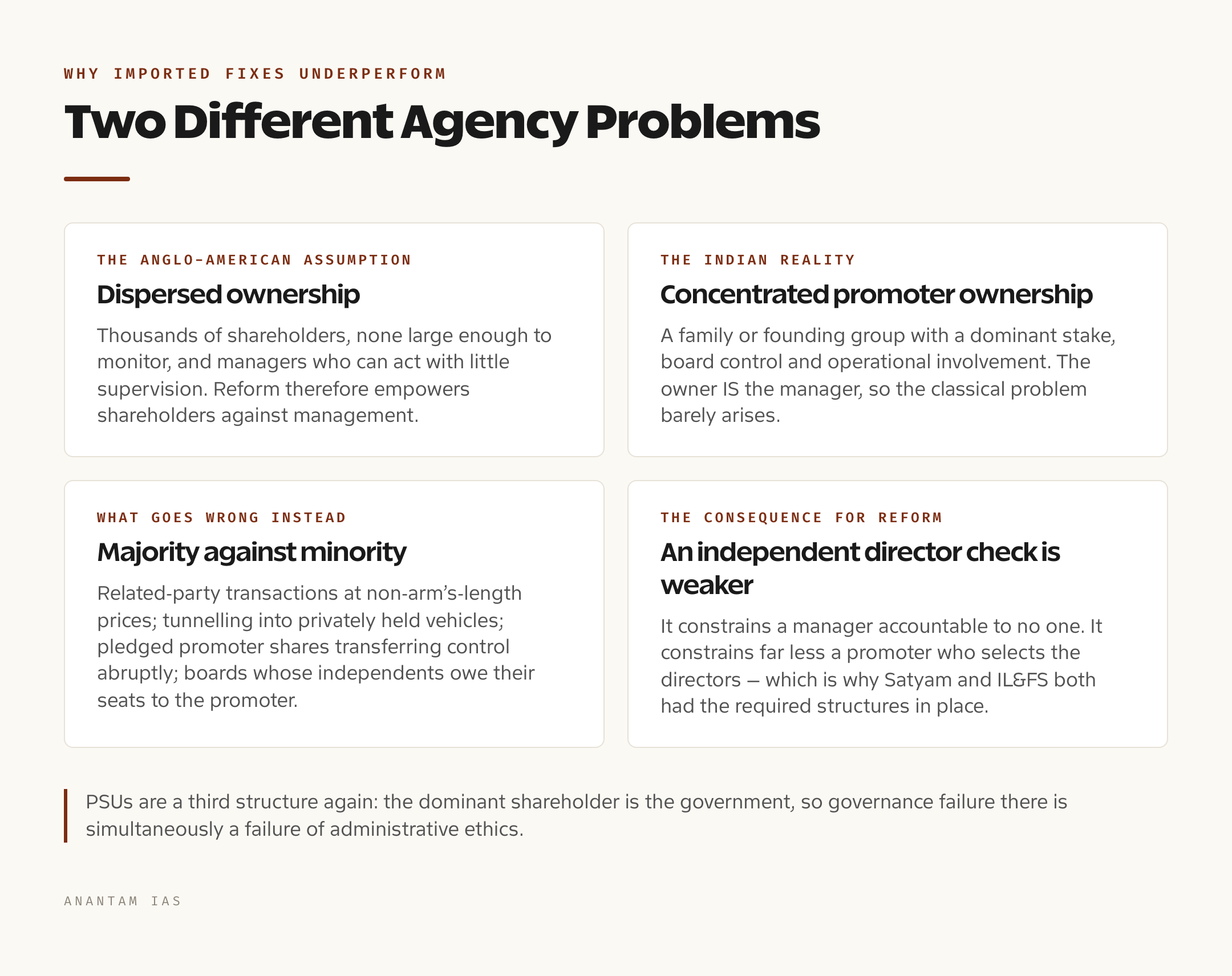
The Anglo-American governance literature assumes dispersed ownership: thousands of shareholders, none large enough to monitor, and managers who can therefore act with little supervision. Governance reform accordingly focuses on empowering shareholders against management.
Most large Indian companies have concentrated promoter ownership — a family or founding group holding a dominant stake, often with board control and operational involvement. The classical agency problem barely arises, because the owner is the manager. What arises instead is a conflict between the dominant shareholder and minority shareholders, and the characteristic abuses are different:
Related-party transactions, where value is moved to entities the promoter controls at prices that would not survive an arm’s-length test. Tunnelling, the extraction of resources from a listed company into privately held vehicles. Pledging of promoter shares, which can transfer control abruptly on a price fall. And captive boards, where independent directors owe their seats to the promoter whose conduct they are meant to scrutinise.
Public-sector undertakings present a third structure again: the dominant shareholder is the government, which means governance failures there are simultaneously administrative-ethics failures, and the officer on the board faces a conflict between the ministry’s preference and the company’s interest.
Getting this distinction right also explains why importing Western governance instruments has produced mixed results. An independent-director requirement is a powerful check on managers accountable to no one; it is a weaker check on a promoter who selects the directors.
The Indian Architecture
India’s framework was built largely after crises, which is itself worth noting.
Voluntary codes came first, followed by the Kumar Mangalam Birla Committee in 1999, whose recommendations produced Clause 49 of the listing agreement — the first mandatory governance regime for listed companies. The Narayana Murthy Committee in 2003 strengthened audit committees and disclosure. The Satyam fraud, revealed in 2009, was the decisive shock: a large, apparently well-governed listed company whose accounts had been falsified for years, with auditors and independent directors present throughout.
The Companies Act, 2013 is the current statutory core. Its governance provisions include Section 149 on board composition and independent directors, Section 166 on directors’ duties, Section 177 on the audit committee — which also requires a vigil mechanism for employees and directors to report genuine concerns, the closest thing most private-sector employees have to whistleblower protection, as discussed in whistleblowing in India — and Section 135 on corporate social responsibility.
SEBI’s LODR Regulations, 2015 consolidated listing obligations, and the Uday Kotak Committee in 2017 recommended further tightening on board independence, related-party disclosure and the separation of chairperson and managing director roles. The IL&FS collapse in 2018 demonstrated, again, that credit ratings, auditors and boards can all be in place while a systemically important entity fails.
CSR under Section 135 deserves careful handling because it is frequently misdescribed. Qualifying companies must spend at least two per cent of average net profits of the preceding three financial years on activities specified in Schedule VII. Ethically it is a hybrid: it accepts the stakeholder premise that firms owe something beyond profit, while implementing it through a statutory spending mandate rather than voluntary conscience — which is why both camps find it unsatisfying. Friedman would object that legislatures should tax and spend rather than direct private expenditure; stakeholder theorists object that a compliance percentage invites box-ticking. The Indian design is set out in CSR under the Companies Act.
Why Codes Keep Failing
The recurring lesson is that governance failures are rarely failures of rules. In Satyam and IL&FS the required structures existed. Four mechanisms explain the gap.
Independence that is not independent. A director selected by, and socially connected to, the person they must question faces a conflict the statute cannot dissolve. Fee income and continued appointment supply a quiet incentive to be agreeable.
Auditor capture. Auditors are paid by the entity they audit, often alongside lucrative non-audit work for the same client. The structural pressure runs towards accommodation.
Compliance as substitute for judgement. Where a board’s function becomes confirming that boxes are ticked, “properly minuted” replaces “actually examined” — the same displacement Arendt described in administrative settings, discussed in Hannah Arendt on thoughtlessness.
Consequences that do not land. Where enforcement is slow and penalties are absorbed as a cost of doing business, the expected value of misconduct stays positive. This is the corporate version of the point the Second ARC made about public cynicism, in the Second ARC’s Ethics in Governance report.
The reform implication is that governance depends less on adding requirements than on changing who appoints, who pays and who bears consequences — and on the willingness of individual directors and auditors to be unpopular, which is the moral courage question in a boardroom setting.
FAQ
What is the agency problem in corporate governance? The conflict that arises when those who own an enterprise are not those who run it: managers hold better information and may have interests that diverge from owners’. Boards, audits and disclosure exist to constrain that gap.
How is India’s corporate governance problem different? Most large Indian companies have concentrated promoter ownership rather than dispersed shareholding, so the owner is often the manager. The conflict is between dominant and minority shareholders, and shows up as related-party transactions, tunnelling and captive boards rather than managerial self-dealing.
What is the difference between shareholder and stakeholder theory? Shareholder primacy holds that a firm’s responsibility is to increase profits within law and ethical custom, since managers spend others’ money. Stakeholder theory holds that the firm owes obligations to all whose interests are substantially affected, with shareholders one group among several.
What does Section 166 of the Companies Act require? That directors act in good faith to promote the company’s objects and in the best interests of the company, its employees, shareholders, the community and the environment — a statutory statement of fiduciary duty.
Is CSR under Section 135 mandatory? Qualifying companies must spend at least two per cent of average net profits over the preceding three financial years on Schedule VII activities. It is a statutory spending obligation rather than voluntary philanthropy.
Why do governance codes keep failing despite reform? Because the failures are usually not of rules but of incentives: directors whose independence depends on the person they must question, auditors paid by those they audit, compliance substituting for judgement, and enforcement too slow for penalties to deter.
Where does corporate governance appear in the GS IV syllabus? Under public/civil service values and ethics in public administration, which expressly covers ethical concerns and dilemmas in government and private institutions, ethical issues in international relations and funding, and corporate governance.
Practice Questions
Prelims MCQs
- Clause 49 of the listing agreement, India’s first mandatory corporate-governance regime, followed the recommendations of the: (a) Narayana Murthy Committee (b) Kumar Mangalam Birla Committee (c) Uday Kotak Committee (d) Naresh Chandra Committee — Answer: (b) The Birla Committee of 1999 led to Clause 49.
- The statutory duties of directors, including acting in the best interests of the company, employees, shareholders, community and environment, are set out in: (a) Section 135 (b) Section 149 (c) Section 166 (d) Section 177 — Answer: (c) Section 166 of the Companies Act, 2013.
- The requirement of a vigil mechanism for employees and directors to report genuine concerns arises under: (a) Section 135 (b) Section 177 (c) Section 149 (d) Section 188 — Answer: (b) Section 177, alongside the audit-committee provisions.
- “Tunnelling” in corporate governance refers to: (a) infrastructure investment (b) extraction of resources from a listed company into privately controlled vehicles (c) short selling (d) cross-border listing — Answer: (b) A characteristic abuse where ownership is concentrated.
- Milton Friedman’s position was that the social responsibility of business is to: (a) balance all stakeholder interests (b) increase its profits within the rules of the game (c) maximise employment (d) fund social causes voluntarily — Answer: (b) His objection was to unelected executives setting social objectives with others’ money.
Mains Practice Questions
- “India’s corporate governance problem is not managers against owners but dominant promoters against minority shareholders.” Examine this claim and its implications for reform. (15 marks, 250 words)
- Compare shareholder primacy, stakeholder theory and Gandhian trusteeship as accounts of the purpose of the firm. Which best fits Indian conditions? (15 marks, 250 words)
- In both Satyam and IL&FS the required governance structures were in place. Discuss why governance failures are usually failures of incentive rather than of rules. (15 marks, 250 words)
- “Statutory CSR satisfies neither camp in the business-ethics debate.” Critically evaluate Section 135 as an ethical instrument. (10 marks, 150 words)
- Discuss the structural reasons why an independent director may fail to be independent, and suggest remedies. (10 marks, 150 words)