
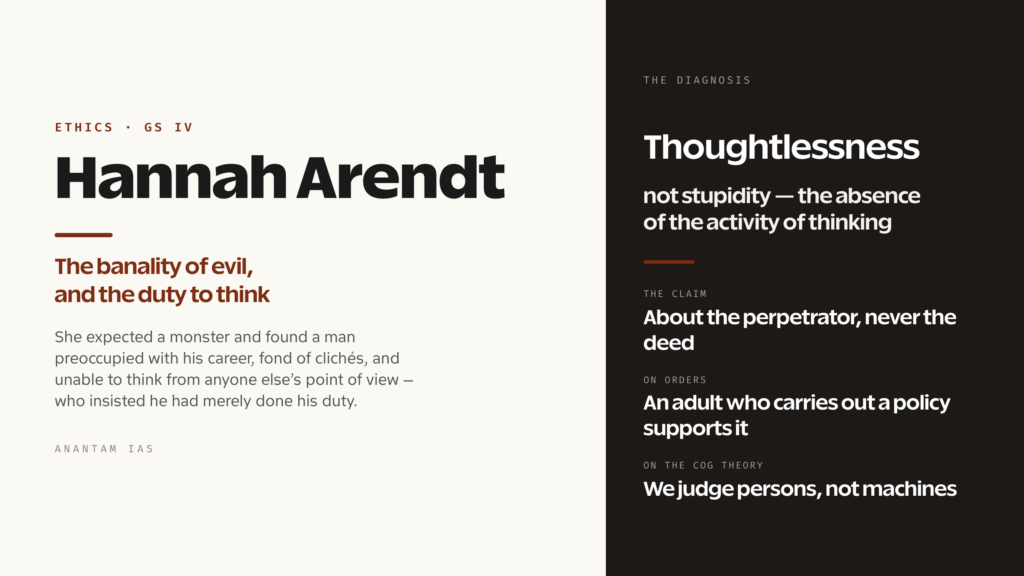
In 1961 a German-born political theorist sat in a Jerusalem courtroom watching the trial of Adolf Eichmann, the official who had organised the transport of Jews to the death camps. She had expected a monster. What she found was a man preoccupied with his career, fond of clichés, apparently unable to think from anyone else’s point of view, and insistent that he had merely done his duty within the rules as he found them.
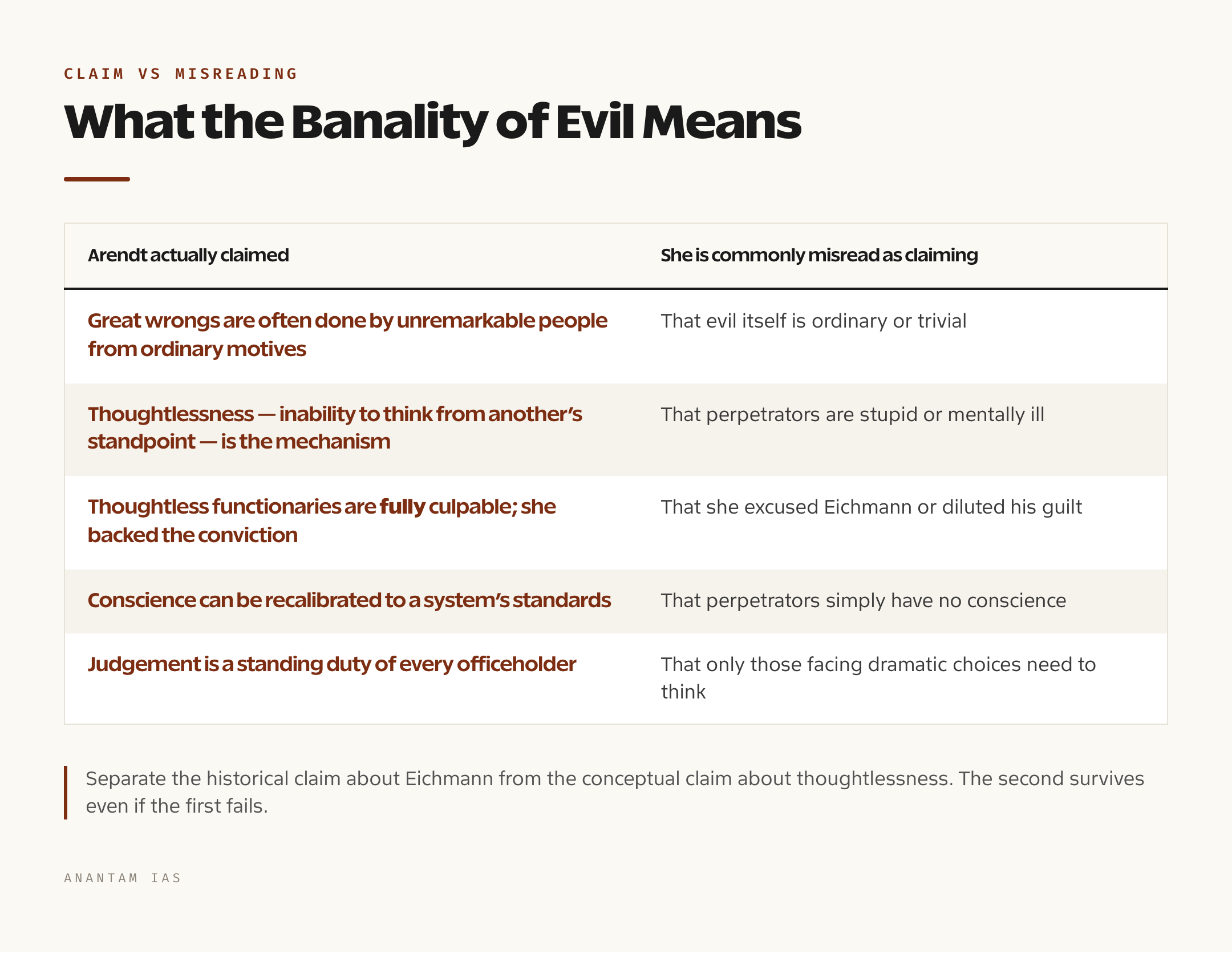
The phrase Hannah Arendt coined for this — the banality of evil — has been misused ever since, and the misuse matters because the correct reading is one of the most useful tools in ethics for anyone entering public administration. Arendt was not saying evil is trivial, nor that Eichmann was innocent. She was making a claim about how catastrophic wrongdoing actually gets done: not usually by monsters, but through ordinary people performing ordinary functions who have stopped exercising judgement.
What the Banality of Evil Claims
The claim is about the perpetrator, not the deed. The deeds Arendt was describing were the opposite of banal. What struck her was the gap between the enormity of what Eichmann had helped do and the unremarkable interior life of the man who did it — no towering hatred, no satanic grandeur, no ideological ecstasy. Just diligence, ambition, and an apparently sincere sense of having behaved correctly.
Her diagnosis was thoughtlessness: not stupidity, but the absence of the activity of thinking. Eichmann could not think from the standpoint of another person. He spoke almost entirely in officialese and stock phrases, which Arendt read as evidence that the words had replaced any independent reckoning with what he was doing. He had substituted the question am I following the rules correctly? for the question what am I actually doing to these people?
Three corollaries follow, and each is examinable.
Wrongdoing does not require wicked motives. Most administrative harm is produced by people who would describe themselves, accurately, as conscientious.
Conscience can be socially calibrated. Arendt observed that Eichmann’s conscience did not disappear; it was reoriented to the standards of the society around him, so that deviating from the system’s expectations would have felt like the transgression.
Judgement is a duty, not an option. If thoughtlessness is the mechanism, then the obligation is to keep thinking — which is a demand on every officeholder, not only on those facing dramatic choices.
Why “Just Following Orders” Fails
Arendt’s own answer to the defence is the sharpest available, and it is worth stating precisely because it is not the obvious one.
The obvious rebuttal is legal: an unlawful order confers no authority, so obedience is no defence. True, but it leaves the moral question untouched, because it makes everything depend on whether the order happened to be lawful.
Arendt’s rebuttal is deeper. Obedience is not a category that applies to adults acting politically. A child obeys; an adult who carries out a policy supports it. Consent is expressed through participation, so the person who continues to perform the function is endorsing the arrangement whether or not they approve of it privately. The relevant question at trial or in an inquiry is therefore never “were you ordered?” but “why did you support this?” — a question to which private distaste is no answer.
This connects directly to the cog theory of administration, which Arendt attacked. The functionary’s self-description is that the machine would have run without them; someone else would have signed; the outcome was overdetermined. Arendt’s reply is that in a court, and in ethics, we do not try systems, we try people — and the machine is made entirely of individuals each making the same claim. If everyone is a cog, nobody did it, and yet it was done.
How Thoughtlessness Operates in Administration
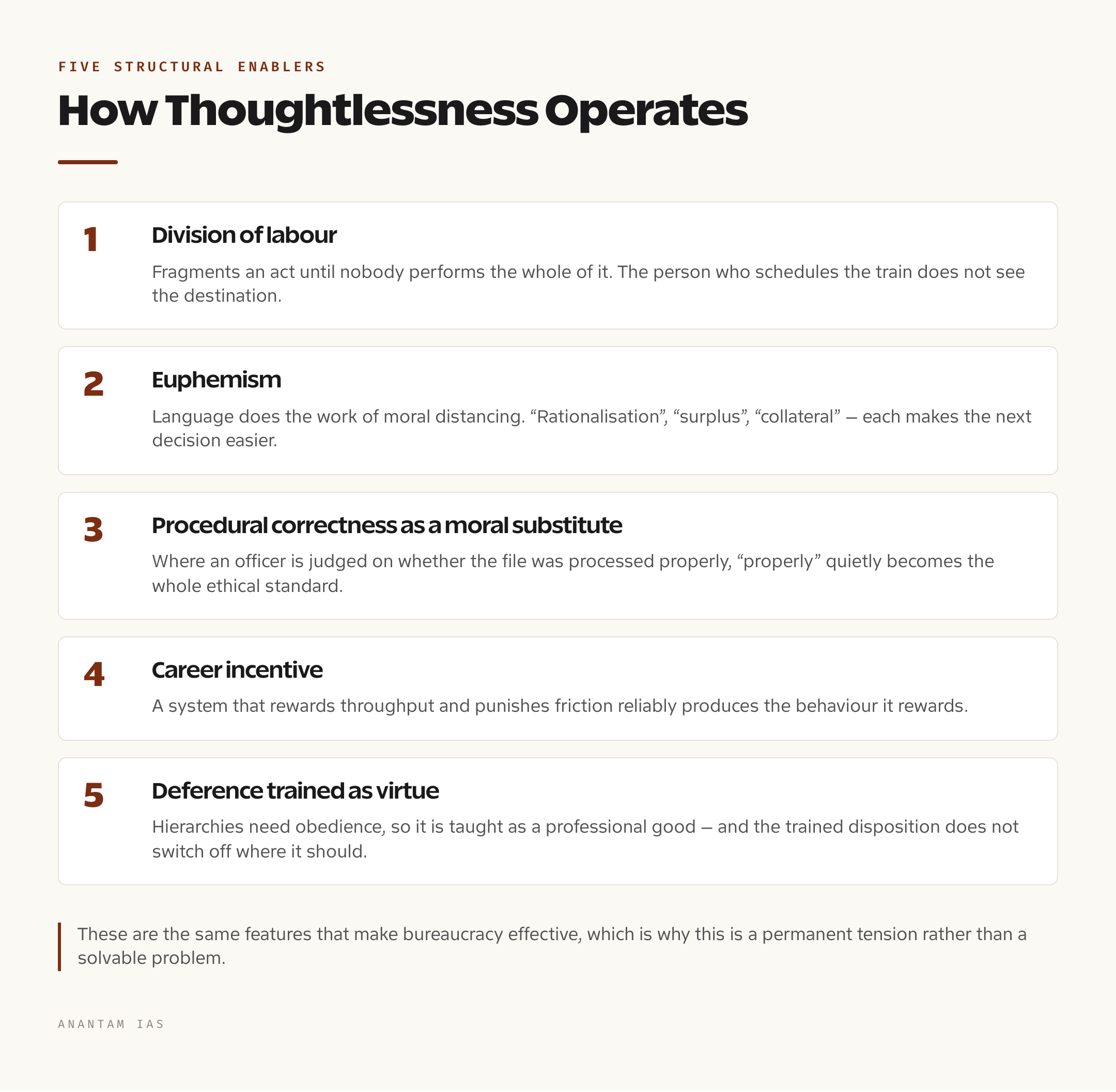
The structural features that make not-thinking easy are precisely the features that make bureaucracy effective. That is what makes this a permanent tension rather than a solvable problem.
Division of labour fragments an act until no one performs the whole of it. The person who schedules the train does not see the destination.
Language does the work of moral distancing. Arendt paid close attention to Eichmann’s vocabulary; the same mechanism runs through every administrative euphemism — “rationalisation”, “surplus population”, “collateral”. This is the same move examined in the ethics of automation, where describing people as low-value human capital makes discarding them seem procedural.
Procedural correctness as a moral substitute. Where an officer is judged on whether the file was processed properly, “properly” quietly becomes the whole of the ethical standard.
Career incentive. Eichmann’s evident ambition was, for Arendt, part of the explanation. A system that rewards throughput and punishes friction produces the behaviour it rewards.
Deference as a virtue. Hierarchies must function, so obedience is trained as a professional good. The difficulty is that the trained disposition does not switch off at the point where it should.
None of this excuses anyone. It explains why the ethical demand on an official cannot be satisfied by following the rules well, and why the foundational values of civil services include judgement and objectivity rather than compliance alone.
The Criticisms, Which Are Serious
An honest treatment cannot present Arendt as settled. Three objections carry weight.
The historical objection. Later scholarship, drawing on Eichmann’s own recorded statements outside the courtroom, argues he was a far more committed ideologue than the trial persona suggested — that Arendt was, in effect, taken in by a performance designed for the dock. If so, her portrait of this man is wrong, even if the general phenomenon she named is real.
The exculpation objection. Critics argued that explaining perpetrators as thoughtless functionaries risks diminishing responsibility and, worse, distributing blame so widely that it dissolves. Arendt rejected this: she supported Eichmann’s conviction and execution, and her point was that ordinary thoughtless people are fully culpable, not less so.
The judgement objection. If moral judgement depends on the capacity to think from others’ standpoints, what follows for people whose circumstances genuinely constrain that capacity? Arendt’s framework is demanding, and it says little about degrees of culpability.
The right handling is to separate the historical claim about Eichmann from the conceptual claim about thoughtlessness. The second survives even if the first fails, because the mechanism has been observed repeatedly since.
Arendt and the Rest of the Syllabus
Against Kant, partly with him. Kant grounds morality in duty discovered by reason, and Eichmann notoriously invoked a garbled Kantian formula in his defence. Arendt’s response was that he had inverted Kant: the categorical imperative requires you to legislate universally as a rational being, not to align yourself with whatever the sovereign commands. Duty without independent judgement is not Kantian duty at all — a distinction worth having when a case study offers a rule-following justification. See Kant’s categorical imperative.
Against pure consequentialism. Arendt’s functionary reasons consequentially at a local level — my refusal changes nothing, so refusing has no value. Her answer is that the significance of an act is not exhausted by its measurable effect; refusing preserves something about the agent and the public world that outcomes do not capture.
With Kohlberg. Eichmann is a study in arrested moral development: conventional-level reasoning, where right means conforming to the expectations of one’s system, applied to catastrophic content. See Kohlberg’s stages.
With Gandhi. Non-cooperation rests on the same insight from the other direction — that unjust systems require the participation of ordinary people, and that withdrawing it is therefore a real act. Arendt explains why the functionary’s cooperation is morally significant; Gandhi built a method out of withdrawing it.
What This Means in Practice
The practical translation is unglamorous and specific.
- Ask what the file does, not only whether it is in order. Procedural correctness is a floor, not a ceiling.
- Distrust your own vocabulary. When a euphemism makes a decision feel easier, that is a signal to restate the decision in plain words and see whether it still reads acceptably.
- Insist on seeing the whole act. Where division of labour hides the outcome, ask what the process produces at the end.
- Record reasons in your own words. Arendt’s diagnostic was cliché; the antidote is being able to say why, unaided.
- Treat “someone else would have signed it” as a warning, not a defence. It is the cog claim, and it is the thing being rejected.
- Protect dissent inside the hierarchy, because a system where objection is career-ending manufactures thoughtlessness at scale.
Arendt’s lasting contribution to administrative ethics is a shift in where we look for danger. We look for bad people; she taught us to look for the conditions under which decent people stop thinking. Those conditions are ordinary, they are present in every large organisation, and noticing them is part of the job.
FAQ
What does “banality of evil” actually mean? That great wrongs are often committed by unremarkable people acting from ordinary motives — career, conformity, diligence — rather than by monsters with demonic intent. The phrase describes the perpetrator, not the deed.
Did Arendt think Eichmann was innocent? No. She supported his conviction and execution. Her claim was that thoughtless functionaries are fully responsible, not that they are excused.
What did Arendt mean by thoughtlessness? Not stupidity, but the absence of the activity of thinking — in particular the inability to think from another person’s standpoint, and reliance on clichés and official language in place of independent judgement.
How does Arendt answer “I was only following orders”? By denying that obedience is the right category. An adult who carries out a policy supports it, so the question is not whether you were ordered but why you supported it. Private disapproval is no answer.
What is the cog theory of administration and why did she reject it? The functionary’s claim that the machine would have run anyway and someone else would have signed. Arendt rejected it because we judge people, not systems, and the machine consists entirely of individuals each making that same claim.
What is the main criticism of Arendt’s account? That later evidence suggests Eichmann was a far more committed ideologue than his courtroom persona indicated, so her portrait of him may be mistaken — though the general phenomenon of thoughtless complicity she identified has been widely observed since.
Practice Questions
Prelims MCQs
- Hannah Arendt’s phrase “the banality of evil” arose from her reporting on: (a) the Nuremberg trials (b) the trial of Adolf Eichmann in Jerusalem (c) the Tokyo tribunal (d) the Dreyfus affair — Answer: (b) She coined it while covering Eichmann’s 1961 trial.
- By “thoughtlessness” Arendt meant: (a) low intelligence (b) mental illness (c) the absence of the activity of thinking, including from others’ standpoints (d) forgetfulness under stress — Answer: (c) She explicitly distinguished it from stupidity.
- Arendt’s rejection of the “cog theory” rests on the claim that: (a) systems are always efficient (b) we judge persons, not machines (c) orders are always unlawful (d) consequences alone determine right action — Answer: (b) In law and ethics individuals are judged, and the machine is made of individuals each disclaiming responsibility.
- Arendt argued that Eichmann’s invocation of Kant was: (a) correct (b) an inversion, since the categorical imperative requires independent rational legislation rather than alignment with sovereign command (c) irrelevant to his defence (d) accepted by the court — Answer: (b) Duty without independent judgement is not Kantian duty.
- Which pairing best captures Arendt’s relevance to Gandhi? (a) Both defended obedience to authority (b) Both held that unjust systems depend on ordinary participation (c) Both rejected the idea of moral duty (d) Both wrote about the banality of evil — Answer: (b) Arendt explains why cooperation matters morally; Gandhi built non-cooperation on it.
Mains Practice Questions
- “The banality of evil is a claim about perpetrators, not about deeds.” Explain Arendt’s thesis and assess its relevance to administrative accountability. (15 marks, 250 words)
- “An adult who carries out a policy supports it.” Examine Arendt’s rejection of obedience as a moral category, and its implications for a civil servant given an improper instruction. (15 marks, 250 words)
- Identify the features of large bureaucracies that enable moral thoughtlessness, and suggest institutional safeguards against them. (15 marks, 250 words)
- Critics argue that explaining perpetrators as thoughtless functionaries risks diluting responsibility. Evaluate this criticism of Arendt. (10 marks, 150 words)
- “Procedural correctness is a floor, not a ceiling.” Discuss with reference to ethical decision-making in public administration. (10 marks, 150 words)
Tell Google you want more of this.
Add Anantam IAS as a preferred sourceOne tap, and this site shows up more often in your own Top Stories, AI Overviews and AI Mode. Remove it any time.