Daily Digest
UPSC · Civil Services Examination
Current Affairs · Thursday, 14 May 2026
Current affairs curated and edited by Anantam IAS faculty — pulled from The Hindu, PIB, IDSA, Foreign Affairs and the ministries. Read, annotate, revise.
Old Rajinder Nagar · Delhi 110005 · anantamias.com
All religious practices presumed protected unless they violate public order, health, morality: Centre in Sabarimala review hearing
Why in News?
During the ongoing Sabarimala review hearing before a nine-judge Constitution Bench of the Supreme Court, the Union government argued that all religious practices are constitutionally protected unless they violate public order, morality or health under Articles 25 and 26 of the Constitution.
The Centre questioned the long-standing “Essential Religious Practices” (ERP) doctrine evolved by the judiciary, arguing that the Constitution itself does not use the phrase “essential religious practices”. The hearing has revived broader constitutional debates concerning:
- Religious freedom
- Judicial review of faith-based practices
- Rights of religious denominations
- Equality and constitutional morality
UPSC Relevance
GS Paper 2
- Fundamental Rights, Judiciary and constitutional interpretation, Secularism in India, Freedom of religion and minority rights
GS Paper 1
- Indian society and religion, Social reform movements, gender justice
Essay
- Constitutional morality versus social morality
- Religion and constitutional governance
- Freedom and reform in a plural society
Background and Context
The Sabarimala issue concerns the entry of women of menstruating age (traditionally between 10 and 50 years) into the Sabarimala temple dedicated to Lord Ayyappa in Kerala.
The restriction was historically justified on the basis that:
- Lord Ayyappa is worshipped as a “Naishtika Brahmachari” (eternal celibate).
- The temple constituted a separate religious denomination with the right to preserve its practices.
In 2018, a five-judge Constitution Bench of the Supreme Court, in the Indian Young Lawyers Association v. State of Kerala case, struck down the exclusionary practice by a 4:1 majority.
The Court held that:
- The practice violated equality and dignity of women.
- Biological characteristics such as menstruation cannot be grounds for exclusion.
- Constitutional morality prevails over discriminatory customs.
Subsequently, review petitions were filed, leading to a larger constitutional reference examining broader questions regarding:
- Scope of religious freedom
- Essential Religious Practices doctrine
- Relationship between Articles 25 and 26
- Judicial role in examining faith-based practices
Constitutional Framework on Religious Freedom
Article 25
Article 25 guarantees:
- Freedom of conscience
- Freedom to profess, practice and propagate religion
However, this right is subject to:
- Public order
- Morality
- Health
- Other Fundamental Rights
The Article protects both:
- Individual religious freedom
- Religious practices
Social Reform Clause
Article 25(2) allows the State to enact laws for:
- Social welfare
- Religious reform
- Opening Hindu religious institutions to all classes and sections
This provision reflects the Constitution’s reformist vision.
Article 26
Article 26 grants religious denominations the right to:
- Establish religious institutions
- Manage religious affairs
- Own and administer property
Again, these rights are subject to:
- Public order
- Morality
- Health
The central constitutional question is whether denominational autonomy can override equality-based claims.
The Essential Religious Practices (ERP) Doctrine
The ERP doctrine was developed judicially to determine which practices deserve constitutional protection under Articles 25 and 26.
Under this doctrine:
- Only practices considered “essential” to a religion receive constitutional protection.
- Non-essential or secular practices can be regulated by the State.
The Court therefore examines:
- Religious texts
- Historical traditions
- Nature of the practice
- Centrality to the religion
This doctrine has become one of the most influential yet controversial aspects of Indian constitutional law.
Origin of the ERP Doctrine
Shirur Mutt Case (1954)
In Commissioner, Hindu Religious Endowments v. Sri Lakshmindra Thirtha Swamiar of Shirur Mutt, the Supreme Court held:
- Essential parts of religion are protected under Article 25.
- Courts can determine what constitutes an essential practice.
This judgment became the foundation of ERP jurisprudence.
Evolution of the Doctrine
Over time, courts used the ERP doctrine in various disputes involving:
- Temple entry
- Animal sacrifice
- Religious processions
- Dress codes
- Women’s entry into religious spaces
However, critics argue that courts increasingly became arbiters of theology rather than constitutional adjudicators.
The Centre’s Argument in the Present Hearing
The Union government argued that:
- The Constitution does not contain the phrase “essential religious practices”.
- Articles 25 and 26 should receive broad interpretation like other Fundamental Rights.
- Religious freedom should be presumed unless the practice violates public order, morality or health.
Key Constitutional Position
According to the Centre:
- The burden should lie on the challenger to prove constitutional violation.
- Courts should not narrowly protect only “essential” practices.
- Denominational and individual rights are interconnected.
The Centre argued that Article 26 is merely the collective manifestation of individual freedom of conscience under Article 25.
This interpretation seeks to reduce judicial scrutiny into theological questions.
Judicial Observations During Hearing
During the hearing, the Bench made broader philosophical observations regarding religion and spirituality.
Chief Justice Surya Kant observed that:
- Temple visits are not the sole expression of religiosity.
- Faith can exist independently of ritualistic practices.
Justice B.V. Nagarathna observed that:
- Hinduism is a way of life.
- Spirituality is not dependent solely on rituals or temple access.
These observations touched upon the distinction between:
- Inner freedom of conscience
- Organised religious practices
Legal scholar Mohan Gopal referred to this as “auto-theism”, emphasising individual spiritual autonomy.
Constitutional Morality versus Religious Autonomy
The Sabarimala issue lies at the intersection of two constitutional values:
Religious Freedom
Supporters of denominational autonomy argue that:
- Religious groups should preserve distinct traditions.
- Courts should avoid interfering in matters of faith.
- Secular courts lack competence in theological interpretation.
Equality and Non-Discrimination
Others argue that:
- Constitutional guarantees of equality override exclusionary customs.
- Gender-based exclusion violates dignity and individual liberty.
- Public religious institutions cannot discriminate.
This tension reflects a deeper constitutional debate:
Can practices rooted in faith survive constitutional scrutiny if they conflict with equality?
Constitutional Morality
The concept of constitutional morality was strongly invoked in the 2018 Sabarimala judgment.
The idea originates from Dr. B.R. Ambedkar, who argued that constitutional governance must be guided by:
- Liberty
- Equality
- Fraternity
- Dignity
rather than social prejudice or majoritarian morality.
The Court used constitutional morality to justify judicial intervention in discriminatory religious practices.
Gender Justice and Religious Reform
The Sabarimala case is also part of a broader trajectory of judicial reform concerning gender and religion.
Triple Talaq Case (2017)
The Supreme Court invalidated instant triple talaq as unconstitutional.
Haji Ali Dargah Case
Restrictions on women’s entry into the inner sanctum were challenged successfully.
Shani Shingnapur Temple Issue
Women’s entry restrictions were opposed using constitutional equality arguments.
These cases reflect growing judicial engagement with gender justice within religious institutions.
Criticisms of the ERP Doctrine
Judicial Overreach into Theology
Critics argue that courts:
- Lack expertise in religious interpretation
- Risk becoming theological authorities
- May selectively interpret traditions
This can undermine secular constitutionalism.
Inconsistency in Application
Different Benches have adopted varying standards for determining:
- What is “essential”
- Which practices deserve protection
This has created doctrinal inconsistency.
Narrowing Religious Freedom
Restricting protection only to “essential” practices may excessively limit religious liberty.
Many practices evolve culturally rather than doctrinally.
Risk of Majoritarian Interpretation
There are concerns that courts may unintentionally privilege dominant interpretations within religions while marginalising minority sects and traditions.
Arguments Supporting Judicial Scrutiny
Supporters of the ERP doctrine argue that:
- Fundamental Rights cannot be defeated by discriminatory customs.
- Constitutional courts must prevent practices violating dignity and equality.
- Social reform is part of the constitutional vision.
Without judicial scrutiny, practices such as:
- Untouchability
- Exclusionary customs
- Gender discrimination
could continue under the guise of religion.
Comparative Perspective
Different democracies adopt different approaches toward religion-state relations.
United States
American courts generally avoid determining theological “essentiality” and focus instead on:
- Sincerity of belief
- State interest tests
France
France follows strict secularism (laïcité), often restricting religious symbolism in public spaces.
India
India adopts:
- Principled distance
- Reform-oriented secularism
- State engagement with religion for social reform
Thus, Indian secularism differs significantly from Western models.
Broader Implications of the Sabarimala Review
The present constitutional reference may shape future judicial approaches toward:
- Temple entry disputes
- Personal laws
- Religious dress codes
- Denominational rights
- State regulation of religion
The outcome could redefine the balance between:
- Religious autonomy
- Equality
- Constitutional morality
- Judicial review
Way Forward
Evolving a Balanced Constitutional Approach
Courts must balance:
- Religious freedom
- Equality rights
- Dignity
- Social reform
without excessively entering theological domains.
A contextual and rights-based approach may be preferable to rigid doctrinal tests.
Clarifying the ERP Doctrine
The Supreme Court may consider:
- Refining the scope of ERP
- Limiting judicial theological inquiry
- Developing clearer constitutional standards
This would improve doctrinal consistency.
Strengthening Constitutional Dialogue
Sensitive religious disputes require:
- Judicial restraint
- Social dialogue
- Institutional sensitivity
Adversarial constitutionalism alone may not resolve deeply embedded social tensions.
Protecting Individual Dignity
Religious freedom should coexist with:
- Gender justice
- Equality
- Human dignity
Constitutional interpretation must ensure that vulnerable groups are not excluded from public religious life solely on discriminatory grounds.
Promoting Reform from Within Communities
Social reform movements emerging internally within religious communities can produce more sustainable and less polarising outcomes.
The Constitution itself encourages reform-oriented engagement with tradition.
Conclusion
The Sabarimala review hearing represents one of the most significant constitutional debates in contemporary India concerning religion, equality and judicial power. At its core lies the challenge of balancing collective religious autonomy with individual constitutional freedoms.
The Centre’s challenge to the Essential Religious Practices doctrine raises important questions regarding the judiciary’s role in interpreting faith and determining constitutional protection for religious practices. At the same time, the constitutional commitment to equality and dignity requires that religious freedom cannot become a shield for exclusion and discrimination.
The final outcome of the case may significantly shape the future of secularism, religious liberty and constitutional morality in India’s democratic framework.
UPSC Practice Questions
Prelims MCQ 1
With reference to the Essential Religious Practices (ERP) doctrine in India, consider the following statements:
- The phrase “essential religious practices” is explicitly mentioned in the Constitution of India.
- The ERP doctrine originated from the Shirur Mutt case.
- Articles 25 and 26 are subject to public order, morality and health.
How many of the above statements are correct?
(a) Only one
(b) Only two
(c) All three
(d) None
Answer: (b) Only two
Explanation:
- Statement 1 is incorrect because the Constitution does not explicitly mention the phrase “essential religious practices”.
- Statement 2 is correct as the doctrine emerged from the Shirur Mutt judgment (1954).
- Statement 3 is correct because Articles 25 and 26 are subject to public order, morality and health.
Prelims MCQ 2
Which of the following cases is most closely associated with the origin of the Essential Religious Practices doctrine?
(a) Kesavananda Bharati case
(b) S.R. Bommai case
(c) Shirur Mutt case
(d) Minerva Mills case
Answer: (c) Shirur Mutt case
Explanation:
The Shirur Mutt case (1954) laid the foundation of the Essential Religious Practices doctrine under Articles 25 and 26.
UPSC Mains Questions
Examine the tension between religious freedom and constitutional morality in the context of the Sabarimala case. How should constitutional courts balance these competing claims?
Discuss the constitutional debate surrounding the Essential Religious Practices doctrine in India. Should courts determine what constitutes an essential religious practice?
Don’t be ‘self-centred’, RTE is for the benefit of children: Supreme Court tells teachers, States in TET review
Why in News?
The Supreme Court recently heard review petitions filed by several States and teachers’ associations against its September 2025 judgment mandating that in-service teachers of Classes I to VIII in non-minority schools must clear the Teachers Eligibility Test (TET) within two years or face compulsory retirement.
During the hearing, the Court emphasised that the Right to Education (RTE) framework exists primarily for the benefit of children and quality education, not merely for protecting employment security of teachers. The case has significant implications for:
- Teacher quality standards
- Educational reforms
- Right to Education implementation
- Federal and administrative challenges in school education
The issue potentially affects more than 25 lakh teachers across India.
UPSC Relevance
Prelims Relevance
- Right to Education Act, 2009, Teachers Eligibility Test (TET), Article 21A, National Council for Teacher Education (NCTE), Constitutional provisions related to education
Mains Relevance
GS Paper 2
- Education and human resource development, Right to Education, Quality of public education, Federal issues in implementation of welfare laws
GS Paper 1
- Social empowerment and educational access
Essay
- Education as a tool of social transformation
- Quality versus access in public education
- Human capital and development
Background and Context
India’s education system has historically faced dual challenges:
- Expanding access to schooling
- Improving quality of education
While enrolment rates have significantly improved over the past decades, learning outcomes remain a serious concern.
The Right of Children to Free and Compulsory Education Act, 2009 (RTE Act) represented a landmark step toward universal elementary education. However, policymakers increasingly recognised that access without quality could not achieve meaningful educational transformation.
Teacher quality emerged as a central concern because:
- Teachers are the most important institutional factor influencing learning outcomes.
- Large numbers of teachers lacked professional training and pedagogical qualifications.
- Several States recruited para-teachers or underqualified teachers to address shortages.
The Teachers Eligibility Test (TET) was introduced to establish minimum quality standards for elementary school teachers across India.
Constitutional Basis of the Right to Education
Article 21A
The 86th Constitutional Amendment Act, 2002 inserted Article 21A into the Constitution.
It provides:
“The State shall provide free and compulsory education to all children of the age of six to fourteen years in such manner as the State may, by law, determine.”
This transformed elementary education into a Fundamental Right.
Directive Principles and Educational Justice
Article 45
Originally directed the State to provide free and compulsory education for children.
After the 86th Amendment, Article 45 focuses on:
- Early childhood care and education
Article 46
Directs the State to promote educational interests of weaker sections.
Thus, educational access and quality are linked to:
- Equality
- Social justice
- Human development
Right to Education Act, 2009
The RTE Act operationalised Article 21A and came into force in 2010.
Key Objectives
The Act seeks to ensure:
- Universal elementary education
- Non-discrimination
- Neighbourhood schools
- Minimum infrastructure standards
- Qualified teachers
The law shifted the focus from charity-based education to a rights-based framework.
Section 23 and Teacher Qualifications
The present dispute revolves around Section 23 of the RTE Act.
Role of NCTE
Section 23 authorises the National Council for Teacher Education (NCTE) to prescribe:
- Minimum qualifications for teachers
The NCTE made TET qualification mandatory for teaching elementary classes.
Relaxation Provision
Recognising shortages of trained teachers, Section 23(2) initially allowed States temporary relaxation in qualification requirements.
Teachers without minimum qualifications were granted time to acquire them.
2017 Amendment
The second proviso inserted in 2017 extended the deadline for certain in-service teachers appointed before March 31, 2015, allowing them additional time to acquire qualifications.
The amendment reflected practical realities such as:
- Teacher shortages
- Limited training infrastructure
- Regional disparities
What is the Teachers Eligibility Test (TET)?
TET is a standardised examination conducted to assess whether candidates possess minimum teaching aptitude and pedagogical competence.
There are generally two levels:
- Paper I: Classes I to V
- Paper II: Classes VI to VIII
The examination evaluates:
- Child pedagogy
- Subject knowledge
- Teaching methodology
- Classroom understanding
Purpose of TET
The objective is to:
- Improve teaching quality
- Standardise recruitment norms
- Ensure professionally competent teachers
TET is conducted by:
- Central Board of Secondary Education (for CTET)
- State authorities for State TETs
The Supreme Court’s 2025 Judgment
The September 2025 judgment held that:
- Clearing TET is a mandatory statutory requirement under the RTE framework.
- In-service teachers who fail to obtain TET qualification within two years could face compulsory retirement.
However, the Court exempted:
- Teachers with less than five years remaining before retirement
The judgment prioritised:
- Educational quality
- Children’s rights
- Statutory compliance
over administrative convenience.
Arguments by the Petitioners
States and teachers’ associations challenged the judgment primarily on the following grounds:
Retrospective Application
Petitioners argued that:
- Teachers appointed decades earlier should not face new qualification requirements retrospectively.
- They were recruited under earlier legal frameworks.
Threat to Livelihood
Compulsory retirement could affect:
- Financial security
- Pension rights
- Livelihoods of lakhs of teachers
Experience versus Qualification
Several petitioners argued that:
- Experienced teachers with long years of service should not be treated as unqualified solely for failing TET.
- Practical classroom experience also matters.
Teacher Shortages
States such as Tamil Nadu argued that large-scale enforcement could create:
- Severe vacancies
- Classroom disruptions
- Learning losses
particularly in rural government schools.
Supreme Court’s Observations
The Bench strongly emphasised the primacy of children’s rights under the RTE framework.
Justice Dipankar Datta observed that:
- Teachers should not focus solely on job security.
- The purpose of the RTE Act is to secure quality education for children.
Justice Manmohan stated that:
- The Court merely enforced statutory minimum standards.
- Better educational qualifications are necessary for improving learning outcomes.
The Court thus framed the issue as a balance between:
- Employment protection
- Educational quality
- Constitutional rights of children
Quality of Education and Learning Crisis in India
The debate must be viewed against the backdrop of India’s learning crisis.
ASER Reports
Annual Status of Education Report (ASER) findings repeatedly show:
- Weak foundational literacy
- Poor numeracy skills
- Learning deficits in government schools
Many students in higher grades struggle with:
- Basic reading
- Arithmetic skills
This has intensified policy emphasis on teacher competency.
National Education Policy (NEP) 2020
The NEP stresses:
- Teacher professionalism
- Continuous training
- Foundational learning
- Merit-based recruitment
The policy describes teachers as the “heart of the learning process”.
Teacher Shortage and Structural Problems
India simultaneously faces:
- Teacher shortages
- Teacher absenteeism
- Uneven teacher quality
According to Unified District Information System for Education (UDISE) data:
- Several schools operate with single teachers.
- Rural and tribal regions face acute shortages.
Thus, the challenge is not merely qualifications but broader educational governance.
Federal and Administrative Dimensions
Education is placed in the Concurrent List after the 42nd Constitutional Amendment.
Thus:
- Both Union and States legislate on education.
- Implementation largely depends on States.
This creates tensions because:
- National quality standards are centrally framed.
- Recruitment and school administration are State responsibilities.
Financial and administrative capacities vary significantly across States.
Minority Institutions and Constitutional Protection
The Court’s judgment applied to non-minority schools.
Minority educational institutions enjoy constitutional protection under:
- Article 30
The State’s regulatory power over minority institutions is more limited, especially regarding administrative autonomy.
This raises larger debates about:
- Uniform standards
- Minority rights
- Regulatory balance
Challenges in Implementing TET Mandates
Lack of Training Infrastructure
Many teachers, especially in rural areas, lack access to:
- Quality teacher training institutes
- Coaching facilities
- Digital learning platforms
Regional Disparities
Educational capacities differ significantly across States.
Backward districts may struggle more with compliance.
Risk of Teacher Vacancies
Strict enforcement without adequate replacement planning could worsen:
- Pupil-teacher ratios
- School functioning
- Rural educational access
Overemphasis on Examination-Based Qualification
Critics argue that:
- Teaching ability cannot be judged solely through standardised tests.
- Classroom experience and pedagogical practice also matter.
International Perspective
Countries with strong public education systems generally maintain:
- Rigorous teacher certification
- Periodic professional training
- Continuous evaluation
For example:
- Finland emphasises highly qualified teachers with strong pedagogical training.
- Singapore combines teacher quality with continuous professional development.
India’s challenge is to improve quality while accommodating large-scale diversity and capacity gaps.
Way Forward
Balancing Quality and Employment Security
Teacher quality standards are essential, but implementation should remain:
- Gradual
- Practical
- Sensitive to ground realities
A balanced transition framework is necessary.
Strengthening Teacher Training Systems
The focus should shift beyond one-time qualification exams toward:
- Continuous professional development
- Refresher programmes
- Digital learning platforms
- Pedagogical mentoring
Teacher capacity-building must become institutionalised.
Improving Foundational Education
Teacher reform should align with:
- Foundational literacy goals
- NEP 2020 objectives
- Child-centric pedagogy
Quality improvement must remain outcome-oriented.
Expanding Educational Infrastructure
States require greater support for:
- Teacher recruitment
- Training institutions
- Rural educational infrastructure
The Union and States must coordinate effectively.
Reforming TET Structure
TET examinations should assess:
- Practical teaching skills
- Classroom management
- Child psychology
- Inclusive pedagogy
rather than relying excessively on rote-based evaluation.
Incentivising Teacher Excellence
Career progression, incentives and recognition systems should encourage:
- Professional competence
- Innovation in teaching
- Continuous learning
This can improve morale and performance.
Protecting Children’s Right to Quality Education
Ultimately, educational policy must remain centred on:
- Learning outcomes
- Equity
- Constitutional rights of children
The right to education must include both:
- Access to schools
- Meaningful quality learning
Conclusion
The ongoing TET review case reflects a broader constitutional and policy debate regarding the meaning of the Right to Education in India. The Supreme Court’s observations underline that educational rights cannot be reduced merely to administrative or employment concerns.
India’s challenge lies in balancing:
- Teacher welfare
- Administrative feasibility
- Educational quality
- Constitutional obligations toward children
Improving teacher standards is necessary for strengthening India’s human capital and social development. However, reforms must be implemented in a manner that is equitable, institutionally supported and sensitive to regional disparities.
A rights-based education system ultimately depends not only on school access but also on ensuring that every child receives quality learning from competent and well-supported teachers.
UPSC Practice Questions
Prelims MCQ 1
With reference to the Right of Children to Free and Compulsory Education Act, 2009, consider the following statements:
- Article 21A was inserted by the 86th Constitutional Amendment Act.
- The National Council for Teacher Education (NCTE) prescribes minimum teacher qualifications under the RTE framework.
- Education is exclusively a State subject under the Constitution of India.
How many of the above statements are correct?
(a) Only one
(b) Only two
(c) All three
(d) None
Answer: (b) Only two
Explanation:
- Statement 1 is correct because Article 21A was inserted by the 86th Amendment.
- Statement 2 is correct because NCTE prescribes minimum teacher qualifications under Section 23 of the RTE Act.
- Statement 3 is incorrect because education is in the Concurrent List after the 42nd Constitutional Amendment.
Prelims MCQ 2
Which of the following statements regarding the Teachers Eligibility Test (TET) is correct?
(a) It is conducted only by the Union government.
(b) It is mandatory only for private school teachers.
(c) It seeks to establish minimum teaching standards for elementary education.
(d) It was introduced through the National Education Policy, 2020.
Answer: (c) It seeks to establish minimum teaching standards for elementary education.
Explanation: TET was introduced under the RTE framework to ensure minimum pedagogical and professional standards for elementary school teachers.
Mains Questions
“Access to schooling without quality education cannot fulfil the constitutional vision of Article 21A.” Examine in the context of teacher quality reforms in India.
Discuss the constitutional and policy dimensions of the Teachers Eligibility Test (TET) in the context of the Right to Education framework in India.
At Delhi’s lone wildlife sanctuary, invasive tree covers 63.48% of landscape
Why in News?
A 10-year management plan prepared by the Wildlife Institute of India (WII) for the Asola Bhatti Wildlife Sanctuary in Delhi has highlighted severe ecological degradation caused by invasive species, urban encroachment and unsustainable wildlife management practices.
The report found that the invasive tree species Prosopis juliflora covers nearly 63.48% of the sanctuary landscape, significantly affecting native biodiversity and ecological recovery. The plan also flagged:
- Habitat fragmentation
- Urban encroachment
- Stray cattle pressure
- Artificial feeding of rhesus macaques
- Pollution and waste dumping
- Weak ecological monitoring
The findings are important in the context of:
- Aravalli ecosystem conservation
- Urban ecology
- Biodiversity management
- Human-wildlife coexistence
UPSC Relevance
Prelims Relevance
- Invasive alien species, Aravalli ecosystem, Wildlife sanctuaries, Prosopis juliflora and Lantana camara, Biodiversity conservation, Human-wildlife conflict
Mains Relevance
GS Paper 3
- Conservation and environmental pollution, Biodiversity and invasive species, Human-wildlife conflict, Urban environmental governance, Climate resilience and ecosystem restoration
GS Paper 1
- Urbanisation and environmental challenges
Essay
- Ecological restoration and sustainable development
- Urbanisation versus conservation
- Human-nature coexistence
Background and Context
Asola Bhatti Wildlife Sanctuary
Asola Bhatti Wildlife Sanctuary is Delhi’s only notified wildlife sanctuary and forms part of the northern extension of the Aravalli hill system.
The sanctuary:
- Lies along the Delhi-Haryana border
- Covers ecologically fragile tropical thorn forest habitat
- Acts as a green buffer for the National Capital Region (NCR)
- Supports biodiversity including nilgai, jackals, reptiles, birds and smaller mammals
The sanctuary also performs critical ecological functions:
- Groundwater recharge
- Dust and pollution control
- Urban heat mitigation
- Carbon sequestration
Its ecological significance has increased due to rapid urbanisation around Delhi.
The Aravalli Ecosystem
Aravalli Range is one of the world’s oldest fold mountain systems.
The Aravallis:
- Extend from Gujarat to Delhi
- Act as a natural barrier against desertification from the Thar Desert
- Influence regional climate and rainfall
- Support dry deciduous and thorn forest ecosystems
However, the range faces severe threats from:
- Mining
- Urban expansion
- Habitat fragmentation
- Deforestation
- Invasive species
The degradation of Asola Bhatti reflects broader ecological stress affecting the Aravallis.
Understanding Invasive Alien Species
Definition
Invasive alien species are:
- Non-native organisms introduced outside their natural range
- Species that spread aggressively
- Organisms that cause ecological, economic or health-related harm
Unlike naturalised species, invasive species disrupt ecosystems by:
- Outcompeting native species
- Altering habitat structure
- Reducing biodiversity
Major Invasive Species in India
Some important invasive species include:
- Prosopis juliflora
- Lantana camara
- Water hyacinth
- Parthenium weed
The India State of Forest Report 2023 identified Prosopis juliflora and Lantana camara among major invasive species affecting Delhi’s forests.
Prosopis Juliflora: Ecological Impacts
Introduction and Spread
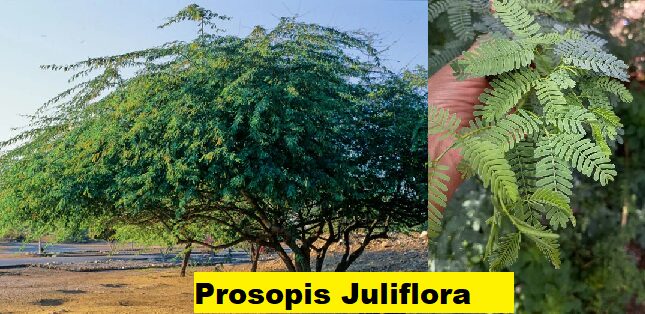
Prosopis juliflora, locally called “Vilayati Kikar”, is native to Central and South America.
It was introduced in India during the colonial period for:
- Afforestation
- Fuelwood supply
- Desertification control
Over time, it spread rapidly across dry and semi-arid landscapes.
Why It Became Invasive
The species possesses several characteristics that make it invasive:
- Rapid growth
- Deep root systems
- High drought resistance
- Aggressive seed dispersal
- Ability to survive poor soil conditions
It often forms dense monocultures that suppress native vegetation.
Ecological Consequences
Suppression of Native Flora
Dense Prosopis growth blocks sunlight and reduces space for native species such as:
- Dhauk (Anogeissus pendula), Palash, Babul
This reduces biodiversity and weakens ecological resilience.
Alteration of Habitat Structure
The species changes:
- Soil composition
- Water availability
- Fire patterns
- Habitat suitability for wildlife
This affects food chains and ecosystem functioning.
Impact on Groundwater and Soil
Research indicates that invasive species can:
- Alter groundwater recharge
- Reduce moisture availability
- Influence local microclimate
The Asola Bhatti plan specifically notes impacts on:
- Groundwater recharge
- Weather buffering
- Desertification control
Ecological Complexity
Despite being invasive, Prosopis juliflora also provides:
- Soil stabilisation
- Shade
- Sub-optimal habitat for some wildlife
Therefore, abrupt removal may create ecological instability.
This is why the management plan recommends:
- Phased removal
- Scientific restoration
- Continuous ecological monitoring
Lantana Camara and Forest Degradation
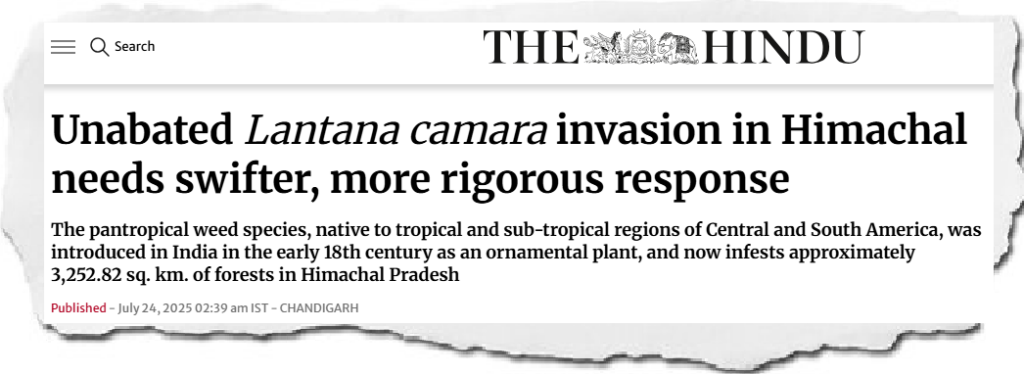
Lantana camara is another major invasive species affecting Indian forests.
It:
- Prevents regeneration of native plants
- Increases forest fire risks
- Reduces grazing quality
- Alters wildlife movement patterns

Lantana invasion is a major issue across:
- Western Ghats
- Central Indian forests
- Himalayan foothills
- Dry forests of North India
Human-Wildlife Conflict and Macaque Management
Rhesus Macaque Relocation
The sanctuary has received nearly 20,000 rhesus macaques relocated from urban areas over the years.
This has created ecological imbalance because:
- The sanctuary’s natural carrying capacity is limited.
- Food availability is inadequate for such large populations.
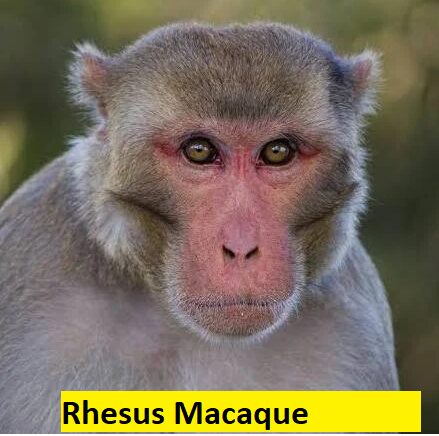
Artificial Feeding Problem
Artificial feeding at designated points has:
- Altered natural foraging behaviour
- Increased population growth
- Encouraged dependence on humans
- Increased human-wildlife conflict
The management plan describes this model as:
- Ecologically unsustainable
- Financially expensive
Carrying Capacity Concept
Carrying capacity refers to:
The maximum population size an ecosystem can sustainably support without ecological degradation.
Exceeding carrying capacity results in:
- Resource depletion
- Habitat degradation
- Competition among species
Suggested Measures
The plan recommends:
- Scientific population assessment
- Habitat enrichment
- Native fruit-bearing plantations
- Gradual withdrawal of artificial feeding
- Humane sterilisation programmes
Urbanisation and Encroachment Pressures
Settlement Expansion
Areas such as:
- Sangam Vihar
- Sanjay Colony
- Bhatti village
have expanded near the sanctuary.
This has caused:
- Habitat fragmentation
- Waste dumping
- Increased human interference
Habitat Fragmentation
Fragmentation breaks continuous habitats into smaller isolated patches.
Its consequences include:
- Reduced wildlife movement
- Declining genetic diversity
- Increased edge effects
- Higher human-animal interactions
Peri-Urban Ecological Stress
Expansion around:
- Devli
- Tughlaqabad
has intensified ecological pressures.
Urban sprawl around protected areas is increasingly becoming a major environmental challenge in India.
Stray Cattle and Ecological Pressure
The report identified stray cattle as major ecological competitors.
Camera-trap studies found:
- Stray cattle formed around 15.1% of mammal detections
Stray cattle:
- Compete with native herbivores
- Reduce water availability
- Disturb natural vegetation
The issue reflects weak urban livestock governance and poor waste management.
Waste Dumping and Pollution
The sanctuary faces:
- Sewage inflow
- Greywater contamination
- Garbage dumping
- Fire risks
Abandoned mining pits are reportedly used for:
- Waste disposal
- Sewage accumulation
This contributes to:
- Soil contamination
- Water pollution
- Habitat degradation
Weak Institutional and Administrative Capacity
The plan identified several governance deficiencies:
- Lack of standard operating procedures (SOPs)
- Weak monitoring systems
- Poor inter-agency coordination
- Inadequate staff training
- Limited scientific management
These challenges are common across many protected areas in India.
Legal and Policy Framework
Wildlife Protection Act, 1972
Provides legal protection to:
- Wildlife habitats
- Protected areas
- Species conservation
Wildlife sanctuaries are governed under this law.
National Biodiversity Action Plan
India’s biodiversity framework recognises:
- Invasive alien species
- Habitat restoration
- Ecosystem-based conservation
as major priorities.
Convention on Biological Diversity (CBD)
India is a party to the Convention on Biological Diversity.
The CBD urges countries to:
- Prevent introduction of invasive species
- Control or eradicate harmful invasive organisms
- Restore degraded ecosystems
Bonn Challenge and Land Restoration
India has committed to restoring degraded landscapes under:
- Bonn Challenge
- UN Decade on Ecosystem Restoration
Urban ecological restoration is increasingly important under these commitments.
Ecological Restoration and Native Species
The management plan recommends:
- Native vegetation restoration
- Soil-binding plants
- Nitrogen-fixing species
Suggested native species include:
- Dhauk
- Palash
- Salai
- Vetiver
- Babul
- Siris
Native species restoration improves:
- Biodiversity
- Water conservation
- Habitat resilience
Climate Change and Urban Ecology
Urban green spaces such as Asola Bhatti are increasingly important because they:
- Reduce urban heat island effects
- Improve air quality
- Enhance climate resilience
- Support ecological connectivity
Climate change may further intensify:
- Water stress
- Forest fires
- Habitat degradation
Therefore, protecting urban ecological systems has become a developmental necessity.
Challenges in Conservation
Balancing Restoration and Existing Ecological Dependence
Sudden removal of invasive species may:
- Destabilise soil
- Affect species dependent on existing cover
Restoration must therefore remain gradual and scientifically guided.
Governance Fragmentation
Multiple agencies operate in the Delhi-NCR region, including:
- Forest departments
- Municipal bodies
- Development authorities
Weak coordination undermines effective conservation.
Urban Population Pressure
High population density around the sanctuary increases:
- Resource pressure
- Waste generation
- Illegal activities
Limited Public Awareness
Urban residents often underestimate the ecological importance of urban forests and wildlife habitats.
Way Forward
Scientific Invasive Species Management
Removal of invasive species should be:
- Phased
- Evidence-based
- Monitored scientifically
Ecological restoration should accompany removal programmes.
Native Habitat Restoration
Priority should be given to:
- Indigenous vegetation
- Ecological connectivity
- Water conservation landscapes
Native species improve ecosystem stability.
Strengthening Urban Ecological Governance
Coordination among:
- Forest departments
- Urban local bodies
- Pollution control agencies
- Planning authorities
must be institutionalised.
Regulating Urban Encroachment
Strict monitoring and enforcement are needed to prevent:
- Illegal settlements
- Waste dumping
- Habitat destruction
Urban planning should integrate ecological buffers around protected areas.
Sustainable Human-Wildlife Coexistence
Scientific wildlife management should include:
- Population assessments
- Carrying-capacity studies
- Humane sterilisation where necessary
- Reduction of artificial feeding
Community Participation
Local communities should be involved in:
- Conservation awareness
- Waste management
- Eco-restoration programmes
Participatory conservation improves long-term sustainability.
Expanding Ecological Research and Monitoring
Protected areas require:
- Long-term biodiversity monitoring
- GIS-based habitat assessment
- Climate vulnerability studies
- Wildlife health surveillance
Evidence-based management is essential for urban ecosystems.
Conclusion
The ecological crisis in Asola Bhatti Wildlife Sanctuary illustrates the growing pressures faced by urban protected areas in India. Invasive species, habitat fragmentation, unplanned urbanisation and weak governance are collectively undermining ecological resilience in the fragile Aravalli ecosystem.
The issue demonstrates that conservation challenges today are no longer confined to remote forests but increasingly linked to urban expansion, ecological mismanagement and climate vulnerability. Protecting urban ecological landscapes such as Asola Bhatti is therefore critical not only for biodiversity conservation but also for groundwater security, climate resilience and sustainable urban development.
A scientifically informed, community-oriented and ecosystem-based approach will be essential for restoring ecological balance and ensuring long-term coexistence between urban populations and fragile natural habitats.
UPSC Practice Questions
Prelims MCQ 1
With reference to invasive alien species in India, consider the following statements:
- Prosopis juliflora is native to India.
- Lantana camara is considered an invasive species affecting Indian forests.
- Invasive species can alter habitat structure and suppress native biodiversity.
How many of the above statements are correct?
(a) Only one
(b) Only two
(c) All three
(d) None
Answer: (b) Only two
Explanation:
- Statement 1 is incorrect because Prosopis juliflora is native to Central and South America.
- Statement 2 is correct because Lantana camara is a major invasive species in Indian forests.
- Statement 3 is correct because invasive species disrupt ecosystems and suppress native flora.
Prelims MCQ 2
The Asola Bhatti Wildlife Sanctuary is ecologically significant primarily because it:
(a) Protects mangrove ecosystems in Delhi
(b) Forms part of the Aravalli hill ecosystem
(c) Hosts alpine biodiversity
(d) Lies within the Gangetic floodplain ecosystem
Answer: (b) Forms part of the Aravalli hill ecosystem
Explanation:
Asola Bhatti Wildlife Sanctuary forms part of the northern extension of the Aravalli Range and serves as an important urban ecological buffer.
UPSC Mains Questions
Urbanisation and ecological degradation are increasingly intersecting in India’s protected landscapes. Analyse in the context of the Asola Bhatti Wildlife Sanctuary.
Discuss the ecological and governance challenges posed by invasive alien species in India. Examine with reference to urban protected areas.
Why the Delhi government’s plans to restore the Ridge raise concerns
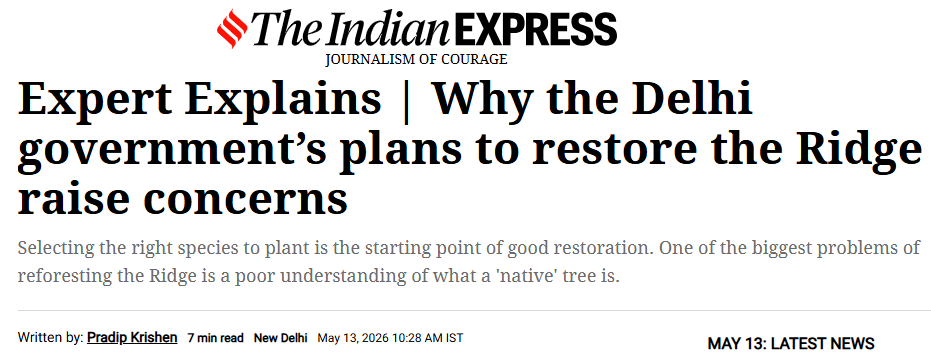
Why in News?
The Delhi government has issued the final notification declaring around 670 hectares of the Central Ridge as a “Reserved Forest” under Section 20 of the Indian Forest Act, 1927. Simultaneously, the Forest Department has proposed ecological restoration initiatives, including:
- Development of themed forests (“vans”)
- Plantation of “native” tree species
- Restoration of degraded Ridge landscapes
However, ecologists and environmental experts have raised concerns regarding:
- Use of ecologically unsuitable tree species
- Anti-termite chemical treatment
- Contractor-driven plantation practices
- Misunderstanding of ecological restoration principles
The debate highlights broader issues relating to:
- Urban ecology
- Native biodiversity conservation
- Aravalli restoration
- Scientific forest governance
UPSC Relevance
Prelims Relevance
- Indian Forest Act, 1927, Reserved Forests, Aravalli ecosystem, Native vs exotic species, Ecological restoration, Miyawaki forests
Mains Relevance
GS Paper 3
- Conservation and environmental governance, Biodiversity restoration, Urban ecological challenges, Forest management and afforestation, Invasive species
GS Paper 1
- Urbanisation and environmental degradation
Essay
- Ecological restoration and sustainable development
- Scientific conservation versus symbolic environmentalism
- Nature-based urban planning
Background and Context
Delhi Ridge System
Delhi Ridge forms the northern extension of the ancient Aravalli Range and stretches across nearly 35 km through Delhi.
The Ridge:
- Functions as the “green lungs” of Delhi
- Acts as a barrier against desertification from the Thar Desert
- Moderates local climate
- Supports biodiversity and groundwater recharge
- Reduces dust pollution and urban heat island effects
The Ridge is divided into:
- Northern Ridge
- Central Ridge
- South-Central Ridge
- Southern Ridge
Among these, the Central Ridge is one of the most ecologically sensitive segments.
Reserved Forest under Indian Forest Act, 1927
The recent notification relates to the final declaration of the Central Ridge as a Reserved Forest.
Section 4 Notification
Under Section 4 of the Indian Forest Act:
- The government announces its intention to constitute a Reserved Forest.
- Settlement of rights and claims follows.
The Central Ridge was first notified under Section 4 in 1994.
Section 20 Notification
After settlement procedures are completed:
- Section 20 notification grants final legal status as a Reserved Forest.
The latest notification therefore completes a legal process pending for over three decades.
Importance of Reserved Forest Status
Reserved Forests receive the highest degree of protection under the Indian Forest Act.
Activities such as:
- Grazing
- Tree felling
- Construction
- Encroachment
are heavily restricted unless specifically permitted.
Ecological Importance of the Ridge
Dry Thorn Forest Ecosystem
The Ridge supports a tropical dry thorn forest ecosystem adapted to:
- Thin quartzitic soils
- Low moisture conditions
- High temperatures
- Arid climatic stress
Such ecosystems are naturally fragile and slow-growing.
Biodiversity Value
The Ridge supports:
- Native grasses, Shrubs, Birds, Reptiles, Small mammals, Pollinators
It also acts as an ecological corridor within the urban landscape.
Climate Regulation Role
The Ridge contributes to:
- Carbon sequestration, Temperature moderation, Air purification, Water infiltration
As Delhi faces worsening heatwaves and pollution, the Ridge’s ecological importance has increased significantly.
The Debate over Ecological Restoration
Restoration versus Plantation
A central concern raised by ecologists is the confusion between:
- Ecological restoration
and - Conventional plantation drives
Ecological Restoration
Ecological restoration seeks to:
- Rebuild natural ecosystems
- Restore ecological processes
- Revive native biodiversity
- Enhance long-term ecosystem resilience
Plantation-Centric Approach
Plantation programmes often prioritise:
- Number of trees planted
- Fast-growing species
- Visual greening
rather than ecological suitability.
This distinction is crucial because:
Planting trees alone does not necessarily restore ecosystems.
Native Species versus “Indian” Species
Understanding Native Species
The article highlights an important ecological concept:
- “Native” does not merely mean found within India’s political boundaries.
A species is native when it:
- Evolves naturally within a specific ecosystem
- Adapts to local climate, soils and ecological conditions
Thus, ecological nativeness is ecosystem-specific, not nationality-based.
Why Species Selection Matters
The Delhi government proposed species such as:
- Neem
- Jamun
- Tamarind
- Mango
- Shisham
However, ecologists argue these species are poorly suited to the Ridge ecosystem.
Ecological Mismatch
For example:
- Mango requires significant water
- Jamun thrives in moist conditions
- Shisham prefers deep alluvial soils
- Tamarind is frost-sensitive
The Ridge ecosystem instead supports drought-adapted vegetation suited to rocky terrain.
Planting ecologically unsuitable species often results in:
- High mortality
- Artificial irrigation dependence
- Resource wastage
Invasive Species and Historical Mistakes
Prosopis Juliflora (Vilayati Kikar)
Prosopis juliflora was introduced during colonial afforestation efforts.
The species spread aggressively because:
- It tolerates drought
- Grows rapidly
- Competes effectively with native plants
However, its success caused:
- Loss of native biodiversity
- Monoculture formation
- Alteration of habitat structure
The article notes that the dominance of vilayati kikar itself reflects past restoration failures.
Ecological Consequences of Monocultures
Monocultures reduce:
- Biodiversity
- Soil health
- Ecological resilience
They also weaken:
- Pollinator diversity
- Wildlife habitats
- Ecosystem stability
Anti-Termite Treatment Controversy
Role of Termites in Ecosystems
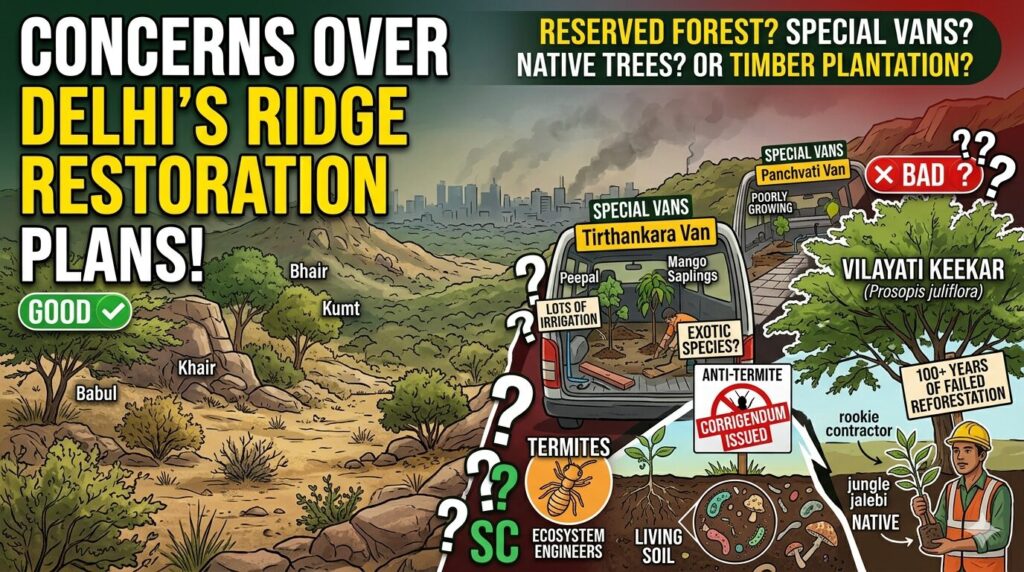
The Forest Department initially proposed anti-termite chemical treatment during plantation.
Ecologists opposed this because termites are:
- Important decomposers
- Soil aerators
- Nutrient recyclers
Termites improve:
- Nitrogen cycling
- Soil moisture retention
- Organic matter decomposition
In dry ecosystems, termites function as:
“Ecosystem engineers”
Living Soil Concept
Healthy ecosystems depend on “living soil” containing:
- Fungi
- Microorganisms
- Insects
- Organic matter
Excessive pesticide use destroys soil biodiversity and weakens ecological recovery.
Following criticism, the Forest Department withdrew the proposal.
Concerns Regarding Themed Forests and Miyawaki Model
Themed Forests (“Vans”)
The Delhi government plans themed forests such as:
- Panchvati Van
- Tirthankara Van
- Ritu Van
Concerns arise if such projects involve:
- Hardscaping
- Artificial landscaping
- Non-native plantations
These may violate the ecological purpose of Reserved Forests.
Miyawaki Forest Model
The Miyawaki technique involves:
- Dense plantation of mixed species
- Rapid forest creation in small urban areas
While useful in highly degraded urban spaces, ecologists argue:
- It is not suitable for all ecosystems.
- It may disrupt naturally open dry forest systems like the Ridge.
Dry forests evolve differently from tropical dense forests.
Governance and Institutional Challenges
Contractor-Driven Plantation Practices
A major issue identified is reliance on contractors for plantation work.
This creates problems such as:
- Procurement of cheaper exotic saplings
- Poor quality control
- Weak monitoring
The article cites the example of:
- “Jungle jalebi” (an exotic species) being planted instead of approved native species.
Weak Implementation Capacity
Even scientifically sound plans often fail because of:
- Lack of ecological expertise
- Administrative pressures
- Monitoring gaps
- Poor inter-agency coordination
Forest Working Plans and Timber Bias
The Forest Research Institute’s Working Plan reportedly emphasises:
- Timber increment estimation
- Plantation approaches
rather than:
- Ecological restoration
- Habitat regeneration
- Biodiversity recovery
This reflects a broader historical problem in Indian forestry where:
- Forests were treated as timber resources rather than ecological systems.
Legal and Policy Dimensions
Forest Conservation Act, 1980
The Act regulates diversion of forest land for non-forest purposes.
Any construction or hardscape development within forests may require:
- Forest clearance
- Environmental scrutiny
National Forest Policy, 1988
The policy shifted forestry focus toward:
- Ecological stability
- Biodiversity conservation
- Community participation
rather than commercial exploitation.
Bonn Challenge and Ecosystem Restoration
India has committed to restoring degraded landscapes under:
- Bonn Challenge
- UN Decade on Ecosystem Restoration
Scientific restoration of the Ridge aligns with these commitments.
Urban Ecology and Climate Change
Urban forests such as the Ridge are increasingly critical because they:
- Reduce urban heat
- Improve air quality
- Enhance climate resilience
- Buffer extreme weather events
Delhi’s worsening:
- Heatwaves
- Air pollution
- Water stress
make ecological restoration an urban survival necessity rather than merely a conservation issue.
Challenges
Ecological Misunderstanding of Restoration
Restoration is often reduced to:
- Tree planting campaigns
- Beautification projects
instead of rebuilding ecological processes.
Use of Non-Native or Unsuitable Species
Incorrect species selection can:
- Increase water dependence
- Reduce survival rates
- Distort ecosystem functioning
Invasive Species Dominance
Existing invasive species continue to suppress native vegetation recovery.
Contractor-Based Plantation Model
Weak accountability often leads to:
- Species substitution
- Poor maintenance
- Ecological mismatch
Institutional Fragmentation
Multiple agencies govern Delhi’s environment, resulting in:
- Coordination failures
- Policy inconsistencies
- Weak enforcement
Urbanisation Pressure
Rapid urban expansion continues to:
- Fragment habitats
- Increase pollution
- Intensify ecological stress
Way Forward
Adopt Scientific Ecological Restoration
Restoration efforts should prioritise:
- Native ecosystem regeneration
- Soil restoration
- Habitat connectivity
rather than plantation targets alone.
Prepare Ecosystem-Specific Native Species Lists
Species selection must be based on:
- Soil conditions
- Rainfall patterns
- Ecological history
- Local biodiversity
The concept of “native” should remain ecosystem-specific.
Strengthen Ecological Monitoring
Continuous scientific monitoring should assess:
- Soil health
- Species survival
- Biodiversity recovery
- Invasive species spread
GIS and remote sensing technologies can support this process.
Control Invasive Species Scientifically
Gradual removal of invasive species should be combined with:
- Native vegetation restoration
- Soil conservation
- Habitat management
Reform Urban Forestry Governance
Urban forest governance should involve:
- Ecologists
- Botanists
- Soil scientists
- Local communities
rather than relying solely on contractor-driven approaches.
Integrate Climate Resilience into Restoration
Urban ecological restoration should support:
- Heat mitigation
- Water conservation
- Air pollution reduction
- Carbon sequestration
Increase Public Ecological Awareness
Public discourse should shift from:
- “More trees”
to - “Right trees in the right ecosystem”
Ecological literacy is essential for sustainable urban conservation.
Conclusion
The debate surrounding the restoration of Delhi’s Ridge reveals a deeper challenge in India’s environmental governance: the tendency to equate ecological restoration with plantation activity. The Ridge is not merely a vacant urban space requiring beautification, but a fragile dry forest ecosystem shaped by unique geological and climatic conditions over centuries.
Protecting and restoring such ecosystems demands scientific understanding, ecosystem-specific planning and long-term ecological commitment. Poorly planned interventions, even when well-intentioned, can undermine biodiversity, increase ecological stress and repeat historical restoration failures.
As climate change and urbanisation intensify environmental pressures, the future of cities like Delhi will increasingly depend on preserving ecologically functional natural landscapes rather than creating artificial green spaces disconnected from local ecosystems.
UPSC Practice Questions
- Consider the following statements regarding ecological restoration:
- Ecological restoration is identical to large-scale tree plantation.
- Native species are determined primarily by ecological suitability to a specific ecosystem.
- Invasive species can alter habitat structure and suppress biodiversity.
How many of the above statements are correct?
(a) Only one
(b) Only two
(c) All three
(d) None
Correct Answer: (b) Only two
Explanation:
Statement 1 is incorrect because ecological restoration involves restoring ecological processes and biodiversity, not merely planting trees.
Statement 2 is correct because ecological nativeness depends on ecosystem adaptation.
Statement 3 is correct because invasive species often disrupt ecological balance.
- With reference to the Delhi Ridge, consider the following statements:
- It forms part of the Aravalli hill system.
- The Central Ridge was declared a Reserved Forest under the Wildlife Protection Act, 1972.
- The Ridge plays a role in preventing desertification in Delhi.
Which of the statements given above are correct?
(a) 1 and 2 only
(b) 2 and 3 only
(c) 1 and 3 only
(d) 1, 2 and 3
Correct Answer: (c) 1 and 3 only
Explanation:
Statement 1 is correct because the Ridge is the northern extension of the Aravallis.
Statement 2 is incorrect because Reserved Forests are notified under the Indian Forest Act, 1927.
Statement 3 is correct because the Ridge acts as a barrier against desertification from the Thar Desert.
Mains Question
Examine the ecological significance of the Delhi Ridge system. Why do restoration efforts in urban ecosystems often fail despite large-scale plantation programmes?
“Ecological restoration is not synonymous with plantation-driven greening.” Discuss in the context of urban forest governance in India.
Cabinet approves ₹37,500 Crore Coal Gasification Scheme to boost Syngas Production
Why in News?
The Union Cabinet has approved a Rs 37,500 crore scheme to promote coal and lignite gasification projects. The initiative is a major step towards cleaner coal utilisation, energy security and import substitution.
It is estimated that coal gasification can help substitute imports of up to ₹3 lakh crore, and ensure self-reliance for India’s industries and overall economic security.
| UPSC Relevance: GS-3: Environment and Biodiversity; GS-3: Economy: Energy & Infrastructure Prelims: Coal Gasification Scheme (key facts), Coal Gasification, Syngas |
What is Coal Gasification?
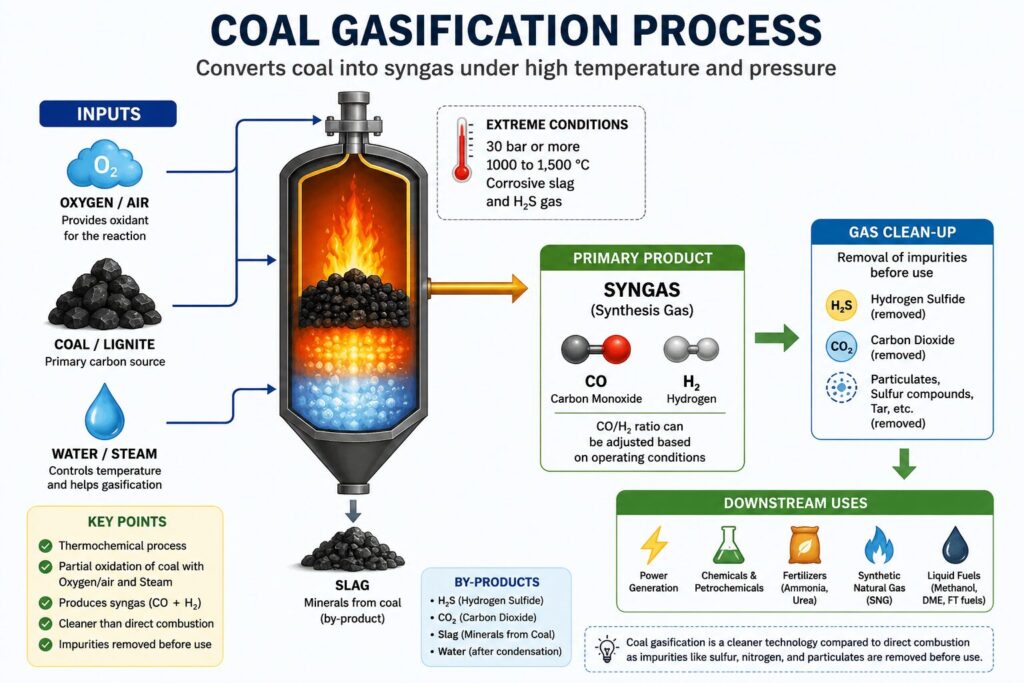
- Coal gasification is a thermochemical process in which solid coal reacts with controlled amounts of oxygen (or air) and steam under high temperature and pressure conditions to produce synthesis gas (syngas).
- This process breaks down coal into its chemical constituents, primarily carbon monoxide (CO) and hydrogen, which can then be used to produce electricity, chemical feedstocks, and liquid fuels.

What is Syngas?
- Syngas is a cleaner-burning fuel mainly composed of Hydrogen (H₂) and Carbon Monoxide (CO). It may also contain Carbon dioxide (CO₂), Methane (CH₄) and Water vapour.
- It is a versatile feedstock and can be further processed into a wide array of industrial and energy products. Syngas downstream products include: Hydrogen, methanol, ammonia, urea, ammonium nitrate, dimethyl ether (DME), synthetic natural gas (SNG), liquid fuels (via Fischer-Tropsch synthesis), and active pharmaceutical ingredients (APIs)
- Applications: Syngas is used to generate electricity, produce methanol, fertilisers (ammonia/urea), and synthetic natural gas.
Coal Gasification is considered a cleaner technology in comparison to coal combustion, as it allows for the removal of impurities such as sulfur and nitrogen from the gas before it is used.
About the Coal Gasification Scheme:
- Scheme: Scheme for Promotion of New Surface Coal/Lignite Gasification Projects for Production of Syngas and Downstream Products.
- Aim: To accelerate the conversion of coal and lignite into syngas. To boost energy independence and reduce the high cost of imported fuels and chemicals.
- Total Outlay: ₹37,500 crore.
- Target: Gasification of 75 Million Tonnes (MT) of coal/lignite, aligning with the 100 MT National Coal Gasification Mission target by 2030.
- Incentive: Up to 20% of plant and machinery costs, aimed at supporting about 25 projects.
- Disbursement: Government will disburse financial incentives in four equal instalments, each tied to specific project milestones to ensure accountability and timely execution.
- Investment Potential: Estimated to mobilise ₹2.5-3 lakh crore across the value chain.
- Employment: Expected to create around 50,000 direct and indirect jobs.
- Incentive Caps & Policy Support: To ensure competitive and fair distribution, the scheme has implemented specific caps:
- Per Project: Max ₹5,000 crore.
- Per Product Category: Max ₹9,000 crore (excluding Synthetic Natural Gas and Urea).
- Per Entity/Group: Max ₹12,000 crore.
- Coal Linkage Extension: Extended to 30 years for syngas-based projects to ensure long-term, stable feedstock.
- Projects under the scheme will be selected through a transparent bidding mechanism, ensuring competitive and fair selection of implementing entities.
- The scheme encourages the adoption of indigenous technologies for coal conversion and clean coal applications.
The scheme aims to reduce dependence on imports for high-value products like Ammonia (100 imported), Methanol (80-90% imported), and LNG (>50% imported). The initiative builds upon a smaller ₹8500 crore coal gasification scheme approved in January 2024.
- Reserves: India possesses ~401 billion tonnes of coal and ~47 billion tonnes of lignite.
- Energy Mix: Coal currently contributes over 55% of India’s total energy supply.
National Coal Gasification Mission:
- The government launched the National Coal Gasification Mission in 2021, targeting 100 million tonnes of coal gasification by 2030 with investments of ₹4-8.5 lakh crore.
- The present ₹37,500 crore scheme is a decisive accelerator of this mission, providing the financial framework to attract private and public-sector participation at scale.
Why does India need this Scheme?
India holds some of the world’s largest coal reserves yet remains heavily dependent on imported fossil fuels and chemical feedstocks. Coal currently contributes over 55% of India’s energy mix, yet its use has largely been confined to thermal power generation, leaving enormous value-creation potential untapped.
- Import substitution imperative: India imports roughly 82% of its crude oil requirement and 45% of its natural gas demand. Additionally, the country spends heavily on importing liquefied natural gas (LNG), urea, ammonia, and methanol. Syngas produced through domestic coal gasification can substitute all these imports, insulating the economy from global price volatility and geopolitical supply disruptions.
- Agricultural and food security linkage: India’s fertiliser sector depends on urea and ammonia, both of which can be produced domestically from syngas. Domestically produced ammonia and urea would insulate India’s agricultural input supply chain from disruptions caused by geopolitical conflicts or shipping route interruptions.
- Coal reserve monetisation: With coal reserves of ~401 billion tonnes and lignite reserves of ~47 billion tonnes, India possesses a vast resource base that currently lacks value diversification. The scheme enables monetisation of this reserve through higher-value downstream products, rather than simple combustion.
- Alignment with energy transition: As India transitions towards renewables, it cannot abruptly phase out coal without destabilising energy supply. Coal gasification offers a bridge technology. i.e., a pathway to use existing coal infrastructure in a cleaner, more productive manner while renewable capacity scales up.
Challenges in Scaling Coal Gasification in India:
- High Ash Content in Indian Coal: Indian coal typically has an ash content of 30–35%, even after washing. High ash content significantly reduces gasification efficiency, increases operational costs, and poses a technical barrier to large-scale adoption compared to international coal quality standards.
- High Capital Costs & Financial Viability: Coal gasification plants require substantial upfront capital investment. Without government support, projects may not be financially viable on their own, which is precisely why the scheme uses a Viability Gap Funding (VGF) approach with structured incentive caps.
- Environmental and GHG Concerns: While gasification is cleaner than direct combustion, it still produces greenhouse gases, including CO₂. Large-scale gasification without Carbon Capture and Storage (CCS) technology may conflict with India’s climate commitments under the Paris Agreement and its net-zero 2070 target.
- High Water Consumption: Gasification is a water-intensive process. Many coal-rich regions in India (such as parts of Jharkhand, Odisha, and Chhattisgarh) already face water scarcity, and scaling gasification in these areas without robust water management could intensify local resource stress.
- Technology Dependence & Indigenisation Gap: India currently lacks mature, commercially viable indigenous gasification technology. Most proven technologies are imported, creating a dependency risk. The scheme’s emphasis on indigenous R&D is essential but will require sustained investment and time to bear fruit.
- Scalability & Infrastructure Integration: Gasification technology faces scalability challenges, particularly for integration with existing industrial infrastructure. Building out downstream processing capacity for syngas derivatives requires coordinated sectoral planning across fertilisers, chemicals, and energy sectors.
- Land Acquisition & Displacement: Setting up large-scale surface gasification plants in coal-bearing states often involves land acquisition in tribal and forest areas, raising social and legal challenges under the Forest Rights Act and PESA provisions.
- Competition from Renewables: As green hydrogen produced from renewable energy becomes increasingly cost-competitive, coal-based syngas may face long-term commercial pressure. The scheme must build in flexibility to integrate Carbon Capture, Utilisation, and Storage (CCUS) to remain relevant in a decarbonising economy.
The scheme represents a major shift in India’s coal policy from treating coal purely as a thermal fuel to positioning it as a platform for chemical and industrial value creation.
India gets its first Alzheimer’s Therapy at Rs 1 lakh/dose
Why in News?
Pharmaceutical company Eli Lilly and Company (India) Pvt. Ltd. has launched Lormalzi (donanemab) in India. This marks the country’s first approved amyloid plaque-targeting therapy for Alzheimer’s disease.
The drug has received approval from the Central Drugs Standard Control Organisation (CDSCO) for patients with early-stage Alzheimer’s disease, including mild cognitive impairment and mild dementia.
| UPSC Relevance: GS-3 Science and Technology: Biology and Biotechnology Prelims: Alzheimer’s disease, Lormalzi (donanemab), monoclonal antibody |
What is Alzheimer’s Disease?
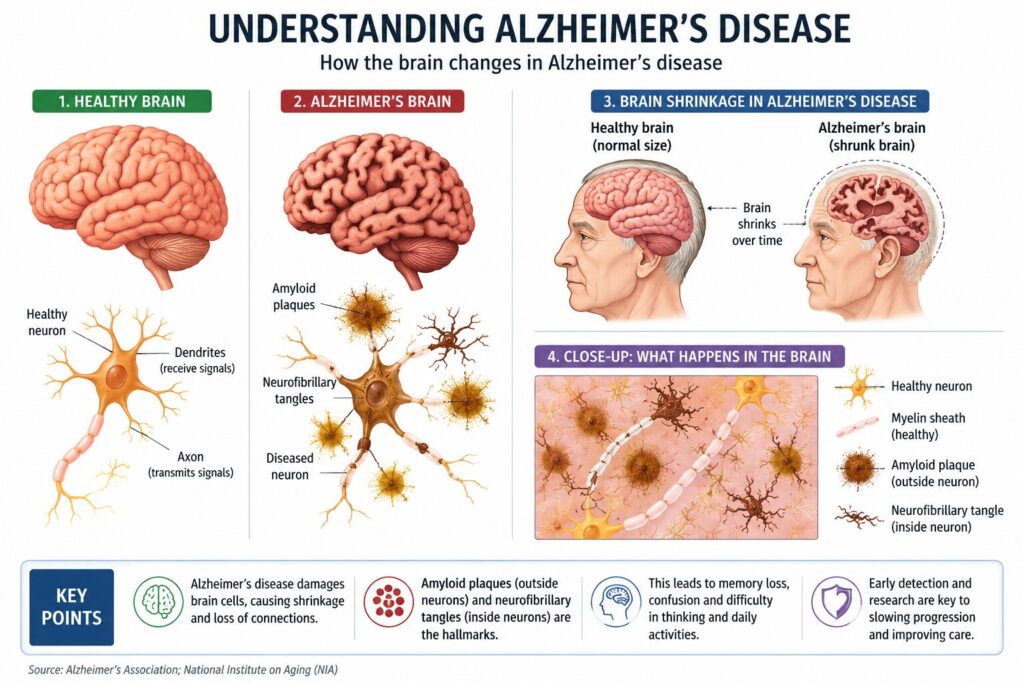
- Alzheimer’s disease is a progressive neurodegenerative disorder and the most common cause of dementia. It gradually damages brain cells (atrophy of the brain), leading to a decline in memory, thinking ability, behaviour and daily functioning.
- Causes: The disease is caused by the abnormal build-up of two proteins in and around brain cells. Together, these deposits destroy neural tissue progressively.
- First is the amyloid protein, which forms plaques between nerve cells.
- Second is the tau protein, which forms tangles within brain cells.
- Symptoms: Early signs include forgetting recent events or conversations. As the disease advances, the patient develops severe memory impairment, loses the ability to perform everyday tasks, and in the final stages, loss of brain function can lead to dehydration, malnutrition, infection, and death.
- Treatment (Pre-2026): Until recently, there was no cure for Alzheimer’s disease. Some medicines (such as donepezil, rivastigmine, galantamine, and memantine) could temporarily slow the worsening of symptoms but did not address the underlying disease biology.
India’s Dementia Burden:
The launch of Lormalzi carries particular significance given the scale of India’s Alzheimer’s challenge.
- Dementia currently affects approximately 8.8 million people in India, with Alzheimer’s disease accounting for the majority of cases. This number is projected to nearly double to 16.9 million by 2036.
- Estimates suggest that dementia costs the Indian economy more than ₹28,300 crore annually. The burden is expected to increase further as life expectancy rises.
Globally, the number of people living with dementia is projected to reach 152 million by 2050.
What is Donanemab (Lormalzi)?
- Donanemab is a monoclonal antibody, a laboratory-manufactured protein that mimics the immune system’s ability to target specific threats. It belongs to the class of anti-amyloid therapies, or disease-modifying therapies (DMTs).
- Mechanism of Action:
- Amyloid plaques are sticky protein clumps that build up in the brains of people with Alzheimer’s disease and are believed to damage brain cells, leading to memory loss and cognitive decline.
- Lormalzi works by helping remove these abnormal protein deposits from the brain. Unlike conventional medicines that only manage symptoms, donanemab targets the underlying disease biology itself.
- Administration: Lormalzi is administered as a once-monthly intravenous (IV) infusion of 350 mg. The treatment course in India is expected to last 18 months (76 weeks) in most patients.
- Cost: Around ₹91,688 per 350 mg vial, making it one of the most expensive neurological treatments available in India.
Who is Eligible for the Treatment?
- The therapy is approved for:
- Patients with mild cognitive impairment due to Alzheimer’s disease.
- Those in the mild dementia stage, provided amyloid pathology is confirmed through diagnostic testing.
- It is not meant for patients who have already progressed to advanced stages of the disease. While the drug can dissolve the build-up of amyloid beta protein, it cannot reverse damage that has already occurred.
Challenges Associated:
The Indian healthcare system faces several structural barriers to making this therapy viable at scale:
- Cost: The prohibitive pricing limits access primarily to affluent patients.
- Late Diagnosis: Alzheimer’s in India is typically diagnosed at advanced stages, whereas donanemab is only effective in early stages. Early diagnosis infrastructure remains underdeveloped.
- Diagnostic Prerequisites: Confirming amyloid pathology ideally requires an amyloid PET scan, which is currently not widely available in India. The company has stated that in the absence of amyloid PET imaging, the standard approach is to treat eligible patients for 18 months.
- Genetic Screening: All eligible patients must be screened for the APOE4 gene, which adds further cost and complexity.
- Safety Monitoring: The risk of ARIA (Amyloid-Related Imaging Abnormalities), i.e., brain swelling and bleeding, requires regular MRI monitoring during treatment, demanding a high level of clinical infrastructure.
Source: https://anantamias.com/current-affairs/india-gets-its-first-alzheimers-therapy-at-rs-1-lakh-dose/
Revving up Immune Cells may help Fight HIV: study
Why in News?
A new study has shown that a modified form of CAR-T cell therapy, widely used in cancer treatment, may help suppress HIV infection for long periods without regular antiretroviral drugs.
Researchers reported that two HIV patients maintained strong viral suppression for nearly one to two years after receiving a single dose of engineered immune cells.
| UPSC Relevance: GS-3 Science and Technology: Biology and Biotechnology Prelims: HIV, CAR-T cell therapy, T-cells |
What is HIV?
- Human Immunodeficiency Virus Infection and Acquired Immunodeficiency Syndrome is caused by the Human Immunodeficiency Virus (HIV), an RNA virus belonging to the retrovirus family.
- HIV attacks the immune system, especially CD4 T-cells, which are crucial for fighting infections. Over time, untreated HIV weakens immunity and can lead to AIDS (Acquired Immunodeficiency Syndrome).
- AIDS is the advanced stage of HIV infection, where the body becomes highly vulnerable to infections and cancers.
Nature of the HIV Virus:
- HIV is a retrovirus because its genetic material is RNA instead of DNA. It uses an enzyme called reverse transcriptase to convert viral RNA into DNA inside host cells.
- The viral DNA integrates into the host genome, making the infection persistent and difficult to eliminate.
Transmission of HIV:
HIV spreads through contact with infected bodily fluids, such as blood, semen, vaginal fluids and breast milk.
- Major Modes of Transmission:
- Unprotected sexual contact
- Sharing contaminated needles or syringes
- Mother-to-child transmission during pregnancy, childbirth, or breastfeeding
- Unsafe blood transfusions
- HIV is not spread through casual contact. Mosquitoes and insects cannot transmit HIV because the virus survives only in human cells and blood.
According to global estimates, nearly 40 million people live with HIV worldwide.
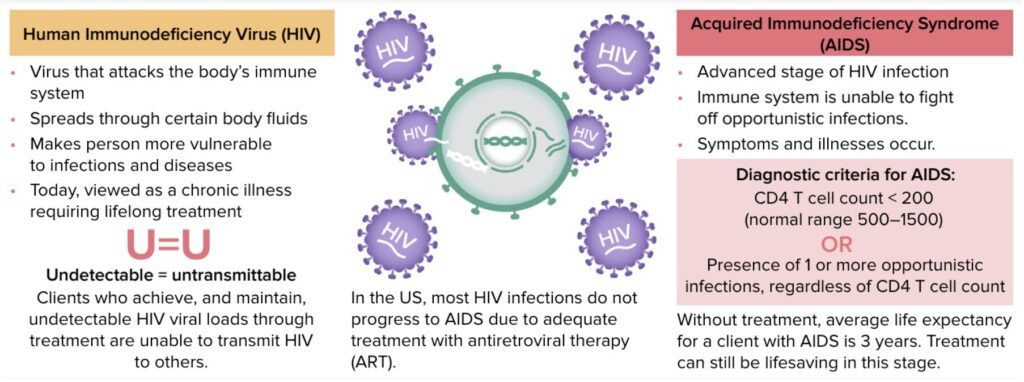
Current Treatment for HIV:
- Antiretroviral Therapy (ART) is the standard treatment for HIV.
- Features of ART: Suppresses viral replication, maintains low or undetectable viral load and prevents progression to AIDS.
- ART is not a cure. HIV remains hidden in viral reservoirs inside the body. If treatment stops, the virus can rebound rapidly.
Why is HIV so difficult to cure?
- HIV hides inside resting immune cells, in lymph nodes and certain tissues and organs. These hidden reservoirs remain invisible to many drugs and immune responses.
- Even when ART reduces HIV to undetectable levels, the dormant virus can reactivate later.
What is CAR-T Cell Therapy?
- Originally developed for cancer treatment, CAR-T therapy modifies a patient’s own immune cells to better attack diseased cells.
- How CAR-T Therapy Works?
- T-cells are removed from the patient’s blood.
- Scientists genetically engineer these T-cells in the laboratory.
- The modified cells are equipped with special receptors called Chimeric Antigen Receptors (CARs). These engineered cells are infused back into the patient.
- The CAR-T cells identify and destroy infected or cancerous cells.
How was CAR-T Modified for HIV?
Scientists created CAR-T cells with dual features:
- Enhanced HIV Detection: The modified cells were programmed to better identify and kill HIV-infected cells.
- Resistance to HIV Infection: The CAR-T cells were engineered to resist infection by HIV itself. This protective armour allows the engineered immune cells to survive longer and continue fighting the virus.
Findings of the New Study:
- A single dose of modified CAR-T cells strongly suppressed HIV in two patients. One patient maintained suppression for nearly one year. Another maintained suppression for almost two years. These patients remained off conventional HIV medication during this period.
- No serious side effects were reported. Patients who had begun HIV treatment early after infection showed better responses. Early treatment likely reduced viral reservoirs and preserved immune function.
Significance of the Study:
- Researchers are exploring whether CAR-T therapy could become a “one-and-done” treatment. The therapy may move HIV treatment closer to a functional cure where the virus can be controlled without lifelong medicines. Patients maintain normal immune function.
Challenges and Limitations:
Despite promising results, several challenges remain.
- Limited Study Size: Only a small number of patients were studied.
- High Cost: CAR-T therapies are currently extremely expensive and technologically complex.
- Scalability Issues: Developing personalised immune-cell therapies for millions of HIV patients remains difficult.
- Long-Term Safety: Scientists still need to assess the durability of response, long-term immune effects and the risk of relapse.
The new CAR-T cell therapy study represents an important breakthrough in long-term HIV control and possible functional cures. By genetically enhancing the body’s own immune cells, scientists are attempting to overcome hidden viral reservoirs, one of the greatest challenges in HIV treatment.
Practice MCQ:
Q. With reference to Human Immunodeficiency Virus (HIV), consider the following statements:
1. CAR-T therapy involves genetically engineering T-cells to target specific diseased cells.
2. In the recent HIV study, engineered CAR-T cells were modified to resist HIV infection themselves.
3. Antiretroviral Therapy (ART) completely eliminates latent HIV reservoirs from the body.
4. HIV is classified as a retrovirus because it uses reverse transcriptase to convert RNA into DNA.
Which of the statements given above are correct?
(a) 1, 2 and 4 only
(b) 1 and 3 only
(c) 2, 3 and 4 only
(d) 1, 2, 3 and 4
Answer: (a)
Source: https://anantamias.com/current-affairs/revving-up-immune-cells-may-help-fight-hiv-study/