
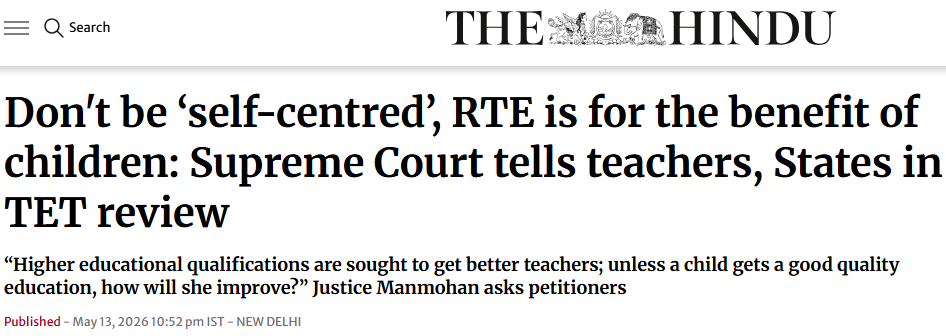
Why in News?
The Supreme Court recently heard review petitions filed by several States and teachers’ associations against its September 2025 judgment mandating that in-service teachers of Classes I to VIII in non-minority schools must clear the Teachers Eligibility Test (TET) within two years or face compulsory retirement.
During the hearing, the Court emphasised that the Right to Education (RTE) framework exists primarily for the benefit of children and quality education, not merely for protecting employment security of teachers. The case has significant implications for:
- Teacher quality standards
- Educational reforms
- Right to Education implementation
- Federal and administrative challenges in school education
The issue potentially affects more than 25 lakh teachers across India.
UPSC Relevance
Prelims Relevance
- Right to Education Act, 2009, Teachers Eligibility Test (TET), Article 21A, National Council for Teacher Education (NCTE), Constitutional provisions related to education
Mains Relevance
GS Paper 2
- Education and human resource development, Right to Education, Quality of public education, Federal issues in implementation of welfare laws
GS Paper 1
- Social empowerment and educational access
Essay
- Education as a tool of social transformation
- Quality versus access in public education
- Human capital and development
Background and Context
India’s education system has historically faced dual challenges:
- Expanding access to schooling
- Improving quality of education
While enrolment rates have significantly improved over the past decades, learning outcomes remain a serious concern.
The Right of Children to Free and Compulsory Education Act, 2009 (RTE Act) represented a landmark step toward universal elementary education. However, policymakers increasingly recognised that access without quality could not achieve meaningful educational transformation.
Teacher quality emerged as a central concern because:
- Teachers are the most important institutional factor influencing learning outcomes.
- Large numbers of teachers lacked professional training and pedagogical qualifications.
- Several States recruited para-teachers or underqualified teachers to address shortages.
The Teachers Eligibility Test (TET) was introduced to establish minimum quality standards for elementary school teachers across India.
Constitutional Basis of the Right to Education
Article 21A
The 86th Constitutional Amendment Act, 2002 inserted Article 21A into the Constitution.
It provides:
“The State shall provide free and compulsory education to all children of the age of six to fourteen years in such manner as the State may, by law, determine.”
This transformed elementary education into a Fundamental Right.
Directive Principles and Educational Justice
Article 45
Originally directed the State to provide free and compulsory education for children.
After the 86th Amendment, Article 45 focuses on:
- Early childhood care and education
Article 46
Directs the State to promote educational interests of weaker sections.
Thus, educational access and quality are linked to:
- Equality
- Social justice
- Human development
Right to Education Act, 2009
The RTE Act operationalised Article 21A and came into force in 2010.
Key Objectives
The Act seeks to ensure:
- Universal elementary education
- Non-discrimination
- Neighbourhood schools
- Minimum infrastructure standards
- Qualified teachers
The law shifted the focus from charity-based education to a rights-based framework.
Section 23 and Teacher Qualifications
The present dispute revolves around Section 23 of the RTE Act.
Role of NCTE
Section 23 authorises the National Council for Teacher Education (NCTE) to prescribe:
- Minimum qualifications for teachers
The NCTE made TET qualification mandatory for teaching elementary classes.
Relaxation Provision
Recognising shortages of trained teachers, Section 23(2) initially allowed States temporary relaxation in qualification requirements.
Teachers without minimum qualifications were granted time to acquire them.
2017 Amendment
The second proviso inserted in 2017 extended the deadline for certain in-service teachers appointed before March 31, 2015, allowing them additional time to acquire qualifications.
The amendment reflected practical realities such as:
- Teacher shortages
- Limited training infrastructure
- Regional disparities
What is the Teachers Eligibility Test (TET)?
TET is a standardised examination conducted to assess whether candidates possess minimum teaching aptitude and pedagogical competence.
There are generally two levels:
- Paper I: Classes I to V
- Paper II: Classes VI to VIII
The examination evaluates:
- Child pedagogy
- Subject knowledge
- Teaching methodology
- Classroom understanding
Purpose of TET
The objective is to:
- Improve teaching quality
- Standardise recruitment norms
- Ensure professionally competent teachers
TET is conducted by:
- Central Board of Secondary Education (for CTET)
- State authorities for State TETs
The Supreme Court’s 2025 Judgment
The September 2025 judgment held that:
- Clearing TET is a mandatory statutory requirement under the RTE framework.
- In-service teachers who fail to obtain TET qualification within two years could face compulsory retirement.
However, the Court exempted:
- Teachers with less than five years remaining before retirement
The judgment prioritised:
- Educational quality
- Children’s rights
- Statutory compliance
over administrative convenience.
Arguments by the Petitioners
States and teachers’ associations challenged the judgment primarily on the following grounds:
Retrospective Application
Petitioners argued that:
- Teachers appointed decades earlier should not face new qualification requirements retrospectively.
- They were recruited under earlier legal frameworks.
Threat to Livelihood
Compulsory retirement could affect:
- Financial security
- Pension rights
- Livelihoods of lakhs of teachers
Experience versus Qualification
Several petitioners argued that:
- Experienced teachers with long years of service should not be treated as unqualified solely for failing TET.
- Practical classroom experience also matters.
Teacher Shortages
States such as Tamil Nadu argued that large-scale enforcement could create:
- Severe vacancies
- Classroom disruptions
- Learning losses
particularly in rural government schools.
Supreme Court’s Observations
The Bench strongly emphasised the primacy of children’s rights under the RTE framework.
Justice Dipankar Datta observed that:
- Teachers should not focus solely on job security.
- The purpose of the RTE Act is to secure quality education for children.
Justice Manmohan stated that:
- The Court merely enforced statutory minimum standards.
- Better educational qualifications are necessary for improving learning outcomes.
The Court thus framed the issue as a balance between:
- Employment protection
- Educational quality
- Constitutional rights of children
Quality of Education and Learning Crisis in India
The debate must be viewed against the backdrop of India’s learning crisis.
ASER Reports
Annual Status of Education Report (ASER) findings repeatedly show:
- Weak foundational literacy
- Poor numeracy skills
- Learning deficits in government schools
Many students in higher grades struggle with:
- Basic reading
- Arithmetic skills
This has intensified policy emphasis on teacher competency.
National Education Policy (NEP) 2020
The NEP stresses:
- Teacher professionalism
- Continuous training
- Foundational learning
- Merit-based recruitment
The policy describes teachers as the “heart of the learning process”.
Teacher Shortage and Structural Problems
India simultaneously faces:
- Teacher shortages
- Teacher absenteeism
- Uneven teacher quality
According to Unified District Information System for Education (UDISE) data:
- Several schools operate with single teachers.
- Rural and tribal regions face acute shortages.
Thus, the challenge is not merely qualifications but broader educational governance.
Federal and Administrative Dimensions
Education is placed in the Concurrent List after the 42nd Constitutional Amendment.
Thus:
- Both Union and States legislate on education.
- Implementation largely depends on States.
This creates tensions because:
- National quality standards are centrally framed.
- Recruitment and school administration are State responsibilities.
Financial and administrative capacities vary significantly across States.
Minority Institutions and Constitutional Protection
The Court’s judgment applied to non-minority schools.
Minority educational institutions enjoy constitutional protection under:
- Article 30
The State’s regulatory power over minority institutions is more limited, especially regarding administrative autonomy.
This raises larger debates about:
- Uniform standards
- Minority rights
- Regulatory balance
Challenges in Implementing TET Mandates
Lack of Training Infrastructure
Many teachers, especially in rural areas, lack access to:
- Quality teacher training institutes
- Coaching facilities
- Digital learning platforms
Regional Disparities
Educational capacities differ significantly across States.
Backward districts may struggle more with compliance.
Risk of Teacher Vacancies
Strict enforcement without adequate replacement planning could worsen:
- Pupil-teacher ratios
- School functioning
- Rural educational access
Overemphasis on Examination-Based Qualification
Critics argue that:
- Teaching ability cannot be judged solely through standardised tests.
- Classroom experience and pedagogical practice also matter.
International Perspective
Countries with strong public education systems generally maintain:
- Rigorous teacher certification
- Periodic professional training
- Continuous evaluation
For example:
- Finland emphasises highly qualified teachers with strong pedagogical training.
- Singapore combines teacher quality with continuous professional development.
India’s challenge is to improve quality while accommodating large-scale diversity and capacity gaps.
Way Forward
Balancing Quality and Employment Security
Teacher quality standards are essential, but implementation should remain:
- Gradual
- Practical
- Sensitive to ground realities
A balanced transition framework is necessary.
Strengthening Teacher Training Systems
The focus should shift beyond one-time qualification exams toward:
- Continuous professional development
- Refresher programmes
- Digital learning platforms
- Pedagogical mentoring
Teacher capacity-building must become institutionalised.
Improving Foundational Education
Teacher reform should align with:
- Foundational literacy goals
- NEP 2020 objectives
- Child-centric pedagogy
Quality improvement must remain outcome-oriented.
Expanding Educational Infrastructure
States require greater support for:
- Teacher recruitment
- Training institutions
- Rural educational infrastructure
The Union and States must coordinate effectively.
Reforming TET Structure
TET examinations should assess:
- Practical teaching skills
- Classroom management
- Child psychology
- Inclusive pedagogy
rather than relying excessively on rote-based evaluation.
Incentivising Teacher Excellence
Career progression, incentives and recognition systems should encourage:
- Professional competence
- Innovation in teaching
- Continuous learning
This can improve morale and performance.
Protecting Children’s Right to Quality Education
Ultimately, educational policy must remain centred on:
- Learning outcomes
- Equity
- Constitutional rights of children
The right to education must include both:
- Access to schools
- Meaningful quality learning
Conclusion
The ongoing TET review case reflects a broader constitutional and policy debate regarding the meaning of the Right to Education in India. The Supreme Court’s observations underline that educational rights cannot be reduced merely to administrative or employment concerns.
India’s challenge lies in balancing:
- Teacher welfare
- Administrative feasibility
- Educational quality
- Constitutional obligations toward children
Improving teacher standards is necessary for strengthening India’s human capital and social development. However, reforms must be implemented in a manner that is equitable, institutionally supported and sensitive to regional disparities.
A rights-based education system ultimately depends not only on school access but also on ensuring that every child receives quality learning from competent and well-supported teachers.
UPSC Practice Questions
Prelims MCQ 1
With reference to the Right of Children to Free and Compulsory Education Act, 2009, consider the following statements:
- Article 21A was inserted by the 86th Constitutional Amendment Act.
- The National Council for Teacher Education (NCTE) prescribes minimum teacher qualifications under the RTE framework.
- Education is exclusively a State subject under the Constitution of India.
How many of the above statements are correct?
(a) Only one
(b) Only two
(c) All three
(d) None
Answer: (b) Only two
Explanation:
- Statement 1 is correct because Article 21A was inserted by the 86th Amendment.
- Statement 2 is correct because NCTE prescribes minimum teacher qualifications under Section 23 of the RTE Act.
- Statement 3 is incorrect because education is in the Concurrent List after the 42nd Constitutional Amendment.
Prelims MCQ 2
Which of the following statements regarding the Teachers Eligibility Test (TET) is correct?
(a) It is conducted only by the Union government.
(b) It is mandatory only for private school teachers.
(c) It seeks to establish minimum teaching standards for elementary education.
(d) It was introduced through the National Education Policy, 2020.
Answer: (c) It seeks to establish minimum teaching standards for elementary education.
Explanation: TET was introduced under the RTE framework to ensure minimum pedagogical and professional standards for elementary school teachers.
Mains Questions
“Access to schooling without quality education cannot fulfil the constitutional vision of Article 21A.” Examine in the context of teacher quality reforms in India.
Discuss the constitutional and policy dimensions of the Teachers Eligibility Test (TET) in the context of the Right to Education framework in India.
Tell Google you want more of this.
Add Anantam IAS as a preferred sourceOne tap, and this site shows up more often in your own Top Stories, AI Overviews and AI Mode. Remove it any time.