Why in News?
The Union Cabinet has approved a Rs 37,500 crore scheme to promote coal and lignite gasification projects. The initiative is a major step towards cleaner coal utilisation, energy security and import substitution.
It is estimated that coal gasification can help substitute imports of up to ₹3 lakh crore, and ensure self-reliance for India’s industries and overall economic security.
| UPSC Relevance: GS-3: Environment and Biodiversity; GS-3: Economy: Energy & Infrastructure Prelims: Coal Gasification Scheme (key facts), Coal Gasification, Syngas |
What is Coal Gasification?
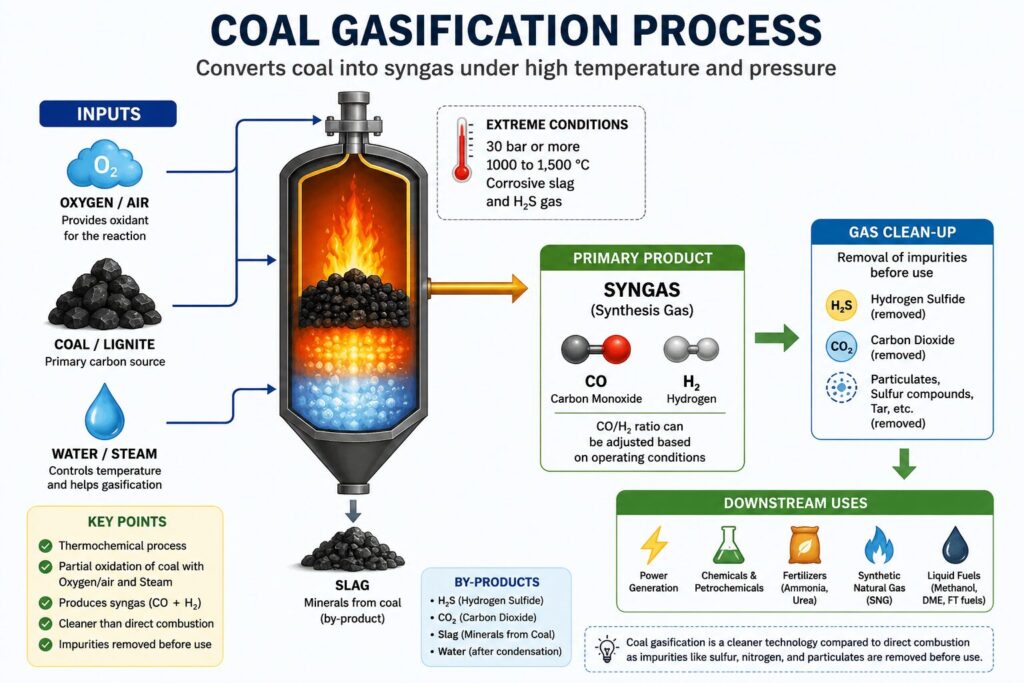
- Coal gasification is a thermochemical process in which solid coal reacts with controlled amounts of oxygen (or air) and steam under high temperature and pressure conditions to produce synthesis gas (syngas).
- This process breaks down coal into its chemical constituents, primarily carbon monoxide (CO) and hydrogen, which can then be used to produce electricity, chemical feedstocks, and liquid fuels.

What is Syngas?
- Syngas is a cleaner-burning fuel mainly composed of Hydrogen (H₂) and Carbon Monoxide (CO). It may also contain Carbon dioxide (CO₂), Methane (CH₄) and Water vapour.
- It is a versatile feedstock and can be further processed into a wide array of industrial and energy products. Syngas downstream products include: Hydrogen, methanol, ammonia, urea, ammonium nitrate, dimethyl ether (DME), synthetic natural gas (SNG), liquid fuels (via Fischer-Tropsch synthesis), and active pharmaceutical ingredients (APIs)
- Applications: Syngas is used to generate electricity, produce methanol, fertilisers (ammonia/urea), and synthetic natural gas.
Coal Gasification is considered a cleaner technology in comparison to coal combustion, as it allows for the removal of impurities such as sulfur and nitrogen from the gas before it is used.
About the Coal Gasification Scheme:
- Scheme: Scheme for Promotion of New Surface Coal/Lignite Gasification Projects for Production of Syngas and Downstream Products.
- Aim: To accelerate the conversion of coal and lignite into syngas. To boost energy independence and reduce the high cost of imported fuels and chemicals.
- Total Outlay: ₹37,500 crore.
- Target: Gasification of 75 Million Tonnes (MT) of coal/lignite, aligning with the 100 MT National Coal Gasification Mission target by 2030.
- Incentive: Up to 20% of plant and machinery costs, aimed at supporting about 25 projects.
- Disbursement: Government will disburse financial incentives in four equal instalments, each tied to specific project milestones to ensure accountability and timely execution.
- Investment Potential: Estimated to mobilise ₹2.5-3 lakh crore across the value chain.
- Employment: Expected to create around 50,000 direct and indirect jobs.
- Incentive Caps & Policy Support: To ensure competitive and fair distribution, the scheme has implemented specific caps:
- Per Project: Max ₹5,000 crore.
- Per Product Category: Max ₹9,000 crore (excluding Synthetic Natural Gas and Urea).
- Per Entity/Group: Max ₹12,000 crore.
- Coal Linkage Extension: Extended to 30 years for syngas-based projects to ensure long-term, stable feedstock.
- Projects under the scheme will be selected through a transparent bidding mechanism, ensuring competitive and fair selection of implementing entities.
- The scheme encourages the adoption of indigenous technologies for coal conversion and clean coal applications.
The scheme aims to reduce dependence on imports for high-value products like Ammonia (100 imported), Methanol (80-90% imported), and LNG (>50% imported). The initiative builds upon a smaller ₹8500 crore coal gasification scheme approved in January 2024.
- Reserves: India possesses ~401 billion tonnes of coal and ~47 billion tonnes of lignite.
- Energy Mix: Coal currently contributes over 55% of India’s total energy supply.
National Coal Gasification Mission:
- The government launched the National Coal Gasification Mission in 2021, targeting 100 million tonnes of coal gasification by 2030 with investments of ₹4-8.5 lakh crore.
- The present ₹37,500 crore scheme is a decisive accelerator of this mission, providing the financial framework to attract private and public-sector participation at scale.
Why does India need this Scheme?
India holds some of the world’s largest coal reserves yet remains heavily dependent on imported fossil fuels and chemical feedstocks. Coal currently contributes over 55% of India’s energy mix, yet its use has largely been confined to thermal power generation, leaving enormous value-creation potential untapped.
- Import substitution imperative: India imports roughly 82% of its crude oil requirement and 45% of its natural gas demand. Additionally, the country spends heavily on importing liquefied natural gas (LNG), urea, ammonia, and methanol. Syngas produced through domestic coal gasification can substitute all these imports, insulating the economy from global price volatility and geopolitical supply disruptions.
- Agricultural and food security linkage: India’s fertiliser sector depends on urea and ammonia, both of which can be produced domestically from syngas. Domestically produced ammonia and urea would insulate India’s agricultural input supply chain from disruptions caused by geopolitical conflicts or shipping route interruptions.
- Coal reserve monetisation: With coal reserves of ~401 billion tonnes and lignite reserves of ~47 billion tonnes, India possesses a vast resource base that currently lacks value diversification. The scheme enables monetisation of this reserve through higher-value downstream products, rather than simple combustion.
- Alignment with energy transition: As India transitions towards renewables, it cannot abruptly phase out coal without destabilising energy supply. Coal gasification offers a bridge technology. i.e., a pathway to use existing coal infrastructure in a cleaner, more productive manner while renewable capacity scales up.
Challenges in Scaling Coal Gasification in India:
- High Ash Content in Indian Coal: Indian coal typically has an ash content of 30–35%, even after washing. High ash content significantly reduces gasification efficiency, increases operational costs, and poses a technical barrier to large-scale adoption compared to international coal quality standards.
- High Capital Costs & Financial Viability: Coal gasification plants require substantial upfront capital investment. Without government support, projects may not be financially viable on their own, which is precisely why the scheme uses a Viability Gap Funding (VGF) approach with structured incentive caps.
- Environmental and GHG Concerns: While gasification is cleaner than direct combustion, it still produces greenhouse gases, including CO₂. Large-scale gasification without Carbon Capture and Storage (CCS) technology may conflict with India’s climate commitments under the Paris Agreement and its net-zero 2070 target.
- High Water Consumption: Gasification is a water-intensive process. Many coal-rich regions in India (such as parts of Jharkhand, Odisha, and Chhattisgarh) already face water scarcity, and scaling gasification in these areas without robust water management could intensify local resource stress.
- Technology Dependence & Indigenisation Gap: India currently lacks mature, commercially viable indigenous gasification technology. Most proven technologies are imported, creating a dependency risk. The scheme’s emphasis on indigenous R&D is essential but will require sustained investment and time to bear fruit.
- Scalability & Infrastructure Integration: Gasification technology faces scalability challenges, particularly for integration with existing industrial infrastructure. Building out downstream processing capacity for syngas derivatives requires coordinated sectoral planning across fertilisers, chemicals, and energy sectors.
- Land Acquisition & Displacement: Setting up large-scale surface gasification plants in coal-bearing states often involves land acquisition in tribal and forest areas, raising social and legal challenges under the Forest Rights Act and PESA provisions.
- Competition from Renewables: As green hydrogen produced from renewable energy becomes increasingly cost-competitive, coal-based syngas may face long-term commercial pressure. The scheme must build in flexibility to integrate Carbon Capture, Utilisation, and Storage (CCUS) to remain relevant in a decarbonising economy.
The scheme represents a major shift in India’s coal policy from treating coal purely as a thermal fuel to positioning it as a platform for chemical and industrial value creation.
Tell Google you want more of this.
Add Anantam IAS as a preferred sourceOne tap, and this site shows up more often in your own Top Stories, AI Overviews and AI Mode. Remove it any time.