
Why in News?
Pharmaceutical company Eli Lilly and Company (India) Pvt. Ltd. has launched Lormalzi (donanemab) in India. This marks the country’s first approved amyloid plaque-targeting therapy for Alzheimer’s disease.
The drug has received approval from the Central Drugs Standard Control Organisation (CDSCO) for patients with early-stage Alzheimer’s disease, including mild cognitive impairment and mild dementia.
| UPSC Relevance: GS-3 Science and Technology: Biology and Biotechnology Prelims: Alzheimer’s disease, Lormalzi (donanemab), monoclonal antibody |
What is Alzheimer’s Disease?
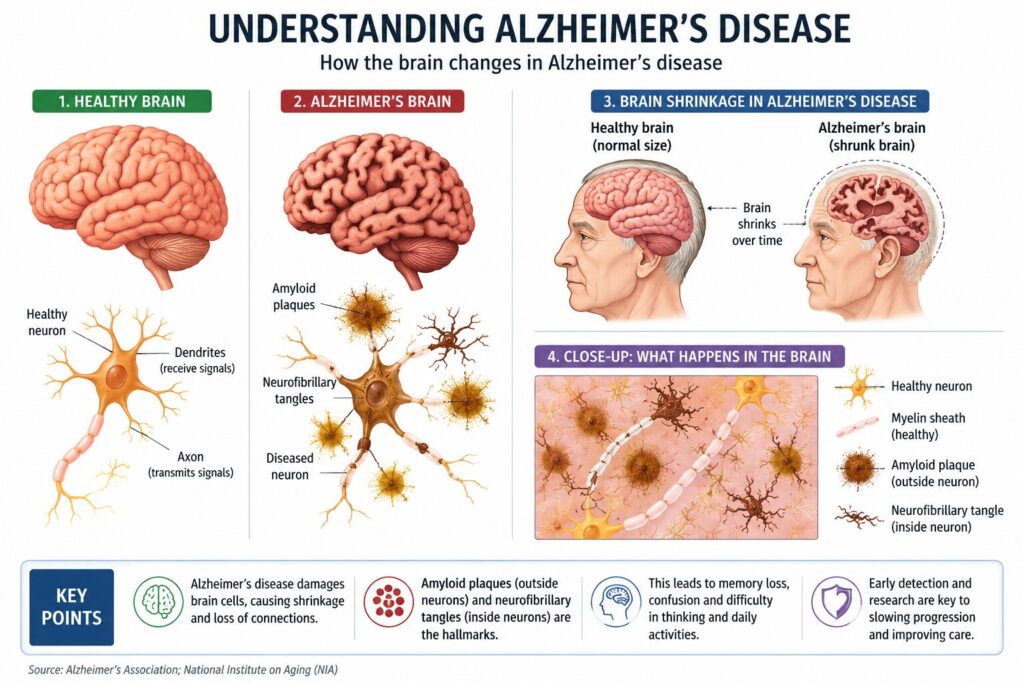
- Alzheimer’s disease is a progressive neurodegenerative disorder and the most common cause of dementia. It gradually damages brain cells (atrophy of the brain), leading to a decline in memory, thinking ability, behaviour and daily functioning.
- Causes: The disease is caused by the abnormal build-up of two proteins in and around brain cells. Together, these deposits destroy neural tissue progressively.
- First is the amyloid protein, which forms plaques between nerve cells.
- Second is the tau protein, which forms tangles within brain cells.
- Symptoms: Early signs include forgetting recent events or conversations. As the disease advances, the patient develops severe memory impairment, loses the ability to perform everyday tasks, and in the final stages, loss of brain function can lead to dehydration, malnutrition, infection, and death.
- Treatment (Pre-2026): Until recently, there was no cure for Alzheimer’s disease. Some medicines (such as donepezil, rivastigmine, galantamine, and memantine) could temporarily slow the worsening of symptoms but did not address the underlying disease biology.
India’s Dementia Burden:
The launch of Lormalzi carries particular significance given the scale of India’s Alzheimer’s challenge.
- Dementia currently affects approximately 8.8 million people in India, with Alzheimer’s disease accounting for the majority of cases. This number is projected to nearly double to 16.9 million by 2036.
- Estimates suggest that dementia costs the Indian economy more than ₹28,300 crore annually. The burden is expected to increase further as life expectancy rises.
Globally, the number of people living with dementia is projected to reach 152 million by 2050.
What is Donanemab (Lormalzi)?
- Donanemab is a monoclonal antibody, a laboratory-manufactured protein that mimics the immune system’s ability to target specific threats. It belongs to the class of anti-amyloid therapies, or disease-modifying therapies (DMTs).
- Mechanism of Action:
- Amyloid plaques are sticky protein clumps that build up in the brains of people with Alzheimer’s disease and are believed to damage brain cells, leading to memory loss and cognitive decline.
- Lormalzi works by helping remove these abnormal protein deposits from the brain. Unlike conventional medicines that only manage symptoms, donanemab targets the underlying disease biology itself.
- Administration: Lormalzi is administered as a once-monthly intravenous (IV) infusion of 350 mg. The treatment course in India is expected to last 18 months (76 weeks) in most patients.
- Cost: Around ₹91,688 per 350 mg vial, making it one of the most expensive neurological treatments available in India.
Who is Eligible for the Treatment?
- The therapy is approved for:
- Patients with mild cognitive impairment due to Alzheimer’s disease.
- Those in the mild dementia stage, provided amyloid pathology is confirmed through diagnostic testing.
- It is not meant for patients who have already progressed to advanced stages of the disease. While the drug can dissolve the build-up of amyloid beta protein, it cannot reverse damage that has already occurred.
Challenges Associated:
The Indian healthcare system faces several structural barriers to making this therapy viable at scale:
- Cost: The prohibitive pricing limits access primarily to affluent patients.
- Late Diagnosis: Alzheimer’s in India is typically diagnosed at advanced stages, whereas donanemab is only effective in early stages. Early diagnosis infrastructure remains underdeveloped.
- Diagnostic Prerequisites: Confirming amyloid pathology ideally requires an amyloid PET scan, which is currently not widely available in India. The company has stated that in the absence of amyloid PET imaging, the standard approach is to treat eligible patients for 18 months.
- Genetic Screening: All eligible patients must be screened for the APOE4 gene, which adds further cost and complexity.
- Safety Monitoring: The risk of ARIA (Amyloid-Related Imaging Abnormalities), i.e., brain swelling and bleeding, requires regular MRI monitoring during treatment, demanding a high level of clinical infrastructure.
Tell Google you want more of this.
Add Anantam IAS as a preferred sourceOne tap, and this site shows up more often in your own Top Stories, AI Overviews and AI Mode. Remove it any time.