Why in News?
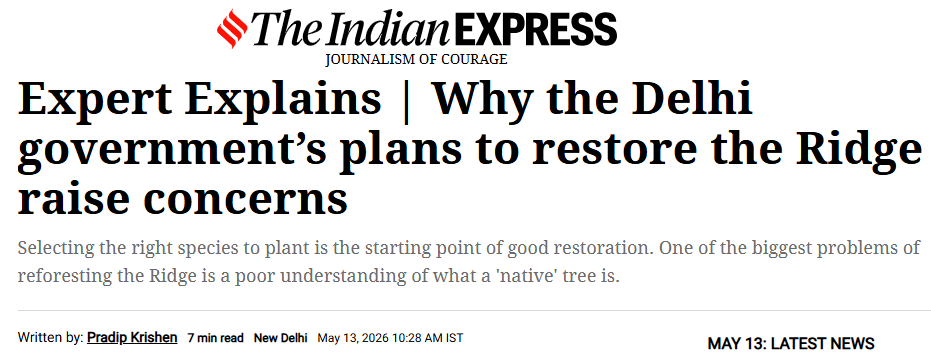
The Delhi government has issued the final notification declaring around 670 hectares of the Central Ridge as a “Reserved Forest” under Section 20 of the Indian Forest Act, 1927. Simultaneously, the Forest Department has proposed ecological restoration initiatives, including:
- Development of themed forests (“vans”)
- Plantation of “native” tree species
- Restoration of degraded Ridge landscapes
However, ecologists and environmental experts have raised concerns regarding:
- Use of ecologically unsuitable tree species
- Anti-termite chemical treatment
- Contractor-driven plantation practices
- Misunderstanding of ecological restoration principles
The debate highlights broader issues relating to:
- Urban ecology
- Native biodiversity conservation
- Aravalli restoration
- Scientific forest governance
UPSC Relevance
Prelims Relevance
- Indian Forest Act, 1927, Reserved Forests, Aravalli ecosystem, Native vs exotic species, Ecological restoration, Miyawaki forests
Mains Relevance
GS Paper 3
- Conservation and environmental governance, Biodiversity restoration, Urban ecological challenges, Forest management and afforestation, Invasive species
GS Paper 1
- Urbanisation and environmental degradation
Essay
- Ecological restoration and sustainable development
- Scientific conservation versus symbolic environmentalism
- Nature-based urban planning
Background and Context
Delhi Ridge System
Delhi Ridge forms the northern extension of the ancient Aravalli Range and stretches across nearly 35 km through Delhi.
The Ridge:
- Functions as the “green lungs” of Delhi
- Acts as a barrier against desertification from the Thar Desert
- Moderates local climate
- Supports biodiversity and groundwater recharge
- Reduces dust pollution and urban heat island effects
The Ridge is divided into:
- Northern Ridge
- Central Ridge
- South-Central Ridge
- Southern Ridge
Among these, the Central Ridge is one of the most ecologically sensitive segments.
Reserved Forest under Indian Forest Act, 1927
The recent notification relates to the final declaration of the Central Ridge as a Reserved Forest.
Section 4 Notification
Under Section 4 of the Indian Forest Act:
- The government announces its intention to constitute a Reserved Forest.
- Settlement of rights and claims follows.
The Central Ridge was first notified under Section 4 in 1994.
Section 20 Notification
After settlement procedures are completed:
- Section 20 notification grants final legal status as a Reserved Forest.
The latest notification therefore completes a legal process pending for over three decades.
Importance of Reserved Forest Status
Reserved Forests receive the highest degree of protection under the Indian Forest Act.
Activities such as:
- Grazing
- Tree felling
- Construction
- Encroachment
are heavily restricted unless specifically permitted.
Ecological Importance of the Ridge
Dry Thorn Forest Ecosystem
The Ridge supports a tropical dry thorn forest ecosystem adapted to:
- Thin quartzitic soils
- Low moisture conditions
- High temperatures
- Arid climatic stress
Such ecosystems are naturally fragile and slow-growing.
Biodiversity Value
The Ridge supports:
- Native grasses, Shrubs, Birds, Reptiles, Small mammals, Pollinators
It also acts as an ecological corridor within the urban landscape.
Climate Regulation Role
The Ridge contributes to:
- Carbon sequestration, Temperature moderation, Air purification, Water infiltration
As Delhi faces worsening heatwaves and pollution, the Ridge’s ecological importance has increased significantly.
The Debate over Ecological Restoration
Restoration versus Plantation
A central concern raised by ecologists is the confusion between:
- Ecological restoration
and - Conventional plantation drives
Ecological Restoration
Ecological restoration seeks to:
- Rebuild natural ecosystems
- Restore ecological processes
- Revive native biodiversity
- Enhance long-term ecosystem resilience
Plantation-Centric Approach
Plantation programmes often prioritise:
- Number of trees planted
- Fast-growing species
- Visual greening
rather than ecological suitability.
This distinction is crucial because:
Planting trees alone does not necessarily restore ecosystems.
Native Species versus “Indian” Species
Understanding Native Species
The article highlights an important ecological concept:
- “Native” does not merely mean found within India’s political boundaries.
A species is native when it:
- Evolves naturally within a specific ecosystem
- Adapts to local climate, soils and ecological conditions
Thus, ecological nativeness is ecosystem-specific, not nationality-based.
Why Species Selection Matters
The Delhi government proposed species such as:
- Neem
- Jamun
- Tamarind
- Mango
- Shisham
However, ecologists argue these species are poorly suited to the Ridge ecosystem.
Ecological Mismatch
For example:
- Mango requires significant water
- Jamun thrives in moist conditions
- Shisham prefers deep alluvial soils
- Tamarind is frost-sensitive
The Ridge ecosystem instead supports drought-adapted vegetation suited to rocky terrain.
Planting ecologically unsuitable species often results in:
- High mortality
- Artificial irrigation dependence
- Resource wastage
Invasive Species and Historical Mistakes
Prosopis Juliflora (Vilayati Kikar)
Prosopis juliflora was introduced during colonial afforestation efforts.
The species spread aggressively because:
- It tolerates drought
- Grows rapidly
- Competes effectively with native plants
However, its success caused:
- Loss of native biodiversity
- Monoculture formation
- Alteration of habitat structure
The article notes that the dominance of vilayati kikar itself reflects past restoration failures.
Ecological Consequences of Monocultures
Monocultures reduce:
- Biodiversity
- Soil health
- Ecological resilience
They also weaken:
- Pollinator diversity
- Wildlife habitats
- Ecosystem stability
Anti-Termite Treatment Controversy
Role of Termites in Ecosystems
The Forest Department initially proposed anti-termite chemical treatment during plantation.
Ecologists opposed this because termites are:
- Important decomposers
- Soil aerators
- Nutrient recyclers
Termites improve:
- Nitrogen cycling
- Soil moisture retention
- Organic matter decomposition
In dry ecosystems, termites function as:
“Ecosystem engineers”
Living Soil Concept
Healthy ecosystems depend on “living soil” containing:
- Fungi
- Microorganisms
- Insects
- Organic matter
Excessive pesticide use destroys soil biodiversity and weakens ecological recovery.
Following criticism, the Forest Department withdrew the proposal.
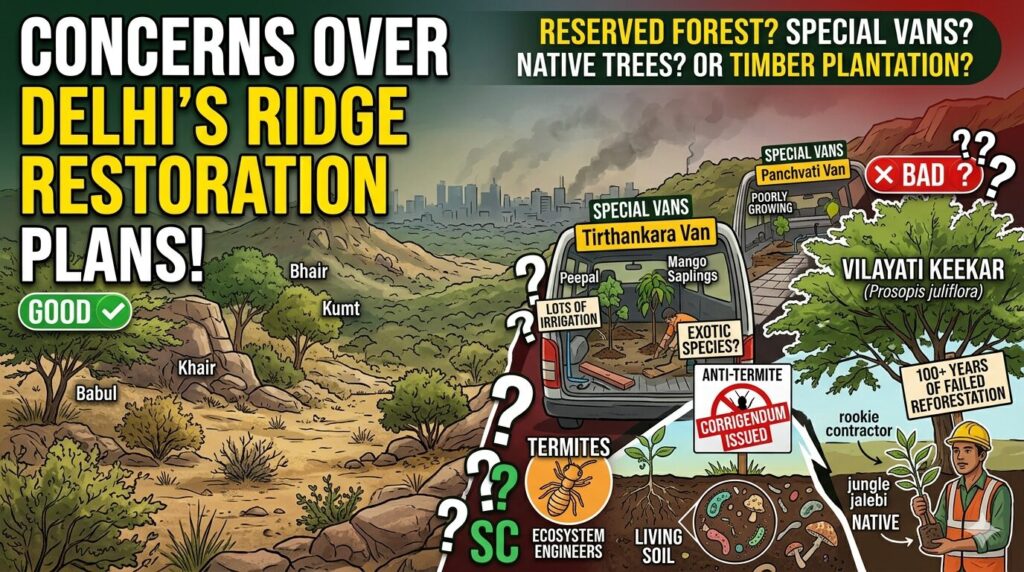
Concerns Regarding Themed Forests and Miyawaki Model
Themed Forests (“Vans”)
The Delhi government plans themed forests such as:
- Panchvati Van
- Tirthankara Van
- Ritu Van
Concerns arise if such projects involve:
- Hardscaping
- Artificial landscaping
- Non-native plantations
These may violate the ecological purpose of Reserved Forests.
Miyawaki Forest Model
The Miyawaki technique involves:
- Dense plantation of mixed species
- Rapid forest creation in small urban areas
While useful in highly degraded urban spaces, ecologists argue:
- It is not suitable for all ecosystems.
- It may disrupt naturally open dry forest systems like the Ridge.
Dry forests evolve differently from tropical dense forests.
Governance and Institutional Challenges
Contractor-Driven Plantation Practices
A major issue identified is reliance on contractors for plantation work.
This creates problems such as:
- Procurement of cheaper exotic saplings
- Poor quality control
- Weak monitoring
The article cites the example of:
- “Jungle jalebi” (an exotic species) being planted instead of approved native species.
Weak Implementation Capacity
Even scientifically sound plans often fail because of:
- Lack of ecological expertise
- Administrative pressures
- Monitoring gaps
- Poor inter-agency coordination
Forest Working Plans and Timber Bias
The Forest Research Institute’s Working Plan reportedly emphasises:
- Timber increment estimation
- Plantation approaches
rather than:
- Ecological restoration
- Habitat regeneration
- Biodiversity recovery
This reflects a broader historical problem in Indian forestry where:
- Forests were treated as timber resources rather than ecological systems.
Legal and Policy Dimensions
Forest Conservation Act, 1980
The Act regulates diversion of forest land for non-forest purposes.
Any construction or hardscape development within forests may require:
- Forest clearance
- Environmental scrutiny
National Forest Policy, 1988
The policy shifted forestry focus toward:
- Ecological stability
- Biodiversity conservation
- Community participation
rather than commercial exploitation.
Bonn Challenge and Ecosystem Restoration
India has committed to restoring degraded landscapes under:
- Bonn Challenge
- UN Decade on Ecosystem Restoration
Scientific restoration of the Ridge aligns with these commitments.
Urban Ecology and Climate Change
Urban forests such as the Ridge are increasingly critical because they:
- Reduce urban heat
- Improve air quality
- Enhance climate resilience
- Buffer extreme weather events
Delhi’s worsening:
- Heatwaves
- Air pollution
- Water stress
make ecological restoration an urban survival necessity rather than merely a conservation issue.
Challenges
Ecological Misunderstanding of Restoration
Restoration is often reduced to:
- Tree planting campaigns
- Beautification projects
instead of rebuilding ecological processes.
Use of Non-Native or Unsuitable Species
Incorrect species selection can:
- Increase water dependence
- Reduce survival rates
- Distort ecosystem functioning
Invasive Species Dominance
Existing invasive species continue to suppress native vegetation recovery.
Contractor-Based Plantation Model
Weak accountability often leads to:
- Species substitution
- Poor maintenance
- Ecological mismatch
Institutional Fragmentation
Multiple agencies govern Delhi’s environment, resulting in:
- Coordination failures
- Policy inconsistencies
- Weak enforcement
Urbanisation Pressure
Rapid urban expansion continues to:
- Fragment habitats
- Increase pollution
- Intensify ecological stress
Way Forward
Adopt Scientific Ecological Restoration
Restoration efforts should prioritise:
- Native ecosystem regeneration
- Soil restoration
- Habitat connectivity
rather than plantation targets alone.
Prepare Ecosystem-Specific Native Species Lists
Species selection must be based on:
- Soil conditions
- Rainfall patterns
- Ecological history
- Local biodiversity
The concept of “native” should remain ecosystem-specific.
Strengthen Ecological Monitoring
Continuous scientific monitoring should assess:
- Soil health
- Species survival
- Biodiversity recovery
- Invasive species spread
GIS and remote sensing technologies can support this process.
Control Invasive Species Scientifically
Gradual removal of invasive species should be combined with:
- Native vegetation restoration
- Soil conservation
- Habitat management
Reform Urban Forestry Governance
Urban forest governance should involve:
- Ecologists
- Botanists
- Soil scientists
- Local communities
rather than relying solely on contractor-driven approaches.
Integrate Climate Resilience into Restoration
Urban ecological restoration should support:
- Heat mitigation
- Water conservation
- Air pollution reduction
- Carbon sequestration
Increase Public Ecological Awareness
Public discourse should shift from:
- “More trees”
to - “Right trees in the right ecosystem”
Ecological literacy is essential for sustainable urban conservation.
Conclusion
The debate surrounding the restoration of Delhi’s Ridge reveals a deeper challenge in India’s environmental governance: the tendency to equate ecological restoration with plantation activity. The Ridge is not merely a vacant urban space requiring beautification, but a fragile dry forest ecosystem shaped by unique geological and climatic conditions over centuries.
Protecting and restoring such ecosystems demands scientific understanding, ecosystem-specific planning and long-term ecological commitment. Poorly planned interventions, even when well-intentioned, can undermine biodiversity, increase ecological stress and repeat historical restoration failures.
As climate change and urbanisation intensify environmental pressures, the future of cities like Delhi will increasingly depend on preserving ecologically functional natural landscapes rather than creating artificial green spaces disconnected from local ecosystems.
UPSC Practice Questions
- Consider the following statements regarding ecological restoration:
- Ecological restoration is identical to large-scale tree plantation.
- Native species are determined primarily by ecological suitability to a specific ecosystem.
- Invasive species can alter habitat structure and suppress biodiversity.
How many of the above statements are correct?
(a) Only one
(b) Only two
(c) All three
(d) None
Correct Answer: (b) Only two
Explanation:
Statement 1 is incorrect because ecological restoration involves restoring ecological processes and biodiversity, not merely planting trees.
Statement 2 is correct because ecological nativeness depends on ecosystem adaptation.
Statement 3 is correct because invasive species often disrupt ecological balance.
- With reference to the Delhi Ridge, consider the following statements:
- It forms part of the Aravalli hill system.
- The Central Ridge was declared a Reserved Forest under the Wildlife Protection Act, 1972.
- The Ridge plays a role in preventing desertification in Delhi.
Which of the statements given above are correct?
(a) 1 and 2 only
(b) 2 and 3 only
(c) 1 and 3 only
(d) 1, 2 and 3
Correct Answer: (c) 1 and 3 only
Explanation:
Statement 1 is correct because the Ridge is the northern extension of the Aravallis.
Statement 2 is incorrect because Reserved Forests are notified under the Indian Forest Act, 1927.
Statement 3 is correct because the Ridge acts as a barrier against desertification from the Thar Desert.
Mains Question
Examine the ecological significance of the Delhi Ridge system. Why do restoration efforts in urban ecosystems often fail despite large-scale plantation programmes?
“Ecological restoration is not synonymous with plantation-driven greening.” Discuss in the context of urban forest governance in India.
Tell Google you want more of this.
Add Anantam IAS as a preferred sourceOne tap, and this site shows up more often in your own Top Stories, AI Overviews and AI Mode. Remove it any time.