Daily Digest
UPSC · Civil Services Examination
Current Affairs · Saturday, 15 November 2025
Current affairs curated and edited by Anantam IAS faculty — pulled from The Hindu, PIB, IDSA, Foreign Affairs and the ministries. Read, annotate, revise.
Old Rajinder Nagar · Delhi 110005 · anantamias.com
Prelims Nuggets
Saranda Forest to be declared a Wildlife Sanctuary

- The Supreme Court (SC) directed the Jharkhand government to declare 31,468.25 hectares (approximately 314 sq. km.) of the Saranda forest area as a wildlife sanctuary.
- The directive aims to balance biodiversity protection with sustainable iron ore mining.
- The Jharkhand government initially suggested a smaller area (24,941.64 hectares) for the sanctuary, citing “vital public infrastructure” that would need demolition. The State later clarified that the mandated 31,468.25 hectares did not host mining activities or non-forest use.
- The SC reminded Jharkhand of its “positive obligation and a mandate to provide statutory protection to forests and wildlife.”
- The Bench ordered the Jharkhand government to widely publicize that the judgment will not adversely affect the individual or community rights of tribals and forest dwellers in the area.
Saranda Forest Area and Mines in Jharkhand
- It is renowned as the finest and one of the world’s most pristine and largest Sal forests (Shorea robusta), often called the “Kingdom of Sal trees.”
- “Saranda” (or Serengda in the local language) literally means the “Land of Seven Hundred Hills.”
- Area: It covers a core area of approximately 820 square kilometers, making it one of the largest continuous dense forest blocks in Asia.
- Rivers: The perennial rivers Koina and Karo pass through the forest, serving as vital water sources for wildlife.
- The region is characterized by hilly uplands, dense forest valleys, and elevation ranging up to 927 meters (Kiriburu peak).
- Saranda forms the core area of the Singhbhum Elephant Reserve.
- It is home to critically endangered species, including the endemic sal forest tortoise, four-horned antelope, Asian palm civet, and wild elephants.
- The area has been inhabited for centuries by the Ho, Munda, Uraon, and allied Adivasi communities, whose traditions are intrinsically tied to forest produce.
- The Saranda forest division accounts for 26% of India’s iron ore reserves.
- Steel plants belonging to SAIL and Tata are critically dependent on mining activities in this region. The court noted submissions that declaring the entire area a wildlife sanctuary would halt mining and negatively affect employment opportunities.
Wildlife Sanctuary
| Feature | Description | Key Statutory Provisions (as per WLPA, 1972) |
| What is a Wildlife Sanctuary? | A protected area established for the conservation of wildlife (animals and plants) and their environment/habitats. The main objective is to protect species from hunting, poaching, and habitat destruction. It is an in-situ conservation method. | Declared under Section 18(1) of the Wild Life (Protection) Act, 1972 (WLPA). An area must have adequate ecological, faunal, floral, geomorphological, natural, or zoological significance. |
| Who Notifies It? | The State Government is primarily responsible for declaring a Wildlife Sanctuary by official notification. The Central Government can also declare a sanctuary in an area transferred to it by the State Government. | State Government: Section 18(1) (Initial Notification of Intent) and Section 26A (Final Notification). Central Government: Section 38. |
| Restrictions on Human Activities | Human activities are strictly controlled but generally less restrictive than in a National Park. Some activities may be permitted under strict regulation to balance conservation with local livelihoods. | Prohibited Activities (Without Permit): * Hunting any wild animal. * Destroying, removing, or exploiting any wildlife or forest produce. * Damaging or altering the natural habitat. * Diverting, stopping, or enhancing the flow of water. * Causing fire or leaving fire burning. Permitted Activities (With Permit from Chief Wildlife Warden): * Scientific research and studies. * Photography and Tourism. * Lawful business with residents. * Grazing by local communities (in some cases, after rights settlement). |
| Who Manages It? | The sanctuary is managed, controlled, and maintained by the respective State Government’s Forest/Wildlife Department. The Chief Wildlife Warden (CWLW) of the State is the primary statutory authority responsible for its day-to-day management. | The Chief Wildlife Warden is appointed under the WLPA and is the statutory head of the management. |
| How is it Denotified? | A Wildlife Sanctuary can be denotified (its protected status withdrawn) only if the State Government is satisfied that the area is no longer ecologically significant for wildlife conservation. | The proposal for denotification must be recommended by the National Board for Wild Life (NBWL). Furthermore, in practice, a denotification often requires approval from the Supreme Court of India, following various judicial orders that have imposed a ban on dereservation/denotification. |
Export Promotion Mission & Credit Guarantee Scheme
- The Union Cabinet approved the Export Promotion Mission (EPM) and the Credit Guarantee Scheme for Exporters (CGSE) on 12 November.
Credit Guarantee Scheme for Exporters (CGSE)
| Aspect | Explanation |
| Functioning/Mechanism | The CGSE aims to provide collateral-free or easier access to additional credit for exporters by protecting lenders from default risk. |
| Credit Guarantee | The National Credit Guarantee Trustee Company (NCGTC) provides 100% credit guarantee coverage to Member Lending Institutions (MLIs) on the loans they extend under the scheme. |
| Loan Details | MLIs will extend additional credit facilities (working capital or term loans) to eligible exporters. The maximum loan amount is typically capped (e.g., at ₹50 crore per borrower in the compact version). |
| Duration / Limit | The scheme will remain in force until:March 31, 2026; ORUntil guarantees amounting to ₹20,000 crore (the maximum credit coverage limit) are issued, |
| Affordability | Lending institutions are required to offer loans at a lower interest rate (e.g., 1% lower than the existing rate applicable to the borrower). No guarantee fee is charged to the exporter, and no additional collateral is required. |
| Scheme Goal | To strengthen liquidity, ensure smooth business operations, and enhance the global competitiveness of Indian exporters by easing working capital constraints. |
| Eligible Exporters | All eligible exporters, including both Micro, Small, and Medium Enterprises (MSMEs) and non-MSME exporters. |
| Scheme Operator/Implementer | National Credit Guarantee Trustee Company Limited (NCGTC), which is an institution under the Department of Financial Services (DFS). |
| Oversight | A Management Committee chaired by the Secretary of the Department of Financial Services (DFS) oversees the progress and implementation of the scheme. |
| WTO Compliance | Likely to be compliant. While older, direct export subsidy schemes (like MEIS, EOU, EPCG) were ruled non-compliant by the WTO panel because India’s per capita GNI crossed the limit, a credit guarantee scheme that addresses liquidity constraints is a financial mechanism designed to improve the export ecosystem. The new CGSE/EPM are part of a shift towards WTO-compliant support measures. |
| Note | CGSE is a new scheme. Please do not mistake it for the already existing Credit Guarantee Scheme for MSMEs. |
Features and Structure of Export Promotion Mission, 2025
- The EPM is a flagship initiative announced in Budget 2025 to strengthen India’s export competitiveness, especially for MSMEs, first-time exporters, and labour-intensive sectors.
- The total outlay for the EPM is ₹25,060 crore covering the period FY 2025-26 to FY 2030-31.
- It is anchored in a digitally driven collaborative framework involving the Department of Commerce, Ministry of MSME, Ministry of Finance, financial institutions, export promotion councils, and state governments.
- The Directorate General of Foreign Trade (DGFT) will be the implementing agency through a dedicated digital platform.
- The Mission will operate through 2 integrated sub-schemes:
- NIRYAT PROTSAHAN: Focuses on improving access to affordable trade finance for MSMEs (e.g., interest subvention, export factoring, credit enhancement).
- NIRYAT DISHA: Focuses on non-financial enablers that enhance market readiness and competitiveness (e.g., export quality support, international branding, participation in trade fairs, logistics).
- EPM consolidates key support schemes like the Interest Equalisation Scheme (IES) and Market Access Initiative (MAI).
- The Mission is designed to address structural challenges in Indian exports, including:
- Limited and expensive trade finance access.
- High cost of compliance with international standards.
- Inadequate export branding and fragmented market access.
- Logistical disadvantages for exporters in interior regions.
- Priority support will be extended to sectors impacted by recent global tariff escalations, such as textiles, leather, gems & jewellery, engineering goods, and marine products.
Global Carbon Project : Findings on CO2 Emissions

- Significant Deceleration: India’s Carbon Dioxide (CO2) emissions from fossil fuel sources are expected to increase by 1.4% in 2025, which is a significant slowdown from the 4% growth registered in 2024.
- Emissions Volume: India’s fossil fuel-related (CO2) emissions are estimated to increase from 3.19 billion tonnes (2024) to 3.22 billion tonnes (2025).
- Reason for Slowdown: The relatively modest growth is attributed to:
- An early monsoon, which reduced cooling requirements during the hottest months.
- Strong growth in renewables, leading to very low growth in coal consumption.
- Decadal Trend: India’s average annual emissions growth has slowed over the decade: 3.6% (2015-2024 average) versus 6.4% (2005-2014 average), possibly due to an expanding base effect and continuous improvements in the carbon intensity of the economy.
- Global (CO2) emissions from fossil fuels are expected to rise by about 1.1% in 2025, reaching a record 38.1 billion tonnes, indicating that overall emissions are still not declining.
- China’s emissions growth is projected at 0.4% in 2025.
- India’s projected 1.4% growth in 2025 is lower than the United States’ expected 1.9% increase.
- Fossil Fuel (CO2): These emissions (from electricity, transport, industry, etc.) account for about 90% of all (CO2) emissions globally, and (CO2) itself accounts for about 75% of global greenhouse gas emissions.
- The data comes from the annual Global Carbon Budget study carried out by the Global Carbon Project (GCP), an international collaborative program established in 2001, that tracks global carbon cycles.
- Timing and Reliability: The study is published annually in the Nature journal, timed to coincide with the UN climate conference (COP30 this year). It is considered one of the most reliable and keenly tracked estimates (not official data) of global emissions.
Belem Action Plan for Health and Climate Adaptation

- The Belem Action Plan for Health and Climate Adaptation was launched at COP30 in Belem, Brazil, with the participation of approximately 80 countries and organizations.
- The most recent Global Conference on Climate and Health which was held in Brasília, Brazil, from July 29-31, 2025 had resulted in the Belém Health Action Plan that has now been launched at COP 30.
- It was hosted by the Government of Brazil, the World Health Organization (WHO), and the Pan American Health Organization (PAHO).
- Primary Goal: To strengthen global health systems so they can better cope with the growing impacts of climate change.
- Initial Funding: A coalition of about 35 philanthropies, under the Climate and Health Funders Coalition, committed an initial US $300 million.
- Funding Use: This money is earmarked for integrated action to address both the causes and consequences of climate change on human health, and will support the implementation of the Belem Plan.
- Basis of the Plan: The plan is based on the findings of the 2025 Lancet Countdown Report on Health and Climate Change, which documents the massive global health impact of climate change. The report highlights that:
- Climate-change-related deaths are in the millions.
- Millions more are affected by extreme heat, flooding, vicious storms, and desertification.
- Over half a million lives are lost annually due to heat, and over 150,000 deaths are linked to wildfire smoke exposure.
- Health System Strain: Health systems are described as already “stretched and underfunded,” struggling to cope and “unprepared for what is coming.”
- Global Adaptation Finance Gap : The event highlighted an acute finance gap for adaptation, with an even smaller amount available for health-focused adaptation plans.
- The latest Adaptation Gap Report released by UNEP estimated that developing countries will require US $310-$365 billion a year by 2035 for adaptation.
- The international community is struggling to mobilize the US $40 billion in annual flows that were promised at COP26 in Glasgow (2021).
- India’s Context: India’s 2023 national communication to the UNFCCC states the country will require$643 billion between now and 2030 for climate adaptation.
- India’s spending on adaptation in 2021-2022 was $146 billion (5.6% of GDP), a significant rise from 3.7% of GDP spent in 2015-2016.
Source: https://anantamias.com/current-affairs/prelims-nuggets-8/
150th anniversary year of Birsa Munda

Why in News?
1) PM Modi to visit Dediapada on Birsa Munda birth anniversary, unveil ₹9,700-crore projects for tribal areas
2) Vice President C.P. Radhakrishnan wrote on Birsa Munda’s Birth Anniversary & Tribal Empowerment
UPSC CSE Relevance:
History
Question from UPSC Prelims 2020 GS Paper
With reference to the history of India, “Ulgulan” or the Great Trumult is the description of which of the following events?
(a) The Revolt of 1857
(b) The Mappila Rebellion of 1921
(c) The Indigo Revolt of 1859-60
(d) Birsa Munda’s Revolt of 1899-1900
Birsa Munda (1875 – 1900):
- Leader of the Ulgulan (Great Tumult) movement (1899 – 1900).
- Revered as Dharti Aaba (Father of the Earth).
- From Munda tribe, region: Chotanagpur, Jharkhand.
- Fought against British policies, moneylenders, dikus, zamindars disrupting tribal land systems.
- Aimed to restore Munda traditional land system (Khuntkatti): Eventually forced the British administration to enact the Chotanagpur Tenancy Act of 1908, which prohibited the transfer of tribal land to non-tribals and recognized their traditional communal land rights (Khuntkatti system).
- Religious Reformer: Birsa founded a new faith called ‘Birsait’, which encouraged tribals to return to their indigenous religious beliefs, shun superstitions and alcoholism, and resist Christian missionary conversion activities, thus promoting cultural pride and social reform.
- Guerrilla Warfare: He united thousands of Munda and Oraon tribals and employed guerrilla tactics to attack symbols of British authority, such as police stations and the houses of landlords and moneylenders.
Key Facts from the News:
- Occasion: PM visit on Birth anniversary of Birsa Munda (also celebrated nationally as Janjatiya Gaurav Diwas) – 15th November. Janjatiya Gaurav Varsh (2024–2025) – 150th anniversary year.
- Location of event: Dediapada, Narmada district, Gujarat (tribal-dominated region).
Major Initiatives Announced:
- Grih Pravesh of 1 lakh houses under:
- PM-JANMAN (Pradhan Mantri Janjati Adivasi Nyaya Maha Abhiyan): To improve the socio-economic development of Particularly Vulnerable Tribal Groups (PVTGs) in India.
- India’s first mission specifically for PVTGs.
- Multi-ministerial collaboration (MoTA + Rural Dev + Power + Jal Shakti etc.).
- PM-JANMAN (Pradhan Mantri Janjati Adivasi Nyaya Maha Abhiyan): To improve the socio-economic development of Particularly Vulnerable Tribal Groups (PVTGs) in India.
- DA-JAGUA (Dharti Aaba Janjatiya Gram Utkarsh Abhiyan): to drive inclusive and sustainable development by addressing critical gaps in social infrastructure, healthcare, education, and livelihoods in tribal regions.
- Multi-Purpose Centres = community activity hubs
- Tribal Multi-Marketing Centres (TMMCs) = aggregation & marketing of tribal products
- Supports: Digitisation, Geotagging of tribal products, Tribal entrepreneurship (via Tribal Business Conclaves)
- 42 Eklavya Model Residential Schools (EMRS) inaugurated -Ministry of Tribal Affairs
- Foundation stone for 50 new EMRS.
- Launch of 14 Tribal Multi-Marketing Centres (TMMCs).
- Inauguration of Centre of Competence (Assam Medical College)
Source: https://anantamias.com/current-affairs/150th-anniversary-year-of-birsa-munda/
Antimicrobial Resistance
Context:
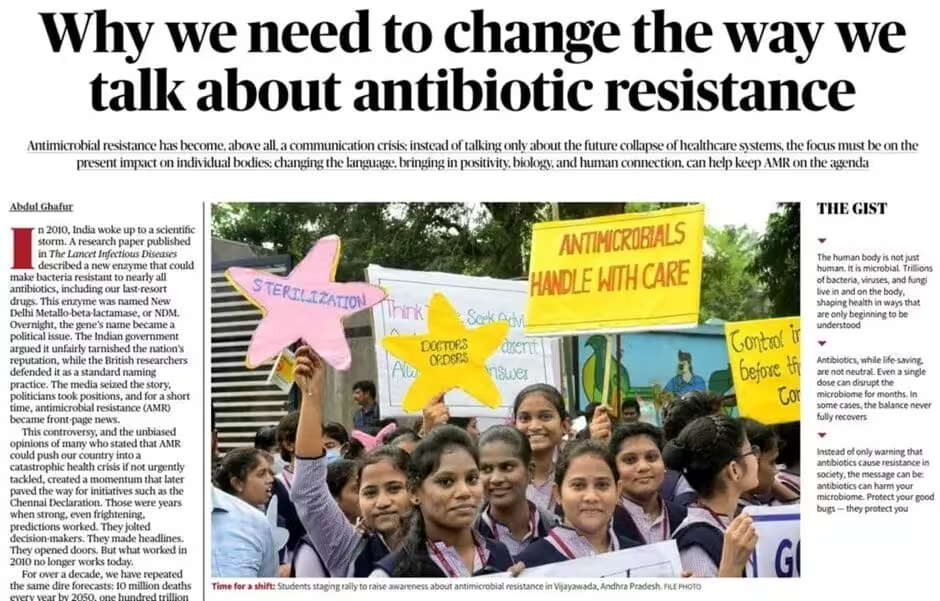
The article revisits the Antimicrobial Resistance (AMR) debate, first sparked in 2010 when the New Delhi Metallo-beta-lactamase (NDM) enzyme was discovered.
UPSC Relevance:
Disease (GS3- Science and Tech.)
UPSC PYQ:
Q. Which of the following are the reasons for the occurrence of multi-drug resistance in microbial pathogens in India? (2019)
- Genetic predisposition of some people
- Taking incorrect doses of antibiotics to cure diseases
- Using antibiotics in livestock farming
- Multiple chronic diseases in some people
Select the correct answer using the code given below.
(a) 1 and 2
(b) 2 and 3 only
(c) 1, 3 and 4
(d) 2, 3 and 4
Mains
Q. Can overuse and free availability of antibiotics without Doctor’s prescription, be contributors to the emergence of drug-resistant diseasesin India? What are the available mechanisms for monitoring and control? Critically discuss the various issues involved. (2014)
About Antimicrobial Resistance:
- Antimicrobials – including antibiotics, antivirals, antifungals, and antiparasitic – are medicines used to prevent and treat infectious diseases in humans, animals and plants.
- Antimicrobial Resistance (AMR) occurs when bacteria, viruses, fungi and parasites no longer respond to antimicrobial medicines. As a result of drug resistance, antibiotics and other antimicrobial medicines become ineffective and infections become difficult or impossible to treat, increasing the risk of disease spread, severe illness, disability and death.

Key facts:
- Antimicrobial resistance (AMR) is one of the top global public health and development threats. It is estimated that bacterial AMR was directly responsible for 1.27 million global deaths in 2019 and contributed to 4.95 million deaths.
- In addition to death and disability, AMR has significant economic costs. The World Bank estimates that AMR could result in US$ 1 trillion additional healthcare costs by 2050, and US$ 1 trillion to US$ 3.4 trillion gross domestic product (GDP) losses per year by 2030.
- Each year in the US, more than 2.8 million infections occur from antibiotic-resistant bacteria, and more than 35,000 people die as a result
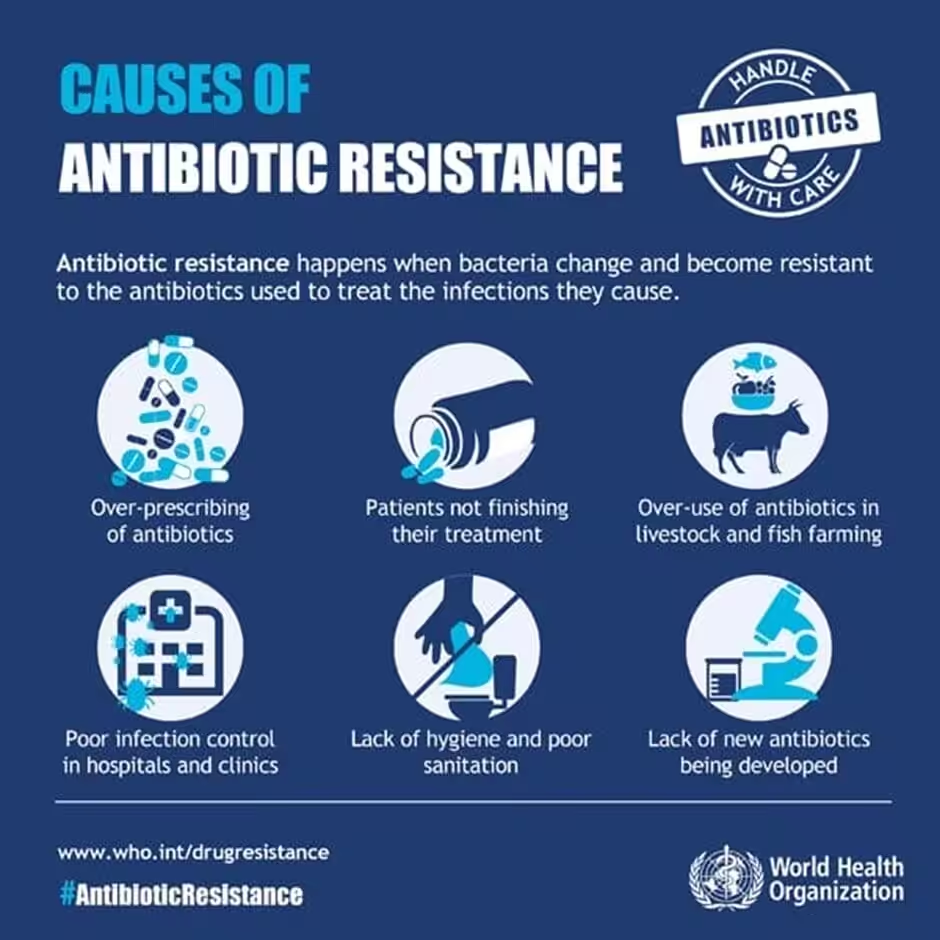
Causes:
Measures:
- National programme on AMR containment was launched during 12th FYP in 2012-17. Under this programme, AMR Surveillance Network has been strengthened by establishing labs in State Medical College.
- National Action Plan on Antimicrobial Resistance (NAP-AMR) focusing on One Health approach was launched on 19th April 2017 with the aim of involving various stakeholder ministries/departments. Delhi Declaration on AMR– an inter-ministerial consensus was signed by the ministers of the concerned ministries pledging their support in AMR containment.
- Initiatives to control overuse or misuse of antibiotics:
- ICMR has initiated antibiotic stewardship program (AMSP) on a pilot project basis in 20 tertiary care hospitals across India to control misuse and overuse of antibiotics in hospital wards and ICUs.
- On the recommendations of ICMR, DCGI has banned 40 fixed dose combinations (FDCs) which were found inappropriate.
- ICMR worked in collaboration with Indian Council of Agriculture Research, Department of Animal Husbandry, Dairy and Fisheries and the DCGI to ban use of Colistin as growth promoter in animal feed in poultry.
- The Red Line campaign is an Indian Ministry of Health and Family Welfare (MoHFW) initiative to combat antimicrobial resistance (AMR) by educating the public to never use medicines marked with a red vertical line without a doctor’s prescription.
Steps taken Globally to fight Antimicrobial Resistance:
- Global Action Plan on Antimicrobial Resistance (GAP)
- Globally, countries committed to the framework set out in the Global Action Plan (GAP) 2015 on AMR during the 2015 World Health Assembly.
- It mandated nations to develop & implement national action plans to tackle microbial resistance.
- Tripartite Joint Secretariat on Antimicrobial Resistance
- A tripartite joint secretariat (FAO, World Organisation for Animal Health (OIE) & WHO) is established in 2016.
- It aims to drive multi-stakeholder engagement in AMR.
- World Antimicrobial Awareness Week (WAAW)
- Held annually since 2015.
- It is a global campaign that aims to raise awareness of antimicrobial resistance worldwide.
- The Global Antimicrobial Resistance & Use Surveillance System (GLASS)
- It was launched by WHO in 2015 to continue fill knowledge gaps & to inform strategies at all levels.
- It is conceived to progressively incorporate data from surveillance of AMR in humans, medicines, food chain & in the environment.
- Global Research & Development priority setting for AMR
- In 2017, to guide research & development into new antimicrobials, diagnostics & vaccines, WHO developed the WHO priority pathogens list.
- Global Antibiotic Research & Development Partnership (GARDP)
- A joint initiative of WHO & the Drugs for Neglected Diseases Initiative (DNDi).
- The partnership aims to develop & deliver 5 new treatments that target drug-resistant bacteria identified by WHO as posing the greatest threat by 2025.
Suggestions to Improve India’s fight against AMR:
- Provide a supportive environment for startups: E.g. Pfizer COVID-19 vaccine was developed by the relatively small German startup BioNTech.
- Development of advanced rapid diagnostics: Prompt and precise detection of infections is essential for curbing the spread of resistant microbes.
- Cultivating indigenous phage therapies: India imports high-quality phages from Eastern Europe.
- We need to channel our efforts into developing new, innovative vaccines such as therapeutic vaccines. These are designed to prevent the recurrence of infections.
- Need to prioritise infection control strategies.
- A vast majority of our hospitals lack the requisite policies, committees, and expertise for effectively preventing drug-resistant infection transmission to patients.
- Prescribe antibiotics only when needed and in the right doses. Overusing and misusing antibiotics in humans, livestock, and crops are the main reasons for antimicrobial resistance.
Case Study: Highlighted in the GLASS Report by WHO.
- A key factor for the worsening situation Is attributed to snail’s pace progress on Implementation of India’s National Action Plan on Antimicrobial Resistance (NAP-AMR).
- While the national framework set a strong vision in 2017, only a few States have formally launched or operationalised their State Action Plans on AMR; even among these, most remain in the very early stages of execution.
- Apart from Kerala, no other State has done anything significant in terms of AMR.
- Kerala Antimicrobial Resistance Strategic Action Plan was rolled out in 2018 and took the path of inter-sectoral collaborations and One Health to handle AMR.
- The State went on to launch “AMRITH” (Antimicrobial Resistance Intervention for Total Health) in January 2024 to stop the over the counter (OTC) sale of antibiotics.
- In the latest antibiogram released by the State government, a slight dip has been noticed in AMR levels.
- Kerala also alms to become antibiotic-literate by December 2025 through awareness programmes and proper antibiotic use initiatives. basic understanding of the role of bacteria.
Source: https://anantamias.com/current-affairs/antimicrobial-resistance/
Consumer Price Index
Context:
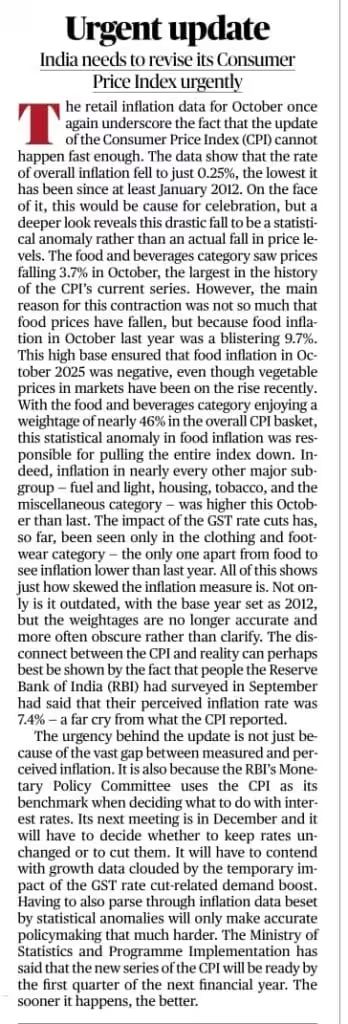
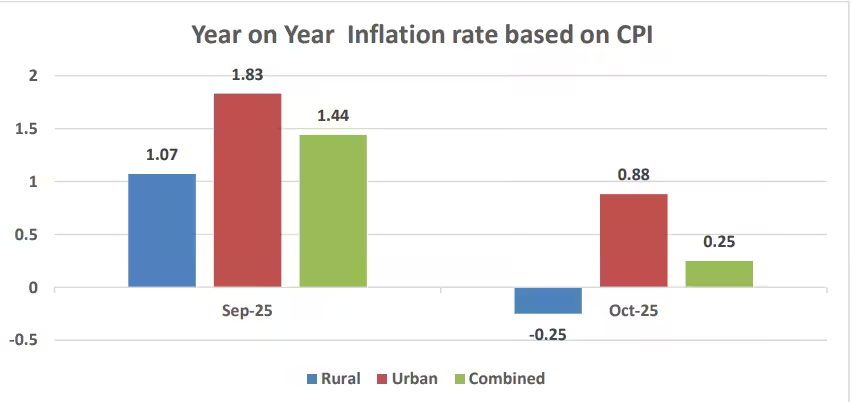
Rretail inflation (CPI) fell sharply to 0.25%, the lowest since January 2012. However, this dramatic fall is not a sign of real price decline but is the result of statistical distortions in the Consumer Price Index (CPI).
UPSC Relevance:
Economics
UPSC PYQ:
Consider the following statements: (2020)
1. The weightage of food in Consumer Price Index (CPI) is higher than that in Wholesale Price Index (WPI).
2. The WPI does not capture changes in the prices of services, which CPI does.
3. The Reserve Bank of India has now adopted WPI as its key measure of inflation and to decide on changing the key policy rates.
Which of the statements given above is/are correct?
(a) 1 and 2 only
(b) 2 only
(c) 3 only
(d) 1, 2 and 3
Price indices in India
- (i) WPI- It is compiled and released on monthly basis by the Office of Economic Adviser, Department of Industrial Policy and Promotion (DIPP), Ministry of Commerce & Industry;
- (ii) CPI (Urban, Rural and All India)- It is released by Central Statistics Office (CSO), Ministry of Statistics & Programme Implementation (MoSPI);
- (iii) CPI (Industrial Workers)- CPI (Agricultural Labour) and CPI (Rural Labour) are a set of Indices released by the Labour Bureau, Ministry of Labour. Some States also compile variants of CPI and WPI indices at the State level.
About CPI:
Consumer Price Index (CPI) measures the changes over time in the level of retail prices of goods and services that a reference population acquires, use, or pay for consumption (The population that falls within the scope of an index is termed as the reference population). In practice, a CPI measures the cost of purchasing a fixed basket of goods and services. The coverage and applicability of CPIs are generally limited to specified socio-economic groups.
Uses of CPI:
- To measure the changes over time in the general level of prices of consumption goods and
services that the reference population acquire, use or pay for consumption. - For indexation of prices in contracts for the supply of goods and services by firms.
- To provide one of the basic parameters needed for economic planning and policy
formulations by Government as well as private organizations. - To adjust the taxes, fines or fees levied by Government so as to maintain the burden upon
the people paying taxes, fines, etc. constant in real terms. - For obtaining constant-price estimates of consumption expenditure for national accounting.
- For indexation of wages and salaries in contracts of employment. This presumably avoids
the need to renegotiate the contracts when prices rise.
Selection of a base year:
(i) A normal year i.e. a year in which there are no abnormalities in the level of production, trade and in the price level and price variations,
(ii) a year for which reliable price data are available and
(iii) a year as recent as possible, and comparable with other price index series released at national and state levels
Difference b/w CPI and WPI:
| Criteria | Wholesale Price Index | Consumer Price Index (CPI) |
| Level | Measures Inflation at Wholesale level | Measures Inflation at Retail level |
| Who Calculates? | Office of Economic Advisor, Ministry of Commerce and Industry | National Statistical Office, MoSPI |
| Base year | 2011-12 | 2012 |
| Released on | 14th of Every Month | 12th of Every Month |
| Number of Items covered | 697 | 299 |
| Categories and their respective weightages | Primary Articles: (22.6%)Manufactured products (64.2%)Fuel and Power (13.2%) | Food and beverages (45.86%)Pan, Tobacco and Intoxicants (2.38%) Clothing and Footwear (6.53%)Housing (10%)Fuel and Light (6.84%): Electricity, LPG, Kerosene etc. (Does not include Petrol and Diesel)Miscellaneous- Education, Healthcare, Transportation and Communication etc. (28.32%) |
| Weightage given to Food Articles | WPI-Food Index (24%): Food articles from “Primary Articles” and “Manufactured Food Product”. | Consumer Food Price Index (CFPI): (39%): Out of 12 sub-groups contained in ‘Food and Beverages’ group, CFPI is based on ten sub-groups, excluding ‘Non-alcoholic beverages’ and ‘Prepared meals, snacks, sweets etc. (For Details, refer to Rau’s Economic Survey Video) |
| Impact of increase in Food items | Less impact on WPI as compared to CPI | Larger impact on CPI |
| Weightage of Fuel and Power | Included in separate category of Fuel and Power (13.2%) | Weightage (~8%): Included in (a) category of Fuel and light and (b) Category of Transportation and Communication (Fuel for Transportation) |
| Highest Weightage | Manufactured products (64.2%) | Food and Beverages (45.9%) |
| Services included | No | Yes |
| Indirect Taxes Included? | No | Yes |
| Targeted by RBI? | No | Yes. The RBI is required to maintain CPI rate of inflation of 4% with a deviation of 2%. |
Source: https://anantamias.com/current-affairs/consumer-price-index/