
Context:
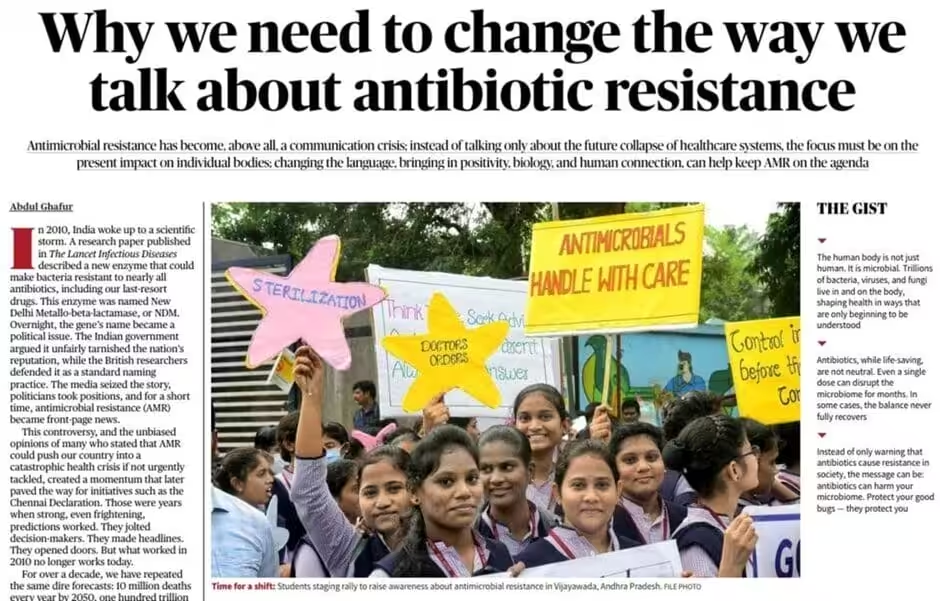
The article revisits the Antimicrobial Resistance (AMR) debate, first sparked in 2010 when the New Delhi Metallo-beta-lactamase (NDM) enzyme was discovered.
UPSC Relevance:
Disease (GS3- Science and Tech.)
UPSC PYQ:
Q. Which of the following are the reasons for the occurrence of multi-drug resistance in microbial pathogens in India? (2019)
- Genetic predisposition of some people
- Taking incorrect doses of antibiotics to cure diseases
- Using antibiotics in livestock farming
- Multiple chronic diseases in some people
Select the correct answer using the code given below.
(a) 1 and 2
(b) 2 and 3 only
(c) 1, 3 and 4
(d) 2, 3 and 4
Mains
Q. Can overuse and free availability of antibiotics without Doctor’s prescription, be contributors to the emergence of drug-resistant diseasesin India? What are the available mechanisms for monitoring and control? Critically discuss the various issues involved. (2014)
About Antimicrobial Resistance:

- Antimicrobials – including antibiotics, antivirals, antifungals, and antiparasitic – are medicines used to prevent and treat infectious diseases in humans, animals and plants.
- Antimicrobial Resistance (AMR) occurs when bacteria, viruses, fungi and parasites no longer respond to antimicrobial medicines. As a result of drug resistance, antibiotics and other antimicrobial medicines become ineffective and infections become difficult or impossible to treat, increasing the risk of disease spread, severe illness, disability and death.

Key facts:
- Antimicrobial resistance (AMR) is one of the top global public health and development threats. It is estimated that bacterial AMR was directly responsible for 1.27 million global deaths in 2019 and contributed to 4.95 million deaths.
- In addition to death and disability, AMR has significant economic costs. The World Bank estimates that AMR could result in US$ 1 trillion additional healthcare costs by 2050, and US$ 1 trillion to US$ 3.4 trillion gross domestic product (GDP) losses per year by 2030.
- Each year in the US, more than 2.8 million infections occur from antibiotic-resistant bacteria, and more than 35,000 people die as a result
Causes:
Measures:
- National programme on AMR containment was launched during 12th FYP in 2012-17. Under this programme, AMR Surveillance Network has been strengthened by establishing labs in State Medical College.
- National Action Plan on Antimicrobial Resistance (NAP-AMR) focusing on One Health approach was launched on 19th April 2017 with the aim of involving various stakeholder ministries/departments. Delhi Declaration on AMR– an inter-ministerial consensus was signed by the ministers of the concerned ministries pledging their support in AMR containment.
- Initiatives to control overuse or misuse of antibiotics:
- ICMR has initiated antibiotic stewardship program (AMSP) on a pilot project basis in 20 tertiary care hospitals across India to control misuse and overuse of antibiotics in hospital wards and ICUs.
- On the recommendations of ICMR, DCGI has banned 40 fixed dose combinations (FDCs) which were found inappropriate.
- ICMR worked in collaboration with Indian Council of Agriculture Research, Department of Animal Husbandry, Dairy and Fisheries and the DCGI to ban use of Colistin as growth promoter in animal feed in poultry.
- The Red Line campaign is an Indian Ministry of Health and Family Welfare (MoHFW) initiative to combat antimicrobial resistance (AMR) by educating the public to never use medicines marked with a red vertical line without a doctor’s prescription.
Steps taken Globally to fight Antimicrobial Resistance:
- Global Action Plan on Antimicrobial Resistance (GAP)
- Globally, countries committed to the framework set out in the Global Action Plan (GAP) 2015 on AMR during the 2015 World Health Assembly.
- It mandated nations to develop & implement national action plans to tackle microbial resistance.
- Tripartite Joint Secretariat on Antimicrobial Resistance
- A tripartite joint secretariat (FAO, World Organisation for Animal Health (OIE) & WHO) is established in 2016.
- It aims to drive multi-stakeholder engagement in AMR.
- World Antimicrobial Awareness Week (WAAW)
- Held annually since 2015.
- It is a global campaign that aims to raise awareness of antimicrobial resistance worldwide.
- The Global Antimicrobial Resistance & Use Surveillance System (GLASS)
- It was launched by WHO in 2015 to continue fill knowledge gaps & to inform strategies at all levels.
- It is conceived to progressively incorporate data from surveillance of AMR in humans, medicines, food chain & in the environment.
- Global Research & Development priority setting for AMR
- In 2017, to guide research & development into new antimicrobials, diagnostics & vaccines, WHO developed the WHO priority pathogens list.
- Global Antibiotic Research & Development Partnership (GARDP)
- A joint initiative of WHO & the Drugs for Neglected Diseases Initiative (DNDi).
- The partnership aims to develop & deliver 5 new treatments that target drug-resistant bacteria identified by WHO as posing the greatest threat by 2025.
Suggestions to Improve India’s fight against AMR:
- Provide a supportive environment for startups: E.g. Pfizer COVID-19 vaccine was developed by the relatively small German startup BioNTech.
- Development of advanced rapid diagnostics: Prompt and precise detection of infections is essential for curbing the spread of resistant microbes.
- Cultivating indigenous phage therapies: India imports high-quality phages from Eastern Europe.
- We need to channel our efforts into developing new, innovative vaccines such as therapeutic vaccines. These are designed to prevent the recurrence of infections.
- Need to prioritise infection control strategies.
- A vast majority of our hospitals lack the requisite policies, committees, and expertise for effectively preventing drug-resistant infection transmission to patients.
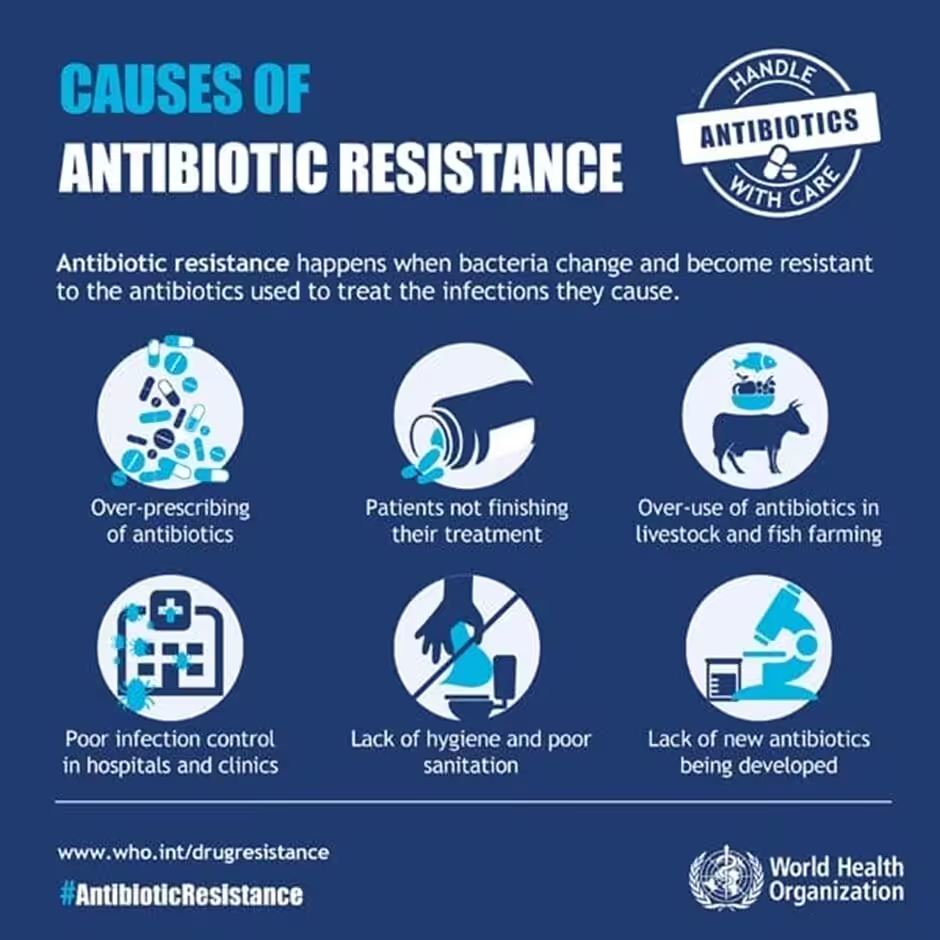
- Prescribe antibiotics only when needed and in the right doses. Overusing and misusing antibiotics in humans, livestock, and crops are the main reasons for antimicrobial resistance.
Case Study: Highlighted in the GLASS Report by WHO.
- A key factor for the worsening situation Is attributed to snail’s pace progress on Implementation of India’s National Action Plan on Antimicrobial Resistance (NAP-AMR).
- While the national framework set a strong vision in 2017, only a few States have formally launched or operationalised their State Action Plans on AMR; even among these, most remain in the very early stages of execution.
- Apart from Kerala, no other State has done anything significant in terms of AMR.
- Kerala Antimicrobial Resistance Strategic Action Plan was rolled out in 2018 and took the path of inter-sectoral collaborations and One Health to handle AMR.
- The State went on to launch “AMRITH” (Antimicrobial Resistance Intervention for Total Health) in January 2024 to stop the over the counter (OTC) sale of antibiotics.
- In the latest antibiogram released by the State government, a slight dip has been noticed in AMR levels.
- Kerala also alms to become antibiotic-literate by December 2025 through awareness programmes and proper antibiotic use initiatives. basic understanding of the role of bacteria.
Tell Google you want more of this.
Add Anantam IAS as a preferred sourceOne tap, and this site shows up more often in your own Top Stories, AI Overviews and AI Mode. Remove it any time.