Daily Digest
UPSC · Civil Services Examination
Current Affairs · Sunday, 16 August 2026
Current affairs curated and edited by Anantam IAS faculty — pulled from The Hindu, PIB, IDSA, Foreign Affairs and the ministries. Read, annotate, revise.
Old Rajinder Nagar · Delhi 110005 · anantamias.com
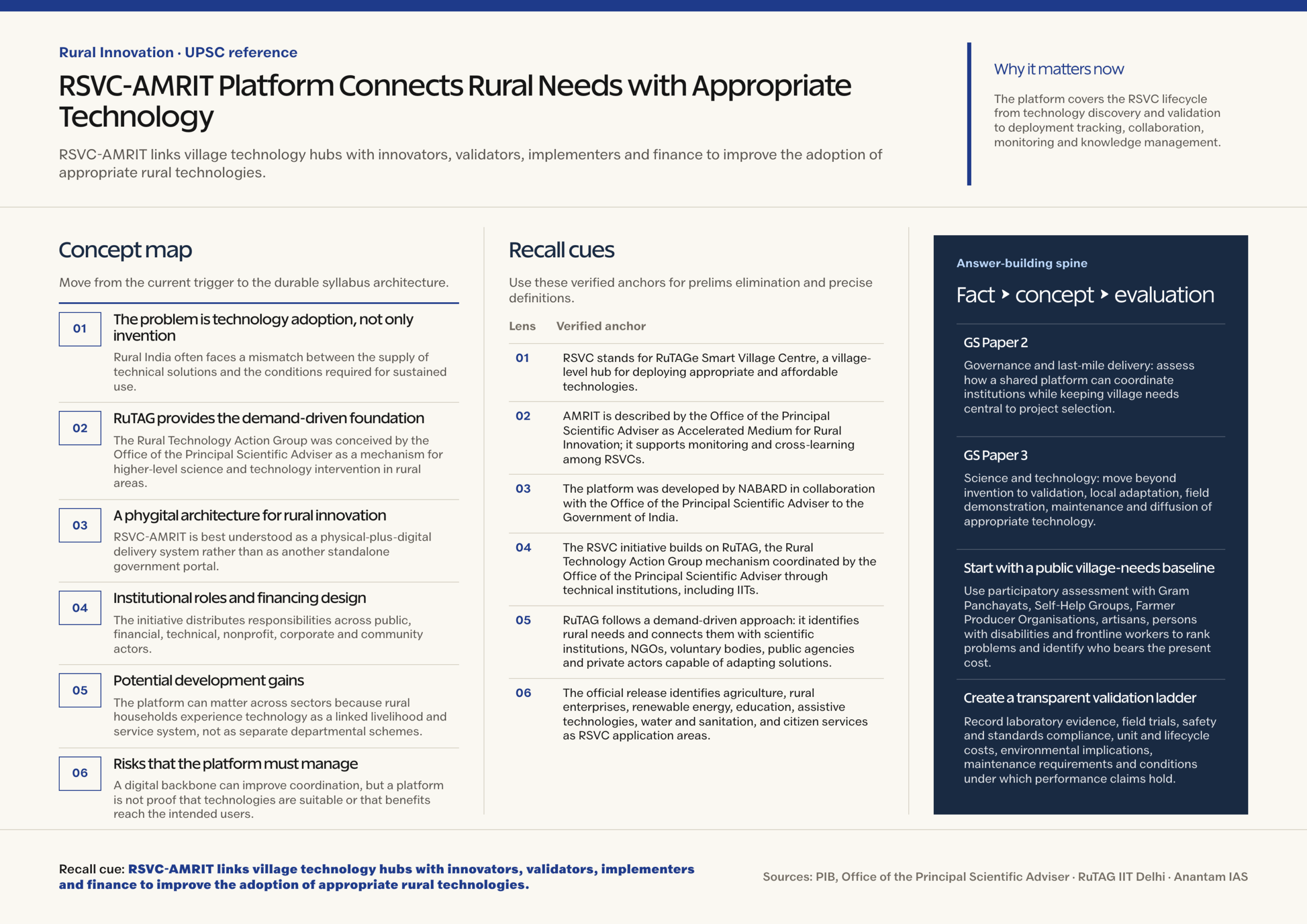
RSVC-AMRIT Platform Connects Rural Needs with Appropriate Technology
Why in News?
The Principal Scientific Adviser to the Government of India launched the RSVC-AMRIT platform , developed by NABARD with the Office of the Principal Scientific Adviser, in an official release dated 15 August 2026 .
- The platform covers the RSVC lifecycle from technology discovery and validation to deployment tracking, collaboration, monitoring and knowledge management.
- It is intended to progressively bring together innovators, startups, technology providers, validators, accelerators, academic institutions, funding agencies, implementation partners and rural communities.
- The physical RSVC network works through village-level technology hubs; AMRIT adds a shared digital layer for records, coordination and cross-learning.
- The PIB release says NABARD was supporting eight RSVCs at the time of the announcement. This figure describes NABARD-supported centres in that release and should not be read as a complete national count.
- The release metadata is dated 15 August 2026, while one sentence in its body says 15 August 2025. This appears to be a source-year typo; the announcement is anchored here to the official 2026 release.
- India has many laboratories, technical institutions and grassroots innovators, but the harder policy problem is the last-mile adoption gap: finding the right technology, adapting it to local conditions, financing deployment and maintaining it after installation.
- RSVC-AMRIT matters because it combines a physical last-mile institution with a digital coordination system instead of assuming that an online catalogue alone can solve rural technology diffusion.
- The model also tests whether public institutions, CSR funders, civil-society implementers and local communities can share responsibilities without weakening accountability or treating villages as passive technology recipients.
UPSC Relevance
Prelims Relevance
- RSVC stands for RuTAGe Smart Village Centre, a village-level hub for deploying appropriate and affordable technologies.
- AMRIT is described by the Office of the Principal Scientific Adviser as Accelerated Medium for Rural Innovation; it supports monitoring and cross-learning among RSVCs.
- The platform was developed by NABARD in collaboration with the Office of the Principal Scientific Adviser to the Government of India.
- The RSVC initiative builds on RuTAG, the Rural Technology Action Group mechanism coordinated by the Office of the Principal Scientific Adviser through technical institutions, including IITs.
- RuTAG follows a demand-driven approach: it identifies rural needs and connects them with scientific institutions, NGOs, voluntary bodies, public agencies and private actors capable of adapting solutions.
- The official release identifies agriculture, rural enterprises, renewable energy, education, assistive technologies, water and sanitation, and citizen services as RSVC application areas.
Mains Relevance
GS Paper 2
- Governance and last-mile delivery: assess how a shared platform can coordinate institutions while keeping village needs central to project selection.
- Development processes: examine the respective roles of government advisers, a development financial institution, a nonprofit implementation arm, CSR partners, academic bodies and community organisations.
GS Paper 3
- Science and technology: move beyond invention to validation, local adaptation, field demonstration, maintenance and diffusion of appropriate technology.
- Inclusive growth: connect rural technology with productivity, reduced drudgery, livelihoods, micro-enterprises and access for persons with disabilities.
Essay
- Innovation creates public value only when institutions can carry it from the laboratory to the last mile.
Background and Context
The problem is technology adoption, not only invention
Rural India often faces a mismatch between the supply of technical solutions and the conditions required for sustained use.
- Research institutions, startups and grassroots innovators may develop useful devices, but potential users can struggle to discover them, compare alternatives or judge whether they fit local soil, water, skills, energy and market conditions.
- A successful pilot may still fail to scale because of weak maintenance networks, unavailable spare parts, limited operator training, uncertain demand or the absence of affordable finance.
- Technology transfer is not a one-way delivery of equipment. It requires problem definition, co-design, field validation, training, feedback and repair across the technology’s working life.
- This is why appropriate technology must be affordable, maintainable and suited to local social and ecological conditions. A sophisticated device that communities cannot own or repair can deepen dependence instead of building capability.
RuTAG provides the demand-driven foundation
The Rural Technology Action Group was conceived by the Office of the Principal Scientific Adviser as a mechanism for higher-level science and technology intervention in rural areas.
- RuTAG identifies concrete problems faced by farmers, artisans, landless workers and rural enterprises, then seeks technical support from scientific institutions, universities, NGOs, voluntary bodies, public agencies and responsible private actors.
- Its role is mainly synergising and catalytic, not that of a single large funding scheme. It tries to reduce fragmentation and repeated work among institutions that otherwise act in separate silos.
- The RuTAG process can include technology upgrading, validation, demonstration and training. Examples from RuTAG IIT Delhi include devices and processes related to irrigation, millet de-husking, animal power, biomass, rural crafts and food processing.
- RSVC extends this approach through a permanent village-facing hub. The centre can identify local demand, demonstrate options, support use and convey field feedback to the institutions responsible for technical improvement.
A phygital architecture for rural innovation
RSVC-AMRIT is best understood as a physical-plus-digital delivery system rather than as another standalone government portal.
- The physical layer consists of RSVCs that bring technology demonstrations, services, skills and implementation support closer to rural communities.
- The digital layer records rural needs, technologies, validation status, deployments, partners, progress and knowledge generated through implementation.
- The platform’s stated lifecycle spans discovery, validation, deployment tracking, collaboration, monitoring and knowledge management. These functions can create a feedback loop between the user, the implementation partner and the innovator.
- The structure resembles other phygital approaches in rural governance. An online system widens coordination, while a local intermediary supports assisted access, trust, training and problem resolution.
- For comparison, Anantam IAS notes on Samriddh Gram and BharatNet-enabled rural services show why digital connectivity produces results only when the human last mile is built alongside it.
Institutional roles and financing design
The initiative distributes responsibilities across public, financial, technical, nonprofit, corporate and community actors.
- The Office of the Principal Scientific Adviser supplies the science-policy and rural-innovation framework, including the RuTAGe ecosystem.
- NABARD developed the AMRIT platform and is positioned as a strategic enabler for RSVC support. Its broader role in rural finance is explained in this NABARD study note.
- NABFOUNDATION is named as the implementation partner under the scheme outlined in the release, while corporates may support centre establishment through CSR initiatives.
- Innovators and academic institutions supply or improve technologies; validators assess readiness; implementation partners mobilise communities and manage field deployment; funding partners support capital and scale; rural users supply the demand signal and operating feedback.
- This division can combine specialised capabilities, but it also creates a coordination risk. Contracts and platform records should make responsibility for selection, procurement, maintenance, data and outcomes visible.
Way Forward
Start with a public village-needs baseline
- Use participatory assessment with Gram Panchayats, Self-Help Groups, Farmer Producer Organisations, artisans, persons with disabilities and frontline workers to rank problems and identify who bears the present cost.
- Publish the need, technology-selection rationale, expected beneficiaries and alternatives considered so that the match can be scrutinised.
- Record laboratory evidence, field trials, safety and standards compliance, unit and lifecycle costs, environmental implications, maintenance requirements and conditions under which performance claims hold.
- Use independent validators and publish failures and adaptations as learning assets, not only success stories.
Conclusion
- RSVC-AMRIT addresses a real policy gap between India’s capacity to invent and its capacity to place useful, maintainable technology in rural hands.
- Its success should be judged by durable local capability: communities able to choose technologies, operate and repair them, improve livelihoods and send evidence back into the innovation system.
UPSC Practice Questions
Prelims MCQ 1
With reference to the RSVC-AMRIT initiative, consider the following statements:
- AMRIT is the digital backbone of the RuTAGe Smart Village Centre ecosystem.
- The platform was developed by NABARD in collaboration with the Office of the Principal Scientific Adviser.
- NABFOUNDATION is identified as an implementation partner for the NABARD-supported RSVC scheme.
How many of the above statements are correct?
(a) Only one (b) Only two (c) All three (d) None
Answer: (c) All three
Explanation:
All three statements follow the official launch release. AMRIT supports the RSVC lifecycle; NABARD developed it with the Office of the Principal Scientific Adviser; and NABFOUNDATION is named as the implementation partner under the scheme outlined by NABARD.
Prelims MCQ 2
Which one of the following best describes the core purpose of the Rural Technology Action Group approach?
(a) To replace all rural development programmes with a single centrally managed technology scheme (b) To connect identified rural needs with science and technology institutions for adaptation, validation and delivery (c) To provide crop insurance directly to individual farmers through IITs (d) To regulate corporate social responsibility expenditure across all sectors
Answer: (b) To connect identified rural needs with science and technology institutions for adaptation, validation and delivery
Explanation:
RuTAG is a demand-driven, synergising mechanism. It identifies grassroots problems and mobilises technical institutions and other partners to adapt and deliver appropriate solutions; it is not a crop-insurance programme, a CSR regulator or a replacement for rural development schemes.
UPSC Mains Questions
- A rural innovation policy succeeds only when it closes the distance between invention, adoption and local capability. Discuss with reference to the institutional design of RSVC-AMRIT. (250 words)
- Digital platforms can coordinate rural technology transfer, but they cannot substitute for participation, validation and maintenance at the last mile. Examine. (250 words)
Sources: PIB, Office of the Principal Scientific Adviser and RuTAG IIT Delhi.
Frequently Asked Questions
What is the RSVC-AMRIT platform?
RSVC-AMRIT is the digital backbone of the RuTAGe Smart Village Centre ecosystem. It is designed to support technology discovery, validation, deployment tracking, stakeholder collaboration, monitoring and knowledge management while connecting rural needs with innovators, institutions, implementation partners and funding agencies.
What does AMRIT stand for in this initiative?
The Office of the Principal Scientific Adviser describes AMRIT as the Accelerated Medium for Rural Innovation. It operates as a digital layer for monitoring RSVCs, sharing learning and organising information on rural needs, technologies, partners and deployments.
What is a RuTAGe Smart Village Centre?
A RuTAGe Smart Village Centre is a village-level hub that helps communities access, test and adopt appropriate and affordable technologies. It can connect local needs with demonstrations, training, technical support, rural-enterprise services and feedback channels to innovators and research institutions.
Which institutions are involved in RSVC-AMRIT?
The Office of the Principal Scientific Adviser provides the wider RuTAGe framework, while NABARD developed the platform and supports the RSVC ecosystem. NABFOUNDATION is identified as an implementation partner, and the model also involves technical institutions, innovators, validators, corporate CSR.
Which sectors can RSVCs support?
The official release lists agriculture, rural enterprises, renewable energy, education, assistive technologies, water and sanitation, and citizen services. The correct technology mix should differ by village because selection is meant to begin with local needs and field conditions.
Source: https://anantamias.com/current-affairs/rsvc-amrit-rural-technology-platform/
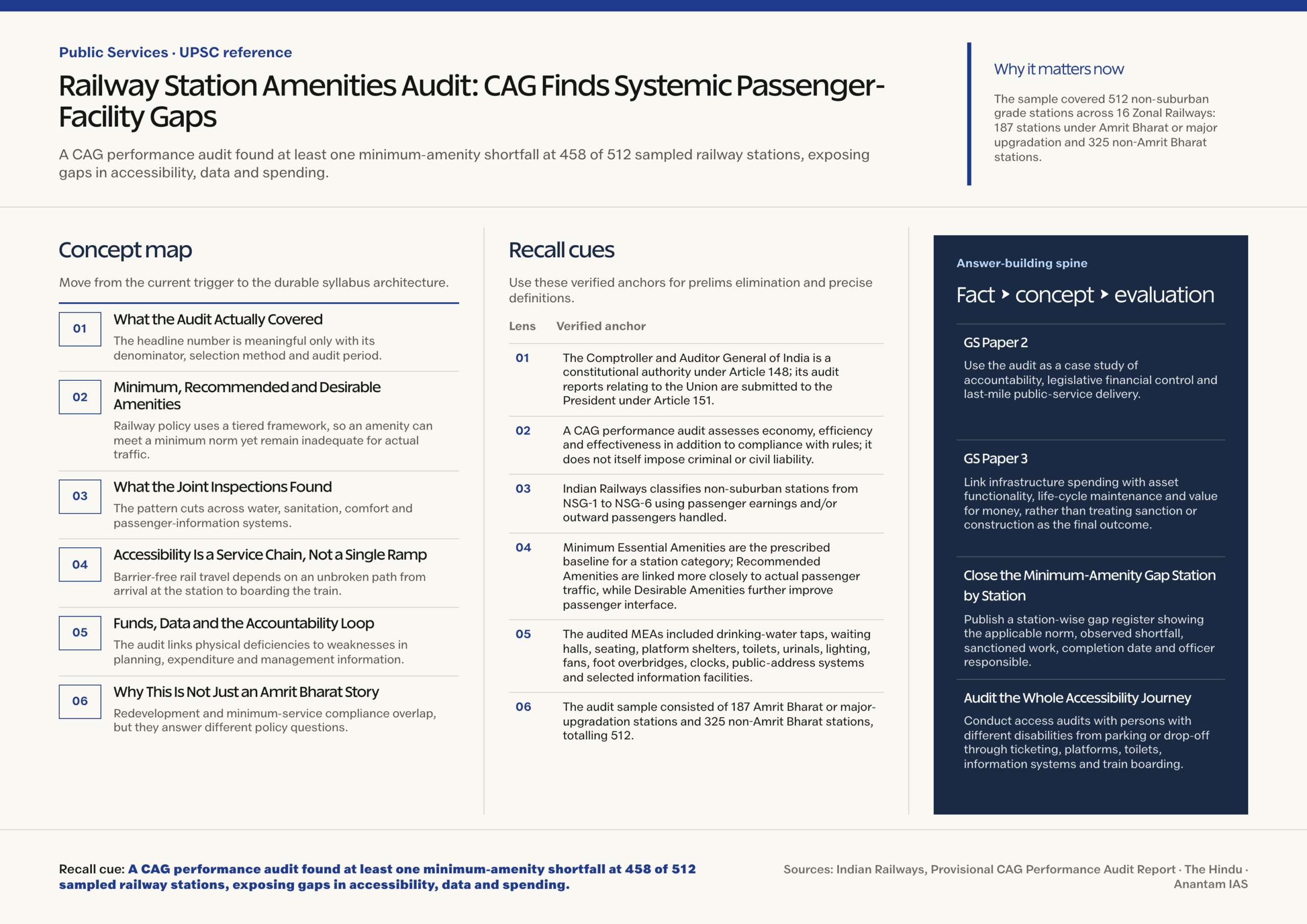
Railway Station Amenities Audit: CAG Finds Systemic Passenger-Facility Gaps
Why in News?
A performance audit on passenger amenities and sanitation found that only 54 of 512 sampled non-suburban railway stations had no shortfall in the Minimum Essential Amenities checked.
- The sample covered 512 non-suburban grade stations across 16 Zonal Railways: 187 stations under Amrit Bharat or major upgradation and 325 non-Amrit Bharat stations.
- The 512 stations represented 8.66% of 5,908 NSG stations recorded as of 31 March 2023. The result must not be generalised as if 458 stations meant all Indian railway stations.
- Joint inspections found that 54 sampled stations, or 11%, had no shortfall in the MEAs checked; the remaining 458 had one or more shortfalls.
- First inspections recorded shortfalls at 147 stations for drinking-water taps, 122 for urinals, 114 for fans in one covered-platform category and 129 of the 240 relevant stations for water coolers.
- Accessibility checks found missing standard ramps with railings at 246 of 512 stations in the first inspection and missing priority seating at 490 of 512 stations under a separate February 2020 standards check.
- Railway stations are a test of everyday State capacity: rules, budgets and schemes matter only when water, toilets, shelter, information and barrier-free movement are available at the point of use.
- The report follows earlier CAG scrutiny and Railway Ministry assurances, so repeated deficiencies raise questions about corrective-action loops, not merely first-time asset creation.
- The audit separates three questions that are often collapsed in public debate: whether an amenity exists, whether it is adequate for traffic and whether it is functional and accessible.
UPSC Relevance
Prelims Relevance
- The Comptroller and Auditor General of India is a constitutional authority under Article 148; its audit reports relating to the Union are submitted to the President under Article 151.
- A CAG performance audit assesses economy, efficiency and effectiveness in addition to compliance with rules; it does not itself impose criminal or civil liability.
- Indian Railways classifies non-suburban stations from NSG-1 to NSG-6 using passenger earnings and/or outward passengers handled.
- Minimum Essential Amenities are the prescribed baseline for a station category; Recommended Amenities are linked more closely to actual passenger traffic, while Desirable Amenities further improve passenger interface.
- The audited MEAs included drinking-water taps, waiting halls, seating, platform shelters, toilets, urinals, lighting, fans, foot overbridges, clocks, public-address systems and selected information facilities.
- The audit sample consisted of 187 Amrit Bharat or major-upgradation stations and 325 non-Amrit Bharat stations, totalling 512.
Mains Relevance
GS Paper 2
- Use the audit as a case study of accountability, legislative financial control and last-mile public-service delivery.
- Connect constitutional audit with outcome monitoring: Article 148 gives institutional independence, while Article 151 enables legislative scrutiny of audit findings.
GS Paper 3
- Link infrastructure spending with asset functionality, life-cycle maintenance and value for money, rather than treating sanction or construction as the final outcome.
- Use the distinction between baseline amenities and station redevelopment to argue for service-level indicators alongside capital-project milestones.
Essay
- Public infrastructure earns legitimacy through ordinary reliability: a working tap, accessible toilet or safe pathway may reveal more about governance than a prominent inauguration.
Background and Context
What the Audit Actually Covered
The headline number is meaningful only with its denominator, selection method and audit period.
- The audit examined 512 selected NSG stations, not every station in the Indian Railways network. They were drawn across all 16 zones and categories NSG-1 to NSG-6.
- Selection included the highest-footfall stations within categories, representation of divisions and limits of up to 12 Amrit Bharat and 20 non-Amrit Bharat stations per zone. It was a structured audit sample, not a simple nationwide census.
- Of the 512 stations, 187 were Amrit Bharat or major-upgradation stations and 325 were non-Amrit Bharat stations. This allowed the audit to examine baseline amenities across both redevelopment and ordinary operational contexts.
- The auditors conducted joint inspections with railway officials, reviewed records and revisited selected non-Amrit Bharat stations after roughly two to three months to test whether observed deficiencies were isolated.
- Feedback was collected from 7,511 passengers, another 2,507 passengers in waiting rooms and 374 persons with disabilities. These responses supplemented, rather than replaced, physical and documentary verification.
Minimum, Recommended and Desirable Amenities
Railway policy uses a tiered framework, so an amenity can meet a minimum norm yet remain inadequate for actual traffic.
- Minimum Essential Amenities are the category-linked baseline expected when a station is constructed or brought to the prescribed standard. They include fundamental passenger facilities such as water, seating, shelter, toilets and lighting.
- Recommended Amenities address whether the scale of provision is commensurate with actual passenger volume. This matters because the same numerical minimum may serve a quiet NSG-6 station differently from a heavily used NSG-1 station.
- Desirable Amenities go beyond the baseline to improve passenger satisfaction and interface. Railway instructions allow their provision based on need and importance rather than waiting for every recommended amenity to be completed.
- The audit noted that Railway Board norms for the quantum of several basic amenities changed little between 2003 and 2018 even as traffic conditions evolved. Good governance requires periodic revision of standards, not only compliance with.
- The Railway Board had directed that revised MEAs be provided by 31 August 2018. Persistent gaps years later show a failure of implementation and follow-up, not an absence of a formal deadline.
What the Joint Inspections Found
The pattern cuts across water, sanitation, comfort and passenger-information systems.
- During first inspections, shortfalls against MEA norms were observed at 147 stations for drinking-water taps, 122 for urinals, 69 for latrines, 78 for seating and 68 for platform shelters.
- Among the 240 sampled NSG-1 to NSG-4 stations for which two water coolers on each platform were prescribed, 129 stations showed a shortfall in the first inspection.
- Fan provision fell short at 114 stations for covered platforms six to nine metres wide and at 214 stations for covered platforms wider than nine metres under the applicable norm.
- The second-inspection figures improved only modestly for several basic amenities: drinking-water shortfalls fell from 147 to 138 stations, urinals from 122 to 111 and latrines from 69 to 59.
- Only one NSG-1 station in the sample was among the 54 stations with no MEA shortfall checked. The audit’s PAMS analysis also found that only five of 22 NSG-1 stations across the network recorded all MEAs.
Accessibility Is a Service Chain, Not a Single Ramp
Barrier-free rail travel depends on an unbroken path from arrival at the station to boarding the train.
- Railway instructions since 1999 have included short-term facilities such as ramps with railings, reserved parking, non-slippery walkways, visible signs, accessible water taps and at least one accessible ground-floor toilet.
- First inspections found no standard ramp with railing at 246 of 512 sampled stations. At the second inspection the number was still 243.
- Under the April 2018 requirements, all 297 relevant sampled stations lacked the specified drinking-water tap suitable for persons with disabilities on alternate water booths at each platform.
- A separate check against February 2020 accessibility standards found shortfalls in priority seating at 490 of 512 stations, coach-position displays at 343, announcements about the accessible coach at 273 and accessible toilets at 134.
- Tactile pathways existed at some stations but did not connect to foot overbridges, lifts or subways; an incorrectly placed tactile path near a platform edge was recorded at Madurai Junction. A disconnected asset can create a.
Way Forward
Close the Minimum-Amenity Gap Station by Station
- Publish a station-wise gap register showing the applicable norm, observed shortfall, sanctioned work, completion date and officer responsible.
- Prioritise water, sanitation, shelter, safe circulation and passenger information before aesthetic additions.
- Group repeated small deficiencies into zonal procurement and maintenance packages where this shortens delivery without weakening local accountability.
- Use repeat joint inspections and random passenger verification to confirm that a repaired asset remains functional after handover.
Conclusion
- The sharpest lesson is not that 458 railway stations are deficient in the abstract.
- Indian Railways needs both ambitious redevelopment and dependable basics.
UPSC Practice Questions
Prelims MCQ 1
With reference to the CAG performance audit on passenger amenities at railway stations, consider the following statements:
- The audit’s joint-inspection sample consisted of 512 non-suburban grade stations.
- The finding on 458 deficient stations refers to all railway stations in India.
- The sample included both Amrit Bharat or major-upgradation stations and non-Amrit Bharat stations.
How many of the above statements are correct?
(a) Only one (b) Only two (c) All three (d) None
Answer: (b) Only two
Explanation:
Statements 1 and 3 are correct. The audit jointly inspected 512 selected NSG stations, including 187 Amrit Bharat or major-upgradation stations and 325 non-Amrit Bharat stations. Statement 2 is incorrect because 458 is the number with at least one shortfall within that sample, not across every station in India.
Prelims MCQ 2
Which one of the following best distinguishes Recommended Amenities from Minimum Essential Amenities in Indian Railways’ passenger-amenity framework?
(a) Recommended Amenities are judicially enforceable, while Minimum Essential Amenities are voluntary (b) Recommended Amenities are linked to actual passenger traffic, while Minimum Essential Amenities provide a category-based baseline (c) Recommended Amenities apply only to suburban stations, while Minimum Essential Amenities apply only to non-suburban stations (d) Recommended Amenities are funded only through CSR, while Minimum Essential Amenities are funded only through MPLADS
Answer: (b) Recommended Amenities are linked to actual passenger traffic, while Minimum Essential Amenities provide a category-based baseline
Explanation:
Minimum Essential Amenities set the prescribed baseline for each station category. Recommended Amenities consider whether provision is adequate for the actual passenger traffic handled. Desirable Amenities form a further tier intended to improve passenger satisfaction and interface.
UPSC Mains Questions
- The gap between sanctioned infrastructure and usable public services is often a problem of State capacity rather than policy absence. Discuss with reference to the CAG audit of passenger amenities at railway stations. (250 words)
- Accessible transport requires an unbroken service chain, not isolated compliant assets. Examine this proposition in the context of railway stations and suggest an outcome-based monitoring framework. (250 words)
Sources: Indian Railways, Provisional CAG Performance Audit Report and The Hindu.
Frequently Asked Questions
Did the CAG find that 458 of all Indian railway stations lacked amenities?
No. The audit jointly inspected a sample of 512 non-suburban grade stations. Only 54 had no shortfall in the Minimum Essential Amenities checked, so 458 sampled stations had at least one shortfall. The denominator is the 512 audited stations, not.
What are Minimum Essential Amenities at railway stations?
They are the category-based baseline facilities prescribed for stations, including drinking water, waiting space, seating, platform shelter, toilets, urinals, lighting and other basic passenger services. Recommended Amenities respond more closely to actual passenger traffic, while Desirable Amenities further improve the.
How is this audit different from Amrit Bharat Station Scheme coverage?
The Amrit Bharat Station Scheme concerns long-term station development and master planning. This performance audit tested whether amenities and sanitation were provided, maintained and funded according to rules. Its sample included 187 Amrit Bharat or major-upgradation stations and 325 non-Amrit.
What were the main accessibility concerns found by the audit?
The audit found gaps in ramps, accessible water taps, toilets, priority seating, coach-position information and inter-platform movement. Some tactile paths did not connect to lifts, foot overbridges or subways. These findings show why accessibility must be assessed as a continuous.
What did the audit say about customer-amenity funds?
Underutilisation of budget grants under the Customer Amenities plan head ranged from 36% to 44% annually during 2019-20 to 2023-24. Railway administrations cited delayed work, tender and contractor problems, late bills and site constraints, pointing to execution and project-management weaknesses.
Source: https://anantamias.com/current-affairs/cag-railway-station-amenities-audit/
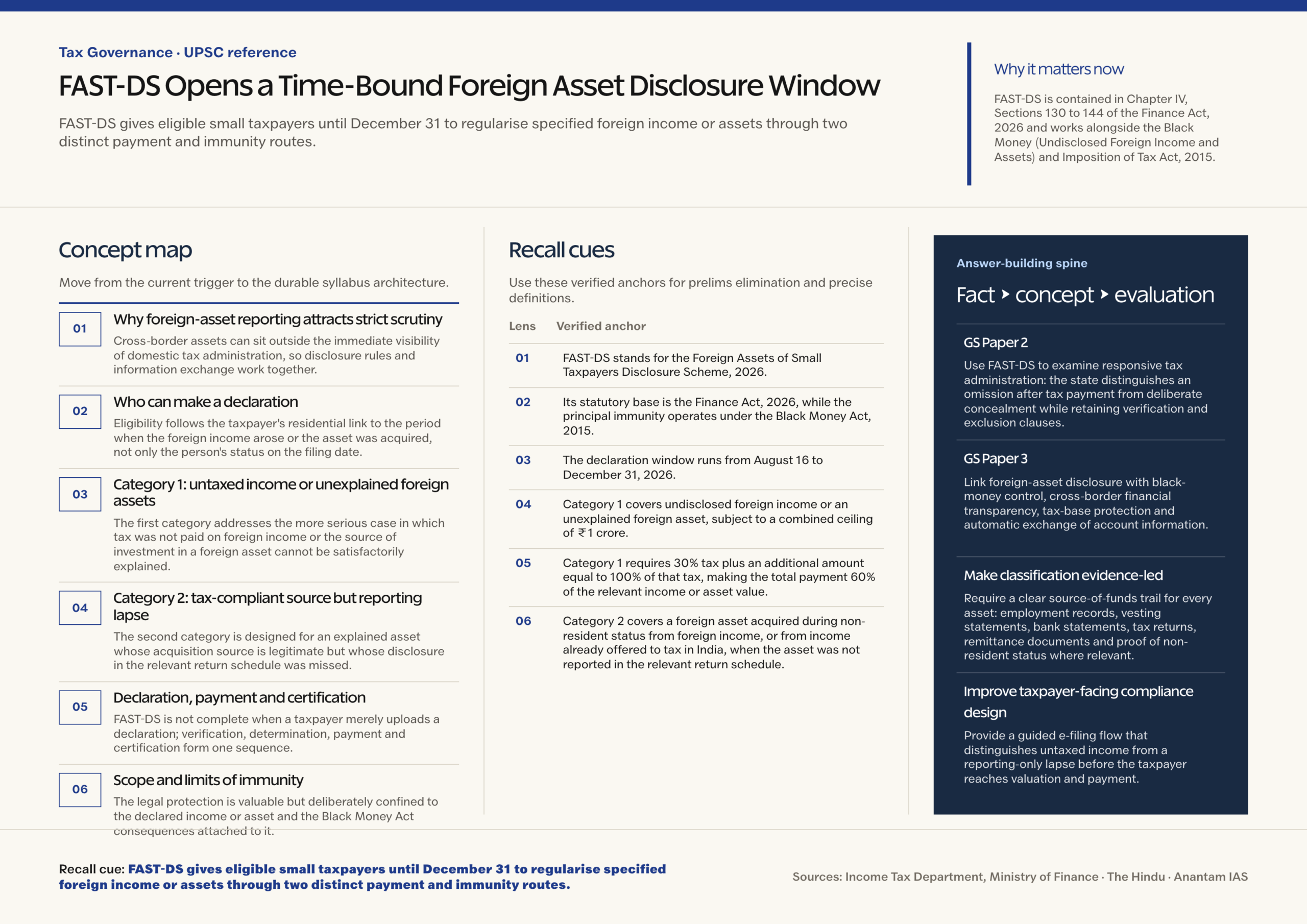
FAST-DS Opens a Time-Bound Foreign Asset Disclosure Window
Why in News?
The Central Government has brought the Foreign Assets of Small Taxpayers Disclosure Scheme, 2026 , or FAST-DS, into force from August 16, 2026, after notifying the operational rules on August 14.
- FAST-DS is contained in Chapter IV, Sections 130 to 144 of the Finance Act, 2026 and works alongside the Black Money (Undisclosed Foreign Income and Assets) and Imposition of Tax Act, 2015.
- An eligible declaration can cover a failure to file a return, a failure to disclose the relevant foreign income or asset in a return filed before commencement, or income or an asset that escaped assessment.
- The statutory valuation date for covered foreign assets is March 31, 2026; the immunity covers declared matters for the previous year ending on that date or an earlier previous year.
- A declaration must be complete, electronically verified and factually true. A materially false declaration or breach of a scheme condition makes it invalid.
- The measure responds to legacy lapses involving foreign ESOPs or RSUs, overseas bank accounts, foreign savings or insurance products and assets retained after study, employment or deputation abroad.
- Foreign-asset reporting is no longer a purely domestic information problem. India receives financial-account information through the Automatic Exchange of Information architecture, including the Common Reporting Standard.
- FAST-DS recognises that the same reporting failure can conceal untaxed wealth or reflect a technical lapse involving income already taxed. Applying one punitive formula to both would ignore their different levels of culpability.
- The scheme combines a short compliance window with verification, payment and narrowly framed immunity. It is better understood as a conditional settlement mechanism than as erasure of all legal exposure.
UPSC Relevance
Prelims Relevance
- FAST-DS stands for the Foreign Assets of Small Taxpayers Disclosure Scheme, 2026.
- Its statutory base is the Finance Act, 2026, while the principal immunity operates under the Black Money Act, 2015.
- The declaration window runs from August 16 to December 31, 2026.
- Category 1 covers undisclosed foreign income or an unexplained foreign asset, subject to a combined ceiling of ₹1 crore.
- Category 1 requires 30% tax plus an additional amount equal to 100% of that tax, making the total payment 60% of the relevant income or asset value.
- Category 2 covers a foreign asset acquired during non-resident status from foreign income, or from income already offered to tax in India, when the asset was not reported in the relevant return schedule.
Mains Relevance
GS Paper 2
- Use FAST-DS to examine responsive tax administration: the state distinguishes an omission after tax payment from deliberate concealment while retaining verification and exclusion clauses.
- Connect the scheme to digital governance, voluntary compliance, proportionality in penalties and the need for clear taxpayer communication.
GS Paper 3
- Link foreign-asset disclosure with black-money control, cross-border financial transparency, tax-base protection and automatic exchange of account information.
- Assess the trade-off between a one-time compliance window and moral hazard: relief may unlock honest disclosure, but repeated windows can weaken deterrence for regular filers.
Essay
- A capable state must distinguish between concealment and correctable non-compliance without allowing administrative compassion to become regulatory weakness.
Background and Context
Why foreign-asset reporting attracts strict scrutiny
Cross-border assets can sit outside the immediate visibility of domestic tax administration, so disclosure rules and information exchange work together.
- The Black Money Act, 2015 created a separate framework for undisclosed foreign income and assets of resident taxpayers, with tax, penalty and prosecution consequences.
- Its logic differs from ordinary domestic-income assessment. An offshore asset can remain relevant across years, and a missed disclosure may expose the taxpayer even when no sale has occurred. This is why the acquisition source, residential.
- Foreign holdings may include bank and custodial accounts, equity interests, employee stock awards, insurance or annuity contracts, immovable property and beneficial interests in foreign entities.
- The Income Tax Department’s Schedule FA guidance requires relevant resident taxpayers to report specified foreign assets and income. Foreign income, foreign-tax credit and asset disclosure may also engage Schedules FSI and TR, depending on the case.
- Information received through the Common Reporting Standard and other exchange arrangements allows tax authorities to compare offshore account data with domestic returns. This reduces the practical anonymity of a foreign account.
Who can make a declaration
Eligibility follows the taxpayer’s residential link to the period when the foreign income arose or the asset was acquired, not only the person’s status on the filing date.
- A person who is a resident in India in the relevant previous year can make a declaration if the statutory conditions are met.
- A person who is now non-resident or resident but not ordinarily resident may also qualify if that person was resident in India in the year to which the undisclosed foreign income relates or in the year.
- The scheme can address three procedural situations: no return was furnished under Section 139, the income or asset was omitted from a return furnished before FAST-DS commenced, or the matter escaped assessment under Section 147.
- Typical users may include employees who received foreign ESOPs or RSUs, former students with retained overseas accounts, returning non-residents with foreign savings, and personnel who served on overseas deputation. These examples do not replace the legal.
Category 1: untaxed income or unexplained foreign assets
The first category addresses the more serious case in which tax was not paid on foreign income or the source of investment in a foreign asset cannot be.
- It covers undisclosed foreign income: income from a source outside India that was chargeable to tax in India but was not offered to tax.
- It also covers an undisclosed foreign asset, including a financial interest in an entity abroad, held in the taxpayer’s name or beneficial ownership where the source of investment is unexplained or the explanation is unsatisfactory.
- Eligibility requires the aggregate of the undisclosed foreign income and the value of the undisclosed foreign asset to be no more than ₹1 crore.
- The declarant pays 30% of the foreign income and 30% of the foreign asset’s value as on March 31, 2026, plus an additional amount equal to 100% of that tax. The combined burden is 60% of.
- Calling the extra amount merely a reduced penalty can obscure the text. The Finance Act describes it as an amount equal to the tax; the Budget explanation described it as additional income tax in lieu of.
Category 2: tax-compliant source but reporting lapse
The second category is designed for an explained asset whose acquisition source is legitimate but whose disclosure in the relevant return schedule was missed.
- One limb covers an asset acquired from foreign income while the assessee was a non-resident, but not declared in the relevant schedule after becoming resident.
- The other covers an asset acquired from income already offered to tax in India but not declared in the relevant return schedule. Foreign shares received as a taxed employment perquisite may fit this logic, subject to.
- The value of the foreign asset must not exceed ₹5 crore as on March 31, 2026.
- The amount payable is a flat ₹1 lakh fee, not 60% of the asset value. This is the scheme’s clearest expression of proportionality between tax evasion and a reporting-only lapse.
- Classification must follow the source trail. Unreported dividend, interest or capital gains that should have been taxed cannot be converted into a reporting-only case merely because the underlying shares were acquired from taxed salary.
Way Forward
Make classification evidence-led
- Require a clear source-of-funds trail for every asset: employment records, vesting statements, bank statements, tax returns, remittance documents and proof of non-resident status where relevant.
- Separate the asset’s acquisition source from later income generated by it. A taxed acquisition does not settle an omitted dividend, interest receipt or capital gain.
- Publish worked examples for mixed portfolios, jointly held accounts, closed accounts and multiple acquisition years without diluting the statutory thresholds.
- Create a standard reconciliation statement matching each foreign asset to acquisition date, residence status, source income, taxes paid, past Schedule FA entries and income later earned. Such a record would reduce classification errors for both declarants.
Conclusion
- FAST-DS uses a sensible legal distinction: untaxed wealth and an explained but unreported asset are not the same wrong.
- Its success will depend less on the number of declarations than on durable compliance after the window closes.
UPSC Practice Questions
Prelims MCQ 1
With reference to the Foreign Assets of Small Taxpayers Disclosure Scheme, 2026, consider the following statements:
- The scheme covers both undisclosed foreign income and certain foreign assets acquired from income already offered to tax.
- The ₹1 crore ceiling applies to the reporting-only category in which the asset’s acquisition source is already explained.
- A valid declaration and prescribed payment can provide immunity from further tax, penalty and prosecution under the Black Money Act for the declared matter.
How many of the above statements are correct?
(a) Only one (b) Only two (c) All three (d) None
Answer: (b) Only two
Explanation:
Statements 1 and 3 are correct. The reporting-only category has an asset-value ceiling of ₹5 crore and a ₹1 lakh fee. The ₹1 crore ceiling applies to the aggregate of undisclosed foreign income and unexplained foreign assets in Category 1.
Prelims MCQ 2
Which one of the following correctly describes the payment for an eligible Category 1 declaration under FAST-DS?
(a) A flat fee of ₹1 lakh irrespective of asset value (b) Tax at 30% with no additional amount (c) Tax at 30% plus an additional amount equal to that tax (d) Tax at the declarant’s normal slab rate plus a ₹1 lakh fee
Answer: (c) Tax at 30% plus an additional amount equal to that tax
Explanation:
Category 1 requires 30% tax on the relevant undisclosed income or foreign asset value and an additional amount equal to 100% of that tax, producing an effective payment of 60% of the relevant base.
UPSC Mains Questions
- FAST-DS attempts to reconcile strict action against undisclosed foreign wealth with proportional treatment of technical reporting lapses. Examine the design of the scheme and the safeguards needed to preserve deterrence. (250 words)
- How do automatic exchange of financial information and taxpayer-friendly disclosure mechanisms complement each other in strengthening India’s tax governance? Discuss. (150 words)
Sources: Income Tax Department, Ministry of Finance and The Hindu.
Frequently Asked Questions
What is FAST-DS?
FAST-DS is the Foreign Assets of Small Taxpayers Disclosure Scheme, 2026. It gives eligible persons a time-bound opportunity to declare specified foreign income or assets, pay the applicable tax, additional amount or fee, and receive limited protection under the Black.
What is the difference between the two FAST-DS categories?
Category 1 covers foreign income not offered to tax or a foreign asset with an unexplained investment source; its combined ceiling is ₹1 crore and the effective payment is 60%. Category 2 covers an explained asset acquired during non-resident status.
What are the key FAST-DS dates?
The scheme commenced on August 16, 2026 and declarations may be filed through December 31, 2026. Foreign assets are valued with reference to March 31, 2026. After the authority communicates the payable amount, the taxpayer normally has two months from.
Does FAST-DS give complete immunity from every law?
No. A valid declaration and payment provide immunity from further tax, penalty and prosecution under the Black Money Act only for the income or asset declared. The scheme excludes specified proceeds-of-crime cases under the PMLA and does not protect false.
Can a person who is currently non-resident use FAST-DS?
Potentially yes. A current non-resident or resident but not ordinarily resident may qualify if the person was resident in India in the year to which the undisclosed foreign income relates or in the year when the undisclosed foreign asset was.
Source: https://anantamias.com/current-affairs/fast-ds-foreign-asset-disclosure-scheme/
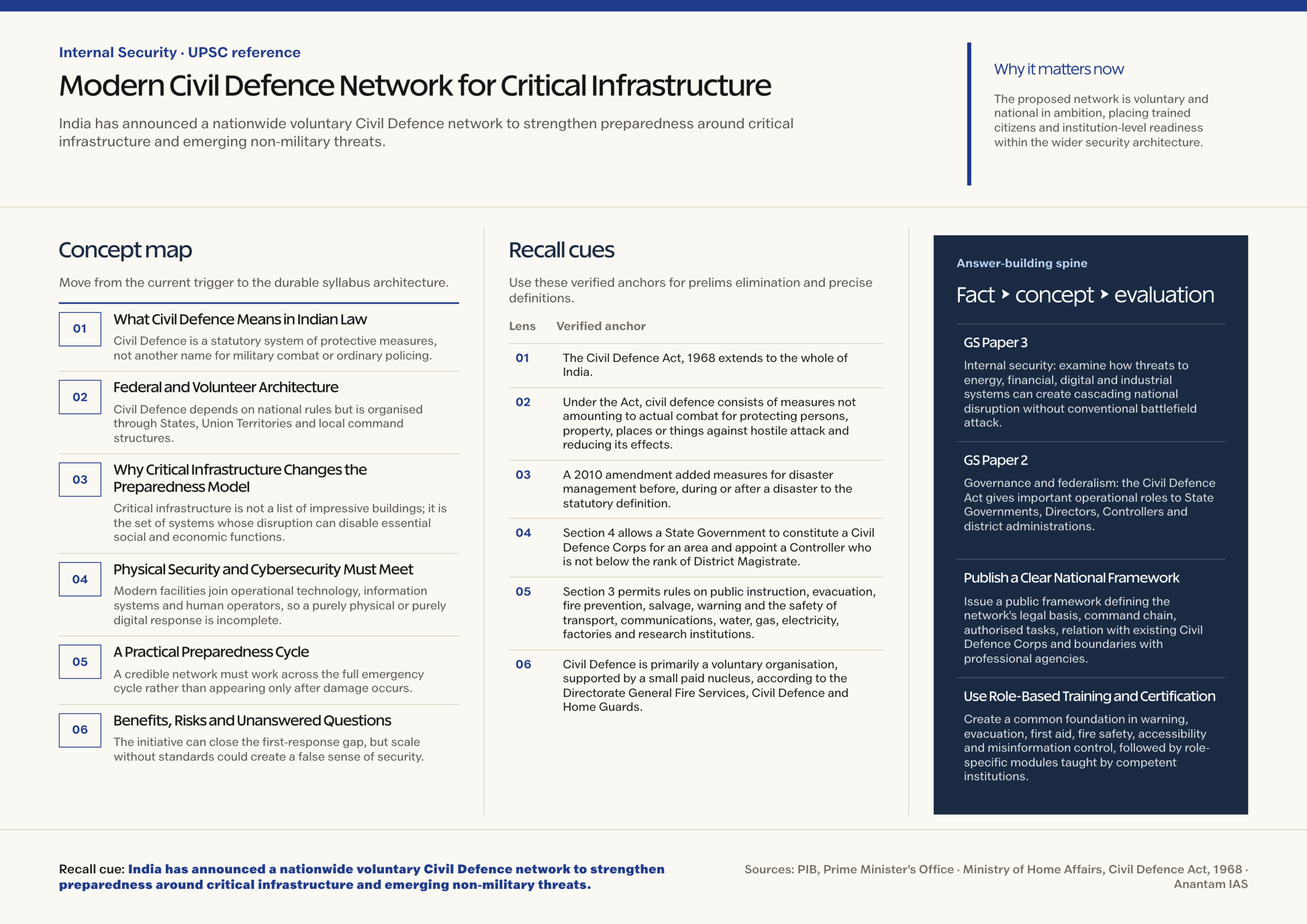
Modern Civil Defence Network for Critical Infrastructure
Why in News?
In his Independence Day address on 15 August 2026 , the Prime Minister announced a nationwide voluntary Civil Defence network designed for modern security risks rather than only the older image of wartime preparedness near India’s borders.
- The proposed network is voluntary and national in ambition, placing trained citizens and institution-level readiness within the wider security architecture.
- Its stated focus reflects a change in the threat environment: disruption can reach the hinterland through sabotage, drones, cyber incidents, fire, hazardous-material emergencies or cascading failures in essential services.
- The announcement named both physical and digital assets, showing that resilience now depends on the continuity of energy, finance, communications, data and industrial production.
- No official operational design has yet assigned a lead ministry, recruitment channel, volunteer strength, training syllabus or site list for the new network. These details should be treated as pending.
- For UPSC answers, the initiative should be assessed as a proposal to modernise community preparedness, not as a new armed force or proof that a nationwide system is already operational.
- Modern infrastructure works as an interdependent system. A power outage can disable telecom towers and data centres; payment failure can slow fuel and relief supply; a refinery accident can affect transport and local health services.
- Professional agencies cannot be present at every facility in the first minutes of an emergency. Trained local volunteers can support warning, evacuation, first aid, fire safety, crowd management and verified communication until specialist responders take charge.
- Civilian participation can increase resilience only when command, vetting, liability, training standards and limits on volunteer access to sensitive sites are clearly defined.
UPSC Relevance
Prelims Relevance
- The Civil Defence Act, 1968 extends to the whole of India.
- Under the Act, civil defence consists of measures not amounting to actual combat for protecting persons, property, places or things against hostile attack and reducing its effects.
- A 2010 amendment added measures for disaster management before, during or after a disaster to the statutory definition.
- Section 4 allows a State Government to constitute a Civil Defence Corps for an area and appoint a Controller who is not below the rank of District Magistrate.
- Section 3 permits rules on public instruction, evacuation, fire prevention, salvage, warning and the safety of transport, communications, water, gas, electricity, factories and research institutions.
- Civil Defence is primarily a voluntary organisation, supported by a small paid nucleus, according to the Directorate General Fire Services, Civil Defence and Home Guards.
Mains Relevance
GS Paper 3
- Internal security: examine how threats to energy, financial, digital and industrial systems can create cascading national disruption without conventional battlefield attack.
- Disaster management: connect community volunteers with prevention, preparedness, response, recovery and the principle of whole-of-society resilience.
GS Paper 2
- Governance and federalism: the Civil Defence Act gives important operational roles to State Governments, Directors, Controllers and district administrations.
- Institutional design: assess accountability, privacy, volunteer vetting and safeguards against overlapping commands or misuse of access to sensitive facilities.
Essay
- National security is not only the defence of territory; it is also society’s capacity to keep essential systems functioning under stress.
Background and Context
What Civil Defence Means in Indian Law
Civil Defence is a statutory system of protective measures, not another name for military combat or ordinary policing.
- The Civil Defence Act, 1968 defines it as measures that do not amount to actual combat and protect people, property, places or things from hostile attack, or reduce the effects of such an attack.
- The definition covers measures taken before, during or after a hostile attack. The law defines hostile attack broadly enough to include dangers arising during war, external aggression, internal disturbance or otherwise.
- The Civil Defence (Amendment) Act, 2009, brought into effect in 2010, added disaster-management measures before, during and after natural or human-made disasters while retaining the organisation’s primary civil-defence role.
- Section 3 authorises rules covering public instruction, storage of essential items, control of lights and sounds, fire prevention, evacuation, shelter, salvage and protection of essential facilities.
- This statutory breadth matters because the new announcement is not a complete break from the law. It can be read as an effort to update the risk model, geographic reach and operational readiness of an existing.
Federal and Volunteer Architecture
Civil Defence depends on national rules but is organised through States, Union Territories and local command structures.
- Under Section 4, a State Government may constitute a Civil Defence Corps for an area and appoint a Controller, not below the rank of District Magistrate, to command it.
- A State may appoint a Director of Civil Defence to coordinate Controllers. This makes district administration central to mobilisation, training and site-level coordination.
- Members are persons whom the State Government considers fit and willing to serve. A Controller may call members out for training or assigned civil-defence functions.
- The official Civil Defence portal describes the organisation as primarily voluntary, with a small nucleus of paid staff. It also describes training at local or district, State and national levels.
- A nationwide network will need interoperability across States without weakening local accountability. Common operating procedures can support mutual aid, while the incident authority must remain unambiguous.
Why Critical Infrastructure Changes the Preparedness Model
Critical infrastructure is not a list of impressive buildings; it is the set of systems whose disruption can disable essential social and economic functions.
- The Civil Defence Act already lists the safety of transport, communication, water, gas, electricity, warehouses, oilfields, factories, commercial undertakings and research institutions among matters for which rules may be made.
- The 2026 announcement brings this older legal scope into a setting shaped by digitised operations, remotely controlled equipment, tightly coupled supply chains and around-the-clock financial services.
- A refinery emergency can combine fire, toxic exposure, evacuation and fuel-supply disruption. A data-centre failure can affect cloud services and dependent institutions. A bank-system outage can obstruct payments needed for emergency logistics.
- These are cascading risks: the first failure may be local, but interdependence spreads its effects across sectors and districts.
- Resilience needs both hardening and continuity. Physical security, cybersecurity, backup power, alternative communication, manual fallback procedures, stockpiles and rehearsed public instructions serve different parts of the same problem.
Physical Security and Cybersecurity Must Meet
Modern facilities join operational technology, information systems and human operators, so a purely physical or purely digital response is incomplete.
- Under Section 70 of the Information Technology Act, Critical Information Infrastructure refers to computer resources whose incapacitation or destruction would have a debilitating impact on national security, the economy, public health or safety.
- The appropriate government may notify a relevant computer resource as a protected system. Section 70A provides for a national nodal agency for Critical Information Infrastructure protection.
- Civil Defence volunteers should not receive unrestricted access to protected systems or sensitive control rooms. Their useful roles can include perimeter safety, public warning, evacuation support, first aid and disciplined reporting under authorised command.
- Cyber specialists and facility operators must handle containment, restoration and evidence preservation. Volunteers need simple protocols for recognising suspicious events and escalating them without spreading rumours or sensitive details.
- Joint exercises should test mixed incidents, such as a cyber-triggered service outage accompanied by fire, crowd panic or communications failure. This reveals gaps that isolated drills miss.
Way Forward
Publish a Clear National Framework
- Issue a public framework defining the network’s legal basis, command chain, authorised tasks, relation with existing Civil Defence Corps and boundaries with professional agencies.
- Publish measurable readiness outcomes, financing arrangements and a phased coverage rationale without disclosing site vulnerabilities.
- Create a common foundation in warning, evacuation, first aid, fire safety, accessibility and misinformation control, followed by role-specific modules taught by competent institutions.
- Require practical assessment, refresher training and expiry of certification so a database entry does not become a permanent claim of competence.
Conclusion
- The proposed Modern Civil Defence network recognises a central fact of contemporary security: the home front now includes refineries, factories, payment systems, data centres and the communities living around them.
- The announcement is only a starting point.
UPSC Practice Questions
Prelims MCQ 1
With reference to the Civil Defence Act, 1968, consider the following statements:
- Civil defence measures under the Act do not amount to actual combat.
- The statutory definition includes disaster-management measures before, during or after a disaster.
- Only the Central Government may constitute a Civil Defence Corps for an area.
How many of the above statements are correct?
(a) Only one (b) Only two (c) All three (d) None
Answer: (b) Only two
Explanation:
Statements 1 and 2 are correct. The Act defines civil defence as non-combat protective measures and, after the amendment effective in 2010, includes disaster management. Statement 3 is incorrect because Section 4 permits a State Government to constitute a Civil Defence Corps for an area.
Prelims MCQ 2
Which one of the following best describes Critical Information Infrastructure under the Information Technology Act, 2000?
(a) Every computer owned by a government department (b) Any privately owned data centre with overseas customers (c) A computer resource whose incapacitation or destruction would have a debilitating impact on national security, the economy, public health or safety (d) Any social-media platform with more than one million users
Answer: (c) A computer resource whose incapacitation or destruction would have a debilitating impact on national security, the economy, public health or safety
Explanation:
Section 70 of the Information Technology Act uses the debilitating-impact test. Government ownership, foreign customers or user count alone does not satisfy this statutory definition. The appropriate government may notify qualifying computer resources as protected systems.
UPSC Mains Questions
- Modern national security requires protection of networks and services as much as protection of territory. Discuss in the context of India’s proposed nationwide Civil Defence network for critical infrastructure. (GS Paper 3)
- Community volunteers can reduce the first-response gap, but they cannot replace professional emergency services. Suggest an accountable institutional design for integrating volunteers into critical-infrastructure preparedness. (GS Paper 3)
Sources: PIB, Prime Minister's Office and Ministry of Home Affairs, Civil Defence Act, 1968.
Frequently Asked Questions
What has India announced about a modern Civil Defence network?
The Prime Minister announced a nationwide voluntary Civil Defence network on 15 August 2026, linking preparedness to modern threats facing refineries, banks, data centres, factories and other critical infrastructure. It remains an announced initiative; a detailed budget, curriculum, implementing arrangement.
Is Civil Defence the same as the armed forces or police?
No. The Civil Defence Act defines civil defence as protective measures that do not amount to actual combat. Volunteers may support warning, evacuation, first aid, fire safety and civil administration under authorised command. Armed forces, police, firefighters, cyber specialists and.
Who can constitute a Civil Defence Corps in India?
Section 4 of the Civil Defence Act allows a State Government to constitute a Corps for an area. The State may appoint a Controller, not below the rank of District Magistrate, and a Director of Civil Defence to coordinate Controllers.
Why are data centres and banks part of a Civil Defence discussion?
Digital and financial systems support payments, communications, government services and emergency logistics. Their disruption can spread across sectors even when the initial incident is local. Civil Defence can support public safety and continuity around these facilities, while authorised cyber and.
How is Critical Information Infrastructure different from critical infrastructure generally?
Critical infrastructure is a wider resilience idea covering essential physical and service systems. Critical Information Infrastructure has a specific definition under Section 70 of the Information Technology Act: a computer resource whose incapacitation or destruction would seriously affect national security.
Source: https://anantamias.com/current-affairs/civil-defence-network-critical-infrastructure/
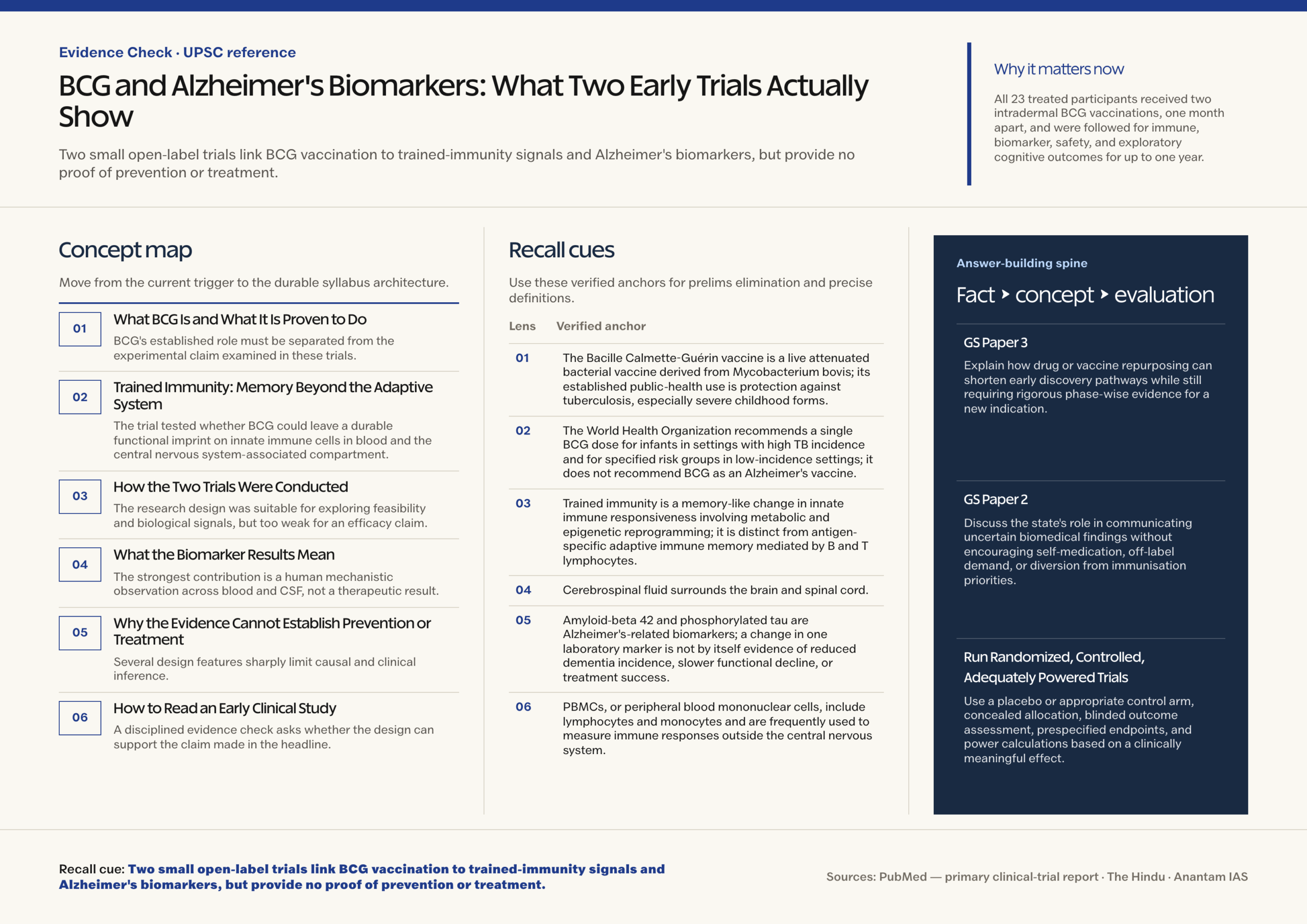
BCG and Alzheimer’s Biomarkers: What Two Early Trials Actually Show
Why in News?
A report in Communications Medicine , indexed on PubMed and discussed by The Hindu, combined two very small, single-centre, open-label trials of Bacille Calmette-Guérin vaccination in older adults.
- All 23 treated participants received two intradermal BCG vaccinations, one month apart, and were followed for immune, biomarker, safety, and exploratory cognitive outcomes for up to one year.
- The trials were open-label and uncontrolled: participants and investigators knew the intervention, and there was no placebo or untreated comparison group against which natural change, measurement variation, or test-retest effects could be separated.
- Researchers found persistent stimulus-responsive changes in peripheral blood mononuclear cells and cerebrospinal-fluid monocytes, consistent with, but not definitive proof of, trained innate immunity in the central nervous system compartment.
- In participants classified without Alzheimer-related changes, cerebrospinal-fluid amyloid-beta 42 decreased while plasma amyloid-beta 42 increased. The authors described this as a biomarker association, not proof of improved brain clearance or clinical benefit.
- No significant longitudinal change was found in cerebrospinal-fluid phosphorylated tau-181, neurofilament light, or GFAP, and the study was not powered or designed to establish clinical efficacy.
- The study connects three syllabus themes: vaccine platforms, the changing science of innate immune memory, and the evidentiary path from an exploratory biomarker signal to a clinically useful intervention.
- It also illustrates why public-health communication must separate biological plausibility from demonstrated patient benefit, especially when a familiar vaccine is studied for a new indication.
- For India, the development matters scientifically because BCG is embedded in tuberculosis control, but an experimental neurodegeneration hypothesis must not be confused with the vaccine’s established TB-prevention role.
UPSC Relevance
Prelims Relevance
- The Bacille Calmette-Guérin vaccine is a live attenuated bacterial vaccine derived from Mycobacterium bovis; its established public-health use is protection against tuberculosis, especially severe childhood forms.
- The World Health Organization recommends a single BCG dose for infants in settings with high TB incidence and for specified risk groups in low-incidence settings; it does not recommend BCG as an Alzheimer’s vaccine.
- Trained immunity is a memory-like change in innate immune responsiveness involving metabolic and epigenetic reprogramming; it is distinct from antigen-specific adaptive immune memory mediated by B and T lymphocytes.
- Cerebrospinal fluid surrounds the brain and spinal cord. Sampling it can provide information about the central nervous system, but CSF immune cells are not identical to resident brain microglia.
- Amyloid-beta 42 and phosphorylated tau are Alzheimer’s-related biomarkers; a change in one laboratory marker is not by itself evidence of reduced dementia incidence, slower functional decline, or treatment success.
- PBMCs, or peripheral blood mononuclear cells, include lymphocytes and monocytes and are frequently used to measure immune responses outside the central nervous system.
Mains Relevance
GS Paper 3
- Explain how drug or vaccine repurposing can shorten early discovery pathways while still requiring rigorous phase-wise evidence for a new indication.
- Assess trained immunity as an emerging biotechnology concept linking epigenetic reprogramming, immunometabolism, and disease research.
GS Paper 2
- Discuss the state’s role in communicating uncertain biomedical findings without encouraging self-medication, off-label demand, or diversion from immunisation priorities.
- Examine why trial registration, control groups, adequate sample size, transparent attrition reporting, and diverse recruitment are essential to evidence-based health policy.
Essay
- Scientific progress often begins with a plausible signal, but public trust depends on preserving the boundary between hope and evidence.
Background and Context
What BCG Is and What It Is Proven to Do
BCG’s established role must be separated from the experimental claim examined in these trials.
- BCG is a live attenuated vaccine developed from Mycobacterium bovis. It is the only licensed vaccine against tuberculosis and has been used for more than a century.
- According to the World Health Organization, BCG is given to babies or young children in many countries and protects children against severe forms of TB and TB-related death.
- Its protection against pulmonary TB varies by age, population, geography, and previous mycobacterial exposure. This variability is separate from the Alzheimer’s hypothesis.
- BCG is also used as an immunotherapy for some forms of bladder cancer. That history makes it a useful platform for studying broad immune effects, but success in one indication cannot be transferred to another without.
Trained Immunity: Memory Beyond the Adaptive System
The trial tested whether BCG could leave a durable functional imprint on innate immune cells in blood and the central nervous system-associated compartment.
- Classic immunological memory is associated with antigen-specific B and T cells. Trained immunity refers to longer-lasting changes in innate cells or their progenitors after an initial stimulus.
- These changes can involve epigenetic marks and cellular metabolism, allowing monocytes or related cells to respond differently when challenged later, even by a different stimulus.
- Researchers stimulated cells outside the body with heat-killed BCG, lipopolysaccharide, and, for some blood-cell assays, heat-killed Candida albicans. Cytokine production and single-cell gene-expression patterns were then compared over time.
- CSF monocytes showed a sustained transcriptional response to lipopolysaccharide, while direct response to heat-killed BCG was negligible in that compartment. This supports an indirect trained-immunity-like interpretation, not proof that vaccine organisms entered or acted directly.
- The distinction matters because stronger recall responsiveness is not the same as constant inflammation. Basal CSF interferon-gamma and interleukin-2 declined by 12 months, while several inflammatory cytokines remained low.
How the Two Trials Were Conducted
The research design was suitable for exploring feasibility and biological signals, but too weak for an efficacy claim.
- The studies recruited adults aged 55 years or older at one centre. Thirty-five people were screened, 23 were enrolled and treated, and 17 completed the full 12-month protocol.
- The two protocol cohorts were reported as 12 participants without Alzheimer-related pathology and 11 with it. In a later pooled analysis using the CSF phosphorylated-tau-181 to amyloid-beta-42 ratio, clustering yielded 11 non-AD and 12 AD.
- Participants received two intradermal BCG doses, at baseline and one month. Blood was sampled at baseline and at 3, 6, and 12 months; CSF was sampled at baseline and at 3 and 12 months.
- The first protocol focused on identifying feasible inflammation, immune-response, and neurodegeneration biomarkers. The second focused on safety and immune and Alzheimer’s-related biomarker changes in people with mild cognitive impairment or mild-to-moderate Alzheimer’s disease.
- The trials were open-label. The mild-cognitive-impairment/Alzheimer’s protocol was originally conceived as randomized but proceeded as a single-arm study because of feasibility and funding constraints.
What the Biomarker Results Mean
The strongest contribution is a human mechanistic observation across blood and CSF, not a therapeutic result.
- Peripheral blood cells showed persistent recall responses, including cytokine responses after laboratory stimulation. CSF monocytes also showed transcriptional reprogramming involving immune signalling, oxidative stress, and metabolic adaptation.
- The peripheral and CSF patterns differed. Plasma responses were more pronounced in participants classified with Alzheimer-related pathology, while CSF cytokine patterns were more restrained across groups, pointing to compartment-specific immune effects.
- In the group classified without Alzheimer-related changes, the CSF-to-plasma amyloid-beta-42 ratio fell by a reported 38.2% over 12 months. This was an exploratory, descriptive association and was not observed meaningfully in the AD group.
- A lower CSF-to-plasma ratio could be consistent with altered amyloid movement or clearance, but the trial did not directly measure clearance. Direction, mechanism, and clinical significance remain uncertain.
- CSF phosphorylated tau-181, neurofilament light, and GFAP did not show significant longitudinal changes. The pattern is mixed and cannot be compressed into a claim that Alzheimer’s pathology improved.
Way Forward
Run Randomized, Controlled, Adequately Powered Trials
- Use a placebo or appropriate control arm, concealed allocation, blinded outcome assessment, prespecified endpoints, and power calculations based on a clinically meaningful effect.
- Stratify participants by disease stage and biomarker status before randomization rather than relying mainly on small post hoc subgroups.
- Extend follow-up beyond one year to measure cognitive trajectory, daily functioning, conversion from mild cognitive impairment, and adverse events.
Conclusion
- The two BCG trials offer a credible early clue that an old vaccine can reshape immune responses detectable in blood and cerebrospinal fluid.
- The same evidence also demands restraint.
UPSC Practice Questions
Prelims MCQ 1
With reference to BCG vaccination and trained immunity, consider the following statements:
- BCG is a live attenuated vaccine derived from Mycobacterium bovis.
- Trained immunity refers exclusively to antigen-specific memory generated by B lymphocytes.
- A change in an Alzheimer’s-related fluid biomarker by itself proves clinical benefit.
How many of the above statements are correct?
(a) Only one (b) Only two (c) All three (d) None
Answer: (a) Only one
Explanation:
Statement 1 is correct. Trained immunity is a memory-like alteration of innate immune responsiveness, not exclusively B-cell memory. A surrogate biomarker change cannot by itself establish prevention, treatment, or clinical benefit.
Prelims MCQ 2
Which one of the following most accurately describes the evidentiary value of the reported BCG-Alzheimer’s trials?
(a) They prove that BCG prevents Alzheimer’s disease in older adults (b) They establish BCG as a treatment for mild-to-moderate Alzheimer’s disease (c) They provide an exploratory mechanistic signal that requires confirmation in larger controlled trials (d) They show that all Alzheimer’s biomarkers improve after BCG vaccination
Answer: (c) They provide an exploratory mechanistic signal that requires confirmation in larger controlled trials
Explanation:
The studies were very small, open-label, single-arm trials focused on safety, immune responses, and biomarkers. They did not establish clinical efficacy, and several neurodegeneration biomarkers did not change significantly.
UPSC Mains Questions
- The journey from a biomedical signal to a public-health intervention depends as much on research design as on biological plausibility. Discuss with reference to vaccine repurposing. (15 marks, 250 words)
- Differentiate trained immunity from adaptive immune memory. Evaluate the opportunities and evidentiary risks of targeting trained immunity in neurodegenerative disease. (15 marks, 250 words)
Sources: PubMed — primary clinical-trial report and The Hindu.
Frequently Asked Questions
Did the study prove that BCG prevents Alzheimer’s disease?
No. The report combined two very small open-label trials with no placebo or untreated control group. It found immune and biomarker changes that can generate hypotheses, but it did not measure or demonstrate reduced Alzheimer’s incidence. Prevention would require a.
Can BCG be used to treat someone who already has Alzheimer’s disease?
Not on the basis of this evidence. The study was not designed or powered to prove clinical efficacy, and it did not show meaningful cognitive or functional improvement attributable to BCG. Any Alzheimer’s use remains experimental and should occur only.
What is trained immunity?
Trained immunity is a memory-like alteration in innate immune cells or their progenitors after an earlier stimulus. Metabolic and epigenetic reprogramming can change later responses, including to unrelated stimuli. It differs from the antigen-specific memory classically produced by adaptive B.
What did researchers observe in cerebrospinal fluid?
They observed persistent trained-immunity-like gene-expression responses in CSF monocytes after laboratory stimulation, along with changes in some cytokines and amyloid-beta measures. The pattern differed from blood, suggesting compartment-specific immune effects. CSF findings do not directly establish what resident brain microglia.
Why is the amyloid-beta result not proof of benefit?
Amyloid-beta concentrations are surrogate biological measures. A change can have several explanations and does not automatically mean better clearance, slower cognitive decline, or improved daily functioning. The shift occurred in a small subgroup, lacked a control comparison, and was not.
Source: https://anantamias.com/current-affairs/bcg-trained-immunity-alzheimers-trial/
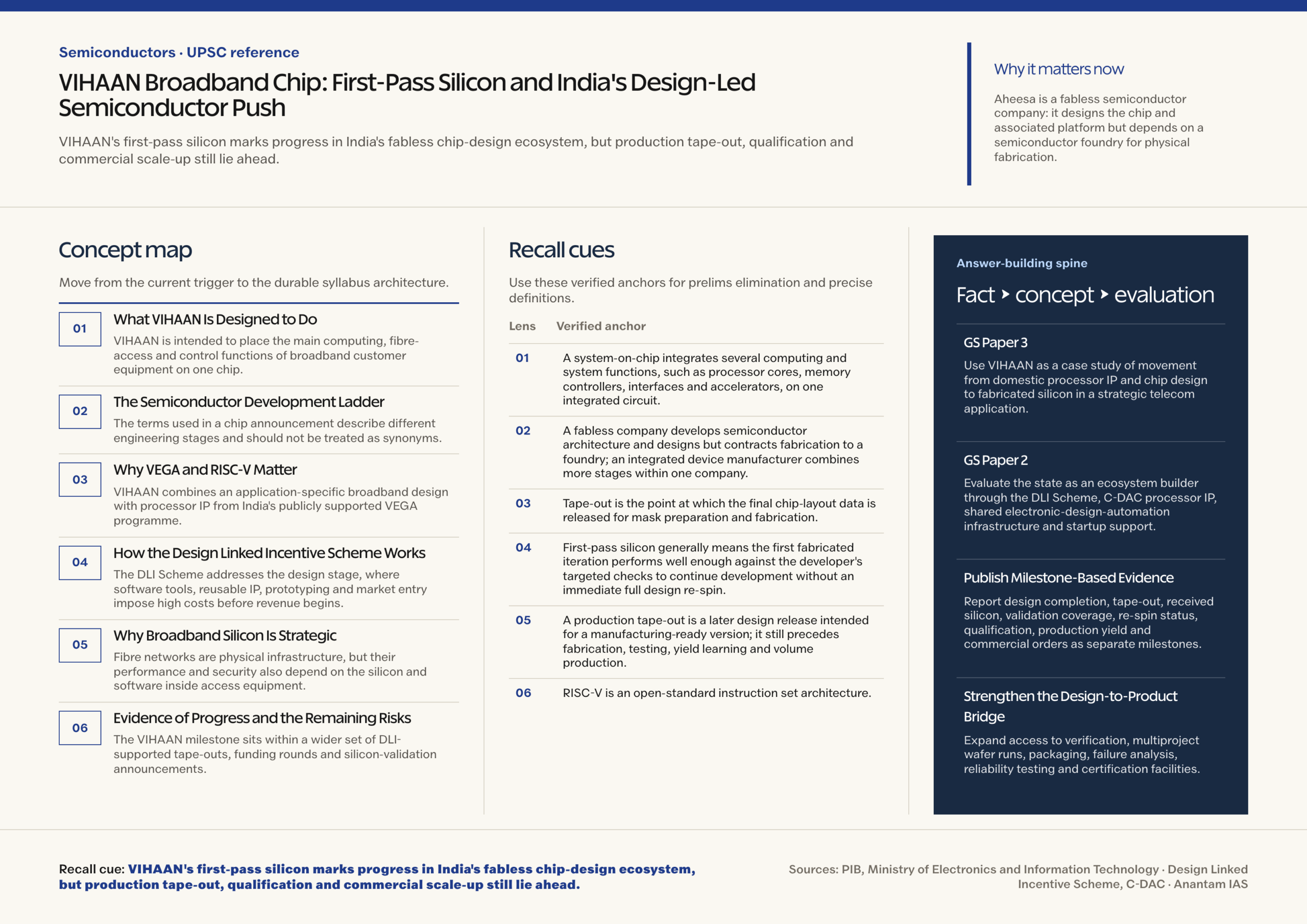
VIHAAN Broadband Chip: First-Pass Silicon and India’s Design-Led Semiconductor Push
Why in News?
On 15 August 2026, the Ministry of Electronics and Information Technology announced that Chennai-based Aheesa Digital Innovations had achieved first-pass silicon success for VIHAAN, a networking system-on-chip designed for fibre-broadband equipment.
- Aheesa is a fabless semiconductor company: it designs the chip and associated platform but depends on a semiconductor foundry for physical fabrication.
- The VIHAAN design was taped out on 26 January 2026, according to the PIB release, and the fabricated silicon achieved the announced first-pass milestone on 15 August 2026.
- VIHAAN is a purpose-built networking SoC for fibre broadband and uses a 64-bit processor from C-DAC’s indigenous VEGA family, which is based on the open RISC-V instruction set architecture.
- The company says the platform is intended for fibre-to-the-home customer-premises equipment and supports broadband interfaces such as GPON and EPON; these product claims still require customer-level integration and validation before mass deployment.
- PIB reported that Aheesa had raised about ₹40 crore from the Tamil Nadu Emerging Sector Seed Fund and other private investors to support product development and growth.
- Broadband equipment contains specialised silicon for packet processing, security, memory control and optical-access functions. Domestic ownership of the design and intellectual property can improve the scope for local adaptation, security review and value addition.
- Chip design captures a high-value part of the semiconductor chain, but it cannot substitute for fabrication, assembly, packaging, testing, reliable software, customer qualification and volume production.
- The milestone illustrates how public design infrastructure and incentives can reduce the high upfront cost faced by fabless startups, while private finance and OEM demand remain necessary for commercial scale.
UPSC Relevance
Prelims Relevance
- A system-on-chip integrates several computing and system functions, such as processor cores, memory controllers, interfaces and accelerators, on one integrated circuit.
- A fabless company develops semiconductor architecture and designs but contracts fabrication to a foundry; an integrated device manufacturer combines more stages within one company.
- Tape-out is the point at which the final chip-layout data is released for mask preparation and fabrication. It is not the same as receiving or validating fabricated silicon.
- First-pass silicon generally means the first fabricated iteration performs well enough against the developer’s targeted checks to continue development without an immediate full design re-spin. The exact validation scope must be read from the developer’s disclosure.
- A production tape-out is a later design release intended for a manufacturing-ready version; it still precedes fabrication, testing, yield learning and volume production.
- RISC-V is an open-standard instruction set architecture. An open ISA does not automatically make every processor implementation or SoC design open-source.
Mains Relevance
GS Paper 3
- Use VIHAAN as a case study of movement from domestic processor IP and chip design to fabricated silicon in a strategic telecom application.
- Examine the different policy requirements of the semiconductor value chain: design tools and IP, foundry access, packaging and testing, firmware, standards compliance, patient capital and assured demand.
GS Paper 2
- Evaluate the state as an ecosystem builder through the DLI Scheme, C-DAC processor IP, shared electronic-design-automation infrastructure and startup support.
- Discuss how transparent milestone reporting and outcome-based public support can balance strategic autonomy with fiscal accountability.
Essay
- Technological self-reliance is not isolation; it is the capacity to design, verify, adapt and negotiate from a position of capability.
Background and Context
What VIHAAN Is Designed to Do
VIHAAN is intended to place the main computing, fibre-access and control functions of broadband customer equipment on one chip.
- Aheesa describes VIHAAN as a RISC-V networking SoC for fibre-to-the-home customer-premises equipment, where it can support the handling of optical-access traffic and local network connections.
- Its published platform description lists GPON, EPON and Gigabit Ethernet, along with DDR4 memory, SPI NOR Flash and eMMC storage support. These interfaces allow a device maker to combine access-network termination, data processing and system.
- The 2025 MeitY roadmap described VIHAAN as being built around a 64-bit C-DAC VEGA processor, with secure boot, security enhancements, PCIe 3.0 and USB 3.0 among the intended connectivity features.
- The chip is one part of a product stack. Reference hardware, boot software, drivers, an operating system, networking software and OEM testing are also needed before a broadband device reaches users.
The Semiconductor Development Ladder
The terms used in a chip announcement describe different engineering stages and should not be treated as synonyms.
- Design covers architecture, logic, integration of processor and interface IP, verification and the physical layout needed for manufacture.
- At tape-out, the design team freezes and sends the final layout data to a foundry. The foundry then uses that data to prepare masks and fabricate wafers.
- Fabricated dies must be packaged and subjected to electrical, functional and reliability tests. A successful first pass reduces the risk and cost of an immediate redesign, but it does not by itself establish production yield, long-term.
- A design may still change after first silicon as engineers correct issues, improve performance, incorporate test learning or prepare a production version. PIB explicitly says VIHAAN will proceed towards a production tape-out targeted for 2027.
- Commercial readiness requires further gates: stable yields at the foundry, packaging and testing capacity, firmware maturity, reference platforms, standards and operator qualification, supply commitments and customer orders.
Why VEGA and RISC-V Matter
VIHAAN combines an application-specific broadband design with processor IP from India’s publicly supported VEGA programme.
- C-DAC’s VEGA family includes 32-bit and 64-bit single-core and multicore processors based on the RISC-V instruction set architecture, with variants for embedded and higher-performance applications.
- RISC-V provides an open instruction set specification, allowing implementers to design compatible processor cores without depending on a proprietary ISA licence. The surrounding processor core, peripherals, accelerators, software and SoC layout can still contain separately.
- Using domestic processor IP can build local competence in debugging, security review, customisation and lifecycle support. It may also give designers greater control over product roadmaps for strategic or India-specific applications.
- The test of sovereignty is not the label alone. Policymakers should ask which design blocks are locally owned, where fabrication and packaging occur, what tool and foreign-IP dependencies remain, and whether local firms can maintain the.
How the Design Linked Incentive Scheme Works
The DLI Scheme addresses the design stage, where software tools, reusable IP, prototyping and market entry impose high costs before revenue begins.
- The scheme supports domestic companies, startups and MSMEs designing integrated circuits, chipsets, SoCs, systems and semiconductor IP cores through financial incentives and design-infrastructure access.
- Its stated objectives are to nurture domestic design firms, increase Indian-owned semiconductor content and IP, support import substitution and value addition, and improve startup and MSME access to design infrastructure.
- C-DAC is the nodal agency. This creates a policy bridge between publicly developed processor technology, shared design support and private product companies such as Aheesa.
- According to PIB, government semiconductor programmes had made advanced chip-design tools available to 455 organisations, comprising 350 academic institutions and 105 startups. Such access can lower entry barriers, but it does not remove the need.
Way Forward
Publish Milestone-Based Evidence
- Report design completion, tape-out, received silicon, validation coverage, re-spin status, qualification, production yield and commercial orders as separate milestones.
- Use independently auditable indicators while protecting genuine trade secrets and security-sensitive design details.
- Track domestic ownership of IP, value addition, skilled employment, exports and long-term product support alongside the number of supported firms.
Conclusion
- VIHAAN’s first-pass silicon is a credible engineering milestone because it shows that an Indian fabless company has carried a broadband SoC from design and tape-out to fabricated hardware that can enter deeper validation.
- The correct policy lesson is neither to dismiss the milestone nor to call the chip commercially produced.
UPSC Practice Questions
Prelims MCQ 1
With reference to semiconductor development, consider the following statements:
- Tape-out refers to the release of a final chip layout for mask preparation and fabrication.
- First-pass silicon necessarily means that a chip has entered commercial volume production.
- A fabless semiconductor company may design chips while contracting their physical fabrication to a foundry.
How many of the above statements are correct?
(a) Only one (b) Only two (c) All three (d) None
Answer: (b) Only two
Explanation:
Statements 1 and 3 are correct. Tape-out precedes fabrication, and fabless firms outsource fabrication. First-pass silicon is an early hardware-validation milestone; it does not establish qualification, production yield or commercial volume manufacturing.
Prelims MCQ 2
Which one of the following best describes the Design Linked Incentive Scheme?
(a) A scheme restricted to constructing semiconductor fabrication plants (b) A programme exclusively for importing semiconductor manufacturing equipment (c) A scheme providing incentives and design-infrastructure support to eligible domestic semiconductor-design entities (d) A compulsory licensing framework for all RISC-V processor designs
Answer: (c) A scheme providing incentives and design-infrastructure support to eligible domestic semiconductor-design entities
Explanation:
The DLI Scheme supports eligible domestic companies, startups and MSMEs across semiconductor-design and deployment stages for ICs, chipsets, SoCs, systems and IP cores. C-DAC is the nodal agency.
UPSC Mains Questions
- The distance from tape-out to a commercially successful chip is as much an ecosystem challenge as a design challenge. Discuss with reference to India’s semiconductor policy.
- How can an open instruction set architecture and domestically developed processor IP strengthen technological capability without eliminating global semiconductor interdependence?
Sources: PIB, Ministry of Electronics and Information Technology and Design Linked Incentive Scheme, C-DAC.
Frequently Asked Questions
What is the VIHAAN broadband chip?
VIHAAN is a networking system-on-chip designed by Chennai-based Aheesa Digital Innovations for fibre-broadband customer equipment. It uses a 64-bit processor from C-DAC’s RISC-V-based VEGA family and is intended to integrate computing, optical-access and network-control functions with interfaces needed by broadband.
What does first-pass silicon mean?
It means the first fabricated silicon iteration performed well enough against the developer’s targeted checks to move forward without an immediate complete design re-spin. The phrase does not disclose every test passed, and it does not mean the chip has.
Is VIHAAN already in commercial production?
No such conclusion follows from the announcement. PIB reported first-pass silicon and said the chip would proceed towards a production tape-out targeted for 2027. Fabrication of that version, packaging, testing, yield improvement, certification, OEM integration and customer orders would still.
What is the difference between tape-out and fabrication?
Tape-out is the handoff of the final chip-layout data for manufacturing. Fabrication is the foundry process that converts that design into physical dies on wafers. The dies are then packaged and tested. Receiving working silicon is a later milestone than.
Why is RISC-V relevant to VIHAAN?
RISC-V is the open-standard instruction set architecture underlying C-DAC’s VEGA processor family. It gives processor designers freedom to build compatible implementations without a proprietary ISA licence. It does not make every processor core, peripheral, accelerator or complete SoC automatically open-source.
Source: https://anantamias.com/current-affairs/vihaan-indigenous-broadband-chip/
Chitra Core Coronary Stent: Indigenous Design and MedTech Regulation
Why in News?
Sree Chitra Tirunal Institute for Medical Sciences and Technology, or SCTIMST , unveiled Chitra Core , a commercially launched indigenous drug-eluting coronary stent, in Thiruvananthapuram in August 2026.
- Chitra Core is a drug-eluting coronary stent, not merely a bare-metal scaffold. It combines mechanical support for a narrowed coronary artery with local drug release intended to limit tissue growth that can re-narrow the treated.
- Its reported design feature is a lower metal-to-artery ratio, meaning less metal surface is placed against the vessel wall. The design is intended to reduce vessel injury, but the public announcement does not establish superiority.
- The product reached the market after technology transfer from SCTIMST to an industry partner and licensing under India’s medical-device regulatory system. A transfer agreement alone would not have been a market authorisation.
- The launch should not be confused with SCTIMST’s separate Chitra titanium-nitride-coated coronary stent. The latter is an L605 alloy, TiN-coated bare-metal platform whose official technology-transfer material places additional pre-clinical, clinical and regulatory work with the.
- No verified retail price, procurement price or head-to-head clinical result was supplied in the source record used for this note. Claims of affordability or performance must be tested through transparent pricing, clinical evidence and post-market.
- Coronary artery disease narrows vessels supplying the heart. During percutaneous coronary intervention, a balloon-mounted stent is guided to the lesion, expanded, and left as a scaffold to preserve blood flow.
- A drug-eluting stent releases an anti-proliferative medicine from its coating to reduce neointimal growth and restenosis. The device still demands careful implantation, appropriate antiplatelet therapy, manufacturing consistency and follow-up.
- Indigenous design can improve supply security and create domestic capability in alloys, laser cutting, surface engineering, coating, catheter delivery systems, testing and regulatory documentation. Local origin by itself does not prove lower cost or better.
UPSC Relevance
Prelims Relevance
- SCTIMST is an Institution of National Importance under the Department of Science and Technology, Government of India.
- Chitra Core is a drug-eluting coronary stent designed for use in a coronary artery during percutaneous coronary intervention.
- A coronary stent provides a mechanical scaffold; the drug coating of a drug-eluting stent is intended to inhibit tissue proliferation associated with restenosis.
- CDSCO classifies both coronary stents and drug-eluting stents as Class D medical devices, the highest-risk category under the Medical Devices Rules framework.
- The Medical Devices Rules, 2017 came into force on 1 January 2018 and use risk-based classification for medical devices.
- For Class C and Class D devices, the Central Licensing Authority has the principal licensing role under the Medical Devices Rules, while lower-risk classes generally involve State Licensing Authorities.
Mains Relevance
GS Paper 3
- Science and technology: explain the progression from an unmet clinical need to device design, prototyping, verification, validation, manufacturing and commercial deployment.
- Indigenisation: assess how domestic intellectual property, process know-how, components and quality systems can reduce strategic dependence in high-risk medical devices.
GS Paper 2
- Health governance: examine the CDSCO’s role under the Medical Devices Rules, 2017, especially for high-risk Class D implants.
- Public policy: balance affordability and access with informed consent, procurement quality, adverse-event reporting and independent clinical evaluation.
Essay
- Self-reliance is capability, not a label: a medical device becomes socially valuable only when indigenous science is converted into safe, scalable and accessible care.
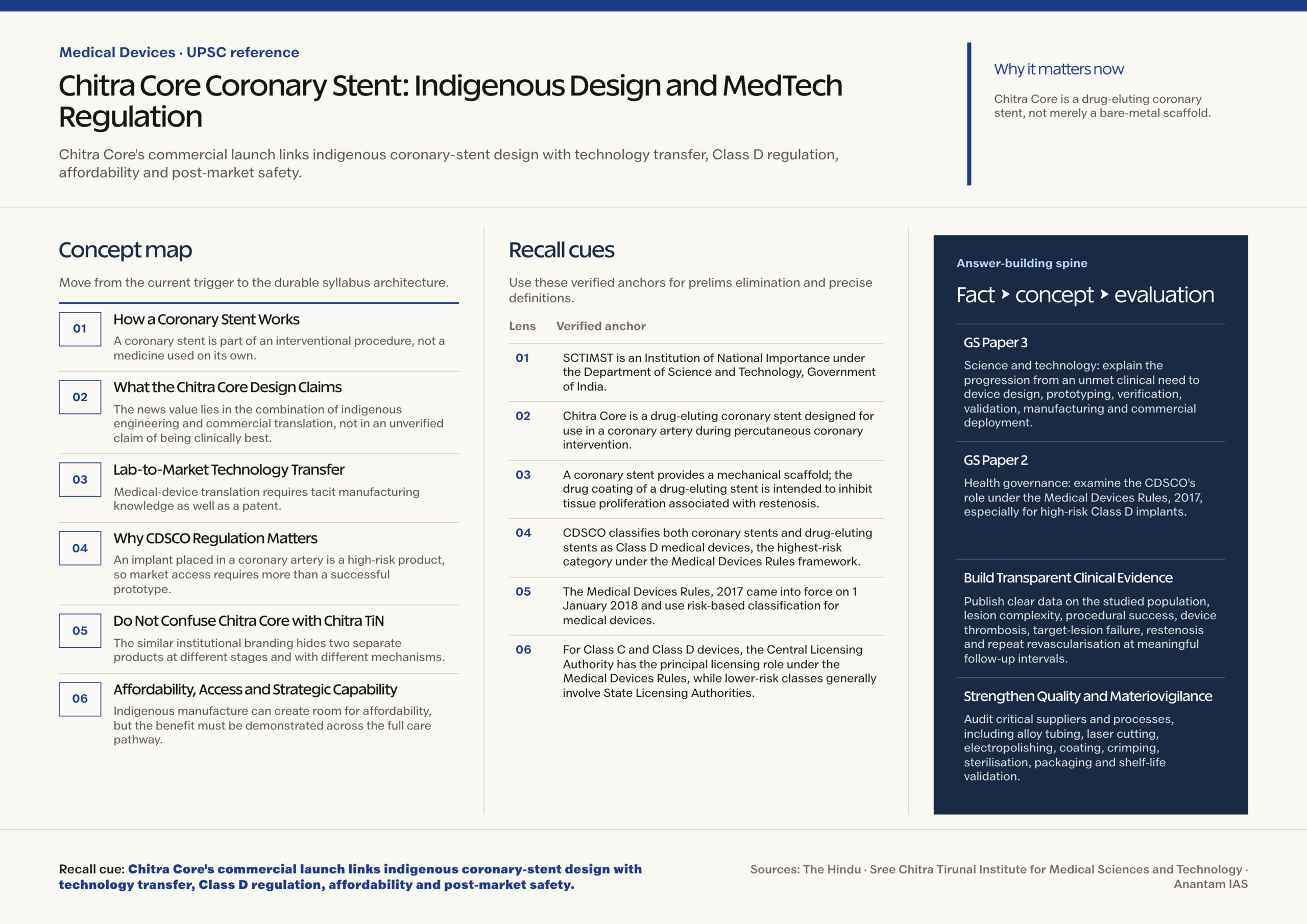
Background and Context
How a Coronary Stent Works
A coronary stent is part of an interventional procedure, not a medicine used on its own.
- Atherosclerotic plaque can narrow a coronary artery and restrict oxygen-rich blood reaching heart muscle. In selected patients, cardiologists perform percutaneous coronary intervention to open the narrowed segment.
- A compressed stent is carried on a balloon catheter to the lesion. Balloon inflation expands both the narrowed segment and the metal scaffold; after the balloon is withdrawn, the stent remains to help keep the lumen.
- A bare-metal stent supplies structural support, but healing tissue can grow within it. A drug-eluting stent adds controlled local release of a medicine intended to limit excessive neointimal proliferation and reduce restenosis.
- Clinical success depends on more than the implant. Lesion selection, deployment technique, complete expansion, antiplatelet management, patient adherence and follow-up can all affect outcomes.
What the Chitra Core Design Claims
The news value lies in the combination of indigenous engineering and commercial translation, not in an unverified claim of being clinically best.
- Chitra Core is described as SCTIMST’s first commercially launched coronary stent and as a drug-eluting product derived from a patented indigenous design.
- The reported lower metal-to-artery ratio seeks to reduce the amount of metal in contact with the vessel wall. In engineering terms, less metal may affect flexibility, deliverability and vessel interaction.
- Stent engineering involves trade-offs among strut geometry, radial support, longitudinal strength, recoil, foreshortening, fatigue resistance, flexibility, coating integrity and catheter deliverability. One attractive design feature cannot substitute for full-device testing.
- The appropriate formulation is that the design is intended to reduce vessel injury. Comparative clinical superiority would require adequately designed studies with defined endpoints and follow-up, not inference from geometry alone.
Lab-to-Market Technology Transfer
Medical-device translation requires tacit manufacturing knowledge as well as a patent.
- SCTIMST combines a hospital environment with a Biomedical Technology Wing. That arrangement can help engineers define clinical needs with doctors and evaluate whether a prototype fits real procedural constraints.
- A technology-transfer package may include design specifications, material requirements, manufacturing processes, jigs and fixtures, quality-control procedures, test reports and a design dossier. The receiving firm must convert these into a reproducible, validated production process.
- The industry partner carries responsibilities such as process scale-up, supplier qualification, quality management, sterilisation and packaging validation, regulatory submissions, distribution, complaint handling and corrective action.
- The Chitra Core case illustrates an innovation chain: publicly supported research can generate intellectual property, while industry supplies manufacturing scale and market access under regulatory oversight.
Why CDSCO Regulation Matters
An implant placed in a coronary artery is a high-risk product, so market access requires more than a successful prototype.
- Under India’s risk-based framework, a drug-eluting stent is a Class D device. The classification reflects the potential consequences of device failure and drives stronger evidence, licensing and quality requirements.
- The Medical Devices Rules, 2017 cover licensing, quality systems, clinical investigation, import or manufacture, labelling and post-market obligations. The precise submission depends on the device, novelty, intended use and evidence already available.
- A CDSCO manufacturing licence shows that the product has crossed the applicable regulatory gate; it should not be translated into a claim that every patient will have a better outcome or that long-term surveillance is unnecessary.
- Materiovigilance connects adverse-event reports, complaint investigation, signal detection, field safety corrective action and recalls. For permanent implants, this feedback loop is central to public trust.
Way Forward
Build Transparent Clinical Evidence
- Publish clear data on the studied population, lesion complexity, procedural success, device thrombosis, target-lesion failure, restenosis and repeat revascularisation at meaningful follow-up intervals.
- Use independent registries and appropriately designed comparative studies before making broad claims about superiority, safety or reduced vessel injury.
- State the device’s licensed sizes, indications and contraindications clearly so promotional language does not outrun the approved evidence.
Conclusion
- Chitra Core is significant because it shows an indigenous coronary-stent design moving from a public research institution into regulated commercial use.
- The strongest measure of success will be neither the launch ceremony nor the indigenous label.
UPSC Practice Questions
Prelims MCQ 1
With reference to coronary stents in India, consider the following statements:
- A drug-eluting coronary stent combines a mechanical scaffold with a coating intended to inhibit restenosis.
- Drug-eluting stents are classified as Class D medical devices under India’s regulatory framework.
- A technology-transfer agreement by itself is equivalent to a CDSCO licence for commercial manufacture.
How many of the above statements are correct?
(a) Only one (b) Only two (c) All three (d) None
Answer: (b) Only two
Explanation:
Statements 1 and 2 are correct. A drug-eluting stent supplies mechanical support and local drug release, and CDSCO places it in Class D. Technology transfer passes know-how or rights to a manufacturer but does not replace the applicable manufacturing and marketing licence.
Prelims MCQ 2
Which one of the following correctly distinguishes Chitra Core from the separate Chitra TiN coronary-stent project?
(a) Chitra Core is a neurovascular flow diverter, while Chitra TiN is a coronary device (b) Chitra Core is a commercially launched drug-eluting coronary stent, while Chitra TiN is a TiN-coated bare-metal platform still on an earlier evaluation pathway (c) Chitra Core is a Class A device, while Chitra TiN is a Class B device (d) Chitra Core is imported, while Chitra TiN has completed global commercial deployment
Answer: (b) Chitra Core is a commercially launched drug-eluting coronary stent, while Chitra TiN is a TiN-coated bare-metal platform still on an earlier evaluation pathway
Explanation:
Chitra Core is the commercially launched drug-eluting product in the news. Official SCTIMST material describes Chitra TiN as an L605 alloy, titanium-nitride-coated bare-metal system whose industry partner must complete further evaluation and regulatory work.
UPSC Mains Questions
- Indigenous medical-device innovation succeeds only when design capability is matched by regulatory science, quality manufacturing and post-market evidence. Discuss with reference to high-risk cardiovascular implants. (250 words)
- Explain the role of technology transfer in India’s medical-device ecosystem. Why must technology transfer, regulatory approval and clinical superiority be treated as three distinct questions? (250 words)
Sources: The Hindu and Sree Chitra Tirunal Institute for Medical Sciences and Technology.
Frequently Asked Questions
What is Chitra Core?
Chitra Core is an indigenous drug-eluting coronary stent developed from SCTIMST technology and commercially launched after technology transfer and the applicable CDSCO licensing pathway. It mechanically supports a narrowed coronary artery and carries a drug coating intended to reduce tissue.
What does a lower metal-to-artery ratio mean?
It means that a smaller proportion of the vessel wall is covered by the stent’s metal structure. The feature may influence flexibility, delivery and vessel interaction, but it cannot alone prove better clinical outcomes. Radial strength, expansion, fatigue, coating integrity.
Is Chitra Core the same as the Chitra TiN-coated stent?
No. Chitra Core is the commercially launched drug-eluting coronary stent in the present news. Chitra TiN is a separate L605 alloy, titanium-nitride-coated bare-metal platform. Official SCTIMST material places the TiN project on an earlier development and evaluation pathway.
Why are drug-eluting stents classified as Class D devices in India?
They are implanted in coronary arteries, remain in the body and can cause grave harm if design, manufacture or deployment fails. India’s risk-based system consequently places coronary and drug-eluting stents in Class D, bringing them under the strongest tier of.
Does CDSCO licensing prove that Chitra Core is superior to imported stents?
No. Licensing permits manufacture and marketing after the applicable regulatory review; it does not establish superiority over every alternative. A superiority claim needs suitable head-to-head clinical evidence, defined endpoints, adequate follow-up and transparent reporting.
Source: https://anantamias.com/current-affairs/chitra-core-indigenous-coronary-stent/
National AI Skilling Drive: Training One Crore Youth in One Year
Why in News?
India’s national AI skilling drive entered the policy agenda on 15 August 2026, when the Prime Minister announced from the Red Fort that one crore youth would be trained in AI skills over the next one year.
- The Prime Minister’s Office release was posted by PIB Delhi at 1:01 p.m. on 15 August 2026 and described the announcement as part of the address on the 80th Independence Day.
- The stated scale is one crore youth, equivalent to 10 million people, within one year.
- The stated purpose is to equip young Indians with the capability to lead in the world of AI as artificial intelligence expands rapidly.
- No official detail in the cited announcement establishes a single course, training duration, delivery platform, eligibility rule or certificate. Those design questions remain open.
- The target concerns skills formation. It is distinct from the National Career Service portal’s use of AI for job matching, recommendations, skill-gap analysis and interview support.
- The target turns AI capacity-building into a mass human-capital challenge: access must be broad, but participation counts alone cannot show whether a learner acquired a useful capability.
- A one-year horizon creates pressure to scale quickly. Public accountability will depend on transparent definitions of trained, assessed, certified and placed rather than treating these terms as interchangeable.
- The policy has a social-justice dimension because device access, connectivity, language, disability, geography, gender and prior education can determine who enters and completes digital training.
UPSC Relevance
Prelims Relevance
- The announcement was made on 15 August 2026 during the Prime Minister’s Independence Day address from the Red Fort.
- Its quantitative target is one crore youth in one year.
- One crore is equal to 10 million.
- The cited PIB release was issued under the Prime Minister’s Office.
- The announcement concerns AI skilling; it should not be confused with an AI system used to match jobseekers and vacancies.
- The official release does not name a curriculum, implementing ministry, budget, certificate or employment entitlement for this target.
Mains Relevance
GS Paper 2
- Use the target to examine human-capital policy, equality of opportunity, the digital divide and the State’s responsibility to make technology-linked training accessible.
- Assess delivery through a rights-aware lens: multilingual access, disability inclusion, assisted learning, grievance redress and transparent beneficiary data.
GS Paper 3
- Discuss the relationship between emerging technology, productivity, occupational change and reskilling while avoiding unsupported claims that training automatically produces employment.
- Evaluate the design of credible AI skilling through competency levels, practical assessment, instructor capacity, ethical use, data protection and independent outcome measurement.
Essay
- Technology becomes inclusive only when access is converted into usable capability.
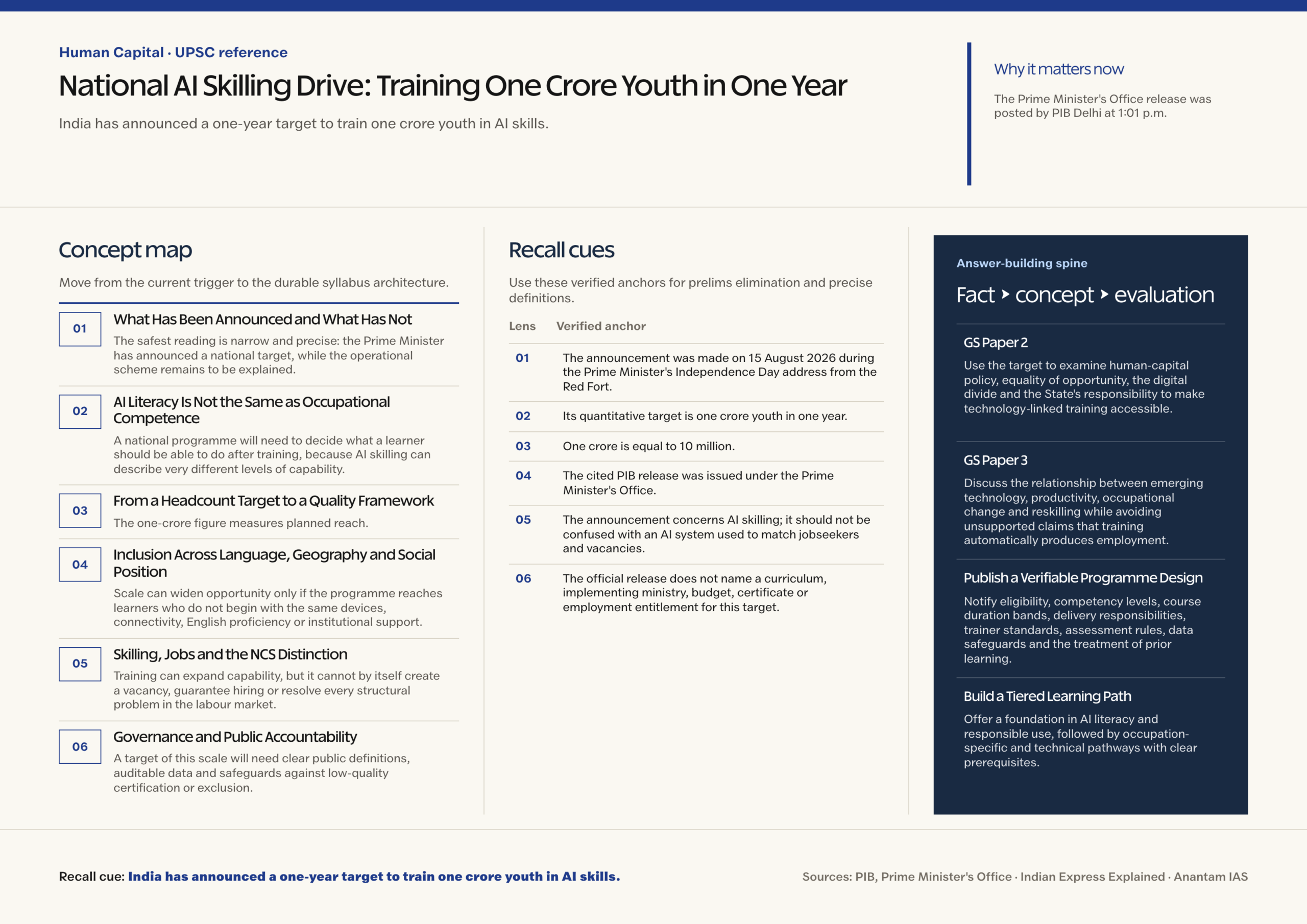
Background and Context
What Has Been Announced and What Has Not
The safest reading is narrow and precise: the Prime Minister has announced a national target, while the operational scheme remains to be explained.
- The official commitment contains two measurable elements: a reach of one crore youth and a time horizon of one year.
- The release links the target to the rapid expansion of AI and to building the capability of Indian youth. It does not define what level of proficiency will count as an AI skill.
- No curriculum, delivery platform, ministry, funding amount, trainer standard, assessment body or employment outcome is identified in the cited announcement. Assigning any of these details to the drive would go beyond the evidence.
- This distinction matters for current-affairs writing. An announced target can set policy direction, but a notified scheme normally supplies eligibility, institutional responsibility, financing, implementation and monitoring rules.
- The term youth also needs an operational definition. Different public programmes use different age bands, and the PIB note does not state which band, educational level or employment status applies here.
AI Literacy Is Not the Same as Occupational Competence
A national programme will need to decide what a learner should be able to do after training, because AI skilling can describe very different levels of capability.
- At the foundational level, AI literacy means understanding what AI systems can and cannot do, recognizing unreliable outputs, protecting personal data and using tools responsibly.
- At the applied level, a learner may need to use AI within an occupation such as agriculture, teaching, health administration, manufacturing, accounting or public service. The required competence differs by domain.
- At the technical level, roles may require mathematics, programming, data handling, model evaluation, cybersecurity or system deployment. A short awareness module cannot be counted as equivalent to technical preparation.
- A credible framework should classify learning levels and assess demonstrated tasks. Completion of a video or attendance at a session is an input measure, not proof of competence.
- Occupational modules should connect AI with domain judgment. A health worker, teacher or farm adviser must know when an output is outside the tool’s competence and when professional or local knowledge should prevail.
From a Headcount Target to a Quality Framework
The one-crore figure measures planned reach. Policy quality depends on what sits behind that number and whether the learning remains useful after the course ends.
- A transparent results chain should separate enrolment, participation, completion, assessment, certification, further learning and employment-related outcomes. Publishing only the largest number can hide attrition.
- Assessment should test practical capability: interpreting an output, checking evidence, identifying bias or unsafe use, solving a domain problem and explaining when human oversight is required.
- Quality assurance needs trainer preparation, updated material, accessible labs or devices, secure learning systems and a method to review training providers. These are design requirements, not features confirmed by the announcement.
- Because AI tools change quickly, the most durable curriculum would combine tool use with data literacy, critical thinking, domain knowledge, ethics and the ability to learn again. The final curriculum must still be verified when official.
- Provider incentives should reward verified learning rather than maximum enrolment. If payment or recognition follows headcount alone, the system may encourage brief, low-value modules and repeated counting instead of serious instruction.
Inclusion Across Language, Geography and Social Position
Scale can widen opportunity only if the programme reaches learners who do not begin with the same devices, connectivity, English proficiency or institutional support.
- Multilingual delivery must go beyond translating menus. Training examples, speech systems, technical terms, assessment and help channels need to work in the language a learner actually uses.
- The challenge connects with the wider question of Indian-language AI and digital inclusion: language representation shapes who can participate in an AI economy and whose knowledge becomes visible.
- Rural learners, women with limited time or mobility, persons with disabilities and first-generation digital users may need assisted access, flexible schedules, accessible interfaces and local mentoring.
- Aggregate completion data should be disaggregated by relevant social and geographic categories, with privacy safeguards. Otherwise, a national average can conceal exclusion.
- Online scale and local support are complements. A low-bandwidth course may widen reach, while a school, college, library, training centre or community facilitator can help a learner who lacks a quiet space, device or confident digital.
Way Forward
Publish a Verifiable Programme Design
- Notify eligibility, competency levels, course duration bands, delivery responsibilities, trainer standards, assessment rules, data safeguards and the treatment of prior learning.
- Define trained separately from enrolled, completed, assessed and certified, and publish the denominator behind every rate.
- Set a dated implementation calendar without assuming that the Independence Day announcement itself supplied these details.
- Publish a plain-language learner charter covering fees, data use, certificate status, assessment rights and grievance channels.
Conclusion
- Training one crore youth in AI skills within a year is an ambitious statement of national intent.
- The policy test is simple: learners should be able to use AI critically and safely in contexts that matter to them, while institutions remain honest about what training can and cannot achieve.
UPSC Practice Questions
Prelims MCQ 1
With reference to the AI-skilling announcement made by the Prime Minister on 15 August 2026, consider the following statements:
- It set a target of training one crore youth in AI skills over one year.
- The cited announcement specified a national curriculum and a single certification agency.
- It was the same programme as the National Career Service portal’s AI-enabled job-matching upgrade.
How many of the above statements are correct?
(a) Only one (b) Only two (c) All three (d) None
Answer: (a) Only one
Explanation:
Only Statement 1 is correct. The PIB release announces the one-crore, one-year target but does not specify a curriculum or certification agency. The NCS update concerns employment-service functions and is a separate policy development.
Prelims MCQ 2
Which one of the following would provide the strongest evidence that a mass AI-skilling programme has built usable capability?
(a) The number of promotional messages sent (b) The number of people who opened a course page (c) Practical competency assessments with disaggregated completion and learning outcomes (d) A single national total that combines enrolment and certification
Answer: (c) Practical competency assessments with disaggregated completion and learning outcomes
Explanation:
Practical assessment tests whether learners can apply knowledge, while disaggregated data shows whether access and achievement are fairly distributed. Page views or blended headline counts do not establish competence.
UPSC Mains Questions
- A mass AI-skilling target should be judged by capabilities acquired, not certificates distributed. Discuss the principles that should guide the design and evaluation of India’s one-crore-youth AI-skilling drive. (250 words)
- Digital skilling can deepen inequality when access is treated as identical to inclusion. Examine the measures needed to make AI training accessible across language, gender, disability, geography and educational background. (250 words)
Sources: PIB, Prime Minister's Office and Indian Express Explained.
Frequently Asked Questions
What did the Prime Minister announce about AI skilling?
On 15 August 2026, the Prime Minister announced that one crore youth would be trained in AI skills over the next one year. The PIB release links the target to rapid AI expansion and India’s ambition to build youth capability.
Is the one-crore AI-skilling drive already a fully specified scheme?
Not on the evidence in the cited announcement. The release states the target and time horizon but does not name a curriculum, implementing agency, budget, eligibility rule, course duration or certification framework. Those details should be checked in later notifications.
Does training one crore youth mean creating one crore AI jobs?
No. The announcement is a training target, not an employment guarantee. Jobs depend on labour demand, occupational change, local economies, complementary education and the quality of learning. Evaluation should report employment-related outcomes carefully, with clear denominators and time periods, without.
How is this different from the National Career Service AI update?
The AI-skilling announcement concerns building capabilities among youth. The National Career Service update concerned a public employment platform using AI for functions such as job matching, recommendations, skill-gap analysis and interview support. One operates on the skills-supply side; the other.
What should count as successful AI training?
Success should mean demonstrated capability at a declared level, not mere enrolment or attendance. Useful measures include course completion, practical assessment, safe and critical tool use, further learning, workplace application and equitable outcomes across learner groups. Each measure needs its.
Source: https://anantamias.com/current-affairs/ai-skilling-one-crore-youth/