Why in News?
The Principal Scientific Adviser to the Government of India launched the RSVC-AMRIT platform , developed by NABARD with the Office of the Principal Scientific Adviser, in an official release dated 15 August 2026 .
- The platform covers the RSVC lifecycle from technology discovery and validation to deployment tracking, collaboration, monitoring and knowledge management.
- It is intended to progressively bring together innovators, startups, technology providers, validators, accelerators, academic institutions, funding agencies, implementation partners and rural communities.
- The physical RSVC network works through village-level technology hubs; AMRIT adds a shared digital layer for records, coordination and cross-learning.
- The PIB release says NABARD was supporting eight RSVCs at the time of the announcement. This figure describes NABARD-supported centres in that release and should not be read as a complete national count.
- The release metadata is dated 15 August 2026, while one sentence in its body says 15 August 2025. This appears to be a source-year typo; the announcement is anchored here to the official 2026 release.
- India has many laboratories, technical institutions and grassroots innovators, but the harder policy problem is the last-mile adoption gap: finding the right technology, adapting it to local conditions, financing deployment and maintaining it after installation.
- RSVC-AMRIT matters because it combines a physical last-mile institution with a digital coordination system instead of assuming that an online catalogue alone can solve rural technology diffusion.
- The model also tests whether public institutions, CSR funders, civil-society implementers and local communities can share responsibilities without weakening accountability or treating villages as passive technology recipients.
UPSC Relevance
Prelims Relevance
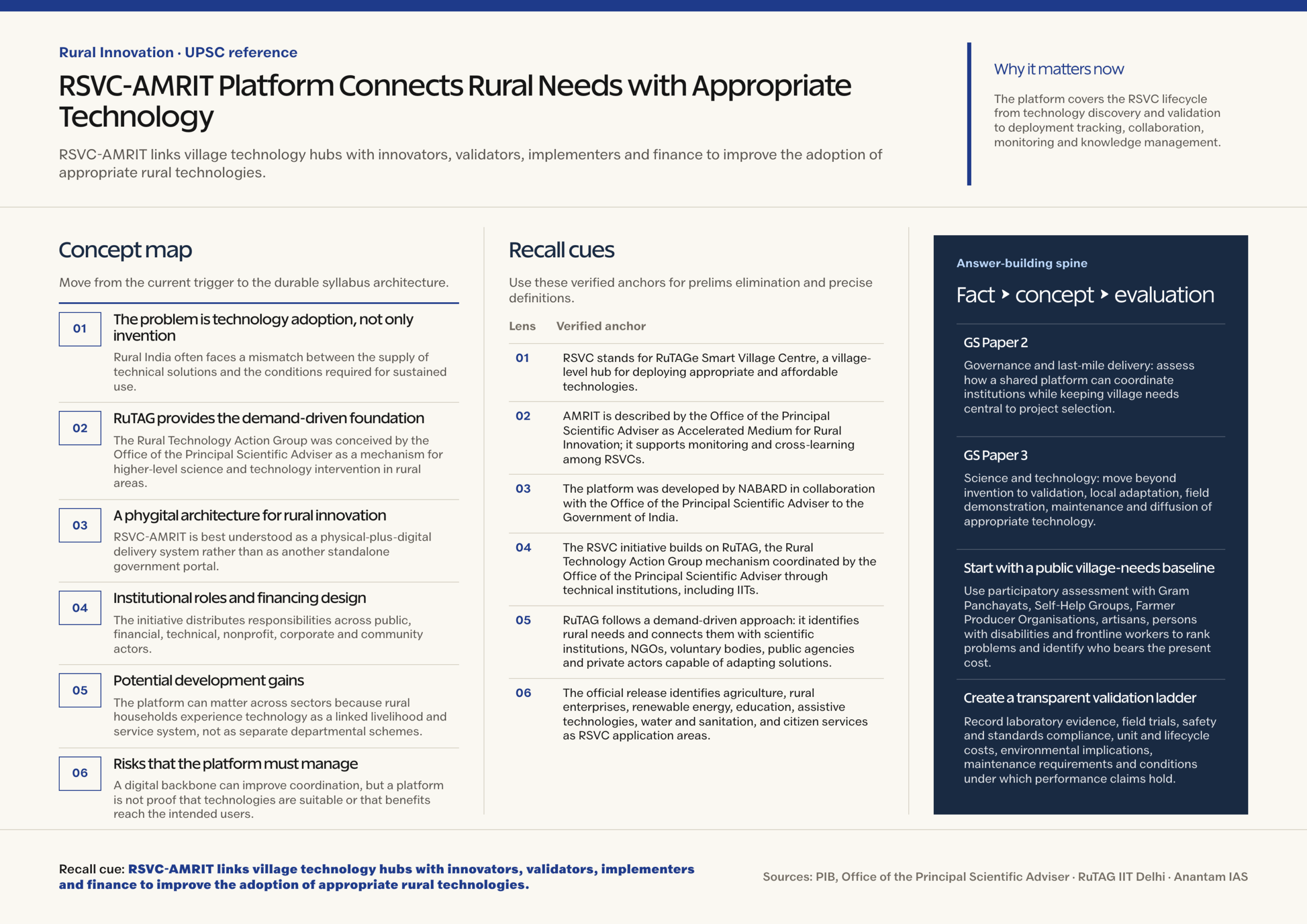
- RSVC stands for RuTAGe Smart Village Centre, a village-level hub for deploying appropriate and affordable technologies.
- AMRIT is described by the Office of the Principal Scientific Adviser as Accelerated Medium for Rural Innovation; it supports monitoring and cross-learning among RSVCs.
- The platform was developed by NABARD in collaboration with the Office of the Principal Scientific Adviser to the Government of India.
- The RSVC initiative builds on RuTAG, the Rural Technology Action Group mechanism coordinated by the Office of the Principal Scientific Adviser through technical institutions, including IITs.
- RuTAG follows a demand-driven approach: it identifies rural needs and connects them with scientific institutions, NGOs, voluntary bodies, public agencies and private actors capable of adapting solutions.
- The official release identifies agriculture, rural enterprises, renewable energy, education, assistive technologies, water and sanitation, and citizen services as RSVC application areas.
Mains Relevance
GS Paper 2
- Governance and last-mile delivery: assess how a shared platform can coordinate institutions while keeping village needs central to project selection.
- Development processes: examine the respective roles of government advisers, a development financial institution, a nonprofit implementation arm, CSR partners, academic bodies and community organisations.
GS Paper 3
- Science and technology: move beyond invention to validation, local adaptation, field demonstration, maintenance and diffusion of appropriate technology.
- Inclusive growth: connect rural technology with productivity, reduced drudgery, livelihoods, micro-enterprises and access for persons with disabilities.
Essay
- Innovation creates public value only when institutions can carry it from the laboratory to the last mile.
Background and Context
The problem is technology adoption, not only invention
Rural India often faces a mismatch between the supply of technical solutions and the conditions required for sustained use.
- Research institutions, startups and grassroots innovators may develop useful devices, but potential users can struggle to discover them, compare alternatives or judge whether they fit local soil, water, skills, energy and market conditions.
- A successful pilot may still fail to scale because of weak maintenance networks, unavailable spare parts, limited operator training, uncertain demand or the absence of affordable finance.
- Technology transfer is not a one-way delivery of equipment. It requires problem definition, co-design, field validation, training, feedback and repair across the technology’s working life.
- This is why appropriate technology must be affordable, maintainable and suited to local social and ecological conditions. A sophisticated device that communities cannot own or repair can deepen dependence instead of building capability.
RuTAG provides the demand-driven foundation
The Rural Technology Action Group was conceived by the Office of the Principal Scientific Adviser as a mechanism for higher-level science and technology intervention in rural areas.
- RuTAG identifies concrete problems faced by farmers, artisans, landless workers and rural enterprises, then seeks technical support from scientific institutions, universities, NGOs, voluntary bodies, public agencies and responsible private actors.
- Its role is mainly synergising and catalytic, not that of a single large funding scheme. It tries to reduce fragmentation and repeated work among institutions that otherwise act in separate silos.
- The RuTAG process can include technology upgrading, validation, demonstration and training. Examples from RuTAG IIT Delhi include devices and processes related to irrigation, millet de-husking, animal power, biomass, rural crafts and food processing.
- RSVC extends this approach through a permanent village-facing hub. The centre can identify local demand, demonstrate options, support use and convey field feedback to the institutions responsible for technical improvement.
A phygital architecture for rural innovation
RSVC-AMRIT is best understood as a physical-plus-digital delivery system rather than as another standalone government portal.
- The physical layer consists of RSVCs that bring technology demonstrations, services, skills and implementation support closer to rural communities.
- The digital layer records rural needs, technologies, validation status, deployments, partners, progress and knowledge generated through implementation.
- The platform’s stated lifecycle spans discovery, validation, deployment tracking, collaboration, monitoring and knowledge management. These functions can create a feedback loop between the user, the implementation partner and the innovator.
- The structure resembles other phygital approaches in rural governance. An online system widens coordination, while a local intermediary supports assisted access, trust, training and problem resolution.
- For comparison, Anantam IAS notes on Samriddh Gram and BharatNet-enabled rural services show why digital connectivity produces results only when the human last mile is built alongside it.
Institutional roles and financing design
The initiative distributes responsibilities across public, financial, technical, nonprofit, corporate and community actors.
- The Office of the Principal Scientific Adviser supplies the science-policy and rural-innovation framework, including the RuTAGe ecosystem.
- NABARD developed the AMRIT platform and is positioned as a strategic enabler for RSVC support. Its broader role in rural finance is explained in this NABARD study note.
- NABFOUNDATION is named as the implementation partner under the scheme outlined in the release, while corporates may support centre establishment through CSR initiatives.
- Innovators and academic institutions supply or improve technologies; validators assess readiness; implementation partners mobilise communities and manage field deployment; funding partners support capital and scale; rural users supply the demand signal and operating feedback.
- This division can combine specialised capabilities, but it also creates a coordination risk. Contracts and platform records should make responsibility for selection, procurement, maintenance, data and outcomes visible.
Way Forward
Start with a public village-needs baseline
- Use participatory assessment with Gram Panchayats, Self-Help Groups, Farmer Producer Organisations, artisans, persons with disabilities and frontline workers to rank problems and identify who bears the present cost.
- Publish the need, technology-selection rationale, expected beneficiaries and alternatives considered so that the match can be scrutinised.
- Record laboratory evidence, field trials, safety and standards compliance, unit and lifecycle costs, environmental implications, maintenance requirements and conditions under which performance claims hold.
- Use independent validators and publish failures and adaptations as learning assets, not only success stories.
Conclusion
- RSVC-AMRIT addresses a real policy gap between India’s capacity to invent and its capacity to place useful, maintainable technology in rural hands.
- Its success should be judged by durable local capability: communities able to choose technologies, operate and repair them, improve livelihoods and send evidence back into the innovation system.
UPSC Practice Questions
Prelims MCQ 1
With reference to the RSVC-AMRIT initiative, consider the following statements:
- AMRIT is the digital backbone of the RuTAGe Smart Village Centre ecosystem.
- The platform was developed by NABARD in collaboration with the Office of the Principal Scientific Adviser.
- NABFOUNDATION is identified as an implementation partner for the NABARD-supported RSVC scheme.
How many of the above statements are correct?
(a) Only one (b) Only two (c) All three (d) None
Answer: (c) All three
Explanation:
All three statements follow the official launch release. AMRIT supports the RSVC lifecycle; NABARD developed it with the Office of the Principal Scientific Adviser; and NABFOUNDATION is named as the implementation partner under the scheme outlined by NABARD.
Prelims MCQ 2
Which one of the following best describes the core purpose of the Rural Technology Action Group approach?
(a) To replace all rural development programmes with a single centrally managed technology scheme (b) To connect identified rural needs with science and technology institutions for adaptation, validation and delivery (c) To provide crop insurance directly to individual farmers through IITs (d) To regulate corporate social responsibility expenditure across all sectors
Answer: (b) To connect identified rural needs with science and technology institutions for adaptation, validation and delivery
Explanation:
RuTAG is a demand-driven, synergising mechanism. It identifies grassroots problems and mobilises technical institutions and other partners to adapt and deliver appropriate solutions; it is not a crop-insurance programme, a CSR regulator or a replacement for rural development schemes.
UPSC Mains Questions
- A rural innovation policy succeeds only when it closes the distance between invention, adoption and local capability. Discuss with reference to the institutional design of RSVC-AMRIT. (250 words)
- Digital platforms can coordinate rural technology transfer, but they cannot substitute for participation, validation and maintenance at the last mile. Examine. (250 words)
Sources: PIB, Office of the Principal Scientific Adviser and RuTAG IIT Delhi.
Frequently Asked Questions
What is the RSVC-AMRIT platform?
RSVC-AMRIT is the digital backbone of the RuTAGe Smart Village Centre ecosystem. It is designed to support technology discovery, validation, deployment tracking, stakeholder collaboration, monitoring and knowledge management while connecting rural needs with innovators, institutions, implementation partners and funding agencies.
What does AMRIT stand for in this initiative?
The Office of the Principal Scientific Adviser describes AMRIT as the Accelerated Medium for Rural Innovation. It operates as a digital layer for monitoring RSVCs, sharing learning and organising information on rural needs, technologies, partners and deployments.
What is a RuTAGe Smart Village Centre?
A RuTAGe Smart Village Centre is a village-level hub that helps communities access, test and adopt appropriate and affordable technologies. It can connect local needs with demonstrations, training, technical support, rural-enterprise services and feedback channels to innovators and research institutions.
Which institutions are involved in RSVC-AMRIT?
The Office of the Principal Scientific Adviser provides the wider RuTAGe framework, while NABARD developed the platform and supports the RSVC ecosystem. NABFOUNDATION is identified as an implementation partner, and the model also involves technical institutions, innovators, validators, corporate CSR.
Which sectors can RSVCs support?
The official release lists agriculture, rural enterprises, renewable energy, education, assistive technologies, water and sanitation, and citizen services. The correct technology mix should differ by village because selection is meant to begin with local needs and field conditions.
Tell Google you want more of this.
Add Anantam IAS as a preferred sourceOne tap, and this site shows up more often in your own Top Stories, AI Overviews and AI Mode. Remove it any time.