Why in News?
The Central Government has brought the Foreign Assets of Small Taxpayers Disclosure Scheme, 2026 , or FAST-DS, into force from August 16, 2026, after notifying the operational rules on August 14.
- FAST-DS is contained in Chapter IV, Sections 130 to 144 of the Finance Act, 2026 and works alongside the Black Money (Undisclosed Foreign Income and Assets) and Imposition of Tax Act, 2015.
- An eligible declaration can cover a failure to file a return, a failure to disclose the relevant foreign income or asset in a return filed before commencement, or income or an asset that escaped assessment.
- The statutory valuation date for covered foreign assets is March 31, 2026; the immunity covers declared matters for the previous year ending on that date or an earlier previous year.
- A declaration must be complete, electronically verified and factually true. A materially false declaration or breach of a scheme condition makes it invalid.
- The measure responds to legacy lapses involving foreign ESOPs or RSUs, overseas bank accounts, foreign savings or insurance products and assets retained after study, employment or deputation abroad.
- Foreign-asset reporting is no longer a purely domestic information problem. India receives financial-account information through the Automatic Exchange of Information architecture, including the Common Reporting Standard.
- FAST-DS recognises that the same reporting failure can conceal untaxed wealth or reflect a technical lapse involving income already taxed. Applying one punitive formula to both would ignore their different levels of culpability.
- The scheme combines a short compliance window with verification, payment and narrowly framed immunity. It is better understood as a conditional settlement mechanism than as erasure of all legal exposure.
UPSC Relevance
Prelims Relevance
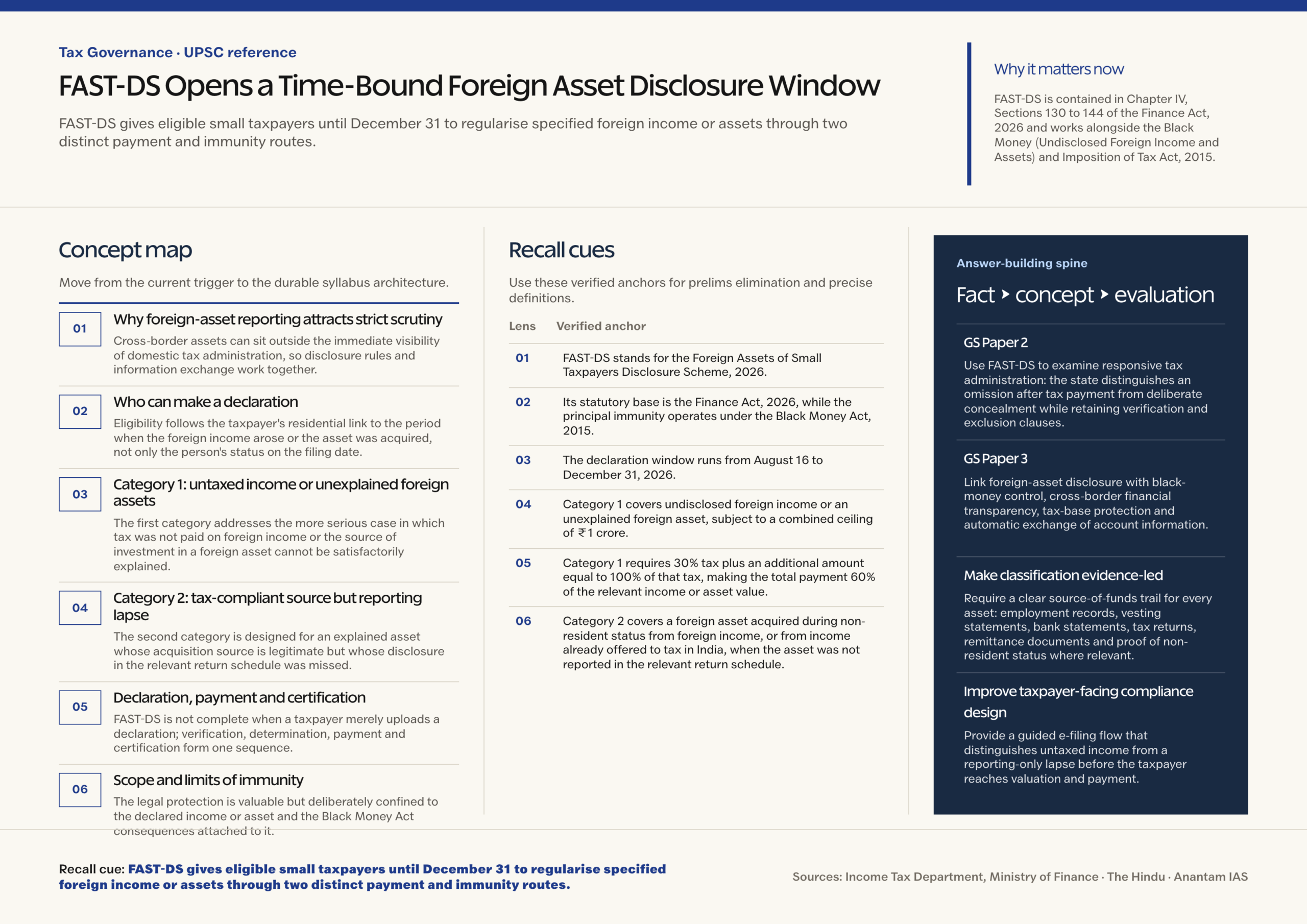
- FAST-DS stands for the Foreign Assets of Small Taxpayers Disclosure Scheme, 2026.
- Its statutory base is the Finance Act, 2026, while the principal immunity operates under the Black Money Act, 2015.
- The declaration window runs from August 16 to December 31, 2026.
- Category 1 covers undisclosed foreign income or an unexplained foreign asset, subject to a combined ceiling of ₹1 crore.
- Category 1 requires 30% tax plus an additional amount equal to 100% of that tax, making the total payment 60% of the relevant income or asset value.
- Category 2 covers a foreign asset acquired during non-resident status from foreign income, or from income already offered to tax in India, when the asset was not reported in the relevant return schedule.
Mains Relevance
GS Paper 2
- Use FAST-DS to examine responsive tax administration: the state distinguishes an omission after tax payment from deliberate concealment while retaining verification and exclusion clauses.
- Connect the scheme to digital governance, voluntary compliance, proportionality in penalties and the need for clear taxpayer communication.
GS Paper 3
- Link foreign-asset disclosure with black-money control, cross-border financial transparency, tax-base protection and automatic exchange of account information.
- Assess the trade-off between a one-time compliance window and moral hazard: relief may unlock honest disclosure, but repeated windows can weaken deterrence for regular filers.
Essay
- A capable state must distinguish between concealment and correctable non-compliance without allowing administrative compassion to become regulatory weakness.
Background and Context
Why foreign-asset reporting attracts strict scrutiny
Cross-border assets can sit outside the immediate visibility of domestic tax administration, so disclosure rules and information exchange work together.
- The Black Money Act, 2015 created a separate framework for undisclosed foreign income and assets of resident taxpayers, with tax, penalty and prosecution consequences.
- Its logic differs from ordinary domestic-income assessment. An offshore asset can remain relevant across years, and a missed disclosure may expose the taxpayer even when no sale has occurred. This is why the acquisition source, residential.
- Foreign holdings may include bank and custodial accounts, equity interests, employee stock awards, insurance or annuity contracts, immovable property and beneficial interests in foreign entities.
- The Income Tax Department’s Schedule FA guidance requires relevant resident taxpayers to report specified foreign assets and income. Foreign income, foreign-tax credit and asset disclosure may also engage Schedules FSI and TR, depending on the case.
- Information received through the Common Reporting Standard and other exchange arrangements allows tax authorities to compare offshore account data with domestic returns. This reduces the practical anonymity of a foreign account.
Who can make a declaration
Eligibility follows the taxpayer’s residential link to the period when the foreign income arose or the asset was acquired, not only the person’s status on the filing date.
- A person who is a resident in India in the relevant previous year can make a declaration if the statutory conditions are met.
- A person who is now non-resident or resident but not ordinarily resident may also qualify if that person was resident in India in the year to which the undisclosed foreign income relates or in the year.
- The scheme can address three procedural situations: no return was furnished under Section 139, the income or asset was omitted from a return furnished before FAST-DS commenced, or the matter escaped assessment under Section 147.
- Typical users may include employees who received foreign ESOPs or RSUs, former students with retained overseas accounts, returning non-residents with foreign savings, and personnel who served on overseas deputation. These examples do not replace the legal.
Category 1: untaxed income or unexplained foreign assets
The first category addresses the more serious case in which tax was not paid on foreign income or the source of investment in a foreign asset cannot be.
- It covers undisclosed foreign income: income from a source outside India that was chargeable to tax in India but was not offered to tax.
- It also covers an undisclosed foreign asset, including a financial interest in an entity abroad, held in the taxpayer’s name or beneficial ownership where the source of investment is unexplained or the explanation is unsatisfactory.
- Eligibility requires the aggregate of the undisclosed foreign income and the value of the undisclosed foreign asset to be no more than ₹1 crore.
- The declarant pays 30% of the foreign income and 30% of the foreign asset’s value as on March 31, 2026, plus an additional amount equal to 100% of that tax. The combined burden is 60% of.
- Calling the extra amount merely a reduced penalty can obscure the text. The Finance Act describes it as an amount equal to the tax; the Budget explanation described it as additional income tax in lieu of.
Category 2: tax-compliant source but reporting lapse
The second category is designed for an explained asset whose acquisition source is legitimate but whose disclosure in the relevant return schedule was missed.
- One limb covers an asset acquired from foreign income while the assessee was a non-resident, but not declared in the relevant schedule after becoming resident.
- The other covers an asset acquired from income already offered to tax in India but not declared in the relevant return schedule. Foreign shares received as a taxed employment perquisite may fit this logic, subject to.
- The value of the foreign asset must not exceed ₹5 crore as on March 31, 2026.
- The amount payable is a flat ₹1 lakh fee, not 60% of the asset value. This is the scheme’s clearest expression of proportionality between tax evasion and a reporting-only lapse.
- Classification must follow the source trail. Unreported dividend, interest or capital gains that should have been taxed cannot be converted into a reporting-only case merely because the underlying shares were acquired from taxed salary.
Way Forward
Make classification evidence-led
- Require a clear source-of-funds trail for every asset: employment records, vesting statements, bank statements, tax returns, remittance documents and proof of non-resident status where relevant.
- Separate the asset’s acquisition source from later income generated by it. A taxed acquisition does not settle an omitted dividend, interest receipt or capital gain.
- Publish worked examples for mixed portfolios, jointly held accounts, closed accounts and multiple acquisition years without diluting the statutory thresholds.
- Create a standard reconciliation statement matching each foreign asset to acquisition date, residence status, source income, taxes paid, past Schedule FA entries and income later earned. Such a record would reduce classification errors for both declarants.
Conclusion
- FAST-DS uses a sensible legal distinction: untaxed wealth and an explained but unreported asset are not the same wrong.
- Its success will depend less on the number of declarations than on durable compliance after the window closes.
UPSC Practice Questions
Prelims MCQ 1
With reference to the Foreign Assets of Small Taxpayers Disclosure Scheme, 2026, consider the following statements:
- The scheme covers both undisclosed foreign income and certain foreign assets acquired from income already offered to tax.
- The ₹1 crore ceiling applies to the reporting-only category in which the asset’s acquisition source is already explained.
- A valid declaration and prescribed payment can provide immunity from further tax, penalty and prosecution under the Black Money Act for the declared matter.
How many of the above statements are correct?
(a) Only one (b) Only two (c) All three (d) None
Answer: (b) Only two
Explanation:
Statements 1 and 3 are correct. The reporting-only category has an asset-value ceiling of ₹5 crore and a ₹1 lakh fee. The ₹1 crore ceiling applies to the aggregate of undisclosed foreign income and unexplained foreign assets in Category 1.
Prelims MCQ 2
Which one of the following correctly describes the payment for an eligible Category 1 declaration under FAST-DS?
(a) A flat fee of ₹1 lakh irrespective of asset value (b) Tax at 30% with no additional amount (c) Tax at 30% plus an additional amount equal to that tax (d) Tax at the declarant’s normal slab rate plus a ₹1 lakh fee
Answer: (c) Tax at 30% plus an additional amount equal to that tax
Explanation:
Category 1 requires 30% tax on the relevant undisclosed income or foreign asset value and an additional amount equal to 100% of that tax, producing an effective payment of 60% of the relevant base.
UPSC Mains Questions
- FAST-DS attempts to reconcile strict action against undisclosed foreign wealth with proportional treatment of technical reporting lapses. Examine the design of the scheme and the safeguards needed to preserve deterrence. (250 words)
- How do automatic exchange of financial information and taxpayer-friendly disclosure mechanisms complement each other in strengthening India’s tax governance? Discuss. (150 words)
Sources: Income Tax Department, Ministry of Finance and The Hindu.
Frequently Asked Questions
What is FAST-DS?
FAST-DS is the Foreign Assets of Small Taxpayers Disclosure Scheme, 2026. It gives eligible persons a time-bound opportunity to declare specified foreign income or assets, pay the applicable tax, additional amount or fee, and receive limited protection under the Black.
What is the difference between the two FAST-DS categories?
Category 1 covers foreign income not offered to tax or a foreign asset with an unexplained investment source; its combined ceiling is ₹1 crore and the effective payment is 60%. Category 2 covers an explained asset acquired during non-resident status.
What are the key FAST-DS dates?
The scheme commenced on August 16, 2026 and declarations may be filed through December 31, 2026. Foreign assets are valued with reference to March 31, 2026. After the authority communicates the payable amount, the taxpayer normally has two months from.
Does FAST-DS give complete immunity from every law?
No. A valid declaration and payment provide immunity from further tax, penalty and prosecution under the Black Money Act only for the income or asset declared. The scheme excludes specified proceeds-of-crime cases under the PMLA and does not protect false.
Can a person who is currently non-resident use FAST-DS?
Potentially yes. A current non-resident or resident but not ordinarily resident may qualify if the person was resident in India in the year to which the undisclosed foreign income relates or in the year when the undisclosed foreign asset was.
Tell Google you want more of this.
Add Anantam IAS as a preferred sourceOne tap, and this site shows up more often in your own Top Stories, AI Overviews and AI Mode. Remove it any time.