Daily Digest
UPSC · Civil Services Examination
Current Affairs · Wednesday, 16 September 2026
Current affairs curated and edited by Anantam IAS faculty — pulled from The Hindu, PIB, IDSA, Foreign Affairs and the ministries. Read, annotate, revise.
Old Rajinder Nagar · Delhi 110005 · anantamias.com
Orbital Weapons: What the Outer Space Treaty Prohibits
Why in News?
The Indian Express reported on September 16, 2026 that US Air Force Secretary Troy Meink had acknowledged orbital weapons a day earlier, renewing debate over the Outer Space Treaty.
- The reported acknowledgment concerned on-orbit space-control weapons; their nature and deployment timing were not disclosed.
- The statement does not establish that nuclear weapons or other weapons of mass destruction have been deployed.
- Article IV distinguishes orbital WMD restrictions from the broader prohibitions applicable on the Moon and other celestial bodies.
- Articles III and IX remain relevant: international law, the UN Charter, due regard and consultation obligations constrain space activities.
- A gap in an express weapons prohibition is not a blanket finding of legality. The activity, location, effects and applicable international law must be examined.
- Military use of space includes support functions as well as potential weapons. Describing a satellite as military does not alone establish that it carries a weapon.
UPSC Relevance
Prelims Relevance
- Article III: space activities must accord with international law, including the UN Charter.
- Article IV: prohibition concerning nuclear weapons and other WMD in orbit and elsewhere in outer space.
- Article IV: broader demilitarisation provisions for the Moon and other celestial bodies.
- Article IX: due regard and appropriate consultations over potentially harmful interference.
- Military personnel may undertake scientific research or other peaceful activities on celestial bodies.
Mains Relevance
GS Paper 2
- Treaty interpretation and gaps in international security governance.
- Confidence-building and responsibility in a shared domain.
GS Paper 3
- Space-system security and risks to essential satellite services.
Essay
- Technological capability can advance faster than common rules for its responsible use.
Background and Context
Article IV treats orbit and celestial bodies differently
The Outer Space Treaty contains specific prohibitions; reading them accurately requires attention to both the weapon category and its location.
- States Parties must not place objects carrying nuclear weapons or other weapons of mass destruction in Earth orbit. Article IV also prohibits installing such weapons on celestial bodies or stationing them elsewhere in space.
- For the Moon and other celestial bodies, the restrictions are broader: military bases, installations and fortifications, weapons testing of any type, and military manoeuvres are forbidden under the treaty’s peaceful-use requirement.
- Military personnel are not automatically excluded from celestial bodies. Article IV permits their use for scientific research or other peaceful purposes, and permits equipment or facilities necessary for peaceful exploration.
- Do not extend the celestial-body wording into a claim that every military satellite is prohibited in Earth orbit. Equally, do not reduce Article IV to a nuclear-weapons rule that ignores its other provisions.
Article III prevents a legal free-for-all
The absence of an explicit ban on every conventional orbital weapon does not remove the wider legal rules governing how States act.
- Article III requires space exploration and use to comply with international law, including the UN Charter. Treaty interpretation must consider this obligation alongside the more specific weapons provisions in Article IV.
- Conventional weapons are not covered by Article IV’s orbital WMD prohibition merely because they are weapons. This narrow observation does not establish that their deployment or use is lawful in every situation.
- A legality assessment requires facts about conduct, intended and actual effects, and applicable obligations. An undisclosed capability cannot be conclusively classified by treating the word “weapon” as a complete technical description.
- Peaceful scientific activity, military support functions and hostile action are not interchangeable categories. Clear analysis identifies what a system does before drawing conclusions about which treaty provisions or other legal rules apply.
Article IX adds due regard and consultation
Space activities can affect other users, so the treaty addresses interference and shared interests rather than relying only on a list of prohibited weapons.
- Due regard requires States Parties to consider the corresponding interests of other States Parties in their space activities. This continuing obligation remains relevant even when an activity is outside a specific weapons prohibition.
- A State must undertake appropriate international consultations before proceeding when it has reason to believe its planned activity, or its nationals’ activity, would cause potentially harmful interference with others’ peaceful space activities.
- Another State Party may request consultation when it has reason to believe a planned activity would cause such interference. Consultation is a treaty mechanism; the text should not be rewritten as an automatic veto.
- Shared-use risks matter because disruption can affect systems beyond the immediate parties. The wider space-debris problem illustrates why damage in a common orbital environment can create lasting concerns for other operators.
What the reported acknowledgment does not establish
The news provides a security-policy trigger, but limited disclosure leaves essential technical questions unanswered and makes confident claims about the specific systems premature.
- The report does not disclose weapon type or deployment timing. Avoid adding nuclear capability, a particular orbital platform or a specific method of attack when those details have not been established.
- Counterspace capabilities and orbital weapons are not identical categories. A ground-launched anti-satellite system, such as the subject of Mission Shakti, differs in location from a weapon already positioned in orbit.
- Military satellites can support communications or observation without thereby proving an onboard weapon. Establishing a weapon’s nature requires evidence about its functions and payload, rather than an assumption based only on military ownership.
- For an exam answer, distinguish the reported claim from the legal framework. Apply the relevant rules conditionally rather than concluding either that all orbital weapons are banned or that anything outside WMD is permitted.

Way Forward
Reduce uncertainty without overstating treaty coverage
- Use consultation and communication channels where potentially harmful interference is anticipated, consistent with Article IX rather than treating opacity as a substitute for compliance.
- Develop clearer understandings of risky behaviour, with verifiable commitments that protect shared space services and distinguish ordinary support functions from threatening conduct.
- Separate legal obligations from proposals for stronger future restraints; wider agreements can address gaps without misrepresenting the treaty’s existing wording.
Conclusion
- The Outer Space Treaty combines specific weapons bans with wider duties. Its orbital WMD rule, celestial-body restrictions and international-law obligations must be read together.
- The strongest answer avoids both extremes: military use is not automatically prohibited, and the absence of a particular prohibition is not unconditional permission to deploy or use a weapon.
UPSC Practice Questions
Prelims MCQ 1
With reference to Article IV of the Outer Space Treaty, consider the following statements:
- Objects carrying nuclear weapons may not be placed in Earth orbit.
- Testing any type of weapon is prohibited on the Moon and other celestial bodies.
- Military personnel are prohibited from conducting peaceful scientific research on celestial bodies.
How many of the above statements are correct?
(a) Only one (b) Only two (c) All three (d) None
Answer: (b) Only two
Explanation:
Statements 1 and 2 are correct. Article IV permits military personnel to conduct scientific research or other peaceful activities on celestial bodies.
Prelims MCQ 2
Which interpretation of the Outer Space Treaty is most accurate?
(a) Every military use of an Earth-orbiting satellite is expressly prohibited. (b) Activities outside Article IV are exempt from international law. (c) Article IX gives every State an automatic veto over another State’s mission. (d) Article III applies international law, including the UN Charter, to space activities.
Answer: (d) Article III applies international law, including the UN Charter, to space activities.
Explanation:
Article III preserves the application of international law and the UN Charter. Article IX requires due regard and appropriate consultations in specified circumstances, not an automatic universal veto.
UPSC Mains Questions
- Distinguish the Outer Space Treaty’s restrictions on Earth orbit from those on celestial bodies. Why does the absence of a blanket conventional-weapons ban not settle legality? (150 words)
- Examine how due regard and consultation obligations can help manage security risks in outer space. Discuss the limits created by undisclosed capabilities. (250 words)
Sources: UNOOSA, Outer Space Treaty and The Indian Express.
Frequently Asked Questions
Does the Outer Space Treaty ban all orbital weapons?
Article IV specifically prohibits objects carrying nuclear weapons or other WMD in Earth orbit. It does not expressly ban every conventional orbital weapon, but international law and other treaty duties remain applicable.
Are the Moon and Earth orbit governed by identical weapons restrictions?
No. Article IV imposes broader restrictions on celestial bodies, including military bases, weapons testing of any type and military manoeuvres. Its Earth-orbit prohibition specifically concerns nuclear weapons and other WMD.
Can military personnel undertake research on the Moon?
Yes. Article IV expressly permits military personnel to carry out scientific research or other peaceful activities. The personnel’s military status alone does not make an otherwise peaceful scientific activity prohibited.
Does the reported US acknowledgment prove nuclear deployment?
No. The report says the nature and timing of the acknowledged deployment were not disclosed. Nuclear capability, weapon design and a specific means of attack cannot be inferred from that acknowledgment alone.
Source: https://anantamias.com/current-affairs/orbital-weapons-outer-space-treaty-limits/
Coal India Smart Mining: From Remote Sensing to Safer Operations
Why in News?
The Coal Ministry’s 15 September 2026 update described Coal India’s smart-mining systems, pilots and development projects, linking digital monitoring with safer operations and equipment maintenance.
- Deployed systems include command centres, vehicle tracking, RFID, automated weighbridges and GPS fleet monitoring.
- DigiCoal tested 17 solutions in seven mines; broader replication is a stated next step, not evidence of nationwide completion.
- Remote-operated line-of-sight dozers are being piloted; underground networks, digital twins and monitoring rovers are under development.
- Mining safety depends on connecting reliable information to timely action, rather than simply installing more screens and sensors.
- Operational status matters: a deployed tracking system, a field pilot and a developing autonomous tool represent different levels of demonstrated capability.
UPSC Relevance
Prelims Relevance
- Operational technology monitors or controls physical equipment and processes.
- RFID identifies tagged objects using radio-frequency communication.
- Predictive maintenance uses condition information to anticipate maintenance needs.
- Remote operation is distinct from autonomous operation.
- A digital twin is a digital representation of a physical asset or system used for analysis.
Mains Relevance
GS Paper 3
- How sensing, communication and supervised action can reduce occupational exposure.
- Limits of digitalisation: reliability, skills, cybersecurity and local operating conditions.
- Why safer and more efficient mining does not eliminate coal-related environmental impacts.
Essay
- Technology improves safety when information becomes accountable action.
Background and Context
From mine data to an operational decision
Smart mining connects observations about equipment, movement and working conditions with decisions about dispatch, maintenance and safety; each stage needs a usable response.
- Sensing and tracking establish what equipment is doing and where it is located. Coal India reports deployed vehicle tracking, RFID and GPS fleet monitoring; these tools provide operational visibility rather than automatically making machines autonomous.
- Command centres bring information together so responsible personnel can coordinate operations. A display becomes useful when teams can interpret an alert, identify the relevant equipment and decide what action is appropriate for the situation.
- Vehicle-health monitoring supplies information about equipment condition, while payload and dispatch systems support management of work. Their functions differ: locating a truck, measuring its load and assessing its condition answer separate operational questions.
- Predictive maintenance uses condition patterns to anticipate problems and plan intervention. It can support earlier action, but a prediction still needs inspection, scheduling and repair; recording a warning is not the same as removing a hazard.
- Operational technology differs from office IT. Tracking equipment and controlling physical processes concern mine operations; procurement, finance and personnel systems support enterprise administration. Digitalisation in one area does not establish equivalent capability in the other.

Remote action needs feedback and human responsibility
The safety objective is to reduce hazardous exposure while retaining reliable supervision, communication and the ability to verify what happened after a command.
- Remote-operated line-of-sight dozers are being piloted in SECL and NCL, according to the update. Remote control can separate an operator from the machine, but it must not be described as unrestricted autonomous operation.
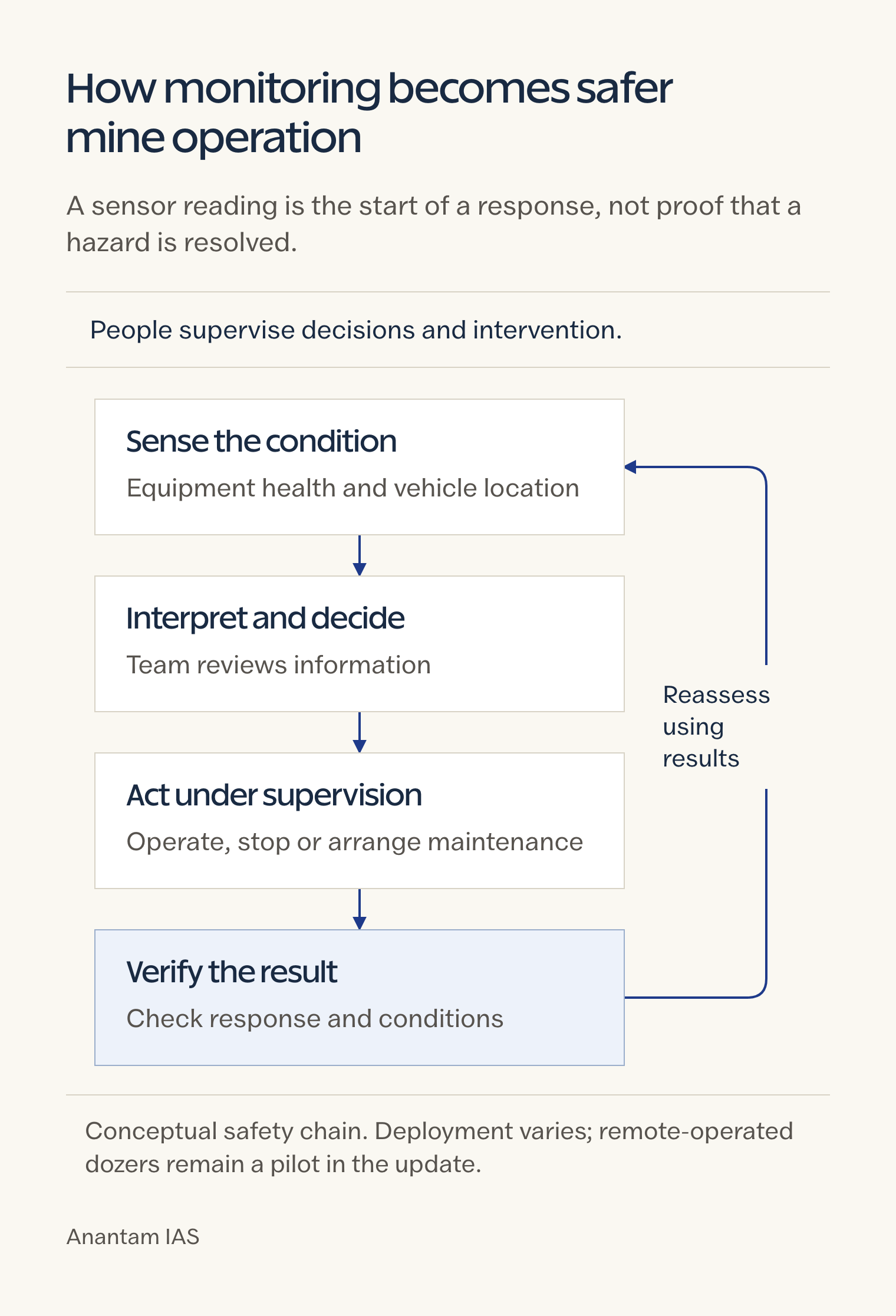
- The control chain runs from observation to a decision, a command and confirmation of the result. This is a conceptual explanation of safe remote operation, not a claim that every Coal India mine uses identical architecture.
- Feedback matters because sending a command does not prove that the intended action occurred. Equipment response and surrounding conditions must remain observable; responsibility for stopping unsafe work cannot be replaced by confidence in a dashboard.
- Safety features being incorporated include fatigue monitoring, proximity warnings, cameras and automatic fire detection or suppression. Their different purposes show why a single sensor cannot substitute for the full range of operational safety measures.
- Skills remain part of the system. The release identifies training and capacity constraints alongside technology adoption. Operators and maintenance teams need to understand alerts, limitations and intervention procedures as equipment becomes connected and digitally managed.
Pilots, environmental monitoring and the limits of automation
The update includes deployed tools alongside future plans. Keeping these categories separate prevents a technology roadmap from being mistaken for an already completed transformation.
- DigiCoal’s tested solutions are not universal deployment. Replication across mega mines is a future direction in the release; evidence from pilot sites should guide adaptation to local geology, equipment and operating conditions before broader implementation.
- Underground networks, digital twins and autonomous monitoring rovers are under development. These projects may support communication and simulation, but their mention does not establish that all underground mines already operate with autonomous inspection or control.
- Satellite and drone information can support mine monitoring and environmental auditing. The forest-roadmap discussion on better inventories offers a related measurement lesson: observations must be translated into dependable information before they support management decisions.
- Operational improvements do not replace environmental decisions. The Tara coal-block boundary discussion concerns a different governance stage; digital monitoring of machinery cannot by itself resolve questions about project location, ecological impact or appropriate mining boundaries.
- Safer mining is not impact-free mining. Better monitoring, dispatch and maintenance can address particular operational problems, but the update does not prove elimination of coal-related emissions, land disturbance or every occupational risk associated with extraction.
Way Forward
Scale verified safety functions
- Evaluate pilots against operational outcomes, including hazard exposure, maintenance response and reliability, before replicating tools across mines with different conditions.
- Specify human responsibility and fallback procedures for communication failure, uncertain readings and unsafe equipment responses.
- Protect connected operational systems through information security, controlled access and staff training, while retaining independent safety and environmental oversight.
Conclusion
- The useful unit of smart mining is a complete safety chain: dependable sensing, informed decisions, supervised action and verified results. Hardware and dashboards alone cannot guarantee safer work or effective maintenance.
- Distinguish deployed systems, pilots and development projects. Coal India’s update supports an answer on industrial modernisation, but claims about nationwide autonomy or elimination of environmental impacts go beyond the evidence it provides.
UPSC Practice Questions
Prelims MCQ 1
With reference to the Coal Ministry’s September 2026 technology update, consider the following statements:
- Coal India reports deployed GPS fleet monitoring and RFID systems.
- Remote-operated line-of-sight dozers are described as pilots.
- The update establishes nationwide autonomous operation of all underground mines.
How many of the above statements are correct?
(a) Only one (b) Only two (c) All three (d) None
Answer: (b) Only two
Explanation:
Statements 1 and 2 are correct. Underground networks, digital twins and monitoring rovers are under development; the release does not establish nationwide autonomy.
Prelims MCQ 2
Which example best describes predictive maintenance?
(a) Inferring equipment problems from condition trends to plan inspection and repair (b) Assuming every machine is safe because its position is known (c) Replacing maintenance staff with a digital map (d) Treating all sensors as autonomous controllers
Answer: (a) Inferring equipment problems from condition trends to plan inspection and repair
Explanation:
Predictive maintenance uses condition information to support timely intervention. Location tracking alone does not diagnose equipment health, and a prediction still needs an appropriate maintenance response.
UPSC Mains Questions
- Explain how sensing, communication and supervised remote operations can improve mine safety. What institutional and technical conditions determine their effectiveness? (150 words)
- A digitalisation roadmap should not be confused with demonstrated operational transformation. Discuss with reference to Coal India’s deployed systems, pilots and developing technologies. (250 words)
Source: PIB, Ministry of Coal.
Frequently Asked Questions
What is the main idea behind smart mining?
Smart mining uses connected information and control tools to support operational decisions, maintenance and safety. Its value depends on linking observations to timely action rather than merely collecting data or adding dashboards.
Are Coal India’s remote dozers fully autonomous?
The update describes remote-operated line-of-sight dozers as pilots in SECL and NCL. That wording does not establish fully autonomous operation or deployment across all mines; remote control and autonomy are different capabilities.
Which technologies are still under development?
The release places underground networks, digital twins and autonomous monitoring rovers under development. Their proposed roles include communication, automation and simulation, but this should not be presented as completed nationwide implementation.
Does smart mining eliminate coal’s environmental impacts?
No. Monitoring and operational improvements address specific problems, such as equipment management or hazardous exposure. They do not by themselves establish elimination of emissions, land disturbance or the need for environmental assessment and oversight.
Source: https://anantamias.com/current-affairs/cil-smart-mining-remote-operations-safety/
Rapido CCPA Order: When Tipping Prompts Distort Consumer Choice
Why in News?
On 15 September 2026, CCPA announced a ₹10 lakh penalty against Rapido’s operator over misleading advance-payment prompts and dark patterns.
- The order concerns Roppen Transportation Services Private Limited, which operates Rapido; CCPA directed discontinuation of the misleading prompts and practices.
- CCPA identified confirm shaming in prompts seeking more money after a rider had booked at the quoted fare but before confirmation.
- It separately identified interface interference in a colour-coded price slider that visually favoured increasing the amount.
- The authority said Rapido had not produced supporting data showing that extra payment actually increased the likelihood of obtaining a ride.
- A platform can offer a nominal choice while arranging its timing and presentation to make refusal feel costly or risky.
- This case concerns the actual booking journey, not a general announcement of new e-commerce rules or a blanket prohibition on changing prices.
UPSC Relevance
Prelims Relevance
- CCPA: Central Consumer Protection Authority.
- Confirm shaming: the finding attributed to the advance-payment prompts in this order.
- Interface interference: the finding attributed to the asymmetric pricing slider.
- Dark Patterns Guidelines, 2023: the framework cited by CCPA.
- Motor Vehicle Aggregator Guidelines, 2025: the release cites a post-completion timing requirement for tips.
Mains Relevance
GS Paper 2
- Consumer protection through evidence-based enforcement of platform conduct.
GS Paper 3
- Digital-market information asymmetry and meaningful consumer consent.
Essay
- Freedom of choice depends on how choices are presented and when they are offered.
Background and Context
Why the timing of the prompt mattered
CCPA examined the sequence of the transaction, rather than accepting the label of voluntary tipping at face value.
- According to the authority, the platform first presented a quoted fare. After the rider booked at that fare, further prompts suggested that paying more could improve the chance of acceptance.
- The rider had already committed to a booking process but was still waiting for the service. CCPA considered this a moment of dependence, with limited scope for meaningful negotiation.
- CCPA found the prompts created urgency and fear of losing the ride. It classified that pressure as confirm shaming under the dark-pattern framework cited in the release.
- The issue was not simply that an additional amount appeared on screen. Its connection to obtaining a ride changed the apparent consequence of declining to pay it.
- For an answer, reconstruct fare quotation, booking and payment pressure in that order. The chronology explains why a choice described as optional may still undermine effective consent.

How interface design can steer a decision
The pricing slider presented a second issue, independent of the wording of the advance-payment prompts.
- CCPA reported that increasing the price produced a green indication of a higher chance of getting a ride, while lowering it triggered a red or orange warning.
- The slider also provided more room to increase the price than to decrease it. This asymmetry formed part of the authority’s explanation of how the screen steered users.
- The finding of interface interference concerns the arrangement of choices. A user may technically retain an alternative while visual emphasis and control design make that alternative less attractive.
- Colour alone does not establish an unlawful interface in every setting. Here, CCPA assessed colour, unequal adjustment space and the accompanying price-related message within the specific booking journey.
- The e-commerce rules explainer discusses broad platform duties. This order adds a concrete enforcement example: examine the actual choice architecture rather than compliance statements alone.
A tip and a condition of service are different
The authority distinguished appreciation after service from a payment presented as improving access before service.
- CCPA observed that a tip is ordinarily voluntary and paid after a service has been rendered. It should not be presented as a condition for obtaining that service.
- The release cites the Motor Vehicle Aggregator Guidelines, 2025 as requiring tipping features only after ride completion, rather than at booking or during the ride itself.
- According to CCPA, the quoted fare already reflected ride-related factors, including distance, time, traffic and tolls. It found no justification for the subsequent prompts seeking more for that same ride.
- Rapido argued that payment remained voluntary, matching continued without it and the prompts reflected negotiation. CCPA rejected those submissions because of the timing and design of the pressure.
- The restaurant service-charge case offers a related question about voluntary payment. Keep each sector’s facts and applicable directions separate rather than assuming identical rules.
What the evidence establishes and what it does not
An enforcement finding should be read at its demonstrated scope, without adding conclusions absent from the source.
- CCPA said Rapido had not placed data on record establishing that extra payment increased ride acceptance. The asserted benefit was consequently found unsubstantiated and misleading by the authority.
- This is an evidentiary finding about the claim presented to consumers. It does not establish that a specified proportion of riders paid extra or suffered a quantified financial loss.
- The announced action is a CCPA penalty and direction, not a reported criminal conviction. The release does not establish an appellate outcome or demonstrate implementation of every required correction.
- The release says examination of Uber and Ola remains ongoing. Scrutiny of other platforms must not be described as a final finding against them merely because Rapido was penalised.
- The durable distinction is between transparent pricing and unsupported, coercive presentation. This particular order should not be expanded into a sweeping claim that every form of dynamic pricing is prohibited.
Way Forward
Test the complete booking journey
- Platforms should review prompt timing and interface symmetry across the actual booking process, including low-connectivity and urgent-use situations.
- Retain evidence for acceptance claims; a statement implying a measurable benefit should be supported rather than relying on persuasive wording.
- Keep post-service tips distinct from the fare and booking process, with a clear choice to decline.
- Regulatory follow-up should verify actual interface corrections, not only written assurances or a renamed payment prompt.
Conclusion
- The Rapido order connects timing, visual design and evidence: a nominally optional payment can become coercive when the interface links refusal to losing access to a needed service.
- Use this case to explain meaningful consumer choice, while distinguishing attributed enforcement findings from criminal guilt, measured harm or a general ban on dynamic pricing.
UPSC Practice Questions
Prelims MCQ 1
With reference to the CCPA action concerning Rapido, consider the following statements:
- CCPA considered both the timing of advance-payment prompts and the design of the pricing slider.
- The release reports a criminal conviction of Rapido’s operator.
- CCPA found the claim of improved ride acceptance through additional payment unsubstantiated on the record.
How many of the above statements are correct?
(a) Only one (b) Only two (c) All three (d) None
Answer: (b) Only two
Explanation:
Statements 1 and 3 reflect CCPA’s findings. The source reports a penalty and directions by the authority, not a criminal conviction.
Prelims MCQ 2
Which feature most directly illustrates the interface-interference finding described in the release?
(a) Showing the journey distance (b) Offering a clearly optional tip after completion (c) A price slider with unequal adjustment space and colours favouring higher payment (d) Providing a receipt after payment
Answer: (c) A price slider with unequal adjustment space and colours favouring higher payment
Explanation:
CCPA identified the combination of colour cues and asymmetric adjustment space as visually steering users towards higher payments.
UPSC Mains Questions
- Explain how the timing and design of digital interfaces can undermine meaningful consumer consent, using the Rapido CCPA order. (150 words)
- Distinguish transparent pricing from manipulative choice architecture. What evidence should regulators examine when assessing claims that additional payments improve service access? (250 words)
Source: PIB, Ministry of Consumer Affairs.
Frequently Asked Questions
Why did CCPA penalise Rapido’s operator?
CCPA found that advance-payment prompts and a pricing slider misled and pressured riders towards higher payments before confirmation. The release reports a ₹10 lakh penalty and directions to discontinue the misleading practices.
What was the problem with the pricing slider?
CCPA said the slider used colours favouring higher payments and allowed more room to increase than decrease the price. It treated that combination as interface interference in the specific ride-booking context.
Does this order ban all dynamic pricing?
The source does not support that conclusion. The order concerns particular prompts, unsupported acceptance claims and interface design. Its findings should not be expanded into a universal prohibition on every changing fare.
When should a ride-hailing tip be offered?
The release cites the Motor Vehicle Aggregator Guidelines, 2025 as permitting the tipping feature only after ride completion. CCPA distinguished that voluntary payment from pressure to pay more before obtaining the service.
Source: https://anantamias.com/current-affairs/rapido-ccpa-tipping-interface-consumer-choice/
GATCs: Expanding Measurement Verification While Retaining Enforcement
Why in News?
On September 15, 2026, the Department of Consumer Affairs reported fresh applications to expand Government Approved Test Centres, supplementing India’s legal-metrology verification infrastructure.
- 51 GATCs were already recognised; fresh applications were under examination, not an announcement that 51 new centres had opened.
- The expanded framework covers 23 categories of weighing and measuring instruments, including meters, weighing instruments and fuel dispensers.
- Several States have aligned their GATC rules with the amended central framework; the release does not identify all such States.
- Recognition checks cover documentation, infrastructure, qualified personnel and site inspection, coordinated with State Legal Metrology Departments.
- Measurement errors can affect what consumers receive and what businesses charge, making accurate instruments part of fair commercial exchange.
- Additional verification capacity can reduce access bottlenecks while allowing public officers to focus more attention on surveillance, serious violations and grievances.
UPSC Relevance
Prelims Relevance
- GATC: Government Approved Test Centre.
- Legal metrology applies regulatory requirements to measurements and measuring instruments.
- Verification and re-verification differ from calibration.
- State Legal Metrology Departments retain market-surveillance and enforcement functions.
- OIML-CS concerns international cooperation in instrument type evaluation and approval.
Mains Relevance
GS Paper 2
- Regulatory capacity, consumer protection and Centre-State coordination.
- Using recognised technical institutions without weakening public accountability.
GS Paper 3
- Measurement infrastructure and transaction costs for businesses.
Essay
- Trust in markets rests on small, verifiable public systems.
Background and Context
What a recognised test centre actually does
GATCs expand where eligible instruments can be checked, but recognition remains a specific regulatory responsibility rather than an unrestricted licence to conduct every kind of test.
- Government Approved Test Centres undertake verification and re-verification of specified weights and measures. Technically competent institutions supplement State infrastructure, giving businesses additional routes to obtain the required checks for covered instruments.
- The eligible applicant pool includes industry, laboratories and technical institutions. Submitting an application does not confer recognition; the Department examines capability in consultation with the relevant State Legal Metrology Department before approval.
- Recognition checks cover documentation, verification infrastructure, qualified technical personnel and site inspection. These conditions matter because expanding the number of service providers is useful only when they can perform reliable checks.
- Scope matters: a network covering multiple instrument categories does not mean every recognised centre can verify every instrument. Businesses should identify a centre whose recognition covers the instrument and service they need.
- The reported existing network and pending applications represent different stages. The announcement supports an expectation of expansion; it does not establish that every applicant has passed inspection or started offering verification services.
Verification, calibration and international certification differ
These terms all concern confidence in measurement, but they answer different questions and should not be treated as interchangeable approvals for commercial use.
- Calibration establishes a relationship between an instrument’s indications and reference measurement values under specified conditions. It characterises measurement performance; by itself, it is not the same as a legal decision of conformity.
- Verification assesses whether the instrument meets the applicable requirements, with the relevant mark or certificate. A useful distinction is measuring the error versus deciding whether performance satisfies the governing requirements for use.
- Re-verification provides a further conformity check rather than assuming an earlier result lasts indefinitely. Do not infer a single universal interval from this announcement; requirements depend on the relevant instrument and applicable rules.
- Accreditation, discussed in the wider quality-infrastructure ecosystem, concerns competence within a defined scope. It should not be confused with the specific recognition that authorises an institution to operate as a GATC.
- The OIML Certification System supports recognition of instrument-type evaluation results internationally. It is not a blanket waiver of domestic controls: international certification should not be treated as automatic exemption from Indian verification requirements.

Why State enforcement still matters
Adding technical service providers can free public capacity, but a functioning market also needs officers who detect violations and act when instruments are misused.
- State Legal Metrology Departments retain the wider regulatory role. The release identifies market surveillance, risk-based inspections, enforcement against serious violations and consumer-grievance redressal as areas where officers can focus greater attention.
- A successful verification assesses conformity at the relevant check; it does not guarantee that an instrument will never malfunction or be misused later. Continuing surveillance addresses risks that a one-time check cannot eliminate.
- Centre-State coordination links recognition and local implementation. Alignment of State rules can help recognised centres operate within a clearer framework, but the release does not establish uniform service availability across every district.
- Consumer protection combines prevention and redress. Measurement controls seek fair quantities at the transaction stage; the broader consumer-protection framework provides related context for rights and complaints without replacing the metrology system.
- Ease of doing business should mean accessible, predictable compliance, not weaker checks. The practical test is whether firms can obtain competent verification while consumers remain protected against inaccurate measurement and serious market violations.
Way Forward
Expand access with visible accountability
- Publish an accessible centre directory showing recognition status, instrument scope and contact details so businesses can distinguish approved providers from applicants.
- Maintain technical oversight through checks on personnel, equipment and service quality; recognition should remain connected to demonstrable competence.
- Track access and turnaround alongside centre counts, and use complaints to identify areas where capacity or reliability needs improvement.
- Preserve State surveillance and clear complaint routes so that outsourcing specified technical checks does not obscure regulatory responsibility.
Conclusion
- GATCs add verification capacity; they do not replace the State’s responsibility to oversee markets and act against violations. More accessible testing works best alongside credible enforcement.
- For a governance answer, separate technical service delivery from regulatory authority. For Prelims, distinguish pending applications from recognised centres, and calibration from verification under applicable requirements.
UPSC Practice Questions
Prelims MCQ 1
With reference to Government Approved Test Centres, consider the following statements:
- They supplement the verification infrastructure of State Legal Metrology Departments.
- Submitting a recognition application automatically permits an institution to operate as a GATC.
- State Legal Metrology Officers continue to perform market-surveillance and enforcement functions.
How many of the above statements are correct?
(a) Only one (b) Only two (c) All three (d) None
Answer: (b) Only two
Explanation:
Statements 1 and 3 are correct. Recognition requires examination of documentation, infrastructure, personnel and site conditions; an application alone is not approval.
Prelims MCQ 2
Which distinction between calibration and verification is most accurate?
(a) Calibration automatically grants permission for every regulated use. (b) Verification only records an instrument’s appearance. (c) Calibration characterises measurement performance, while verification assesses conformity with applicable requirements. (d) International certification eliminates every domestic verification requirement.
Answer: (c) Calibration characterises measurement performance, while verification assesses conformity with applicable requirements.
Explanation:
The procedures are related but distinct. Calibration establishes measurement relationships; legal verification concerns conformity with the applicable requirements.
UPSC Mains Questions
- How can Government Approved Test Centres improve ease of doing business without weakening consumer protection? Discuss the continuing role of State Legal Metrology Departments. (150 words)
- Distinguish calibration, verification and regulatory enforcement. Explain why a modern measurement infrastructure requires technical competence as well as public accountability. (250 words)
Sources: PIB, Department of Consumer Affairs and OIML, Certification System principles.
Frequently Asked Questions
Were 51 new GATCs opened in September 2026?
No. The Department reported 51 centres already recognised and additional applications under examination. The update describes an existing network and a potential expansion, not approval or opening of every new applicant.
Do GATCs replace State Legal Metrology Departments?
No. They supplement verification and re-verification capacity for specified instruments. State departments continue their wider regulatory work, including surveillance, risk-based inspections, action against serious violations and consumer-grievance redressal.
Is a calibration certificate the same as legal verification?
No. Calibration characterises measurement performance against reference values, while verification assesses conformity with applicable requirements. A calibration result should not automatically be treated as permission for every legally regulated use.
Does OIML certification remove Indian verification requirements?
No automatic exemption follows. The international system supports instrument-type evaluation and recognition processes. Domestic legal-metrology requirements remain a separate matter and must be checked for the instrument and its intended use.
Source: https://anantamias.com/current-affairs/gatc-measurement-verification-state-enforcement/
UPI MDR Framework: Merchant Costs and Customer Protection
Why in News?
On 15 September 2026, the Finance Ministry explained the new UPI MDR framework, distinguishing charges on specified merchant transactions from continued free usage for individuals.
- P2P transfers remain free regardless of the amount transferred; MDR concerns specified merchant payments.
- Merchant payments up to ₹2,000 remain free of MDR, alongside separately protected small-merchant receipts.
- Approximately 96% of merchant transactions remain unaffected, according to the release; this refers to transaction count, not payment value.
- Free customer use and payment-system operating costs can coexist. The policy question is how infrastructure is financed without excluding users or small businesses.
- Merchant classification matters alongside payment amount; reading a headline rate without exemptions and sector-specific treatment gives an incomplete picture.
UPSC Relevance
Prelims Relevance
- P2P: person-to-person transfers.
- P2M: person-to-merchant payments.
- P2PM: the small-merchant category identified in the release.
- MDR: merchant discount rate, a payment-ecosystem charge rather than a government tax.
- Transaction count and transaction value measure different things.
Mains Relevance
GS Paper 3
- Balancing digital-payment infrastructure financing with financial inclusion.
- How differentiated merchant charges affect payment acceptance and ecosystem sustainability.
GS Paper 2
- Consumer protection through restrictions on pass-through, hidden charges and misleading communication.
Essay
- Publicly useful digital infrastructure needs both broad access and dependable financing.
Background and Context
Who remains protected from MDR?
The framework distinguishes personal transfers, ordinary merchant payments and an explicitly protected small-merchant category; payment amount alone does not answer every charging question.
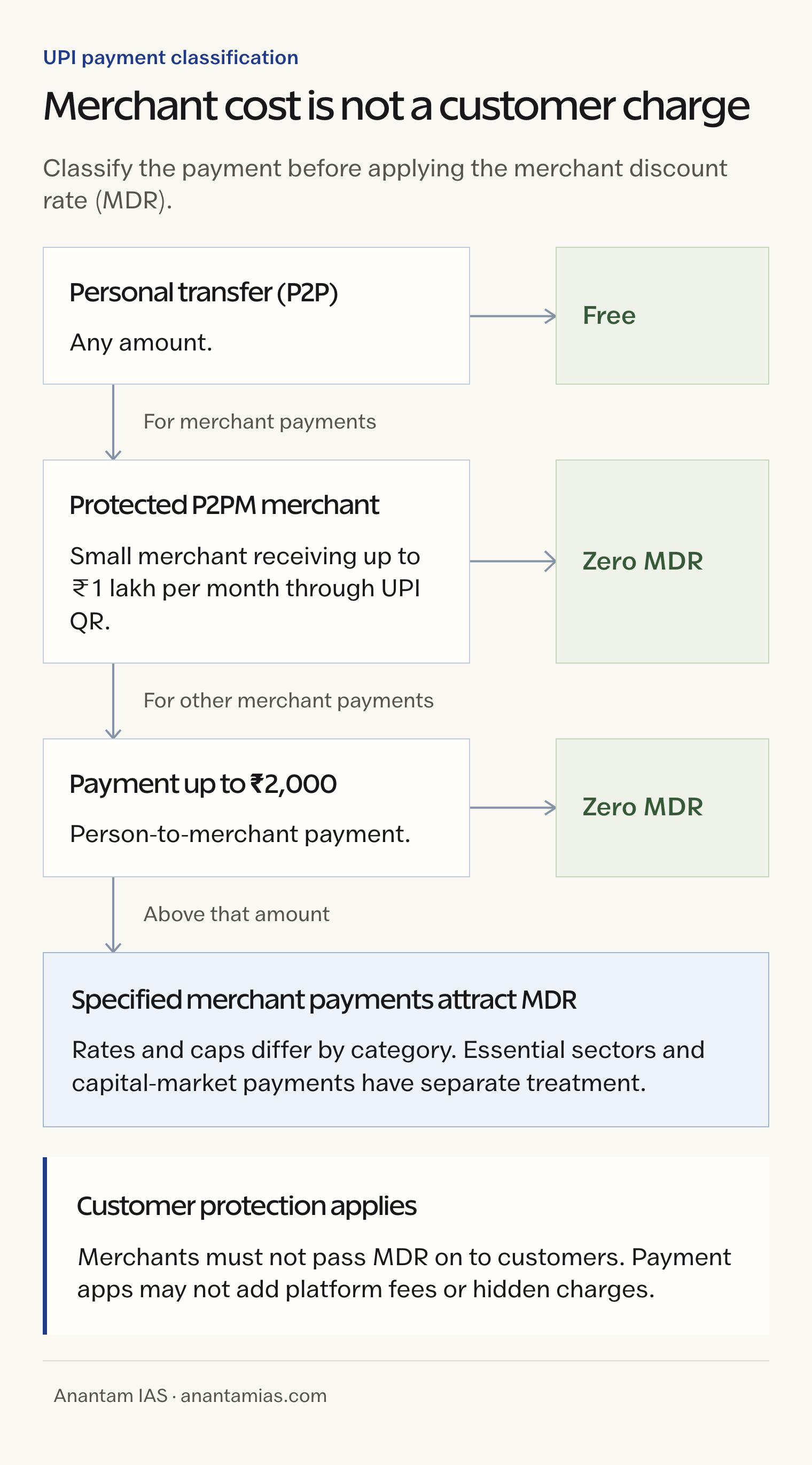
- Person-to-person transfers remain completely free, irrespective of the amount sent. The release rules out transaction fees, platform fees and other charges on individuals for sending or receiving money through this personal-transfer channel.
- Small merchant protection covers businesses receiving up to ₹1 lakh per month through UPI QR codes under the P2PM category. Both the receipt criterion and category matter; this is not a universal turnover exemption.
- The merchant-payment threshold protects payments at or below the stated cutoff. A larger purchase does not automatically establish a customer charge: merchant category and the framework’s differentiated treatment must still be checked before drawing conclusions.
- Approximately 96% refers to merchant-transaction count, according to the ministry. It does not mean the same share of money transferred is exempt, because a small number of large payments can represent substantial transaction value.
- Free usage has no monthly quota under the safeguards described in the release. Separate bank or NPCI transaction limits still serve security and risk-management purposes; they should not be confused with a paid usage tier.
What MDR finances, and why rates differ
Merchant discount rate is a cost within the payment ecosystem. The announcement uses differentiated treatment rather than one charge that applies identically to every transaction.
- MDR is neither a tax nor government revenue, the release clarifies. It is distributed among participating banks, payment service providers and application providers to support the operation and expansion of the digital-payment ecosystem.
- Specified larger merchant transactions attract MDR, with caps and separate arrangements for certain sectors. Quoting only the standard percentage can mislead because the applicable treatment depends on the nature of the payment being processed.
- Essential and thin-margin sectors receive a flat-charge arrangement for covered payments. Capital-market transactions have separate treatment. These distinctions reflect the framework’s attempt to accommodate different business economics without treating all merchant activity as identical.
- Financing and interoperability solve different problems. The discussion on linked cross-border payment systems concerns connections between payment networks; this framework concerns how specified domestic merchant payments contribute to supporting the ecosystem that processes them.
- A dedicated small-merchant fund is proposed in the release, financed from MDR collections to support acceptance and sustained use. Its announcement should not be presented as evidence that funds have already reached particular businesses.
Customer protection depends on implementation
The release separates merchant-side costs from customer charges, but that distinction must remain clear at the payment counter and inside the application.
- Customers should not pay MDR for making UPI payments. Banks have been advised to ensure merchants do not pass it on; the framework cannot be accurately summarized as a general fee on every UPI user.
- Application providers are prohibited from hidden charges and platform fees, according to the release. Calling a payment surcharge something else would undermine the stated consumer safeguard rather than explain how the merchant framework actually works.
- Formal safeguards need usable remedies. Customers should be able to identify disputed charges and seek resolution. Clear receipts, visible support routes and consistent merchant instructions are implementation priorities, not proof that enforcement already succeeds.
- Charging rules differ from fraud controls. The RBI money-mule draft discussion examines temporary debit restrictions and customer safeguards; free payment usage does not remove risk checks or turn every transaction limit into a fee.
- Announcement date is not an invented commencement date. This explanation follows the ministry’s September release; it does not infer a separate implementation deadline, operational circular or bank-specific charging procedure that the source does not supply.

Way Forward
Make the distinction visible at checkout
- Explain merchant categories clearly so small businesses understand the protection criteria and applicable treatment without relying on headline rates.
- Audit customer-facing charges and provide practical complaint routes when merchants or applications seek to pass through prohibited payment costs.
- Evaluate inclusion alongside revenue, tracking merchant acceptance and sustained usage rather than assuming collections alone demonstrate a healthier payment ecosystem.
Conclusion
- Merchant-side financing does not mean a general customer fee. The release preserves free personal transfers and customer use while applying differentiated MDR treatment to specified merchant payments, with small-business protections.
- Separate category, amount and incidence. In a Mains answer, explain which payment is covered, who bears its cost and how safeguards protect adoption; avoid confusing transaction count with the value of money transferred.
UPSC Practice Questions
Prelims MCQ 1
With reference to the UPI framework explained by the Finance Ministry on 15 September 2026, consider the following statements:
- Personal UPI transfers remain free regardless of the amount transferred.
- MDR is a tax collected by the Government from UPI customers.
- The approximately 96% unaffected figure refers to merchant-transaction count.
How many of the above statements are correct?
(a) Only one (b) Only two (c) All three (d) None
Answer: (b) Only two
Explanation:
Statements 1 and 3 are correct. The release describes MDR as a payment-ecosystem charge, not a government tax or a charge on customers making UPI payments.
Prelims MCQ 2
Which interpretation correctly distinguishes UPI risk controls from its charging framework?
(a) A daily transaction limit necessarily creates a paid tier (b) Free usage removes all bank risk-management limits (c) Transaction limits can serve security purposes without being charging thresholds (d) Every merchant payment attracts the same rate
Answer: (c) Transaction limits can serve security purposes without being charging thresholds
Explanation:
The release distinguishes bank and NPCI security limits from fee thresholds. It also provides differentiated merchant treatment, including protections and sector-specific arrangements.
UPSC Mains Questions
- How can digital-payment systems reconcile infrastructure financing with financial inclusion? Discuss using the UPI merchant framework and its customer safeguards. (150 words)
- Distinguish merchant payment costs from charges imposed on customers. Examine the implementation challenges in preserving this distinction within digital-payment ecosystems. (250 words)
Source: PIB, Ministry of Finance.
Frequently Asked Questions
Does the framework impose a fee on personal UPI transfers?
No. The Finance Ministry release states that person-to-person transfers remain free irrespective of the amount transferred. Individuals should not face transaction fees or platform charges for sending or receiving money through this channel.
Can a merchant pass MDR to the customer?
The release says MDR is not a charge on customers making UPI payments. Banks have been advised to ensure merchants do not pass it on, while applications are prohibited from hidden charges and platform fees.
Does the 96% figure describe the value of merchant payments?
No. It describes the approximate share of merchant transactions remaining unaffected. Counting transactions and adding their monetary value are different measures, so the figure should not be rewritten as a share of payment value.
Do all merchant payments above the threshold attract the same charge?
No. Protected small merchants and differentiated sector-specific arrangements matter. The release describes standard treatment, caps and special arrangements; applying one headline rate to every larger payment would misrepresent the framework.
Source: https://anantamias.com/current-affairs/upi-mdr-framework-merchant-cost-customer-protection/
Kishau Agreement: Shared Storage, Federal Coordination and River Flows
Why in News?
The Kishau Multipurpose Project agreement was signed on 15 September 2026, advancing cooperation among six participating governments in the Yamuna basin.
- The proposed project lies on the Tons River along the Uttarakhand-Himachal Pradesh border; the agreement concerns a future storage project, not an operational dam.
- The participating governments include Delhi, a National Capital Territory. Describing every signatory as a state would obscure that constitutional distinction.
- The official release describes proposed storage capacity of 1,562 million cubic metres, connecting drinking-water, irrigation and hydropower objectives within a shared project.
- The Centre presents the agreement as negotiated cooperation following consultations on technical, economic and participating governments’ interests; projected benefits still depend on implementation.
- Upstream storage and downstream demand cross administrative boundaries. Agreement must connect who bears project burdens with who receives water and other benefits.
- Environmental flows require explicit attention alongside human withdrawals. Additional storage cannot, by itself, establish that enough water will remain in a river during every season.
UPSC Relevance
Prelims Relevance
- Tons River and the Uttarakhand-Himachal Pradesh border.
- Multipurpose storage: drinking water, irrigation and hydropower objectives.
- Delhi NCT as a participating government.
- Storage volume differs from flow rate and electricity-generation capacity.
- Environmental flows concern the river’s functioning, not only water supplied to users.
Mains Relevance
GS Paper 2
- Cooperative federalism through negotiated benefits, responsibilities and continuing coordination.
GS Paper 3
- Water security and the relationship between reservoir operations, downstream flows and environmental safeguards.
Essay
- Shared resources need institutions that connect agreement with accountable operation.
Background and Context
What storage changes in a river basin
A reservoir changes when water is available; its usefulness depends on inflows, releases and competing demands.
- Storage capacity describes the volume a reservoir can hold. It does not establish the quantity of dependable water that can be supplied throughout an unusually dry year.
- Seasonal regulation can shift some water availability across time. That benefit depends on operating rules: how much is retained, when it is released and which needs receive priority.
- Drinking water and irrigation create different demand patterns. A multipurpose project must reconcile these uses instead of treating every stored unit as simultaneously available for every purpose.
- Hydropower adds another operating objective. Water released for generation continues downstream, but the timing of those releases may not automatically match agricultural demand or river requirements.
- The Nepal power-supply note illustrates why availability windows matter. Kishau concerns reservoir coordination rather than permission to trade electricity across borders.

Why a negotiated agreement matters
The central institutional challenge is to connect project burdens with benefits distributed across jurisdictions.
- Upstream jurisdictions host infrastructure and experience local consequences, while downstream users may receive substantial benefits. Negotiation makes this imbalance a shared governance issue rather than a purely engineering question.
- The release links Kishau to the 1994 Yamuna agreement, under which separate agreements were envisaged for storage projects. Basin cooperation and individual project arrangements operate at different levels.
- Central financial support may ease bargaining, but funding participation and water entitlement are separate questions. A contribution percentage cannot be assumed to determine an identical share of stored water.
- Signing consent establishes an important political and administrative step. It does not prove that construction, rehabilitation, permissions or future operational arrangements have already been completed successfully.
- Continuing coordination matters after signature: participating governments need arrangements for sharing information, responding to shortages and resolving disagreements over how the project is operated.
Keeping water for the river
The release raises environmental flows, making river requirements part of the discussion rather than an assumed leftover.
- The Home Minister said earlier allocations had overlooked the Yamuna’s environmental-flow requirement. Treat this as the official account supporting the agreement, not an independently established legal finding.
- Environmental flows concern the water needed to sustain river ecosystems and their functions. Their adequacy depends on timing and seasonal variation, not simply a total annual volume.
- Stored water can support downstream releases only if operating decisions provide for them. Construction alone cannot guarantee that water will reach the required river stretch when it is needed.
- Pollution control remains a separate obligation. More available water does not remove the need to intercept untreated sewage and manage other pollutant inputs entering the Yamuna.
- The Brahmaputra dam explainer offers a comparison in upstream-downstream interdependence; Kishau involves domestic cooperation, not negotiation between sovereign countries.
Reading project claims without confusing the units
Different measures answer different questions about project performance; they cannot substitute for each other.
- Storage volume measures water held; a flow rate measures water passing a point over time. Neither figure alone shows how reliably specific users receive supply across seasons.
- Generation capacity describes the rate at which a power plant can produce electricity. Energy generated accumulates over time, so a figure in electricity units must not be relabelled as megawatts.
- Projected irrigation coverage identifies an intended service area. Actual benefits depend on delivery infrastructure, water availability and distribution; announcing an area does not demonstrate that every farm already receives water.
- Assessment should match each claim to its evidence: release records for river flows, delivery records for users and implementation records for construction. One headline cannot verify all three outcomes.
Way Forward
Make project cooperation operational
- Publish understandable allocation and operating arrangements, distinguishing commitments, projected benefits and implementation milestones.
- Connect downstream-flow monitoring with reservoir release records and seasonal conditions so environmental commitments can be assessed.
- Track rehabilitation and local impacts alongside construction progress; beneficiaries’ gains should not obscure burdens at the project site.
- Coordinate water releases and pollution reduction through measurable responsibilities rather than treating the dam as a complete river-cleaning solution.
Conclusion
- Kishau illustrates how shared storage requires negotiated institutions as well as infrastructure: water availability, benefit distribution and river functioning must be considered together.
- In an answer, distinguish agreement from completion and storage from dependable supply, then explain why transparent operating rules are needed to turn cooperation into durable outcomes.
UPSC Practice Questions
Prelims MCQ 1
With reference to the Kishau Multipurpose Project agreement, consider the following statements:
- The proposed project is on the Tons River along the Uttarakhand-Himachal Pradesh border.
- The signing of the agreement establishes that the dam is already operational.
- Delhi participates as a National Capital Territory.
How many of the above statements are correct?
(a) Only one (b) Only two (c) All three (d) None
Answer: (b) Only two
Explanation:
Statements 1 and 3 are correct. The agreement advances a proposed project; it does not establish completion or operation.
Prelims MCQ 2
Which information would best establish whether reservoir operations support downstream environmental flows?
(a) Only the reservoir’s maximum storage volume (b) Only the construction expenditure (c) Seasonal release records assessed against river requirements (d) Only the number of participating governments
Answer: (c) Seasonal release records assessed against river requirements
Explanation:
Environmental flows depend on the quantity and timing of water reaching the river. Storage capacity alone cannot establish whether those needs are met.
UPSC Mains Questions
- Using the Kishau agreement as an example, explain why negotiated cooperation is essential for multipurpose river projects. (150 words)
- How can reservoir operating rules reconcile water supply, hydropower and environmental flows? Discuss the limits of treating storage infrastructure as a river-restoration solution. (250 words)
Source: PIB, Ministry of Home Affairs.
Frequently Asked Questions
What is the Kishau agreement?
It is an agreement signed on 15 September 2026 among participating governments for a proposed multipurpose storage project on the Tons River. The signing advances cooperation but does not mean the dam is operational.
Where is the proposed Kishau project?
The official release places it on the Tons River along the Uttarakhand-Himachal Pradesh border. Its proposed benefits concern the wider Yamuna basin, illustrating why the site and beneficiary areas are different governance considerations.
Does storage capacity equal assured water supply?
No. Storage capacity measures the volume a reservoir can hold. Dependable supply also depends on inflows, seasonal conditions, operating rules and competing uses, so the headline capacity alone cannot establish year-round availability.
Will the project by itself clean the Yamuna?
No such outcome follows automatically. Any downstream-flow benefit depends on actual releases and river needs. Pollution reduction also requires control of untreated sewage and other inputs; projected storage benefits should not be treated as achieved restoration.
Source: https://anantamias.com/current-affairs/kishau-agreement-water-storage-federal-coordination/
DRDO VIMARSH: Source-Code Access and Defence Technology Absorption
Why in News?
On September 15, 2026, DRDO VIMARSH introduced secure software source-code sharing with licensee industries and measures to improve industry participation in defence technology development.
- A standardised, secure framework covers DRDO-developed software source codes shared with licensee industries.
- Support for MSMEs and deep-tech start-ups includes direct funding, incubation and dedicated access to DRDO testing facilities.
- Nine licensing agreements for technology transfer were handed over to 13 manufacturing partners to enable commercial production.
- DRDO contracted with the Quality Council of India for SAMAR version 2.0, intended to benchmark manufacturing maturity.
- Technology absorption means building the practical capability to use transferred knowledge, troubleshoot production and support a system throughout its working life.
- The policy addresses the gap between laboratory development and reliable industrial production; an announcement alone does not demonstrate that this gap has closed.
UPSC Relevance
Prelims Relevance
- DRDO: Defence Research and Development Organisation.
- LAToT: Licensing Agreement for Transfer of Technology.
- Licensee source-code access differs from public open-source release.
- Obsolescence management concerns support when technologies or components age.
- SAMAR benchmarks manufacturing maturity; it is not a procurement order.
Mains Relevance
GS Paper 3
- Technology absorption and indigenous defence manufacturing.
- Balancing industry participation with security and lifecycle reliability.
GS Paper 2
- Institutional coordination and accountable implementation of industrial policy.
Essay
- Self-reliance depends on the capacity to learn, adapt and maintain technology.
Background and Context
What licensee source-code sharing changes
The central change concerns controlled access to the instructions behind software, which can matter long after a physical system leaves the factory.
- Source code is the human-readable set of instructions used to develop software. Access can help authorised engineers understand behaviour and maintain software, rather than relying only on a finished executable.
- The announced recipients are licensee industries. This is a controlled transfer framework, not a declaration that DRDO software is publicly available for anyone to copy, modify or redistribute without restrictions.
- Software-defined capabilities depend partly on software behaviour. Authorised access can support adaptation as requirements evolve, but the release does not promise unrestricted modification rights or automatic approval of every change.
- Obsolescence management addresses ageing technologies and support dependencies. Source access can help a licensed partner diagnose compatibility problems when hardware changes, subject to the permissions and safeguards governing the transfer.
- The PIB announcement does not disclose the complete licence clauses or access-control design. Treat expected maintenance benefits as a policy mechanism, not as proof that every licensee already has operational access.
Technology absorption is different from buying equipment
A production licence can open a route to manufacturing; absorption requires the recipient to develop the skills and routines needed to use that route.
- Technology transfer supplies authorised knowledge or rights. Technology absorption is the receiving firm’s ability to understand and apply them consistently, including resolving practical production problems and maintaining quality over time.
- A Licensing Agreement for Transfer of Technology enables the specified commercial-production relationship. It does not, by itself, establish a government purchase order, a guaranteed market or acceptance by an operational user.
- Access to a testing facility gives firms a route to generate evidence about performance. It does not mean their products have already passed testing, received certification or entered military service.
- Industry-led development and procurement solve different problems: one builds capability, while the other acquires products against requirements. Confusing them hides the work needed between a prototype and reliable delivery.
- Read the wider defence manufacturing challenge through lifecycle capability: can domestic firms produce, maintain and improve equipment, rather than merely assemble it from transferred instructions?
Why funding, incubation and testing belong together
Small technology firms can possess a promising design while lacking the money, facilities or production experience needed to turn it into a dependable product.
- Funding addresses resource constraints during development. It cannot substitute for engineering validation, but it can help firms sustain the work required before a product becomes commercially viable and attracts repeat demand.
- Incubation support can connect a young firm with technical guidance and development resources. Its value depends on solving specific execution problems, rather than simply adding another institutional affiliation to a proposal.
- Dedicated testing access can reduce the need to recreate expensive facilities. Transparent access arrangements matter because an unavailable test slot can interrupt development even when a firm has engineers and financing.
- The proposed move covers research, design, testing, certification and manufacturing. Participation across this chain offers a deeper role for MSMEs than treating them only as suppliers of low-value components.
- iDEX provides related context on the defence innovation ecosystem. Do not assume its rules, funding terms or selection process automatically apply to the newly announced VIMARSH framework.
Manufacturing maturity and security remain separate tests
Wider participation becomes useful only when firms can handle sensitive knowledge responsibly and deliver consistent manufacturing outcomes under the applicable requirements.
- SAMAR stands for System for Advance Manufacturing Assessment and Rating. The announced contract with the Quality Council of India concerns benchmarking manufacturing maturity, a different question from access to software.
- Manufacturing maturity asks whether an enterprise has dependable production capability. A maturity benchmark can guide improvement; it should not be presented as proof that every product meets all operational requirements.
- Secure sharing requires a balance between usable access and protection of sensitive knowledge. Recommended safeguards include clear responsibilities and controlled access, without pretending that these unpublished licence terms are already verified.
- Lifecycle accountability also matters after transfer: who maintains documentation, resolves defects and supports changed components? These are implementation questions to examine, rather than benefits established merely by signing an agreement.
Way Forward
Measure absorption through demonstrated capability
- Define licence responsibilities clearly, including permitted access, maintenance obligations and responsibility for changes; publish non-sensitive guidance that helps smaller firms judge eligibility.
- Make facility access predictable through clear application steps and testing schedules, while retaining the relevant security and technical requirements.
- Evaluate outcomes through reliable production, maintainability and resolved technical bottlenecks, alongside participation counts and signed agreements.
- Keep development support, testing, certification and procurement distinct so that faster collaboration does not become a claim of automatic acceptance.
Conclusion
- VIMARSH is best understood as an attempt to improve technology absorption: controlled knowledge access must work together with finance, facilities and manufacturing competence.
- For an answer on defence self-reliance, distinguish access from capability and capability from procurement. The decisive outcome is dependable domestic support across a system’s lifecycle.
UPSC Practice Questions
Prelims MCQ 1
With reference to the DRDO VIMARSH initiatives, consider the following statements:
- The source-code framework is intended for licensee industries.
- Access to DRDO testing facilities automatically establishes acceptance by the armed forces.
- SAMAR concerns assessment and rating of manufacturing maturity.
How many of the above statements are correct?
(a) Only one (b) Only two (c) All three (d) None
Answer: (b) Only two
Explanation:
Statements 1 and 3 are correct. Testing access provides an opportunity for evaluation; it does not establish that a product has passed testing or received user acceptance.
Prelims MCQ 2
Which situation best illustrates technology absorption?
(a) A firm receives an invitation to an industry conference. (b) A firm obtains a licence but cannot resolve production problems. (c) A licensed firm develops the skills to manufacture consistently and maintain the transferred technology. (d) A laboratory publishes the title of a research project.
Answer: (c) A licensed firm develops the skills to manufacture consistently and maintain the transferred technology.
Explanation:
Technology absorption means the recipient develops practical competence to apply transferred knowledge. Merely receiving a licence or attending an event does not demonstrate that competence.
UPSC Mains Questions
- How can controlled source-code sharing improve technology absorption in India’s defence industry? Examine the safeguards and implementation conditions required. (150 words)
- Distinguish technology transfer, testing access and procurement. Explain why MSME participation in defence manufacturing requires more than licensing agreements. (250 words)
Source: PIB, Ministry of Defence.
Frequently Asked Questions
What did DRDO announce at VIMARSH?
DRDO announced secure source-code sharing with licensee industries, alongside support for MSMEs and start-ups through funding, incubation and testing access. Technology-transfer agreements and a manufacturing-maturity assessment initiative were also announced.
Does DRDO source-code sharing mean open-source software?
No. The announcement specifies a standardised, secure framework for sharing with licensee industries. It does not announce public access or unrestricted rights to copy, modify and distribute the software.
Does a technology-transfer licence guarantee a defence order?
No. A licence enables the specified transfer and production relationship. A procurement order, successful testing and acceptance by an operational user are separate matters that cannot be inferred from the licence alone.
Why does software access matter for obsolescence management?
Authorised access can help engineers understand software behaviour and address compatibility or maintenance problems as components age. The benefit depends on licence permissions, engineering competence and the applicable validation requirements.
Source: https://anantamias.com/current-affairs/drdo-vimarsh-licensee-software-technology-absorption/
SPROUT and SpeedSeed: Testing Crop Traits and Accelerating Breeding
Why in News?
The SPROUT crop-phenotyping facility was inaugurated at BRIC-National Institute of Plant Genome Research in New Delhi on 15 September 2026, alongside attention to its separate SpeedSeed technology.
- SPROUT supports controlled-environment phenotyping and precision stress screening, with a major focus on chickpea.
- SpeedSeed accelerates generation advancement; optimized chickpea protocols can shorten a generation cycle to approximately 40 days.
- SpeedSeed can operate within SPROUT or other suitable controlled-environment facilities; the technology and the facility are distinct.
- Climate-resilient agriculture needs reliable evaluation of useful traits as well as faster breeding; shortening a cycle alone does not establish field performance.
- Research infrastructure can connect gene discovery with crop improvement, but farmers benefit only when promising results survive practical testing and reach usable seed systems.
UPSC Relevance
Prelims Relevance
- SPROUT: controlled-environment phenotyping facility at BRIC-NIPGR, New Delhi.
- Phenotyping: measurement of observable plant characteristics.
- SpeedSeed: separate technology for accelerated generation advancement.
- Approximately 40 days: optimized chickpea generation cycle, not a universal field-harvest claim.
- Germplasm: plant genetic material used in research and breeding.
Mains Relevance
GS Paper 3
- How phenotyping and faster generation advancement address different crop-breeding bottlenecks.
- Why climate-resilient agriculture requires field validation, seed access and locally relevant selection.
Essay
- Scientific speed is useful when paired with reliable evidence and practical access.
Background and Context
What SPROUT actually measures
SPROUT helps researchers test whether promising plant material expresses useful characteristics under selected environmental conditions, connecting genetic research with observable crop performance.
- Phenotyping measures observable characteristics rather than merely identifying DNA differences. A candidate gene becomes useful for breeding when researchers can connect it with a relevant, repeatable plant response under clearly described conditions.
- Controlled environments make selected conditions more consistent across comparisons. This helps researchers examine plant responses without relying entirely on the arrival of a particular outdoor season, while keeping the experiment distinct from farming.
- Precision stress screening evaluates responses to specified stresses. Comparing plant lines under defined conditions helps identify promising material, but the meaning of a result depends on the stress actually tested and measured.
- High-throughput phenotyping enables evaluation of many plants or lines. Its value lies in making trait comparisons more systematic, helping researchers decide which candidates deserve further investigation rather than declaring every candidate an improved variety.
- SPROUT evaluates diverse material, including germplasm, breeding populations, mutants, transgenic plants and genome-edited lines. These are categories of research material; their presence in the facility does not establish commercial release or farmer availability.

Why SpeedSeed is a separate breeding tool
SpeedSeed addresses the time between generations; SPROUT addresses the quality of trait evaluation. Combining them can help breeding, but their functions should remain separate.
- Generation advancement moves breeding material through successive plant generations. Shortening that interval can reduce waiting time within a research programme, allowing breeders to advance promising material sooner while continuing to assess its useful characteristics.
- Approximately 40 days refers to an optimized chickpea generation cycle reported for SpeedSeed. It is not a claim that farmers can harvest every chickpea variety within that period under ordinary field conditions.
- Protocols matter: the reported result belongs to chickpea under optimized conditions. Applying the same number to other crops, different facilities or all breeding material would extend the claim beyond the official announcement.
- The facility and technology are separable. SpeedSeed can be used within SPROUT or adapted to other suitable controlled-environment facilities, so neither the name nor the location should be mistaken for the entire breeding method.
- Different interventions solve different bottlenecks. Compare this with mustard self-incompatibility in hybrid breeding: controlling reproduction, advancing generations and measuring useful traits are related tasks, but they are not interchangeable scientific operations.
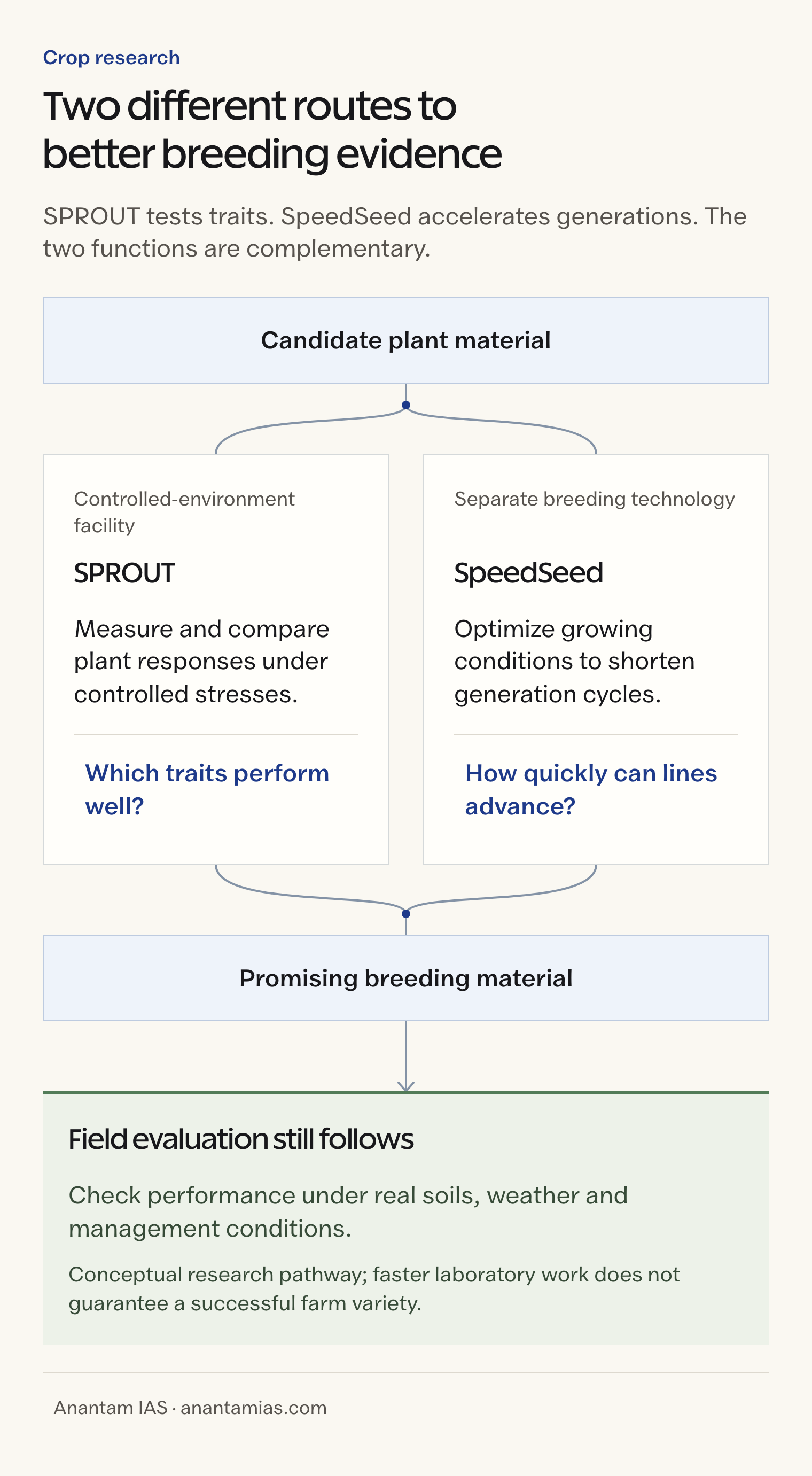
Why laboratory success still needs field evidence
The announcement describes research capability. Translating that capability into dependable varieties requires evidence about performance across the conditions farmers actually face.
- Trait validation asks whether a promising characteristic is reliably expressed. A line selected under controlled conditions must still be assessed for relevant agricultural performance before a laboratory result becomes a defensible recommendation to farmers.
- Field conditions combine multiple influences, including weather, soils and management. A controlled experiment can isolate a useful response, but it cannot by itself represent every combination encountered across different production environments and growing seasons.
- Climate resilience is context-dependent. A useful response under one tested stress does not automatically prove tolerance to every stress, dependable yield everywhere or suitability for every farming system in which the crop is grown.
- Participatory testing can connect scientific selection with farmers’ priorities. The Delhi Drylands Declaration discussion on living laboratories offers a related lens: bringing research into real production settings helps test whether innovations address practical needs.
- Announcement versus outcome is the central evidence distinction. The inauguration establishes that a facility has been introduced; it does not establish that all evaluated lines are released varieties or that future benefits have already occurred.
Way Forward
Measure progress from screening to usable seed
- Report experimental conditions alongside generation times and trait results so users can distinguish demonstrated findings from possible applications.
- Connect screening with field evaluation, comparing promising material across relevant locations and farming conditions before making broad performance claims.
- Include farmer priorities in selection and testing, and plan seed multiplication and access when material becomes suitable for deployment.
Conclusion
- SPROUT strengthens trait evaluation; SpeedSeed accelerates generation advancement. Their combined value lies in improving different stages of crop research, with the reported chickpea cycle remaining conditional on optimized protocols.
- Faster breeding needs trustworthy selection. In an answer on climate-resilient agriculture, connect controlled research with field evidence and farmer access, and distinguish promising research material from an already released variety.
UPSC Practice Questions
Prelims MCQ 1
With reference to SPROUT and SpeedSeed, consider the following statements:
- SPROUT is a controlled-environment facility for crop phenotyping.
- SpeedSeed can be adapted to suitable facilities other than SPROUT.
- The reported 40-day cycle guarantees field harvest of every chickpea variety within 40 days.
How many of the above statements are correct?
(a) Only one (b) Only two (c) All three (d) None
Answer: (b) Only two
Explanation:
Statements 1 and 2 are correct. Approximately 40 days refers to a chickpea generation cycle under optimized SpeedSeed protocols, not a universal field-harvest guarantee.
Prelims MCQ 2
Which activity most directly describes crop phenotyping?
(a) Measuring observable plant traits under specified conditions (b) Approving all experimental lines for sale (c) Replacing field testing with DNA sequencing (d) Distributing certified seed to every farmer
Answer: (a) Measuring observable plant traits under specified conditions
Explanation:
Phenotyping measures observable characteristics and responses. It supports selection but does not itself release varieties, distribute seeds or eliminate field evaluation.
UPSC Mains Questions
- Explain how controlled-environment phenotyping and accelerated generation advancement address different bottlenecks in developing climate-resilient crops. (150 words)
- Faster laboratory research does not automatically produce dependable agricultural outcomes. Discuss with reference to trait validation, field testing and farmer access. (250 words)
Source: PIB, Ministry of Science & Technology.
Frequently Asked Questions
What is SPROUT?
SPROUT is a season-independent, controlled-environment crop-phenotyping facility at BRIC-NIPGR in New Delhi. It supports precision stress screening and evaluation of diverse plant research material, with a major focus on chickpea.
How is SpeedSeed different from SPROUT?
SpeedSeed is a separate technology for accelerated generation advancement. SPROUT is a facility for trait evaluation. SpeedSeed can operate within SPROUT or be adapted to other suitable controlled-environment facilities.
Does the 40-day claim mean chickpea can always be harvested that quickly?
No. The official announcement reports approximately 40 days for a chickpea generation cycle under optimized SpeedSeed protocols. It does not promise the same field-harvest duration for every variety or environment.
Does successful screening mean a variety is ready for farmers?
No. Screening identifies promising plant material under tested conditions. Practical suitability requires further evaluation, including relevant field performance; research lines should not be described as released varieties merely because they were studied.
Source: https://anantamias.com/current-affairs/sprout-speedseed-phenotyping-generation-advancement/
Merchants face 0.4% fee on UPI payment above ₹2,000
Why in news?
The National Pay-ments Corporation of India has introduced a charge of 0.4% that most merchants will have to pay banks and payment processors on UPI payments they receive in excess of ₹2,000 per transaction.
UPSC Relevance
Prelims
GS3, Indian Economy
What is the Merchant Discount Rate ?
Merchant Discount Rate (MDR) is the fee charged to merchants by acquiring banks and payment aggregators to cover the operational, network, and processing costs of accepting digital payments (such as credit/debit cards or UPI). It is usually calculated as a percentage of the total transaction value.
Merchant Acquiring Bank : A merchant acquiring bank (or acquirer) is a financial institution that lets a business accept credit and debit card payments.
- It acts as a middleman between the business (merchant), the card networks (like Visa or Mastercard), and the customer’s bank (the issuer).

Government Policy Trajectory in India for MDR:
2020: In January 2020, the government introduced a Zero-MDR policy on UPI and RuPay debit card transactions to accelerate mass digital payment adoption.
2026: To address payment infrastructure maintenance costs for banks and fintechs, the government introduced a targeted 0.4% MDR (capped at ₹300) only for P2M transactions exceeding ₹2,000.
Recent changes :-
- National Payments Corporation of India (NPCI) introduced a 0.4% MDR on Person-to-Merchant (P2M) transactions above ₹2,000,
- It will be effective from October 15.
- For transactions of ₹75,000 and above, the MDR charge is capped at ₹300 per transaction.
- Exemptions:
- All Person-to-Person (P2P) transactions (accounting for 37% of volume and 70% of value of present UPI transactions) remain completely free.
- P2M transactions up to ₹2,000 are exempted
- Transactions done via RuPay debit cards carry zero MDR.
- Small merchants (receiving up to ₹1 lakh per month via P2PM QR codes) are fully exempt.
- Concessional / Flat Rates:
- Flat ₹5 MDR: Applies to transactions above ₹2,000 in essential/thin-margin sectors like Railways, telecom, insurance, fuel, and agricultural inputs.
- 0.02% MDR (Capped at ₹300): Applies to capital market transactions (mutual funds, securities, stockbrokers) to encourage retail participation.
- Distribution & Dedicated Fund:
- The 0.4% charge will be shared among ecosystem partners (acquiring banks, app providers, etc.).
- 5% of total MDR collections will build a dedicated fund to promote UPI adoption among small and unorganized street vendors.
Associated Concerns
- Merchant Pushback & Price Bumping: Risk of merchants attempting to pass the fee onto consumers informally or inflating retail shelf prices despite prohibitions.
- Informal Cash Reversion: Merchants might encourage customers to pay cash for purchases above ₹2,000 to avoid incurring the 0.4% fee.
- Implementation & Monitoring Burden: Ensuring acquiring banks strictly prevent merchants from adding surcharges requires strong regulatory enforcement.
- Concerns raised regarding the friction or burden it creates within the digital payments ecosystem.
Government’s Stand
- Self-Sustainability & Infrastructure Investment: Funds generated will support the expansion, security, and maintenance of server bandwidth for the massive UPI infrastructure.
- Financial Inclusion & Digital Public Infrastructure (DPI): UPI forms a core pillar of India’s DPI (“India Stack”). The 5% allocation for small-merchant onboarding directly strengthens formalization of the informal sector.
- Negligible Impact on Small Vendors: Data shows only 4% of total merchant transactions exceed ₹2,000 or fall outside the zero-MDR P2PM threshold, leaving 96% of everyday small payments completely unaffected.
- Consumer Protection: Strict advice issued to banks and app providers prohibiting platform fees, hidden charges, or passing the cost to buyers.
- Financial Sector Stabilization: Flat/reduced rates prevent cost escalation in essential public services and encourage retail investment in formal financial markets.
- Comparison with Card Networks: The 0.4% rate is significantly lower than traditional credit card MDRs (typically 1.5%–2.5%) and debit card MDRs (up to 0.9%), preserving UPI’s competitive edge.
NPCI (National Payments Corporation of India)
- An umbrella organization for operating retail payments and settlement systems in India.
- Non-profit organization under Section 8 of the Companies Act.
- Established as an initiative of the Reserve Bank of India (RBI) and Indian Banks’ Association (IBA) under the Payment and Settlement Systems Act, 2007.
- Built transformative systems including UPI, RuPay, IMPS, AePS, NETC FASTag, and NACH.
- Drives nearly half of the world’s real-time payment volumes through UPI, expanding globally via its international arm, NIPL(NPCI International Payments Limited).
Practice MCQ
Consider the following statements regarding the National Payments Corporation of India (NPCI) and the Merchant Discount Rate (MDR) regulations for UPI:
- NPCI is a subsidiary company created by the Reserve Bank of India (RBI).
- All Person-to-Person (P2P) UPI transactions are not subject to a standard 0.4% MDR charge.
- Merchant Discount Rate (MDR) is the fee charged to customers by acquiring banks and payment aggregators on UPI transactions.
Which of the statements given above are correct?
(a) 1 only
(b) 2 only
(c) 1 and 3 only
(d) 1, 2 and 3
Answer: (b) 2 only
Source: https://anantamias.com/current-affairs/merchants-face-0-4-fee-on-upi-payment-above-%e2%82%b92000/
Youth discontent and the changing face of protest
Why in news?
Across the world, new forms of rebellion and revolt by the masses are emerging especially led by youth. The author has analysed their nature and cautioned against any complacency while dealing with them.
UPSC Relevance
GS2, Pressure Groups and Formal/Informal Associations and their Role in the Polity.
Characteristics of Modern Youth Uprisings
M.K. Narayanan, has noted that the nature of recent youth uprisings is characterized by a fundamental belief among Gen Z that disruption is essential to dismantle an old order incapable of handling modern challenges.
- Erosion of Institutional Trust: Today’s youth feel that traditional democratic institutions, checks and balances, and political parties are failing to represent their interests or address systemic issues. As a result, youth are taking matters into their own hands rather than relying on established political processes.
- Driven by Discontent with Governance: Rather than abstract ideology alone, protests are sparked by concrete issues like the mismanagement of public examinations, employment security, recruitment irregularities, and perception of corruption.
- Role of Digital Platforms: Modern agitation is amplified by digital platforms and social media, which rapidly expand the reach, speed, and connectivity of youth movements.
- Spontaneous and Less Structured: Recent movements tend to be less hierarchically structured and more spontaneous compared to traditional political protests.
Examples
- Nepal and Bangladesh: In India’s neighborhood, student and youth upheavals recently escalated to the point of ousting long-established regimes.
- Exam & Recruitment Issues : Student unrest in states like Jharkhand, Chhattisgarh, and Bihar has centered around examination irregularities (such as the NEET controversy).
- The Cockroach Janta Party (CJP) Sit-in: While smaller in scale than the revolutions in Nepal or Bangladesh, serves as an indicator of pent-up fury among students over institutional failures and suspected corruption/collusion in national entrance exams.
Parallelism Between Naxalism and Youth Uprisings
- Small Beginnings Escalating into “Prairie Fires”: The author highlights how Naxalism began as a small “spring thunder” in Naxalbari in the late 1960s before spreading across vast parts of India. Similarly, modern student protests may start small but carry the potential for widespread rebellion.
- If authorities ignore youth anger or use indiscriminate force, separate localized protests can shift the focus from specific educational or recruitment grievances to a broader rebellion against authority and democratic governance per se.
- Attracting the Youth and Intellectuals: Just as Naxalism persuaded India’s “best and brightest” students, intelligentsia, and working class into its fold, current agitations are capturing the minds of Gen Z and young people across different regions.
- Vulnerable to extremist takeover: The author notes that spokesperson groups associated with extreme ideologies (like “dimagi Naxals”) are already referring to new youth protest movements (like the CJP) as their “siblings,” showing how radical elements seek to co-opt and misuse youth anger.
Strategy Adopted by the Government So Far
- Indiscriminate and Mindless Force: Authorities and state governments tend to deploy force meant for unruly and violent mobs against peaceful student agitators.
- Delegitimization and Labelling: A common tactic—seen both in India and neighboring regions—is branding protestors as “foreign agents,” “anti-nationals,” “traitors,” or linking them to radical groups like “Naxals” to discredit their grievances.
- Knee-Jerk Reactive Measures: Rather than resolving root issues, state responses often involve extreme reactive decisions (e.g., Jharkhand’s Chief Minister scrapping recruitment examinations entirely), which the author characterizes as “throwing the baby out with the bathwater”.
- Dismissal of Threat: Authorities often maintain that major subversions (like Naxalism) are “dead,” missing how small localized sparks can re-ignite wider unrest.
Are these protests unconstitutional ?
- Article 19(1)(a): Guarantees freedom of speech and expression, enabling citizens to express opinions, dissent, and criticize government policies.
- Article 19(1)(b): Guarantees the right to assemble peaceably and without arms.
- Article 19(1)(c): Guarantees the right to form associations or unions, enabling collective organizing for demonstrations.
- Reasonable Restrictions (Articles 19(2) & 19(3)): These fundamental rights are not absolute. The State can impose reasonable restrictions in the interests of sovereignty and integrity of India, security of the State, public order, decency, morality, or in relation to contempt of court, defamation, or incitement to an offense.
- Fundamental Duty (Article 51A(i)): Mandates every citizen to safeguard public property and abjure violence during agitations.
Supreme Court Judgments
- Himat Lal K. Shah v. Commissioner of Police (1973): Held that citizens have a basic right to hold public meetings on public streets, and the state’s power to regulate public assemblies cannot extend to a complete prohibition.
- Ramlila Maidan Incident v. Home Secretary (2012): Ruled that peaceful protest is a fundamental right that cannot be curtailed by arbitrary executive or legislative action. The Court emphasized that peaceful assembly is a cornerstone of democratic governance.
- Mazdoor Kisan Shakti Sangathan (MKSS) v. Union of India (2018): Stripped down a blanket ban on protests at Jantar Mantar, holding that police must balance the rights of protesters with the rights of local residents by establishing designated protest zones.
- Amit Sahni v. Commissioner of Police / Shaheen Bagh Judgment (2020): Affirmed the right to protest, but ruled that public spaces and roads cannot be occupied indefinitely, as the right to protest must be balanced against the right of commuters to free movement.
Strategy Recommended by the Author (M.K. Narayanan)
The author argues for a proactive, perceptive, and constructive approach to curb the erosion of public trust:
- Comprehend the True Nature of Discontent: Leading political figures must recognize the warning signs early and acknowledge that youth anger stems from genuine institutional failures, and systemic corruption rather than mere law-and-order issues.
- Restraint in Force: Authorities must refrain from using indiscriminate force, which only triggers a backlash against all forms of authority.
- Prevent Protests from Coalescing: The primary objective should be to address individual, localized grievances before different forms of protest coalesce into a broader anti-government wave.
- Rebuild Democratic Faith (“Reset the Compass”): All political parties—both government and opposition—must adopt measures to restore youth faith in democratic processes, institutional safeguards, and governance systems.
Practice Question
Q. Examine how institutional trust deficits and governance failures drive modern youth unrest. How can the State balance law enforcement with constructive engagement to prevent such agitations from threatening democratic stability? (15 Marks | 250 Words)
Source: https://anantamias.com/current-affairs/youth-discontent-and-the-changing-face-of-protest/
Lessons from India’s Smallholder Farmers
Why in News?
India and the International Fund for Agricultural Development (IFAD) launched the Country Strategic Opportunities Programme, 2026-2033, in May 2026 to strengthen rural incomes, resilience and sustainable livelihoods.
The editorial draws lessons from India’s experience of connecting smallholders with institutions, finance and markets.
| UPSC Relevance: GS-3 Economy: Agriculture, Rural finance, Inclusive growth Prelims: IFAD, FPOs and AgriStack Mains: Agriculture sector in India: prospects and associated challenges. |
Challenges faced by Smallholder Farmers:
- Small and fragmented holdings: Small and marginal holdings constituted 86% of operational holdings, while the average holding measured 1.08 hectares (Agriculture Census 2015-16). Limited scale makes independent investment in machinery, irrigation and storage less economical.
- Financial vulnerability: Uncertain earnings and difficulty obtaining timely credit restrict productive investment, especially for smallholder farmers. The 2019 Situation Assessment Survey found 50.2% of agricultural households indebted, with an average outstanding debt of ₹74,121 per agricultural household.
- Unequal access to land and water: Informal tenants may lack documents establishing cultivation rights, while women often face limited control over productive assets. Irrigation also remains uneven: gross irrigated area represented ~55% of gross cropped area in 2022-23.
- Weak bargaining power: Small marketable surpluses, transport costs and urgent repayment needs compel farmers to sell through limited local channels; perishable-crop growers have little capacity to wait for better prices.
- Infrastructure and technology gaps: Inadequate access to machinery, extension, storage and processing reduces productivity and saleable output. NABCONS’ 2022 study estimated harvest and post-harvest losses of 6-15% for selected fruits and 4-11% for selected vegetables nationally.
- Climate stress and declining soil health: Erratic rainfall, heat, floods and soil degradation destabilise production. ICAR’s NICRA assessment identified 310 of 651 agricultural districts as highly or very highly climate-vulnerable, while smallholders possess limited resources for recovery and adaptation.
Lessons from India’s Smallholder Experience:
- Collective organisation can overcome disadvantages of small scale: Farmers can retain individual holdings while collectively purchasing inputs, accessing machinery and aggregating produce. This spreads costs and strengthens bargaining power. E.g., Youth- and women-led FPO enterprises in Uttarakhand. (India’s FPO framework links producer organisations with finance, infrastructure and marketing support)
- Infrastructure works best when connected to services and markets: A road or irrigation facility generates greater benefits when farmers also receive extension, credit, storage and reliable buyer access. Development therefore requires coordinated investment across the production-to-market chain. E.g., Meghalaya’s hub-and-spoke model shows how dispersed rural producers can connect with shared economic services.
- Women’s collectives can become engines of rural enterprise: SHGs can help women build savings, financial records, confidence and business capabilities. Enterprise support must also strengthen women’s control over earnings and decisions. E.g., in Maharashtra’s IFAD-supported Tejaswini programme, strengthened SHGs accessed commercial-bank finance for productive assets and microbusinesses.
- Local knowledge and climate resilience should shape agricultural transformation: Successful interventions must fit local terrain, water availability, community institutions and production practices. Productivity gains must remain compatible with soil health and ecological resilience. E.g., Zau farming in Mizoram. IFAD project documents describe a cluster-based production approach that links locally adapted farming with services, climate resilience and markets.
- Rural prosperity requires opportunities beyond cultivation: Processing, grading, packaging, transport and agricultural services can diversify household earnings and retain more value within rural economies. E.g., Young entrepreneurs in Jammu and Kashmir and FPO enterprises in Uttarakhand show how rural development can connect farming with skills and business opportunities.
- Digital infrastructure can improve coordination and service delivery: Reliable information on farmers, land and crops can support more responsive agricultural services. Digital tools become useful when connected to accessible institutions and practical assistance. E.g., AgriStack comprises the Farmer Registry, Geo-Referenced Village Maps and Crop Sown Registry, maintained by States/UTs, to facilitate agricultural service delivery.
- Rural transformation needs complementary institutional roles: Government supplies public infrastructure and enabling support; organisations such as NABARD facilitate rural finance and institution-building; collectives aggregate demand and production; enterprises connect farmers with commercial opportunities.
- Development models should be adapted and evaluated before wider replication: India’s experience offers useful principles for the Global South, but their application must reflect different land systems, ecologies and markets. E.g., Maharashtra’s SHG-based enterprise approach and Mizoram’s production clusters address different local conditions.
Implementation Challenges:
The following difficulties concern putting these lessons into practice, beyond the underlying disadvantages farmers already face:
- Fragmented programme delivery: Separate departments may finance irrigation, roads, credit and processing without coordinating their location, timing or intended beneficiaries.
- Formation without functionality: An FPO may be registered but lack sufficient business volume, professional management, member trust or working capital.
- Infrastructure without viable operations: Cold stores and processing facilities require electricity, maintenance, throughput and buyers; construction alone does not ensure use.
- Unequal participation and elite capture: Better-connected members may dominate collective decisions, while marginal farmers, women and tenants have limited influence over benefits.
- Credit without commercial viability: Lending targets can overlook demand, profitability and repayment cycles; an enterprise may remain financially weak despite obtaining a loan.
- Digital identification and exclusion risks: Incorrect land records, limited connectivity and weak digital literacy can obstruct access. Land-linked databases require mechanisms to recognise actual cultivators and correct errors.
- Weak continuity and evaluation: Institutions may struggle after project funding or external facilitation ends; group formation, loan disbursal and infrastructure counts do not establish sustained income gains.
Way Forward:
- Coordinate investment around local value chains: Align water, roads, extension, finance, storage and marketing with viable products and identified demand.
- Strengthen collective business capacity: Provide FPOs and SHG enterprises with professional management, transparent accounts, working capital and sustained mentoring.
- Make shared infrastructure commercially usable: Assess demand, operating costs and maintenance responsibilities before financing machinery centres, warehouses or processing units.
- Ensure substantive inclusion: Facilitate access for tenants and women cultivators, provide assisted digital services, and track participation in decisions and control over earnings.
- Link finance with risk management: Align credit with production and payment cycles, support diversified livelihoods, and improve timely access to insurance and contingency assistance.
- Embed ecological safeguards: Combine water budgeting, soil restoration, crop diversification and locally appropriate climate-resilient practices.
- Measure durable results: Evaluate net household income, enterprise survival, women’s economic agency and resilience after external support ends; expand models on that evidence.
Thus, India’s experience offers the Global South adaptable principles: strong local institutions, coordinated investment and producer participation.
| International Fund for Agricultural Development (IFAD): Nature: A specialised agency of the United Nations and an international financial institution, dedicated to reducing rural poverty and hunger. Established: 1977, following the 1974 World Food Conference, which highlighted the need to finance agricultural development in developing countries. Headquarters: Rome, Italy. Mandate: Improve rural incomes, food security and resilience by supporting small-scale producers, especially women, youth and marginalised communities. Functions: Provides loans, grants and technical support for agricultural productivity, rural enterprises, financial inclusion, market access and sustainable natural-resource management. Indian examples: IFAD-supported interventions include women’s enterprise development in Maharashtra and climate-resilient agricultural development in Mizoram. |
| India-IFAD Country Strategic Opportunities Programme (COSOP), 2026-2033: India and IFAD launched the eight-year programme in 2026 in New Delhi to enhance rural incomes, resilience and sustainable livelihood opportunities. Nature: A country-level strategic framework guiding India-IFAD cooperation and investments during 2026-2033. Alignment: Supports India’s Viksit Bharat@2047 vision through inclusive and sustainable rural transformation. Two strategic objectives: 1. Strengthen rural resilience: Enhance the social, economic and climatic resilience of rural communities. 2. Strengthen knowledge systems: Improve the performance and scalability of interventions, enabling successful models to expand within India and be shared across the Global South. Development approach: Connect strong rural institutions such as SHGs, FPOs and cooperatives with finance, infrastructure, technology, enterprise development and markets. |
UPSC Mains PYQ 2023:
Q. “How does e-Technology help farmers in production and marketing of agricultural produce? Explain it.”
Mains Practice Question:
Q. “India’s smallholder experience demonstrates that rural prosperity depends on connecting strong local institutions with infrastructure, finance and markets.” Discuss the lessons and challenges in implementing this approach.
Prelims Practice MCQ:
Q. With reference to AgriStack, consider the following statements:
- Its foundational registries include the Farmer Registry, Geo-Referenced Village Maps and Crop Sown Registry.
- These registries are created and maintained by State Governments/Union Territories.
- AgriStack requires participating farmers to transfer ownership of their land to an FPO.
Which of the statements given above are correct?
(a) 1 and 2 only
(b) 2 and 3 only
(c) 1 and 3 only
(d) 1, 2 and 3
Answer: (a) Statement 3 is incorrect: AgriStack is an agricultural digital public infrastructure and does not require such a transfer.
Source: https://anantamias.com/current-affairs/lessons-from-indias-smallholder-farmers/
Kishau Multipurpose Project: Water Security and Cooperative Federalism
Why in News?
On 15 September 2026, Himachal Pradesh, Uttarakhand, Uttar Pradesh, Haryana, Rajasthan and the National Capital Territory of Delhi signed an agreement to advance the long-pending Kishau Multipurpose Project.
The agreement addresses intergovernmental differences over project implementation and financial responsibilities.
| UPSC Relevance: GS-2 Polity and Governance: Cooperative federalism and interstate water disputes; GS-3: Environment: Environmental impacts, Dam safety. Prelims: Kishau Multipurpose Project Mains: Inter-State River Water Disputes |
About the Kishau Multipurpose Project:
- Location: On the Tons River, a major tributary of the Yamuna, along the Himachal Pradesh-Uttarakhand border.
- Capacity: 422 MW
- Purpose: Water storage for drinking-water supply and irrigation, alongside hydroelectricity generation.
- Estimated cost: ₹15,624 crore.
- Dam: A proposed 232.6-metre-high concrete gravity dam (A gravity dam resists the pressure of stored water primarily through its own weight)
- Storage: 1562 million cubic metres
- Expected benefits: Irrigation for 97,000 hectares and electricity generation of 1,476 million units annually
- Implementing entity: Kishau Corporation Limited, a 50:50 joint venture of Himachal Pradesh and Uttarakhand.
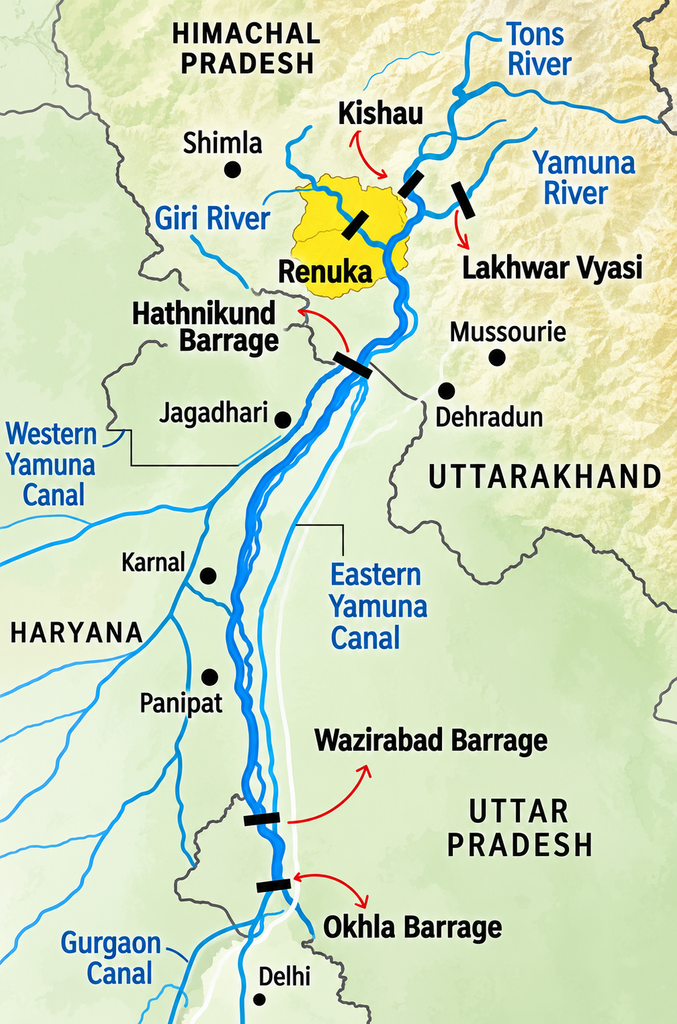
Background: The 1994 Upper Yamuna Agreement
1994 Upper Yamuna Agreement:
- The landmark Memorandum of Understanding (MoU) was signed in 1994 by the basin states: Uttar Pradesh, Haryana, Rajasthan, Himachal Pradesh, and the NCT of Delhi to allocate the Yamuna’s surface flow up to the Okhla Barrage. Uttarakhand (part of Uttar Pradesh at the time) was formally integrated later.
- The Upper Yamuna River Board oversees implementation of the water-sharing arrangement.
The Deadlock and Negotiated Settlement:
- The dispute involved the unequal geographical distribution of costs and benefits:
- Upstream host States face land acquisition, displacement and environmental disruption.
- Downstream beneficiaries gain drinking water, irrigation and regulated supplies.
- The Solution: Under the June 2026 consensus, Himachal Pradesh allocated its share of the water to Delhi and Rajasthan. In return, Delhi and Rajasthan agreed to bear the financial cost of Himachal Pradesh’s share of the project’s power component. This cross-benefit bargaining paved the way for the formal signing of the final MoA in September 2026.
- Funding Structure: The Central Government will fund 90% of the water component as Central Assistance. The remaining 10% of the water component’s financial burden will be shared among the six participating states according to the 1994 framework.
Significance of the Agreement:
- Cooperative federalism: Centre-facilitated negotiation aligns the interests of several governments and removes a major implementation obstacle.
- Urban water security: Delhi’s government expects 109.9 million cubic metres of additional water annually; delivery will depend on project completion and operational arrangements.
- Irrigation reliability: Reservoir storage can shift water availability across seasons, supporting agriculture during periods of lower river flow.
- Hydropower generation: The project can contribute renewable electricity, although actual generation depends on inflows and competing water-release requirements.
- Potential support for Yamuna flows: Regulated releases may improve downstream water availability. River rejuvenation also requires sewage treatment and pollution control; additional water alone is insufficient.
- A model of benefit-sharing: Compensating host regions and redistributing financial responsibilities can help address resistance to interstate infrastructure.
Constitutional Framework for Interstate Water Disputes:
(i) Distribution of legislative powers:
- State List, Entry 17: Covers water supply, irrigation, canals, drainage, water storage and water power, subject to Union List Entry 56.
- Union List, Entry 56: Covers regulation and development of interstate rivers and river valleys to the extent Parliament declares Union control expedient in the public interest.
(ii) Article 262 of the Indian Constitution provides for adjudication of inter-state water disputes. It makes two provisions:
- Adjudication: Parliament may legislate for adjudicating disputes or complaints concerning the use, distribution or control of waters of an interstate river or river valley.
- Exclusion of jurisdiction: Parliament may provide that neither the Supreme Court nor another court shall exercise jurisdiction over such disputes or complaints.
Based on Article 262, Parliament has enacted the Inter-State River Water Disputes Act (1956) & River Boards Act (1956).
(iii) River Boards Act, 1956
- Provides for river boards to advise on the regulation and development of interstate rivers and river valleys. The Centre may establish a board on a State’s request or otherwise, following the prescribed consultation.
- Its constitutional foundation is principally Union List Entry 56; it should not be described as an adjudicatory law enacted under Article 262.
(iv) Inter-State River Water Disputes Act, 1956
- Enacted pursuant to Article 262, the Act seeks to resolve water disputes that would arise in the use, control and distribution of an interstate river or river valley through adjudication by tribunals where disputes cannot be settled through negotiations.
- The Award of the Tribunal is final and binding after its publication in the official gazette of the Central Government and has the same force as the order or decree of the Supreme Court.
Key distinction: River boards support coordination and development; water-disputes tribunals perform adjudication.
Concerns with the Inter-State River Water Disputes Act, 1956
- Delays despite statutory timelines: The Act, as amended in 2002, requires a Tribunal to give its decision within three years, extendable by the Centre by a further two years for unavoidable reasons. Thus, the problem is not the absence of a timeline but delays in completing adjudication beyond the prescribed framework.
- Limited emphasis on pre-litigation negotiation: The Centre constitutes a Tribunal when it is of the opinion that the dispute cannot be settled by negotiations. However, the Act does not establish a detailed, structured and time-bound negotiation/mediation mechanism before a Tribunal is constituted.
- Delay in publication and implementation: The Centre is required to publish the Tribunal’s decision in the Official Gazette, after which it becomes final and binding on the parties. Delays in publication and, more importantly, in creating mechanisms for implementation can prolong disputes.
- Regionalisation of water disputes: Persistent disputes can intensify inter-State political tensions and regional identities, particularly when water scarcity and agricultural interests are involved.
- Creation/reorganisation of States can complicate sharing arrangements: The formation of Telangana in 2014, for example, added a new claimant in the Krishna and Godavari river systems and complicated existing arrangements between Andhra Pradesh and other basin States.
- Prolonged constitution and functioning of Tribunals: The Mahadayi Water Disputes Tribunal, constituted in November 2010 for Goa, Karnataka and Maharashtra, illustrates the prolonged nature of the process; the dispute had already involved negotiations and litigation before the Tribunal was constituted.
Way Forward
- Strengthen dialogue: Establish structured, time-bound negotiations before disputes escalate to tribunals.
- Ensure timely implementation: Expedite adjudication, award publication and operational arrangements for compliance.
- Share reliable data: Develop jointly monitored basin-level databases and clear drought-year water-sharing rules.
- Distribute benefits equitably: Recognise upstream States’ ecological and displacement costs through compensation and livelihood restoration.
- Safeguard sustainability: Combine dam safety and environmental flows with efficient irrigation, reduced urban leakage and wastewater reuse.
The Kishau agreement demonstrates how dialogue and equitable benefit-sharing can advance cooperative federalism. Its lasting success will depend on translating consensus into timely implementation, secure livelihoods for affected communities and ecologically sustainable water management.
Prelims Practice MCQ:
Q. Consider the following statements:
- Kishau is proposed on the Tons River, a tributary of the Yamuna.
- The project is located along the Himachal Pradesh–Uttarakhand border.
- The 1994 Upper Yamuna Agreement concerned the Yamuna’s utilisable surface flow up to its confluence with the Ganga.
Which statements are correct?
(a) 1 and 2 only
(b) 2 and 3 only
(c) 1 and 3 only
(d) 1, 2 and 3
Answer: (a). Statement 3 is incorrect because the agreement concerns flows up to the Okhla Barrage.
Industrial Tourism: Learning from China & Exploring India’s Potential
Why in News?
China is witnessing growing interest in visits to factories producing electric vehicles, electronics and high-speed trains, alongside breweries and industrial heritage sites. The factory-tour bookings increased by over 36% year-on-year during the 2026 summer season, with families accounting for 68% of bookings.
The editorial highlights how China combines industrial capability, STEM education, brand promotion and tourism, offering lessons for India.
| UPSC Relevance: GS-1: Industrial locations and heritage; GS-3 Economy: Manufacturing, employment, infrastructure and tourism Mains: Industrial Tourism: Prospects and Challenges |
What is Industrial Tourism?
Industrial tourism involves organised visits to functioning production facilities, industrial museums or former industrial sites to understand production processes, technology, industrial history and workers’ contributions.
Its principal forms include:
- Working-factory tourism: Visits to automobile plants, dairies, food-processing units and other operational facilities.
- Industrial heritage tourism: Exploration of historic mills, mines, machinery and manufacturing settlements.
- Technology-based experiences: Demonstrations, simulations and interactive exhibits explaining contemporary industrial processes.
China’s Experience: Key Lessons
- Coordinated policy: Cooperation among tourism, industry and education authorities helps convert factories into organised visitor experiences.
- Education through observation: Production lines make robotics, engineering and automation tangible, potentially encouraging interest in STEM careers.
- Commercial incentives: Tours, product demonstrations and showrooms help firms build consumer relationships and supplementary revenues.
- Heritage alongside innovation: Older industrial sites preserve manufacturing history, while advanced factories showcase contemporary capabilities.
China had 122 national industrial-tourism demonstration bases by the end of 2024, illustrating its institutional support for the sector.
Does India Offer Opportunities?
India already has examples of industrial tourism and substantial scope to expand it. The challenge is to turn suitable industrial assets into safe, accessible and commercially sustainable visitor experiences.
- Dairy and food-processing industries: Amul’s dairy factory and museum in Anand, Gujarat, offer guided exposure to processing technology and the cooperative dairy model. Such visits can connect production with lessons on the White Revolution, rural livelihoods and food supply chains.
- Plantation-processing and industrial heritage: The Tea Museum in Munnar, Kerala, displays tea-processing machinery and explains the evolution of the local tea industry. It demonstrates how an existing tourist destination can integrate manufacturing history into its attractions.
- Mining and reclaimed industrial landscapes: The Ministry of Coal promotes mine tourism and eco-parks, including Saoner in Maharashtra, which incorporates a mine museum. These sites can explain mining, reclamation and environmental management while creating local tourism opportunities.
- Modern manufacturing clusters: Tamil Nadu, Maharashtra and Gujarat are promising locations for industrial circuits. Potential experiences could include selected automobile, engineering, textile and electronics facilities, subject to company participation and safety clearance.
- Traditional production and MSMEs: Textile, pottery, coir and other production clusters could combine demonstrations, workshops and direct sales. Their value lies in explaining both the production process and the skills of workers and artisans.
Why does this matter for India?
- Tourism diversification: Adds educational and experiential attractions to established cultural and nature tourism.
- Scientific temper: Connects classroom concepts with practical production and problem-solving.
- Local employment: Creates opportunities for guides, transport providers, hospitality enterprises and small retailers.
- Industrial heritage conservation: Gives suitable mills and other historic structures a viable new use.
- Manufacturing visibility: Helps consumers understand quality, technology and the human effort behind Indian products.
Associated Challenges:
- Visitor safety and liability: Moving machinery, heat, chemicals, heavy vehicles and mine conditions require controlled access, emergency arrangements and clear responsibility for accidents.
- Security and intellectual property: Sensitive processes, designs and strategic facilities cannot be freely exposed; photography and access require careful management.
- Production disruption: Tours may interfere with workflow, hygiene standards and workers’ concentration, particularly in food-processing and precision manufacturing.
- Inadequate visitor infrastructure: Factories may lack viewing galleries, accessible pathways, toilets, parking and guides capable of explaining technical processes.
- Uncertain commercial returns: Retrofitting facilities and employing visitor-management staff may cost more than ticket revenue, especially where demand is seasonal.
- Fragmented institutional responsibility: Industry, tourism, education, local authorities and safety agencies must coordinate approvals, operations and promotion.
Existing Policies and Initiatives
India has relevant initiatives, but no dedicated nationwide industrial-tourism scheme exists.
- Mine-tourism initiatives: The Ministry of Coal explicitly promotes tourism in suitable mining areas and integration with local tourism circuits. Its FY25 Annual Report records a commitment to develop 40 new eco-parks/mine-tourism sites during FY25 to FY29.
- Swadesh Darshan 2.0: Revamped in 2022, it supports sustainable and responsible destination development. It provides a broader framework within which suitable industrial experiences could be proposed, subject to scheme eligibility and approval. However, it is not an industrial tourism-specific scheme.
- State-level promotion: Gujarat Tourism’s promotion of Amul and Kerala Tourism’s promotion of Munnar’s Tea Museum show how industrial attractions can enter official destination marketing.
Way Forward:
- Begin with voluntary pilots: Select willing firms with understandable processes, manageable risks and proximity to existing tourist destinations.
- Develop thematic circuits: Explore dairy and engineering experiences in Gujarat, manufacturing experiences in Tamil Nadu, and engineering and mine-heritage experiences in Maharashtra.
- Create safe visitor zones: Use separated walkways, viewing galleries, guided timings and simulations where direct factory access is unsuitable.
- Coordinate departments: Establish joint arrangements among tourism, industry and education authorities, with plant operators retaining control over operational safety.
- Build educational value: Develop multilingual explanations, curriculum-linked worksheets and interactions with engineers, technicians and workers.
- Ensure inclusion and local benefits: Provide affordable student slots, accessible facilities, local guide training and opportunities for nearby small businesses.
Mains Practice Question:
Q. “Industrial tourism can connect manufacturing, education and regional development.” Examine India’s opportunities and the safeguards required for its sustainable expansion.
FPI and FDI: Understanding Foreign Investment in India
Why in News?
Foreign Portfolio Investors (FPIs) sold Indian equities worth ₹13,138 crore in the first 10 trading sessions of September 2026, equivalent to approximately 44% of August’s net inflows. The renewed selling highlights the sensitivity of portfolio flows to valuations, global interest rates and exchange-rate movements.
| UPSC Relevance: GS-3 Economy: Foreign investment, mobilisation of resources, financial markets Prelims: FPI and FDI |
1. Foreign Portfolio Investment (FPI):
- FPI refers to investment by non-residents in financial assets such as equity shares, government securities and corporate bonds, primarily for financial returns rather than managerial control.
- The earlier Foreign Institutional Investor (FII) category was subsumed into the unified FPI framework in 2014, along with sub-accounts and Qualified Foreign Investors (QFIs).
- Key features:
- FPI is relatively liquid and reversible, as investors can quickly buy or sell marketable securities.
- An individual FPI or investor group is generally restricted to below 10% of the paid-up equity capital of a listed Indian company on a fully diluted basis.
- FPIs can invest in both primary and secondary markets, subject to applicable regulations.
- FPIs are regulated primarily through SEBI’s FPI Regulations, 2019 framework, along with FEMA and RBI regulations.
- Significance and concerns:
- FPIs deepen capital markets, improve liquidity and price discovery, and broaden the investor base.
- However, sudden outflows can increase stock-market volatility and pressure the rupee, particularly when global yields rise or risk appetite declines.
Thus, FPI is often associated with “hot money” because portfolio capital can move relatively quickly across countries.
2. Foreign Direct Investment (FDI):
- FDI involves investment in an Indian enterprise with a longer-term business interest and potential participation in its operations. Under India’s framework, investment through equity instruments is classified as FDI when it is:
- Any investment in an unlisted Indian company, or
- 10% or more in a listed Indian company, measured on a fully diluted basis.
- Once classified as FDI, it continues to be treated as FDI even if the holding subsequently falls below 10%.
- Key features:
- FDI can bring capital, technology, managerial expertise, employment, supply-chain integration and access to global markets. However, these benefits depend on the nature of the investment and its linkages with the domestic economy.
- FDI may be:
- Greenfield investment, where a new production facility or enterprise is established.
- Brownfield investment, where an investor acquires or invests in an existing enterprise.
- FDI can enter through the Automatic Route, subject to sectoral caps and conditions, or the Government Route, which requires prior approval.
- Concerns: FDI may raise concerns regarding market concentration, strategic sectors, profit/royalty repatriation and inadequate domestic linkages.
FDI vs FPI:
| Basis | Foreign Direct Investment (FDI) | Foreign Portfolio Investment (FPI) |
| Basic nature | Investment intended to establish a lasting interest in an Indian business and is classified based on the nature and size of the investment under FEMA. | Investment in eligible Indian securities without being classified as direct investment. |
| Equity classification | Investment in an unlisted Indian company, or 10% or more of the post-issue paid-up equity capital of a listed Indian company, on a fully diluted basis, is treated as FDI, subject to applicable conditions. | Equity investment of less than 10% in a listed Indian company is generally classified as FPI, subject to the applicable framework. |
| Management/control | May provide significant influence or control, but management control is not essential for an investment to qualify as FDI. The 10% threshold is a regulatory classification criterion, not a requirement of control. | Generally does not seek management control, although the investor enjoys the rights attached to the securities held. |
| Main instruments | Equity shares and other eligible equity instruments, including eligible compulsorily/mandatorily convertible instruments. FDI can also be made through capital contribution in an LLP, subject to applicable rules. | Eligible listed equity and debt securities and other securities permitted under the FPI framework, including government securities, corporate debt securities, mutual fund/ETF units, and other permitted instruments. |
| Investment horizon | Usually associated with a longer-term business interest, but there is no fixed minimum holding period that defines FDI. | Can be short-term or long-term; it is generally more market-oriented and liquid. |
| Liquidity/exit | Generally less liquid because it is linked to ownership/business assets and may involve acquisition or establishment of enterprises. | Generally more liquid because securities can usually be bought and sold through financial markets, subject to applicable restrictions. |
| Stability of flows | Generally considered more stable | Generally more sensitive to interest rates, market valuations, exchange rates and global investor sentiment. |
| Debt creation | Equity FDI is non-debt creating because it does not create a fixed repayment obligation for the recipient company. | FPI in equity is non-debt creating, while FPI in debt securities represents borrowing/debt for the issuer. |
| Creation of productive capacity | Greenfield FDI can create new factories, offices and infrastructure; brownfield FDI may involve acquisition of an existing business. | Primary-market investment can provide fresh capital to an issuer, whereas secondary-market purchases normally transfer securities between investors. |
| Regulation in India | Primarily governed by the FDI Policy, FEMA and Foreign Exchange Management (Non-Debt Instruments) Rules, 2019, along with RBI requirements. | Governed principally by SEBI’s FPI Regulations, along with FEMA/RBI requirements. The FPI Regulations were last amended in July 2026. |
UPSC PYQ 2021:
Q. Consider the following:
1. Foreign currency convertible bonds
2. Foreign institutional investment with certain conditions
3. Global depository receipts
4. Non-resident external deposits
Which of the above can be included in Foreign Direct Investment?
(a) 1, 2 and 3
(b) 3 only
(c) 2 and 4
(d) 1 and 4
Answer: (a)
UPSC PYQ 2020:
Q. With reference to Foreign Direct Investment in India, which one of the following is considered its major characteristic?
(a) It is the investment through capital instruments essentially in a listed company.
(b) It is a largely non-debt-creating capital flow.
(c) It is the investment which involves debt servicing.
(d) It is the investment made by foreign institutional investors in government securities.
Answer: (b)
Source: https://anantamias.com/current-affairs/fpi-and-fdi-understanding-foreign-investment-in-india/
China’s Open-Weight AI Strategy: Opportunities and Risks for India
Why in News?
The editorial highlights Indian startups’ growing use of Chinese AI models such as Qwen, DeepSeek and Kimi to reduce costs. Meanwhile, reports of China considering tighter controls on AI technology exports raise questions about continued access.
| UPSC Relevance: GS-2 Polity and Governance: Technology governance and strategic autonomy; GS-3 Science and Technology: Artificial intelligence, indigenisation and cybersecurity. Prelims: Open-Weight AI Models Mains: Artificial intelligence: Associated Challenges and Policy Framework |
What are Open-Weight AI Models?
- Model weights are numbers adjusted as an AI model learns from data. They capture learned patterns and guide how it responds to a question or instruction.
- Open-weight models make these learned parameters available for download. Developers can run the model on their own computers or servers and adapt it for tasks such as answering questions in Indian languages, subject to licence conditions.
- Open-weight is not necessarily fully open-source: Having the trained model does not mean having the training code, detailed information about its training data, or unrestricted permission to use and modify it.
Why is China promoting Open-Weight Models?
- Cost competitiveness: Efficient model architectures and training methods help Chinese firms offer affordable alternatives to proprietary systems.
- Technological prestige: Widely adopted models strengthen China’s reputation and influence, particularly among developing countries.
- Pressure on competitors: Free or inexpensive alternatives weaken proprietary AI providers’ ability to charge premium prices.
- State-supported expansion: The author argues that access to inexpensive capital helps strategic technology firms expand despite uncertain immediate profits.
- Complementary revenues: Free models encourage adoption of associated cloud services, computing infrastructure and enterprise tools.
Thus, openness can serve both commercial expansion and geopolitical influence.
Why might this advantage become restricted?
China could restrict access when the benefits of freely sharing advanced models begin to decline:
- Fewer firms make restrictions easier: Once a few companies dominate China’s AI industry, the government can coordinate access restrictions more easily than across hundreds of competing developers.
- Dependence makes switching costly: Initially, free models attract users. Once businesses build products around Chinese models and cloud services, changing providers may require costly redesign and testing, making restrictions less likely to drive users away.
- Free access may have served its purpose: Once Chinese models gain widespread adoption and weaken competitors’ pricing power, firms may seek greater revenue through paid licences or controlled access.
Restrictions could therefore emerge gradually: keeping smaller models free while delaying downloads of advanced models or offering them only through paid online services.
Implications for India:
Benefits:
- Lower innovation costs: Affordable models help startups build AI products without financing expensive model training.
- Faster adoption: Ready-to-use models can accelerate applications in agriculture, education, healthcare and public services.
- Local adaptation: Downloadable weights enable fine-tuning for Indian languages and sector-specific needs, subject to licence terms.
- Greater deployment control: Locally hosted models can reduce reliance on overseas APIs and keep sensitive data within the chosen infrastructure.
Challenges:
- Access uncertainty: Future models, updates or essential tools could become restricted or expensive.
- Costly dependence: Products closely integrated with one model or cloud provider may be difficult to migrate.
- Data-security concerns: Using an overseas API may transmit information abroad; locally hosting downloaded weights offers greater control, but still requires security evaluation.
- Persistent capability gaps: Reliance on imported models may leave India dependent on foreign advances in foundational AI, chips and computing infrastructure.
Way Forward:
- Design for switching: Build applications that can operate across multiple models and providers, with regular migration tests.
- Develop selective domestic capabilities: Prioritise Indian-language datasets, sector-specific models, efficient inference and chip-design expertise.
- Use IndiaAI effectively: The ₹10,371 crore IndiaAI Mission supports computing access, indigenous models, datasets, skills and safe AI, providing a foundation for reducing critical dependencies.
- Improve public procurement: Consider a common gateway to multiple approved models, alongside privacy safeguards and performance benchmarks.
- Shape international norms: Advocate transparent licensing, interoperability and predictable access to openly released models.
India should use affordable open models to accelerate productivity while building the capability to evaluate, adapt, host and replace them. Strategic autonomy requires practical alternatives and domestic competence.
