Why in News?
On 15 September 2026, Himachal Pradesh, Uttarakhand, Uttar Pradesh, Haryana, Rajasthan and the National Capital Territory of Delhi signed an agreement to advance the long-pending Kishau Multipurpose Project.
The agreement addresses intergovernmental differences over project implementation and financial responsibilities.
| UPSC Relevance: GS-2 Polity and Governance: Cooperative federalism and interstate water disputes; GS-3: Environment: Environmental impacts, Dam safety. Prelims: Kishau Multipurpose Project Mains: Inter-State River Water Disputes |
About the Kishau Multipurpose Project:
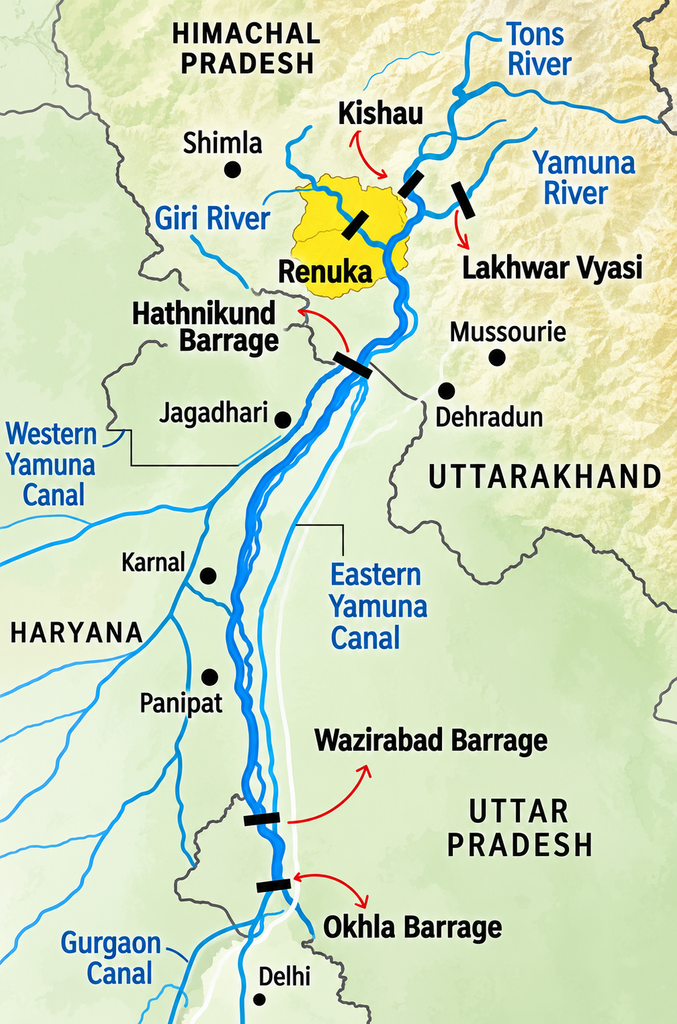
- Location: On the Tons River, a major tributary of the Yamuna, along the Himachal Pradesh-Uttarakhand border.
- Capacity: 422 MW
- Purpose: Water storage for drinking-water supply and irrigation, alongside hydroelectricity generation.
- Estimated cost: ₹15,624 crore.
- Dam: A proposed 232.6-metre-high concrete gravity dam (A gravity dam resists the pressure of stored water primarily through its own weight)
- Storage: 1562 million cubic metres
- Expected benefits: Irrigation for 97,000 hectares and electricity generation of 1,476 million units annually
- Implementing entity: Kishau Corporation Limited, a 50:50 joint venture of Himachal Pradesh and Uttarakhand.
Background: The 1994 Upper Yamuna Agreement
1994 Upper Yamuna Agreement:
- The landmark Memorandum of Understanding (MoU) was signed in 1994 by the basin states: Uttar Pradesh, Haryana, Rajasthan, Himachal Pradesh, and the NCT of Delhi to allocate the Yamuna’s surface flow up to the Okhla Barrage. Uttarakhand (part of Uttar Pradesh at the time) was formally integrated later.
- The Upper Yamuna River Board oversees implementation of the water-sharing arrangement.
The Deadlock and Negotiated Settlement:
- The dispute involved the unequal geographical distribution of costs and benefits:
- Upstream host States face land acquisition, displacement and environmental disruption.
- Downstream beneficiaries gain drinking water, irrigation and regulated supplies.
- The Solution: Under the June 2026 consensus, Himachal Pradesh allocated its share of the water to Delhi and Rajasthan. In return, Delhi and Rajasthan agreed to bear the financial cost of Himachal Pradesh’s share of the project’s power component. This cross-benefit bargaining paved the way for the formal signing of the final MoA in September 2026.
- Funding Structure: The Central Government will fund 90% of the water component as Central Assistance. The remaining 10% of the water component’s financial burden will be shared among the six participating states according to the 1994 framework.
Significance of the Agreement:
- Cooperative federalism: Centre-facilitated negotiation aligns the interests of several governments and removes a major implementation obstacle.
- Urban water security: Delhi’s government expects 109.9 million cubic metres of additional water annually; delivery will depend on project completion and operational arrangements.
- Irrigation reliability: Reservoir storage can shift water availability across seasons, supporting agriculture during periods of lower river flow.
- Hydropower generation: The project can contribute renewable electricity, although actual generation depends on inflows and competing water-release requirements.
- Potential support for Yamuna flows: Regulated releases may improve downstream water availability. River rejuvenation also requires sewage treatment and pollution control; additional water alone is insufficient.
- A model of benefit-sharing: Compensating host regions and redistributing financial responsibilities can help address resistance to interstate infrastructure.
Constitutional Framework for Interstate Water Disputes:
(i) Distribution of legislative powers:
- State List, Entry 17: Covers water supply, irrigation, canals, drainage, water storage and water power, subject to Union List Entry 56.
- Union List, Entry 56: Covers regulation and development of interstate rivers and river valleys to the extent Parliament declares Union control expedient in the public interest.
(ii) Article 262 of the Indian Constitution provides for adjudication of inter-state water disputes. It makes two provisions:
- Adjudication: Parliament may legislate for adjudicating disputes or complaints concerning the use, distribution or control of waters of an interstate river or river valley.
- Exclusion of jurisdiction: Parliament may provide that neither the Supreme Court nor another court shall exercise jurisdiction over such disputes or complaints.
Based on Article 262, Parliament has enacted the Inter-State River Water Disputes Act (1956) & River Boards Act (1956).
(iii) River Boards Act, 1956
- Provides for river boards to advise on the regulation and development of interstate rivers and river valleys. The Centre may establish a board on a State’s request or otherwise, following the prescribed consultation.
- Its constitutional foundation is principally Union List Entry 56; it should not be described as an adjudicatory law enacted under Article 262.
(iv) Inter-State River Water Disputes Act, 1956
- Enacted pursuant to Article 262, the Act seeks to resolve water disputes that would arise in the use, control and distribution of an interstate river or river valley through adjudication by tribunals where disputes cannot be settled through negotiations.
- The Award of the Tribunal is final and binding after its publication in the official gazette of the Central Government and has the same force as the order or decree of the Supreme Court.
Key distinction: River boards support coordination and development; water-disputes tribunals perform adjudication.
Concerns with the Inter-State River Water Disputes Act, 1956
- Delays despite statutory timelines: The Act, as amended in 2002, requires a Tribunal to give its decision within three years, extendable by the Centre by a further two years for unavoidable reasons. Thus, the problem is not the absence of a timeline but delays in completing adjudication beyond the prescribed framework.
- Limited emphasis on pre-litigation negotiation: The Centre constitutes a Tribunal when it is of the opinion that the dispute cannot be settled by negotiations. However, the Act does not establish a detailed, structured and time-bound negotiation/mediation mechanism before a Tribunal is constituted.
- Delay in publication and implementation: The Centre is required to publish the Tribunal’s decision in the Official Gazette, after which it becomes final and binding on the parties. Delays in publication and, more importantly, in creating mechanisms for implementation can prolong disputes.
- Regionalisation of water disputes: Persistent disputes can intensify inter-State political tensions and regional identities, particularly when water scarcity and agricultural interests are involved.
- Creation/reorganisation of States can complicate sharing arrangements: The formation of Telangana in 2014, for example, added a new claimant in the Krishna and Godavari river systems and complicated existing arrangements between Andhra Pradesh and other basin States.
- Prolonged constitution and functioning of Tribunals: The Mahadayi Water Disputes Tribunal, constituted in November 2010 for Goa, Karnataka and Maharashtra, illustrates the prolonged nature of the process; the dispute had already involved negotiations and litigation before the Tribunal was constituted.
Way Forward
- Strengthen dialogue: Establish structured, time-bound negotiations before disputes escalate to tribunals.
- Ensure timely implementation: Expedite adjudication, award publication and operational arrangements for compliance.
- Share reliable data: Develop jointly monitored basin-level databases and clear drought-year water-sharing rules.
- Distribute benefits equitably: Recognise upstream States’ ecological and displacement costs through compensation and livelihood restoration.
- Safeguard sustainability: Combine dam safety and environmental flows with efficient irrigation, reduced urban leakage and wastewater reuse.
The Kishau agreement demonstrates how dialogue and equitable benefit-sharing can advance cooperative federalism. Its lasting success will depend on translating consensus into timely implementation, secure livelihoods for affected communities and ecologically sustainable water management.
Prelims Practice MCQ:
Q. Consider the following statements:
- Kishau is proposed on the Tons River, a tributary of the Yamuna.
- The project is located along the Himachal Pradesh–Uttarakhand border.
- The 1994 Upper Yamuna Agreement concerned the Yamuna’s utilisable surface flow up to its confluence with the Ganga.
Which statements are correct?
(a) 1 and 2 only
(b) 2 and 3 only
(c) 1 and 3 only
(d) 1, 2 and 3
Answer: (a). Statement 3 is incorrect because the agreement concerns flows up to the Okhla Barrage.
Tell Google you want more of this.
Add Anantam IAS as a preferred sourceOne tap, and this site shows up more often in your own Top Stories, AI Overviews and AI Mode. Remove it any time.