Why in News?
On 15 September 2026, the Finance Ministry explained the new UPI MDR framework, distinguishing charges on specified merchant transactions from continued free usage for individuals.
- P2P transfers remain free regardless of the amount transferred; MDR concerns specified merchant payments.
- Merchant payments up to ₹2,000 remain free of MDR, alongside separately protected small-merchant receipts.
- Approximately 96% of merchant transactions remain unaffected, according to the release; this refers to transaction count, not payment value.
- Free customer use and payment-system operating costs can coexist. The policy question is how infrastructure is financed without excluding users or small businesses.
- Merchant classification matters alongside payment amount; reading a headline rate without exemptions and sector-specific treatment gives an incomplete picture.
UPSC Relevance
Prelims Relevance
- P2P: person-to-person transfers.
- P2M: person-to-merchant payments.
- P2PM: the small-merchant category identified in the release.
- MDR: merchant discount rate, a payment-ecosystem charge rather than a government tax.
- Transaction count and transaction value measure different things.
Mains Relevance
GS Paper 3
- Balancing digital-payment infrastructure financing with financial inclusion.
- How differentiated merchant charges affect payment acceptance and ecosystem sustainability.
GS Paper 2
- Consumer protection through restrictions on pass-through, hidden charges and misleading communication.
Essay
- Publicly useful digital infrastructure needs both broad access and dependable financing.
Background and Context
Who remains protected from MDR?
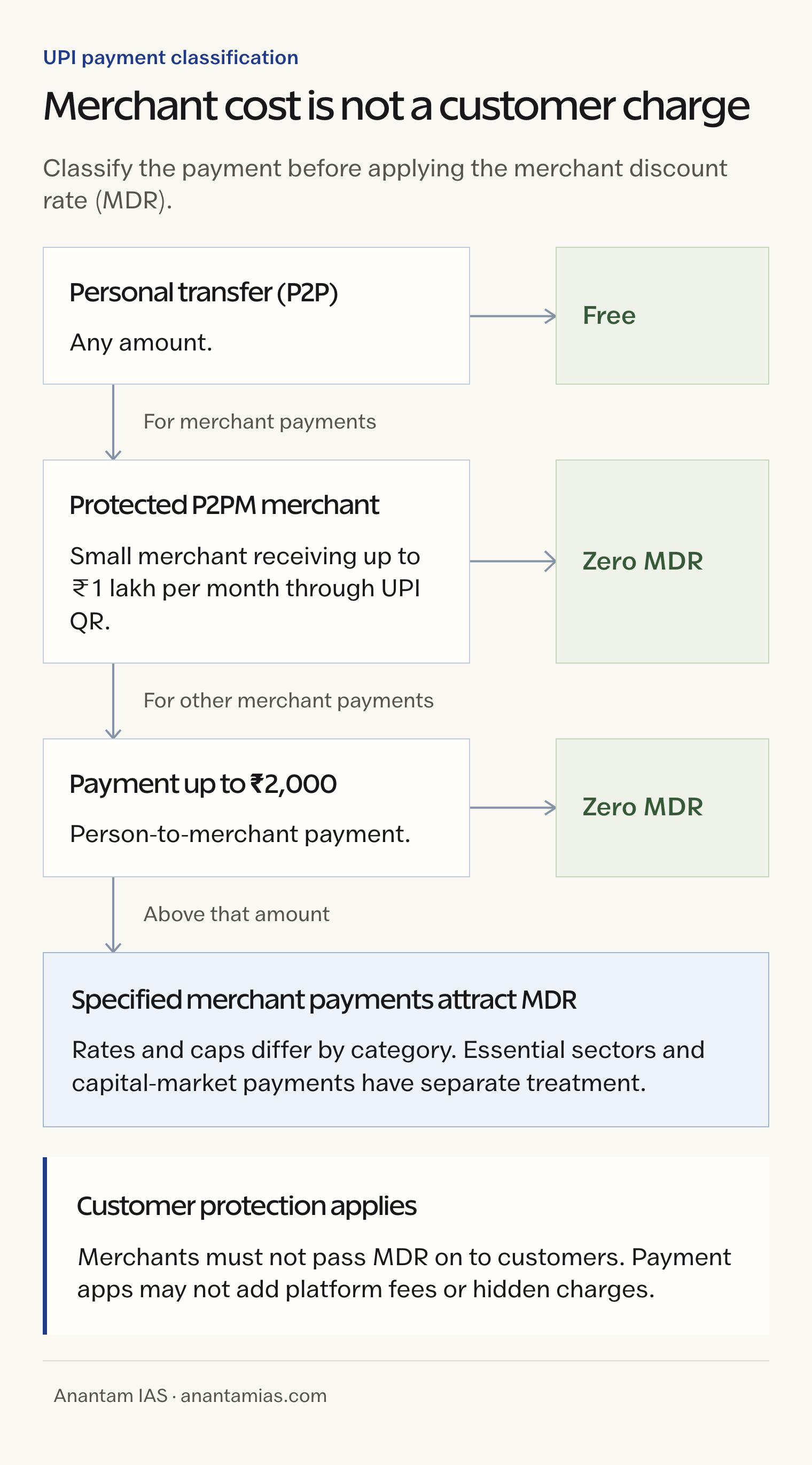
The framework distinguishes personal transfers, ordinary merchant payments and an explicitly protected small-merchant category; payment amount alone does not answer every charging question.
- Person-to-person transfers remain completely free, irrespective of the amount sent. The release rules out transaction fees, platform fees and other charges on individuals for sending or receiving money through this personal-transfer channel.
- Small merchant protection covers businesses receiving up to ₹1 lakh per month through UPI QR codes under the P2PM category. Both the receipt criterion and category matter; this is not a universal turnover exemption.
- The merchant-payment threshold protects payments at or below the stated cutoff. A larger purchase does not automatically establish a customer charge: merchant category and the framework’s differentiated treatment must still be checked before drawing conclusions.
- Approximately 96% refers to merchant-transaction count, according to the ministry. It does not mean the same share of money transferred is exempt, because a small number of large payments can represent substantial transaction value.
- Free usage has no monthly quota under the safeguards described in the release. Separate bank or NPCI transaction limits still serve security and risk-management purposes; they should not be confused with a paid usage tier.
What MDR finances, and why rates differ
Merchant discount rate is a cost within the payment ecosystem. The announcement uses differentiated treatment rather than one charge that applies identically to every transaction.
- MDR is neither a tax nor government revenue, the release clarifies. It is distributed among participating banks, payment service providers and application providers to support the operation and expansion of the digital-payment ecosystem.
- Specified larger merchant transactions attract MDR, with caps and separate arrangements for certain sectors. Quoting only the standard percentage can mislead because the applicable treatment depends on the nature of the payment being processed.
- Essential and thin-margin sectors receive a flat-charge arrangement for covered payments. Capital-market transactions have separate treatment. These distinctions reflect the framework’s attempt to accommodate different business economics without treating all merchant activity as identical.
- Financing and interoperability solve different problems. The discussion on linked cross-border payment systems concerns connections between payment networks; this framework concerns how specified domestic merchant payments contribute to supporting the ecosystem that processes them.
- A dedicated small-merchant fund is proposed in the release, financed from MDR collections to support acceptance and sustained use. Its announcement should not be presented as evidence that funds have already reached particular businesses.
Customer protection depends on implementation
The release separates merchant-side costs from customer charges, but that distinction must remain clear at the payment counter and inside the application.
- Customers should not pay MDR for making UPI payments. Banks have been advised to ensure merchants do not pass it on; the framework cannot be accurately summarized as a general fee on every UPI user.
- Application providers are prohibited from hidden charges and platform fees, according to the release. Calling a payment surcharge something else would undermine the stated consumer safeguard rather than explain how the merchant framework actually works.
- Formal safeguards need usable remedies. Customers should be able to identify disputed charges and seek resolution. Clear receipts, visible support routes and consistent merchant instructions are implementation priorities, not proof that enforcement already succeeds.
- Charging rules differ from fraud controls. The RBI money-mule draft discussion examines temporary debit restrictions and customer safeguards; free payment usage does not remove risk checks or turn every transaction limit into a fee.
- Announcement date is not an invented commencement date. This explanation follows the ministry’s September release; it does not infer a separate implementation deadline, operational circular or bank-specific charging procedure that the source does not supply.
Way Forward
Make the distinction visible at checkout
- Explain merchant categories clearly so small businesses understand the protection criteria and applicable treatment without relying on headline rates.
- Audit customer-facing charges and provide practical complaint routes when merchants or applications seek to pass through prohibited payment costs.
- Evaluate inclusion alongside revenue, tracking merchant acceptance and sustained usage rather than assuming collections alone demonstrate a healthier payment ecosystem.
Conclusion
- Merchant-side financing does not mean a general customer fee. The release preserves free personal transfers and customer use while applying differentiated MDR treatment to specified merchant payments, with small-business protections.
- Separate category, amount and incidence. In a Mains answer, explain which payment is covered, who bears its cost and how safeguards protect adoption; avoid confusing transaction count with the value of money transferred.
UPSC Practice Questions
Prelims MCQ 1
With reference to the UPI framework explained by the Finance Ministry on 15 September 2026, consider the following statements:
- Personal UPI transfers remain free regardless of the amount transferred.
- MDR is a tax collected by the Government from UPI customers.
- The approximately 96% unaffected figure refers to merchant-transaction count.
How many of the above statements are correct?
(a) Only one (b) Only two (c) All three (d) None
Answer: (b) Only two
Explanation:
Statements 1 and 3 are correct. The release describes MDR as a payment-ecosystem charge, not a government tax or a charge on customers making UPI payments.
Prelims MCQ 2
Which interpretation correctly distinguishes UPI risk controls from its charging framework?
(a) A daily transaction limit necessarily creates a paid tier (b) Free usage removes all bank risk-management limits (c) Transaction limits can serve security purposes without being charging thresholds (d) Every merchant payment attracts the same rate
Answer: (c) Transaction limits can serve security purposes without being charging thresholds
Explanation:
The release distinguishes bank and NPCI security limits from fee thresholds. It also provides differentiated merchant treatment, including protections and sector-specific arrangements.
UPSC Mains Questions
- How can digital-payment systems reconcile infrastructure financing with financial inclusion? Discuss using the UPI merchant framework and its customer safeguards. (150 words)
- Distinguish merchant payment costs from charges imposed on customers. Examine the implementation challenges in preserving this distinction within digital-payment ecosystems. (250 words)
Source: PIB, Ministry of Finance.
Frequently Asked Questions
Does the framework impose a fee on personal UPI transfers?
No. The Finance Ministry release states that person-to-person transfers remain free irrespective of the amount transferred. Individuals should not face transaction fees or platform charges for sending or receiving money through this channel.
Can a merchant pass MDR to the customer?
The release says MDR is not a charge on customers making UPI payments. Banks have been advised to ensure merchants do not pass it on, while applications are prohibited from hidden charges and platform fees.
Does the 96% figure describe the value of merchant payments?
No. It describes the approximate share of merchant transactions remaining unaffected. Counting transactions and adding their monetary value are different measures, so the figure should not be rewritten as a share of payment value.
Do all merchant payments above the threshold attract the same charge?
No. Protected small merchants and differentiated sector-specific arrangements matter. The release describes standard treatment, caps and special arrangements; applying one headline rate to every larger payment would misrepresent the framework.
Tell Google you want more of this.
Add Anantam IAS as a preferred sourceOne tap, and this site shows up more often in your own Top Stories, AI Overviews and AI Mode. Remove it any time.