Daily Digest
UPSC · Civil Services Examination
Current Affairs · Thursday, 18 June 2026
Current affairs curated and edited by Anantam IAS faculty — pulled from The Hindu, PIB, IDSA, Foreign Affairs and the ministries. Read, annotate, revise.
Old Rajinder Nagar · Delhi 110005 · anantamias.com
G7 Summit 2026: Modi pitches IMPACT connectivity and Global South support fund
Why in News?
Prime Minister Narendra Modi addressed the G7 Summit outreach session held at Evian-les-Bains, France, on 17 June 2026, speaking as the voice of the Global South. He warned that the war in West Asia will disrupt fuel, fertiliser and food supply chains for the developing world for “a considerable period”.
PM Modi told G7 leaders that the most vulnerable countries must not bear the burden of these crises alone, and proposed three ideas: an IMPACT connectivity framework, a Global Skills Partnership, and a financial support mechanism through international institutions.
- Session theme: ‘Reviving a Balanced, Shared and Sustainable Economic Growth for All’, under the French G7 Presidency.
- IMPACT = International Mobilisation Partnership for Accelerating Connectivity and Trade — a proposed expansion of the IMEC model.
- Modi linked the supply disruption to the near-closure of the Strait of Hormuz, which has spiked prices of LPG, LNG, diesel, petrol and fertilisers.
- He called on the IMF, World Bank, OECD and the African Development Bank (all present) to build shock-absorption mechanisms for developing nations.
- On the sidelines, Modi raised the safety of Indian seafarers with Trump after three Indian sailors were killed in a US strike off Oman last week.
- G7 partner countries invited: Brazil, Egypt, South Korea, Kenya, plus Ukraine, Qatar and the UAE.
The development matters in the context of:
- India has positioned itself as the bridge between the G7 (developed) and the G77/Global South (developing) blocs, building on its 2023 G20 Presidency.
- The proposals deepen India’s pivot from aid-seeker to partnership-broker, leveraging its demographic dividend against the ageing West.
- They land amid an unfinished India-US trade deal and a fragile West Asia ceasefire.
UPSC Relevance
Prelims Relevance
- G7 members: USA, UK, France, Germany, Italy, Canada, Japan (plus EU) — an informal grouping, not a treaty body.
- IMPACT full form: International Mobilisation Partnership for Accelerating Connectivity and Trade.
- IMEC launched on 9 September 2023 at the G20 New Delhi Summit.
- IMEC signatories: India, USA, UAE, Saudi Arabia, France, Germany, Italy and the EU.
- Strait of Hormuz connects the Persian Gulf to the Gulf of Oman / Arabian Sea — a critical oil-shipping chokepoint.
- Modi’s growth motto cited: ‘Sabka Saath, Sabka Vikas, Sabka Vishwas, Sabka Prayas’.
- International financial institutions named: IMF, World Bank, OECD, and African Development Bank.
- Global Skills Partnership — proposed for skill-mapping and trusted skilled mobility.
- Venue: Evian-les-Bains, eastern France.
Mains Relevance
GS Paper 2
- India’s role as a bridge between the developed world and the Global South in multilateral forums.
- Effect of policies and politics of developed/developing countries on India’s interests; significance of G7 outreach diplomacy.
GS Paper 3
- Impact of West Asian instability on India’s energy and fertiliser security via the Strait of Hormuz.
- Connectivity corridors (IMEC, IMPACT) and infrastructure-led economic growth and trade.
Essay
- Growth for whom, with whom and in what direction — rethinking development beyond GDP.
- From recipient to partner: the rise of the Global South in a multipolar world.
Background and Context
What Modi proposed at Evian
Three connected ideas framed around the Global South’s vulnerability to the West Asia shock.
- IMPACT framework — a new connectivity-and-trade partnership modelled on IMEC, combining G7 capital, India’s talent and Global South ownership.
- Geographic ambition: extend connectivity projects to Africa, Latin America and the Pacific Islands, not just the IMEC arc.
- Global Skills Partnership — joint skill-mapping plus trusted skilled mobility, linked to India’s bilateral mobility/migration pacts.
- A support mechanism via international financial institutions so vulnerable economies can absorb fuel, food and fertiliser shocks.
Why the West Asia crisis hits the Global South
Modi tied the proposals to a concrete supply-chain emergency.
- The war in West Asia has disrupted the supply of LPG, LNG, diesel, petrol and fertilisers.
- The near-closure of the Strait of Hormuz — through which a large share of global oil and LNG transits — is the trigger.
- Result: higher fuel prices with cascading effects across Asia, Africa and Latin America.
- Modi warned the damage would persist for “a considerable period“, outlasting any quick ceasefire.
IMEC — the template behind IMPACT
IMPACT borrows IMEC’s logic of multi-stakeholder, multi-modal connectivity.
- IMEC (India-Middle East-Europe Economic Corridor) was launched at the G20 New Delhi Summit, 9 September 2023.
- It pairs an eastern corridor (India to the Gulf) with a northern corridor (Gulf to Europe).
- Three pillars: a rail-and-shipping transport network, an energy link (including a hydrogen pipeline) and a digital (fibre-optic) layer.
- Progress has stalled since the October 2023 Gaza war; IMPACT signals India is widening the connectivity agenda beyond one route.
Reframing growth: ‘for whom, with whom’
Modi pushed a values-led definition of development to the G7 table.
- He argued the real question is not GDP or trade numbers but “growth for whom, with whom and in what direction“.
- Cited India’s model of inclusion, scale and democratic empowerment, anchored in ‘Sabka Saath, Sabka Vikas’.
- Invoked the 2023 G20 Presidency and the launch of IMEC as proof of delivery.
- Positioned the Global South as seeking “not mere support, but partnership“.
Demographic complementarity and skilled mobility
The Skills Partnership rests on a demographic mismatch between North and South.
- Many developed societies are ageing; India and the Global South have young talent and entrepreneurship.
- Proposed remedy: joint skill mapping and legal migration channels for skilled and semi-skilled workers.
- Builds on India’s existing mobility pacts with several developed countries.
- Aim: turn migration into a managed, trusted complementarity rather than a flashpoint.
The Modi-Trump bilateral
A separate meeting on the fringes covered seafarers, Hormuz and trade.
- Modi flagged the safety of Indian seafarers after three sailors were killed in a US strike off Oman.
- Both leaders agreed that keeping the Strait of Hormuz open is vital to the world economy.
- Trump said the India-US trade deal, finalised in principle in February 2026, was “very close” but still unsigned.
- The Hindu noted the talks came amid friction over tariffs and skilled-migration curbs.
Way Forward
Operationalise IMPACT
- Convert the proposal into a structured platform with G7 financing commitments and clear Global South ownership, learning from IMEC’s funding gaps.
- Pilot bankable connectivity projects in Africa and the Pacific Islands before scaling.
Cushion supply shocks
- Push the IMF and World Bank to create dedicated shock-absorption windows for fuel-, food- and fertiliser-importing economies.
- Diversify India’s own energy and fertiliser sourcing away from Hormuz-dependent routes.
Institutionalise skilled mobility
- Expand bilateral mobility and migration pacts with standardised skill-recognition frameworks.
- Protect Indian seafarers and workers abroad through clearer safety and legal-migration norms.
Conclusion
The Evian address reads as India’s clearest pitch yet to act as the broker between the G7 and the Global South — converting demographic strength and a track record on IMEC into agenda-setting power.
Whether IMPACT and the support fund move beyond rhetoric will hinge on firm financing, which is exactly where the parent idea, IMEC, has so far fallen short.
UPSC Practice Questions
Prelims MCQ 1
With reference to the India-Middle East-Europe Economic Corridor (IMEC), consider the following statements:
- It was launched on the sidelines of the G20 Summit held in New Delhi in 2023.
- Its signatories include India, the United States, the UAE, Saudi Arabia and the European Union.
- It is conceived purely as a maritime shipping route with no rail or digital component.
How many of the above statements are correct?
(a) Only one (b) Only two (c) All three (d) None
Answer: (b) Only two
Explanation:
Statements 1 and 2 are correct. Statement 3 is wrong: IMEC integrates rail-and-shipping transport, an energy/hydrogen pillar and a digital (fibre-optic) pillar.
Prelims MCQ 2
In Prime Minister Modi’s 2026 G7 address, the acronym ‘IMPACT’ stands for which of the following?
(a) Indo-Pacific Maritime Partnership for Asian Connectivity and Trade
(b) International Mobilisation Partnership for Accelerating Connectivity and Trade
(c) Integrated Multilateral Pact for African and Caribbean Trade
(d) Inclusive Mechanism for Promoting Affordable Clean Technology
Answer: (b) International Mobilisation Partnership for Accelerating Connectivity and Trade
Explanation:
Modi proposed IMPACT as a connectivity-and-trade framework modelled on IMEC, combining G7 capital, India’s talent and Global South ownership.
UPSC Mains Questions
- Examine how the instability in West Asia and the near-closure of the Strait of Hormuz threaten India’s energy and fertiliser security, and assess the policy options available to cushion such external supply shocks.
- India increasingly projects itself as a bridge between the developed world and the Global South. In this light, evaluate the significance of proposals such as the IMPACT connectivity framework and a Global Skills Partnership.
Sources: The Indian Express and The Hindu.
Frequently Asked Questions
What is the IMPACT framework proposed by Modi?
IMPACT stands for International Mobilisation Partnership for Accelerating Connectivity and Trade. Proposed by PM Modi at the 2026 G7 Summit in Evian, it is a connectivity-and-trade partnership modelled on IMEC. The idea is to combine G7 capital, India’s talent and Global South ownership to build infrastructure and trade links across Africa, Latin America and the Pacific Islands.
How is IMPACT different from IMEC?
IMEC (India-Middle East-Europe Economic Corridor), launched at the 2023 G20, is a specific route linking India to Europe via the Gulf. IMPACT is broader: it takes IMEC’s multi-stakeholder model and extends the connectivity ambition to Africa, Latin America and the Pacific Islands, rather than a single corridor.
Why did Modi raise the Global South at the G7?
Modi spoke as the voice of the Global South, arguing that the West Asia war has disrupted fuel, food and fertiliser supplies and will hurt developing nations for years. He urged that the most vulnerable countries should not bear the cost of such crises alone, and that international financial institutions should build shock-absorption mechanisms.
What is the Global Skills Partnership Modi proposed?
It is a proposed framework for joint skill-mapping and ‘trusted skilled mobility’ between ageing developed economies and young Global South nations. It builds on India’s existing bilateral mobility pacts, which let Indian skilled and semi-skilled professionals work abroad through legal migration channels.
How does the Strait of Hormuz crisis affect India?
The near-closure of the Strait of Hormuz, a key oil and LNG chokepoint, has disrupted supplies of LPG, LNG, diesel, petrol and fertilisers. This pushes up fuel prices in India and other developing countries, with cascading effects on inflation, farm costs and the wider economy.
What did Modi and Trump discuss on the G7 sidelines?
In their bilateral meeting at Evian, Modi raised the safety of Indian seafarers after three sailors were killed in a US strike off Oman. Both leaders agreed on keeping the Strait of Hormuz open, and Trump said the pending India-US trade deal was close to being finalised.
Source: https://anantamias.com/current-affairs/g7-summit-2026-modi-impact-global-south/
Homemakers as Nation Builders: Supreme Court’s ‘Loss of Domestic Care’ Head
Why in News?
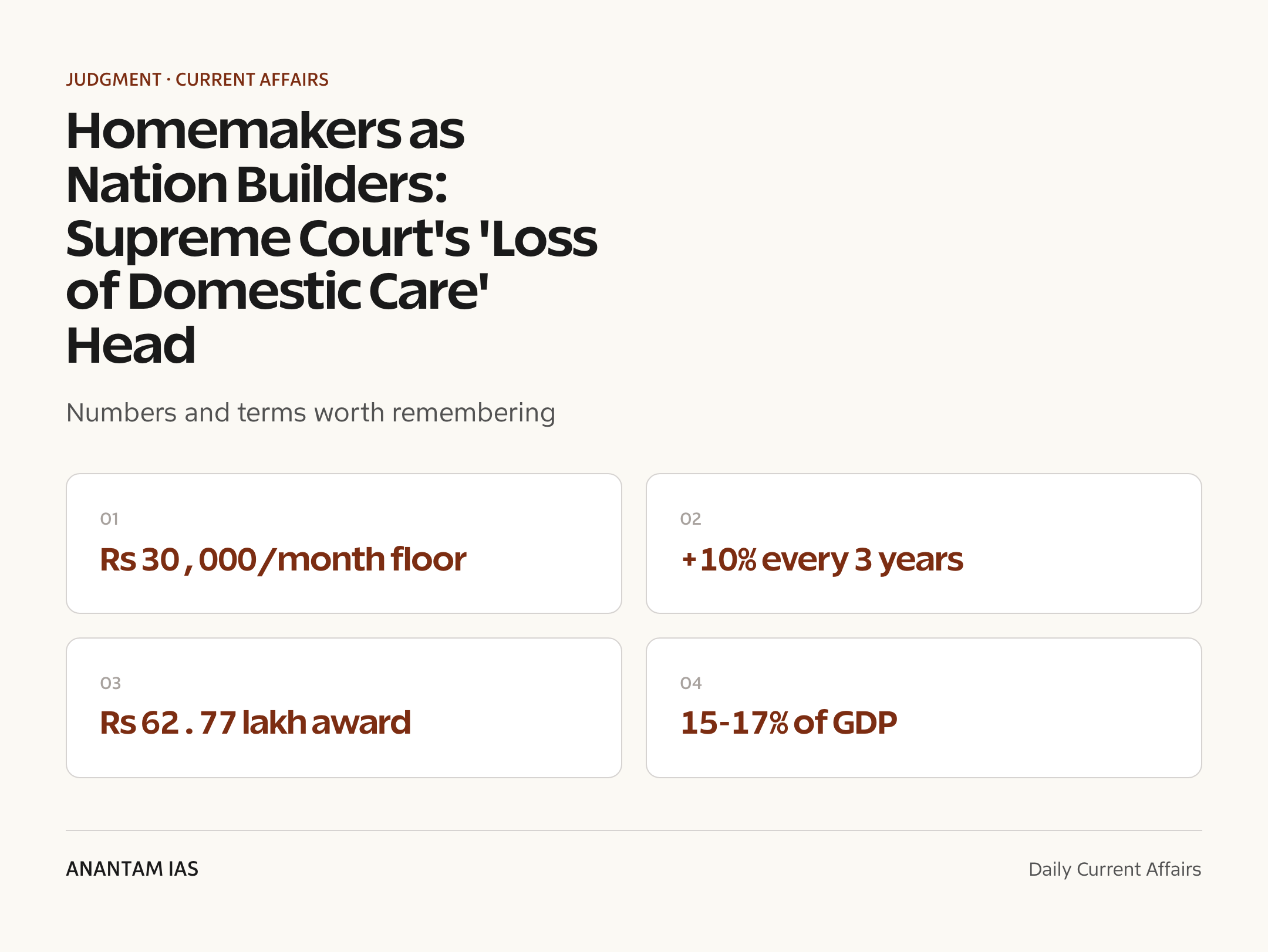
The Supreme Court of India, in Shishupal @ Shish Ram v. Surjeet (June 2026), for the first time created a distinct compensable head called ‘loss of domestic care’ in motor-accident claims, fixing the economic value of a homemaker’s unpaid labour at a baseline of Rs 30,000 per month.
A two-judge bench held that homemakers are not merely caregivers but ‘economic entities’, declaring that they ‘actually are the nation builders’.
The ruling arose from a 2001 Haryana road accident in which Reshma (aged 35) died. The Motor Accident Claims Tribunal had awarded her family Rs 2.42 lakh; the Court raised the total compensation to about Rs 62.77 lakh, with the new head replacing the old ‘notional income’ as the starting figure.
- Bench: Justices Sanjay Karol and N. Kotiswar Singh; case Shishupal @ Shish Ram v. Surjeet.
- New head ‘loss of domestic care’ set at a floor of Rs 30,000/month, revised up 10% every three years.
- Compensation journey: MACT Rs 2.42 lakh (initial) → Punjab & Haryana HC Rs 8.43 lakh (2024) → SC ~Rs 62.77 lakh.
- Where the homemaker also earned Rs 30,000 is added to her actual income, not substituted.
- The court relied on the NSO Time Use Survey 2019: women aged 15-59 spend over 7 hours/day on unpaid domestic work versus under 3 hours for men.
- Applies only to the Motor Vehicles Act, 1988 compensation; creates no salary, pension or employment relationship for homemakers.
The development matters in the context of:
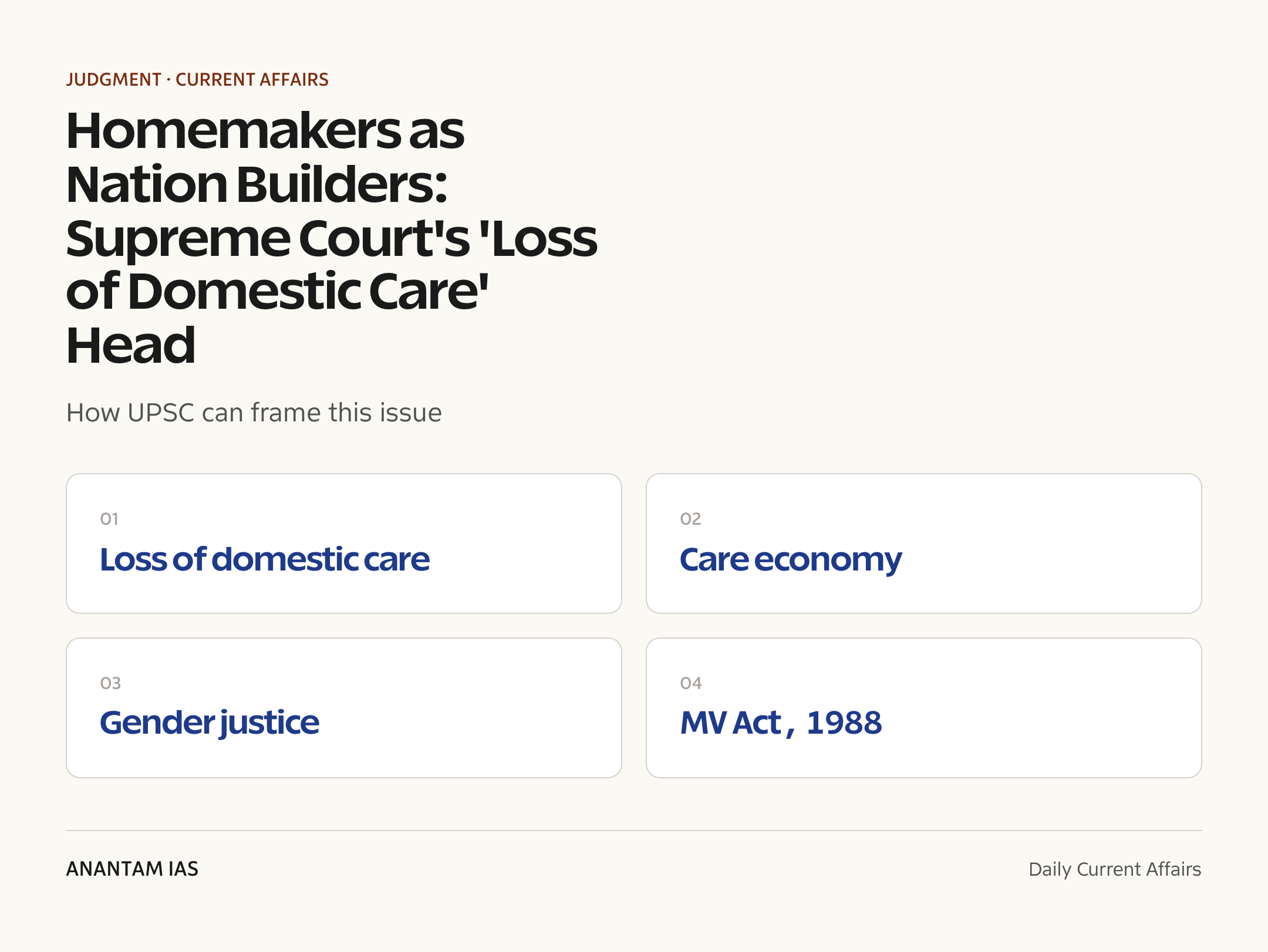
- It anchors the long-debated idea of the care economy in enforceable tort law, not just policy rhetoric.
- It links unpaid domestic labour to gender justice and India’s low female labour-force participation.
- It standardises a previously inconsistent practice of valuing homemakers through ad-hoc ‘notional income’ figures.
UPSC Relevance
Prelims Relevance
- Motor Vehicles Act, 1988 — statutory basis for accident compensation and MACT claims.
- Motor Accident Claims Tribunal (MACT) — adjudicates compensation; appeals go to the High Court, then the Supreme Court.
- ‘Loss of domestic care’ — new compensatory head, baseline Rs 30,000/month, +10% every 3 years.
- Notional income — figure imputed to non-earning persons to value unpaid work.
- Loss of consortium — fixed at Rs 40,000 per dependent under Pranay Sethi (emotional loss, distinct from domestic care).
- Key precedents: Lata Wadhwa (2001) Rs 3,000 notional income; Arun Kumar Agarwal (2010); Kirti v. Oriental Insurance (2021); National Insurance v. Pranay Sethi (2017).
- NSO Time Use Survey 2019 — unpaid caregiving estimated at 15-17% of India’s GDP.
- Compensation formula: income − personal expenses + future prospects × age-based multiplier.
- Case name and Bench: Shishupal @ Shish Ram v. Surjeet; Justices Sanjay Karol and N. Kotiswar Singh.
Mains Relevance
GS Paper 2
- Role of the judiciary in advancing social justice and gender equality through the interpretation of compensation law.
- Recognition of unpaid care work as a step toward substantive equality under Articles 14, 15 and 39.
GS Paper 1
- Women’s unpaid domestic labour, the gendered division of work, and its link to female labour-force participation.
GS Paper 3
- The care economy, GDP measurement gaps, and the economics of counting unpaid work.
Essay
- ‘The hand that rocks the cradle’: valuing the invisible economy of care.
- Justice delayed and justice quantified — courts and the worth of unpaid labour.
Background and Context
The Case and What the Court Held
The judgment converted a routine accident appeal into a structural rethink of how courts value a homemaker.
- Victim Reshma, a 35-year-old homemaker, died in a 2001 road accident in Haryana.
- The Supreme Court created a new head, ‘loss of domestic care’, with a baseline of Rs 30,000/month as the deceased’s notional monthly income.
- This figure replaces the old notional income as the starting number to which future prospects and the multiplier are then applied.
- It applies only where three conditions co-exist: the homemaker ran the household, children lost her care and guidance, and the spouse or parents lost support.
- Where the homemaker also held paid employment, Rs 30,000 is added to her actual income.
- The floor is to be revised upward by 10% every three years.
How Accident Compensation Is Calculated
The problem was structural — the formula leaned on a number that did not exist for homemakers.
- Under the Motor Vehicles Act, 1988, a court takes the deceased’s income, deducts personal expenses, adds future prospects, and multiplies by an age-based multiplier.
- The opening income figure drives almost the entire award.
- A salaried person has payslips and tax returns; a homemaker has none, so courts impute a ‘notional income’.
- Earlier, the Act treated a non-earning person as having an annual income of just Rs 15,000 — a number that crushed the final award.
- The Court found ‘notional income’ could never fully capture what a homemaker actually contributes.
The Trail of Precedent
Courts had recognised the value of domestic work in principle for over two decades, but never fixed a workable method.
- Lata Wadhwa v. State of Bihar (2001) — approved a modest Rs 3,000/month notional income for homemakers aged 34-59.
- Arun Kumar Agarwal v. National Insurance (2010) — called a homemaker’s services ‘invaluable’, beyond mere cooking or cleaning.
- National Insurance v. Pranay Sethi (2017) — a Constitution Bench standardised heads like loss of consortium, estate and funeral expenses.
- Kirti v. Oriental Insurance (2021) — held that a homemaker’s economic value cannot be discounted simply because the work is unpaid or done by women.
- Despite this, quantification stayed inconsistent — the gap the 2026 ruling closes.
Three Dimensions of Loss
The Court mapped exactly what a household loses when a homemaker dies.
- Household management — the daily running of the home that keeps the family functional.
- Loss of the ‘first teacher’ — transmission of skills, language and values to children that no paid arrangement replicates.
- Loss of the earning spouse of the domestic infrastructure that freed them to focus on paid work.
- These make a homemaker’s contribution ‘neither entirely economic nor entirely non-economic’.
- The Court separated this from loss of consortium (Rs 40,000), which covers only emotional loss — affection, companionship and solace.
The Data Behind the Verdict
The Court grounded its reasoning in national time-use evidence, not sentiment.
- It cited the NSO Time Use Survey 2019: women aged 15-59 spend over 7 hours/day on unpaid domestic tasks, against under 3 hours for men.
- Women’s unpaid caregiving is estimated at 15-17% of India’s GDP — a contribution that never enters GDP because unpaid work is not counted as productive.
- This invisibility in national accounts is precisely what the ‘loss of domestic care’ head seeks to correct in tort terms.
- It echoes the wider economic finding that suppressed valuation of domestic labour depresses female labour-force participation.
Significance and Ripple Effects
The narrow ruling on motor claims could radiate across maintenance, labour and insurance law.
- It is a ‘vital corrective to decades of economic erasure’, as The Hindu put it in its editorial.
- Homemakers seeking maintenance under the Hindu Marriage Act now have judicial reasoning backing the economic value of their work.
- Rural women who ‘assist in sowing, harvesting and cattle-tending’ can argue that their labour be valued higher rather than treated as incidental.
- Future litigation may test whether male homemakers can claim equivalent treatment.
- Insurers face larger average claim sizes — possibly applied retrospectively — pushing them to revise risk models and settle faster in Lok Adalats.
The Limits of the Ruling
The judgment is deliberately narrow and does not, by itself, change the status of homemakers in the economy.
- It creates no salary, wage, pension scheme or employment relationship for homemakers.
- It applies only to MACT compensation under the Motor Vehicles Act, 1988.
- The Rs 30,000 figure is itself notional — a floor, not a market wage.
- Counting care work in GDP/national accounts still requires statistical and policy reform beyond the courtroom.
- A flat baseline may under-value or over-value depending on household size, region and circumstance.
Way Forward
Measure the care economy
- Institutionalise a recurring Time Use Survey and pilot satellite accounts to record unpaid work alongside GDP.
- Use the data to inform social-security and care-infrastructure policy.
Extend the principle thoughtfully
- Allow consistent application of the reasoning to maintenance, succession and labour disputes through clear guidelines.
- Keep the head gender-neutral so male homemakers and diverse households are covered.
Build supporting infrastructure
- Invest in childcare, elder-care and public services that reduce and redistribute unpaid domestic burdens.
- Pair recognition with measures that lift female labour-force participation, not entrench role segregation.
Conclusion
By naming a ‘loss of domestic care’ head and calling homemakers ‘nation builders’, the Supreme Court has put a concrete, enforceable value on labour that national accounts have long ignored. The reform is narrow in law but large in symbolism, and its reasoning is likely to travel well beyond motor-accident tribunals.
The deeper task remains political and statistical: to count, fund, and fairly redistribute care work so that recognition on paper translates into real economic security for those who do it.
UPSC Practice Questions
Prelims MCQ 1
With reference to the Supreme Court’s judgment in Shishupal v. Surjeet (2026), consider the following statements:
- It created a new compensatory head called ‘loss of domestic care’ with a baseline of Rs 30,000 per month.
- It granted homemakers a statutory salary and pension under the Motor Vehicles Act, 1988.
- It relied on the NSO Time Use Survey 2019 to value unpaid domestic labour.
How many of the above statements are correct?
(a) Only one (b) Only two (c) All three (d) None
Answer: (b) Only two
Explanation:
Statements 1 and 3 are correct. Statement 2 is wrong — the Court expressly created no salary, pension or employment relationship; the ruling applies only to MACT compensation.
Prelims MCQ 2
The ‘loss of consortium’ head in motor-accident compensation, as standardised in National Insurance v. Pranay Sethi (2017), primarily compensates for which of the following?
(a) The economic value of a homemaker’s daily household management
(b) The emotional loss — affection, companionship and solace — suffered by dependants
(c) Funeral expenses and loss of estate
(d) Future medical costs of surviving dependants
Answer: (b) The emotional loss — affection, companionship and solace — suffered by dependants
Explanation:
Loss of consortium (fixed at Rs 40,000 per dependent) covers emotional loss only. The 2026 ruling created the separate ‘loss of domestic care’ head to capture the economic value of domestic work.
UPSC Mains Questions
- The Supreme Court’s recognition of ‘loss of domestic care’ values unpaid homemaker labour in tort law. Examine how this judgment advances gender justice and discuss why counting the care economy still needs statistical and policy reform beyond the courtroom. (250 words)
- ‘Homemakers are nation builders.’ In light of recent judicial reasoning and the NSO Time Use Survey, analyse the link between unpaid domestic labour, GDP measurement and female labour-force participation in India. (250 words)
Sources: The Indian Express (Explained) and The Hindu (editorial).
Frequently Asked Questions
What is the ‘loss of domestic care’ head?
It is a new compensatory head created by the Supreme Court in Shishupal v. Surjeet (2026) for motor-accident claims. It puts a baseline value of Rs 30,000 per month on the unpaid domestic work of a homemaker, replacing the old ‘notional income’ as the starting figure for calculating compensation when a homemaker dies in an accident.
Why did the Court call homemakers ‘nation builders’?
The Bench held that homemakers are not merely caregivers but ‘economic entities’ whose contribution has been consistently undervalued. Citing that women spend over seven hours a day on unpaid domestic work and that such caregiving equals 15-17% of GDP, it concluded that homemakers ‘actually are the nation builders’ and ought to be recognised as such.
Does the judgment give homemakers a salary or pension?
No. The Court was explicit that it creates no salary, wage entitlement, pension scheme or employment relationship. The Rs 30,000 figure is a notional floor used only to calculate compensation in Motor Accident Claims Tribunal cases under the Motor Vehicles Act, 1988 — not a real wage paid to homemakers.
How is the Rs 30,000 figure applied?
Where a homemaker dies and three conditions are met — she ran the household, children lost her care, and the spouse or parents lost support — Rs 30,000 per month becomes the base monthly income. Future prospects and an age-based multiplier are then applied to it. If she also earned, Rs 30,000 is added to her actual income, and the floor rises 10% every three years.
What earlier cases shaped this ruling?
Lata Wadhwa (2001) valued a homemaker’s services at Rs 3,000; Arun Kumar Agarwal (2010) called them ‘invaluable’; Pranay Sethi (2017) standardised compensation heads; and Kirti v. Oriental Insurance (2021) said domestic work cannot be discounted because it is unpaid. The 2026 judgment finally fixed a consistent method to quantify that value.
Why does this matter for UPSC?
It connects GS2 themes of judiciary and social justice with GS1 on gender and the GS3 care economy. It illustrates how courts can advance substantive equality, the link between unpaid labour and female labour-force participation, and the gap between recognising care work in principle and counting it in national accounts.
Source: https://anantamias.com/current-affairs/homemakers-nation-builders-loss-of-domestic-care/
India’s Defence Production: An All-Time High of Rs 1.78 Lakh Crore

Why in News?
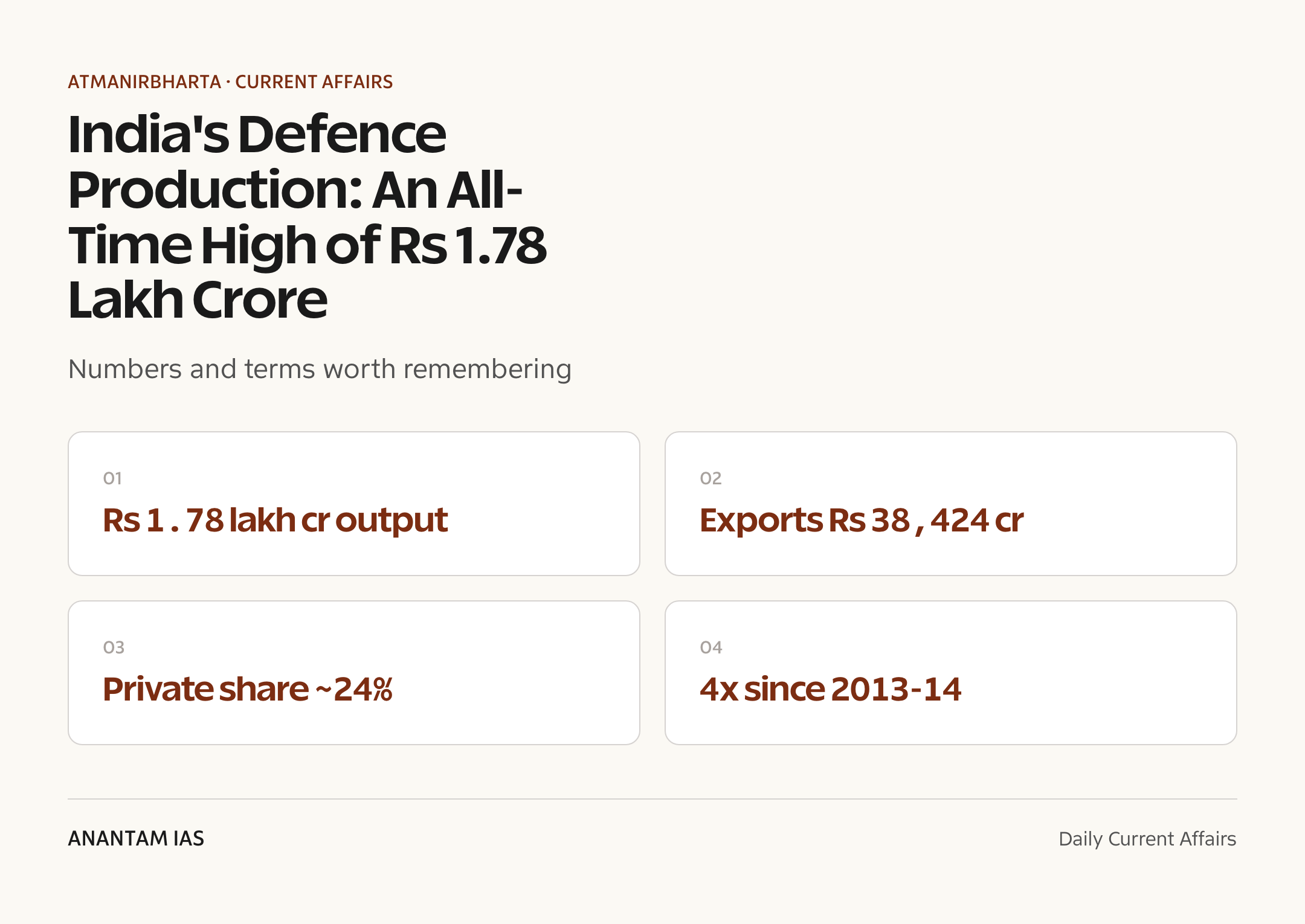
The Ministry of Defence announced on 18 June 2026 that India’s annual defence production touched an all-time high of Rs 1.78 lakh crore in the financial year 2025-26, a 15.6% rise over the previous year’s Rs 1.54 lakh crore. Defence Minister Rajnath Singh credited sustained policy support and rising private-sector participation under the Atmanirbhar Bharat push.
The same year recorded the highest-ever defence exports of Rs 38,424 crore, with the private sector’s contribution alone touching roughly Rs 42,000 crore of output. India’s indigenous defence production has grown almost fourfold since 2013-14 (Rs 43,746 crore).
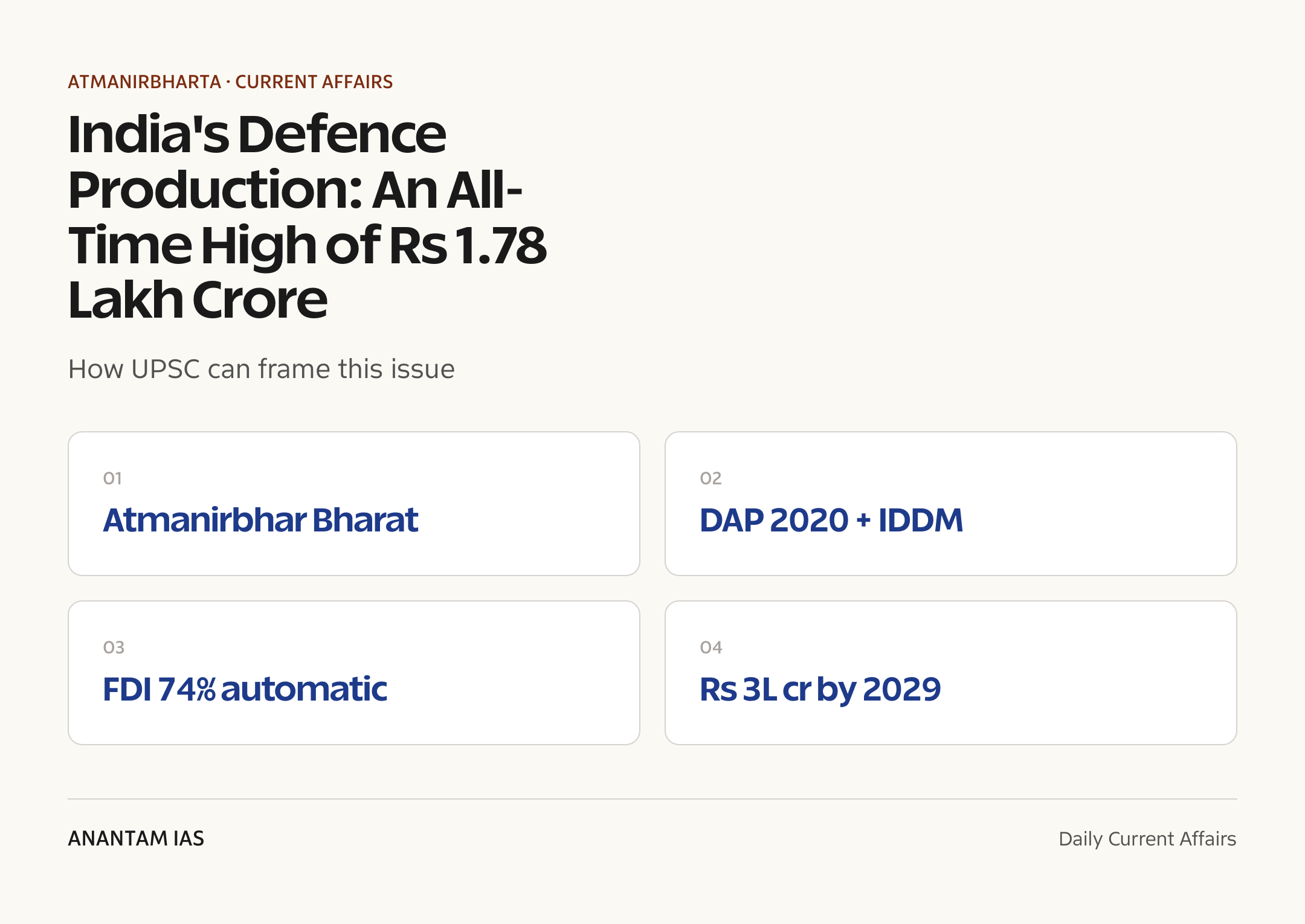
- Production: Rs 1.78 lakh crore in 2025-26, up 15.6% over 2024-25 (Rs 1.54 lakh crore) and 110% over 2020-21 (Rs 84,643 crore).
- Exports at a record Rs 38,424 crore, with India now exporting to over 100 nations, including the United States, France and Armenia.
- DPSUs and other PSUs made up about 76% of production; the private sector contributed about 24% (~Rs 42,000 crore), an all-time high share.
- Indigenous production has grown nearly fourfold since 2013-14 (Rs 43,746 crore).
- Government target: Rs 3 lakh crore production and Rs 50,000 crore exports by 2029.
The development matters in the context of:
- Anchors the durable syllabus theme of self-reliance in defence — moving India from the world’s largest arms importer toward a net exporter.
- Showcases the policy architecture (DAP 2020, Positive Indigenisation Lists, FDI liberalisation, iDEX) that examiners test under indigenisation of technology.
- Links defence manufacturing to Make in India, MSME growth, jobs and the wider economy.
UPSC Relevance
Prelims Relevance
- Atmanirbhar Bharat in defence — self-reliance vision
- Defence Acquisition Procedure (DAP) 2020 and its ‘Buy {Indian-IDDM}’ top-priority category
- Positive Indigenisation Lists (PILs) — items barred from import after set timelines
- FDI in defence: up to 74% via automatic route, up to 100% via government route
- iDEX (Innovations for Defence Excellence) and the Defence Innovation Organisation
- Defence Production & Export Promotion Policy (DPEPP) — draft roadmap
- RDI Scheme — Rs 1 lakh crore Research, Development and Innovation corpus
- DPSUs (e.g. HAL, BEL, BDL) and the corporatised Ordnance Factory Board (now 7 DPSUs)
- SRIJAN portal for indigenisation; Defence Industrial Corridors in UP and Tamil Nadu
Mains Relevance
GS Paper 3
- Assess India’s progress toward self-reliance in defence manufacturing and the role of the private sector and MSMEs.
- Examine how policy reforms (DAP 2020, indigenisation lists, FDI norms) have reshaped India’s defence industrial base and exports.
GS Paper 2
- Defence exports as an instrument of foreign policy and strategic partnerships.
Essay
- Self-reliance is the foundation of national security.
- From importer to exporter: India’s quest for strategic autonomy.
Background and Context
The headline numbers
The 2025-26 data marks a step-change in scale across production and exports.
- Total production: Rs 1.78 lakh crore (2025-26), against Rs 1.54 lakh crore (2024-25) — a 15.6% jump.
- Growth of 110% over 2020-21 (Rs 84,643 crore) and nearly 4x over 2013-14 (Rs 43,746 crore).
- Exports at Rs 38,424 crore, up from less than Rs 1,000 crore a decade ago, reaching 100+ nations.
- Defence budget rose from Rs 2.53 lakh crore (2013-14) to Rs 6.81 lakh crore (2025-26).

What changed: from importer to producer
India long ranked among the world’s largest arms importers, exposing it to costly delays and supply shocks.
- Earlier procurement was slow, with critical capability gaps and heavy import dependence straining forex reserves.
- Private participation was limited by restrictive policy, DPSU dominance and poor technology access.
- Exports in 2013-14 were just Rs 686 crore — India was a buyer, not a builder.
- A decade of reform under the Atmanirbhar Bharat banner reversed the trajectory; 2025 was declared the ‘Year of Reforms’.
The policy architecture
A cluster of reforms — not a single scheme — drives the indigenisation push.
- DAP 2020: makes ‘Buy {Indian-IDDM}’ (Indigenously Designed, Developed and Manufactured) the top-priority procurement category.
- Positive Indigenisation Lists: notified items that must be sourced domestically after fixed deadlines, run by the DMA and Department of Defence Production.
- FDI liberalised to 74% via the automatic route and up to 100% through the government route.
- RDI Scheme (Rs 1 lakh crore) funds R&D across DPSUs, private firms, MSMEs and startups; iDEX backs defence startups.
- Defence Industrial Corridors in Uttar Pradesh and Tamil Nadu, plus the SRIJAN indigenisation portal.
Who is producing — public vs private
The structure of the industrial base is shifting toward private players.
- DPSUs and other PSUs accounted for about 76% of 2025-26 output; the private sector contributed about 24% (~Rs 42,000 crore).
- The Ordnance Factory Board was corporatised into 7 new DPSUs in 2021 to improve accountability.
- Roughly 16,000 MSMEs now feed the supply chain as ‘game-changers’.
- Over 788 industrial licences have been issued to about 462 companies.
What India now exports
Exports span platforms, sub-systems and components, not just spares.
- Items include bulletproof jackets, Dornier aircraft, Chetak helicopters, fast interceptor boats and lightweight torpedoes.
- Buyers include the United States, France and Armenia, alongside many smaller states.
- Exports give Indian firms scale, hard-currency earnings and a foothold in global supply chains.
- They also serve as an instrument of defence diplomacy, and strategic partnership-building.
Why it matters strategically
Self-reliance in arms is both a security and an economic objective.
- Reduces vulnerability during global disruptions and sanctions, supporting strategic autonomy.
- Builds a deep-tech industrial base spilling over into aerospace, electronics and materials.
- Creates skilled jobs and links to the wider Make in India manufacturing agenda.
- Signals India’s ambition to be a global defence manufacturing hub.
The gaps that remain
Records on value mask continuing dependence in high-end systems.
- India still imports critical aero-engines, advanced sensors and some sub-systems.
- Much ‘indigenous’ output relies on licensed/transferred technology rather than home-grown design.
- R&D spend as a share of the defence budget stays modest versus leading producers.
- Export figures remain small against the Rs 50,000 crore by 2029 target, and global majors dominate the market.
Way Forward
Deepen genuine indigenisation
- Prioritise IDDM projects and home-grown design IP, not just assembly under licence.
- Crack the hardest dependencies — aero-engines, advanced sensors and propulsion.
Strengthen the ecosystem
- Scale iDEX and the RDI Scheme to fund startups, MSMEs and academia.
- Use the Defence Industrial Corridors and predictable orders to anchor private investment.
Build durable export markets
- Pair exports with credit lines, lifecycle support and defence diplomacy.
- Move up the value chain from components toward complete platforms and systems.
Conclusion
The Rs 1.78 lakh crore record confirms that India’s decade-long bet on Atmanirbharta in defence is producing measurable results — rising output, a stronger private base and exports to over 100 countries.
The next test is qualitative: turning value records into genuine technological self-reliance in high-end systems and meeting the Rs 3 lakh crore production and Rs 50,000 crore export targets by 2029.
UPSC Practice Questions
Prelims MCQ 1
With reference to India’s defence-manufacturing policy, consider the following statements:
- Under the Defence Acquisition Procedure (DAP) 2020, ‘Buy {Indian-IDDM}’ is the highest-priority procurement category.
- Foreign Direct Investment in defence is allowed up to 74% through the automatic route.
- Positive Indigenisation Lists permit the import of listed items only after a fixed timeline.
How many of the above statements are correct?
(a) Only one (b) Only two (c) All three (d) None
Answer: (b) Only two
Explanation:
Statements 1 and 2 are correct. Statement 3 is reversed — Positive Indigenisation Lists BAR the import of listed items after a fixed timeline (forcing domestic sourcing), they do not permit import only after a deadline.
Prelims MCQ 2
India’s annual indigenous defence production in the financial year 2025-26 was approximately:
(a) Rs 46,429 crore (b) Rs 84,643 crore (c) Rs 1.54 lakh crore (d) Rs 1.78 lakh crore
Answer: (d) Rs 1.78 lakh crore
Explanation:
Production hit a record Rs 1.78 lakh crore in 2025-26, up 15.6% over 2024-25 (Rs 1.54 lakh crore). Rs 46,429 crore was the 2014-15 figure and Rs 84,643 crore the 2020-21 figure.
UPSC Mains Questions
- India’s defence production has touched a record high even as the country remains dependent on imports for high-end systems. Critically examine the progress and the gaps in India’s drive for self-reliance in defence manufacturing. (250 words)
- Discuss how policy reforms over the past decade — including DAP 2020, indigenisation lists and FDI liberalisation — have reshaped India’s defence industrial base and its export profile. (250 words)
Sources: PIB, Ministry of Defence and The Indian Express.
Frequently Asked Questions
What was India’s defence production in 2025-26?
India’s indigenous defence production reached an all-time high of about Rs 1.78 lakh crore in financial year 2025-26, a 15.6% increase over the previous year’s Rs 1.54 lakh crore. This was almost four times the 2013-14 figure of Rs 43,746 crore, reflecting a decade of Atmanirbhar Bharat reforms.
How much were India’s defence exports in 2025-26?
Defence exports touched a record Rs 38,424 crore in 2025-26, up from less than Rs 1,000 crore a decade earlier. India now exports to over 100 nations, including the United States, France and Armenia, supplying items such as bulletproof jackets, Dornier aircraft and Chetak helicopters.
What is Atmanirbhar Bharat in defence?
It is the policy push to make India self-reliant in arms manufacturing, cutting import dependence by promoting indigenous design, development and production. Its tools include Positive Indigenisation Lists, the ‘Buy {Indian-IDDM}’ procurement priority, liberalised FDI, and funding schemes such as iDEX and the RDI Scheme.
What is the Defence Acquisition Procedure (DAP) 2020?
DAP 2020 is the framework governing defence capital acquisitions. It gives top priority to the ‘Buy {Indian-IDDM}’ category — systems indigenously designed, developed and manufactured — and aims to speed up procurement, improve transparency and build a globally competitive domestic defence industry.
What is a Positive Indigenisation List?
It is a list of defence items, notified by the Ministry of Defence, that can no longer be imported after a fixed deadline and must be sourced from Indian industry. Such lists guarantee domestic firms a captive market and steadily reduce reliance on foreign suppliers.
What are India’s defence-manufacturing targets for 2029?
The government aims to raise annual defence production to about Rs 3 lakh crore and defence exports to Rs 50,000 crore by 2029, reinforcing India’s ambition to become a global defence manufacturing hub while supporting jobs and economic growth.
Source: https://anantamias.com/current-affairs/india-defence-production-record-1-78-lakh-crore/
Floating Solar: India’s First National Assessment Maps 102 GW Potential
Why in News?
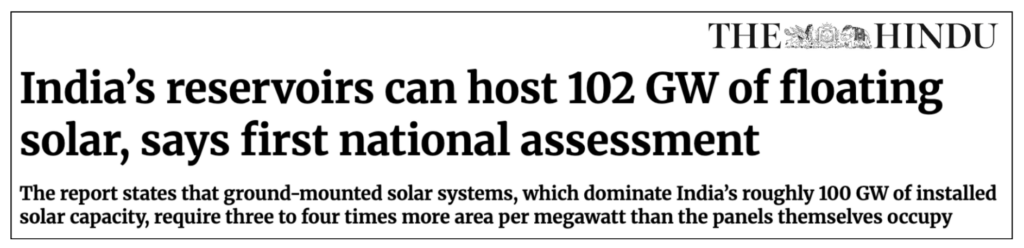
The Ministry for New and Renewable Energy recently released the report ‘Solar PV Potential of India (Floating Solar)’ — the first comprehensive national assessment of floating-solar potential, prepared by the National Institute of Solar Energy (NISE), an autonomous body under the Ministry of New and Renewable Energy (MNRE).
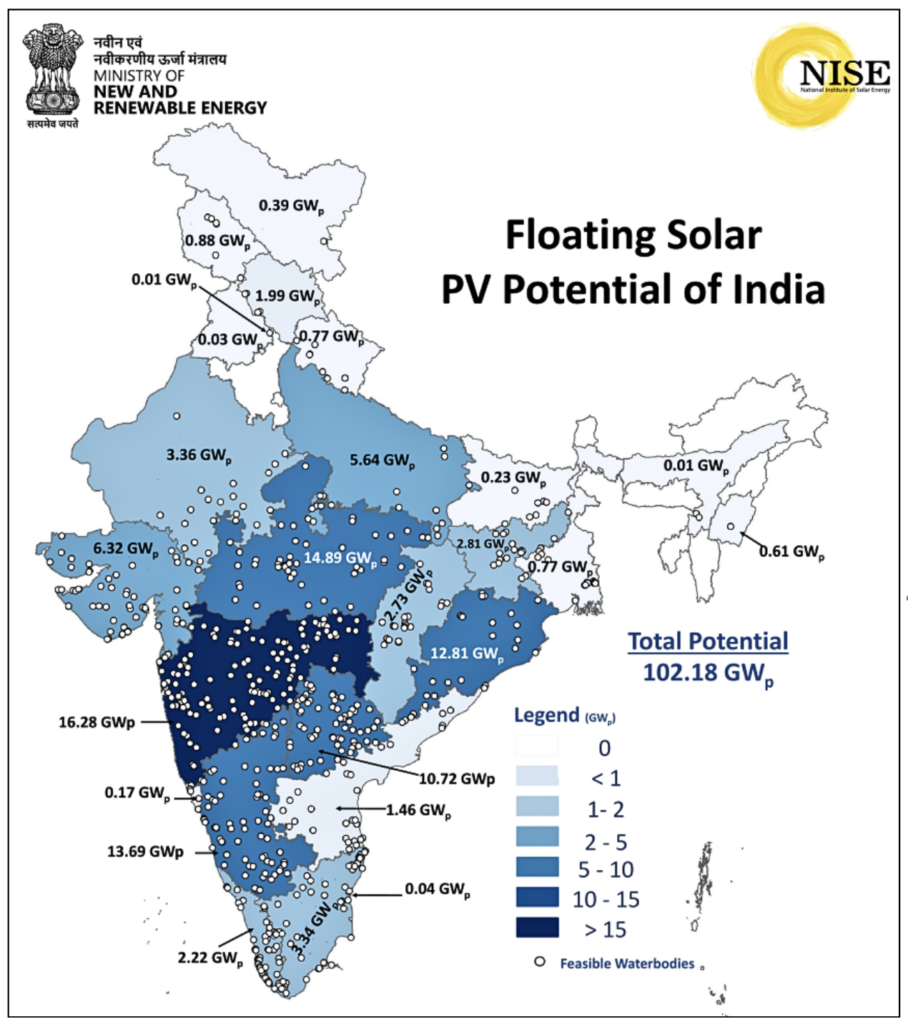
The 121-page assessment estimates India’s reservoirs can host about 102.18 GWp of floating-solar capacity, framing water-mounted panels as a way around the sector’s most intractable obstacle — land.
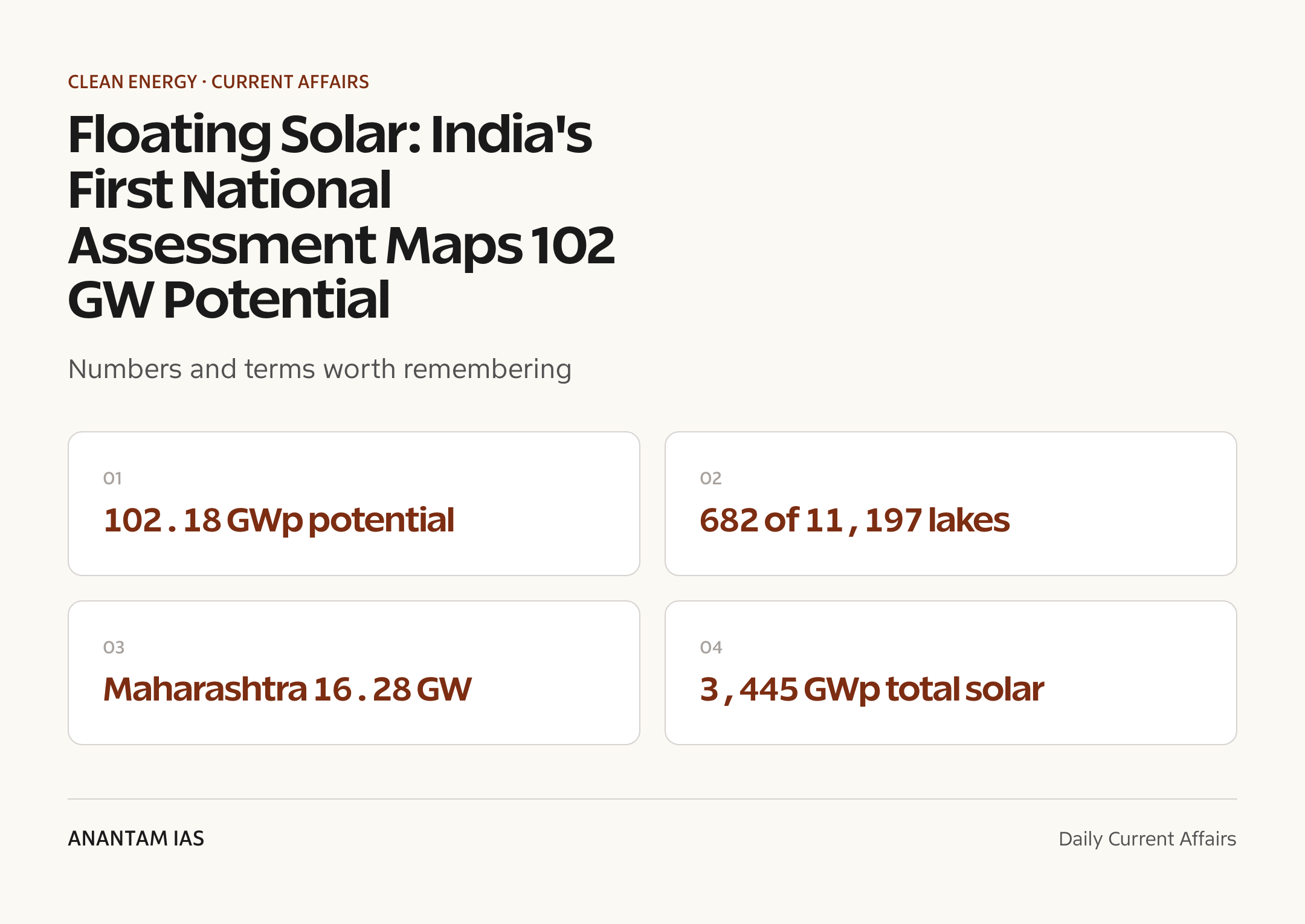
- NISE screened 11,197 inland waterbodies and found 682 technically feasible, covering 1,946 sq km of usable surface.
- Maharashtra leads with 16.28 GW, followed by Madhya Pradesh (14.89 GW), Karnataka (13.69 GW), Odisha (12.81 GW) and Telangana (10.72 GW).
- Added to last year’s land-based estimate of 3,343 GWp, India’s total assessed solar potential now stands at 3,445 GWp.
- MNRE said it is working on a dedicated programme to promote floating-solar deployment nationwide.
- Secretary Santosh Kumar Sarangi said MNRE is in talks with the Finance Ministry to promote floating solar and agri-photovoltaics.
The development matters in the context of:
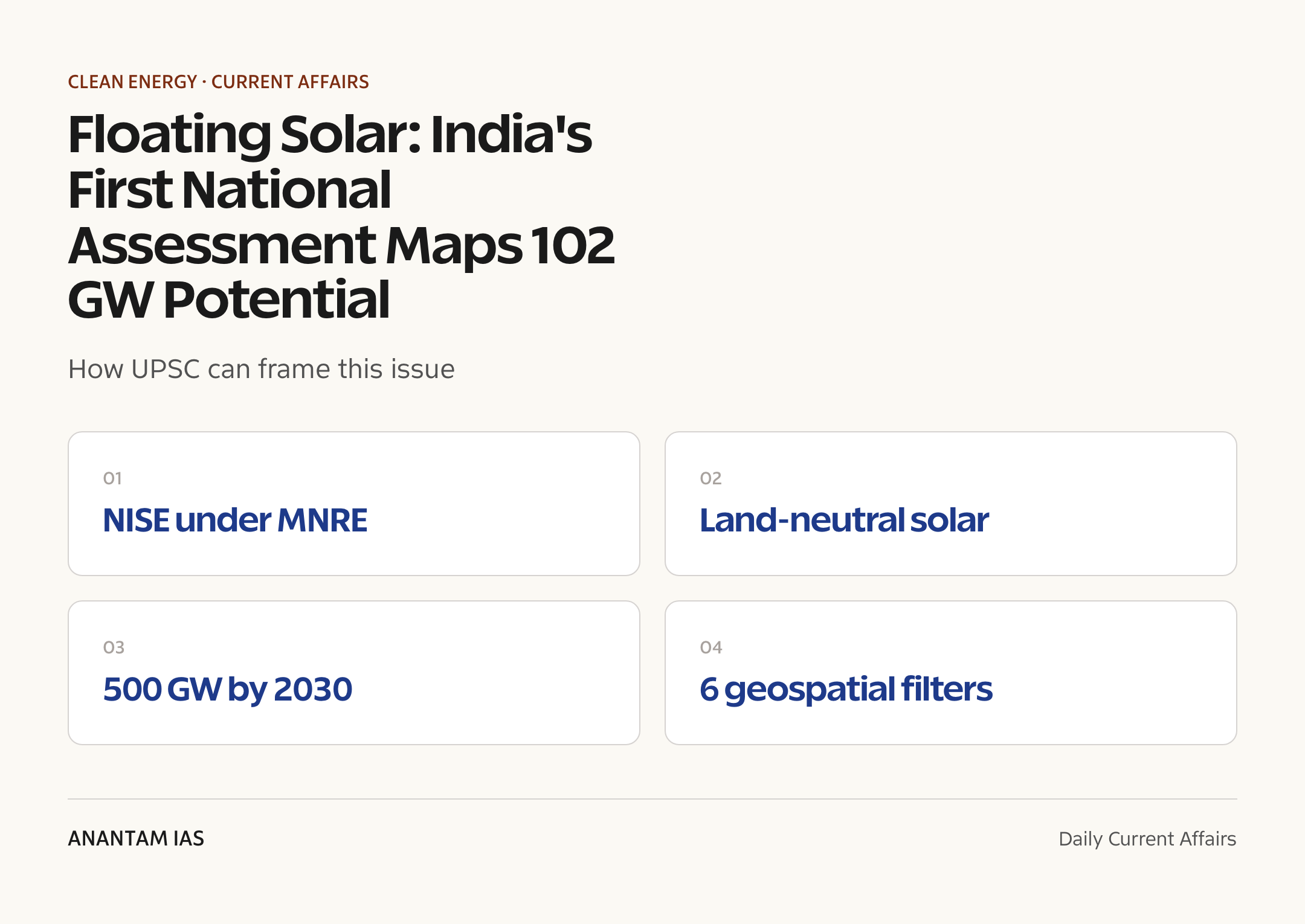
- Floating solar matters because land acquisition — costly, slow and conflict-prone — is a chokepoint for India’s target of 500 GW non-fossil capacity by 2030.
- It supports India’s Panchamrit commitments and the goal of net-zero by 2070 announced at COP26.
- Ground-mounted solar needs three to four times more area per megawatt than the panels themselves occupy; floating solar is ‘land neutral’.
UPSC Relevance
Prelims Relevance
- NISE — National Institute of Solar Energy, an autonomous body under MNRE, is the nodal agency for solar potential assessment.
- Report title: ‘Solar PV Potential of India (Floating Solar)’; released in June 2026.
- Floating-solar potential: 102.18 GWp; total assessed solar potential: 3,445 GWp.
- Six geospatial filters: waterbodies >10 ha; water for >=11 months/year; depth 3-30 m; irradiance >4.5 kWh/m2/day; within 10 km of roads and substations.
- Self-imposed cap of 20% of any reservoir’s surface area.
- Largest plant: Omkareshwar floating solar park on the Narmada (Khandwa, Madhya Pradesh), 278 MW, scaling to 600 MW.
- India’s non-fossil target: 500 GW by 2030; net-zero by 2070.
- Global floating solar reached about 9.6 GW by 2024, nearly 90% of it in Asia; China leads.
Mains Relevance
GS Paper 3
- Land-saving renewable technologies and the land-acquisition chokepoint in India’s clean-energy transition.
- Energy security, the 500 GW non-fossil target, and the role of geospatial assessments in resource mapping.
GS Paper 3
- Environmental trade-offs of floating solar — evaporation reduction versus aquatic-ecosystem and reservoir-use impacts.
GS Paper 2
- Centre-state coordination and dedicated schemes for deploying clean-energy infrastructure on shared water resources.
Essay
- Innovation and the energy transition — turning constraints (scarce land) into opportunity.
- Development versus environment: harnessing water surfaces without harming ecosystems.
Background and Context
What floating solar is and why it matters
Floating photovoltaic (FPV) systems mount solar panels on pontoons over reservoirs and lakes instead of on land.
- Panels float on buoyant structures anchored to the reservoir bed or banks, with cabling routed to onshore substations.
- Chief advantage is being ‘land neutral’ — no land acquisition, sidestepping a slow, costly process prone to conflict with agriculture and habitation.
- Co-benefits include reduced evaporation from covered water surfaces and a cooling effect that can lift panel efficiency.
- It also unlocks idle assets — dam reservoirs, irrigation tanks and quarry lakes — for clean-energy generation near existing grid infrastructure.
How NISE arrived at 102 GWp
NISE passed India’s inland waterbodies through six geospatial filters to isolate feasible sites.
- Filters: lakes/reservoirs larger than 10 hectares; water present for at least 11 months a year; depths between 3 and 30 metres.
- Solar irradiance above 4.5 kWh/m2/day; located within 10 km of both roads and substations.
- A self-imposed cap of 20% of any reservoir’s surface to limit ecological and usage conflict.
- Method demonstrated on Odisha’s Hirakud reservoir, where 499 sq km of water was whittled to 99.5 sq km of usable surface.
- Applied nationwide, the filters yielded 1,946 sq km of feasible area across 682 of 11,197 waterbodies, translating to 102.18 GW.
Where the potential lies
Five states account for the bulk of the assessed capacity.
- Maharashtra — 16.28 GW (highest);
- Madhya Pradesh — 14.89 GW.
- Karnataka — 13.69 GW;
- Odisha — 12.81 GW;
- Telangana — 10.72 GW.
- Combined with the 2025 land-based estimate of 3,343 GWp, India’s total assessed solar potential is now 3,445 GWp.
- Mercom India reported MNRE is preparing a dedicated floating-solar programme and discussing fiscal support with the Finance Ministry.
Where it fits in India’s energy goals
Floating solar is positioned to relieve the land bottleneck in India’s renewable push.
- Ground-mounted solar dominates India’s roughly 100 GW of installed solar, but it needs three to four times more area per megawatt than the panels occupy.
- Land acquisition remains a chokepoint as India pursues 500 GW non-fossil capacity by 2030.
- Non-fossil capacity has risen from 81 GW in 2014 to about 288 GW, with solar growing from 2.8 GW to roughly 155 GW (per MNRE figures cited by Mercom).
- Floating solar dovetails with agri-photovoltaics, the other land-saving model MNRE is promoting.
The catch — cost, durability and ecology
The assessment flags real-world hurdles that temper the headline number.
- The 121-page report contains no cost estimate for realising the potential; its only reference is a 2021 US NREL benchmark that floating plants cost about 25% more upfront than ground-mounted ones (floats, anchoring, waterproofing).
- Field observations at the flagship Omkareshwar park (278 MW on the Narmada, Khandwa, MP) recorded loosening float joints, misaligned platforms, uneven buoyancy and broken electric cables.
- Covering reservoir surfaces raises questions on aquatic ecosystems, oxygen exchange, fisheries and competing water uses — so the 20% cap.
- Anchoring in variable-depth reservoirs and long-term durability in monsoon conditions remain engineering challenges.
Global picture
India’s move follows a fast-maturing but still small global market.
- Global floating solar reached about 9.6 GW by 2024, nearly 90% of it in Asia.
- China leads, including a 120 MW plant on a fish farm at Poyang Lake.
- Singapore’s 1 MW Tengeh reservoir testbed has supplied much of the field’s performance data.
- The Netherlands accounts for roughly three-fourths of Europe’s capacity, built largely on quarry lakes.
Way Forward
Build a costed scheme
- Pair the dedicated floating-solar programme with viability-gap funding and a clear cost-benefit framework, given the ~25% upfront premium.
- Standardise floats, anchoring and cabling specifications to prevent the failures seen at Omkareshwar.
Safeguard ecosystems
- Retain the 20% surface cap and mandate environmental and social impact assessments for fisheries, irrigation and biodiversity.
- Run long-term monitoring of water quality and aquatic life on pilot reservoirs.
Strengthen domestic capacity
- Leverage India’s expanding module manufacturing to localise FPV components and reduce import dependence.
- Train local technicians and developers for water-based O&M, which differs from ground-mount maintenance.
Integrate floating solar with hybrid hydro-solar plants at dam reservoirs to use shared evacuation infrastructure and balance variable generation.
Conclusion
The NISE assessment converts a long-discussed idea into a mapped, quantified resource — 102 GWp that needs no farmland — and gives planners a credible basis for a national programme.
Whether it scales depends on closing the cost, durability and ecological gaps the report itself acknowledges. With states like Maharashtra and Madhya Pradesh holding the bulk of the potential, the next test is turning geospatial promise into bankable, well-engineered projects.
UPSC Practice Questions
Prelims MCQ 1
With reference to the 2026 NISE assessment of India’s floating-solar potential, consider the following statements:
- It was prepared by the National Institute of Solar Energy, an autonomous body under the Ministry of New and Renewable Energy.
- It estimated India’s floating-solar potential at over 100 GWp.
- Maharashtra was assessed to have the highest floating-solar potential among states.
How many of the above statements are correct?
(a) Only one (b) Only two (c) All three (d) None
Answer: (c) All three
Explanation:
NISE (under MNRE) prepared ‘Solar PV Potential of India (Floating Solar)’, estimating about 102.18 GWp, with Maharashtra leading at 16.28 GW. All three statements are correct.
Prelims MCQ 2
Which of the following was NOT one of the geospatial filters NISE used to identify feasible floating-solar sites?
(a) Waterbodies larger than 10 hectares
(b) Water present for at least 11 months a year
(c) Water depth between 3 and 30 metres
(d) Location within 50 km of a major airport
Answer: (d) Location within 50 km of a major airport
Explanation:
NISE’s filters were area (>10 ha), water availability (>=11 months), depth (3-30 m), irradiance (>4.5 kWh/m2/day) and proximity within 10 km of roads and substations. Airport proximity was not a criterion.
UPSC Mains Questions
- Land acquisition has become a key chokepoint in India’s renewable-energy expansion. Examine how floating solar and agri-photovoltaics can ease this constraint, and discuss the cost, durability and ecological challenges they face. (250 words)
- Geospatial assessments are reshaping how India maps its natural resources. With reference to the first national floating-solar assessment, discuss the value and limitations of such resource-potential studies in clean-energy planning. (150 words)
Sources: The Hindu and Mercom India.
Frequently Asked Questions
What is floating solar?
Floating solar, or floating photovoltaics (FPV), mounts solar panels on buoyant structures over reservoirs, lakes and other waterbodies instead of on land. The panels are anchored to the bed or banks, and power is routed to onshore substations. It avoids land acquisition and can reduce water evaporation while cooling the panels.
How much floating-solar potential did NISE estimate?
The National Institute of Solar Energy’s first national assessment, released on 10 June 2026, estimated about 102.18 GWp of floating-solar potential. It screened 11,197 inland waterbodies and found 682 feasible, covering 1,946 sq km of usable surface.
Which state has the highest floating-solar potential?
Maharashtra leads with 16.28 GW, followed by Madhya Pradesh (14.89 GW), Karnataka (13.69 GW), Odisha (12.81 GW) and Telangana (10.72 GW). Together these five states account for most of the assessed national potential.
What filters did NISE use to identify feasible sites?
NISE used six geospatial filters: waterbodies larger than 10 hectares, water present for at least 11 months a year, depths of 3-30 metres, solar irradiance above 4.5 kWh/m2/day, and locations within 10 km of both roads and substations. It also capped use at 20% of any reservoir’s surface.
Why is floating solar important for India?
Ground-mounted solar needs three to four times more area per megawatt than the panels occupy, and land acquisition is slow, costly and conflict-prone. Floating solar is ‘land neutral’, helping India pursue its target of 500 GW of non-fossil capacity by 2030 without competing for farmland.
What are the main challenges of floating solar?
Floating plants cost about 25% more upfront than ground-mounted ones owing to floats, anchoring and waterproofing. Field observations at the 278 MW Omkareshwar park recorded loosening float joints, misaligned platforms and broken cables. Covering reservoirs also raises ecological and competing water-use concerns.
Source: https://anantamias.com/current-affairs/india-floating-solar-102-gw-nise-assessment/
Producer Price Index: India’s PPI Is Set to Replace the WPI
Why in News?
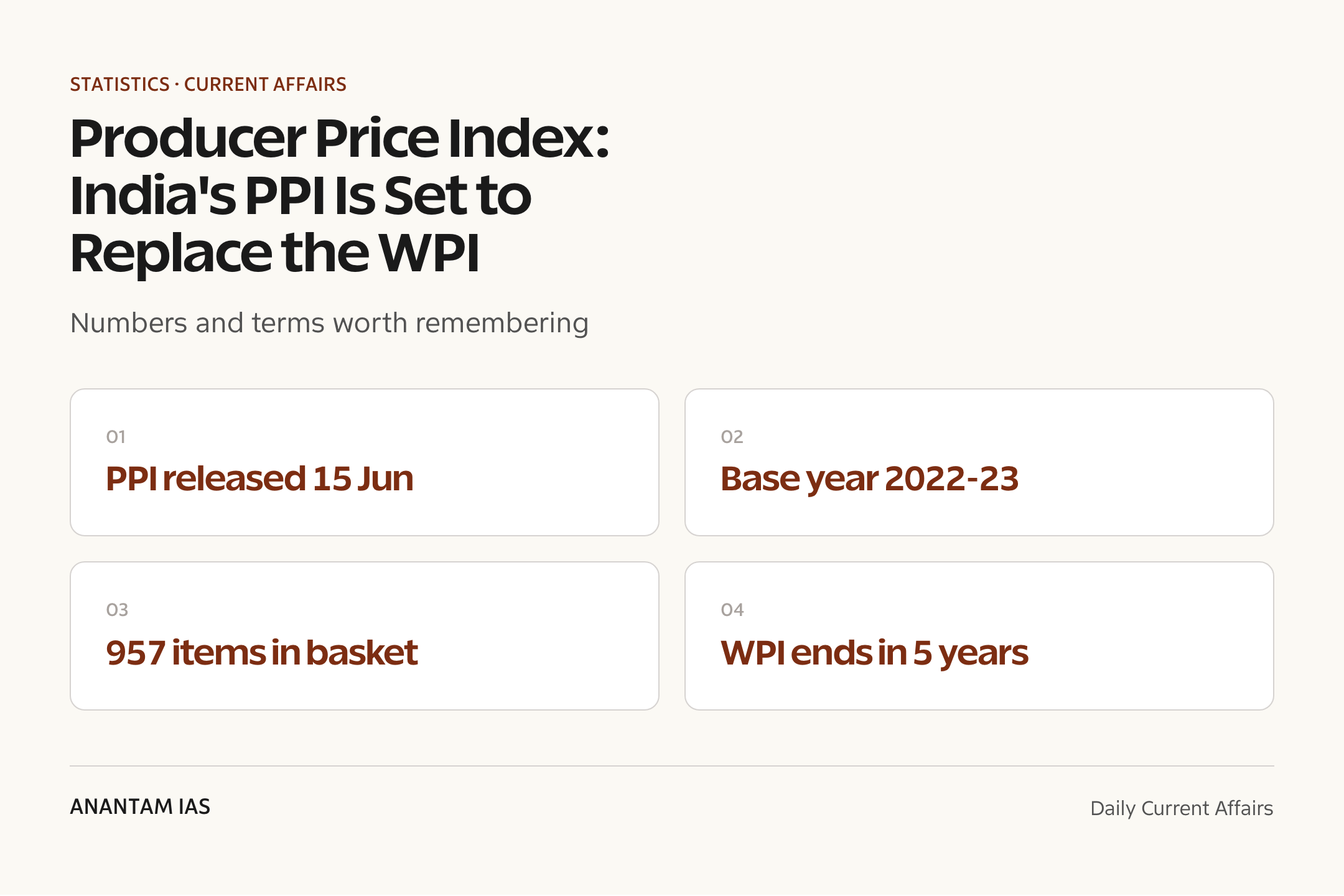
The Government of India, on 15 June 2026, released Producer Price Index (PPI) data for both goods and services for the first time, and announced that the long-running Wholesale Price Index (WPI) will be discontinued and replaced by the PPI over the next five years. The Commerce and Industry Ministry confirmed the move alongside the monthly WPI release.
The switch follows the report of a working group headed by former NITI Aayog member Ramesh Chand and is in line with practices in advanced economies and the recommendation of the International Monetary Fund (IMF) that India transition from WPI to PPI.
- Output PPI (all commodities) for May 2026 stood at 109.6, up from 108.6 in April 2026.
- Output PPI inflation rose to 9.4% in May from 8.1% in April; WPI inflation rose to 9.68% from 8.26%.
- Trial Input PPI for the manufacturing sector stood at 104.9 for May 2026, published on an experimental basis.
- Both WPI and PPI now use a revised base year of 2022-23 (from 2011-12 for WPI), covering 957 items.
- WPI publication ends after five years; the Ramesh Chand working group was set up in December 2024 and submitted its report in April 2026.
The development matters in the context of:
- It matters because the index used to measure producer-side inflation feeds directly into GDP deflators and National Accounts, shaping how real growth is estimated.
- It matters for monetary policy and forecasting, since a producer-perspective gauge captures cost pressures before they reach retail prices.
UPSC Relevance
Prelims Relevance
- PPI measures the average change in selling prices received by domestic producers; WPI measures prices at the wholesale/bulk transaction stage.
- CPI (compiled by NSO, MoSPI) measures retail prices paid by consumers and is the RBI’s headline inflation anchor.
- PPI and WPI are compiled by the Office of the Economic Adviser, under DPIIT, Ministry of Commerce & Industry.
- Revised base year for WPI and PPI: 2022-23; basket of 957 items.
- PPI sub-types released: Output PPI (Goods), Input PPI (Goods) and Service PPI.
- Manufactured items carry the highest weight in output PPI at 69.93%; agriculture, forestry and fishing 22.16%.
- Service PPI Phase 1 covers seven services: banking, securities transactions, insurance, pension fund management, railways, air (passenger) and telecom.
- Working group chaired by former NITI Aayog member Ramesh Chand; PPI aligns with IMF advice and global statistical practice.
Mains Relevance
GS Paper 3
- Inflation measurement reform: why a producer-perspective index improves National Accounts and GDP deflation versus the WPI.
- Implications of the WPI-to-PPI shift for monetary policy signalling, indexation and economic forecasting in India.
GS Paper 2
- Statistical governance and credibility of official data: role of the Office of the Economic Adviser and expert working groups in index reform.
Essay
- Numbers that shape policy: how a nation measures prices reflects the economy it wants to understand.
Background and Context
What changed on 15 June 2026
The government released India’s first PPI and set a sunset date for the WPI.
- The Producer Price Index (PPI) for goods and services was published for the first time, alongside the monthly WPI.
- The Commerce and Industry Ministry said the release of the WPI index will be discontinued after five years, with PPI as the successor.
- Three new series were unveiled: Output PPI (Goods), trial Input PPI (Goods) and Service PPI.
- The shift follows the report of the working group under former NITI Aayog member Ramesh Chand, submitted in April 2026.
PPI vs WPI vs CPI — the three price gauges
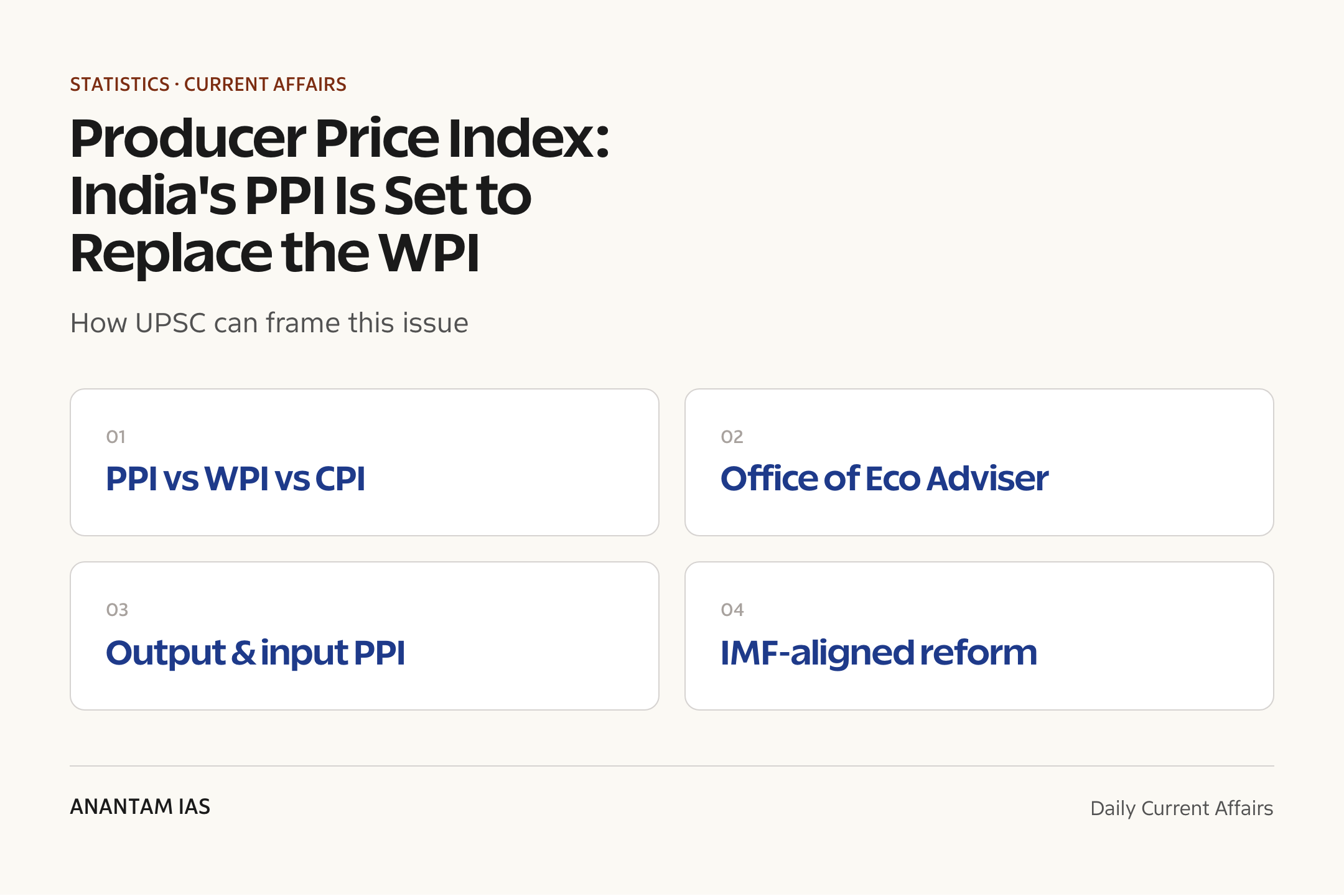
India runs three distinct inflation indices, each measuring a different point in the price chain.
- CPI (Consumer Price Index): retail prices paid by households; compiled by the National Statistical Office under MoSPI; the RBI’s flexible inflation-targeting anchor.
- WPI (Wholesale Price Index): prices in bulk/wholesale transactions; counts goods only, excludes services, and double-counts at multiple transaction stages.
- PPI: the average change in selling prices received by domestic producers for their output, and the prices they pay for inputs.
- PPI covers services (WPI does not) and avoids the double-counting that distorts WPI.
Why PPI captures producer-side inflation better
The PPI is built around the producer rather than the market transaction.
- Ramesh Chand’s report noted that PPI gives a more accurate measure of price changes from the producer’s perspective, improving suitability for National Accounts / GDP compilation.
- Tracking both output and input PPI shows how cost pressure on inputs is passed through to output prices in an industry.
- WPI mixes prices at several points of sale and double-counts; PPI follows the international output/input framework used by advanced economies.
- By including services, PPI reflects a modern, services-heavy economy that the goods-only WPI cannot.
Who compiles it — the Office of the Economic Adviser
Producer and wholesale price data are not a MoSPI product; they sit in the Commerce ministry.
- The Office of the Economic Adviser (OEA), under the Department for Promotion of Industry and Internal Trade (DPIIT), Ministry of Commerce & Industry, compiles the WPI and now the PPI.
- CPI is separate — compiled by the National Statistical Office under the Ministry of Statistics and Programme Implementation (MoSPI).
- Service PPI prices for sampled establishments will be drawn partly from administrative GSTN data, strengthening the data pipeline.
- The expert working group was chaired by Ramesh Chand and constituted on 30 December 2024.
Composition, weights and base year
The new series rebases the index and restructures the basket.
- Revised base year for both WPI and PPI: 2022-23, replacing 2011-12 for the WPI.
- The basket spans 957 items representing goods transacted across the economy.
- Output PPI (Goods) weights: manufacturing 69.93%, agriculture/forestry/fishing 22.16%, electricity 4.49%, mining and quarrying 3.42%.
- By contrast, WPI weights manufactured products 63.12%, fuel and power 14.11%, and primary articles 22.76%.
- Service PPI carries no weights yet, as only seven services are covered; indices are released without weights until the basket expands.
Global practice and why the switch
Most major economies left the wholesale-price model behind years ago.
- The IMF repeatedly flagged a growing need for India to move from WPI to PPI.
- Advanced economies such as the US, UK and Japan rely on a PPI, not a WPI, to gauge producer inflation.
- The Service PPI is being rolled out in phases — seven services first (banking, securities transaction, insurance, pension-fund management, railways, air passenger, telecom), the rest later.
- Input PPI is being published experimentally first, so the OEA can test data quality and collect stakeholder feedback before it goes live.
Way Forward
Manage the transition
- Run WPI and PPI in parallel through the five-year window so contracts, indexation clauses and back-series can migrate smoothly.
- Publish a credible back-cast PPI series so analysts can compare across the changeover without breaks.
Widen and deepen coverage
- Expand Service PPI beyond the first seven services to reflect India’s services-led growth.
- Stabilise the experimental Input PPI using GSTN and survey data before it becomes an official input to policy.
Build user familiarity through documentation and outreach, so the RBI, forecasters and businesses can read PPI signals as fluently as they once read WPI.
Conclusion
The move to a Producer Price Index closes a long-standing gap in India’s statistical system, swapping a goods-only, double-counting wholesale gauge for a producer-centred index that also captures services and feeds cleanly into GDP estimation.
Sequenced over five years and grounded in the Ramesh Chand working group and IMF advice, it brings India in step with global practice — provided the transition keeps both series visible, and the service basket keeps widening.
UPSC Practice Questions
Prelims MCQ 1
With reference to India’s Producer Price Index (PPI) introduced in 2026, consider the following statements:
- It is compiled by the Office of the Economic Adviser under the Ministry of Commerce & Industry.
- It covers selected services in addition to goods.
- It is set to replace the Consumer Price Index over five years.
How many of the above statements are correct?
(a) Only one (b) Only two (c) All three (d) None
Answer: (b) Only two
Explanation:
Statements 1 and 2 are correct: the PPI (and WPI) is compiled by the Office of the Economic Adviser under the Commerce ministry, and the new Service PPI covers seven services. Statement 3 is wrong — the PPI replaces the Wholesale Price Index (WPI), not the CPI.
Prelims MCQ 2
Which sector carries the highest weight in India’s new Output PPI (Goods)?
(a) Agriculture, forestry and fishing
(b) Manufacturing
(c) Electricity
(d) Mining and quarrying
Answer: (b) Manufacturing
Explanation:
Manufactured items carry the highest weight at 69.93% in the Output PPI (Goods), followed by agriculture, forestry and fishing (22.16%), electricity (4.49%) and mining and quarrying (3.42%).
UPSC Mains Questions
- India is phasing out the Wholesale Price Index in favour of a Producer Price Index over five years. Examine how the PPI improves the measurement of producer-side inflation and its compilation of National Accounts.
- Reliable price statistics are foundational to sound economic policy. In this light, discuss the rationale for India’s shift from WPI to PPI and the challenges in managing the transition.
Sources: Office of the Economic Adviser, Ministry of Commerce & Industry and The Hindu.
Frequently Asked Questions
What is the Producer Price Index (PPI)?
The PPI measures the average change over time in the selling prices received by domestic producers for their output, and the prices they pay for inputs. India released its first PPI for goods and services on 15 June 2026, with separate Output PPI, Input PPI and Service PPI series, using a 2022-23 base year.
How is PPI different from WPI?
WPI tracks prices in bulk wholesale transactions, counts only goods, and double-counts at multiple sale stages. PPI is built around the producer, covers services as well as goods, and follows the output/input framework used by advanced economies. This makes PPI a cleaner input for GDP and National Accounts than the WPI.
How is PPI different from CPI?
CPI measures retail prices that consumers actually pay and is compiled by the National Statistical Office under MoSPI; it is the RBI’s headline inflation anchor. PPI measures prices from the producer’s side. The two sit at different points of the supply chain, so they can move differently in the same month.
Who compiles the PPI in India?
The Office of the Economic Adviser, under the Department for Promotion of Industry and Internal Trade (DPIIT) in the Ministry of Commerce & Industry, compiles both the WPI and the new PPI. This is separate from the CPI, which MoSPI’s National Statistical Office produces.
When will the WPI be discontinued?
The Commerce and Industry Ministry has said the WPI will be phased out over five years, after which the PPI becomes the main producer-side inflation gauge. WPI and PPI will run in parallel during the transition so users can migrate smoothly.
Why is India switching to a PPI?
The change follows the Ramesh Chand working group report and the IMF’s recommendation, and aligns India with advanced economies that use a PPI rather than a WPI. A producer-perspective index better captures cost pass-through, includes services, and improves the accuracy of GDP and National Accounts estimates.
Source: https://anantamias.com/current-affairs/ppi-to-replace-wpi-india/
RBI’s FCNR(B) Swap Window: Higher NRI Deposit Rates to Mobilise Forex
Why in News?
On June 17, 2026, the Reserve Bank of India (RBI) issued Amendment Directions temporarily withdrawing the interest-rate ceilings on fresh FCNR(B) and NRE deposits, letting banks pay sharply higher rates to Non-Resident Indians (NRIs) and Persons of Indian Origin (PIOs) to mobilise foreign exchange.
The relaxation, the central bank said, is meant to swell foreign exchange reserves, support a depreciating rupee and ease balance-of-payments pressures, and runs only till September 30, 2026.
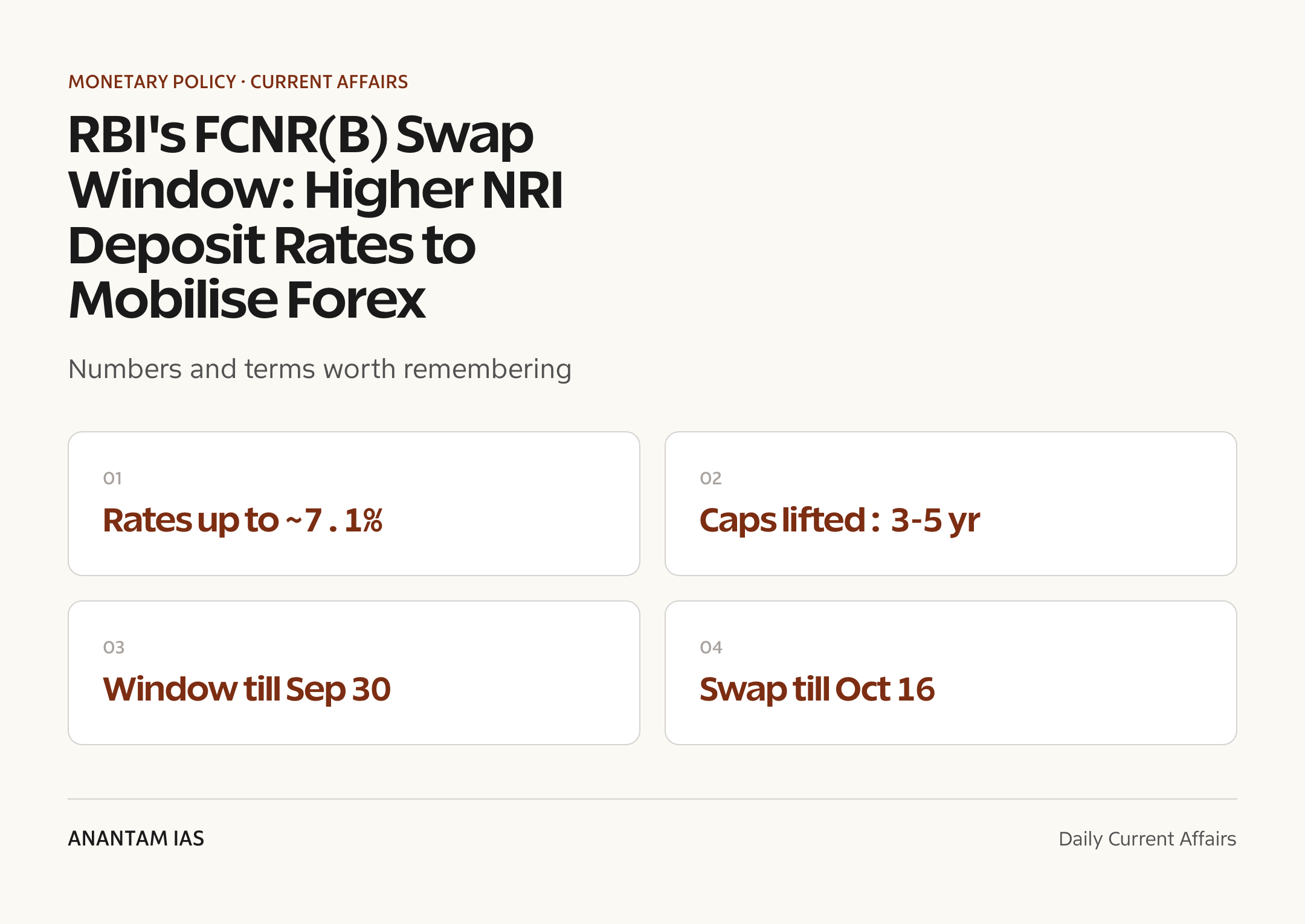
- Ceiling lifted on fresh FCNR(B) deposits of 3-5 year tenors and NRE deposits of 3 years and above, including renewals on maturity, effective June 17, 2026.
- Headline rates on NRI dollar deposits have climbed to about 7.1% (AU Small Finance Bank offered 7.10% on 3-4 year USD FCNR(B)).
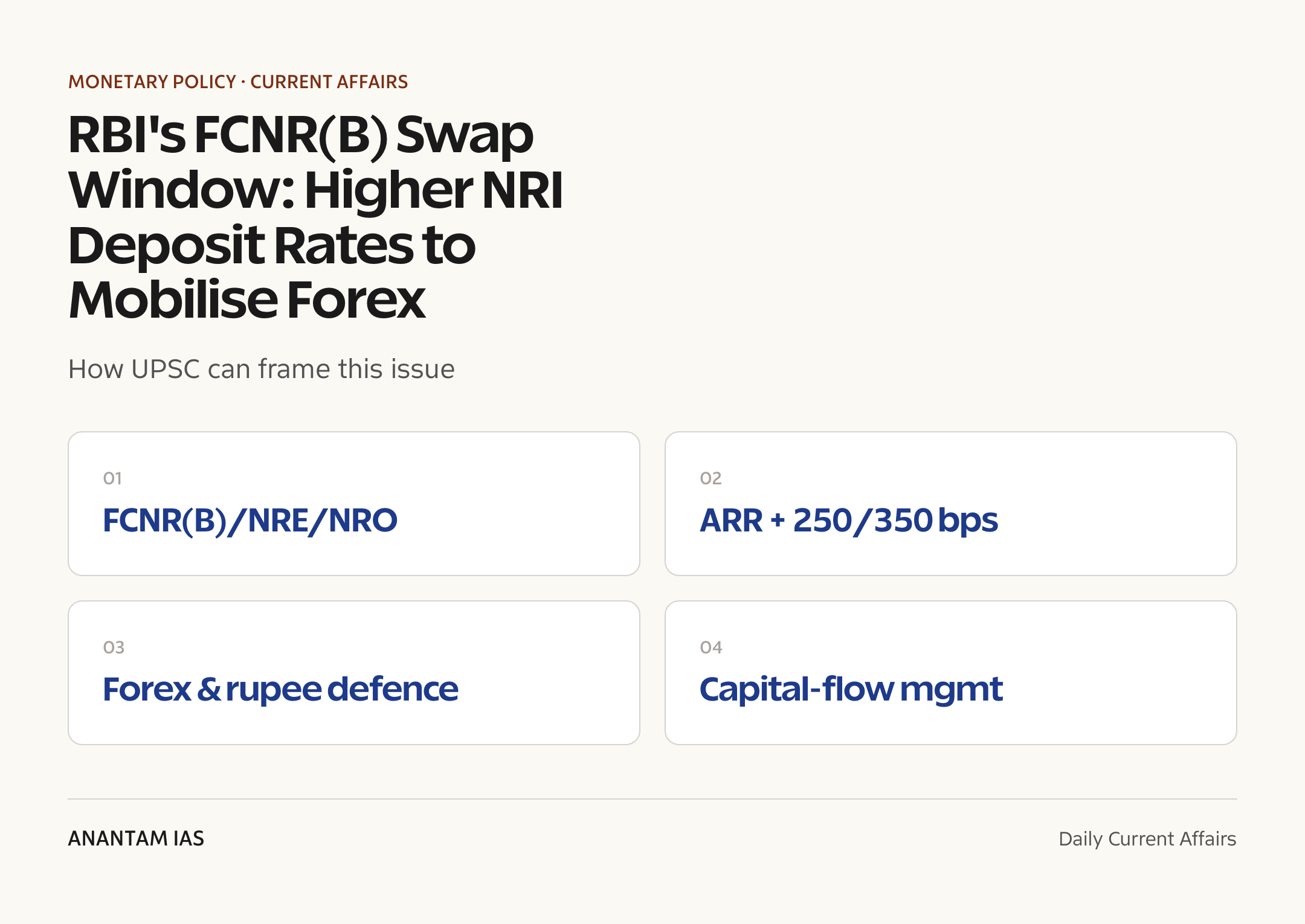
- Ceilings are benchmarked to the Overnight Alternative Reference Rate (ARR) for the currency plus 250 bps (1 to under 3 years) and plus 350 bps (3 to 5 years) — and these caps now stand withdrawn for the eligible tenors.
- A linked RBI dollar-rupee swap window lets banks swap eligible dollar deposits with the RBI and buy them back at maturity, cutting their hedging cost; the swap facility is open till October 16, 2026.
- NRE/NRO rupee-deposit rates still cannot exceed comparable domestic rupee term-deposit rates; transfers from NRO to NRE accounts do not qualify for the relaxation.
- The relaxation covers both commercial banks and small finance banks.
The development matters in the context of:
- Sits within RBI’s toolkit for capital-flow management and exchange-rate defence under a managed-float regime.
- Echoes the 2013 ‘taper tantrum’ response, when a concessional FCNR(B) swap window mobilised about $34 billion to stabilise the rupee.
UPSC Relevance
Prelims Relevance
- FCNR(B) = Foreign Currency Non-Resident (Bank) — a foreign-currency-denominated NRI deposit, so the bank (not the depositor) bears the exchange-rate risk.
- NRE (Non-Resident External) account — rupee-denominated, freely repatriable principal and interest, interest tax-free in India.
- NRO (Non-Resident Ordinary) account — rupee account for income earned in India; interest taxable, repatriation capped (up to USD 1 million/financial year).
- Overnight Alternative Reference Rate (ARR) replaced LIBOR as the benchmark; e.g. SOFR for the US dollar.
- Basis point (bps) = 0.01 percentage point; 250 bps = 2.5%, 350 bps = 3.5%.
- A currency swap exchanges principal/interest in two currencies, with a reverse exchange at maturity at a pre-agreed rate.
- Forex reserves components: foreign currency assets, gold, SDRs, and the Reserve Tranche Position with the IMF.
- Balance of Payments (BoP) = current account + capital account; NRI deposits are a capital-account inflow.
- RBI ‘Amendment Directions’ are issued under the FEMA, 1999 framework governing NRI deposits.
- Rupee depreciation means more rupees per US dollar; reserves give RBI ammunition to sell dollars and steady it.
Mains Relevance
GS Paper 3
- Instruments for managing external-sector vulnerability — forex reserves, NRI deposits, and swap windows.
- Trade-offs of using high-cost capital-account inflows to defend the exchange rate versus letting the rupee adjust.
GS Paper 2
- RBI’s regulatory role and the use of directions under FEMA to channel diaspora savings.
Essay
- The diaspora dividend: can remittances and NRI savings be a stable cushion for a developing economy?
Background and Context
The three NRI deposit accounts, decoded
NRIs park money in India through three distinct accounts that differ on currency, tax and who carries exchange risk.
- FCNR(B) — held in foreign currency (USD, GBP, etc.); principal and interest are fully repatriable; the bank bears the currency risk, making it attractive to depositors wary of rupee swings.
- NRE — rupee account funded from abroad; fully repatriable; interest is tax-free in India; the depositor carries the rupee-conversion risk.
- NRO — rupee account for income arising in India (rent, dividends, pension); interest is taxable and repatriation is capped (up to USD 1 million per financial year).
- All three are governed under the Foreign Exchange Management Act (FEMA), 1999; only FCNR(B) and NRE qualify for the new ceiling relaxation.
What exactly changed on June 17
The RBI did not mandate higher rates — it removed the cap that had been holding them down.
- Pre-existing caps tied NRI deposit rates to the Overnight ARR plus a spread: 250 bps for 1 to under 3 years and 350 bps for 3 to 5 years.
- These ceilings are temporarily withdrawn for fresh FCNR(B) (3-5 yr) and NRE (3 yr+) deposits, including maturity renewals, only till September 30, 2026.
- Banks now have headroom to compete for diaspora dollars; The Hindu reported NRI dollar rates rising to around 7.1%.
- Guard-rails stay: NRE/NRO rupee rates must not exceed comparable domestic term-deposit rates, and NRO-to-NRE transfers are excluded to stop arbitrage.
The swap window — the real mechanism
A parallel dollar-rupee swap facility is what makes the higher rates viable for banks without exposing them to currency risk.
- A bank that raises a dollar FCNR(B) deposit can swap the dollars with the RBI for rupees at the prevailing reference rate, then buy the dollars back at the same rate when the deposit matures.
- Fixing the reverse-exchange rate removes the bank’s hedging cost, so it can pass part of the saving on as a higher deposit rate.
- The swap facility is open till October 16, 2026, slightly beyond the deposit window, so banks can hedge deposits taken up to the deadline.
- Net effect: the RBI absorbs the exchange-rate risk while the economy gains a front-loaded inflow of dollars into reserves.
Why now — rupee, reserves and the BoP
The trigger is external-sector stress, and NRI deposits are a quick, sizeable source of forex.
- A depreciating rupee raises import bills, fuels imported inflation and unsettles markets; reserves let the RBI sell dollars to slow the slide.
- Higher reserves improve import cover and the cushion for balance-of-payments obligations and external debt servicing.
- NRI deposits are a capital-account inflow that can be mobilised faster than equity or FDI, which respond slowly to incentives.
- India draws on a vast diaspora and is among the world’s largest remittance recipients, giving this lever real scale.
The 2013 playbook it echoes
This is a familiar crisis-management move with a strong precedent.
- During the 2013 ‘taper tantrum’, a sliding rupee prompted the RBI to open a concessional FCNR(B) swap window.
- That scheme mobilised roughly USD 34 billion and is widely credited with stabilising the rupee.
- The 2026 version is more measured — a temporary ceiling relaxation plus swap support, not a deeply subsidised scheme.
- It signals the RBI’s preference for incentive-based capital-flow management over blunt controls.
The trade-offs and risks
Mobilising hot money to defend the rupee carries well-known costs.
- These are short-tenor, rate-sensitive liabilities; inflows can reverse when global rates or sentiment shift, adding future redemption risk.
- Higher offshore rates raise banks’ cost of funds and, via the swap, place currency risk on the RBI’s balance sheet.
- Over-reliance on debt inflows can mask underlying weakness in the current account rather than fix it.
- It treats a symptom — the falling rupee — more than the cause, which lies in trade and competitiveness.
Way Forward
Use as a bridge, not a crutch
- Deploy the swap window as a temporary stabiliser while durable fixes — export competitiveness and import substitution — are pursued.
- Pre-plan the maturity profile so 2029-30 redemptions don’t cluster into a fresh outflow shock.
Strengthen the structural base
- Deepen FDI and stable, long-term flows that are less reversible than short-tenor deposits.
- Keep building forex reserves and diversify their composition (including gold) for resilience.
- Sustain the diaspora link through cheaper, faster remittance and deposit channels.
Conclusion
The FCNR(B) ceiling relaxation and swap window are a precise, time-bound tool: by shifting exchange-rate risk onto the RBI, they coax diaspora dollars into reserves and steady the rupee when sentiment turns.
The 2013 episode shows it works as crisis management. The lasting test, though, is whether India narrows its external imbalances so that the rupee needs less defending in the first place.
UPSC Practice Questions
Prelims MCQ 1
With reference to NRI deposit schemes in India, consider the following statements:
- In an FCNR(B) deposit, the exchange-rate risk is borne by the depositor, not the bank.
- Interest earned on NRE deposits is exempt from income tax in India.
- Repatriation of funds from an NRO account is subject to an annual limit.
How many of the above statements are correct?
(a) Only one (b) Only two (c) All three (d) None
Answer: (b) Only two
Explanation:
Statement 1 is wrong — in FCNR(B) the deposit is held in foreign currency, so the BANK bears the exchange-rate risk. Statements 2 (NRE interest is tax-free) and 3 (NRO repatriation is capped, up to USD 1 million per financial year) are correct.
Prelims MCQ 2
The RBI’s June 2026 ‘swap window’ linked to FCNR(B) deposits primarily helps banks by:
(a) Guaranteeing a minimum interest rate to depositors (b) Removing their currency-hedging cost so they can offer higher rates (c) Exempting such deposits from the cash reserve ratio permanently (d) Converting the deposits into equity capital
Answer: (b) Removing their currency-hedging cost so they can offer higher rates
Explanation:
Banks swap dollar deposits with the RBI and buy them back at the same rate at maturity, fixing the reverse-exchange rate. This removes their hedging cost, freeing room to offer NRIs higher rates while the RBI absorbs the currency risk.
UPSC Mains Questions
- Explain how the RBI uses NRI deposit schemes and a dollar-rupee swap window as instruments of capital-flow management. Discuss their effectiveness and risks in defending a depreciating rupee. (250 words)
- “Mobilising short-term diaspora deposits to shore up forex reserves treats the symptom, not the cause, of external-sector stress.” Critically examine in the context of India’s balance-of-payments management. (250 words)
Sources: Reserve Bank of India and The Hindu.
Frequently Asked Questions
What is an FCNR(B) deposit?
A Foreign Currency Non-Resident (Bank) deposit is an account in which NRIs and PIOs hold money in a foreign currency such as the US dollar, rather than in rupees. Because it stays in foreign currency, the bank bears the exchange-rate risk, and both principal and interest are fully repatriable abroad.
How is FCNR(B) different from NRE and NRO accounts?
FCNR(B) is in foreign currency; NRE and NRO are rupee accounts. NRE holds money remitted from abroad, is freely repatriable and earns tax-free interest. NRO holds income earned in India, attracts tax on interest, and has a repatriation cap of up to USD 1 million per financial year.
What did the RBI change in June 2026?
From June 17, 2026, the RBI temporarily withdrew the interest-rate ceilings on fresh FCNR(B) deposits of 3-5 years and NRE deposits of 3 years and above, including renewals. The relaxation runs till September 30, 2026, letting banks offer NRIs sharply higher rates, around 7.1%, to attract foreign exchange.
How does the dollar-rupee swap window work?
A bank that raises a dollar deposit swaps the dollars with the RBI for rupees at the current rate, and buys them back at the same rate when the deposit matures. Fixing this reverse rate removes the bank’s hedging cost, so it can pass on a higher interest rate while the RBI carries the currency risk.
Why is the RBI doing this now?
The aim is to attract foreign currency, swell forex reserves and steady a depreciating rupee. Higher reserves give the RBI more ammunition to sell dollars, improve import cover and ease balance-of-payments pressures. NRI deposits are a quick capital-account inflow compared with FDI or equity.
Has the RBI used such a window before?
Yes. During the 2013 ‘taper tantrum’, when the rupee fell sharply, the RBI opened a concessional FCNR(B) swap window that mobilised roughly USD 34 billion and helped stabilise the currency. The 2026 measure is a lighter, time-bound version of that crisis-management tool.
Source: https://anantamias.com/current-affairs/rbi-fcnr-swap-higher-nri-deposit-rates/
India-UK Trade Deal: July 15 Set as the Implementation Date
Why in News?
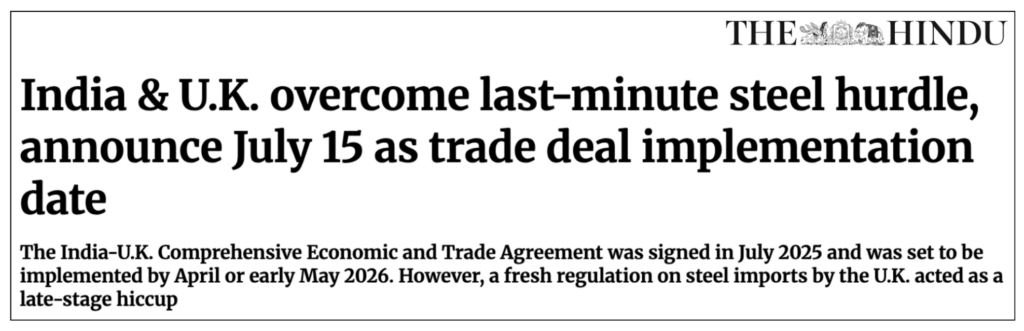
India and the United Kingdom announced July 15, 2026, as the entry-into-force date for their Comprehensive Economic and Trade Agreement (CETA), after resolving an eleventh-hour dispute over UK steel-import duties that had stalled the rollout. The two governments confirmed the date on the sidelines of the G7 Summit.
The deal, signed in July 2025, was originally meant to take effect by April–May 2026 but slipped when a fresh UK steel regulation upended the timeline. The Ministry of Commerce and Industry said both sides reached a consensus to safeguard bilateral steel trade, and that the Double Contribution Convention (DCC) on social security will be implemented the same day.
- July 15, 2026, is fixed as the day CETA and the social-security pact enter into force.
- CETA was signed on 24 July 2025, following negotiations that concluded in May 2025.
- A May 2026 UK rule cut its duty-free steel-import quota by 60% and doubled the above-quota tariff to 50%, effective July 1, 2026 — the ‘last-minute hurdle’.
- Steel solution to use country-specific quotas, residual quotas and an Authorised Use Scheme (AUS).
- UK will remove tariffs on 99% of its product lines; India gets duty-free access for 99% of its exports.
The development matters in the context of:
- First major bilateral FTA India has concluded with a G7 economy in years.
- Tests the durability of a signed FTA when a partner’s domestic regulation changes after signature.
- DCC directly affects Indian professionals and IT firms sending workers to the UK.
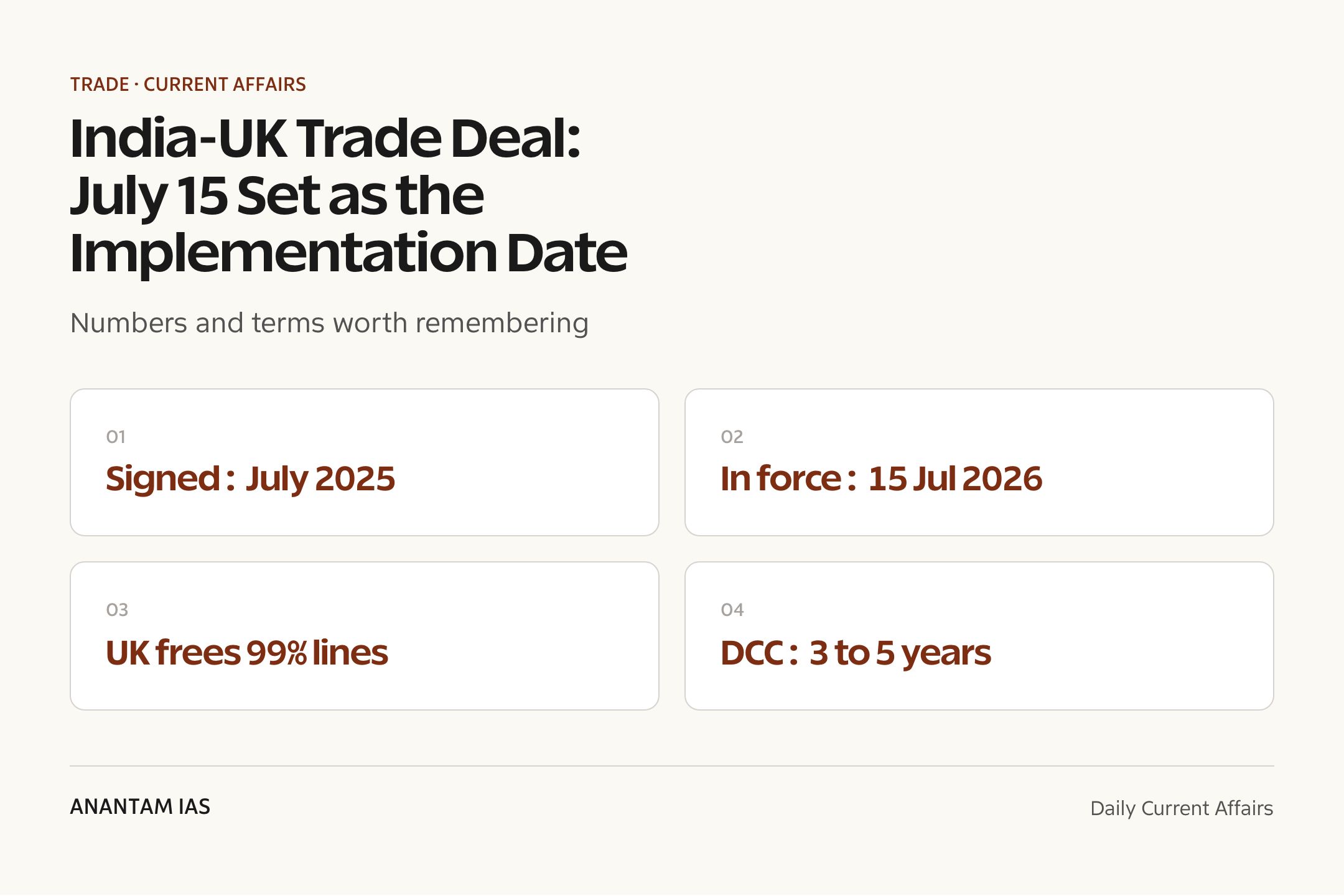
UPSC Relevance
Prelims Relevance
- CETA = Comprehensive Economic and Trade Agreement; the India-UK FTA’s formal name.
- Signed 24 July 2025; enters into force 15 July 2026.
- UK removes tariffs on 99% of product lines; India frees ~99% of its exports by value.
- Double Contribution Convention (DCC) = social-security pact; exemption raised from 3 to 5 years.
- Scotch whisky/gin duty: 150% to 75% on day one, tapering to 40% over 10 years.
- Auto tariffs cut from 110% to 10% in-quota over phased years.
- Authorised Use Scheme (AUS) and country-specific/residual quotas resolve the steel issue.
- Sensitive sectors shielded by India: dairy, cereals, millets, pulses, apples, gold, jewellery.
- Bilateral trade target: double by 2030 from ~USD 56 billion.
Mains Relevance
GS Paper 3
- FTAs and the external sector — how CETA reshapes India’s market access, tariff structure and export basket.
- Trade defence: how a partner’s post-signature steel safeguard threatened the deal, and the quota/AUS fix.
GS Paper 2
- India-UK bilateral relations and economic diplomacy after Brexit; mobility gains via the DCC.
Essay
- Free trade in an age of rising protectionism — promise and friction.
- Globalisation and the mobility of labour: who gains from social-security pacts?
Background and Context
What CETA is, and the 2025 signing
CETA is the India-UK free trade agreement — distinct from the July 15 ‘entry into force’ now in the news.
- Full name: Comprehensive Economic and Trade Agreement; negotiations concluded 6 May 2025, signed 24 July 2025.
- It is a comprehensive FTA — goods, services, investment, mobility, government procurement and IPR, not just tariff lines.
- Signing (2025) is the legal commitment; entry into force (15 July 2026) is when tariff cuts and rules actually start. The two are separate stages.
- Billed as the UK’s most economically significant trade deal since leaving the European Union.
Tariff cuts and market access
The deal trades deep, phased tariff cuts on both sides, with India ring-fencing its sensitive farm and metals lines.
- UK eliminates tariffs on 99% of its product lines; India secures duty-free access for around 99% of its export value.
- Labour-intensive Indian gains: textiles, leather, marine products, gems and jewellery, toys; plus engineering goods and chemicals.
- Scotch whisky and gin duty drops from 150% to 75% immediately, then to 40% over a decade.
- Automobiles: duties on petrol/diesel cars fall from 110% to 10% in-quota; EVs phased from year 6.
- India protected sensitive items: dairy, cereals, millets, pulses, apples, gold, jewellery, and lab-grown diamonds.
- Services: India won commitments across all 12 service sectors and 137 sub-sectors.
Double Contribution Convention (DCC)
The social-security pact riding alongside CETA is a direct win for Indian professionals working in Britain.
- Also called the Agreement on Social Security; takes effect the same day, 15 July 2026.
- Lets the posted workers avoid paying social-security contributions in both countries — so-called ‘double contribution’.
- Exemption period extended from 3 to 5 years, a major gain for India’s temporary workers and IT services firms.
- Cuts payroll costs for Indian companies sending staff to the UK, improving their competitiveness.
- Mobility concessions sit within the wider India-UK Comprehensive Economic Partnership framework.
The steel hurdle that delayed it
A UK rule announced after signature — not part of the negotiated text — nearly derailed the rollout.
- In May 2026, the UK announced a steel regulation applying to all countries, due to start on 1 July 2026.
- It cut the duty-free steel-import quota by 60% and doubled the above-quota tariff to 50%.
- These measures were a safeguard-type action outside the CETA negotiations, so they ‘suddenly halted’ implementation.
- Resolution uses a mix of country-specific quotas, residual quotas and an Authorised Use Scheme (AUS).
- The Ministry of Commerce and Industry stressed protecting commercial interests and minimising market disruption; exact terms were not disclosed.
What does ‘entry into force’ mean?
A trade agreement passes through distinct legal stages; only the final one moves the tariffs.
- Conclusion of negotiations — text agreed (May 2025).
- Signing — political and legal commitment (July 2025).
- Ratification / domestic approval — each side completes its internal legal process.
- Entry into force — the date obligations become operative; tariff cuts and rules apply (15 July 2026).
- Until entry into force, traders still pay the old applied tariffs, which is why the date matters commercially.
Strategic and economic significance
Beyond tariffs, the deal anchors a deeper India-UK economic partnership.
- Bilateral trade stands at USD 56 billion, with a stated aim to double it by 2030.The
- UK estimates the FTA could lift bilateral trade by about GBP 25.5 billion a year in the long run.
- Signals India can secure market access from a G7 partner while shielding sensitive sectors.
- Part of India’s wider FTA push — alongside deals and talks with the EU, EFTA, Oman and others.
- The steel episode is a reminder that regulatory autonomy can collide with FTA commitments even after signing.
Way Forward
Smooth and time-bound rollout
- Publish operational customs and rules-of-origin guidance well before 15 July so exporters can plan.
- Translate the steel quota/AUS arrangement into clear, published numbers to remove uncertainty.
Help exporters capture gains
- Handhold MSMEs in textiles, leather and gems to meet UK standards and certification.
- Build awareness of the DCC, so IT and services firms actually claim the social-security savings.
Institutionalise a standing review mechanism so future partner-side regulations — like the steel safeguard — are flagged early and settled without stalling the whole agreement.
Conclusion
Fixing 15 July 2026 turns a signed text into a live agreement: only at entry into force do the tariff cuts and the social-security pact start to bite. The last-minute steel fix shows both sides were willing to protect the deal’s credibility.
For India, CETA is a template — deep market access from a major economy while sensitive farm and metals lines stay shielded, and a mobility win for professionals through the DCC. The real test now is execution: clear rules, ready exporters and a durable way to handle future regulatory shocks.
UPSC Practice Questions
Prelims MCQ 1
With reference to the India-UK Comprehensive Economic and Trade Agreement (CETA), consider the following statements:
- It was signed in 2025 and is set to enter into force on 15 July 2026.
- Under it, the UK will remove tariffs on 99% of its product lines.
- The Double Contribution Convention deals with social security for workers.
How many of the above statements are correct?
(a) Only one (b) Only two (c) All three (d) None
Answer: (c) All three
Explanation:
CETA was signed in July 2025 and entered into force on 15 July 2026 (1 correct). The UK removes tariffs on 99% of its product lines (2 correct). The DCC is the social-security/Agreement on Social Security pact, extending the contribution exemption from 3 to 5 years (3 correct).
Prelims MCQ 2
The ‘last-minute hurdle’ that delayed the India-UK CETA’s implementation was related to:
(a) UK steel import quotas and tariffs
(b) Scotch whisky duty disputes
(c) Visa rules for Indian students
(d) Agricultural subsidies on dairy
Answer: (a) UK steel import quotas and tariffs
Explanation:
A UK regulation announced in May 2026 cut the duty-free steel-import quota by 60% and doubled the above-quota tariff to 50%, effective July 1, 2026 — a measure outside the CETA text that stalled the rollout until a quota/AUS solution was reached.
UPSC Mains Questions
- The India-UK CETA shows that signing a free trade agreement and bringing it into force are two distinct stages. Examine the legal and economic significance of ‘entry into force’ using the steel-tariff episode that delayed the deal.
- Free trade agreements with developed economies offer market access but raise concerns about sensitive sectors and regulatory shocks. Critically evaluate India’s gains from the India-UK CETA, including the Double Contribution Convention.
Sources: Ministry of Commerce and Industry and The Hindu.
Frequently Asked Questions
What is the India-UK CETA?
CETA stands for Comprehensive Economic and Trade Agreement — the free trade agreement between India and the United Kingdom. Signed in July 2025, it covers goods, services, investment, mobility and more. The UK removes tariffs on 99% of its product lines, while India secures duty-free access for around 99% of its export value, with sensitive sectors protected.
When does the India-UK trade deal take effect?
It enters into force on 15 July 2026. That is the date the negotiated tariff cuts and rules actually start applying. The agreement was signed in July 2025, but until entry into force traders kept paying the old tariffs, which is why fixing this date is a major milestone.
What was the steel hurdle that delayed it?
In May 2026 the UK announced a new steel regulation, applying to all countries from 1 July 2026, that cut its duty-free steel-import quota by 60% and doubled the above-quota tariff to 50%. This was outside the CETA negotiations and stalled the rollout until both sides agreed a fix using country-specific quotas, residual quotas and an Authorised Use Scheme.
What is the Double Contribution Convention (DCC)?
The DCC, also called the Agreement on Social Security, lets Indian professionals posted to the UK avoid paying social-security contributions in both countries. The exemption period was raised from 3 to 5 years, cutting payroll costs for Indian companies and boosting the competitiveness of India’s IT and services firms. It takes effect on 15 July 2026, alongside CETA.
What does ‘entry into force’ mean for a trade deal?
It is the final legal stage when the agreement’s obligations become operative. The earlier stages are concluding negotiations, signing, and domestic ratification. Only at entry into force do tariff cuts and rules apply; before that, the old applied tariffs remain in place, so the date has direct commercial impact for exporters.
How is signing different from implementation?
Signing (July 2025) is the political and legal commitment to the agreed text. Implementation, or entry into force (15 July 2026), is when the deal actually operates and tariffs change. A deal can be signed but not yet in force — as happened here when the steel regulation pushed the date back from the planned April-May 2026 rollout.
Source: https://anantamias.com/current-affairs/india-uk-trade-deal-july-15-implementation/
India-EU FTA: Von der Leyen Says It Will Be Signed by End-2026
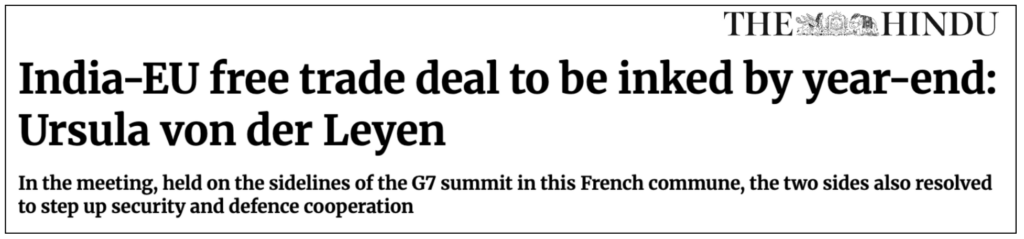
Why in News?
On the sidelines of the G7 Summit in Evian-les-Bains, France (17 June 2026), European Commission President Ursula von der Leyen said the long-pending India-EU Free Trade Agreement (FTA) will be signed by the end of 2026, after a bilateral meeting with Prime Minister Narendra Modi.
She posted on X, “We will sign the Free Trade Agreement by the end of the year”, and said the two sides will accelerate work on an investment agreement, capping nearly two decades of stop-start talks and India’s most ambitious trade deal yet.
- Negotiations were concluded on 27 January 2026 at the 16th India-EU Summit in New Delhi; signing is now targeted for the year-end 2026.The
- The EU is India’s largest trading partner — goods trade hit about €120 billion in 2024 (~11.5% of India’s total goods trade).
- Leaders also agreed to advance the India-Middle East-Europe Economic Corridor (IMEC) and step up security and defence cooperation.
- Talks build on the Joint India-EU Comprehensive Strategic Agenda endorsed in January 2026.
The development matters in the context of:
- India is diversifying trade ties amid US tariff uncertainty and a push to cut over-reliance on any single market.
- Follows the India-UK FTA (signed 2025, in force 15 July 2026) and the India-EFTA TEPA — part of a wider Western trade pivot.
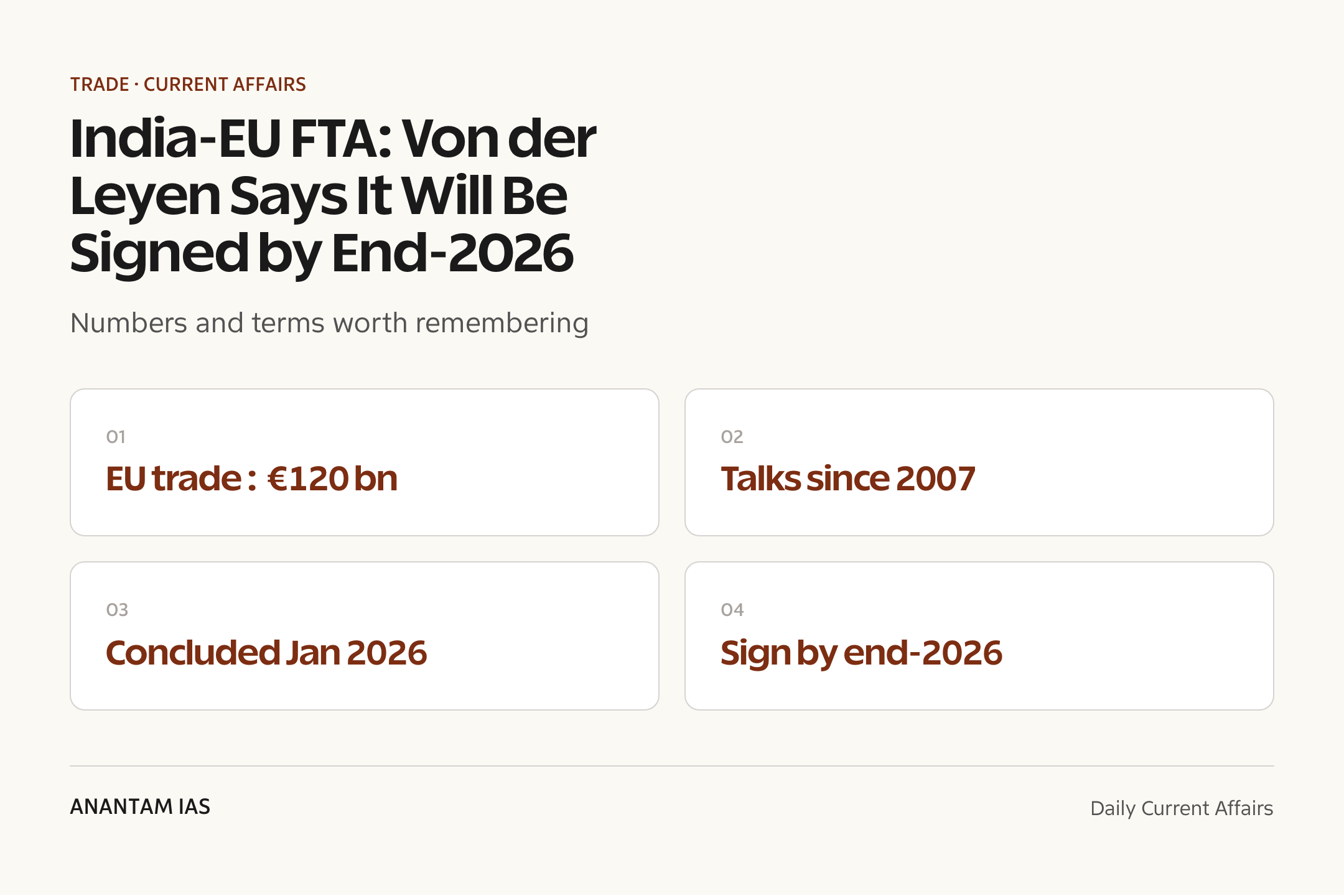
UPSC Relevance
Prelims Relevance
- Free Trade Agreement (FTA) — a pact to cut tariffs/non-tariff barriers on substantially all trade between members.
- European Union (EU) — 27-member bloc; negotiates trade as a single customs union via the European Commission.
- Ursula von der Leyen — President of the European Commission; António Costa — President of the European Council.
- EU is India’s largest trading partner in goods (~€120 bn, 2024).
- CBAM — Carbon Border Adjustment Mechanism, an EU carbon tax on imports of steel, aluminium, cement, etc.
- IMEC — India-Middle East-Europe Economic Corridor, launched at the G20 New Delhi Summit (2023).
- India-EFTA TEPA — Trade and Economic Partnership Agreement with Iceland, Liechtenstein, Norway, and Switzerland (signed 2024).
- Mode 4 — temporary movement of natural persons (service professionals) under WTO/GATS.
- India-UK CETA — Comprehensive Economic and Trade Agreement; comes into force 15 July 2026.
- G7 — Canada, France, Germany, Italy, Japan, the UK, US (India is a regular invitee, not a member).
Mains Relevance
GS Paper 2
- India-EU relations: trade as the anchor of a strategic partnership, and the FTA’s place in India’s foreign policy.
- Implications of India’s bilateral/regional trade deals for its WTO and multilateral commitments.
GS Paper 3
- Effect of the FTA on India’s manufacturing, exports (textiles, pharma, autos) and agriculture; role in trade diversification.
- Non-tariff barriers — CBAM and deforestation rules — as new challenges to Indian exporters.
Essay
- Trade is the new theatre of diplomacy: how economic agreements reshape strategic alignments.
- Self-reliance versus open markets — striking the balance in a protectionist world.
Background and Context
What the FTA is and why it matters
An India-EU FTA would be the largest trade deal either side has concluded.
- An FTA lowers or removes tariffs and eases non-tariff barriers on goods, opens services, and sets rules on investment, IPR, and standards.
- The EU is India’s largest trading partner in goods — about €120 billion in 2024, roughly 11.5% of India’s total goods trade.
- Indian gains: duty-free access for textiles, leather, pharma, chemicals and engineering goods into a high-income market of 27 countries.
- EU gains: lower Indian tariffs on cars, wines and spirits, machinery and better access for European services and investment.
- Beyond trade, it locks in a strategic partnership covering IMEC connectivity, security, technology and supply-chain resilience.
A near-two-decade journey
Talks began in 2007, collapsed in 2013, and were relaunched in 2022.
- Negotiations were first launched in June 2007 but stalled by 2013 after 15 inconclusive rounds over autos, dairy and professional mobility.
- The EU pressed for deep tariff cuts on automobiles, wines and dairy; India sought greater Mode 4 access for its service professionals.
- Negotiations were relaunched on 17 June 2022 amid a shared push to de-risk supply chains.
- Talks concluded on 27 January 2026 at the 16th India-EU Summit in New Delhi; legal scrubbing and translation precede signing.
- Von der Leyen’s G7 statement sets a firm end-2026 deadline to ink the text and move to ratification.
The sticking points — cars, cows and carbon
The hardest issues were autos, agriculture, carbon rules and data.
- Automobiles — the EU long sought the removal of India’s ~110% car tariffs; India offered phased cuts on high-value vehicles under a capped annual quota over a decade.
- Dairy — milk and cheese stayed a red line for India and were largely shielded to protect small farmers.
- CBAM — the EU’s carbon border tax on steel, aluminium and cement threatens Indian exports; India sought safeguards and a technical working group on carbon compliance.
- Deforestation rules (EUDR) — EU due diligence norms on coffee, leather, rubber and timber raise compliance costs for exporters.
- Data adequacy — the EU’s data-protection standards and India’s DPDP Act, 2023, shape cross-border data flows for services trade.
Why the timing — India’s trade diversification
The deal is one piece of India’s wider pivot to friendly, high-income markets.
- Comes amid US tariff uncertainty, pushing India to spread export risk across partners.
- Follows the India-UK CETA (signed 2025, in force 15 July 2026) and the India-EFTA TEPA (signed 2024), targeting $100 billion in EFTA investment.
- Reinforces India’s ‘China+1’ appeal as global firms seek alternative manufacturing bases.
- Aligns with India’s goal of becoming a $5-trillion economy and lifting merchandise and services exports.
Strategic and connectivity dimension
The FTA sits inside a broader India-EU strategic agenda.
- Leaders agreed to advance the India-Middle East-Europe Economic Corridor (IMEC) — rail, port and digital links from India to Europe via West Asia.
- Talks tracked the Joint India-EU Comprehensive Strategic Agenda endorsed in January 2026.
- Both sides flagged stronger security and defence cooperation and work toward an investment protection agreement.
- Anchored in shared democratic values and a stated common vision, positioning India and the EU as the world’s two largest democracies trading freely.
Way Forward
Close the text and ratify
- Complete legal scrubbing, translation into EU languages, and signing by end-2026, then secure European Parliament and member-state ratification.
- Lock down the parallel investment protection agreement to give investors certainty.
Help exporters adapt
- Build firm-level capacity on CBAM and the EU deforestation rules through the agreed technical working groups.
- Support MSMEs in textiles, leather and engineering to meet EU standards and certification.
Protect sensitive sectors
- Preserve carve-outs for dairy and sensitive agriculture while phasing in auto and wine concessions cautiously.
- Use the deal to push for Mode 4 mobility gains for Indian professionals.
Conclusion
A signed India-EU FTA would be the bloc’s largest-ever trade pact and a centrepiece of India’s strategy to diversify trade away from over-dependence on any one partner.
The harder test lies after signing — turning headline access into real gains while managing carbon and deforestation barriers, protecting farmers, and converting trade into a durable strategic partnership.
UPSC Practice Questions
Prelims MCQ 1
With reference to the India-EU Free Trade Agreement, consider the following statements:
- The European Union is India’s largest trading partner in goods.
- Negotiations for the FTA were first launched in 2007 and relaunched in 2022.
- The Carbon Border Adjustment Mechanism (CBAM) is an Indian carbon tax on EU imports.
How many of the above statements are correct?
(a) Only one (b) Only two (c) All three (d) None
Answer: (b) Only two
Explanation:
Statements 1 and 2 are correct. Statement 3 is wrong: CBAM is the EU’s carbon border tax on imports (steel, aluminium, cement), not an Indian levy.
Prelims MCQ 2
The India-Middle East-Europe Economic Corridor (IMEC), referenced in the India-EU talks, was launched at which event?
(a) The 16th India-EU Summit, 2026
(b) The G20 Summit in New Delhi, 2023
(c) The G7 Summit in France, 2026
(d) The India-EFTA signing, 2024
Answer: (b) The G20 Summit in New Delhi, 2023
Explanation:
IMEC was announced on the sidelines of the G20 New Delhi Summit in 2023 as a connectivity corridor linking India, West Asia and Europe.
UPSC Mains Questions
- “Trade agreements are increasingly instruments of strategic alignment, not just commerce.” In the light of the India-EU FTA, examine how India is using trade deals to advance its foreign-policy and economic-security goals. (250 words)
- Discuss the major sticking points that delayed the India-EU FTA for nearly two decades, and assess how new non-tariff barriers like CBAM and EU deforestation rules could affect Indian exporters. (250 words)
Sources: Ministry of External Affairs and The Hindu.
Frequently Asked Questions
What is the India-EU FTA?
It is a Free Trade Agreement between India and the 27-member European Union that lowers or removes tariffs and eases non-tariff barriers on goods, opens services and investment, and sets common rules on standards and intellectual property. It would be the largest trade deal either side has concluded.
When will the India-EU FTA be signed?
Negotiations were concluded on 27 January 2026 at the 16th India-EU Summit in New Delhi. At the G7 Summit in June 2026, European Commission President Ursula von der Leyen said the agreement will be signed by the end of 2026, after which it needs ratification by the European Parliament and member states.
Why is the EU important for India’s trade?
The EU is India’s largest trading partner in goods, with bilateral goods trade of about €120 billion in 2024 — roughly 11.5% of India’s total goods trade. The bloc is also a major source of investment and technology, making the FTA central to India’s export and growth ambitions.
What were the main sticking points?
The hardest issues were autos (India’s high car tariffs versus EU demands), dairy and sensitive agriculture (a red line for India), the EU’s carbon border tax CBAM, EU deforestation due-diligence rules, data-protection standards, and mobility for Indian professionals under Mode 4.
What is CBAM and why does it matter?
CBAM is the EU’s Carbon Border Adjustment Mechanism, a carbon tax on imports of carbon-intensive goods like steel, aluminium and cement. It could raise costs for Indian exporters, so India sought safeguards and a technical working group to ease carbon-compliance under the FTA.
How does this link to India’s other trade deals?
It follows India’s recent pivot to high-income markets: the India-UK CETA (signed 2025, in force 15 July 2026) and the India-EFTA TEPA (signed 2024). Together they reflect India’s strategy of trade diversification amid US tariff uncertainty.
Source: https://anantamias.com/current-affairs/india-eu-fta-by-end-2026/
India’s ‘Wild’ Weather: IIT-Delhi Study Links Extremes to Human Activity
Why in News?
A new study by researchers from IIT-Delhi and KSMDB College, Kollam, published in the journal Environmental Research Letters, finds that human activity — not natural variation — is the primary driver of India’s intensifying extreme rainfall.
Using a statistical technique called fingerprinting, the team analysed rainfall data from 1905 to 2014 and produced what it calls the first dispositive evidence that anthropogenic forcing is reshaping the statistics of India’s extreme rains, most visibly in the core monsoon zone.
- Rainfall observations spanning 1905–2014 compared against multiple climate models.
- Greenhouse gas forcing found to be the dominant driver of intensifying extreme precipitation in West Central India.
- Aerosols (vehicle and factory emissions) currently scatter sunlight and partly suppress rain — a cooling ‘mask’.
- Researchers warn that as air pollution falls, the aerosol cooling effect will vanish and greenhouse warming will be ‘unmasked’.
- Key caution: it may ‘no longer be appropriate to assume stationarity‘ in extreme rainfall.
The development matters in the context of:
- For years, scientists debated whether India’s concentrated rains and violent urban floods were natural variability or climate change; this study supplies attribution evidence.
- Matters for disaster management because urban drainage, dams and infrastructure are designed on historical rainfall baselines that may no longer hold.
- Reinforces the IPCC finding that human influence has intensified heavy precipitation events globally.
UPSC Relevance
Prelims Relevance
- Fingerprinting — a detection-and-attribution method separating human signals from natural climate variability.
- Environmental Research Letters — a peer-reviewed climate-science journal carrying the study.
- Anthropogenic forcing vs natural forcing (solar, volcanic) in climate attribution.
- Greenhouse gases warm the atmosphere; aerosols scatter sunlight and can suppress rainfall.
- Aerosol masking / ‘unmasking’ of greenhouse warming as air cleans up.
- The core monsoon zone and West Central India as monsoon-sensitive regions.
- El Niño — a natural ocean-atmosphere cycle.
- Stationarity assumption — the idea that past climate statistics predict future risk.
- IPCC AR6 attribution of intensified heavy precipitation to human influence.
- Centre for Atmospheric Sciences, IIT Delhi — the lead research body.
Mains Relevance
GS Paper 3
- Attribution science as a tool for climate policy — how ‘fingerprinting’ strengthens the case for mitigation and adaptation.
- Implications of non-stationary rainfall for designing climate-resilient infrastructure and urban flood management.
GS Paper 3 (Disaster Management)
- Rethinking disaster-risk baselines: why historical return periods may understate future extreme-rainfall risk.
GS Paper 2
- Air-quality policy paradox: cleaning aerosols improves health but may ‘unmask’ greenhouse warming — governance trade-offs.
Essay
- Science as humanity’s mirror — attribution evidence and the moral responsibility for a warming planet.
- When the past stops guiding the future: planning under climate uncertainty.
Background and Context
What attribution science is
Attribution science asks not whether the climate is changing, but how much of a given change is caused by humans.
- Detection identifies that a change has occurred beyond natural variability; attribution assigns its cause.
- Fingerprinting compares real-world observations against climate-model simulations run with and without human forcings.
- Like a forensic investigator matching a fingerprint at a crime scene, scientists look for the unique ‘signal’ of human influence in the data.
- Natural cycles such as El Niño are statistically separated out so they are not mistaken for human-caused trends.
- The method underpins IPCC conclusions and a fast-growing field of single-event attribution for floods and heatwaves.

What the IIT-Delhi study did
The team built a long observational record and tested it against models to isolate the human signal.
- Analysed rainfall data from 1905 to 2014 — over a century of observations.
- Used fingerprinting to separate natural weather cycles from changes caused specifically by human activity.
- Found a contest in India’s skies between greenhouse gases (which warm) and aerosols (which scatter sunlight and suppress rain).
- Impact most visible in the core monsoon zone, including West Central India.
- Concluded that greenhouse gas forcing is a dominant driver of intensifying extreme precipitation there.
- As per the study, statistical characteristics of extreme rainfall are changing over time.
Greenhouse gases vs aerosols — the masking effect
Two human emissions pull India’s rainfall in opposite directions, and that balance is about to shift.
- Greenhouse gases (CO2, methane) trap heat and a warmer atmosphere holds more moisture, intensifying downpours.
- Aerosols from vehicle exhaust and factories scatter incoming sunlight, cooling the surface and partly suppressing rainfall.
- This aerosol masking has been hiding part of the true greenhouse warming.
- As India cuts air pollution, the aerosol load drops and the cooling effect vanishes.
- The full force of greenhouse warming is then ‘unmasked’ — risking a surge in extreme-rainfall events now being kept in check.
- This is the governance paradox: cleaner air saves lives but can reveal stronger warming.
India’s extreme-weather trends
The study fits a wider pattern of weather growing more violent and erratic across India.
- Increasingly concentrated rainfall and violent floods have devastated Indian cities and farms.
- More frequent and intense heatwaves, including hotter nights, are recorded across the plains.
- The monsoon is turning erratic — longer dry spells punctuated by short, heavy bursts.
- Cloudbursts and flash floods in the Himalayas and urban centres are rising.
- Urban flooding events (Chennai, Bengaluru, Mumbai) reflect this shift toward sharp, concentrated rain.
- These trends mirror the global picture in the IPCC AR6 report.
Why historical baselines are failing
The most practical warning is that the past may no longer be a reliable guide to the future.
- Engineers design drains, dams and culverts using return periods — e.g. the ‘100-year flood’ from past records.
- The study warns it may ‘no longer be appropriate to assume stationarity‘ in extreme rainfall.
- Stationarity is the assumption that the statistical behaviour of rainfall stays constant over time.
- Where extremes show a clear upward trend, historical statistics alone may understate future risk.
- Chaithra cautions that historical observations remain essential for local vulnerabilities but should not be used blindly.
The disaster-management link
Non-stationary rainfall directly reshapes how India must plan for floods and droughts.
- Climate-resilient infrastructure must be sized for future, not past, extremes.
- Early-warning systems and the India Meteorological Department forecasts gain in importance.
- Aligns with the shift from relief-centric to prevention-centric disaster management under the Disaster Management Act, 2005.
- Supports the Sendai Framework priority of understanding disaster risk through better data.
- Strengthens the case for nature-based solutions — wetlands, urban sponge design — to absorb heavy rain.
Way Forward
Update design standards
- Revise rainfall return-period norms for drainage, dams and urban planning to account for non-stationarity.
- Mandate climate-stress testing of major infrastructure projects.
Invest in science and data
- Expand regional attribution studies and high-resolution climate modelling for India.
- Strengthen dense rain-gauge and radar networks for early warning.
Balance air quality and climate policy
- Plan for the aerosol unmasking effect while pursuing clean-air goals under the National Clean Air Programme.
- Pair pollution cuts with aggressive greenhouse-gas mitigation so the net climate signal is managed.
Mainstream nature-based and ‘sponge city’ solutions in urban master plans so cities can absorb concentrated downpours.
Conclusion
The IIT-Delhi study moves the debate from ‘is the climate changing?’ to ‘humans are changing it, and we can measure how.’ Fingerprinting greenhouse and aerosol signals in a century of rainfall data, it gives India hard attribution evidence for its wilder weather.
Its sharpest lesson is practical: the past is no longer a safe guide. As aerosol cooling fades, planners must design for a future of heavier, more erratic rain — making attribution science a foundation of India’s climate adaptation and disaster preparedness.
UPSC Practice Questions
Prelims MCQ 1
With reference to climate-change attribution and the recent IIT-Delhi rainfall study, consider the following statements:
- ‘Fingerprinting’ separates the human-caused signal in climate data from natural variability.
- Aerosols from vehicle and factory emissions tend to warm the surface and intensify rainfall.
- The study found greenhouse gas forcing to be a dominant driver of extreme precipitation in West Central India.
How many of the above statements are correct?
(a) Only one (b) Only two (c) All three (d) None
Answer: (b) Only two
Explanation:
Statements 1 and 3 are correct. Statement 2 is wrong — aerosols scatter sunlight, cool the surface and tend to suppress rainfall, not intensify it.
Prelims MCQ 2
In climate science, the assumption of ‘stationarity’ that the study questions refer to:
(a) The constant position of the monsoon trough over the year
(b) The assumption that the statistical behaviour of rainfall stays unchanged over time
(c) A fixed ratio between greenhouse gases and aerosols in the atmosphere
(d) The steady-state temperature of the Indian Ocean
Answer: (b) The assumption that the statistical behaviour of rainfall stays unchanged over time
Explanation:
Stationarity assumes that past rainfall statistics (means, extremes, return periods) remain valid for the future. The study warns this can no longer be assumed in a warming climate.
UPSC Mains Questions
- Attribution science is shifting the climate debate from causation to quantification. Discuss how detection-and-attribution methods such as ‘fingerprinting’ can strengthen India’s climate mitigation and adaptation policy.
- ‘Historical rainfall statistics may no longer be a reliable guide to future risk.’ In light of recent research on India’s extreme weather, examine the implications for disaster management and climate-resilient infrastructure.
Sources: The Hindu and Environmental Research Letters.
Frequently Asked Questions
What did the IIT-Delhi study find?
Researchers from IIT-Delhi and KSMDB College, Kollam, found that human activity — not natural variation — is the primary driver of India’s intensifying extreme rainfall. Published in Environmental Research Letters, the study used over a century of rainfall data (1905–2014) and the ‘fingerprinting’ technique to isolate the human signal, with greenhouse gases the dominant force in West Central India.
What is climate ‘fingerprinting’?
Fingerprinting is a detection-and-attribution method. Scientists compare real-world observations with climate models run with and without human forcings, then look for the unique ‘fingerprint’ of human influence — much like matching a fingerprint at a crime scene. It also separates natural cycles such as El Niño from human-caused trends.
How do aerosols affect India’s rainfall?
Aerosols are tiny particles from vehicle exhaust and factories that scatter incoming sunlight. This cools the surface and partly suppresses rainfall, masking some of the true greenhouse warming. As India cuts air pollution, this cooling effect fades and greenhouse warming gets ‘unmasked’, potentially boosting extreme rains.
Why does this matter for disaster management?
Engineers design drains, dams and flood defences using historical rainfall records. The study warns that rainfall is becoming ‘non-stationary’, so past statistics may understate future risk. India must update design standards, strengthen early warning, and build climate-resilient infrastructure sized for heavier, more erratic rain.
What is the ‘stationarity’ assumption?
Stationarity is the assumption that the statistical behaviour of rainfall — its averages, extremes and return periods — stays constant over time. Infrastructure planning relies on it. The study cautions that in a warming climate this assumption may no longer hold where extreme rainfall is clearly rising.
How does this link to the IPCC?
The findings reinforce the IPCC AR6 conclusion that human influence has intensified heavy precipitation events worldwide. By providing India-specific attribution evidence, the study localises the global picture and supports the case for both stronger mitigation of emissions and faster adaptation.
Source: https://anantamias.com/current-affairs/iit-delhi-study-human-activity-wild-weather/
Drug-Resistant Malaria: A Growing Threat to Treatment and Elimination
Why in News?
The growing spread of drug-resistant malaria poses a major challenge to effective treatment and disease elimination, as partial resistance to artemisinin—the cornerstone of modern antimalarial therapy—has emerged in parts of Asia and is confirmed or suspected in several African regions.
Resistance threatens the effectiveness of artemisinin-based combination therapies (ACTs), the gold-standard cure for the deadliest form of malaria, and complicates both India’s 2030 elimination target and the global push under the WHO.
- Malaria is caused by Plasmodium parasites and spread to humans by the bite of an infected female Anopheles mosquito; P. falciparum is the deadliest species.
- ACTs pair a fast-acting artemisinin derivative with a longer-acting partner drug; they replaced chloroquine and sulfadoxine-pyrimethamine after those failed to combat resistance.
- Artemisinin partial resistance shows up as delayed parasite clearance — parasites survive longer after treatment — first detected in the Greater Mekong Subregion around 2008-09.
- The WHO World Malaria Report 2025 estimated about 282 million cases and 610,000 deaths globally in 2024, with roughly 95% of deaths in the African Region, mostly children under five.
- Partial artemisinin resistance is now confirmed or suspected in at least eight African countries, raising fears of treatment failure on the continent that carries most of the burden.
- In India, the parasite is monitored using the kelch13 (k13) molecular marker, with reduced sensitivity and ACT-failure signals reported from the north-east and parts of eastern India.
The development matters in the context of:
- Drug resistance matters because, unlike for chloroquine, there is no equally cheap, proven replacement ready if ACTs fail — losing artemisinin would set back decades of gains.
- India aims for zero indigenous cases by 2027 and sustained malaria-free status by 2030; resistance in border and forested pockets could reverse that trajectory.
- It is also a marker of the wider antimicrobial resistance (AMR) crisis, where over-use, sub-standard drugs and monotherapy accelerate the loss of frontline medicines.
UPSC Relevance
Prelims Relevance
- Vector & parasite: female Anopheles mosquito transmits Plasmodium (P. falciparum, P. vivax, P. malariae, P. ovale, P. knowlesi); P. falciparum is the deadliest, P. vivax the most widespread in India.
- ACT = artemisinin-based combination therapy — artemisinin derivative + a partner drug; WHO-recommended first-line for uncomplicated falciparum malaria.
- Artemisinin is derived from the plant Artemisia annua (sweet wormwood); Tu Youyou won the 2015 Medicine Nobel for its discovery.
- Artemisinin partial resistance = delayed parasite clearance, not full treatment failure; tracked via the kelch13 (k13) gene mutation.
- First reported in the Greater Mekong Subregion (Cambodia-Thailand border) around 2008-09; now in Africa and parts of South Asia.
- India’s blueprint: National Framework for Malaria Elimination (NFME) 2016-2030, by the National Centre for Vector Borne Diseases Control (NCVBDC) under the Ministry of Health and Family Welfare.
- Targets: zero indigenous cases by 2027; malaria-free status maintained through 2030; aligns with WHO’s Global Technical Strategy (GTS) 2016-2030.
- WHO World Malaria Report 2025: ~282 million cases, ~610,000 deaths globally (2024); ~95% of deaths in Africa.
- Other tools: RTS, S/AS01 (Mosquirix) and R21/Matrix-M malaria vaccines; insecticide-treated bed nets and indoor residual spraying for vector control.
Mains Relevance
GS Paper 3
- Drug resistance as a science-and-technology and public-health challenge; the economics of antimalarial R&D and the AMR threat.
- Vector-borne disease surveillance, molecular monitoring (k13) and the technology needs of an elimination programme.
GS Paper 2
- Government health interventions — NFME 2016-2030, primary-health-system readiness and global cooperation with the WHO.
GS Paper 3
- Climate change is widening the transmission window for Anopheles and complicating elimination timelines.
Essay
- Science as a race against nature — when our best cures stop working.
- Health for all: the last mile of disease elimination is the hardest.
Background and Context
What Malaria is and how it spreads
Malaria is a parasitic disease, not a bacterial or viral one, carried by a specific mosquito.
- Caused by single-celled Plasmodium parasites; transmitted by the bite of an infected female Anopheles mosquito, which needs a blood meal to develop her eggs.
- Five species infect humans: P. falciparum (deadliest, dominant in Africa), P. vivax (most widespread, common in India and can relapse), plus P. malariae, P. ovale and the zoonotic P. knowlesi.
- Symptoms — fever, chills, headache — appear after the parasite multiplies in the liver and then red blood cells; untreated falciparum can cause cerebral malaria and death.
- Not spread person-to-person directly; control so targets both the parasite (drugs) and the vector (nets, spraying).
ACTs — the drug that changed malaria treatment
Artemisinin-based combination therapy is the WHO-recommended cure for falciparum malaria.
- Artemisinin comes from Artemisia annua (sweet wormwood), used in traditional Chinese medicine; its isolation earned Tu Youyou the 2015 Nobel Prize in Medicine.
- An ACT pairs a fast-acting artemisinin derivative (artesunate, artemether) that rapidly cuts the parasite load with a longer-acting partner drug (e.g. lumefantrine, piperaquine) that clears the remainder.
- Combining two drugs with different mechanisms is deliberate — it makes resistance harder to develop, the same logic behind multi-drug TB and HIV regimens.
- ACTs became frontline therapy after chloroquine and sulfadoxine-pyrimethamine lost efficacy due to resistance through the late 20th century.
How artemisinin partial resistance works
Resistance here means the drug is slower, not yet useless — but that is an early warning.
- Partial resistance manifests as delayed parasite clearance: parasites take longer to disappear after treatment, surviving the artemisinin pulse and relying on the partner drug to finish the job.
- It is linked to mutations in the parasite’s kelch13 (k13) gene, the validated molecular marker used for surveillance worldwide.
- The danger is cumulative — if the partner drug then also weakens, the whole ACT can fail, as already seen for some combinations in the Mekong.
- First detected in the Greater Mekong Subregion around 2008-09, the WHO World Malaria Report 2025 notes it is now confirmed or suspected in at least eight African countries.
The Indian picture
India has both falciparum and vivax malaria, and early resistance signals in specific pockets.
- Studies have reported a reduction in in-vitro artemisinin sensitivity and instances of ACT failure in north-east India and parts of eastern India, tracked via the k13 marker.
- In the north-east, first-line therapy was shifted to artemether-lumefantrine (AL) as resistance emerged to the earlier artesunate-SP regimen.
- P. vivax, dominant across much of India, brings its own challenge — dormant liver stages cause relapses and need radical cure (e.g. primaquine/tafenoquine), independent of artemisinin resistance.
- Border, forested and tribal districts — with mobile populations and weaker access — are the hardest pockets to clear and the likeliest places for resistance to take hold.
India’s elimination framework
The NFME 2016-2030 sets a phased, district-by-district path to eliminate malaria.
- The National Framework for Malaria Elimination (NFME) 2016-2030 was launched in 2016 by the Ministry of Health and Family Welfare, run through the NCVBDC (formerly NVBDCP).
- It classifies districts by transmission intensity (Category 0-3) and targets zero indigenous cases by 2027 and sustained malaria-free status by 2030.
- India has made large gains — cases fell sharply over the past decade, with the WHO crediting India for being on track to cut cases by over 70% against 2015 levels.
- India accounts for the bulk of cases in the WHO South-East Asia Region, so its progress shapes the regional and global trajectory.
Why resistance imperils elimination
The ‘last mile’ of elimination is exactly where a failing drug does the most damage.
- Elimination depends on rapidly curing every confirmed case to break transmission; if ACTs slow or fail, infections persist, and the chain of transmission survives.
- There is no cheap, ready successor to artemisinin in the way ACTs replaced chloroquine — the antimalarial pipeline is thin, so losing this class is hard to recover from.
- Resistance is amplified by monotherapy, sub-standard or counterfeit drugs, incomplete dosing and unregulated drug sales — all forms of misuse that mirror the broader AMR problem.
- Climate change is extending the geographic and seasonal range of Anopheles, adding new transmission risk just as the drug toolkit narrows.
Way Forward
Sharpen surveillance
- Scale up routine k13 molecular monitoring and therapeutic-efficacy studies, especially in north-east and eastern India and along borders, to catch resistance early.
- Integrate genomic surveillance with the elimination programme so treatment policy can change district-by-district as signals appear.
Protect the drugs
- Ban and police artemisinin monotherapy, crack down on substandard and counterfeit antimalarials, and ensure full-course, supervised dosing.
- Deploy multiple first-line therapies and consider triple ACTs where resistance is emerging, to slow selection pressure.
Invest in the pipeline
- Back R&D for new antimalarials, next-generation ACTs and the wider rollout of RTS, S and R21/Matrix-M vaccines.
- Sustain vector control — insecticide-treated nets, indoor residual spraying — and manage insecticide resistance in parallel.
Strengthen primary health systems and community surveillance in last-mile districts so every fever is tested, every case treated to cure, and no infection is left to transmit.
Conclusion
Drug-resistant malaria is a slow-moving emergency: artemisinin still works, but it is working less well, and there is no easy replacement waiting in line. The same combination logic that made ACTs durable must now be defended through tight stewardship, surveillance and a refilled drug pipeline.
For India, the gap between today’s progress and the 2027-2030 elimination goal will be decided in exactly the forested, border and tribal pockets where resistance is most likely to surface. Catching it early — and protecting the drugs we still have — is what turns elimination from a target into an outcome.
UPSC Practice Questions
Prelims MCQ 1
With reference to malaria and its treatment, consider the following statements:
- Malaria is caused by a Plasmodium parasite transmitted by the bite of a female Anopheles mosquito.
- Artemisinin-based combination therapy (ACT) is the WHO-recommended first-line treatment for uncomplicated Plasmodium falciparum malaria.
- Artemisinin partial resistance refers to the complete failure of the artemisinin drug to kill any parasites.
How many of the above statements are correct?
(a) Only one (b) Only two (c) All three (d) None
Answer: (b) Only two
Explanation:
Statements 1 and 2 are correct. Statement 3 is wrong: partial resistance means delayed parasite clearance (the drug is slower and less effective), not total failure to kill parasites.
Prelims MCQ 2
The ‘National Framework for Malaria Elimination (NFME) 2016-2030’, sometimes seen in the news, is associated with which of the following?
(a) Ministry of Environment, Forest and Climate Change
(b) National Centre for Vector Borne Diseases Control under the Ministry of Health and Family Welfare
(c) Indian Council of Agricultural Research
(d) Department of Biotechnology
Answer: (b) National Centre for Vector Borne Diseases Control under the Ministry of Health and Family Welfare
Explanation:
The NFME 2016-2030 is implemented through the National Centre for Vector Borne Diseases Control (NCVBDC, formerly NVBDCP) under the Ministry of Health and Family Welfare, targeting zero indigenous cases by 2027.
UPSC Mains Questions
- The spread of artemisinin partial resistance threatens to undo decades of progress against malaria. Discuss the causes of antimalarial drug resistance and suggest measures to protect the effectiveness of artemisinin-based combination therapies. (250 words)
- Examine the challenges India faces in meeting its goal of eliminating malaria by 2030, with reference to drug resistance, the vivax parasite, climate change and last-mile health-system gaps. (150 words)
Sources: The Hindu and WHO, World Malaria Report 2025.
Frequently Asked Questions
What causes malaria and how does it spread?
Malaria is caused by single-celled Plasmodium parasites, not bacteria or viruses. It spreads to humans through the bite of an infected female Anopheles mosquito. Of the five species that infect humans, P. falciparum is the deadliest and P. vivax the most widespread in India. It does not spread directly from person to person.
What is ACT and why is it important?
ACT stands for artemisinin-based combination therapy. It pairs a fast-acting artemisinin derivative, which rapidly reduces the parasite load, with a longer-acting partner drug that clears the rest. ACTs are the WHO-recommended cure for falciparum malaria and replaced older drugs like chloroquine after they failed to resistance.
What is artemisinin partial resistance?
Partial resistance means the artemisinin component clears parasites more slowly than it should, so some survive the treatment pulse. It is detected as delayed parasite clearance and tracked through mutations in the parasite’s kelch13 (k13) gene. The drug is not yet useless, but it is an early warning that treatment could fail if the partner drug also weakens.
Where has drug-resistant malaria been found?
Artemisinin partial resistance was first detected in the Greater Mekong Subregion of Southeast Asia around 2008-09. The WHO World Malaria Report 2025 notes it is now confirmed or suspected in at least eight African countries. In India, reduced sensitivity and ACT-failure signals have been reported from the north-east and parts of eastern India.
What is India’s plan to eliminate malaria?
India follows the National Framework for Malaria Elimination (NFME) 2016-2030, run through the National Center for Vector Borne Diseases Control under the Ministry of Health and Family Welfare. It classifies districts by transmission intensity and targets zero indigenous cases by 2027 and sustained malaria-free status by 2030, in line with the WHO Global Technical Strategy.
Why does drug resistance threaten elimination?
Elimination requires curing every case quickly to break transmission. If ACTs slow or fail, infections persist and keep spreading. Unlike when ACTs replaced chloroquine, there is no cheap, proven successor ready, and the antimalarial pipeline is thin. Misuse such as monotherapy and substandard drugs, plus climate change widening mosquito range, makes the threat worse.
Source: https://anantamias.com/current-affairs/drug-resistant-malaria-elimination-challenge/
Indian Ocean Rim Association: Canada Bids for Observer Status
Why in News?
Canada has applied to join the Indian Ocean Rim Association (IORA) as a dialogue partner, and the bid is being examined at the 28th Committee of Senior Officials meeting hosted in New Delhi.
IORA is the principal pan-Indian Ocean grouping — 23 member states spanning Asia, Africa, the Middle East and Oceania — in which India is a founding member and lead player.
- Canada has sought entry as a dialogue partner; the headline framing of an ‘observer’ role tracks this request.
- Ranjan flagged Canada’s maritime safety, security and connectivity expertise and its ‘huge coastal zones’ as a benefit to members.
- He welcomed a possible Iran-US peace deal to end over 100 days of hostilities affecting the Strait of Hormuz.
- Disaster response and mitigation, and a ‘disproportionate’ climate-change impact in the Indian Ocean were named as IORA priorities.
The development matters in the context of:
- Why it matters for India: the Indian Ocean carries the bulk of India’s trade and energy, making IORA a core platform for India’s SAGAR and Indo-Pacific outreach.
- A new Western maritime power inside the IOR architecture reshapes the balance of dialogue partners alongside China, the US, the UK, Japan and the EU.
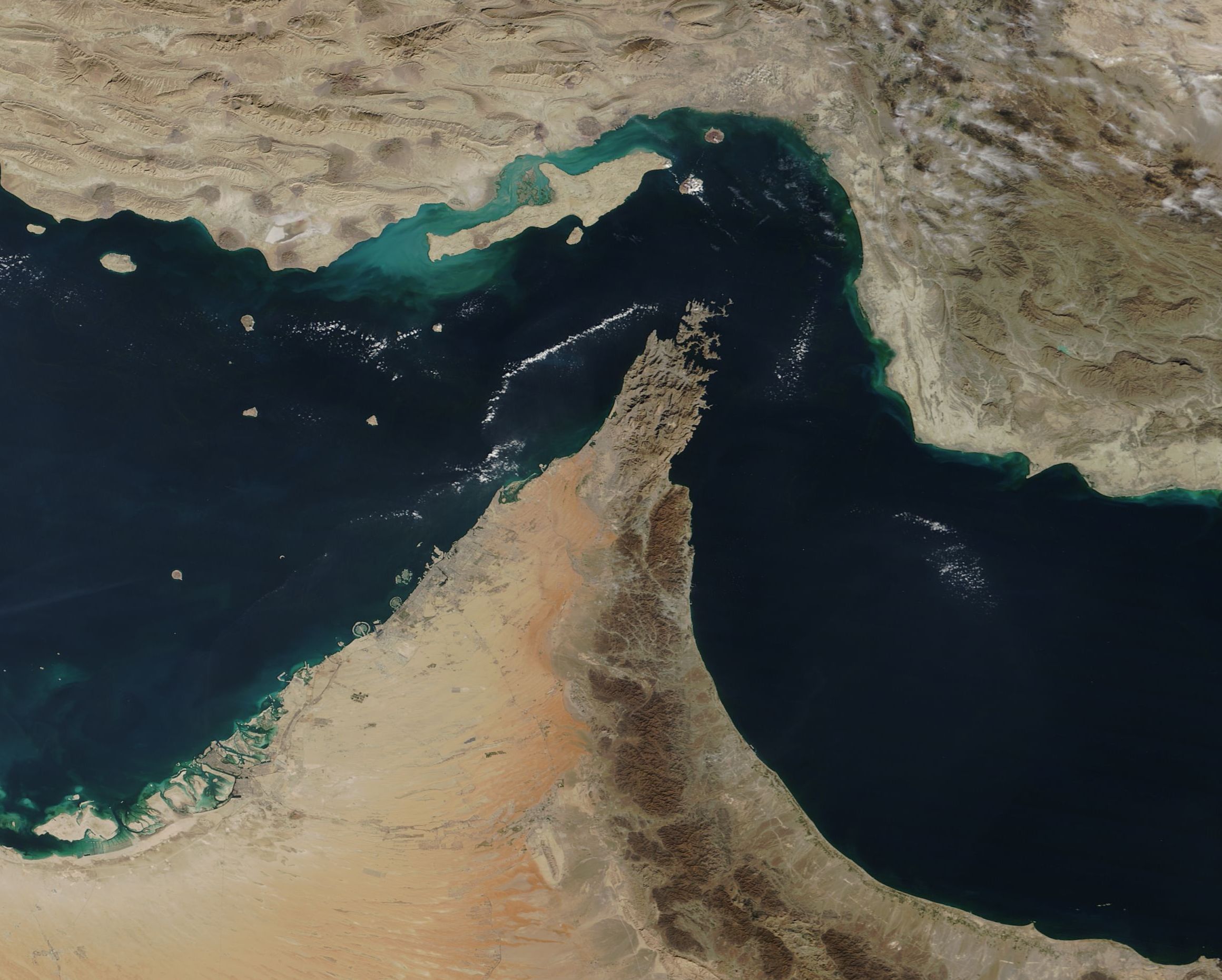
UPSC Relevance
Prelims Relevance
- IORA launched in 1997; Coordinating Secretariat at Ebene, Mauritius.
- 23 member states across the Indian Ocean rim; India is a founding member.
- Origin: Indian Ocean Rim Initiative seeded by South Africa and India (1995).
- Six priority areas, including Maritime Safety & Security and Disaster Risk Management.
- Two cross-cutting issues: Blue Economy and Women’s Economic Empowerment.
- Dialogue Partners include China, the US, the UK, Japan, Germany, France’s status as a member.
- Strait of Hormuz — a chokepoint linking the Persian Gulf to the Gulf of Oman.
- Indian Ocean Dialogue (IOD) — IORA’s flagship track-1.5 forum.
Mains Relevance
GS Paper 2
- India’s role in regional groupings of the Indian Ocean and its bearing on national interest.
- Effect of expanding dialogue partnerships on the strategic balance within IORA.
GS Paper 3
- Maritime security, sea-lane protection and disaster-risk management in the Indian Ocean.
Essay
- The Indian Ocean is the strategic centre of gravity of the 21st century.
- Regionalism and the pursuit of a rules-based maritime order.
Background and Context
What IORA Is
IORA is the only ministerial-level grouping uniting all littoral states of the Indian Ocean.
- Formally launched on 6-7 March 1997 through the Charter of the Indian Ocean Rim Association for Regional Co-operation.
- Grew out of the Indian Ocean Rim Initiative, an idea floated during Nelson Mandela’s 1995 India visit and championed by India and South Africa.
- Coordinating Secretariat sits at Ebene, Mauritius; the chair rotates among members on a biennial basis.
- Works by consensus and an open-regionalism principle — economic cooperation without binding obligations.
Membership and Partners
Membership spans four continents, touching the ocean, with non-littoral powers attached as partners.
- 23 member states: India, Australia, Bangladesh, Indonesia, Iran, Kenya, Madagascar, Malaysia, Maldives, Mauritius, Mozambique, Oman, Seychelles, Singapore, Somalia, South Africa, Sri Lanka, Tanzania, Thailand, the UAE, Yemen, the Comoros and France (via its Indian Ocean territories).
- Dialogue Partners include China, Egypt, Germany, Italy, Japan, the Republic of Korea, Russia, Saudi Arabia, Turkiye, the UK, the US and the European Union.
- Canada’s pending application would make it the newest external partner brought into the IORA fold.
- India was both an originator and remains a lead player, having chaired the grouping in 2011-13 and pressed a maritime-security agenda.
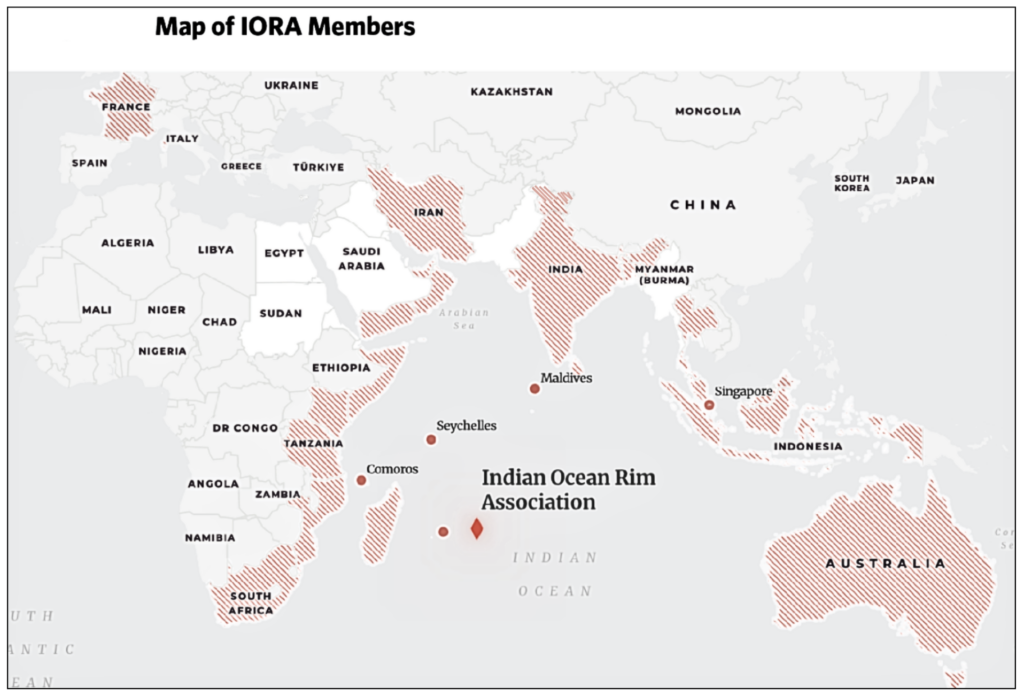
The Six Priority Areas
IORA structures its work around six pillars plus two cross-cutting themes.
- Maritime Safety & Security — anti-piracy, sea-lane protection and counter-trafficking.
- Trade & Investment Facilitation and Fisheries Management.
- Disaster Risk Management — flagged this week as a standing priority given the ocean’s exposure to cyclones and tsunamis.
- Tourism & Cultural Exchanges and Academic, Science & Technology Cooperation.
- Cross-cutting: the Blue Economy and Women’s Economic Empowerment.
Why the Indian Ocean Matters
The Indian Ocean is the world’s busiest energy and trade highway and India’s strategic backyard.
- Carries a large share of the global seaborne oil trade and container traffic between Asia, Africa and Europe.
- Hosts critical chokepoints — the Strait of Hormuz, Bab-el-Mandeb and the Strait of Malacca.
- Faces a ‘disproportionate’ climate-change burden, Ranjan noted, raising the stakes on disaster preparedness.
- Underpins India’s SAGAR (Security and Growth for All in the Region) vision and its Indo-Pacific posture.
Canada’s Pitch and the Hormuz Crisis
Canada offers maritime capability just as a West Asia disruption tests the region’s resilience.
- Canada brings expertise in maritime safety, security and connectivity drawn from its long coastlines.
- Ranjan welcomed a reported Iran-US peace deal that could end 100-plus days of hostilities in the Strait of Hormuz.
- He urged members to build alternate supply routes and capacities to weather such ‘existential’ shocks.
- Seafarer safety and attacks on shipping featured on the agenda of the senior officials’ meeting.
Way Forward
Deepen the security mandate
- Convert IORA’s Maritime Safety & Security pillar into operational mechanisms — information-sharing, joint exercises and a coordinated response to seafarer attacks.
- Use new partners like Canada to plug capability gaps without diluting the consensus, member-led character of the grouping.
Build resilience to shocks
- Develop alternate trade and energy routes so a Hormuz-style disruption does not paralyse member economies.
- Strengthen disaster-risk management and climate-adaptation cooperation across the rim.
India should leverage its founding role to keep IORA the premier inclusive IOR platform, anchoring it to the SAGAR and Indo-Pacific frameworks while keeping it open and non-bloc.
Conclusion
Canada’s bid signals the rising pull of the Indian Ocean for external maritime powers and the growing weight of IORA as a regional convening platform. For India, a wider partner base is welcome only if it reinforces an open, rules-based and member-driven order rather than importing great-power rivalry into the rim.
With chokepoint volatility, climate stress and seafarer security converging, IORA’s task is to move from a dialogue forum to a delivery mechanism — and India, as a founding member hosting the senior officials’ meeting, is well placed to steer that shift.
UPSC Practice Questions
Prelims MCQ 1
With reference to the Indian Ocean Rim Association (IORA), consider the following statements:
- It was launched in 1997, and its Coordinating Secretariat is located in Mauritius.
- India is a founding member of the grouping.
- Maritime Safety & Security is one of its priority areas of cooperation.
How many of the above statements are correct?
(a) Only one (b) Only two (c) All three (d) None
Answer: (c) All three
Explanation:
IORA was launched in March 1997 with its secretariat at Ebene, Mauritius. India is a founding member, and Maritime Safety & Security is one of its six priority areas. All three are correct.
Prelims MCQ 2
The Strait of Hormuz, often in the news, connects the Persian Gulf to which water body?
(a) Red Sea
(b) Gulf of Oman
(c) Arabian Sea directly
(d) Bay of Bengal
Answer: (b) Gulf of Oman
Explanation:
The Strait of Hormuz links the Persian Gulf with the Gulf of Oman, which opens into the Arabian Sea. It is a critical oil-shipping chokepoint.
UPSC Mains Questions
- The Indian Ocean Rim Association is evolving from an economic dialogue forum into a maritime-security platform. Examine the drivers of this shift and India’s stake in steering it.
- Critically assess how the entry of external dialogue partners shapes the strategic character of regional groupings in the Indian Ocean, with reference to India’s interests.
Sources: The Hindu and IORA Secretariat.
Frequently Asked Questions
What is the Indian Ocean Rim Association?
IORA is an inter-governmental organisation launched in 1997 that brings together 23 member states of the Indian Ocean rim for cooperation on trade, maritime security, fisheries, the blue economy and disaster management. Its Coordinating Secretariat is at Ebene, Mauritius, and it works by consensus on the principle of open regionalism.
Is Canada becoming a member of IORA?
No. Canada has applied to become a dialogue partner, not a full member. Full membership is reserved for littoral states of the Indian Ocean. The application is being examined at the 28th Committee of Senior Officials meeting in New Delhi, with a decision to follow the grouping’s consensus process.
What is India’s role in IORA?
India is a founding member and a lead player. It helped seed the original Indian Ocean Rim Initiative alongside South Africa, chaired the grouping in 2011-13, and has pushed maritime security up the agenda. IORA aligns closely with India’s SAGAR vision and Indo-Pacific outreach.
What are IORA’s priority areas?
IORA works across six pillars: maritime safety and security, trade and investment facilitation, fisheries management, disaster risk management, tourism and cultural exchanges, and academic, science and technology cooperation. It also has two cross-cutting themes — the blue economy and women’s economic empowerment.
Why is the Strait of Hormuz important to IORA?
The Strait of Hormuz is a major oil-shipping chokepoint at the mouth of the Persian Gulf. Disruptions there, such as the recent West Asia hostilities, threaten the trade and energy security of IORA members, which is why the grouping stresses alternate routes and resilience.
What is the difference between a member and a dialogue partner?
A member is a littoral state of the Indian Ocean with full participation rights. A dialogue partner is an external country or body that engages with IORA on cooperation but does not have full membership. Existing dialogue partners include China, the US, the UK, Japan and the European Union.
Source: https://anantamias.com/current-affairs/iora-canada-observer-application/
Uniform Civil Code: Madhya Pradesh Fast-Tracks a UCC Bill Amid Tribal Concerns
Why in News?
Madhya Pradesh Chief Minister Mohan Yadav announced that a Uniform Civil Code (UCC) Bill will be introduced and passed in the state Assembly’s monsoon session. If enacted, Madhya Pradesh would become the next BJP-ruled state after Uttarakhand to legislate a UCC, reviving the long-pending Article 44 Directive Principle.
The move has triggered opposition from tribal organisations and the Congress, who want the Scheduled Tribe communities exempted as their customary laws on marriage, succession and inheritance are protected under the Constitution.
- A six-member committee headed by a former Supreme Court judge was constituted to study existing personal laws and prepare a draft framework.
- The proposed law would cover marriage, divorce, maintenance, inheritance, adoption and the regulation of live-in relationships.
- Tribal communities make up over a fifth of MP’s population; the state has 47 Assembly seats reserved for STs.
- Congress leaders demanded clarity on whether the Scheduled Tribes will be exempted, as was done in Uttarakhand.
- Adivasi groups invoked the Fifth Schedule and the PESA Act to argue that customary laws form an integral part of tribal identity.
The development matters in the context of:
- The UCC sits at the intersection of Article 44 (DPSP), Articles 25-26 (religious freedom) and constitutional protections for tribal autonomy.
- After Uttarakhand (2024), MP would extend the state-level UCC trend, raising federalism and uniformity questions absent a central law.
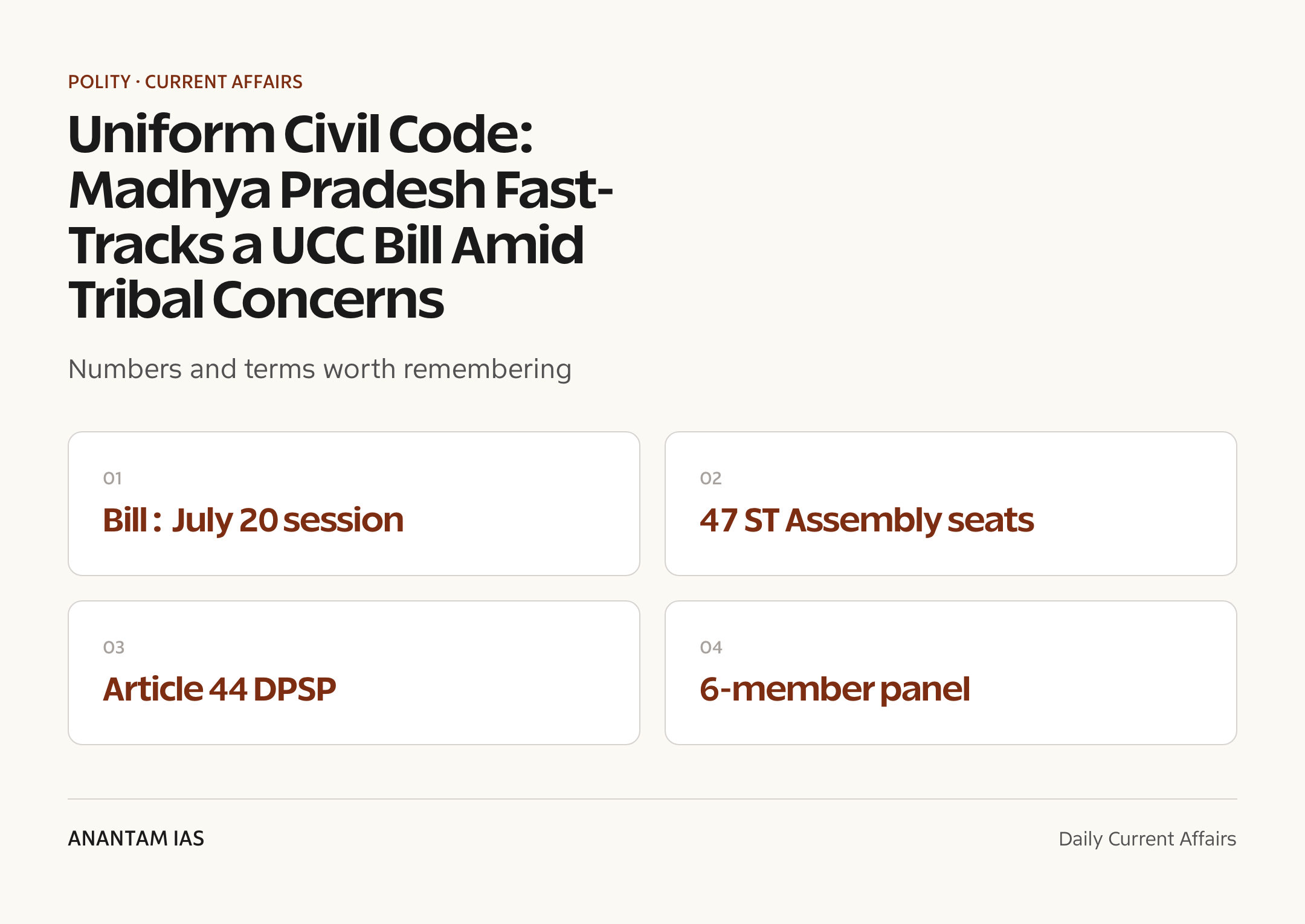
UPSC Relevance
Prelims Relevance
- Article 44 — UCC is a Directive Principle of State Policy (non-justiciable).
- DPSPs lie in Part IV of the Constitution; not enforceable by courts (Article 37).
- Article 25-26 — freedom of religion and management of religious affairs.
- Article 366(25) defines ‘Scheduled Tribes’.
- Fifth Schedule — administration of Scheduled Areas and STs (excludes the North-East).
- Sixth Schedule — tribal areas in Assam, Meghalaya, Tripura and Mizoram with Autonomous District Councils.
- PESA Act, 1996 — extends Panchayati Raj (Part IX) to Scheduled Areas, protecting customary law.
- Concurrent List — marriage, divorce, succession and adoption fall under Entry 5, letting states legislate.
- Uttarakhand became the first state to enact a UCC in 2024; STs were exempted.
- Shah Bano (1985) and Sarla Mudgal (1995) — courts urged enacting a UCC.
Mains Relevance
GS Paper 2
- Significance of Article 44 and the constitutionality of state-level UCCs in a federal polity.
- Reconciling a UCC with Articles 25-26 and the autonomy of tribal customary law under the Fifth Schedule and PESA.
GS Paper 1
- Diversity of personal laws and tribal customs in Indian society; identity and social reform.
Essay
- Uniformity versus diversity: can one civil code serve a plural society?
- Reform without erasure — balancing gender justice and cultural autonomy.
Background and Context
Article 44 and the UCC idea
The Constitution aspires to a common civil code but leaves it to the state’s discretion.
- Article 44 directs the State to ‘endeavour to secure for the citizens a uniform civil code throughout the territory of India’.
- It is a Directive Principle (Part IV) — non-justiciable under Article 37, so no citizen can compel its enactment.
- A UCC would replace community-specific personal laws on marriage, divorce, succession, maintenance, adoption and guardianship with one common set of rules.
- The framers in the Constituent Assembly deferred a mandatory UCC, treating it as a goal to be approached gradually as society readied for it.
- The aim is legal uniformity, equality and gender justice across communities, the MP government has argued.

Judicial nudges over the decades
Courts have repeatedly flagged the absence of a UCC without striking down personal laws.
- In Shah Bano (1985), the Supreme Court granted maintenance to a divorced Muslim woman and lamented that Article 44 ‘remained a dead letter’.
- In Sarla Mudgal (1995) and John Vallamattom (2003), the Court again urged the government to consider a UCC.
- The judiciary has stressed it is for Parliament and legislatures, not courts, to frame such a code.
- The 21st Law Commission (2018) held that a UCC was ‘neither necessary nor desirable at this stage’, favouring reform within each personal law instead.
- The 22nd Law Commission (2023) sought fresh public and religious-body views on the issue.
The Uttarakhand precedent (2024)
Uttarakhand set the template MP is now expected to follow, including a tribal carve-out.
- The Uniform Civil Code of Uttarakhand Act, 2024, made it the first Indian state to enact a UCC; rules were notified in January 2025.
- It standardised marriage, divorce, inheritance and live-in relationship registration across communities.
- Crucially, it exempted Scheduled Tribes defined under Article 366(25), plus persons whose customary rights are protected under Part XXI of the Constitution.
- Much of the code drew on the Hindu Marriage Act, 1955 and the Hindu Succession Act, 1956, which themselves do not apply to ST communities.
- Critics noted the ST exemption exposes a tension at the heart of the ‘uniform’ label.
Tribal autonomy: Fifth Schedule, PESA and custom
Adivasi groups in MP argue that their customary laws enjoy distinct constitutional protection.
- The Fifth Schedule empowers the Governor to direct that any law shall not apply, or apply with modifications, to a Scheduled Area.
- The PESA Act, 1996, mandates that Gram Sabhas in Scheduled Areas safeguard community resources and the ‘customs, religious beliefs and traditional management practices’ of tribes.
- Tribal customary laws on marriage, succession and social relations often differ sharply from Hindu, Muslim or general civil law.
- Several Adivasi bodies and the Congress’s Umang Singhar warned a blanket UCC could dilute these safeguards and ‘erase’ tribal identity.
- Groups practising distinct faiths, such as Sarna, have raised similar concerns about losing customary inheritance systems.
Sixth Schedule and the federalism question
The North-East has a separate protective regime, and state-by-state UCCs raise uniformity puzzles.
- The Sixth Schedule grants Autonomous District Councils in Assam, Meghalaya, Tripura and Mizoram power to make laws on marriage, inheritance and social custom.
- Articles 371A (Nagaland) and 371G (Mizoram) protect Naga and Mizo customary law and procedure from parliamentary override without consent.
- Marriage, divorce, succession and adoption sit in the Concurrent List (Entry 5), letting states legislate but inviting central conflict if a national UCC ever follows.
- A patchwork of state UCCs with varying exemptions risks a ‘uniform’ code that differs across India, undercutting the very rationale of Article 44.
- Article 254 would let a central law override conflicting state UCCs, leaving the present state-led drive provisional.
Religious freedom and the equality balance
The debate weighs Articles 25-26 against equality and gender-justice goals.
- Articles 25-26 guarantee freedom of conscience and the right of religious denominations to manage their own affairs, subject to public order, morality and health.
- Supporters argue that a UCC advances Article 14 equality and women’s rights in maintenance, inheritance and divorce.
- Opponents counter that personal laws are tied to religious and cultural identity, protected by the freedom-of-religion guarantees.
- The MP committee has been asked to examine provisions on women’s rights, children’s welfare and live-in relationships.
- How the bill draws the line between essential religious practice and reformable civil matter will shape any legal challenge.
Way Forward
Consultation and consent
- Hold genuine consultation with tribal Gram Sabhas under PESA and with religious bodies before tabling the bill.
- Spell out clearly whether and how Scheduled Tribes will be exempted, avoiding ambiguity over the ‘uniform’ claim.
Reform within, not erasure
- Target gender-just outcomes — equal inheritance, maintenance and consent in marriage — that most communities can accept.
- Preserve protected customary law under the Fifth Schedule, Sixth Schedule and Articles 371A/371G where it operates.
A durable solution may require a national conversation, possibly a fresh Law Commission consensus and parliamentary debate, rather than a fragmented set of state codes with differing carve-outs.
Conclusion
Madhya Pradesh’s UCC push turns a constitutional aspiration in Article 44 into live legislative politics, following the path Uttarakhand opened in 2024.
Its success will be judged less by speed than by how it reconciles equality and gender justice with religious freedom under Articles 25-26 and the protected customary autonomy of India’s tribal communities.
UPSC Practice Questions
Prelims MCQ 1
With reference to the Uniform Civil Code in the Indian constitutional scheme, consider the following statements:
- Article 44 places the Uniform Civil Code among the Fundamental Rights.
- Directive Principles of State Policy are not enforceable by any court.
- Marriage, divorce and succession fall under the Concurrent List.
How many of the above statements are correct?
(a) Only one (b) Only two (c) All three (d) None
Answer: (b) Only two
Explanation:
Article 44 is a Directive Principle (Part IV), not a Fundamental Right, so statement 1 is wrong. DPSPs are non-justiciable under Article 37 (statement 2 correct). Marriage, divorce, succession and adoption are in the Concurrent List, Entry 5 (statement 3 correct).
Prelims MCQ 2
Which constitutional provision was used to define and exempt Scheduled Tribes under the Uttarakhand UCC, 2024?
(a) Article 244(1)
(b) Article 366(25)
(c) Article 342
(d) Article 164
Answer: (b) Article 366(25)
Explanation:
Article 366(25) supplies the constitutional definition of ‘Scheduled Tribes’. The Uttarakhand UCC exempted STs within that meaning, read with protections under Part XXI, leaving their customary law untouched.
UPSC Mains Questions
- The Uniform Civil Code remains an unfulfilled Directive Principle. Examine the constitutional, federal and social challenges in legislating a UCC at the state level, with reference to recent moves in Uttarakhand and Madhya Pradesh. (250 words)
- Tribal customary law enjoys distinct constitutional protection in India. Discuss how a Uniform Civil Code can be reconciled with the safeguards available under the Fifth Schedule, the Sixth Schedule and the PESA Act. (250 words)
Sources: The Indian Express and Outlook India.
Frequently Asked Questions
What is the Uniform Civil Code (UCC)?
A Uniform Civil Code is a single set of laws governing personal matters such as marriage, divorce, maintenance, inheritance and adoption for all citizens, replacing community-specific personal laws. Article 44 of the Constitution directs the State to endeavour to secure such a code, but it is a non-justiciable Directive Principle, so no one can force its enactment through the courts.
Why is Madhya Pradesh in the news over the UCC?
Chief Minister Mohan Yadav announced that a UCC Bill will be introduced and passed in the state Assembly’s monsoon session beginning July 20, 2026. A six-member committee headed by a former Supreme Court judge is preparing a draft. If enacted, Madhya Pradesh would become the next BJP-ruled state after Uttarakhand to legislate a UCC.
Why do tribal groups oppose the UCC?
Adivasi organisations argue their customary laws on marriage, succession and social relations are integral to tribal identity and are protected by the Constitution. They point to the Fifth Schedule and the PESA Act, 1996, which safeguard the traditions and management practices of communities in Scheduled Areas, and demand that Scheduled Tribes be exempted from the proposed law.
How did Uttarakhand handle tribal communities in its UCC?
The Uniform Civil Code of Uttarakhand Act, 2024, the first state UCC, exempted Scheduled Tribes defined under Article 366(25), along with persons whose customary rights are protected under Part XXI of the Constitution. Much of the code drew on Hindu personal laws, which themselves do not apply to ST communities, making the exemption both practical and constitutionally necessary.
Can states make their own UCC?
Yes. Marriage, divorce, succession and adoption fall under the Concurrent List (Entry 5), so state legislatures can enact civil-code laws with the President’s assent. Uttarakhand did so in 2024. However, under Article 254, a future central UCC could override conflicting state codes, making the present state-led drive provisional rather than final.
What constitutional articles are central to the UCC debate?
Article 44 (the Directive Principle on a UCC) and Article 37 (non-justiciability of DPSPs) frame the goal. Articles 25-26 protect religious freedom and community affairs. Article 366(25) defines Scheduled Tribes, while the Fifth Schedule, Sixth Schedule, Articles 371A and 371G and the PESA Act protect tribal customary autonomy.
Source: https://anantamias.com/current-affairs/madhya-pradesh-uniform-civil-code-bill/
From Indo-Pacific to Pacific Command: What the US Renaming Signals
Why in News?
On 16 June 2026, the renamed US Department of War (formerly Department of Defence) announced that US Indo-Pacific Command (USINDOPACOM) will revert to its older name, US Pacific Command (USPACOM) — dropping the word ‘Indo’ that was added only in 2018. The Indian Express reported the move and its signalling for the Indo-Pacific idea, the Quad and India-US strategic alignment.
Officials stressed the change is largely symbolic: the command’s mission and its area of responsibility (AOR) — stretching from the US West Coast to India’s western maritime boundary — stay unchanged. But the optics matter, because the prefix ‘Indo’ was a deliberate acknowledgement of India and the Indian Ocean as central to US strategy.
- Decision announced by the US Department of War; framed as ‘restoring legacy’.
- Reverses the 2018 rename from PACOM to INDOPACOM made under then-Defence Secretary James Mattis.
- The command’s AOR, mission and structure are officially unchanged; only the name reverts.
- INDOPACOM is the oldest and largest US unified combatant command, set up on 1 January 1947, headquartered in Honolulu, Hawaii.
- It covers roughly 52% of Earth’s surface and over 375,000 service members.
- Congress MP Shashi Tharoor asked whether the Quad is ‘taking another hit’, linking the rename to concerns over US commitment.
The development matters in the context of:
- Tests how far the Indo-Pacific construct — a frame India helped popularise — remains the organising lens of US Asia policy.
- Feeds the debate on whether the Quad and India’s role are being quietly de-emphasised under a more China-direct US posture.
- A live example for understanding how naming and symbolism carry strategic signalling in international relations.
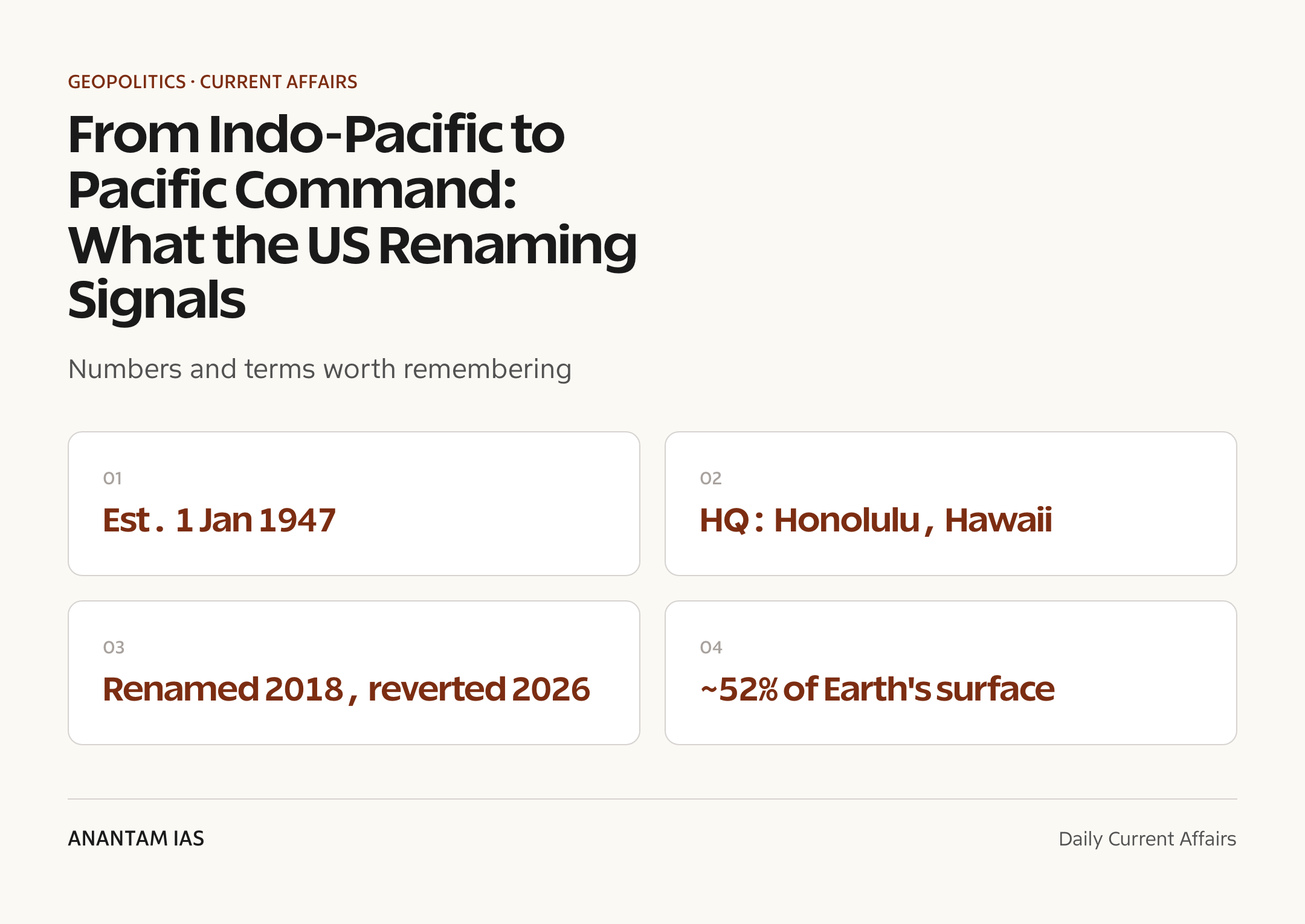
UPSC Relevance
Prelims Relevance
- USINDOPACOM vs USPACOM: 2018 rename and 2026 reversal
- INDOPACOM established 1 January 1947; HQ at Honolulu, Hawaii
- Oldest and largest US unified combatant command; ~52% of Earth’s surface
- AOR runs from the US West Coast to India’s western maritime boundary
- Quad members: India, the United States, Japan, Australia
- Indo-Pacific as a geopolitical (not purely geographic) construct
- SAGAR and MAHASAGAR — India’s maritime vision frameworks
- Malabar naval exercise; IPMDA (Indo-Pacific maritime domain awareness)
- India’s foundational defence agreements with the US: LEMOA, COMCASA, BECA
Mains Relevance
GS Paper 2
- Effect of policies and politics of developed countries on India’s interests — US rebranding and the Indo-Pacific construct.
- Bilateral and regional groupings: how a symbolic US move affects the Quad and India-US strategic alignment.
GS Paper 3
- Security challenges in the maritime domain and China’s balancing in the Indian Ocean Region.
- India’s defence cooperation and interoperability with major powers.
Essay
- What’s in a name? Symbolism, signalling and the limits of soft power in geopolitics.
- India and the Indo-Pacific: from a Pacific-centric order to a two-ocean strategic space.
Background and Context
What exactly changed
Strip the noise: this is a name reversal, not a structural or mission change.
- USINDOPACOM reverts to USPACOM — the prefix ‘Indo’ is dropped after eight years.
- The US Department of War called it ‘restoring legacy’, consistent with Secretary Pete Hegseth’s wider rebranding drive (including reverting the department’s own name from ‘Defence’ to ‘War’).
- Officials confirmed the command’s area of responsibility, mission and forces are unchanged.
- So the substance is intact; the signalling is what India and analysts are reading.

The 2018 rename and why it happened
INDOPACOM was a deliberate strategic statement when it replaced PACOM in 2018.
- In May 2018, PACOM was renamed to INDOPACOM.
- Stated rationale: ‘recognition of the increasing connectivity between the Indian and Pacific Oceans‘.
- It elevated India and the Indian Ocean Region (IOR) from the margins to the centre of US Asia strategy.
- It dovetailed with the US ‘Free and Open Indo-Pacific’ framing and the revival of the Quad the same year.
What the command is
PACOM/INDOPACOM is the anchor of the US military presence across the world’s most contested maritime space.
- Established on 1 January 1947, the oldest and largest of the US unified combatant commands.
- Headquartered in Honolulu, Hawaii; commands over 375,000 personnel.
- AOR spans from the US West Coast westward to India’s western maritime boundary, and from the Arctic to the Antarctic.
- Covers roughly 52% of the Earth’s surface — about 100 million square miles.
The ‘Indo-Pacific’ construct and India’s role
Indo-Pacific is a geopolitical idea, not just a map — and India is integral to it.
- Stitches the Indian and Pacific Oceans into a single strategic theatre, foregrounding the IOR.
- India frames the space through SAGAR (‘Security and Growth for All in the Region’) and its successor vision, MAHASAGAR.
- Underpins cooperation via the Quad, the Malabar exercise and maritime domain awareness initiatives.
- India’s location, navy and the Andaman and Nicobar Command make it a natural pivot for any two-ocean strategy.

The Quad and India-US alignment
The rename lands amid questions about how central India remains to US plans.
- The Quad (India, US, Japan, Australia) uses the Indo-Pacific frame as its core organising logic.
- Congress MP Shashi Tharoor asked whether the Quad is ‘taking another hit’ from the rename.
- India-US defence ties rest on the foundational pacts LEMOA, COMCASA and BECA and growing technology cooperation.
- A semantic downgrade of ‘Indo’ could be read as trimming India’s symbolic weight, even if operations continue.
What does it signal about the US strategy and China
Dropping ‘Indo’ fits a more Pacific-centric, China-direct US posture.
- The reversal narrows the optical emphasis back toward the Pacific and direct China balancing.
- Critics see it as diluting the wider Indian Ocean dimension that ties in partners like India.
- Supporters call it cosmetic — the AOR still reaches India’s waters, so engagement need not shrink.
- For India, the test is actions over labels: arms sales, exercises and tech-transfer trends, not the nameplate.
Way Forward
Read intent through deeds
- India should track operational signals — joint exercises, tech transfer, intelligence-sharing — over nomenclature.
- Keep the Quad agenda functional (IPMDA, supply chains, critical tech), so it is not hostage to one term.
Anchor India’s own framing
- Continue advancing SAGAR/MAHASAGAR and IOR leadership, so the Indo-Pacific idea has an Indian author, not just a US one.
- Deepen ties with Japan, Australia, France and ASEAN to keep the two-ocean logic alive, independent of US labels.
Strategic autonomy means India treats the rename as a data point, not a verdict — diversifying partnerships while keeping the US relationship on a steady, interest-based footing.
Conclusion
The US dropping ‘Indo’ from its Pacific Command is, on paper, a return to a 1947 name with no change to mission or map. But in international relations, names are signals, and the frame India helped centre has been quietly de-emphasised.
For India, the prudent response is to watch behaviour, not branding — sustaining the Quad, deepening defence interoperability and pressing its own SAGAR/MAHASAGAR vision so the Indo-Pacific stays a shared, durable construct rather than an American label that can be switched off.
UPSC Practice Questions
Prelims MCQ 1
With reference to the US Pacific Command (PACOM/INDOPACOM), consider the following statements:
- It is the oldest and largest of the US unified combatant commands.
- It is headquartered in Honolulu, Hawaii.
- Its area of responsibility extends westward up to India’s western maritime boundary.
How many of the above statements are correct?
(a) Only one (b) Only two (c) All three (d) None
Answer: (c) All three
Explanation:
PACOM, set up on 1 January 1947, is the oldest and largest US unified combatant command, headquartered at Honolulu, Hawaii, with an AOR running from the US West Coast to India’s western maritime boundary.
Prelims MCQ 2
The renaming of US Pacific Command to ‘Indo-Pacific Command’ in 2018 was primarily intended to:
(a) Recognise the strategic connectivity between the Indian and Pacific Oceans
(b) Bring the Atlantic Ocean under the command’s responsibility
(c) Replace the role of NATO in Asia
(d) Merge the Quad into a formal military alliance
Answer: (a) Recognise the strategic connectivity between the Indian and Pacific Oceans
Explanation:
Defence Secretary James Mattis said the 2018 rename reflected the ‘increasing connectivity between the Indian and Pacific Oceans’, elevating India and the Indian Ocean in US strategy.
UPSC Mains Questions
- The renaming of the US Indo-Pacific Command back to Pacific Command is officially symbolic, yet it has drawn strategic concern in India. Discuss what the move signals for the Indo-Pacific construct, the Quad and India-US alignment.
- ‘In geopolitics, names are signals.’ Examine the significance of the ‘Indo-Pacific’ construct for India’s maritime strategy, and assess how India can keep the framework durable irrespective of shifts in US nomenclature.
Sources: The Indian Express and Stars and Stripes / Breaking Defence.
Frequently Asked Questions
What changed in the US Pacific Command renaming?
On 16 June 2026, the US Department of War announced that US Indo-Pacific Command (INDOPACOM) will revert to US Pacific Command (PACOM), dropping the prefix ‘Indo’ added in 2018. Officials say it is a symbolic name change; the command’s mission, structure and area of responsibility remain unchanged.
When was PACOM first renamed to INDOPACOM?
In May 2018, under then US Defense Secretary James Mattis, the command was renamed from US Pacific Command to US Indo-Pacific Command. Mattis described it as recognition of the growing connectivity between the Indian and Pacific Oceans, elevating India and the Indian Ocean in US strategy.
Why does the rename matter for India?
The prefix ‘Indo’ was a deliberate acknowledgement of India and the Indian Ocean as central to US Asia strategy. Dropping it is read by some, including MP Shashi Tharoor, as a symbolic downgrade of India’s weight and a possible signal about US commitment to the Quad, even though operations are unchanged.
What is the ‘Indo-Pacific’ construct?
The Indo-Pacific is a geopolitical idea, not merely a geographic region. It stitches the Indian and Pacific Oceans into a single strategic theatre, foregrounding the Indian Ocean and India’s role. It underpins the Quad, the Malabar exercise and the US ‘Free and Open Indo-Pacific’ framing.
Does the rename change the Quad?
Not formally. The Quad (India, US, Japan, Australia) and its work on maritime awareness, technology and supply chains continue. But because the Quad uses the Indo-Pacific frame as its organising logic, the rename has prompted questions about whether the construct and India’s place in it are being de-emphasised.
How big is the command’s area of responsibility?
PACOM/INDOPACOM is the oldest (established 1 January 1947) and largest US unified combatant command, headquartered in Honolulu, Hawaii. It oversees more than 375,000 personnel across an area covering roughly 52% of the Earth’s surface, from the US West Coast to India’s western maritime boundary.
Source: https://anantamias.com/current-affairs/us-pacom-renamed-indo-pacific-command/
Indian Seafarers: Every Fifth Seafarer Is Now Indian
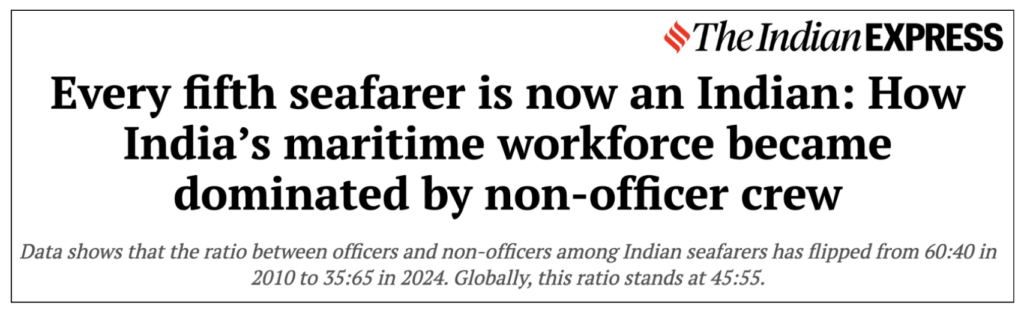
Why in News?
Data maintained by the Directorate General of Shipping (DGS) shows India’s seafarer workforce has expanded more than fivefold since 2010 to over 3.23 lakh, making the country one of the world’s top three suppliers of maritime crew.
Today, nearly one in five seafarers globally is Indian — but the composition has tilted sharply away from officers towards non-officer ratings, even as a closure of the Strait of Hormuz in early March 2026 left thousands of Indian crew exposed in the Gulf.
- India accounts for about 17% of the global seafaring workforce — roughly 3.23 lakh seafarers out of a global total of about 1.89 million.
- The active seafarer base grew from 62,267 in 2010 to over 3 lakh in 2024 — one of the most significant shifts in the global maritime labour market.
- The officer-to-rating ratio among Indian seafarers flipped from 60:40 in 2010 to 35:65 in 2024; the global ratio is about 45:55.
- Nautical (deck) crew rose more than fivefold from 36,423 to 207,109; engineering crew more than tripled from 25,844 to 100,792 (2010-2024).
- Indians overwhelmingly serve on foreign-flagged vessels — about 90% (2,78,466 of 3,07,901) in 2024, up from 86% in 2016.
- As of June 11, 2026, the government said over 18,000 Indian seafarers faced uncertainty across the broader Gulf region (down from 23,000 in mid-March).
The development matters in the context of:
- Links three syllabus strands — labour/skilling economics, the maritime (blue) economy, and external affairs/maritime security in the Gulf.
- Sits within Maritime India Vision 2030, which targets lifting India’s global seafarer share towards 20%.
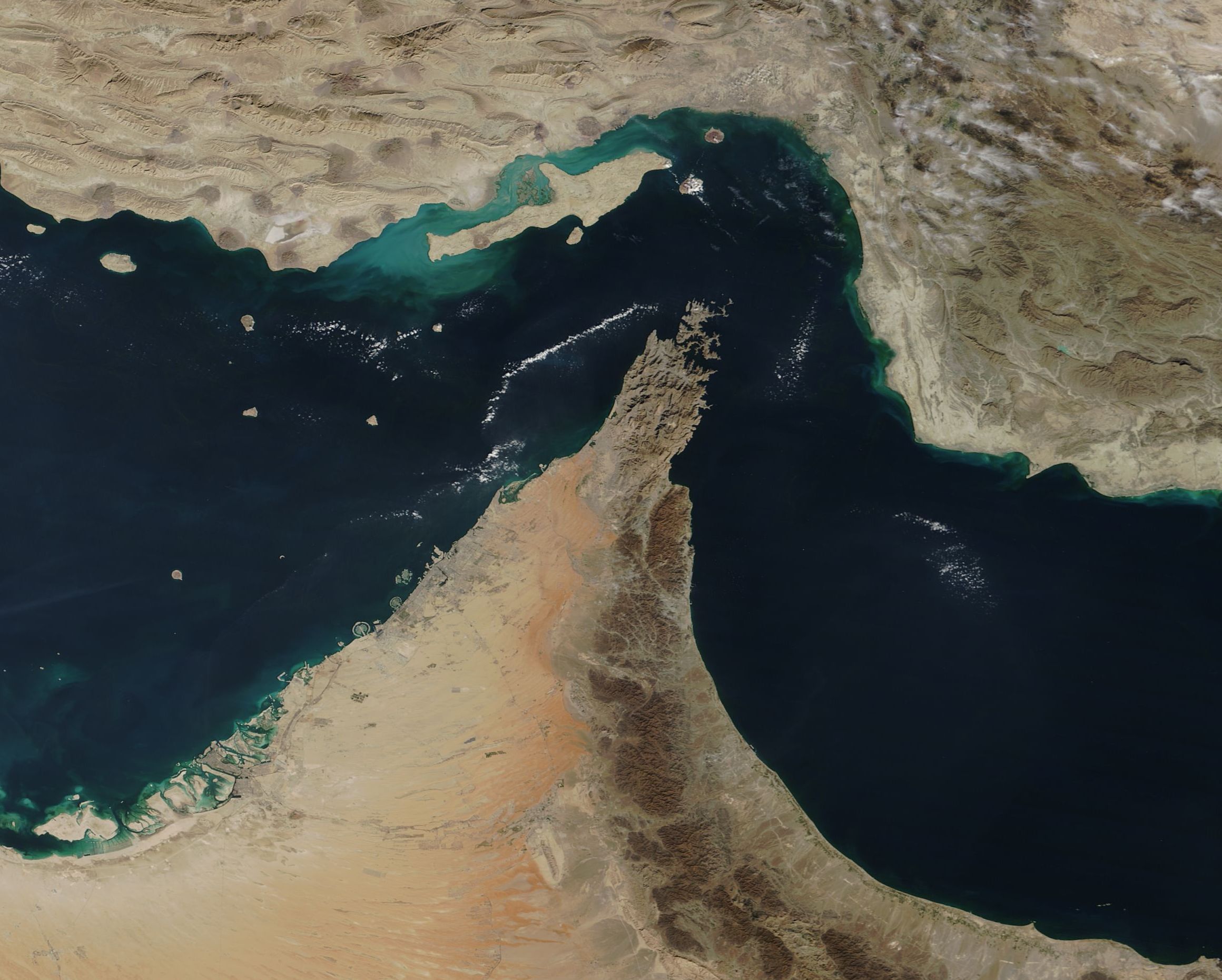
UPSC Relevance
Prelims Relevance
- Directorate General of Shipping (DGS) — apex maritime safety authority (est. 1949) under the Ministry of Ports, Shipping and Waterways; registers seafarers, certifies officers and surveys vessels.
- Seafarer ‘officers’ — certified deck/engine officers (Master, Chief Officer, Chief/Second/Third Engineer) holding Certificates of Competency.
- ‘Ratings’ — non-officer operational crew (Able Seamen, oilers, motormen, bosuns, cooks, hospitality and salon staff).
- Bosun — the senior-most non-officer deckhand; Able Seaman — a qualified deck rating.
- STCW — Standards of Training, Certification and Watchkeeping for Seafarers, the IMO convention governing seafarer qualifications.
- IMO — International Maritime Organisation, the UN body for shipping safety and standards.
- Flag of a vessel — the country of registration whose laws govern the ship; most Indian crew serve on foreign-flagged ships.
- Strait of Hormuz — chokepoint between the Persian Gulf and the Gulf of Oman, carrying a large share of seaborne crude.
- Maritime India Vision 2030 — Ministry blueprint to develop ports, shipping and the maritime workforce.
- Indian Maritime University (IMU) — a central university (Chennai) for maritime education and seafarer training.
Mains Relevance
GS Paper 3
- Maritime workforce as a growth and employment engine within the blue economy; the officer vs rating skill gap and its wage and remittance implications.
- Skilling, certification and infrastructure are needed to move Indian seafarers up the value chain from ratings to officers.
GS Paper 2
- Welfare and safety of Indians abroad — the state’s duty to protect seafarers in conflict-exposed sea lanes like the Strait of Hormuz.
Essay
- Human capital and globalisation: do nations gain when their workers fill the lower rungs of the global labour market?
Background and Context
Officers vs ratings — what the ranks mean
A ship’s crew splits into two broad tiers, and the distinction drives both wages and skill.
- Officers hold IMO Certificates of Competency and command the vessel — the Master and deck officers run navigation; the Chief, Second and Third Engineers run the engine room.
- Ratings are the hands-on non-officer crew — Able Seamen and bosuns on deck, oilers, motormen and engine petty officers below, and cooks, salon and hospitality staff in catering.
- Officers earn substantially more and need longer, costlier training and sea-time; ratings enter faster and cheaper.
- The officer-to-rating ratio is a rough proxy for how high up the value chain a country’s seafarers sit.
The numbers — a fivefold surge
India’s maritime labour force has exploded in scale over one and a half decades.
- Active Indian seafarers rose from 62,267 in 2010 to over 3.23 lakh in 2024 — more than a fivefold jump.
- India is now among the top three suppliers of maritime personnel alongside the Philippines and China, with about a 17% global share.
- Against a global pool of about 1.89 million seafarers, that means nearly one in five is Indian.
- Maritime India Vision 2030 targets pushing this share towards 20% and beyond.
The crew-vs-officer gap has widened
The catch is that almost all of the growth came from non-officer ranks.
- The officer-to-rating ratio flipped from 60:40 in 2010 to 35:65 in 2024 — well below the global 45:55.
- Nautical (deck) crew grew more than fivefold (36,423 → 207,109); engineering crew more than tripled (25,844 → 100,792).
- In 2010, nearly half of non-engineering Indian crew (16,590, or 46%) worked at third officer or above; by 2024, this fell to under 20% (40,303).
- In 2024, half the non-engineering Indian crew were cooks, hospitality, salon, cruise, wiper and cleaner roles — under 37% held such roles in 2010.

Where the bodies serve — foreign flags
Indians are crewing the world’s fleet, not India’s, which shapes both earnings and risk.
- About 90% of Indian seafarers (2,78,466 of 3,07,901) worked on foreign-flagged vessels in 2024, up from 86% in 2016.
- This brings in dollar wages and remittances, reinforcing India’s position as a leading remittance-receiving economy.
- But it also leaves Indian crew exposed to risks on routes governed by other flag states and patrolled by other navies.
- Some bright spots: Indian bosuns rose from none in 2010 to 4,324 in 2024, and Able Seamen from 708 to 16,568.
The MSME and skilling angle
The workforce sits on a base of training institutes and small recruitment-and-placement firms.
- Seafarers are trained at the Indian Maritime University (IMU) and 100-plus DGS-approved STCW institutes, plus Skill-India-linked rating courses.
- Recruitment and crewing are largely run by RPSL (Recruitment and Placement Services Licence) agencies — many of them MSMEs.
- The rating-heavy tilt reflects shorter, cheaper training pipelines that scale fast; upgrading to officers needs longer sea time and certification.
- DGS has rolled out simulator-based training (web and 360-degree immersive) to build higher-end navigational and engineering skills.
The maritime-security context — Hormuz
A volatile Gulf has turned a labour story into a safety-of-Indians-abroad story.
- After the Strait of Hormuz was effectively closed in early March 2026, the heavy Indian presence on foreign-flagged tankers became a liability.
- As of June 11, 2026, 562 Indian seafarers were aboard 13 Indian-flagged vessels — 329 in the Persian Gulf west of the Strait and 233 in the Gulf of Oman to the east.
- That was down from 753 seafarers on 27 Indian-flagged vessels in mid-March; at least one tanker safely exited the strait on June 15.
- Across the broader Gulf, the government said over 18,000 Indian seafarers faced uncertainty (down from 23,000 in mid-March); seafarer safety was flagged at the G7 and IORA levels.
Way Forward
Move up the value chain
- Expand officer-track training, sea-time berths and cadet placements so India’s share of high-wage Certificate of Competency roles rises, not just ratings.
- Strengthen the simulator and STCW capacity at IMU and DGS-approved institutes to push ratings towards officer certification.
Protect and formalise the workforce
- Build contingency and evacuation protocols for crew on conflict-exposed routes, and pursue seafarer safety through the IMO, G7 and IORA.
- Formalise RPSL/MSME crewing agencies, plug remittance leakages, and grow the share of Indians on the limited Indian-flagged fleet.
Conclusion
India’s rise to nearly one in five of the world’s seafarers is a genuine human-capital success, anchored by the Directorate General of Shipping and a fast-scaling training base — and a quiet pillar of the country’s remittance economy.
But the slide in the officer-to-rating ratio and the concentration on foreign-flagged ships show the gains are clustered at the lower, more exposed end of the labour chain. The next phase must move Indians up to officer ranks and harden their safety on volatile sea lanes.
UPSC Practice Questions
Prelims MCQ 1
With reference to India’s seafarer workforce, consider the following statements:
- India is among the top three suppliers of seafarers globally, alongside the Philippines and China.
- Between 2010 and 2024, the officer-to-ratings ratio among Indian seafarers shifted in favour of officers.
- A majority of Indian seafarers are employed on foreign-flagged vessels.
How many of the above statements are correct?
(a) Only one (b) Only two (c) All three (d) None
Answer: (b) Only two
Explanation:
Statements 1 and 3 are correct — India is a top-three supplier (about 17% of the global pool) and roughly 90% of Indian seafarers work on foreign-flagged ships. Statement 2 is wrong: the officer-to-rating ratio shifted AWAY from officers, from 60:40 in 2010 to 35:65 in 2024.
Prelims MCQ 2
The Directorate General of Shipping, which maintains data on Indian seafarers, functions under which Union Ministry?
(a) Ministry of External Affairs
(b) Ministry of Ports, Shipping and Waterways
(c) Ministry of Defence
(d) Ministry of Commerce and Industry
Answer: (b) Ministry of Ports, Shipping and Waterways
Explanation:
The DGS is the apex maritime safety authority (established in 1949), an attached office of the Ministry of Ports, Shipping and Waterways. It handles seafarer registration, officer certification and vessel survey.
UPSC Mains Questions
- India is now among the top three suppliers of seafarers globally, yet its workforce has tilted sharply towards non-officer ratings. Examine the economic significance of this maritime workforce and the challenges in moving it up the value chain. (250 words)
- The heavy presence of Indian seafarers on foreign-flagged vessels in the Gulf has exposed them to maritime-security risks during the Strait of Hormuz disruption. Discuss the state’s responsibility towards Indians working in conflict-exposed sea lanes. (250 words)
Sources: Directorate General of Shipping, Ministry of Ports, Shipping and Waterways and The Indian Express.
Frequently Asked Questions
What does it mean that one in five seafarers is Indian?
It means that of roughly 1.89 million seafarers crewing merchant ships worldwide, about 3.23 lakh — close to 17%, or nearly one in five — are Indian nationals. India is among the top three suppliers of maritime crew alongside the Philippines and China, a position built up over the past decade and a half.
What is the difference between an officer and a rating?
Officers are certified senior crew who command the ship — the Master and deck officers run navigation, while the Chief, Second and Third Engineers run the engine room, all holding IMO Certificates of Competency. Ratings are the non-officer operational crew, such as Able Seamen, bosuns, oilers, motormen, cooks and hospitality staff. Officers earn more and need longer training.
How has the officer-to-rating ratio changed?
Among Indian seafarers, the officer-to-rating ratio flipped from 60:40 in 2010 to 35:65 in 2024, meaning ratings now far outnumber officers. The global ratio is closer to 45:55. Most of India’s fivefold workforce growth came from non-officer ranks, including a rise in cooks, hospitality and salon staff.
Why do most Indian seafarers work on foreign-flagged ships?
India has a small national merchant fleet relative to its huge supply of trained crew, so about 90% of Indian seafarers (around 2.78 lakh of 3.08 lakh in 2024) sail on foreign-flagged vessels. This earns dollar wages and remittances, but leaves crew exposed to risks on routes governed by other flag states and navies.
What is the Directorate General of Shipping?
The Directorate General of Shipping (DGS), established in 1949, is India’s apex maritime safety authority and an attached office of the Ministry of Ports, Shipping and Waterways. It registers seafarers, certifies merchant-navy officers, surveys and certifies vessels, and regulates seafarer training, employment and welfare.
How does the Gulf situation affect Indian seafarers?
After the Strait of Hormuz was effectively closed in early March 2026, the large number of Indian crew on tankers in the Gulf became a safety concern. As of June 11, 2026 the government said over 18,000 Indian seafarers faced uncertainty across the broader Gulf region, and 562 were aboard 13 Indian-flagged vessels near the strait.
Source: https://anantamias.com/current-affairs/indian-seafarers-maritime-workforce-dominance/