Why in News?
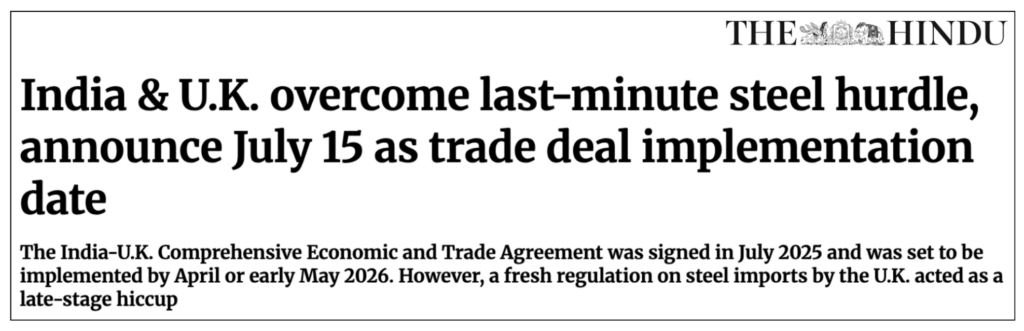
India and the United Kingdom announced July 15, 2026, as the entry-into-force date for their Comprehensive Economic and Trade Agreement (CETA), after resolving an eleventh-hour dispute over UK steel-import duties that had stalled the rollout. The two governments confirmed the date on the sidelines of the G7 Summit.
The deal, signed in July 2025, was originally meant to take effect by April–May 2026 but slipped when a fresh UK steel regulation upended the timeline. The Ministry of Commerce and Industry said both sides reached a consensus to safeguard bilateral steel trade, and that the Double Contribution Convention (DCC) on social security will be implemented the same day.
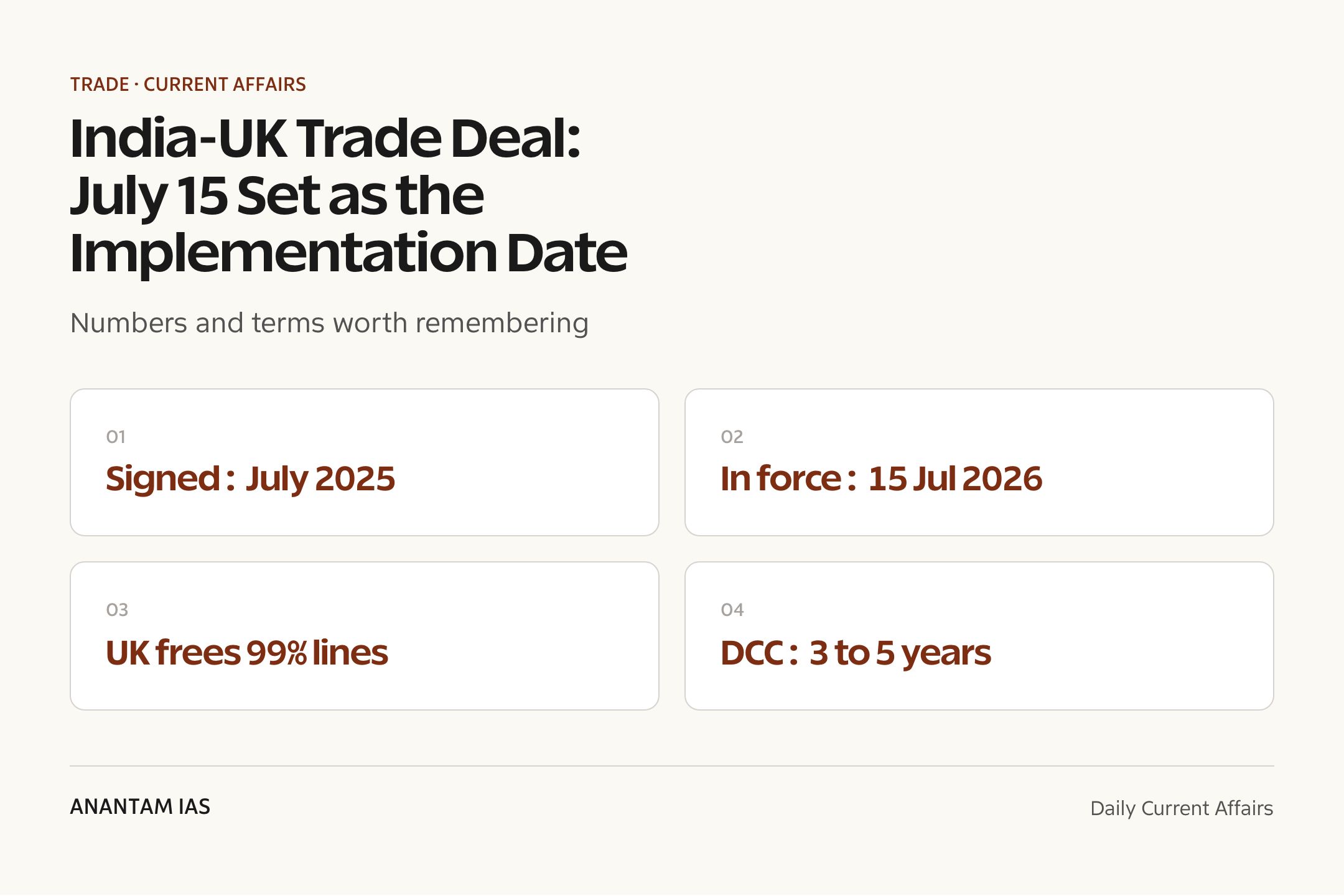
- July 15, 2026, is fixed as the day CETA and the social-security pact enter into force.
- CETA was signed on 24 July 2025, following negotiations that concluded in May 2025.
- A May 2026 UK rule cut its duty-free steel-import quota by 60% and doubled the above-quota tariff to 50%, effective July 1, 2026 — the ‘last-minute hurdle’.
- Steel solution to use country-specific quotas, residual quotas and an Authorised Use Scheme (AUS).
- UK will remove tariffs on 99% of its product lines; India gets duty-free access for 99% of its exports.
The development matters in the context of:
- First major bilateral FTA India has concluded with a G7 economy in years.
- Tests the durability of a signed FTA when a partner’s domestic regulation changes after signature.
- DCC directly affects Indian professionals and IT firms sending workers to the UK.
UPSC Relevance
Prelims Relevance
- CETA = Comprehensive Economic and Trade Agreement; the India-UK FTA’s formal name.
- Signed 24 July 2025; enters into force 15 July 2026.
- UK removes tariffs on 99% of product lines; India frees ~99% of its exports by value.
- Double Contribution Convention (DCC) = social-security pact; exemption raised from 3 to 5 years.
- Scotch whisky/gin duty: 150% to 75% on day one, tapering to 40% over 10 years.
- Auto tariffs cut from 110% to 10% in-quota over phased years.
- Authorised Use Scheme (AUS) and country-specific/residual quotas resolve the steel issue.
- Sensitive sectors shielded by India: dairy, cereals, millets, pulses, apples, gold, jewellery.
- Bilateral trade target: double by 2030 from ~USD 56 billion.
Mains Relevance
GS Paper 3
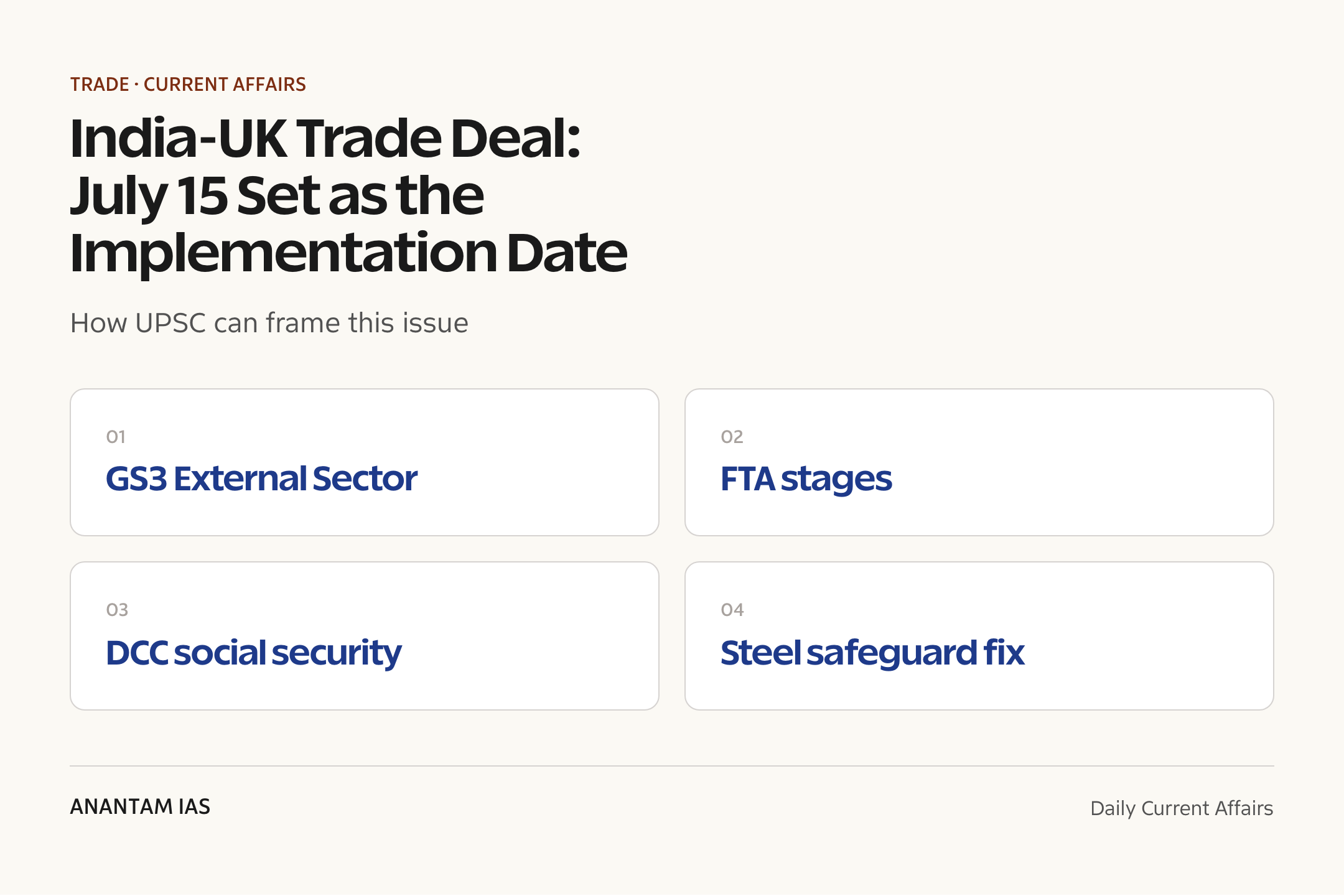
- FTAs and the external sector — how CETA reshapes India’s market access, tariff structure and export basket.
- Trade defence: how a partner’s post-signature steel safeguard threatened the deal, and the quota/AUS fix.
GS Paper 2
- India-UK bilateral relations and economic diplomacy after Brexit; mobility gains via the DCC.
Essay
- Free trade in an age of rising protectionism — promise and friction.
- Globalisation and the mobility of labour: who gains from social-security pacts?
Background and Context
What CETA is, and the 2025 signing
CETA is the India-UK free trade agreement — distinct from the July 15 ‘entry into force’ now in the news.
- Full name: Comprehensive Economic and Trade Agreement; negotiations concluded 6 May 2025, signed 24 July 2025.
- It is a comprehensive FTA — goods, services, investment, mobility, government procurement and IPR, not just tariff lines.
- Signing (2025) is the legal commitment; entry into force (15 July 2026) is when tariff cuts and rules actually start. The two are separate stages.
- Billed as the UK’s most economically significant trade deal since leaving the European Union.
Tariff cuts and market access
The deal trades deep, phased tariff cuts on both sides, with India ring-fencing its sensitive farm and metals lines.
- UK eliminates tariffs on 99% of its product lines; India secures duty-free access for around 99% of its export value.
- Labour-intensive Indian gains: textiles, leather, marine products, gems and jewellery, toys; plus engineering goods and chemicals.
- Scotch whisky and gin duty drops from 150% to 75% immediately, then to 40% over a decade.
- Automobiles: duties on petrol/diesel cars fall from 110% to 10% in-quota; EVs phased from year 6.
- India protected sensitive items: dairy, cereals, millets, pulses, apples, gold, jewellery, and lab-grown diamonds.
- Services: India won commitments across all 12 service sectors and 137 sub-sectors.
Double Contribution Convention (DCC)
The social-security pact riding alongside CETA is a direct win for Indian professionals working in Britain.
- Also called the Agreement on Social Security; takes effect the same day, 15 July 2026.
- Lets the posted workers avoid paying social-security contributions in both countries — so-called ‘double contribution’.
- Exemption period extended from 3 to 5 years, a major gain for India’s temporary workers and IT services firms.
- Cuts payroll costs for Indian companies sending staff to the UK, improving their competitiveness.
- Mobility concessions sit within the wider India-UK Comprehensive Economic Partnership framework.
The steel hurdle that delayed it
A UK rule announced after signature — not part of the negotiated text — nearly derailed the rollout.
- In May 2026, the UK announced a steel regulation applying to all countries, due to start on 1 July 2026.
- It cut the duty-free steel-import quota by 60% and doubled the above-quota tariff to 50%.
- These measures were a safeguard-type action outside the CETA negotiations, so they ‘suddenly halted’ implementation.
- Resolution uses a mix of country-specific quotas, residual quotas and an Authorised Use Scheme (AUS).
- The Ministry of Commerce and Industry stressed protecting commercial interests and minimising market disruption; exact terms were not disclosed.
What does ‘entry into force’ mean?
A trade agreement passes through distinct legal stages; only the final one moves the tariffs.
- Conclusion of negotiations — text agreed (May 2025).
- Signing — political and legal commitment (July 2025).
- Ratification / domestic approval — each side completes its internal legal process.
- Entry into force — the date obligations become operative; tariff cuts and rules apply (15 July 2026).
- Until entry into force, traders still pay the old applied tariffs, which is why the date matters commercially.
Strategic and economic significance
Beyond tariffs, the deal anchors a deeper India-UK economic partnership.
- Bilateral trade stands at USD 56 billion, with a stated aim to double it by 2030.The
- UK estimates the FTA could lift bilateral trade by about GBP 25.5 billion a year in the long run.
- Signals India can secure market access from a G7 partner while shielding sensitive sectors.
- Part of India’s wider FTA push — alongside deals and talks with the EU, EFTA, Oman and others.
- The steel episode is a reminder that regulatory autonomy can collide with FTA commitments even after signing.
Way Forward
Smooth and time-bound rollout
- Publish operational customs and rules-of-origin guidance well before 15 July so exporters can plan.
- Translate the steel quota/AUS arrangement into clear, published numbers to remove uncertainty.
Help exporters capture gains
- Handhold MSMEs in textiles, leather and gems to meet UK standards and certification.
- Build awareness of the DCC, so IT and services firms actually claim the social-security savings.
Institutionalise a standing review mechanism so future partner-side regulations — like the steel safeguard — are flagged early and settled without stalling the whole agreement.
Conclusion
Fixing 15 July 2026 turns a signed text into a live agreement: only at entry into force do the tariff cuts and the social-security pact start to bite. The last-minute steel fix shows both sides were willing to protect the deal’s credibility.
For India, CETA is a template — deep market access from a major economy while sensitive farm and metals lines stay shielded, and a mobility win for professionals through the DCC. The real test now is execution: clear rules, ready exporters and a durable way to handle future regulatory shocks.
UPSC Practice Questions
Prelims MCQ 1
With reference to the India-UK Comprehensive Economic and Trade Agreement (CETA), consider the following statements:
- It was signed in 2025 and is set to enter into force on 15 July 2026.
- Under it, the UK will remove tariffs on 99% of its product lines.
- The Double Contribution Convention deals with social security for workers.
How many of the above statements are correct?
(a) Only one (b) Only two (c) All three (d) None
Answer: (c) All three
Explanation:
CETA was signed in July 2025 and entered into force on 15 July 2026 (1 correct). The UK removes tariffs on 99% of its product lines (2 correct). The DCC is the social-security/Agreement on Social Security pact, extending the contribution exemption from 3 to 5 years (3 correct).
Prelims MCQ 2
The ‘last-minute hurdle’ that delayed the India-UK CETA’s implementation was related to:
(a) UK steel import quotas and tariffs
(b) Scotch whisky duty disputes
(c) Visa rules for Indian students
(d) Agricultural subsidies on dairy
Answer: (a) UK steel import quotas and tariffs
Explanation:
A UK regulation announced in May 2026 cut the duty-free steel-import quota by 60% and doubled the above-quota tariff to 50%, effective July 1, 2026 — a measure outside the CETA text that stalled the rollout until a quota/AUS solution was reached.
UPSC Mains Questions
- The India-UK CETA shows that signing a free trade agreement and bringing it into force are two distinct stages. Examine the legal and economic significance of ‘entry into force’ using the steel-tariff episode that delayed the deal.
- Free trade agreements with developed economies offer market access but raise concerns about sensitive sectors and regulatory shocks. Critically evaluate India’s gains from the India-UK CETA, including the Double Contribution Convention.
Sources: Ministry of Commerce and Industry and The Hindu.
Frequently Asked Questions
What is the India-UK CETA?
CETA stands for Comprehensive Economic and Trade Agreement — the free trade agreement between India and the United Kingdom. Signed in July 2025, it covers goods, services, investment, mobility and more. The UK removes tariffs on 99% of its product lines, while India secures duty-free access for around 99% of its export value, with sensitive sectors protected.
When does the India-UK trade deal take effect?
It enters into force on 15 July 2026. That is the date the negotiated tariff cuts and rules actually start applying. The agreement was signed in July 2025, but until entry into force traders kept paying the old tariffs, which is why fixing this date is a major milestone.
What was the steel hurdle that delayed it?
In May 2026 the UK announced a new steel regulation, applying to all countries from 1 July 2026, that cut its duty-free steel-import quota by 60% and doubled the above-quota tariff to 50%. This was outside the CETA negotiations and stalled the rollout until both sides agreed a fix using country-specific quotas, residual quotas and an Authorised Use Scheme.
What is the Double Contribution Convention (DCC)?
The DCC, also called the Agreement on Social Security, lets Indian professionals posted to the UK avoid paying social-security contributions in both countries. The exemption period was raised from 3 to 5 years, cutting payroll costs for Indian companies and boosting the competitiveness of India’s IT and services firms. It takes effect on 15 July 2026, alongside CETA.
What does ‘entry into force’ mean for a trade deal?
It is the final legal stage when the agreement’s obligations become operative. The earlier stages are concluding negotiations, signing, and domestic ratification. Only at entry into force do tariff cuts and rules apply; before that, the old applied tariffs remain in place, so the date has direct commercial impact for exporters.
How is signing different from implementation?
Signing (July 2025) is the political and legal commitment to the agreed text. Implementation, or entry into force (15 July 2026), is when the deal actually operates and tariffs change. A deal can be signed but not yet in force — as happened here when the steel regulation pushed the date back from the planned April-May 2026 rollout.
Tell Google you want more of this.
Add Anantam IAS as a preferred sourceOne tap, and this site shows up more often in your own Top Stories, AI Overviews and AI Mode. Remove it any time.