Why in News?
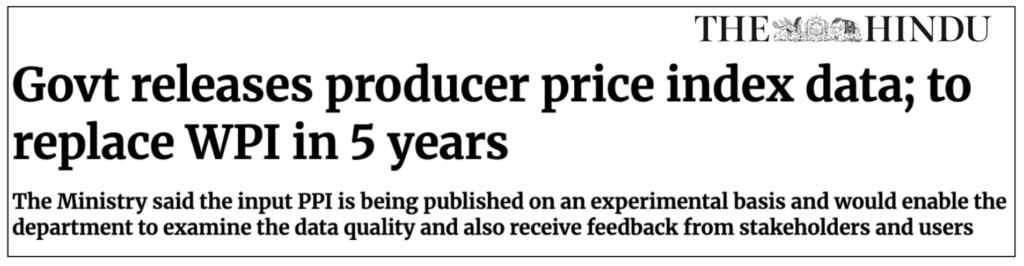
The Government of India, on 15 June 2026, released Producer Price Index (PPI) data for both goods and services for the first time, and announced that the long-running Wholesale Price Index (WPI) will be discontinued and replaced by the PPI over the next five years. The Commerce and Industry Ministry confirmed the move alongside the monthly WPI release.
The switch follows the report of a working group headed by former NITI Aayog member Ramesh Chand and is in line with practices in advanced economies and the recommendation of the International Monetary Fund (IMF) that India transition from WPI to PPI.
- Output PPI (all commodities) for May 2026 stood at 109.6, up from 108.6 in April 2026.
- Output PPI inflation rose to 9.4% in May from 8.1% in April; WPI inflation rose to 9.68% from 8.26%.
- Trial Input PPI for the manufacturing sector stood at 104.9 for May 2026, published on an experimental basis.
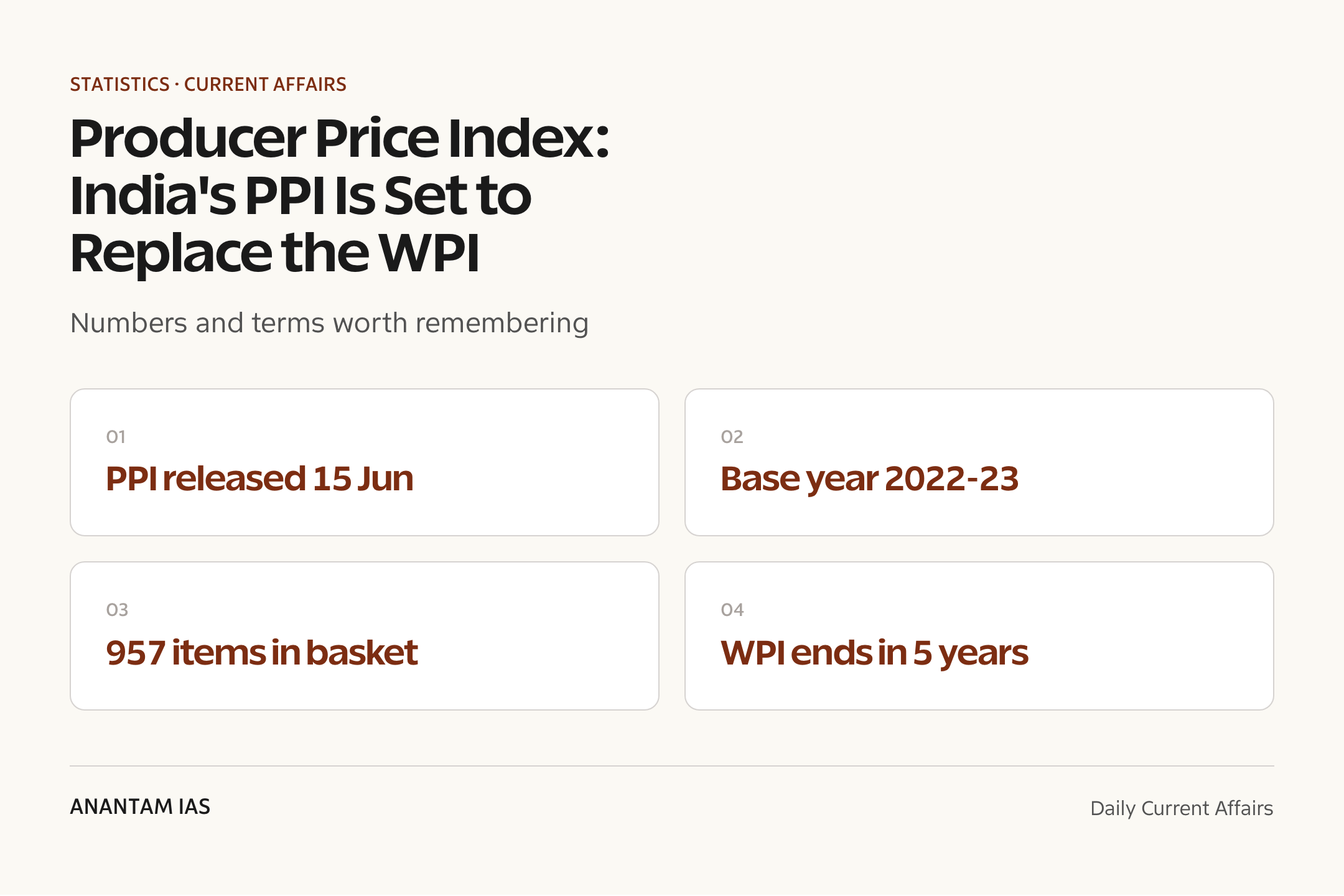
- Both WPI and PPI now use a revised base year of 2022-23 (from 2011-12 for WPI), covering 957 items.
- WPI publication ends after five years; the Ramesh Chand working group was set up in December 2024 and submitted its report in April 2026.
The development matters in the context of:
- It matters because the index used to measure producer-side inflation feeds directly into GDP deflators and National Accounts, shaping how real growth is estimated.
- It matters for monetary policy and forecasting, since a producer-perspective gauge captures cost pressures before they reach retail prices.
UPSC Relevance
Prelims Relevance
- PPI measures the average change in selling prices received by domestic producers; WPI measures prices at the wholesale/bulk transaction stage.
- CPI (compiled by NSO, MoSPI) measures retail prices paid by consumers and is the RBI’s headline inflation anchor.
- PPI and WPI are compiled by the Office of the Economic Adviser, under DPIIT, Ministry of Commerce & Industry.
- Revised base year for WPI and PPI: 2022-23; basket of 957 items.
- PPI sub-types released: Output PPI (Goods), Input PPI (Goods) and Service PPI.
- Manufactured items carry the highest weight in output PPI at 69.93%; agriculture, forestry and fishing 22.16%.
- Service PPI Phase 1 covers seven services: banking, securities transactions, insurance, pension fund management, railways, air (passenger) and telecom.
- Working group chaired by former NITI Aayog member Ramesh Chand; PPI aligns with IMF advice and global statistical practice.
Mains Relevance
GS Paper 3
- Inflation measurement reform: why a producer-perspective index improves National Accounts and GDP deflation versus the WPI.
- Implications of the WPI-to-PPI shift for monetary policy signalling, indexation and economic forecasting in India.
GS Paper 2
- Statistical governance and credibility of official data: role of the Office of the Economic Adviser and expert working groups in index reform.
Essay
- Numbers that shape policy: how a nation measures prices reflects the economy it wants to understand.
Background and Context
What changed on 15 June 2026
The government released India’s first PPI and set a sunset date for the WPI.
- The Producer Price Index (PPI) for goods and services was published for the first time, alongside the monthly WPI.
- The Commerce and Industry Ministry said the release of the WPI index will be discontinued after five years, with PPI as the successor.
- Three new series were unveiled: Output PPI (Goods), trial Input PPI (Goods) and Service PPI.
- The shift follows the report of the working group under former NITI Aayog member Ramesh Chand, submitted in April 2026.
PPI vs WPI vs CPI — the three price gauges
India runs three distinct inflation indices, each measuring a different point in the price chain.
- CPI (Consumer Price Index): retail prices paid by households; compiled by the National Statistical Office under MoSPI; the RBI’s flexible inflation-targeting anchor.
- WPI (Wholesale Price Index): prices in bulk/wholesale transactions; counts goods only, excludes services, and double-counts at multiple transaction stages.
- PPI: the average change in selling prices received by domestic producers for their output, and the prices they pay for inputs.
- PPI covers services (WPI does not) and avoids the double-counting that distorts WPI.
Why PPI captures producer-side inflation better
The PPI is built around the producer rather than the market transaction.
- Ramesh Chand’s report noted that PPI gives a more accurate measure of price changes from the producer’s perspective, improving suitability for National Accounts / GDP compilation.
- Tracking both output and input PPI shows how cost pressure on inputs is passed through to output prices in an industry.
- WPI mixes prices at several points of sale and double-counts; PPI follows the international output/input framework used by advanced economies.
- By including services, PPI reflects a modern, services-heavy economy that the goods-only WPI cannot.
Who compiles it — the Office of the Economic Adviser
Producer and wholesale price data are not a MoSPI product; they sit in the Commerce ministry.
- The Office of the Economic Adviser (OEA), under the Department for Promotion of Industry and Internal Trade (DPIIT), Ministry of Commerce & Industry, compiles the WPI and now the PPI.
- CPI is separate — compiled by the National Statistical Office under the Ministry of Statistics and Programme Implementation (MoSPI).
- Service PPI prices for sampled establishments will be drawn partly from administrative GSTN data, strengthening the data pipeline.
- The expert working group was chaired by Ramesh Chand and constituted on 30 December 2024.
Composition, weights and base year
The new series rebases the index and restructures the basket.
- Revised base year for both WPI and PPI: 2022-23, replacing 2011-12 for the WPI.
- The basket spans 957 items representing goods transacted across the economy.
- Output PPI (Goods) weights: manufacturing 69.93%, agriculture/forestry/fishing 22.16%, electricity 4.49%, mining and quarrying 3.42%.
- By contrast, WPI weights manufactured products 63.12%, fuel and power 14.11%, and primary articles 22.76%.
- Service PPI carries no weights yet, as only seven services are covered; indices are released without weights until the basket expands.
Global practice and why the switch
Most major economies left the wholesale-price model behind years ago.
- The IMF repeatedly flagged a growing need for India to move from WPI to PPI.
- Advanced economies such as the US, UK and Japan rely on a PPI, not a WPI, to gauge producer inflation.
- The Service PPI is being rolled out in phases — seven services first (banking, securities transaction, insurance, pension-fund management, railways, air passenger, telecom), the rest later.
- Input PPI is being published experimentally first, so the OEA can test data quality and collect stakeholder feedback before it goes live.
Way Forward
Manage the transition
- Run WPI and PPI in parallel through the five-year window so contracts, indexation clauses and back-series can migrate smoothly.
- Publish a credible back-cast PPI series so analysts can compare across the changeover without breaks.
Widen and deepen coverage
- Expand Service PPI beyond the first seven services to reflect India’s services-led growth.
- Stabilise the experimental Input PPI using GSTN and survey data before it becomes an official input to policy.
Build user familiarity through documentation and outreach, so the RBI, forecasters and businesses can read PPI signals as fluently as they once read WPI.
Conclusion
The move to a Producer Price Index closes a long-standing gap in India’s statistical system, swapping a goods-only, double-counting wholesale gauge for a producer-centred index that also captures services and feeds cleanly into GDP estimation.
Sequenced over five years and grounded in the Ramesh Chand working group and IMF advice, it brings India in step with global practice — provided the transition keeps both series visible, and the service basket keeps widening.
UPSC Practice Questions
Prelims MCQ 1
With reference to India’s Producer Price Index (PPI) introduced in 2026, consider the following statements:
- It is compiled by the Office of the Economic Adviser under the Ministry of Commerce & Industry.
- It covers selected services in addition to goods.
- It is set to replace the Consumer Price Index over five years.
How many of the above statements are correct?
(a) Only one (b) Only two (c) All three (d) None
Answer: (b) Only two
Explanation:
Statements 1 and 2 are correct: the PPI (and WPI) is compiled by the Office of the Economic Adviser under the Commerce ministry, and the new Service PPI covers seven services. Statement 3 is wrong — the PPI replaces the Wholesale Price Index (WPI), not the CPI.
Prelims MCQ 2
Which sector carries the highest weight in India’s new Output PPI (Goods)?
(a) Agriculture, forestry and fishing
(b) Manufacturing
(c) Electricity
(d) Mining and quarrying
Answer: (b) Manufacturing
Explanation:
Manufactured items carry the highest weight at 69.93% in the Output PPI (Goods), followed by agriculture, forestry and fishing (22.16%), electricity (4.49%) and mining and quarrying (3.42%).
UPSC Mains Questions
- India is phasing out the Wholesale Price Index in favour of a Producer Price Index over five years. Examine how the PPI improves the measurement of producer-side inflation and its compilation of National Accounts.
- Reliable price statistics are foundational to sound economic policy. In this light, discuss the rationale for India’s shift from WPI to PPI and the challenges in managing the transition.
Sources: Office of the Economic Adviser, Ministry of Commerce & Industry and The Hindu.
Frequently Asked Questions
What is the Producer Price Index (PPI)?
The PPI measures the average change over time in the selling prices received by domestic producers for their output, and the prices they pay for inputs. India released its first PPI for goods and services on 15 June 2026, with separate Output PPI, Input PPI and Service PPI series, using a 2022-23 base year.
How is PPI different from WPI?
WPI tracks prices in bulk wholesale transactions, counts only goods, and double-counts at multiple sale stages. PPI is built around the producer, covers services as well as goods, and follows the output/input framework used by advanced economies. This makes PPI a cleaner input for GDP and National Accounts than the WPI.
How is PPI different from CPI?
CPI measures retail prices that consumers actually pay and is compiled by the National Statistical Office under MoSPI; it is the RBI’s headline inflation anchor. PPI measures prices from the producer’s side. The two sit at different points of the supply chain, so they can move differently in the same month.
Who compiles the PPI in India?
The Office of the Economic Adviser, under the Department for Promotion of Industry and Internal Trade (DPIIT) in the Ministry of Commerce & Industry, compiles both the WPI and the new PPI. This is separate from the CPI, which MoSPI’s National Statistical Office produces.
When will the WPI be discontinued?
The Commerce and Industry Ministry has said the WPI will be phased out over five years, after which the PPI becomes the main producer-side inflation gauge. WPI and PPI will run in parallel during the transition so users can migrate smoothly.
Why is India switching to a PPI?
The change follows the Ramesh Chand working group report and the IMF’s recommendation, and aligns India with advanced economies that use a PPI rather than a WPI. A producer-perspective index better captures cost pass-through, includes services, and improves the accuracy of GDP and National Accounts estimates.
Tell Google you want more of this.
Add Anantam IAS as a preferred sourceOne tap, and this site shows up more often in your own Top Stories, AI Overviews and AI Mode. Remove it any time.