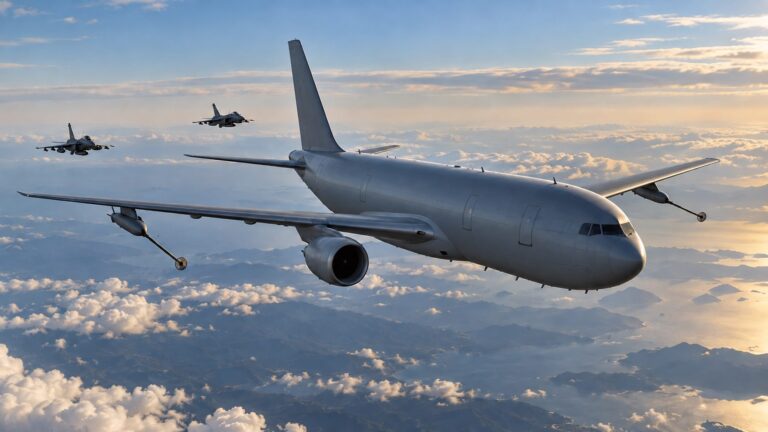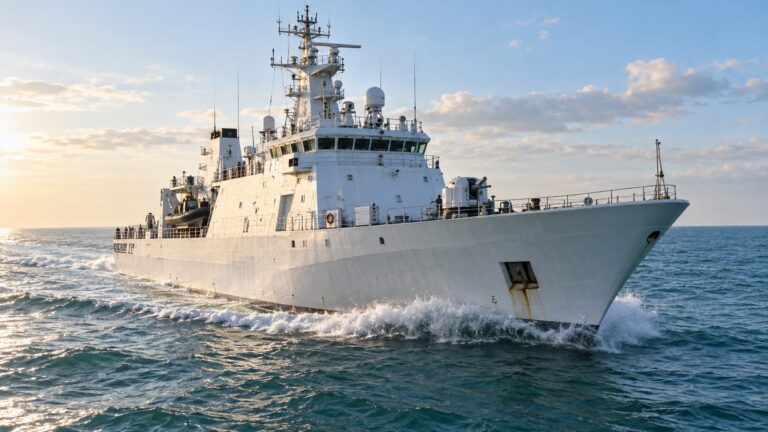
Why in News?
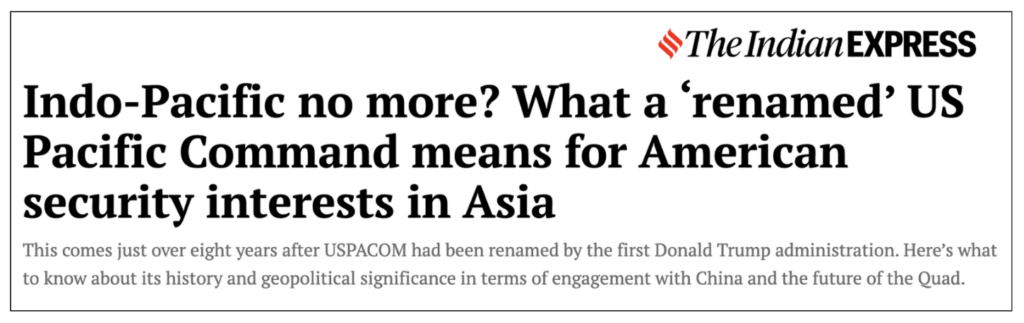
On 16 June 2026, the renamed US Department of War (formerly Department of Defence) announced that US Indo-Pacific Command (USINDOPACOM) will revert to its older name, US Pacific Command (USPACOM) — dropping the word ‘Indo’ that was added only in 2018. The Indian Express reported the move and its signalling for the Indo-Pacific idea, the Quad and India-US strategic alignment.
Officials stressed the change is largely symbolic: the command’s mission and its area of responsibility (AOR) — stretching from the US West Coast to India’s western maritime boundary — stay unchanged. But the optics matter, because the prefix ‘Indo’ was a deliberate acknowledgement of India and the Indian Ocean as central to US strategy.
- Decision announced by the US Department of War; framed as ‘restoring legacy’.
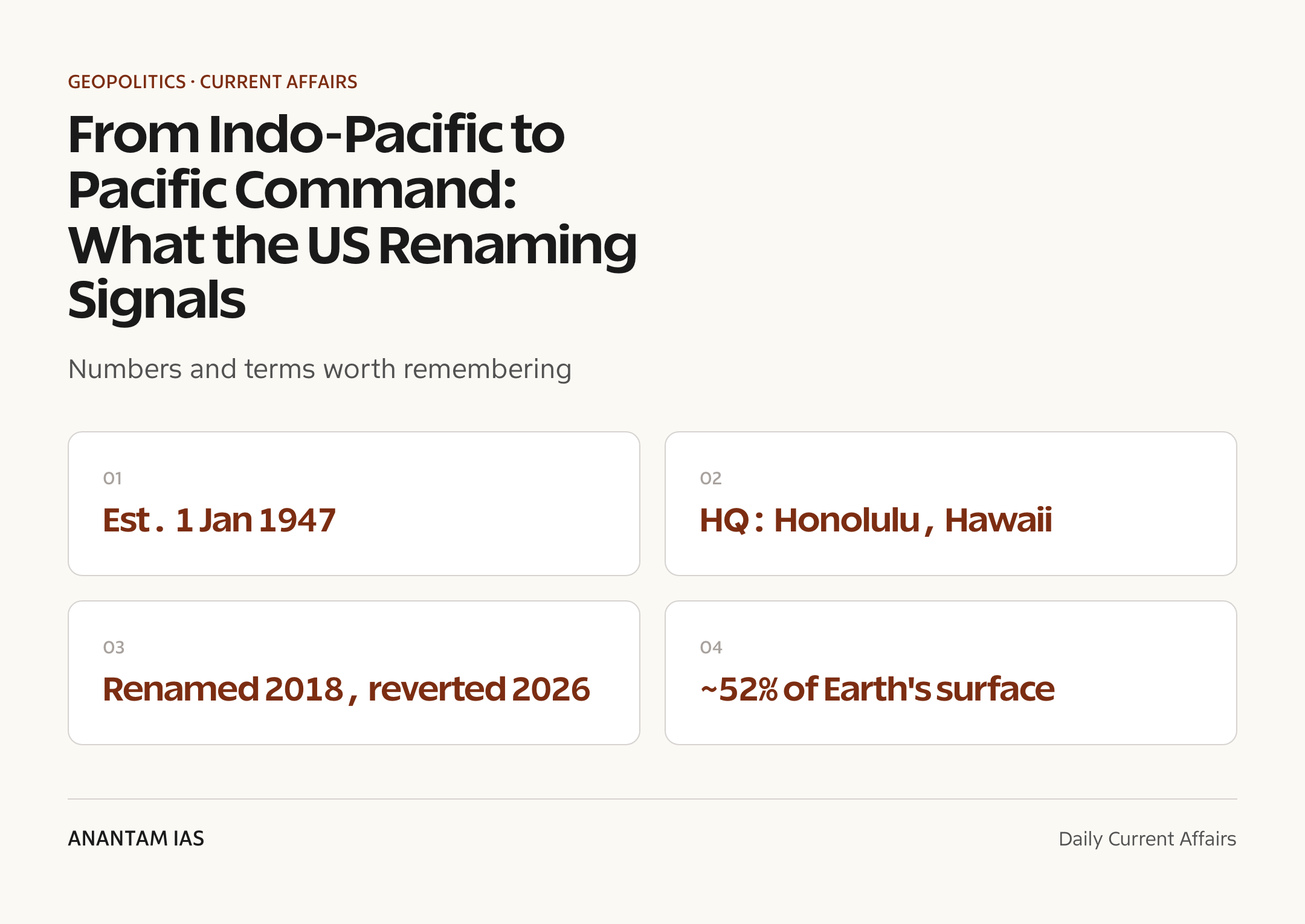
- Reverses the 2018 rename from PACOM to INDOPACOM made under then-Defence Secretary James Mattis.
- The command’s AOR, mission and structure are officially unchanged; only the name reverts.
- INDOPACOM is the oldest and largest US unified combatant command, set up on 1 January 1947, headquartered in Honolulu, Hawaii.
- It covers roughly 52% of Earth’s surface and over 375,000 service members.
- Congress MP Shashi Tharoor asked whether the Quad is ‘taking another hit’, linking the rename to concerns over US commitment.
The development matters in the context of:
- Tests how far the Indo-Pacific construct — a frame India helped popularise — remains the organising lens of US Asia policy.
- Feeds the debate on whether the Quad and India’s role are being quietly de-emphasised under a more China-direct US posture.
- A live example for understanding how naming and symbolism carry strategic signalling in international relations.
UPSC Relevance
Prelims Relevance
- USINDOPACOM vs USPACOM: 2018 rename and 2026 reversal
- INDOPACOM established 1 January 1947; HQ at Honolulu, Hawaii
- Oldest and largest US unified combatant command; ~52% of Earth’s surface
- AOR runs from the US West Coast to India’s western maritime boundary
- Quad members: India, the United States, Japan, Australia
- Indo-Pacific as a geopolitical (not purely geographic) construct
- SAGAR and MAHASAGAR — India’s maritime vision frameworks
- Malabar naval exercise; IPMDA (Indo-Pacific maritime domain awareness)
- India’s foundational defence agreements with the US: LEMOA, COMCASA, BECA
Mains Relevance
GS Paper 2
- Effect of policies and politics of developed countries on India’s interests — US rebranding and the Indo-Pacific construct.
- Bilateral and regional groupings: how a symbolic US move affects the Quad and India-US strategic alignment.
GS Paper 3
- Security challenges in the maritime domain and China’s balancing in the Indian Ocean Region.
- India’s defence cooperation and interoperability with major powers.
Essay
- What’s in a name? Symbolism, signalling and the limits of soft power in geopolitics.
- India and the Indo-Pacific: from a Pacific-centric order to a two-ocean strategic space.
Background and Context
What exactly changed
Strip the noise: this is a name reversal, not a structural or mission change.
- USINDOPACOM reverts to USPACOM — the prefix ‘Indo’ is dropped after eight years.
- The US Department of War called it ‘restoring legacy’, consistent with Secretary Pete Hegseth’s wider rebranding drive (including reverting the department’s own name from ‘Defence’ to ‘War’).
- Officials confirmed the command’s area of responsibility, mission and forces are unchanged.
- So the substance is intact; the signalling is what India and analysts are reading.

The 2018 rename and why it happened
INDOPACOM was a deliberate strategic statement when it replaced PACOM in 2018.
- In May 2018, PACOM was renamed to INDOPACOM.
- Stated rationale: ‘recognition of the increasing connectivity between the Indian and Pacific Oceans‘.
- It elevated India and the Indian Ocean Region (IOR) from the margins to the centre of US Asia strategy.
- It dovetailed with the US ‘Free and Open Indo-Pacific’ framing and the revival of the Quad the same year.
What the command is
PACOM/INDOPACOM is the anchor of the US military presence across the world’s most contested maritime space.
- Established on 1 January 1947, the oldest and largest of the US unified combatant commands.
- Headquartered in Honolulu, Hawaii; commands over 375,000 personnel.
- AOR spans from the US West Coast westward to India’s western maritime boundary, and from the Arctic to the Antarctic.
- Covers roughly 52% of the Earth’s surface — about 100 million square miles.
The ‘Indo-Pacific’ construct and India’s role
Indo-Pacific is a geopolitical idea, not just a map — and India is integral to it.
- Stitches the Indian and Pacific Oceans into a single strategic theatre, foregrounding the IOR.
- India frames the space through SAGAR (‘Security and Growth for All in the Region’) and its successor vision, MAHASAGAR.
- Underpins cooperation via the Quad, the Malabar exercise and maritime domain awareness initiatives.
- India’s location, navy and the Andaman and Nicobar Command make it a natural pivot for any two-ocean strategy.

The Quad and India-US alignment
The rename lands amid questions about how central India remains to US plans.
- The Quad (India, US, Japan, Australia) uses the Indo-Pacific frame as its core organising logic.
- Congress MP Shashi Tharoor asked whether the Quad is ‘taking another hit’ from the rename.
- India-US defence ties rest on the foundational pacts LEMOA, COMCASA and BECA and growing technology cooperation.
- A semantic downgrade of ‘Indo’ could be read as trimming India’s symbolic weight, even if operations continue.
What does it signal about the US strategy and China
Dropping ‘Indo’ fits a more Pacific-centric, China-direct US posture.
- The reversal narrows the optical emphasis back toward the Pacific and direct China balancing.
- Critics see it as diluting the wider Indian Ocean dimension that ties in partners like India.
- Supporters call it cosmetic — the AOR still reaches India’s waters, so engagement need not shrink.
- For India, the test is actions over labels: arms sales, exercises and tech-transfer trends, not the nameplate.
Way Forward
Read intent through deeds
- India should track operational signals — joint exercises, tech transfer, intelligence-sharing — over nomenclature.
- Keep the Quad agenda functional (IPMDA, supply chains, critical tech), so it is not hostage to one term.
Anchor India’s own framing
- Continue advancing SAGAR/MAHASAGAR and IOR leadership, so the Indo-Pacific idea has an Indian author, not just a US one.
- Deepen ties with Japan, Australia, France and ASEAN to keep the two-ocean logic alive, independent of US labels.
Strategic autonomy means India treats the rename as a data point, not a verdict — diversifying partnerships while keeping the US relationship on a steady, interest-based footing.
Conclusion
The US dropping ‘Indo’ from its Pacific Command is, on paper, a return to a 1947 name with no change to mission or map. But in international relations, names are signals, and the frame India helped centre has been quietly de-emphasised.
For India, the prudent response is to watch behaviour, not branding — sustaining the Quad, deepening defence interoperability and pressing its own SAGAR/MAHASAGAR vision so the Indo-Pacific stays a shared, durable construct rather than an American label that can be switched off.
UPSC Practice Questions
Prelims MCQ 1
With reference to the US Pacific Command (PACOM/INDOPACOM), consider the following statements:
- It is the oldest and largest of the US unified combatant commands.
- It is headquartered in Honolulu, Hawaii.
- Its area of responsibility extends westward up to India’s western maritime boundary.
How many of the above statements are correct?
(a) Only one (b) Only two (c) All three (d) None
Answer: (c) All three
Explanation:
PACOM, set up on 1 January 1947, is the oldest and largest US unified combatant command, headquartered at Honolulu, Hawaii, with an AOR running from the US West Coast to India’s western maritime boundary.
Prelims MCQ 2
The renaming of US Pacific Command to ‘Indo-Pacific Command’ in 2018 was primarily intended to:
(a) Recognise the strategic connectivity between the Indian and Pacific Oceans
(b) Bring the Atlantic Ocean under the command’s responsibility
(c) Replace the role of NATO in Asia
(d) Merge the Quad into a formal military alliance
Answer: (a) Recognise the strategic connectivity between the Indian and Pacific Oceans
Explanation:
Defence Secretary James Mattis said the 2018 rename reflected the ‘increasing connectivity between the Indian and Pacific Oceans’, elevating India and the Indian Ocean in US strategy.
UPSC Mains Questions
- The renaming of the US Indo-Pacific Command back to Pacific Command is officially symbolic, yet it has drawn strategic concern in India. Discuss what the move signals for the Indo-Pacific construct, the Quad and India-US alignment.
- ‘In geopolitics, names are signals.’ Examine the significance of the ‘Indo-Pacific’ construct for India’s maritime strategy, and assess how India can keep the framework durable irrespective of shifts in US nomenclature.
Sources: The Indian Express and Stars and Stripes / Breaking Defence.
Frequently Asked Questions
What changed in the US Pacific Command renaming?
On 16 June 2026, the US Department of War announced that US Indo-Pacific Command (INDOPACOM) will revert to US Pacific Command (PACOM), dropping the prefix ‘Indo’ added in 2018. Officials say it is a symbolic name change; the command’s mission, structure and area of responsibility remain unchanged.
When was PACOM first renamed to INDOPACOM?
In May 2018, under then US Defense Secretary James Mattis, the command was renamed from US Pacific Command to US Indo-Pacific Command. Mattis described it as recognition of the growing connectivity between the Indian and Pacific Oceans, elevating India and the Indian Ocean in US strategy.
Why does the rename matter for India?
The prefix ‘Indo’ was a deliberate acknowledgement of India and the Indian Ocean as central to US Asia strategy. Dropping it is read by some, including MP Shashi Tharoor, as a symbolic downgrade of India’s weight and a possible signal about US commitment to the Quad, even though operations are unchanged.
What is the ‘Indo-Pacific’ construct?
The Indo-Pacific is a geopolitical idea, not merely a geographic region. It stitches the Indian and Pacific Oceans into a single strategic theatre, foregrounding the Indian Ocean and India’s role. It underpins the Quad, the Malabar exercise and the US ‘Free and Open Indo-Pacific’ framing.
Does the rename change the Quad?
Not formally. The Quad (India, US, Japan, Australia) and its work on maritime awareness, technology and supply chains continue. But because the Quad uses the Indo-Pacific frame as its organising logic, the rename has prompted questions about whether the construct and India’s place in it are being de-emphasised.
How big is the command’s area of responsibility?
PACOM/INDOPACOM is the oldest (established 1 January 1947) and largest US unified combatant command, headquartered in Honolulu, Hawaii. It oversees more than 375,000 personnel across an area covering roughly 52% of the Earth’s surface, from the US West Coast to India’s western maritime boundary.
Tell Google you want more of this.
Add Anantam IAS as a preferred sourceOne tap, and this site shows up more often in your own Top Stories, AI Overviews and AI Mode. Remove it any time.