Why in News?
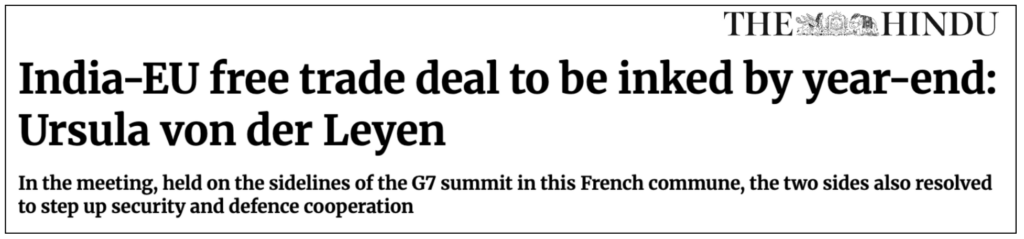
On the sidelines of the G7 Summit in Evian-les-Bains, France (17 June 2026), European Commission President Ursula von der Leyen said the long-pending India-EU Free Trade Agreement (FTA) will be signed by the end of 2026, after a bilateral meeting with Prime Minister Narendra Modi.
She posted on X, “We will sign the Free Trade Agreement by the end of the year”, and said the two sides will accelerate work on an investment agreement, capping nearly two decades of stop-start talks and India’s most ambitious trade deal yet.
- Negotiations were concluded on 27 January 2026 at the 16th India-EU Summit in New Delhi; signing is now targeted for the year-end 2026.The
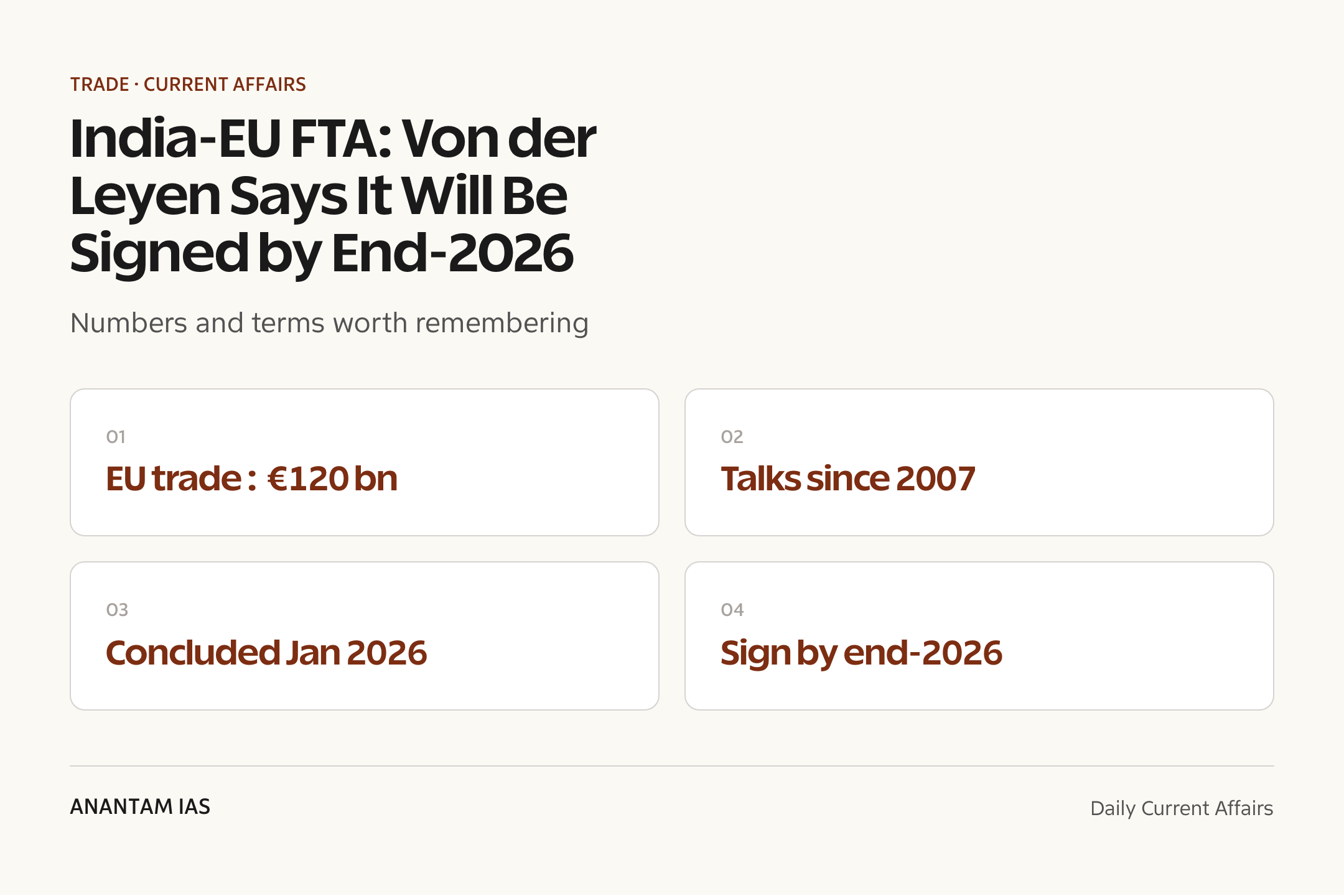
- The EU is India’s largest trading partner — goods trade hit about €120 billion in 2024 (~11.5% of India’s total goods trade).
- Leaders also agreed to advance the India-Middle East-Europe Economic Corridor (IMEC) and step up security and defence cooperation.
- Talks build on the Joint India-EU Comprehensive Strategic Agenda endorsed in January 2026.
The development matters in the context of:
- India is diversifying trade ties amid US tariff uncertainty and a push to cut over-reliance on any single market.
- Follows the India-UK FTA (signed 2025, in force 15 July 2026) and the India-EFTA TEPA — part of a wider Western trade pivot.
UPSC Relevance
Prelims Relevance
- Free Trade Agreement (FTA) — a pact to cut tariffs/non-tariff barriers on substantially all trade between members.
- European Union (EU) — 27-member bloc; negotiates trade as a single customs union via the European Commission.
- Ursula von der Leyen — President of the European Commission; António Costa — President of the European Council.
- EU is India’s largest trading partner in goods (~€120 bn, 2024).
- CBAM — Carbon Border Adjustment Mechanism, an EU carbon tax on imports of steel, aluminium, cement, etc.
- IMEC — India-Middle East-Europe Economic Corridor, launched at the G20 New Delhi Summit (2023).
- India-EFTA TEPA — Trade and Economic Partnership Agreement with Iceland, Liechtenstein, Norway, and Switzerland (signed 2024).
- Mode 4 — temporary movement of natural persons (service professionals) under WTO/GATS.
- India-UK CETA — Comprehensive Economic and Trade Agreement; comes into force 15 July 2026.
- G7 — Canada, France, Germany, Italy, Japan, the UK, US (India is a regular invitee, not a member).
Mains Relevance
GS Paper 2
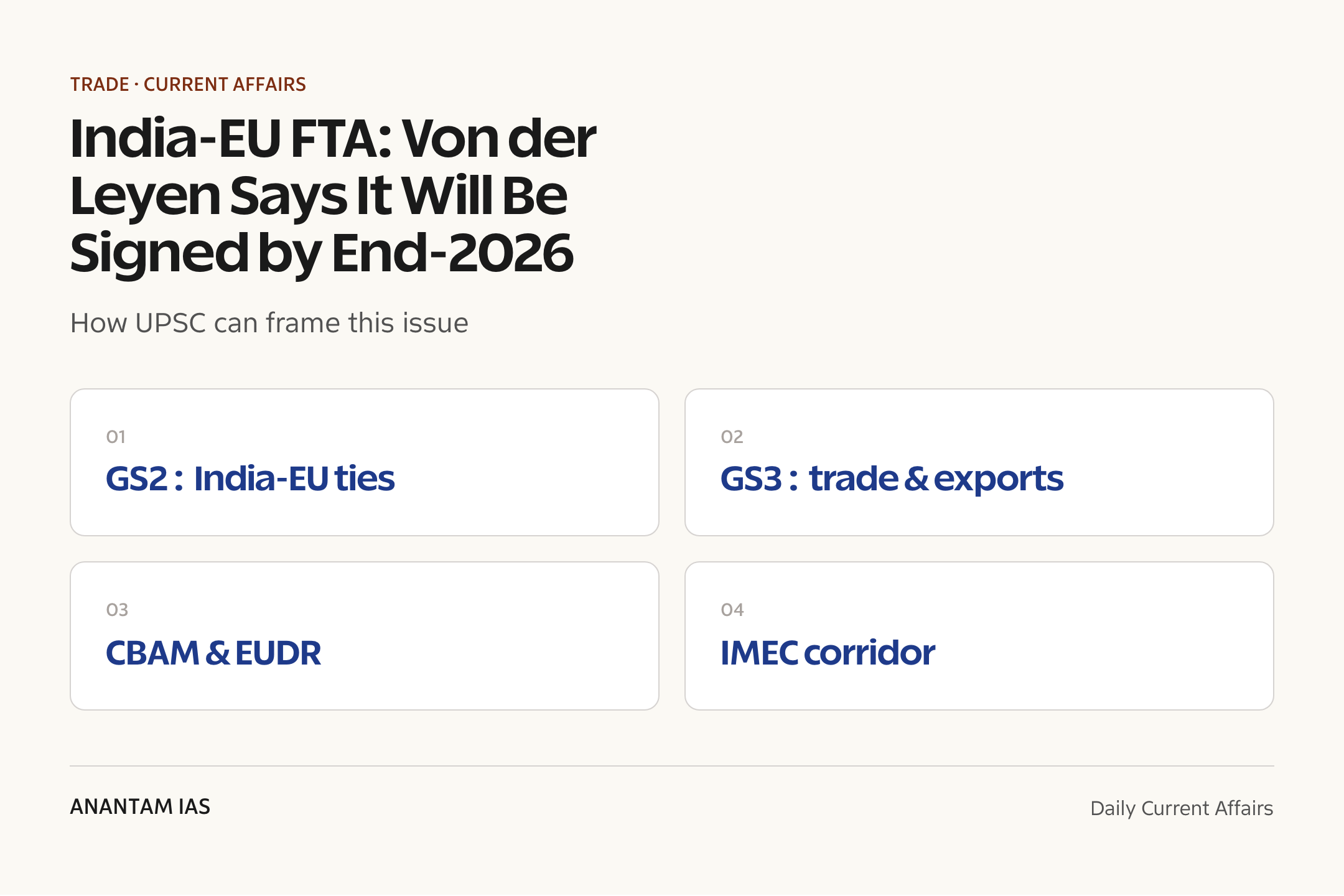
- India-EU relations: trade as the anchor of a strategic partnership, and the FTA’s place in India’s foreign policy.
- Implications of India’s bilateral/regional trade deals for its WTO and multilateral commitments.
GS Paper 3
- Effect of the FTA on India’s manufacturing, exports (textiles, pharma, autos) and agriculture; role in trade diversification.
- Non-tariff barriers — CBAM and deforestation rules — as new challenges to Indian exporters.
Essay
- Trade is the new theatre of diplomacy: how economic agreements reshape strategic alignments.
- Self-reliance versus open markets — striking the balance in a protectionist world.
Background and Context
What the FTA is and why it matters
An India-EU FTA would be the largest trade deal either side has concluded.
- An FTA lowers or removes tariffs and eases non-tariff barriers on goods, opens services, and sets rules on investment, IPR, and standards.
- The EU is India’s largest trading partner in goods — about €120 billion in 2024, roughly 11.5% of India’s total goods trade.
- Indian gains: duty-free access for textiles, leather, pharma, chemicals and engineering goods into a high-income market of 27 countries.
- EU gains: lower Indian tariffs on cars, wines and spirits, machinery and better access for European services and investment.
- Beyond trade, it locks in a strategic partnership covering IMEC connectivity, security, technology and supply-chain resilience.
A near-two-decade journey
Talks began in 2007, collapsed in 2013, and were relaunched in 2022.
- Negotiations were first launched in June 2007 but stalled by 2013 after 15 inconclusive rounds over autos, dairy and professional mobility.
- The EU pressed for deep tariff cuts on automobiles, wines and dairy; India sought greater Mode 4 access for its service professionals.
- Negotiations were relaunched on 17 June 2022 amid a shared push to de-risk supply chains.
- Talks concluded on 27 January 2026 at the 16th India-EU Summit in New Delhi; legal scrubbing and translation precede signing.
- Von der Leyen’s G7 statement sets a firm end-2026 deadline to ink the text and move to ratification.
The sticking points — cars, cows and carbon
The hardest issues were autos, agriculture, carbon rules and data.
- Automobiles — the EU long sought the removal of India’s ~110% car tariffs; India offered phased cuts on high-value vehicles under a capped annual quota over a decade.
- Dairy — milk and cheese stayed a red line for India and were largely shielded to protect small farmers.
- CBAM — the EU’s carbon border tax on steel, aluminium and cement threatens Indian exports; India sought safeguards and a technical working group on carbon compliance.
- Deforestation rules (EUDR) — EU due diligence norms on coffee, leather, rubber and timber raise compliance costs for exporters.
- Data adequacy — the EU’s data-protection standards and India’s DPDP Act, 2023, shape cross-border data flows for services trade.
Why the timing — India’s trade diversification
The deal is one piece of India’s wider pivot to friendly, high-income markets.
- Comes amid US tariff uncertainty, pushing India to spread export risk across partners.
- Follows the India-UK CETA (signed 2025, in force 15 July 2026) and the India-EFTA TEPA (signed 2024), targeting $100 billion in EFTA investment.
- Reinforces India’s ‘China+1’ appeal as global firms seek alternative manufacturing bases.
- Aligns with India’s goal of becoming a $5-trillion economy and lifting merchandise and services exports.
Strategic and connectivity dimension
The FTA sits inside a broader India-EU strategic agenda.
- Leaders agreed to advance the India-Middle East-Europe Economic Corridor (IMEC) — rail, port and digital links from India to Europe via West Asia.
- Talks tracked the Joint India-EU Comprehensive Strategic Agenda endorsed in January 2026.
- Both sides flagged stronger security and defence cooperation and work toward an investment protection agreement.
- Anchored in shared democratic values and a stated common vision, positioning India and the EU as the world’s two largest democracies trading freely.
Way Forward
Close the text and ratify
- Complete legal scrubbing, translation into EU languages, and signing by end-2026, then secure European Parliament and member-state ratification.
- Lock down the parallel investment protection agreement to give investors certainty.
Help exporters adapt
- Build firm-level capacity on CBAM and the EU deforestation rules through the agreed technical working groups.
- Support MSMEs in textiles, leather and engineering to meet EU standards and certification.
Protect sensitive sectors
- Preserve carve-outs for dairy and sensitive agriculture while phasing in auto and wine concessions cautiously.
- Use the deal to push for Mode 4 mobility gains for Indian professionals.
Conclusion
A signed India-EU FTA would be the bloc’s largest-ever trade pact and a centrepiece of India’s strategy to diversify trade away from over-dependence on any one partner.
The harder test lies after signing — turning headline access into real gains while managing carbon and deforestation barriers, protecting farmers, and converting trade into a durable strategic partnership.
UPSC Practice Questions
Prelims MCQ 1
With reference to the India-EU Free Trade Agreement, consider the following statements:
- The European Union is India’s largest trading partner in goods.
- Negotiations for the FTA were first launched in 2007 and relaunched in 2022.
- The Carbon Border Adjustment Mechanism (CBAM) is an Indian carbon tax on EU imports.
How many of the above statements are correct?
(a) Only one (b) Only two (c) All three (d) None
Answer: (b) Only two
Explanation:
Statements 1 and 2 are correct. Statement 3 is wrong: CBAM is the EU’s carbon border tax on imports (steel, aluminium, cement), not an Indian levy.
Prelims MCQ 2
The India-Middle East-Europe Economic Corridor (IMEC), referenced in the India-EU talks, was launched at which event?
(a) The 16th India-EU Summit, 2026
(b) The G20 Summit in New Delhi, 2023
(c) The G7 Summit in France, 2026
(d) The India-EFTA signing, 2024
Answer: (b) The G20 Summit in New Delhi, 2023
Explanation:
IMEC was announced on the sidelines of the G20 New Delhi Summit in 2023 as a connectivity corridor linking India, West Asia and Europe.
UPSC Mains Questions
- “Trade agreements are increasingly instruments of strategic alignment, not just commerce.” In the light of the India-EU FTA, examine how India is using trade deals to advance its foreign-policy and economic-security goals. (250 words)
- Discuss the major sticking points that delayed the India-EU FTA for nearly two decades, and assess how new non-tariff barriers like CBAM and EU deforestation rules could affect Indian exporters. (250 words)
Sources: Ministry of External Affairs and The Hindu.
Frequently Asked Questions
What is the India-EU FTA?
It is a Free Trade Agreement between India and the 27-member European Union that lowers or removes tariffs and eases non-tariff barriers on goods, opens services and investment, and sets common rules on standards and intellectual property. It would be the largest trade deal either side has concluded.
When will the India-EU FTA be signed?
Negotiations were concluded on 27 January 2026 at the 16th India-EU Summit in New Delhi. At the G7 Summit in June 2026, European Commission President Ursula von der Leyen said the agreement will be signed by the end of 2026, after which it needs ratification by the European Parliament and member states.
Why is the EU important for India’s trade?
The EU is India’s largest trading partner in goods, with bilateral goods trade of about €120 billion in 2024 — roughly 11.5% of India’s total goods trade. The bloc is also a major source of investment and technology, making the FTA central to India’s export and growth ambitions.
What were the main sticking points?
The hardest issues were autos (India’s high car tariffs versus EU demands), dairy and sensitive agriculture (a red line for India), the EU’s carbon border tax CBAM, EU deforestation due-diligence rules, data-protection standards, and mobility for Indian professionals under Mode 4.
What is CBAM and why does it matter?
CBAM is the EU’s Carbon Border Adjustment Mechanism, a carbon tax on imports of carbon-intensive goods like steel, aluminium and cement. It could raise costs for Indian exporters, so India sought safeguards and a technical working group to ease carbon-compliance under the FTA.
How does this link to India’s other trade deals?
It follows India’s recent pivot to high-income markets: the India-UK CETA (signed 2025, in force 15 July 2026) and the India-EFTA TEPA (signed 2024). Together they reflect India’s strategy of trade diversification amid US tariff uncertainty.
Tell Google you want more of this.
Add Anantam IAS as a preferred sourceOne tap, and this site shows up more often in your own Top Stories, AI Overviews and AI Mode. Remove it any time.