Daily Digest
UPSC · Civil Services Examination
Current Affairs · Friday, 18 September 2026
Current affairs curated and edited by Anantam IAS faculty — pulled from The Hindu, PIB, IDSA, Foreign Affairs and the ministries. Read, annotate, revise.
Old Rajinder Nagar · Delhi 110005 · anantamias.com
Soil Carbon Payments: Linking Verified Farm Practices to Income
Why in News?
On 17 September 2026, PIB reported the first soil carbon payments under Grow Indigo’s Aadi programme, connecting verified agricultural outcomes with farmer income in Punjab and Haryana.
- The release announced over ₹2.9 crore for 2,550 farmers, with the first digital payments initiated at Punjab Agricultural University, Ludhiana.
- Credits followed measurement and independent verification of farm practices undertaken during 2019–2022; enrollment alone did not trigger payment.
- Grow Indigo paid from its own funds before all credits were sold; the transfer was not a new government income-support entitlement.
- Carbon finance can reward environmental outcomes beyond the crop sold, but only when those outcomes can be credibly accounted for.
- For smallholders, the time between changing a practice and receiving money matters alongside the eventual payment amount.
UPSC Relevance
Prelims Relevance
- Soil organic carbon: carbon contained in soil organic matter.
- MRV: measurement, reporting and verification of claimed outcomes.
- Additionality: climate benefit beyond the credible without-project scenario.
- Permanence: durability of stored carbon and management of reversal risk.
- Credit issuance and sale: distinct stages with different financial consequences.
Mains Relevance
GS Paper 3
- Agriculture: farmer incentives, soil management and transaction costs.
- Environment: credible carbon accounting and climate-finance integrity.
GS Paper 2
- Governance: transparent contracts, benefit sharing and accessible dispute resolution.
Essay
- Environmental value becomes an economic opportunity only when institutions make it measurable and fairly rewarded.
Background and Context
What a soil-carbon payment actually rewards
The asset being credited is an assessed climate outcome associated with management change, rather than simply the presence of carbon in a farmer’s soil.
- Soil organic carbon forms part of soil organic matter. Plant residues and roots contribute carbon, while decomposition releases some back; management affects this balance, but outcomes also depend on soil and climate.
- Regenerative practices in Aadi included direct-seeded rice, reduced tillage and residue management. These are management choices, not automatic certificates: their relevant greenhouse-gas reductions or soil-carbon gains must pass the programme’s assessment before credit issuance.
- A baseline represents conditions against which change is assessed. Credible accounting asks what would happen without the project, so maintaining an already existing carbon stock cannot automatically be described as newly achieved removal.
- Additionality asks whether the credited benefit goes beyond the without-project outcome. A farmer adopting a beneficial practice is not, by itself, sufficient proof that the carbon-market intervention produced an additional climate benefit.
- Net climate benefit requires attention to relevant emissions as well as storage. The IPCC assessment notes that extra fertiliser-related emissions can negate soil-carbon gains; counting only a growing carbon stock can mislead.

From field evidence to farmer payment
The programme separates scientific assessment, independent checking, issuance and financing; each stage answers a different question about whether a farmer can receive credible additional income.
- Measurement and reporting assemble evidence for the climate claim. PIB describes ICAR contributions involving soil-sampling protocols, greenhouse-gas accounting, modelling and remote sensing; these complementary inputs support assessment rather than turning every satellite observation into a credit.
- Independent verification checks the assessed results before issuance. Aadi credits used Verra’s VM0042 methodology; scientific support from ICAR does not convert that voluntary-credit arrangement into a government promise to purchase every farmer’s credits.
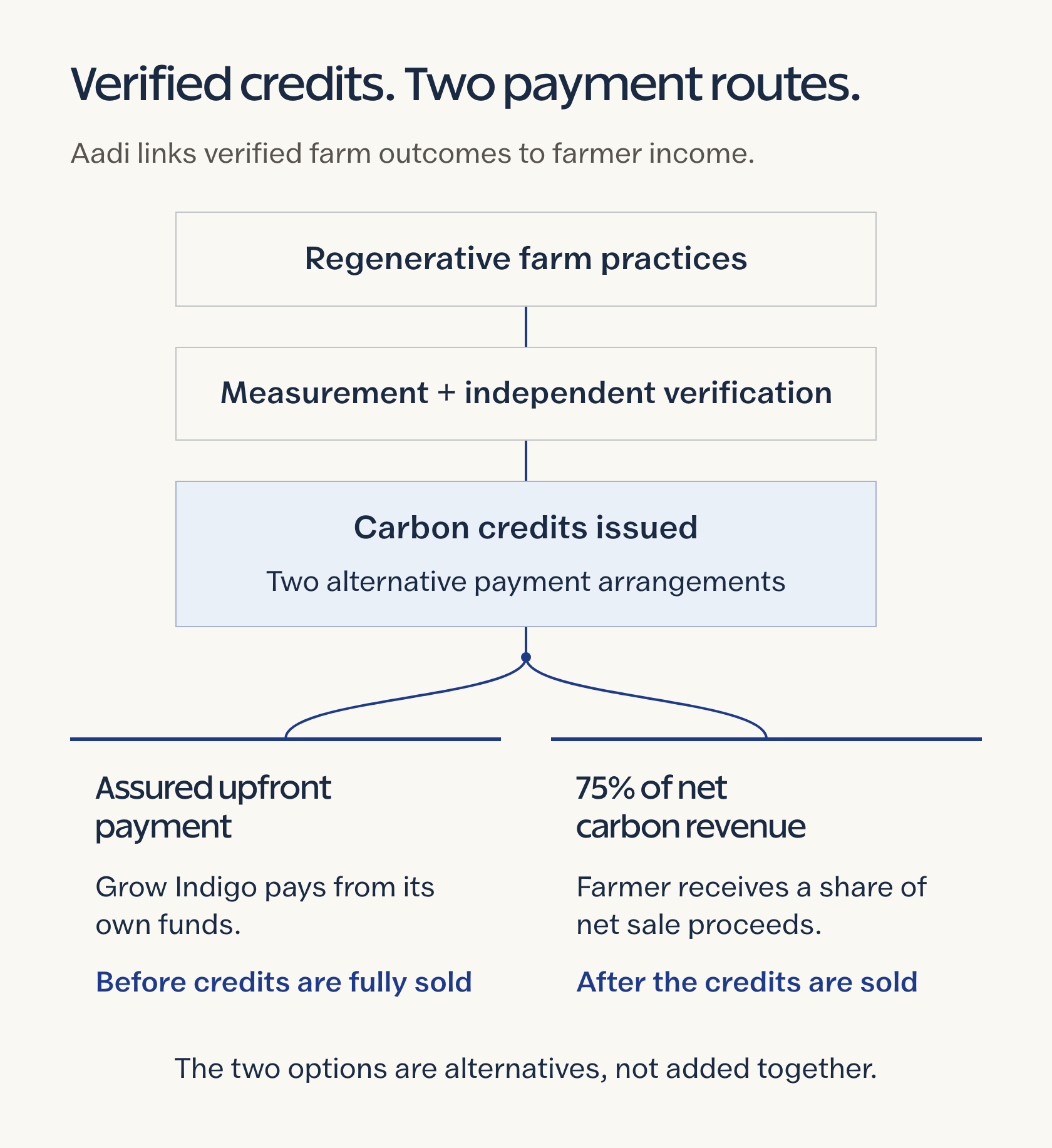
- Issuance is not sale: credits can exist before buyers have paid for them. In this case, Grow Indigo used its own money to bridge that interval, allowing farmer payments before complete sale of the credits.
- Payment choice involved an assured upfront amount or 75% of net carbon revenue after sale. The distinction matters because net proceeds depend on the contract’s deductions, while a percentage alone does not establish earnings.
- Monitoring cycles explain why enrollment and payment dates differ. Farmers joining after 2022 belong to the next cycle; the release links their payments to subsequent credit issuance, not immediate participation in the programme.
What can weaken the incentive
A credible credit and a worthwhile farm decision overlap, but neither guarantees the other; safeguards must protect both the climate claim and the cultivator.
- Permanence concerns how long carbon remains stored. Changed management or environmental stresses can reverse gains, so a payment today cannot by itself demonstrate durable storage; monitoring and responsibility for reversals need explicit treatment.
- Measurement uncertainty matters because soil carbon varies across locations and depths. A representative sampling design and consistent methods are essential; apparent changes caused by inconsistent sampling should not become claims of additional climate benefit.
- Transaction costs can absorb revenue through sampling, verification and administration. Collective arrangements may spread those costs, but farmers need to see deductions and bargaining terms, as the wider smallholder experience illustrates.
- Local suitability should guide practice adoption. Expected carbon income cannot replace assessment of water, labour and crop-management needs; the living-laboratories approach offers a useful model for connecting research with farmers’ field conditions.
- Evidence boundaries remain important: the release reports programme estimates of environmental benefits, not a controlled attribution study. Neither statewide farm-fire trends nor programme coverage proves that every enrolled farmer has achieved or received the same benefit.
Way Forward
Make the claim and the contract readable
- Provide a farmer payment statement showing credited outcomes, payment option, deductions, timing and whom to contact over a disputed amount.
- Use shared verification services to reduce avoidable costs while preserving independent assessment and access to the evidence supporting each claim.
- Explain reversal responsibilities and continuing obligations before enrollment, including how changing cultivation arrangements affects the contract.
- Combine carbon incentives with local agronomic advice, so adoption remains practical even when credit revenue is delayed or uncertain.
Conclusion
- Soil-carbon finance works through a chain of credible outcomes, verified credits and transparent payments. Its promise for farmers depends on both environmental integrity and the actual income left after participating in the programme.
- In an answer, distinguish practice adoption, credit issuance and payment. The Ludhiana case demonstrates financing before complete credit sale, while leaving wider questions about durable storage, costs and equitable participation open to scrutiny.
UPSC Practice Questions
Prelims MCQ 1
With reference to agricultural carbon-credit programmes, consider the following statements:
- Credit issuance necessarily means the credits have already been sold.
- Additionality examines the benefit relative to a credible without-project scenario.
- Changes in soil management can reverse previously achieved soil-carbon gains.
How many of the above statements are correct?
(a) Only one (b) Only two (c) All three (d) None
Answer: (b) Only two
Explanation:
Statements 2 and 3 are correct. Additionality uses a counterfactual, and soil-carbon storage can reverse. Aadi demonstrates that issuance can precede complete sale.
Prelims MCQ 2
Which statement best explains the financing arrangement reported for Aadi’s first soil-carbon payments?
(a) The Union government guaranteed a fixed payment to every farmer. (b) Grow Indigo paid from its own funds before all credits were sold. (c) Farmers were paid automatically upon enrollment. (d) Independent verification was postponed until after credit issuance.
Answer: (b) Grow Indigo paid from its own funds before all credits were sold.
Explanation:
PIB expressly identifies Grow Indigo’s own funds as the source of these advance payments. Measurement and independent verification preceded issuance; enrollment alone was insufficient.
UPSC Mains Questions
- How can agricultural carbon markets connect climate mitigation with smallholder incomes? Examine the roles of verification, payment timing and benefit sharing.
- Why are additionality and permanence central to the credibility of soil-carbon credits? Discuss safeguards suited to farmer participation.
Sources: PIB, Ministry of Agriculture and Farmers Welfare and FAO, Soil Carbon Sequestration for Improved Land Management.
Frequently Asked Questions
What are soil carbon payments?
They reward farmers for credited climate outcomes associated with soil and farm management. Payment depends on programme rules, assessed outcomes and financial arrangements; adopting a practice does not automatically generate a credit.
Is Aadi a new government cash-transfer entitlement?
No. PIB describes Grow Indigo’s farmer carbon programme with ICAR technical support. Grow Indigo used its own funds for the reported payments; digital transfer does not make it a universal government income-support entitlement.
Why can farmers wait years for carbon payments?
Evidence must be collected and assessed over a monitoring cycle, independently verified and followed by credit issuance. Sale proceeds may arrive later, although programme financing can bridge the interval after issuance.
Why does soil-carbon permanence matter?
Stored carbon can return to the atmosphere when management or environmental conditions change. Credible soil-carbon programmes must address that reversal risk rather than treating an observed increase as proof of permanent storage.
Did the payments prove a statewide reduction in stubble burning?
No. The release includes wider environmental trends and programme estimates, but these do not establish that the payments caused statewide changes. Such a claim requires evidence that separates the programme’s effect from other influences.
Source: https://anantamias.com/current-affairs/soil-carbon-payments-verification-farmer-incentives/
Prescription-Drug CCTV Draft: Oversight and Patient Privacy
Why in News?
On 17 September 2026, the Union Health Ministry explained a draft amendment proposing mandatory CCTV at medical stores to strengthen oversight of Schedule H, H1 and X drugs.
- Draft status: The proposal concerns amendments to the Drugs Rules, 1945; it should not be described as an implemented nationwide CCTV requirement.
- Notification: The ministry identifies draft G.S.R. 791(E), dated 8 September 2026, and invites public objections and suggestions.
- Regulatory objective: The proposed surveillance seeks to curb unauthorized access and sales without valid prescriptions.
- Public health: Prescription enforcement concerns both medicine safety and the conditions under which patients can obtain necessary treatment.
- Governance: Recording transactions creates evidence only when inspectors can connect it to valid prescriptions, dispensing records and accountable decisions.
UPSC Relevance
Prelims Relevance
- Schedule H, H1 and X: prescription categories under the Drugs Rules
- Drugs Consultative Committee and Drugs Technical Advisory Board
- Draft notification versus operative legal requirement
- Prescription records versus CCTV footage
Mains Relevance
GS Paper 2
- Regulatory oversight, patient confidentiality and access to medicines
- Consultation and accountability in delegated rulemaking
GS Paper 3
- Limits of surveillance technology in public-health enforcement
Essay
- Technology strengthens public institutions when evidence and accountability develop together.
Background and Context
What the proposal changes, and what it does not
The immediate issue is a proposed monitoring tool within an existing medicine-regulation framework, rather than a new permission to dispense prescription medicines.
- The Drugs Rules already regulate prescription sales. The proposed camera requirement would add an observational layer, helping oversight authorities examine what happened at a medical store alongside its existing transaction records.
- The Drugs Consultative Committee first discussed the proposal; the Drugs Technical Advisory Board subsequently recommended approval. These deliberations explain its institutional route, but a recommendation alone does not establish an operative CCTV obligation.
- The ministry has sought public objections and suggestions. This matters because patients, pharmacists and inspectors encounter different practical problems; consultation can expose costs or confidentiality risks that a surveillance proposal initially overlooks.
- The ministry release does not establish footage-retention periods, access permissions or camera-placement conditions. These details must not be invented or presented as settled legal obligations merely because mandatory surveillance has been proposed.
- For an examination answer, separate the existing prescription requirement, the proposed surveillance addition and expected outcomes. Reducing unauthorized sales is the stated objective; its actual achievement would require evidence after implementation and enforcement.

Why prescription categories and evidence must be distinguished
A prescription authorizes a specified supply, while a record makes the transaction traceable; neither function can be replaced simply by recording a customer.
- Schedule H, H1 and X identify categories with prescription-related controls under the Drugs Rules. They are not interchangeable labels for narcotics; describing every covered medicine as a narcotic confuses distinct regulatory classifications.
- Schedule H1 supply requires a separate register recording the prescriber, patient, medicine and quantity. The teaching point is traceability: an inspector needs a usable transaction trail, not merely evidence that a person visited.
- Schedule X carries additional prescription-copy and secure-storage requirements. This shows why enforcement must match the relevant category: a general camera installation cannot demonstrate that every applicable dispensing and storage condition was fulfilled.
- CCTV footage could help corroborate a disputed transaction when matched with records. Its evidentiary value depends on reliable timing and identification; a visible exchange alone may not establish the medicine or prescription involved.
- Antimicrobial stewardship explains one public-health connection: appropriate prescribing and dispensing help address antimicrobial resistance. However, pharmacy cameras cannot determine whether a clinical diagnosis or the selected medicine was appropriate for that patient.
How to assess effectiveness without overlooking privacy
The policy test is whether better detection produces safer dispensing while protecting legitimate access, rather than whether every store acquires a functioning camera.
- Deterrence is a plausible mechanism, not a demonstrated outcome here. A seller may reconsider an unauthorized transaction if detection is credible, but cameras need inspection follow-through and consequences for verified breaches to matter.
- Patient confidentiality requires attention because a recorded visit can associate an identifiable person with medicine purchases. Even without capturing a consultation, footage may expose sensitive information if copied, shared or viewed without justification.
- Proportionality offers a design test: identify the precise enforcement problem, ask what information is necessary, and compare less intrusive alternatives. Collecting more footage should not automatically be treated as delivering more patient safety.
- Compliance costs include maintenance, secure storage and staff time, beyond buying hardware. An impact assessment should examine whether requirements burden smaller stores or interrupt access, while preserving the same substantive dispensing standards for patients.
- Outcome evaluation should examine verified prescription violations and corrective action, alongside confidentiality complaints. Counting installations alone measures equipment adoption; it cannot show whether unlawful sales declined or legitimate patients obtained medicines more safely.
Way Forward
Link surveillance to accountable dispensing
- Define safeguards: Any final framework should specify necessary coverage, justified retention, authorized access and deletion, with clear responsibility for protecting recordings.
- Strengthen verification: Train inspectors to compare prescriptions, stock and dispensing records before drawing conclusions from footage.
- Evaluate effects: Track substantiated violations, patient complaints and implementation costs to determine whether the intervention improves dispensing practice.
Conclusion
- CCTV can support oversight when it corroborates records within a functioning inspection system. The enduring distinction is between observing a transaction and establishing that dispensing complied with its applicable requirements.
- The proposal remains a draft. Assess its eventual design through effectiveness, proportionality and access to treatment, while keeping uncertain operational details separate from verified existing prescription controls.
UPSC Practice Questions
Prelims MCQ 1
With reference to prescription-drug regulation in India, consider the following statements:
- Schedule H1 supply requires a separate register.
- Every medicine listed in Schedule H, H1 or X is necessarily a narcotic.
- A recommendation by the Drugs Technical Advisory Board alone establishes an operative CCTV obligation.
How many of the above statements are correct?
(a) Only one (b) Only two (c) All three (d) None
Answer: (a) Only one
Explanation:
Only statement 1 is correct. The Drugs Rules require a separate Schedule H1 supply register. Prescription categories do not mean all listed medicines are narcotics, and a board recommendation does not itself bring the proposed CCTV requirement into operation.
Prelims MCQ 2
Which approach best evaluates whether pharmacy CCTV improves prescription-drug oversight?
(a) Count cameras installed, without examining dispensing records. (b) Treat every recorded purchase as proof of a prescription violation. (c) Examine substantiated violations and corrective action while monitoring privacy complaints. (d) Replace prescription verification with continuous video recording.
Answer: (c) Examine substantiated violations and corrective action while monitoring privacy complaints.
Explanation:
This approach examines regulatory outcomes and possible harms. Installations are inputs, while video alone does not establish prescription validity or compliance.
UPSC Mains Questions
- Can CCTV improve the regulation of prescription-drug dispensing? Discuss its evidentiary limits and the safeguards needed to protect patients.
- Explain why consultation and outcome evaluation are important when introducing technology-based regulatory requirements for medical stores.
Sources: PIB, Ministry of Health and Family Welfare and CDSCO, Drugs Rules.
Frequently Asked Questions
Is the pharmacy CCTV proposal already in force?
The ministry described a draft amendment and invited objections and suggestions. Its September announcement should not be treated as proof that the proposed CCTV requirement has entered into force.
Are all Schedule H, H1 and X drugs narcotics?
No. These are categories under the Drugs Rules with prescription-related controls. Narcotic classification is a separate legal question; the categories should not be used as interchangeable descriptions of every covered medicine.
What does the Schedule H1 register achieve?
It records supply details, including the prescriber, patient, medicine and quantity. This creates a transaction trail that inspectors can examine when checking compliance, which footage of a customer alone cannot provide.
Does the proposal specify how long footage must be kept?
The ministry release used for this note does not establish a footage-retention period. Retention and access conditions should be checked against authoritative notification text rather than inferred from the surveillance objective.
Can CCTV replace a prescription or clinical assessment?
No. Recording a transaction does not provide prescribing authorization or establish clinical appropriateness. Cameras may supplement evidence, while valid prescriptions, category-specific controls and professional judgment remain distinct parts of safe dispensing.
Source: https://anantamias.com/current-affairs/prescription-drug-cctv-draft-regulatory-safeguards/
India-New Zealand FTA: Legislation Before Entry Into Force
Why in News?
In a 17 September 2026 release, India welcomed New Zealand’s implementing legislation passed on 16 September for the India-New Zealand FTA, while domestic processes for entry into force remained underway.
- The 17 September announcement describes legislative passage as a step towards implementation; it does not announce that preferential tariffs are already operational.
- The agreement was signed on 27 April 2026 in New Delhi, separating its signature from the later domestic implementation stage.
- According to the Commerce Ministry release, 100 per cent of Indian exports will receive duty-free access to New Zealand from entry into force.
- The central policy question is whether negotiated access becomes usable commercial access after legal commencement, customs preparation and exporter compliance.
- Bilateral cooperation includes services and mobility, but goods tariff concessions cannot establish the detailed conditions governing professionals or students.
UPSC Relevance
Prelims Relevance
- Signature, domestic implementation and entry into force.
- Free-trade area versus customs union.
- Rules of origin and preferential tariff eligibility.
- Tariff preferences versus product standards and customs requirements.
Mains Relevance
GS Paper 2
- Domestic implementation of international economic agreements.
- India-New Zealand cooperation beyond goods trade.
GS Paper 3
- Export competitiveness, compliance costs and preference utilization.
Essay
- International commitments produce public value through domestic implementation.
Background and Context
From signature to an operational agreement
An agreement can advance diplomatically and legally before its concessions become available to traders; each stage answers a different question about implementation.
- Signature records the agreement reached between partners, but the commencement conditions determine when its operational benefits begin. Businesses should distinguish the existence of a signed text from an applicable preferential tariff at customs.
- Domestic implementation prepares a country’s legal framework to give effect to its commitments. New Zealand’s parliamentary action is progress on that side; it does not demonstrate that both partners have completed every required process.
- Entry into force is the decisive commencement stage for the promised duty-free access. The Indian announcement says both countries are completing domestic processes, so a current claim of activated preferences would overstate the development.
- Implementation readiness also concerns usable procedures: traders need to know the applicable tariff treatment, documentary requirements and responsible authorities. Legislative progress alone cannot answer every practical question arising when a shipment reaches the border.
- Trade policy analysis should separate the agreement’s legal status from expected economic effects. Passage of legislation establishes a procedural milestone; stronger exports, investment or employment require subsequent evidence rather than inference from that milestone.
What preferential access changes
A tariff concession changes one component of market access; understanding its scope prevents confusion between lower border duties and unrestricted participation in an economy.
- A free-trade area liberalizes trade among participating economies while allowing separate external tariffs. A customs union additionally involves substantially common external trade treatment; bilateral tariff preferences do not themselves create that deeper institutional arrangement.
- Preferential access means eligible imports receive the agreement’s treatment instead of the otherwise applicable tariff. The relevant comparison is the actual duty saving on a product, rather than the size of a headline commitment.
- Rules of origin connect preferential treatment to qualifying goods. Simply shipping a product through a partner country does not establish eligibility; exporters must use the applicable rules rather than assume that dispatch location establishes origin.
- Duty-free access concerns customs duties, not automatic exemption from product standards or import procedures. A competitive exporter must still address applicable requirements affecting whether its goods can lawfully enter and be sold.
- Coverage is directional: the release promises duty-free access for Indian exports to New Zealand, while describing preferential access for New Zealand exports to India. These statements do not establish identical concessions in both directions.
Why available preferences may remain unused
Legal access creates an opportunity, while commercial use depends on whether a firm can satisfy requirements and sell profitably in the destination market.
- Preference utilization concerns eligible trade actually claiming available concessions. It differs from signing an agreement or announcing coverage: businesses may fail to claim benefits when the required information or documentation is difficult to obtain.
- Compliance costs can absorb a small tariff saving, particularly for smaller consignments. Compare the separate RCMC exemption discussion: reducing paperwork addresses participation costs, whereas a tariff concession changes the duty payable on qualifying trade.
- Documentation systems can help firms demonstrate eligibility without changing the underlying concession. The India-MERCOSUR origin protocol illustrates this separate administrative question; electronic proof should not be confused with bringing a different agreement into force.
- Commercial competitiveness still depends on quality, freight, reliability and buyer demand. Even complete tariff removal cannot guarantee orders when delivered prices remain uncompetitive or the exporter cannot consistently meet the purchaser’s specifications.
- Services and mobility operate through their own commitments and conditions. The announcement identifies opportunities for professionals and students, but it cannot support assumptions about unrestricted migration, automatic professional recognition or specific visa entitlements.

Way Forward
Make commencement usable for firms
- Publish clear commencement guidance once the applicable processes are complete, distinguishing operational benefits from commitments awaiting implementation.
- Provide product-specific exporter guidance on duties, origin evidence and relevant standards, with accessible support for smaller firms.
- Monitor preference claims and recurring clearance difficulties after implementation, alongside export outcomes, to identify whether legal access is becoming usable access.
Conclusion
- The India-New Zealand FTA has advanced through a domestic legislative milestone, but the announcement does not establish entry into force; tariff benefits must be linked to their actual commencement.
- For analytical answers, distinguish legal commitment, operational access and commercial outcomes. A well-designed agreement needs implementation capacity and competitive firms before negotiated opportunities become sustained gains.
UPSC Practice Questions
Prelims MCQ 1
With reference to the India-New Zealand FTA announcement of September 2026, consider the following statements:
- New Zealand passed implementing legislation before the announcement.
- The announcement stated that the agreement had already entered into force.
- The promised duty-free access for Indian exports begins from entry into force.
How many of the above statements are correct?
(a) Only one (b) Only two (c) All three (d) None
Answer: (b) Only two
Explanation:
Statements 1 and 3 are correct. The Commerce Ministry reported legislative passage on 16 September and tied duty-free access to entry into force. Both sides were still completing domestic processes.
Prelims MCQ 2
Which feature distinguishes a customs union from a free-trade area?
(a) Every member must use the same currency (b) Participating countries must abolish all product standards (c) Members apply substantially common external trade treatment (d) All professional qualifications receive automatic recognition
Answer: (c) Members apply substantially common external trade treatment
Explanation:
GATT Article XXIV distinguishes a customs union through substantially the same duties and other regulations of commerce towards outside territories. A free-trade area does not require a common external tariff.
UPSC Mains Questions
- Distinguish signing, domestic implementation and entry into force of a trade agreement. Why do these stages matter for evaluating the India-New Zealand FTA?
- Explain why wide tariff coverage may not produce high preference utilization. Suggest practical measures that can help smaller Indian exporters use trade agreements.
Sources: PIB, Ministry of Commerce and Industry and WTO, Regional Trade Agreements.
Frequently Asked Questions
Has the India-New Zealand FTA entered into force?
The 17 September announcement did not announce entry into force. It welcomed New Zealand’s implementing legislation and said both countries were working to complete their domestic processes for early implementation.
When does duty-free access for Indian exports begin?
The Commerce Ministry says duty-free access to New Zealand begins from the agreement’s entry into force. The announcement does not provide an operational date that exporters can already rely upon.
Does duty-free access remove all import requirements?
No. A customs-duty concession does not automatically remove applicable standards, import procedures or origin requirements. Firms need to establish eligibility and meet the destination market’s requirements before claiming the relevant benefit.
Why might exporters not use an available preference?
Documentation costs, limited information and small duty savings can discourage claims. Freight costs, buyer demand and product compliance also influence whether a firm can convert preferential access into profitable export sales.
Source: https://anantamias.com/current-affairs/india-new-zealand-fta-legislation-entry-into-force/
Primary-Teacher Bridge Course: Pedagogy and Protected Appointments
Why in News?
The Ministry of Education reported on 17 September 2026 that a six-month bridge course for eligible serving primary teachers with B.Ed. degrees was launched on 16 September.
- Delivery: NIOS will implement the Certificate (Bridge) Course in Primary Teacher Education using an NCTE framework.
- Target cohort: The ministry identifies protected B.Ed.-based primary appointments made between 28 June 2018 and 11 August 2023.
- Course format: Open and distance learning combines academic study with online contact classes and school-based practice.
- Eligibility limit: This targeted course does not establish universal B.Ed. eligibility for fresh primary-teacher recruitment.
- Educational quality: Knowing a subject and helping a young child understand it require related but distinct professional skills.
- Administrative fairness: Protecting eligible existing appointments must be connected with meaningful training and assessment, rather than treated as an exemption from teaching standards.
UPSC Relevance
Prelims Relevance
- NIOS: implementing institution for the bridge course
- NCTE: teacher-education framework
- Open and distance learning with school-based practice
- Protected existing appointments versus eligibility for fresh recruitment
- Primary-stage pedagogy and formative assessment
Mains Relevance
GS Paper 2
- Teacher preparation, learning quality and equitable school education
- Balancing protected appointments with professional standards
Essay
- Education depends on how teachers help children learn, not only on qualifications recorded on paper.
Background and Context
Who the bridge course is intended to serve
The policy addresses a defined group of serving teachers; the eligibility boundary is as important as the course announcement itself for understanding this development.
- The ministry announcement identifies primary teachers appointed with B.Ed. degrees during the protected appointment period. It links the bridge course to primary-stage preparation missing from their original qualification pathway, rather than opening general recruitment.
- The NIOS portal expressly says the bridge course is not valid for teachers seeking subsequent employment as primary teachers. A targeted remedy for an existing appointment must not be mistaken for a transferable recruitment entitlement.
- Court-authorized exceptions require separate attention: NIOS provides a registration route for applicants outside the standard appointment dates who have obtained court relaxation. This is not an automatic extension to every teacher outside the period.
- Enrollment and completion are different administrative events. Being admitted indicates entry into training; it does not demonstrate that the teacher has completed practical work, passed assessment or satisfied the applicable conditions for certification.
- The governance challenge is to combine continuity with competence: verify the protected appointment and qualification, then ensure meaningful training. Either indiscriminate inclusion or purely documentary compliance would weaken the targeted purpose of the intervention.
Why teaching young children requires stage-specific pedagogy
The central educational distinction is between possessing subject knowledge and choosing experiences through which children can understand, communicate and use that knowledge in primary classrooms.
- Child development should shape lesson design. For example, sorting familiar objects before introducing abstract categories can reveal how a child reasons; copying a correct definition may conceal whether the underlying concept has been understood.
- Play and activity are purposeful teaching methods when linked to learning goals. A counting game can connect objects with quantities, while teacher observation identifies confusion that a chorus of memorized number names might conceal.
- Language-sensitive teaching connects unfamiliar classroom expressions with language children already understand. A teacher can invite oral descriptions before formal written responses, distinguishing difficulty expressing an idea from difficulty understanding the idea itself.
- Inclusive pedagogy requires adjusting participation and materials for different learning needs. Offering tactile objects, oral explanations or additional response time can help children demonstrate understanding without treating one format as the only acceptable evidence.
- Formative assessment uses classroom evidence to adjust the next lesson. Asking a child to explain a choice can be more useful than simply marking it wrong; the response identifies what support the learner needs next.

How training can translate into classroom improvement
The course design combines flexible study with classroom work, but its public value depends on whether teachers actually revise their practice after receiving useful feedback.
- Open and distance learning allows serving teachers to combine study with professional responsibilities. Flexibility describes how learning is organized; it should not be interpreted as removing supervised contact, practical work or assessment from professional preparation.
- The course includes school-based practice alongside academic learning. Its rationale is application: a teacher studies a method, tries it with children, observes their responses and considers how the next attempt could better support learning.
- Reflective journals and portfolios can document this improvement when they include actual classroom decisions and evidence. Their value falls if assessment rewards copied descriptions instead of explaining why a method worked or needed revision.
- The broader National Education Policy context emphasizes developmentally appropriate learning. Primary schooling includes different developmental phases, so applying the same pace, activity or assessment format across every primary class would miss important differences.
- Evaluation should examine demonstrated teaching practices, not only enrollment or certificates issued. Classroom observation, feedback quality and children’s participation can test whether training changes instruction, while avoiding claims that short-term scores prove lasting impact.
Way Forward
Make certification demonstrate classroom competence
- Verify eligibility: Check appointments and relevant protection before admission; communicate separate court-authorized routes without implying universal access.
- Support practice: Provide useful mentor feedback on observed lessons and realistic opportunities to revise teaching methods.
- Assess application: Require authentic classroom evidence in practical work and offer accessible study support for serving teachers.
Conclusion
- The bridge course is a targeted qualification pathway for eligible serving teachers, not a general route to new primary appointments. Its eligibility conditions and successful-completion requirements must remain distinct in any policy answer.
- The educational purpose is better teaching. A credible bridge connects study with observed classroom practice, allowing teachers to adapt methods to children’s development while demonstrating the professional competence that certification is meant to represent.
UPSC Practice Questions
Prelims MCQ 1
With reference to the NIOS bridge course in Primary Teacher Education, consider the following statements:
- It is directed at an eligible cohort of serving primary teachers with B.Ed. degrees.
- It establishes universal B.Ed. eligibility for fresh primary-teacher recruitment.
- Its open and distance learning format includes school-based practical work.
How many of the above statements are correct?
(a) Only one (b) Only two (c) All three (d) None
Answer: (b) Only two
Explanation:
Statements 1 and 3 are correct. The course targets eligible serving teachers and includes practical work. NIOS explicitly limits its validity for subsequent primary-teacher employment; it is not universal recruitment eligibility.
Prelims MCQ 2
Which classroom practice best illustrates formative assessment at the primary stage?
(a) Publishing a final rank without discussing the child’s work. (b) Repeating the same lesson regardless of pupils’ responses. (c) Using a child’s explanation of an error to plan the next learning activity. (d) Equating successful memorization with understanding every concept.
Answer: (c) Using a child's explanation of an error to plan the next learning activity.
Explanation:
Formative assessment informs ongoing teaching. The teacher interprets evidence of the child’s understanding and changes instruction accordingly, rather than using assessment only to label performance.
UPSC Mains Questions
- Why does primary education require stage-specific teacher preparation? Discuss with examples of pedagogy and assessment.
- A targeted bridge course must balance protected appointments with professional competence. Examine the administrative and classroom safeguards needed to achieve this balance.
Sources: PIB, Ministry of Education and NIOS, Bridge Course in Primary Teacher Education.
Frequently Asked Questions
Who is the primary-teacher bridge course intended for?
It is intended for eligible serving primary teachers with B.Ed. degrees whose appointments fall within the protected cohort. Applicants must satisfy the applicable conditions; holding a B.Ed. degree alone does not establish eligibility.
Does the course qualify every B.Ed. holder for fresh recruitment?
No. It addresses eligible existing primary-teacher appointments. The NIOS portal states that the bridge course is not valid for teachers seeking subsequent employment as primary teachers, so it cannot be treated as universal recruitment eligibility.
Is the course entirely self-study?
No. It uses open and distance learning but also includes online contact and school-based practical work. The combination is intended to connect academic understanding with actual classroom teaching rather than rely exclusively on reading.
Why is primary-stage pedagogy different from subject knowledge?
A teacher must choose activities, language and assessment appropriate to children’s development. Knowing an answer does not automatically provide the skill to diagnose a learner’s difficulty or help that child build understanding.
Does course admission mean the qualification is complete?
No. Admission begins the learning process. Certification requires successful completion of the applicable course and assessment requirements; a registration or admission record alone does not demonstrate teaching competence or completed training.
Source: https://anantamias.com/current-affairs/primary-teacher-bridge-course-pedagogy-eligibility/
OneTag FASTag Portability: Keeping the Tag While Changing Issuers
Why in News?
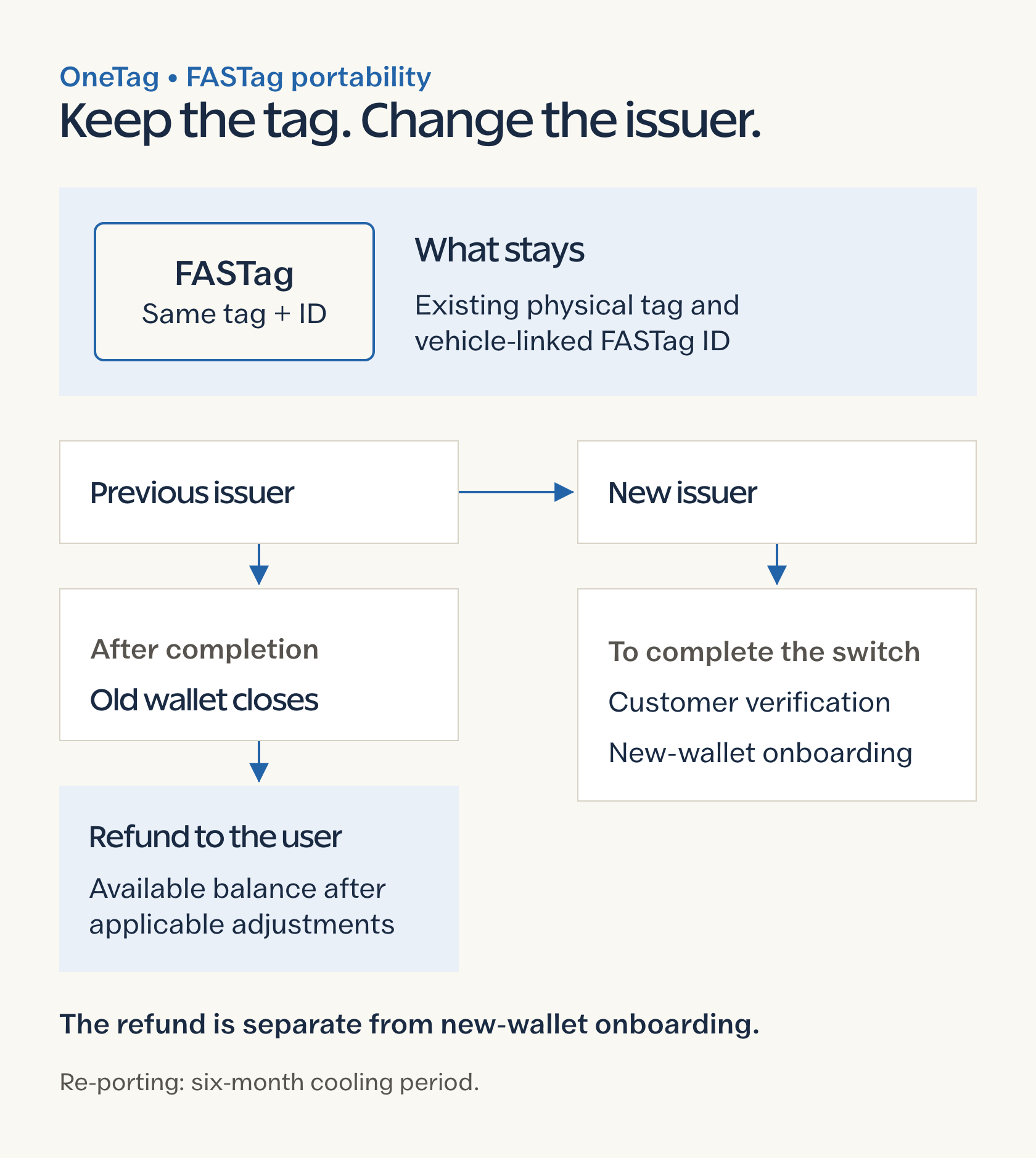
On 17 September 2026, NHAI announced OneTag FASTag portability on the Rajmargyatra app, enabling users to change issuers while retaining their existing physical tag and FASTag identifier.
- Users must check eligibility, authorise the switch and complete verification and wallet onboarding with the new issuer.
- The previous issuer closes the old wallet after portability and refunds its available balance following applicable adjustments.
- A six-month cooling period applies before the interoperable FASTag can be ported again.
- Provider choice becomes easier when changing a financial relationship no longer requires replacing the identifier attached to the vehicle.
- Wallet settlement still matters: retaining a tag does not mean the old account or its balance automatically becomes the new issuer’s account.
UPSC Relevance
Prelims Relevance
- FASTag: RFID-based electronic toll payment device attached to the vehicle.
- NETC: National Electronic Toll Collection, developed by NPCI.
- Interoperability: common arrangements allowing acceptance across participating toll operators.
- Portability: changing the issuer while retaining the existing tag and ID.
- Mobile Verification Code: authorisation code supplied by the current issuer.
Mains Relevance
GS Paper 3
- Digital infrastructure: common identifiers and competition between service providers.
- Transaction costs: reducing replacement costs while managing financial settlement.
GS Paper 2
- Citizen services: transparent switching, verification and complaint handling.
Essay
- Meaningful choice depends on being able to leave a service provider without rebuilding access to the service.
Background and Context
Separate the tag, the issuer and the payment network
FASTag combines a device on the windscreen with a financial relationship and a shared payment network; portability changes only specified parts of that arrangement.
- FASTag uses radio-frequency identification to support electronic toll payment from a linked account. The tag identifies the payment arrangement; it should not be confused with the wallet where the user’s available funds are recorded.
- The issuer supplies the customer-facing financial relationship. OneTag allows that provider to change while the existing FASTag ID remains linked to the vehicle registration number, avoiding a fresh physical tag solely for an issuer switch.
- NETC interoperability concerns acceptance across participating toll operators through common rules and specifications. As PIB explains, shared payment arrangements support settlement and disputes; this differs from permission to change the bank serving the customer.
- Portability concerns changing the issuer without replacing the retained identifier. A system can accept one tag across operators yet still make switching issuers cumbersome; OneTag addresses that separate source of effort for the user.
- Infrastructure layers also differ: multi-lane free-flow tolling concerns how vehicles are detected and charged on the road. OneTag concerns the issuer relationship behind the tag, so portability does not itself remove toll barriers.

How the issuer switch and wallet closure work
The announced sequence combines eligibility, authorisation and a new financial relationship; retaining the device does not remove the checks needed to establish the receiving issuer’s account.
- Eligibility comes first: the user logs into Rajmargyatra and enters the vehicle registration number. This initiates a check, rather than establishing that every vehicle, account or attempted switch must qualify for the service.
- Authorisation uses a six-digit Mobile Verification Code from the current issuer bank. This connects the request to the existing relationship; receiving the code does not itself complete all the new issuer’s onboarding requirements.
- New-issuer onboarding follows authorisation and issuer selection. Customer verification and wallet onboarding remain required steps, even though the physical tag stays on the vehicle; continuity of the device is different from continuity of the account.
- Old-wallet closure occurs after portability is completed. The previous issuer refunds the available balance after applicable adjustments; the announcement describes refund and closure, not automatic movement of the old balance into the new wallet.
- Cooling period: the tag cannot be ported again for six months. This limits the frequency of subsequent issuer changes; it should not be mistaken for a stated processing time for completing the current request.
Consumer choice needs a clear completion process
Lower switching effort is useful only if users understand which provider serves them, what happens to their money and which conditions still apply after the switch.
- Switching costs include effort and replacement logistics, not only explicit fees. NHAI expects reduced tag production, dispatch and reissuance costs; these are anticipated operational benefits, not evidence that every customer must receive a specified saving.
- Competition may improve when users can change providers with less disruption. Whether that produces better service depends on practical completion, accessible support and informed choices; the announcement alone does not demonstrate a measured competitive outcome.
- Refund transparency requires users to distinguish the old issuer’s settlement from the new issuer’s wallet setup. A completion record should identify deductions and refund status, without implying that an unchanged tag guarantees access to refunded money.
- Pass eligibility addresses different conditions from issuer portability. The digital FASTag local pass concerns a concession framework; OneTag’s announcement does not establish automatic treatment of annual or local passes when a user changes issuers.
- Operational limits remain unspecified in the release: it does not promise instant completion, a fee waiver or approval for every account. Exam answers should retain the stated checks rather than replace them with assumptions about convenience.
Way Forward
Make each stage visible to the user
- Display separate status confirmations for authorisation, new-issuer onboarding, portability completion and old-wallet refund.
- Explain eligibility failures and applicable adjustments clearly, with a route to resolve incorrect vehicle or account information.
- Identify the responsible issuer and support channel for pending refunds and onboarding problems, so users are not passed between organisations.
- Evaluate the service through completed switches and resolved complaints, alongside tag replacement costs, rather than relying only on app availability.
Conclusion
- OneTag separates a stable vehicle-linked identifier from a changeable financial provider. Its practical value lies in reducing replacement effort while preserving authorisation, customer verification and an orderly closure of the previous wallet.
- For exam answers, keep tag continuity, issuer change and wallet settlement distinct. The user retains the tag and ID, establishes the new relationship and receives the old balance through refund after applicable adjustments.
UPSC Practice Questions
Prelims MCQ 1
With reference to OneTag FASTag portability, consider the following statements:
- The existing FASTag ID remains unchanged after successful portability.
- The old-wallet balance automatically transfers into the new issuer’s wallet.
- Customer verification and wallet onboarding with the new issuer remain necessary.
How many of the above statements are correct?
(a) Only one (b) Only two (c) All three (d) None
Answer: (b) Only two
Explanation:
Statements 1 and 3 are correct. The previous issuer closes the old wallet and refunds the available balance after adjustments; automatic wallet-to-wallet balance transfer is not the announced mechanism.
Prelims MCQ 2
Which option correctly distinguishes FASTag interoperability from OneTag portability?
(a) Interoperability enables acceptance across participating toll operators; portability enables an issuer change while retaining the tag. (b) Interoperability removes customer verification; portability removes toll liability. (c) Interoperability requires a new tag at each plaza; portability replaces the vehicle registration number. (d) Interoperability and portability both guarantee automatic transfer of wallet balances.
Answer: (a) Interoperability enables acceptance across participating toll operators; portability enables an issuer change while retaining the tag.
Explanation:
NETC interoperability concerns shared acceptance arrangements. OneTag adds issuer switching with retention of the physical tag and FASTag ID, subject to eligibility, authorisation and onboarding.
UPSC Mains Questions
- How can portability improve consumer choice in digital payment services? Discuss using OneTag, with attention to verification and financial settlement.
- Distinguish interoperability from portability in digital infrastructure. Why must simpler provider switching be accompanied by clear accountability for customer funds?
Sources: PIB, Ministry of Road Transport and Highways and PIB, Redefining India's Highways.
Frequently Asked Questions
What remains unchanged after OneTag portability?
The existing physical FASTag and its identifier linked to the vehicle registration number remain unchanged. The user changes the issuer and must complete customer verification and wallet onboarding with the new provider.
Does the old wallet balance automatically move to the new wallet?
No. After portability completes, the previous issuer closes the existing wallet and refunds the available balance after applicable adjustments. The announcement does not describe an automatic transfer into the new issuer’s wallet.
Is the Mobile Verification Code enough to complete portability?
No. The code from the current issuer supports authorisation. The user must also select a new issuer and complete customer verification and wallet onboarding to complete the portability process described in the announcement.
What does the six-month cooling period mean?
It is the interval before the interoperable FASTag can be ported again. It is not a promised processing duration for the current switch, nor a waiting period announced for the old-wallet refund.
Does OneTag automatically preserve every pass benefit?
The announcement does not specify how annual or local pass benefits are treated during an issuer change. Retaining the physical tag and ID should not be treated as an automatic guarantee about those separate arrangements.
Source: https://anantamias.com/current-affairs/onetag-fastag-portability-issuer-wallet-separation/
Community TB Detection: From Household Screening to Confirmed Care
Why in News?
On 17 September 2026, the government reported an AIIMS Jodhpur community TB initiative linking household screening, laboratory confirmation and care in underserved tribal areas of southern Rajasthan.
- The official release describes a local research and community initiative, supported by the Department of Science and Technology, rather than a newly launched national scheme.
- The programme combined household surveys, symptom screening, sputum testing and diagnostics under the National Tuberculosis Elimination Programme, alongside community engagement.
- The release reports improved detection and control but provides no controlled comparison or quantified transmission reduction; those outcomes cannot be treated as independently established by the announcement.
- Geographical and social barriers can delay diagnosis even when medical services exist. Community outreach addresses the gap between available facilities and people able to reach them.
- Screening creates a referral obligation: identifying a person who may have TB has limited value unless evaluation, results and continuing care remain accessible.
UPSC Relevance
Prelims Relevance
- Active case finding versus patient-initiated presentation.
- Screening versus diagnostic assessment.
- TB infection versus TB disease.
- Contact investigation and drug-resistance testing.
Mains Relevance
GS Paper 2
- Last-mile public healthcare and health equity in underserved communities.
- Community participation with confidentiality and accountable referral services.
GS Paper 3
- Diagnostic systems and evaluation of public-health interventions.
Essay
- Access to healthcare means completing care, not merely locating a facility.
Background and Context
Why active case finding changes the access pathway
Community outreach changes who initiates contact with the health system, helping identify people who might otherwise remain outside routine services despite needing further assessment.
- Active case finding brings screening towards people, commonly outside health facilities. It differs from waiting for someone to seek care after recognizing symptoms, finding transport and overcoming the financial or social costs of attendance.
- Local barriers matter to programme design. The Rajasthan release identifies difficult terrain, stigma and seasonal migration; these can interrupt participation at different stages, from agreeing to screening through reaching a diagnostic centre and follow-up.
- Trusted participation can improve communication where an unfamiliar medical team may struggle to engage households. Local health workers and panchayat members supported the initiative, but community involvement should preserve individual consent and confidential health information.
- Sample transport connects outreach with laboratory capacity. A person screened in a village may still face delay if specimens or results cannot move reliably; the ICMR TB transport study examines this separate service bottleneck.
- Continuity of care requires responsibility beyond the screening visit. A practical local system must connect identification, referral, evaluation and follow-up, including people who migrate temporarily and cannot return easily to the original screening location.

Screening, infection and disease are different findings
The word positive has meaning only when the test and its purpose are clear; a screening result, infection marker and diagnosis answer different questions.
- A positive screen indicates possible disease requiring evaluation; symptoms can have causes other than TB. WHO guidance separates screening from diagnostic testing and clinical assessment, preventing an outreach checklist from being mistaken for a diagnosis.
- TB infection, often described as latent infection, is distinct from TB disease. People with infection alone are not contagious; evidence of infection must not be presented as proof that someone currently has infectious pulmonary disease.
- TB disease can affect the lungs or other organs, and symptoms may be absent or subtle. The absence of a reported cough cannot, by itself, establish either freedom from disease or a diagnosis of latent infection.
- Contact investigation evaluates people exposed to someone with TB, including household contacts. Its purpose includes finding undiagnosed disease and infection; being a contact establishes a reason for assessment rather than proving that transmission has occurred.
- Drug resistance concerns the organism’s response to medicines, not simply how ill a person appears. Appropriate testing informs clinical decisions; a symptom questionnaire cannot determine resistance or select a suitable course of care for someone.
How to judge a community detection programme
A useful evaluation follows people through the care pathway and separates improved detection from changes in the underlying occurrence or spread of disease.
- Detection is not incidence: finding more cases after outreach may reveal previously missed disease. Without appropriate comparison and follow-up, a rise in detected cases cannot establish that the programme caused more infections in that community.
- Screening volume measures activity, while completed diagnostic assessments and successful linkage to care measure service delivery. Reporting only households visited can conceal people who were referred but never received results or reached the next service.
- Missed disease and false alarms are different screening risks. Programme quality depends on suitable tools and diagnostic follow-up, not merely identifying many suspected cases; resource planning should anticipate the additional workload that referral creates.
- Impact claims need evidence beyond an announcement of improved control. The Rajasthan release does not provide a controlled effect estimate, so it supports discussion of the approach without establishing the magnitude of any transmission reduction.
- Transferability depends on local conditions: terrain, staffing, laboratory access and migration patterns may differ elsewhere. Before wider adoption, administrators should examine which parts of the pathway worked and what resources maintained those links over time.
Way Forward
Close gaps after identification
- Track referral completion and result delivery, with a named service responsible for following up unresolved diagnostic assessments.
- Protect confidentiality and participation through private communication, voluntary engagement and locally understandable information; avoid publicly labelling households.
- Arrange continuity across locations for mobile populations and assess practical barriers such as travel and lost work time.
- Evaluate clinical and service outcomes over time, separating outreach activity, confirmed diagnoses, care linkage and evidence of reduced disease burden.
Conclusion
- The Rajasthan initiative illustrates how community outreach can connect underserved households with diagnostic services. Its teaching value lies in the completed care pathway, rather than an unsupported claim of nationwide or measured transmission impact.
- In policy answers, distinguish possible disease, confirmed diagnosis and population outcomes. Effective screening needs accessible follow-up, while credible evaluation must show what happened after people were identified and referred.
UPSC Practice Questions
Prelims MCQ 1
With reference to tuberculosis screening, consider the following statements:
- A positive symptom screen alone establishes a confirmed TB diagnosis.
- People with TB infection alone, without TB disease, are contagious.
- Household contact investigation can help identify previously undiagnosed TB disease and infection.
How many of the above statements are correct?
(a) Only one (b) Only two (c) All three (d) None
Answer: (a) Only one
Explanation:
Only statement 3 is correct. WHO distinguishes screening from diagnosis and states that people with TB infection alone are not contagious. Contact investigation can identify both disease and infection.
Prelims MCQ 2
A community outreach programme reports more TB diagnoses after household screening. Which conclusion is most justified from this observation alone?
(a) The programme necessarily increased TB transmission (b) Every person screened has active TB (c) Outreach may have identified previously missed disease (d) Local TB elimination has been demonstrated
Answer: (c) Outreach may have identified previously missed disease
Explanation:
More detected cases can reflect improved ascertainment. The observation alone cannot establish changes in transmission, infection incidence or elimination; these require additional evidence and an appropriate evaluation.
UPSC Mains Questions
- Explain how active case finding can address barriers to TB care in underserved communities. Discuss why diagnostic follow-up and confidentiality are essential to its effectiveness.
- Distinguish screening activity, confirmed case detection and public-health impact. How should administrators evaluate a community TB initiative before expanding it?
Sources: PIB, Ministry of Science and Technology and WHO, Systematic Screening for Tuberculosis.
Frequently Asked Questions
Is this a new national TB scheme?
No. The announcement describes an AIIMS Jodhpur community initiative in underserved areas of Rajasthan. It combines outreach, laboratory confirmation and linkage with existing diagnostic services rather than launching a new national scheme.
Does a positive symptom screen confirm TB?
No. Screening identifies people who may need diagnostic assessment. Symptoms can arise from other conditions, and a positive screen must be interpreted through the appropriate diagnostic and clinical evaluation pathway.
Is latent TB infection the same as infectious TB disease?
No. TB infection alone differs from disease and is not contagious. Tests for infection do not by themselves establish active disease; clinical evaluation determines the relevant diagnosis and care pathway.
Has this initiative proved a reduction in transmission?
The release claims improved control but supplies no controlled comparison or quantified transmission effect. It describes a service approach; the magnitude of any population-level impact cannot be established from that announcement alone.
Source: https://anantamias.com/current-affairs/community-tb-active-case-finding-rajasthan/
Sambalpur Doppler Radar: From Weather Observations to Early Action
Why in News?
A Doppler Weather Radar was inaugurated at Sambalpur, Odisha, on 17 September 2026 to strengthen weather observations and early-warning inputs for western Odisha and adjoining regions.
- Commissioned facility: The ministry identifies Sambalpur as an addition to Odisha’s existing radar infrastructure at Gopalpur and Paradip.
- Regional purpose: The installation addresses an observation gap affecting the monitoring of weather systems over western Odisha.
- Complementary measurements: The announcement also emphasizes automatic weather stations, rain gauges and upper-air observations.
- Risk reduction: Better observations can improve understanding of an approaching weather hazard, but protective decisions still require local knowledge and timely communication.
- Scientific distinction: A radar measures signals from the atmosphere; a forecast interprets how weather may evolve, and a warning connects expected hazards with action.
UPSC Relevance
Prelims Relevance
- Doppler Weather Radar: active remote sensing
- Reflectivity and radial velocity
- Nowcasting and numerical weather prediction
- Rain gauges and automatic weather stations
- Hazard observations versus impact-based warnings
Mains Relevance
GS Paper 3
- Observational infrastructure and disaster preparedness
- Warning communication, forecast uncertainty and local response
GS Paper 1
- Weather observation and regional rainfall variability
Essay
- Scientific information protects communities when public institutions turn it into timely decisions.
Background and Context
What radar observations actually tell a forecaster
Doppler radar sends electromagnetic pulses and examines returned signals, providing different kinds of information about precipitation and motion that should not be confused with one another.
- Reflectivity describes the strength of the radar return after processing. It helps locate precipitation and compare its structure, but conversion into surface rainfall requires assumptions about the particles producing the signal and their distribution.
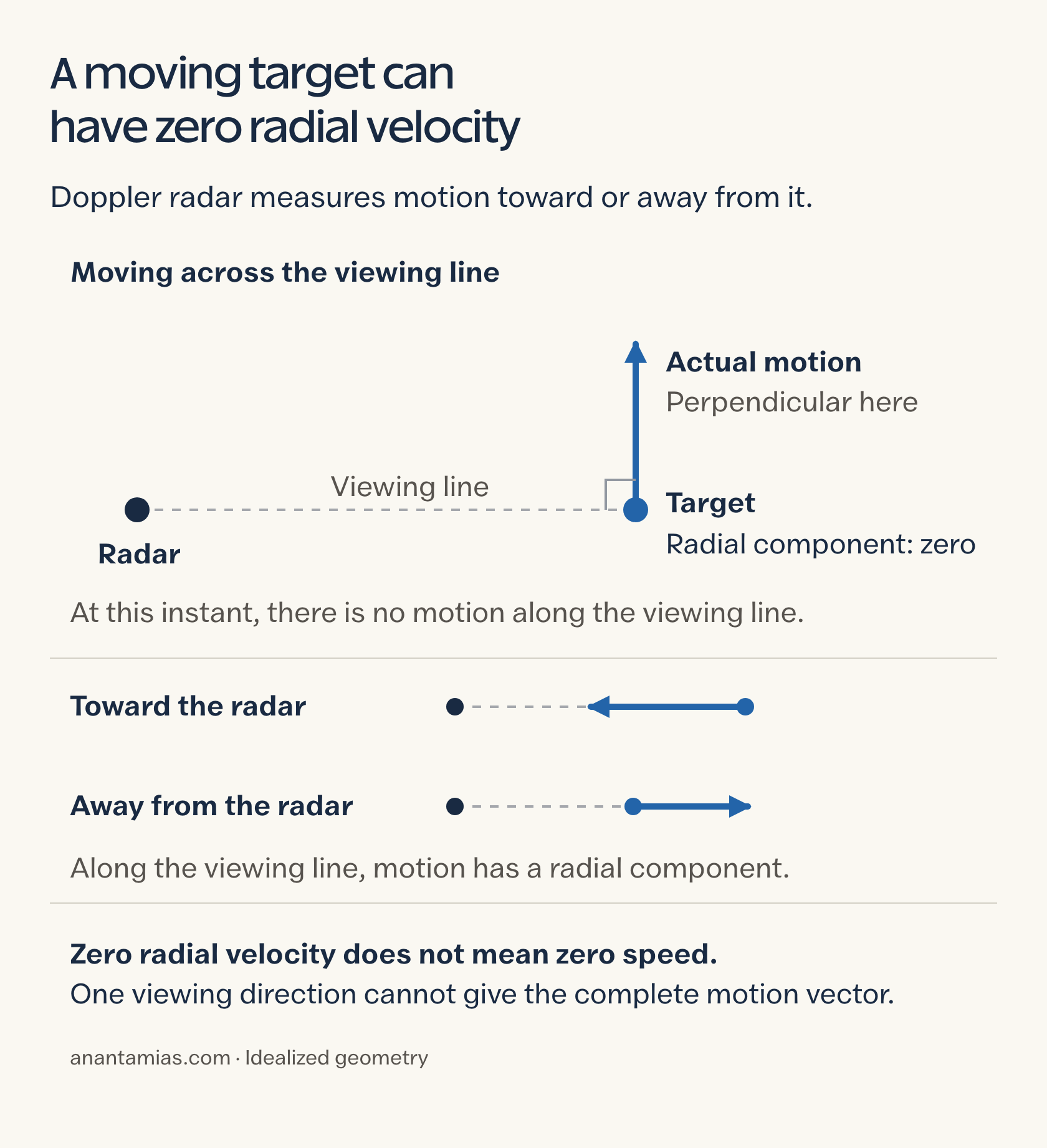
- Radial velocity measures motion toward or away from the radar along its viewing direction. It is only a component of movement, so a single measurement does not directly reveal the complete wind vector.
- The Doppler effect links relative motion to a shift in the returned signal. Motion directly across the viewing direction can have little radial component even when the target is moving quickly through the atmosphere.
- Repeated scans help forecasters examine changes in precipitation structure and movement. Comparing successive observations is more informative than reading one image as a prediction, because weather systems may strengthen, weaken or change direction after observation.
- Rainfall estimation is a derived product, not the same measurement as collecting rain in a gauge. A strong echo can support interpretation of an intense system without proving the exact amount falling at ground level.
Why Sambalpur needs a network, not an isolated instrument
The new radar supplies a regional view of developing weather, while other instruments help check conditions near the surface and across the atmosphere around it.
- Western Odisha is the commissioning announcement’s central geographic focus. The additional observations can help meteorological agencies follow developing systems in this area; the release does not establish a guaranteed forecast accuracy for every locality.
- Rain gauges measure accumulated precipitation at particular sites, while radar provides broader spatial information. Comparing them can reveal discrepancies in estimated rainfall, helping forecasters interpret whether a radar-derived pattern agrees with conditions on the ground.
- Automatic weather stations add local measurements, while upper-air instruments describe atmospheric conditions above the surface. Their complementary roles matter because an evolving storm cannot be understood fully through a single type of observation alone.
- Radar limitations include unwanted echoes and differences between precipitation sampled aloft and rain reaching the surface. Quality checks and correction methods are part of producing useful observations; more equipment does not remove measurement uncertainty automatically.
- The earlier Wayanad radar discussion offers a comparison in network planning. However, its project specifications cannot be transferred to Sambalpur: frequency band, useful range and coverage depend on the particular installation and its operation.

How observations become useful warnings
Observation, forecast and action are separate stages: failure in interpretation or communication can waste the additional preparation time that improved monitoring is intended to provide.
- Nowcasting addresses weather developing over the immediate future, drawing on current observations and their evolution. Radar is useful here, but extrapolating an existing rain cell cannot guarantee that new cells will not develop elsewhere.
- Forecast interpretation combines observations with wider meteorological analysis and model guidance. Forecasters must assess uncertainty rather than equate a clear radar image with certainty about the timing, location or severity of the next event.
- Impact assessment adds information about exposed people, drainage, roads and essential services. Similar rainfall can create different consequences in different places, which is why a weather signal alone cannot determine the required local response.
- Warning delivery should specify the threatened area, expected timing and recommended action in language recipients understand. The related monsoon-warning framework explains why administrative readiness and public communication belong alongside technical forecasting in disaster preparedness.
- Evaluation should follow the whole chain: whether the hazard was detected, whether a useful alert arrived and whether protective action followed. Counting instruments or messages sent cannot establish that vulnerable communities actually received effective protection.
Way Forward
Test the observation-to-action chain
- Maintain reliable observations: Check instrument performance and compare radar estimates with ground measurements before relying on derived products.
- Prepare local decisions: Link warnings with agreed responsibilities for schools, transport operators, utilities and district authorities.
- Review real events: Examine missed hazards, false alarms and communication delays together so that technical and administrative weaknesses are corrected.
Conclusion
- Sambalpur strengthens weather observation in western Odisha. Its significance lies in additional information about developing systems, while the scientific distinction between reflectivity, radial motion and estimated rainfall remains essential for interpreting what radar can show.
- Early warning requires early action. Better observation becomes public protection when forecasts are interpreted with local risk information, communicated promptly and connected with practical decisions that communities and institutions are ready to carry out.
UPSC Practice Questions
Prelims MCQ 1
With reference to Doppler Weather Radar, consider the following statements:
- Radial velocity represents movement toward or away from the radar along the viewing direction.
- A single radial-velocity measurement directly gives the complete wind vector.
- Surface rainfall estimates derived from radar require interpretation and can be compared with rain-gauge observations.
How many of the above statements are correct?
(a) Only one (b) Only two (c) All three (d) None
Answer: (b) Only two
Explanation:
Statements 1 and 3 are correct. Radial velocity is one component of motion. Radar-derived rainfall involves assumptions and corrections, so it is not identical to direct surface measurement.
Prelims MCQ 2
A useful weather alert reaches a district office but does not reach the affected villages in time. Which part of early warning has most directly failed?
(a) Generation of the electromagnetic pulse (b) Measurement of radial velocity (c) Last-mile communication (d) Calculation of radar reflectivity
Answer: (c) Last-mile communication
Explanation:
The scenario specifies that a useful alert already exists and reaches the district. The immediate failure is timely delivery to affected communities, demonstrating that observation and forecasting alone are insufficient.
UPSC Mains Questions
- Explain the information supplied by Doppler Weather Radar and its limitations as a tool for local disaster preparedness.
- Using the Sambalpur commissioning as context, examine why a weather-observation network must be linked with impact assessment, communication and institutional readiness.
Sources: PIB, Ministry of Earth Sciences and India Meteorological Department, Radar Meteorology.
Frequently Asked Questions
What is the significance of the Sambalpur radar?
The commissioned installation strengthens observations over western Odisha and adjoining regions. It adds information for tracking weather systems and informing warnings, while ground measurements and local preparedness remain necessary for effective disaster-risk reduction.
What is radial velocity?
It is the component of motion toward or away from the radar along the viewing direction. Motion across that direction may have little radial component, so one measurement does not provide the complete wind vector.
Is radar reflectivity the same as rainfall measured on the ground?
No. Reflectivity concerns the returned radar signal. Estimating surface rainfall from it requires assumptions and corrections, while a rain gauge measures precipitation collected at a particular location on the ground.
Does better radar coverage guarantee an accurate forecast?
No. Observations improve the available evidence, but measurement limits and the changing atmosphere create uncertainty. Forecasters combine radar with other observations and analysis before issuing predictions or warnings for particular places.
Can the new radar prevent floods or thunderstorms?
No. Radar observes weather rather than stopping hazardous processes. It can inform warnings and protective decisions, but reduced losses depend on appropriate forecasts, communication, preparedness and timely action by institutions and communities.
Source: https://anantamias.com/current-affairs/sambalpur-doppler-radar-observations-early-warning/
Urban Waste LCA: Comparing Pathways Across the Full System
Why in News?
On 17 September 2026, PIB reported the previous day’s release of an urban-waste life-cycle assessment report and launch of a greenhouse-gas calculator for comparing municipal waste-management scenarios.
- The PSA-supported consortium of IISc Bengaluru, IIT Madras and IIT BHU developed an India-specific framework for urban local bodies.
- The report’s cover is dated May 2026; the September development is its public release and application, not the beginning of the research.
- The framework compares collection, treatment and disposal pathways, including recycling, composting, anaerobic digestion, waste-to-energy and landfilling.
- A treatment plant’s direct emissions do not reveal the environmental performance of the entire municipal waste system.
- A useful comparison must connect actual waste flows with the emissions and resource substitutions assumed for each pathway.
UPSC Relevance
Prelims Relevance
- Life-cycle assessment: evaluation of environmental impacts across a defined system.
- Functional unit: common quantified service used for comparison.
- System boundary: processes and flows included in the assessment.
- Material flow analysis: accounting for material inputs, outputs and accumulation.
- Avoided burden: impacts credited as avoided through displacement of another product or process.
Mains Relevance
GS Paper 3
- Environment: comparing waste treatment, recovery and disposal options.
- Circular economy: actual substitution of primary resources and energy.
GS Paper 2
- Urban governance: municipal data quality and evidence-based project appraisal.
Essay
- What a city leaves outside its accounting can change what it considers a successful environmental policy.
Background and Context
Define the service before comparing technologies
Life-cycle assessment becomes useful when alternatives perform a comparable waste-management service and include the relevant processes, rather than reporting only what happens inside a plant.
- The functional unit provides the common comparison basis, such as treating a tonne of specified municipal waste. Comparing facilities handling different waste amounts or fractions without adjustment can confuse scale with better environmental performance.
- The system boundary determines which stages count: collection, transport, processing, recovery and final disposal. A treatment option should not appear cleaner merely because its burdens have been shifted to a stage excluded from assessment.
- The inventory records material inputs, energy use and emissions within that boundary. The report’s methodology combines field information and secondary sources, with region-specific data intended to reflect different waste characteristics and operating conditions.
- Material flow analysis follows waste through collection, sorting, treatment and disposal using mass balance. It checks where material actually goes, including rejects and accumulated waste, rather than assuming everything entering a facility becomes a useful product.
- Impact assessment translates the inventory into environmental indicators. Climate impact is one indicator; the report also considers issues such as acidification and toxicity, so a favourable carbon result is not a complete environmental safety assessment.
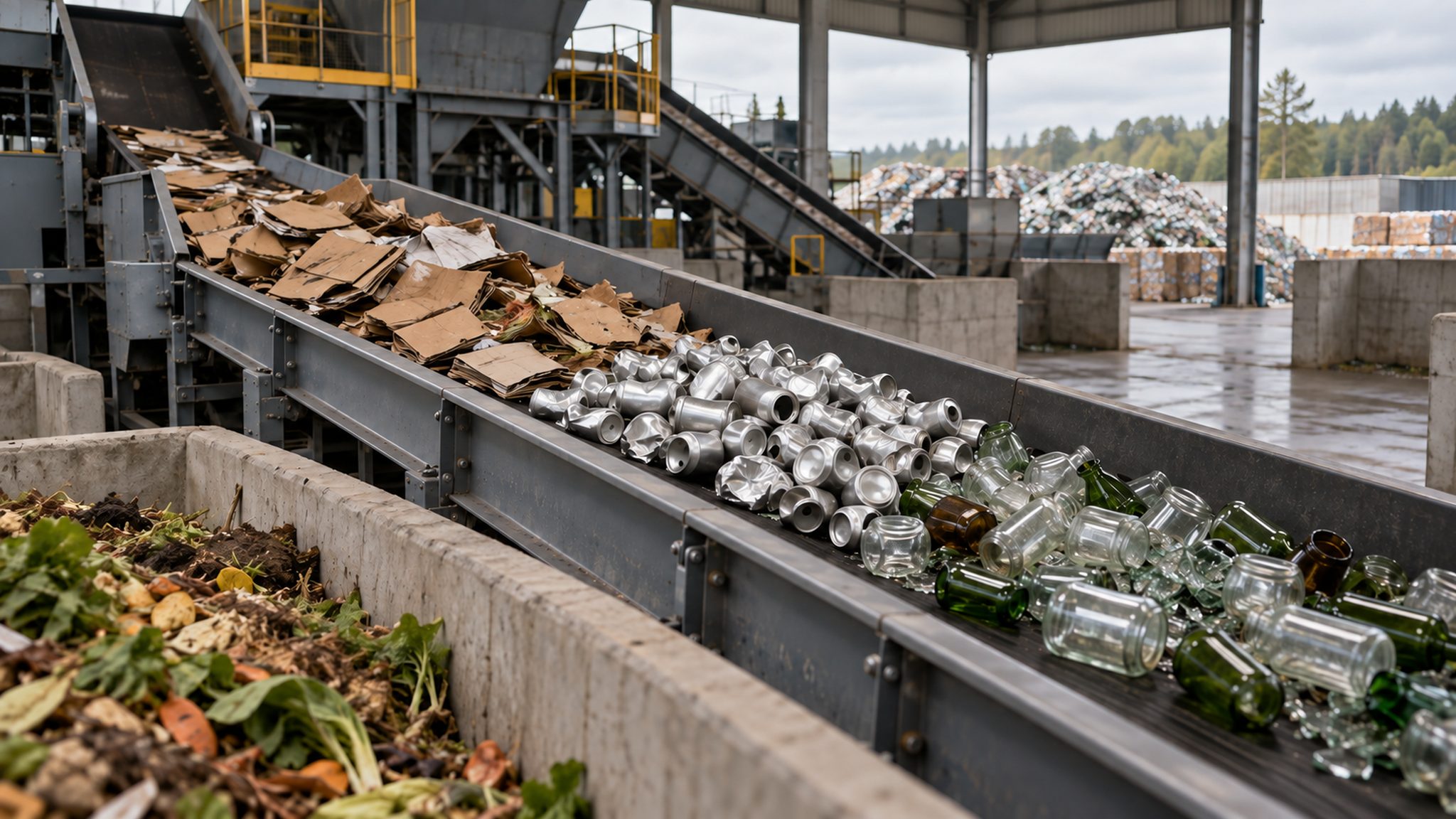
Distinguish direct emissions from avoided burdens
Resource recovery can displace other production, but that benefit belongs to an explicit comparison with an alternative supply route, not to a claim that emissions disappear.
- Direct emissions arise from the waste-management operations themselves. Energy use and transport add further burdens across the system; evaluating only a treatment plant’s output misses these connected activities and can misstate the pathway’s overall footprint.
- Avoided burdens represent production displaced by recovered energy or materials. For example, useful biogas can substitute a conventional cooking fuel; the report accounts for emissions avoided along that fuel’s extraction, processing and use pathway.
- Net results combine assessed burdens with applicable avoided impacts. A lower or negative net result does not mean negative emissions from a chimney, and an accounting credit in LCA is not automatically a tradable carbon credit.
- Substitution assumptions determine the credited benefit: what product is displaced, in what quantity and with what production impacts? Material recovery, as illustrated by reuse in leather processing, must connect to a useful downstream application.
- Boundary consistency is essential when comparing scenarios. Crediting recovered energy in one pathway while ignoring comparable recovery in another can bias the result; the report explicitly examines configurations with and without resource-recovery benefits.
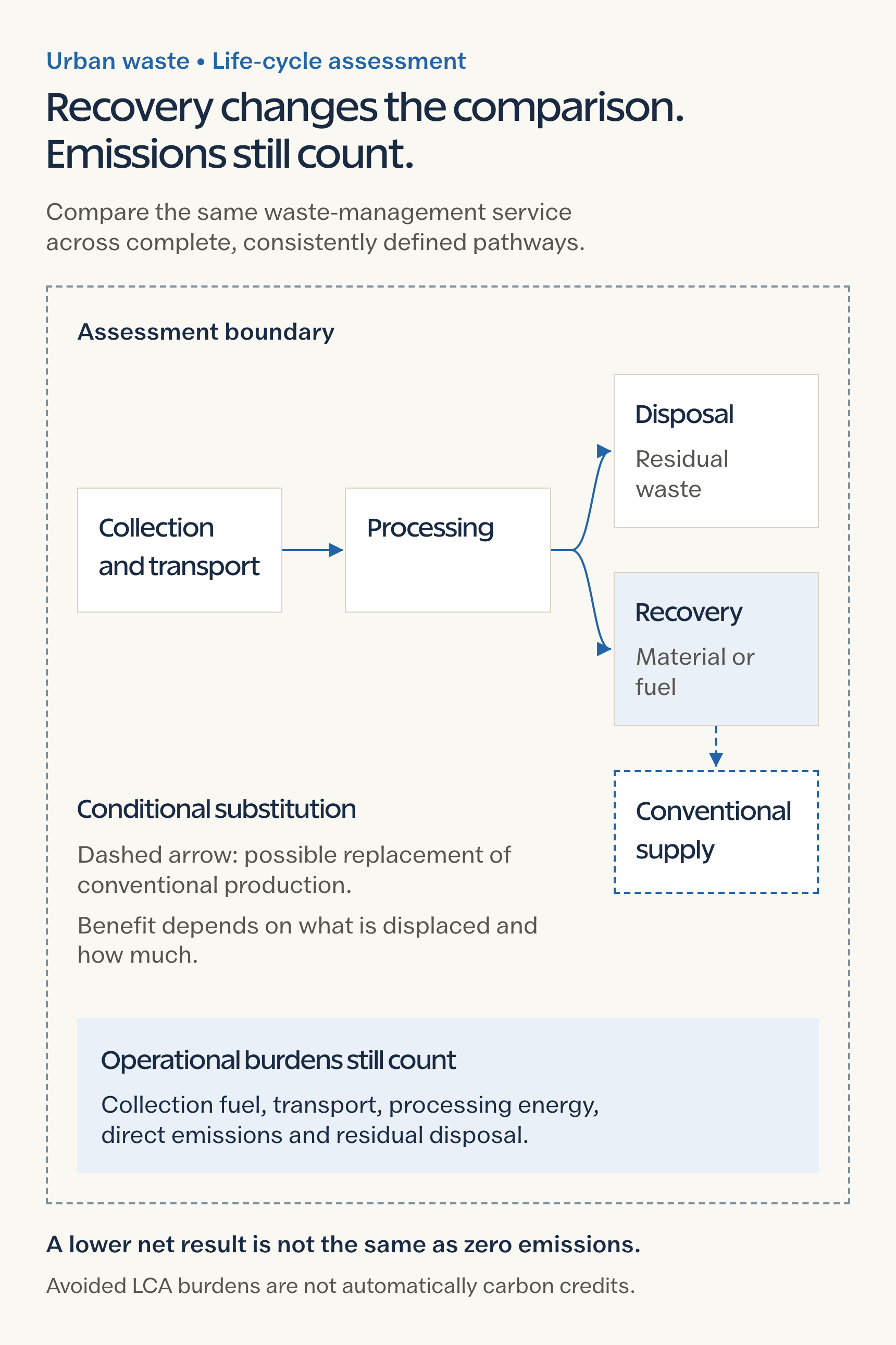
Use scenarios as conditional evidence
A scenario describes performance under specified conditions; the important question is whether those conditions match the city’s waste stream, infrastructure and ability to operate the system.
- Waste composition and segregation affect the material available for each treatment. The report identifies poor source segregation and limited processing capacity as constraints, meaning nominal recovery capacity cannot substitute for evidence about actual material throughput.
- Methane management can change disposal impacts substantially. The case studies identify landfilling as a major burden and discuss gas capture; a city must examine its actual operating conditions before borrowing the result of a better-controlled facility.
- Sensitivity analysis tests whether a preferred pathway stays preferable when influential assumptions change. Transport distances, recovery performance and displaced energy deserve examination; a narrow advantage dependent on optimistic inputs provides weaker support for a major investment.
- Data gaps can distort both waste quantities and recovery rates. The report notes undocumented informal-sector flows and inconsistent municipal reporting; excluding those pathways can misrepresent where materials go and how much disposal or recovery actually occurs.
- Climate and air quality need separate assessment. Methane and carbon dioxide are greenhouse gases; NOx and particulate black carbon are air pollutants. Complement carbon comparison with local air-quality evidence.
Way Forward
Make municipal comparisons auditable
- Publish the functional unit, boundary and assumptions alongside each scenario result, so consultants and municipalities compare equivalent services.
- Measure actual flows, including sorting rejects and informal recovery, and update operating data instead of relying only on installed capacity.
- Test plausible alternatives for transport, methane management and substitution before selecting a preferred pathway.
- Combine the climate comparison with cost, local pollution and operational feasibility; a calculator should support scrutiny of a project proposal.
Conclusion
- Urban waste LCA is a method for comparing complete, specified pathways. Its value depends on comparable boundaries, reliable flows and credible substitution assumptions, rather than declaring a technology universally clean because it recovers energy or materials.
- In an answer, connect waste segregation, material accounting and municipal decisions. Separate modelled net benefits from direct emissions, and explain why a scenario’s result must be tested against local conditions before it guides investment.
UPSC Practice Questions
Prelims MCQ 1
With reference to life-cycle assessment of municipal waste, consider the following statements:
- A common functional unit helps compare alternatives providing an equivalent service.
- Avoided burdens can arise when recovered materials displace virgin material production.
- A negative net result necessarily means the treatment plant physically removes greenhouse gases from the atmosphere.
How many of the above statements are correct?
(a) Only one (b) Only two (c) All three (d) None
Answer: (b) Only two
Explanation:
Statements 1 and 2 are correct. A negative net result may reflect credited avoided production impacts exceeding assessed burdens; it does not establish physical atmospheric removal by the treatment plant.
Prelims MCQ 2
A city finds one waste pathway performs better only when high recovery rates and long-distance fuel displacement are assumed. Which response best improves the comparison?
(a) Declare the pathway universally preferable. (b) Remove transport and recovery assumptions from the report. (c) Test locally plausible recovery and substitution assumptions through sensitivity analysis. (d) Treat the modelled advantage as carbon credits already issued.
Answer: (c) Test locally plausible recovery and substitution assumptions through sensitivity analysis.
Explanation:
The framework incorporates sensitivity and uncertainty analysis. Testing influential assumptions shows whether the preference remains robust under conditions the city can realistically achieve.
UPSC Mains Questions
- How can life-cycle assessment improve urban solid-waste decisions? Explain the importance of system boundaries, material flows and avoided burdens.
- A low modelled carbon footprint does not by itself establish the best municipal waste-management option. Discuss with reference to data quality and operational constraints.
Sources: PIB, Office of Principal Scientific Adviser and PSA-supported IISc, IIT Madras and IIT BHU LCA report.
Frequently Asked Questions
What is a functional unit in waste LCA?
It is the quantified service used as a common comparison basis, such as treating a tonne of a specified waste stream. It helps prevent differences in scale or waste type from misleading the comparison.
What are avoided emissions in resource recovery?
They are emissions assessed as avoided when recovered energy or materials replace another source of supply. Their size depends on what is displaced, how much is replaced and the chosen accounting assumptions.
Does a negative net LCA result mean a plant has no emissions?
No. Avoided production impacts may outweigh the assessed burdens in the model. Direct emissions can still occur, and the result does not automatically demonstrate atmospheric carbon removal or create tradable carbon credits.
Does this framework identify one best technology for every city?
No. Waste composition, segregation, transport, recovery performance and disposal conditions vary. Municipalities must compare scenarios using local evidence and test influential assumptions before adopting a result for their own waste system.
Was all the research completed in September 2026?
No. The report cover is dated May 2026 and describes earlier development work. The September news concerns its public release and the application intended to help urban local bodies compare waste-management scenarios.
Source: https://anantamias.com/current-affairs/urban-waste-lca-boundaries-scenario-comparison/
Stem Cell Therapy for Autism only in approved Clinical Trials: Centre
Why in News?
The Union Health Ministry has directed States and Union Territories to ensure that stem cell therapy is offered as standard clinical care only for the approved disease conditions and indications.
- Therapeutic use of any type of stem cell must remain confined to duly approved clinical trials in accordance with the National Guidelines for Stem Cell Research, 2017, issued by the Indian Council of Medical Research (ICMR) and the Department of Biotechnology (DBT).
- The move comes against the backdrop of the continuing use of stem-cell interventions for Autism despite the lack of established evidence supporting them as a standard treatment.
| UPSC Relevance: GS-3 Science and Technology: Biotechnology Prelims: Types of Stem Cells, Stem Cell Therapy Mains: Stem Cell Therapy: Applications & Concerns |
What are Stem Cells?
- Stem cells are unspecialised cells possessing two distinctive properties:
- Self-renewal: They can repeatedly divide to produce more stem cells.
- Differentiation: They can develop into specialised cells such as blood, nerve or muscle cells.
- Sources of Stem Cells:
- Embryonic stem cells
- Adult or somatic stem cells
- Umbilical-cord blood
- Bone marrow
- Peripheral blood
- Induced pluripotent stem cells, created by reprogramming mature cells.
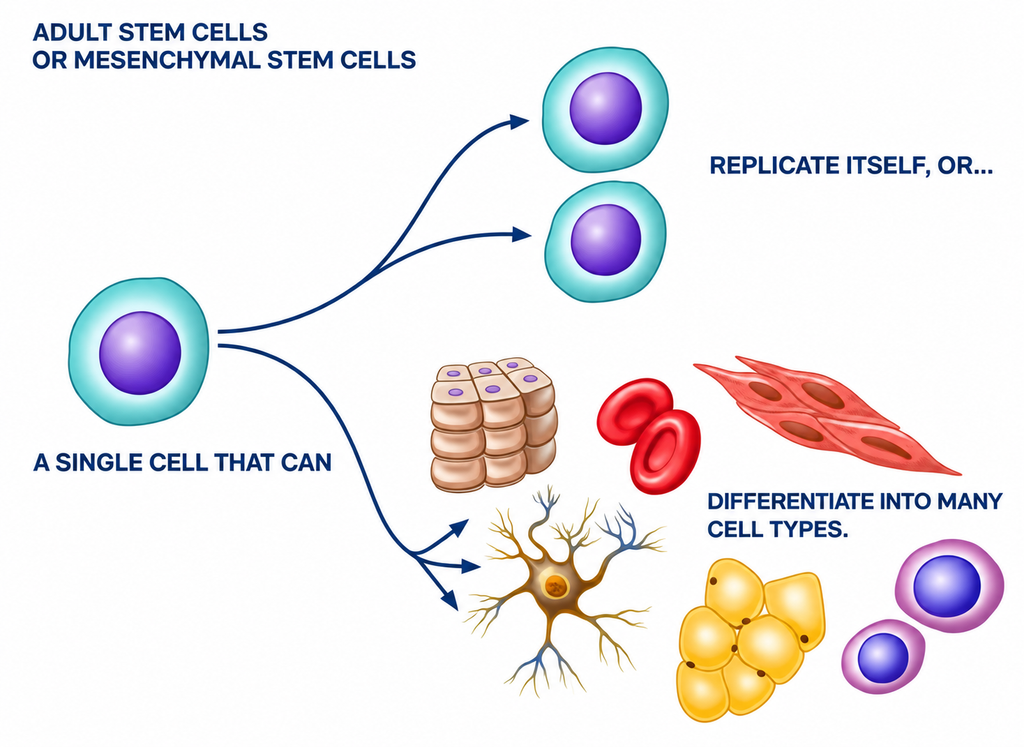
Types of Stem Cells:
- Totipotent Stem Cells are the most versatile stem cells. They can give rise to all cell types of the body as well as extra-embryonic tissues such as the placenta. E.g., Zygote and very early embryonic cells.
- Pluripotent Stem Cells can give rise to almost all cell types of the body but generally not extra-embryonic tissues. E.g., embryonic stem cells and induced pluripotent stem cells.
- Multipotent Stem Cells can differentiate into a limited range of related cell types. E.g., hematopoietic stem cells, which form blood cells, and mesenchymal stem cells, which can form bone, cartilage and fat cells.
- Unipotent Stem Cells: Unipotent stem cells can renew themselves and differentiate into only one specific cell type. E.g., some skin stem cells generate only skin cells.
- Induced Pluripotent Stem Cells, or iPS cells, are adult body cells that are genetically reprogrammed into a pluripotent state. They are important because they reduce dependence on embryos and can be used for disease modelling, drug testing and future personalised therapies.
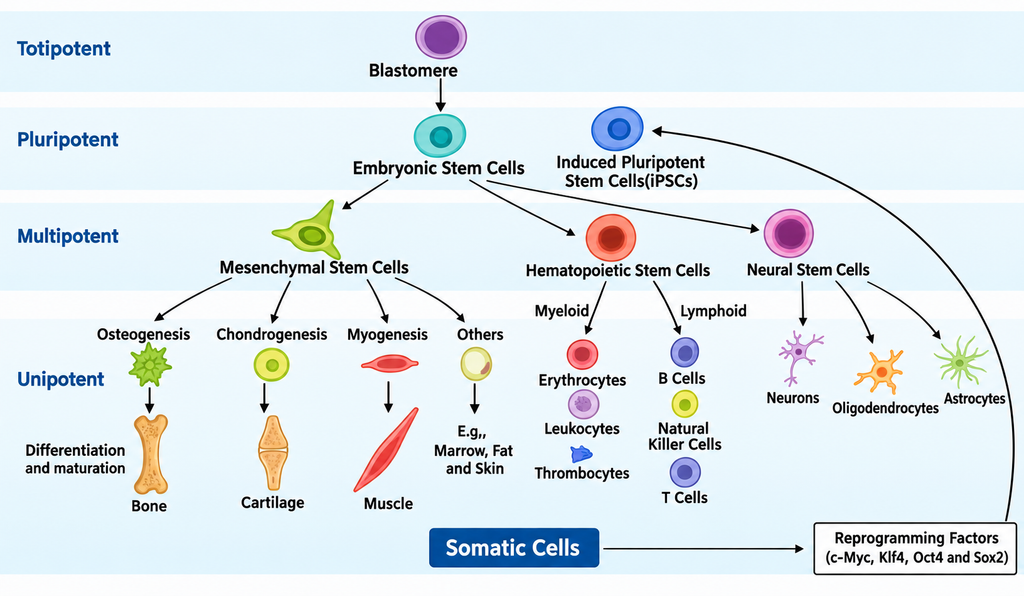
What is Stem Cell Therapy?
- Stem-cell therapy involves administering stem cells or stem-cell-derived products to replace, repair or regenerate damaged or dysfunctional tissues.
- The best-established application is haematopoietic stem-cell transplantation (commonly called bone-marrow transplantation) for certain blood cancers, bone-marrow failure syndromes, immunodeficiencies and inherited blood disorders.
Under the ICMR-DBT National Guidelines for Stem Cell Research, 2017, only haematopoietic stem-cell transplantation/reconstitution for approved indications is recognised as established clinical use.
Other uses of stem cells in patients are considered investigational and must be undertaken only within duly approved and monitored clinical trials. Thus, stem-cell treatment as standard care is not authorised for Autism Spectrum Disorder at present.
What is Autism Spectrum Disorder?
- ASD is a neurodevelopmental condition characterised by varying degrees of:
- Difficulty in social communication and interaction
- Restricted or repetitive behaviour and interests
- Sensory sensitivities
- Differences in language, learning and adaptive functioning
- The term “spectrum” indicates substantial variation in symptoms, support needs and abilities. Autism is not a single damaged tissue that can simply be replaced by new cells.
- There is currently no established medicine or biological procedure that cures autism.
Why has Stem Cell Therapy been proposed for Autism?
- Experimental approaches generally claim that stem cells may:
- Modulate inflammation or immune responses
- Secrete growth factors supporting neuronal functioning
- Promote repair of neural networks; or
- Improve cerebral blood flow and connectivity.
However, these remain hypothesised mechanisms. Improvements reported in small or uncontrolled studies may arise from natural development, concurrent behavioural therapy, placebo effects, observer bias or inappropriate outcome measurement.
The advisory does not prohibit scientific research into stem-cell interventions for autism. It draws the essential line between responsible experimentation and unproven commercial treatment.
Applications of Stem Cell Therapy in India:
- Established clinical applications in India: Haematopoietic stem-cell transplantation (HSCT) for specified indications and suitable patients:
- Blood cancers: Selected leukaemias, lymphomas and multiple myeloma.
- Inherited blood disorders: Thalassaemia and selected cases of sickle-cell disease.
- Bone-marrow failure: Severe aplastic anaemia.
- Other approved indications: Certain primary immunodeficiencies and inherited metabolic disorders.
- Emerging or Experimental therapeutic applications: These are at different research stages:
- Type-1 diabetes: Generating insulin-producing pancreatic beta/islet cells to restore insulin secretion.
- Parkinson’s disease: Developing dopamine-producing neurons to replace cells lost through degeneration.
- Spinal-cord injury: Investigating cell-based approaches to neural repair and functional recovery.
- Heart damage: Exploring stem-cell-derived cardiac cells and tissue patches to repair injured heart muscle.
- Burns and wound healing: Investigating stem-cell-based skin substitutes and regenerative approaches.
- Research and biotechnology applications:
- Tissue and organ engineering: Developing tissue constructs and organoids; laboratory-grown whole replacement organs remain a research goal.
- Disease modelling: Using patient-derived induced pluripotent stem cells to study disease mechanisms.
- Drug screening: Testing drug effectiveness and toxicity on stem-cell-derived human cells and tissues.
Associated Challenges:
- Difficulty in controlling stem cell differentiation into fully functional mature cells.
- Risk of tumour formation or uncontrolled cell growth.
- Immune rejection of transplanted cells.
- Need for long-term immunosuppression in some therapies.
- Ethical concerns around embryonic stem cells.
- High cost and technical complexity.
- Risk of misuse by clinics offering unproven stem cell treatments.
- Need for strict regulation, informed consent and long-term follow-up.
Stem cell therapy has great potential in regenerative medicine, personalised medicine and treatment of blood disorders. India needs to encourage genuine research while preventing commercial misuse of unproven stem cell therapies.
UPSC Mains PYQ 2017:
Q. Stem cell therapy is gaining popularity in India to treat a wide variety of medical conditions including Leukaemia, Thalassemia, damaged cornea and several burns. Describe briefly what stem cell therapy is and what advantages it has over other treatments.
Practice Prelims MCQ:
Q. With reference to stem cells and their therapeutic use, consider the following statements:
- All adult stem cells are pluripotent.
- Haematopoietic stem cells can generate different types of blood cells.
- Stem-cell therapy for Autism Spectrum Disorder is approved in India as routine clinical care.
- An unproven stem-cell intervention may be studied within a duly approved and monitored clinical trial.
Which of the statements given above are correct?
(a) 1 and 3 only
(b) 2 and 4 only
(c) 1, 2 and 4 only
(d) 2, 3 and 4 only
Answer: (b)
Adult stem cells are generally multipotent rather than pluripotent. Stem-cell therapy for ASD is not approved as routine care, but regulated clinical research may continue.
Who has to pay the Merchant Discount Rate on UPI?
Why in News?
A revised Merchant Discount Rate (MDR) framework is scheduled to apply to selected UPI merchant payments from 15 October 2026. The framework seeks to finance the payment ecosystem while retaining free transactions for individuals and protecting small merchants.
| UPSC Relevance: GS-3 Economy: Digital Payments, Financial Inclusion and Infrastructure Prelims: UPI, NPCI and Merchant Discount Rate |
What is Merchant Discount Rate?
- MDR is the fee (service charge) a merchant pays for accepting a digital payment. It compensates participants providing payment processing, banking and related services.
- For example, on an eligible ₹10,000 purchase, a 0.4% MDR equals ₹40, excluding any applicable tax. The customer pays the purchase price; the merchant bears the processing fee.
Key features of the reported MDR framework:
- Person-to-Person (P2P) transactions will remain free of charge, regardless of the amount being transferred.
- Small-value merchant payments: Payments up to and including ₹2,000 remain MDR-free.
- Small merchants, including street vendors receiving up to ₹1 lakh per month through UPI QR codes under the Person-to-Person-Merchant (P2PM) category, will also be exempt from MDR.
- General merchant payments: Eligible person-to-merchant (P2M) transactions above ₹2,000 attract 0.4% MDR. For transactions of ₹75,000 and above, the MDR will be capped at ₹300 per transaction.
- Essential sectors: Transactions of ₹2,000 or more in essential and thin-margin sectors, such as railways, telecommunications, insurance, fuel, and agricultural inputs, will attract a flat MDR of ₹5 per transaction. This flat charge is intended to provide cost certainty for critical public services and businesses operating on narrow margins.
- Capital market transactions such as payments to mutual funds, stockbrokers, dealers, and for equities will attract an MDR of 0.02%, capped at ₹300 per transaction. This rate is aimed at supporting retail participation in formal financial markets.
- Consumer protection: Merchants are not supposed to pass MDR directly to customers; UPI apps cannot impose hidden user charges.
A dedicated fund will be established to promote UPI adoption among small merchants, with an amount equivalent to 5% of total MDR collections contributed to this fund.
How widespread is the impact?
According to an analysis:
- 37% of transactions by volume are P2P transfers & 60.5% are P2M payments up to ₹2,000. Thus, 97.5% remain outside MDR on these criteria alone.
- P2M transactions above ₹2,000 make up just 2.5% of all UPI transactions by volume. However, it represents around 20% of total transaction value.
The MDR will be shared among payment ecosystem participants, including banks, payment service providers, and UPI application providers.
Why introduce MDR?
- Finance operational costs: Free customer transactions still require expenditure on servers, settlement, dispute resolution and customer support.
- Improve security and reliability: Predictable revenue can support fraud detection, cybersecurity and infrastructure upgrades.
- Sustain merchant services: Revenue can fund onboarding, reconciliation tools and assistance beyond merely issuing a QR code.
- Reduce dependence on subsidies: A commercial revenue stream can complement public support for socially valuable payment services.
Associated Concerns:
- Indirect consumer burden: Prohibiting a separate UPI surcharge does not eliminate possible recovery through higher general prices. Legal liability and ultimate economic burden can differ.
- Pressure on thin margins: Illustratively, a 0.4% charge consumes 20% of a 2% margin on the affected sale, before considering savings from reduced cash handling.
- Return to cash or avoidance: Merchants may discourage UPI, split payments or route business receipts through personal accounts.
- Market concentration: Revenue may disproportionately accrue to established apps and banks; transparent pricing and interoperability remain important.
- Unclear redistribution: The article reports a small-merchant adoption fund equivalent to 5% of MDR collections. Its funding source, governance and utilisation require clarification.
UPSC PYQ 2018:
Q. Which one of the following best describes the term “Merchant Discount Rate” sometimes seen in the news?
(a) The incentive is given by a bank to a merchant for accepting payments through debit cards pertaining to that bank.
(b) The amount paid back by banks to their customers when they use debit cards for financial transactions for purchasing goods or services.
(c) The charge to a merchant by a bank for accepting payments from its customers through the bank’s debit cards.
(d) The incentive given by the Government to merchants for promoting digital payments by their customers through Point of Sale PoS machines and debit cards.
Answer: (c) A charge paid by a merchant to a bank for accepting customers’ debit-card payments.
Source: https://anantamias.com/current-affairs/who-has-to-pay-the-merchant-discount-rate-on-upi/
PM pitches India as a global destination for chip making
Why in news?
Prime Minister Narendra Modi, at the SEMICON 2026, pitched India as a “new and trustworthy location” for global electronics manufacturing, urging chipmakers to help relieve the industry from the “weaponisation” of supply chains.
UPSC Relevance
Prelims,
Mains
GS3, Changes in Industrial Policy and their Effects on Industrial Growth.
”Semiconductors constitute the bedrock of the modern digital economy, acting as a multi-billion-dollar multiplier that powers downstream electronics manufacturing, Industry 4.0, and green transition technologies. For India, establishing an indigenous semiconductor ecosystem is crucial to curbing massive non-oil import liabilities, moving up global tech value chains, and realizing the vision of an Atmanirbhar $5 trillion economy.”

Factors affecting development of robust Semiconductor Ecosystem
- Policy & Capital Support: Fabs are capital-intensive, requiring heavy subsidies.
- The India Semiconductor Mission (ISM) provided a ₹76,000 crore ($9.1B) outlay in Phase 1 and extended Semicon 2.0 with ₹1.28 lakh crore ($13B) to offer up to 50% fiscal support for fabs, packaging, and supply chain ecosystem players.
- Ultra-Reliable Infrastructure: Manufacturing demands uninterrupted power and massive volumes of ultra-pure water (UPW).
- Fabs require 18-megohm-cm purity water. To overcome municipal limits, Tata Electronics built dedicated desalination and reverse-osmosis facilities alongside grid substations for its $11B Dholera fab.
- High-Skilled Talent Pool: While India holds ~20% of the world’s chip design workforce, scaling up requires talent across front-end fab operations and back-end assembly.
- Global firms like Micron rely heavily on Indian engineers, with its R&D teams in Bengaluru and Hyderabad contributing to over 3,700 patents and disclosures.
- Robust Domestic & Global Supply Chains: A fab cannot run without immediate access to specialty gases, raw silicon wafers, and machinery.
- Applied Materials and Lab Research are expanding localized equipment infrastructure, while companies like Japan’s Inabata are establishing local specialty chemical and scrubber supply chains in India.
- Sustained Local Market Demand: Fabs require domestic off-takers in consumer electronics, automotive, and telecom to maintain high capacity utilization.
- India’s domestic semiconductor market is projected to reach $100B+, propelled by EV adoption, local consumer electronics assembly, and 5G/BharatNet fiber expansions.
Why the Semiconductor push ?
- Economic Sovereignty & Resilience
- Import Burden Reduction: Microchips are one of India’s largest non-oil import liabilities. Localizing production cushions foreign exchange reserves and shields domestic industries from costly trade imbalances.
- Industrial Multiplier Effect: A localized supply chain accelerates the broader electronics manufacturing sector—creating high-value jobs across hardware design, advanced packaging, chemical processing, and equipment servicing.
- Upward Mobility in Value Chains: Capturing front-end fabrication and intellectual property (IP) moves India away from low-margin assembly to high-margin tech export leadership.
- Geopolitics & International Relations
- “China+1” Global Alternative: As global firms seek resilient alternatives to East Asian manufacturing monopolies, India positions itself as a critical, trusted node in global tech supply chains.
- Strategic Alliances: A credible chip ecosystem strengthens bilateral technology ties with major economies—such as the US, Japan, and the EU—underpinning initiatives like iCET (Initiative on Critical and Emerging Technology).
- Defense & Domestic Security
- Prevent espionage: Indigenous chips eliminate espionage and backdoor vulnerabilities in defense systems, space programs (ISRO), intelligence networks, and critical power infrastructure.
- Defense Modernization: Ensures an uninterrupted supply of radiation-hardened and specialized chips required for indigenous missile guidance, radar systems, and autonomous defense platforms.
- Environmental & Technological Sustainability
- Green Tech Acceleration: Locally produced power-management microchips enable efficient energy conversion in Electric Vehicles (EVs), smart grids, and renewable energy storage.
- Domestic Governance & Societal Scale
- Digital Public Infrastructure (DPI): Indigenous silicon bolsters national digital platforms (UPI, Aadhaar, 5G networks, and rural broadband) against supply shocks, ensuring cheap access to technology for a billion-plus citizens.
- AI & Frontier Tech Sovereignty: Domestic processing power ensures India isn’t reliant on foreign computational hardware to drive homegrown AI models and cloud computing.
Challenges
- High Capital Outlays & Long Gestation Periods : Semiconductor fabs require multi-billion-dollar investments upfront with long break-even cycles, making financing difficult without heavy, sustained government subsidization.
- Specialized Utility & Infrastructure Demands : Fabs require uninterrupted zero-fluctuation power and massive quantities of ultra-pure water (UPW). Even a millisecond voltage drop or micro-contamination in water can ruin entire production runs.
- “Design-Rich, Fabrication-Thin” Talent Gap : While India accounts for nearly 20% of global semiconductor chip design engineers, it severely lacks personnel experienced in front-end wafer fabrication, process engineering, yield optimization, and cleanroom maintenance.
- Ecosystem & Supply Chain Fragmentation : Semiconductor fabs do not exist in isolation—they depend on hundreds of micro-suppliers for raw silicon wafers, ultrapure specialty gases, photolithography chemicals, and precision machinery servicing which are heavily concentrated in Japan, Taiwan, and South Korea.
- Technological & IP Disadvantage : The global chip market is dominated by legacy players with thousands of patents on process nodes (e.g., TSMC, Samsung, Intel). Entering advanced-node manufacturing (sub-7nm) requires decades of continuous proprietary R&D.
- Most initial domestic fabs in India are focusing on legacy nodes (28nm or higher) for automotive and power electronics rather than cutting-edge smartphone/AI processors, limiting short-term competitiveness in high-margin frontier tech.
Way Ahead : ISM 2.0

Source: https://anantamias.com/current-affairs/pm-pitches-india-as-a-global-destination-for-chip-making/
EC bars rival factions from using TMC name, symbol for bypolls
Why in news?
The Election Commission (EC) issued an interim order barring rival factions of the Trinamool Congress from using the party name and symbol for upcoming Assembly bypolls in Nandigram and Rejinagar.
UPSC Relevance
Prelims,
Mains
GS2, Salient Features of the Representation of People’s Act.
Appointment to various Constitutional Posts, Powers, Functions and Responsibilities of various Constitutional Bodies.
Statutory, Regulatory and various Quasi-judicial Bodies.
Statutory provisions
- Rules 5 and 10 of the Conduct of Elections Rules, 1961: Direct the ECI to specify symbols that candidates can choose from and empower Returning Officers to allot symbols to contesting candidates.
- The Election Symbols (Reservation and Allotment) Order, 1968: The primary regulatory framework promulgated by the ECI under Article 324. It lays down rules for symbol classification, reservation, allotment, and dispute resolution.
Classification of Symbols
Symbols are categorized into two main groups under the 1968 Order:
- Reserved Symbols: Exclusively reserved for recognized political parties (National and State parties) for their official candidates.
- Free Symbols: A pool of non-exclusive symbols maintained by the ECI for candidates of Registered Unrecognized Political Parties (RUPPs) and Independent candidates.
Note : Symbols must not depict animals (with limited historical exceptions), religious/communal symbols, or cause public offense.
Rules Governing Symbol Allocation
| Category of Party | Rules & Allocation Mechanism |
| National Parties | Granted an exclusive reserved symbol valid across all parliamentary and assembly constituencies throughout India. |
| State Parties | Granted an exclusive reserved symbol valid in the specific State(s) where they are recognized. Their reserved symbol cannot be allocated to any other party in another State. |
| Registered Unrecognized Political Parties (RUPPs) | Candidates select from the list of free symbols. RUPPs can apply for a common free symbol across multiple constituencies if contesting at least 10% of seats in a State Assembly or Lok Sabha election. |
| Independent Candidates | Allotted remaining free symbols by the Returning Officer on nomination day. If multiple independents request the same free symbol, preference is resolved by draw of lots. |
Powers of the Election Commission of India (ECI)
- Power to Specify and Update Symbols: The ECI periodically notifies and updates lists of reserved and free symbols.
- Power to Adjudicate Party Splits (Paragraph 15): Under Paragraph 15 of the Symbols Order, 1968, the ECI holds exclusive judicial authority to decide which rival faction represents a recognized political party in the event of an internal split. It evaluates legislative and organizational majority, and its decision is legally binding.
- Power to Freeze Symbols: In ongoing split disputes or interim scenarios where a final decision cannot be reached before an election deadline, the ECI can temporarily “freeze” the party’s name and symbol, forcing both rival factions to choose interim names and free symbols.
- Power to Derecognize or Deregister Compliance Default: While the ECI cannot deregister a party except under strict conditions (e.g., fraud or unconstitutional conduct), it can withdraw a party’s “Recognized” status and forfeit its reserved symbol if it fails to perform adequately in general elections.
Practice MCQ
Q. During a panel discussion on election laws and party symbols in India, two experts, ‘A’ and ‘B’, debated the legal powers of the Election Commission of India (ECI):
‘A’ stated: The ECI derives its primary power to allocate symbols and resolve disputes during party splits from The Representation of the People Act, 1951, which explicitly grants the Commission quasi-judicial authority over political party symbols.
‘B’ argued: The ECI’s authority to freeze symbols and decide on rival factions in a split is sourced primarily from executive orders issued under The Election Symbols (Reservation and Allotment) Order, 1968.
Based on the above, select the correct conclusion from the options given below:
(a) Only the view of ‘A’ is correct.
(b) The view of ‘B’ is correct.
(c) The views of both ‘A’ and ‘B’ are correct.
(d) Neither ‘A’ nor ‘B’ is correct.
Answer: (b)
Mining amendment is unfair to States
Why in news?
The Mines and Minerals (Development and Regulation) Amendment Act, 2026 amends this Act to establish a uniform and balanced fiscal framework for the sector. However, there remain concerns around erosion of the state’s fiscal autonomy.
UPSC Relevance
Prelims – latest provisions
Mains, GS1, Distribution of Key Natural Resources across the world (including South Asia and the Indian sub-continent)
GS2, Issues and Challenges Pertaining to the Federal Structure
GS3, Indian Economy and issues relating to Planning, Mobilization of Resources, Growth, Development and Employment.
The Mines and Minerals (Development and Regulation) Amendment Act, 2026
India’s mineral wealth lies in a few States but supports the entire national economy, making its taxation a question of national importance.
Mining in India is regulated under the Mines and Minerals (Development and Regulation) Act, 1957. The Mines and Minerals (Development and Regulation) Amendment Act, 2026 amends this Act to establish a uniform and balanced fiscal framework for the sector.
Major amendments :-
The Act makes focused amendments to the MMDR Act, 1957. Its key provisions are as follows:
- New Section 9D — limits on State levies: No tax, cess or other levy, by whatever name called, shall be imposed by a State Government on mineral rights or mineral-bearing lands. This covers levies based on mineral quantity, mineral value, royalty or any other basis. Such levies may be imposed only as per conditions or restrictions prescribed by the Central Government.
- Treatment of past levies: Any levy not paid or collected by the State before the amendment applies will be treated as invalid. However, amounts already deposited or recovered before such commencement shall not be liable to be refunded.
- Rule-making power under Section 13: Section 13 of the MMDR Act is amended to empower the Central Government to make rules. These rules will prescribe the conditions or restrictions for imposition of such levies by State Governments.

The Need for Reform – create a predictable tax framework
- Promote Long-Term Investment – Investors commit capital to mining only where the tax structure is stable and foreseeable. Sudden changes discourage such commitment and slow technological and infrastructural expansion. A stable regime under the Act is intended to secure that confidence.
- Prevent Multiplicity of Levies – States currently impose around 14 taxes, charges and fees on mining like royalty, auction premium, GST and transit fee. Some States have additionally begun taxing mineral-bearing lands, at rates as high as 20 %. The Act addresses this cumulative and open-ended burden on the sector.
- High levies extend even to critical minerals such as graphite and atomic minerals such as uranium making the extraction of these strategic minerals uneconomical.
- Dual Burden on Foreign Exchange – When Indian minerals cost more than imported ones, user industries such as steel source cheaper raw material from abroad. At the same time, costly domestic minerals lose ground in export markets. Curbing this cost escalation is essential to the Atmanirbhar goal in the mineral sector.
- Fragmentation of the National Mineral Market – Widely differing State levies cause mineral costs to vary sharply across regions which obstructs supply chains and pushes up transport and logistics costs.
- The Cost Ultimately Reaches the Household – A levy at the mining stage is added directly to the mineral’s price. It then passes through steel, cement, electricity and construction. Ordinary families finally pay more for housing, power and essential goods.
- Threat to Employment, Including in Tribal Areas – The coal sector employs over 5 lakh people directly and indirectly while the non-coal sector supports more than 1 crore workers. High levies have already forced some mines to close and left other projects unopened. Small and medium operators work on thin margins and shut down first, taking local jobs with them.
- Mining Viability is Central to Energy Security – Growing global uncertainty makes a resilient domestic mining sector essential. The coal sector is simultaneously being made more competitive and technologically advanced to reduce import dependence. A viable and predictable tax regime is a precondition for both.
Concerns arising with Section 9D
- Erosion of Fiscal Autonomy: Section 9D makes future State taxes and levies on minerals dependent on a framework controlled by the Central Government. This restricts the financial self-reliance of mineral-rich States whose budgets depend heavily on mining revenues to fund regional development.
- States like Odisha rely heavily on mining for non-tax revenue; constraining their tax flexibility undermines fiscal self-reliance brought out in NITI Aayog’s Fiscal Health Index where they had performed better.
- Disproportionate Externalities vs. Revenue: While the Centre emphasizes that 90% of sector revenue accrues to States and will continue to do so, the amendment prevents States from adjusting local levies in the future. States carry the heavy, long-term costs of mineral extraction—such as environmental damage, population displacement, and heavy public infrastructure wear—without having flexible taxation mechanisms to cover them.
- Constitutional Overreach (Entry 49 & Entry 50): Entry 50 of the State List allows Parliament to impose limitations on State power to tax mineral rights, but Entry 49 grants States exclusive legislative power over land taxation. Extending central restrictions to taxes on ‘mineral-bearing land’ raises constitutional concerns over whether a federal mining law can restrict a State’s exclusive land-taxing authority.
- Undermining Judicial Precedents: In 2024, a nine-judge Supreme Court bench (Mineral Area Development Authority vs. Steel Authority of India) ruled that royalties are not taxes, affirmed States’ legislative power to tax mineral rights, and recognized their authority over mineral-bearing lands. The 2026 amendment risks bypassing and rendering this landmark ruling ineffective.
- Predictability at the Expense of Federal Balance: While the Centre argues the rule creates a stable, predictable tax environment to attract long-term private investment, critics argue this uniformity narrows fiscal federalism by decoupling a State’s natural economic advantages from its governance capacity.
The Mines and Minerals (Development and Regulation) Amendment Act, 2026 marks an important step in modernising India’s mineral governance. However, the state’s already eroding fiscal capacity must be considered for ensuring a truly sustainable and viable mining ecosystem.
Other major provisions of the MMDR Act, 1957
- Auction-Based Resource Allocation (Section 10B & 11): Mandatory competitive e-auctions for granting mining leases and composite licenses to eliminate discretionary allocations and ensure fair price discovery.
- Unified Concession Types:
- Composite Licence [Section 3(a)]: A single, seamless two-stage concession combining prospecting and subsequent mining operations.
- Exploration Licence (Section 10BA): Granted through competitive auction to promote private-sector participation in deep-seated and critical mineral reconnaissance and prospecting.
- District Mineral Foundation (DMF) [Section 9B]: Established as a non-profit trust in mining-affected districts, funded by a statutory contribution (up to one-third of royalties) paid by leaseholders to support local socio-economic welfare and infrastructure.
- National Mineral Exploration and Development Trust (NMEDT) [Section 9C]: Funded by an additional 3% of royalty paid by lessees to support regional exploration, airborne surveys, and deep-seated mineral research.
- Removal of End-Use Reservations: The distinction between captive and merchant (non-captive) mines for future allocations has been abolished. All future mineral blocks are auctioned without end-use restrictions, effectively standardizing them as commercial/merchant blocks.
- Cap on Captive Restrictions: Existing Captive mine operators are permitted to sell up to 50% of their annual mineral production in the open market after satisfying the end-use requirement of their linked plants.
- Lapsing & Transfer of Clearances (Section 4A & 8B): Statutory clearances (environmental and forest approvals) automatically transfer to successful new auction bidders. Mining leases lapse if production fails to commence within two continuous years.
List of Minerals Under First Schedule
The First Schedule of the MMDR Act categorizes minerals requiring specific Union oversight, Central approvals, or special auction mechanisms:
Part A: Hydrocarbon / Energy Minerals – Minerals related to fossil-fuel energy generation:
- Coal
- Lignite
Part B: Atomic Minerals – Strategic elements regulated under strict government domain:
- Uranium-bearing minerals
- Thorium-bearing minerals (e.g., Monazite)
- Rare metals containing Caesium, Rubidium, and Lithium (if occurring in atomic grade)
- Pitchblende and other radioactive ores (Note: Six key minerals—Lithium, Titanium, Beryl/Beryllium, Niobium, Tantalum, and Zirconium—were de-listed from Atomic Minerals and reclassified into Part D to allow private sector exploration.)
Part C: Metallic and Non-Metallic Major Minerals – High-value metallic ores and industrial major minerals:
- Metallic: Iron Ore, Bauxite (Aluminum), Copper, Gold, Silver, Lead, Zinc, Manganese Ore, Chromite.
- Industrial/Precious: Limestone (Cement Grade), Precious Stones (Diamonds, Emeralds, Rubies).
Part D: Critical and Strategic Minerals – Inserted to secure minerals vital for high-tech, defense, electric vehicles, semiconductors, and green technology. The Central Government holds exclusive power to conduct auctions for these minerals like Lithium, Graphite, Nickel and Rare Earth Elements etc.
Practice MCQ
Q. Given below are two statements, one labeled as Assertion (A) and the other as Reason (R):
- Assertion (A): The introduction of Section 9D under the MMDR Amendment Act, 2026, restricts State Governments from levying any tax, cess, or duty on mineral-bearing lands without Central approval.
- Reason (R): The MMDR Amendment Act, 2026 seeks to address these concerns by bringing predictability, uniformity and rationality to the taxation of minerals.
In the light of the above statements, choose the correct option:
(a) Both (A) and (R) are correct, and (R) is the correct explanation of (A).
(b) Both (A) and (R) are correct, but (R) is NOT the correct explanation of (A).
(c) (A) is correct, but (R) is incorrect.
(d) (A) is incorrect, but (R) is correct.
Answer: (b)
Practice Question
Q. “The recent provisions introduced under the Mines and Minerals (Development and Regulation) Amendment Act, 2026, attempt to strike a balance between investor predictability and fiscal federalism.” Highlight the key changes introduced by the amendment and examine its wider socio-economic and constitutional implications. (10 Marks)
Source: https://anantamias.com/current-affairs/mining-amendment-is-unfair-to-states/
Maharashtra farmers hold protests, seek drought aid; doing everything possible, won’t let them suffer: CM
Why in news?
A pause in the monsoon has caused drought-like conditions in parts of Maharashtra’s Marathwada and Vidarbha regions, with 83 talukas across 19 districts recording rain breaks of 20 to over 40 days.
UPSC Relevance
GS1, Important Geophysical Phenomena such as earthquakes, Tsunami, Volcanic activity, cyclone etc.
GS3, Disaster and Disaster Management
Factors Driving Drought-Like Conditions In 2026
In 2026, widespread drought-like conditions across several regions in India—including Marathwada and Vidarbha in Maharashtra, as well as parts of Rajasthan, Haryana, Bihar, and the Northeast—have been driven by a combination of atmospheric, oceanic, and local factors.
- El Niño Development: The active warming of the central and eastern Pacific Ocean disrupted global atmospheric wind circulation, weakening the Southwest Monsoon and reducing moisture flow toward the Indian subcontinent.
- Deficient Southwest Monsoon: Cumulative rainfall for the season remained around 15% below the Long Period Average (LPA), leading to significant rainfall shortages in major agricultural belts.
- Prolonged Rain Breaks: Long dry spells—in some talukas lasting 20 to over 40 days during critical kharif crop growth phases—severely depleted soil moisture and stressed rain-fed farming.
- Fewer Low-Pressure Systems: The North Indian Ocean saw a deficit in low-pressure areas and depressions, which normally act as the main engines driving rain across inland regions.
- Unfavourable Madden-Julian Oscillation (MJO): The MJO phase remained non-conducive during key monsoon months, failing to provide the periodic pulse needed for sustained rainfall.
- Uneven Spatial Distribution: Highly erratic monsoon behavior led to localized heavy rains in few districts while neighboring agrarian regions faced severe rainfall deficits.
Rain Breaks
A rain break (or monsoon break) refers to a temporary period during the Southwest Monsoon season when rainfall sharply decreases or stops altogether over the core agricultural belts (such as central, northern, and western India) for several days or weeks, even though the overall monsoon season remains active.
During a break, while central plains experience dry spells and high temperatures, rainfall gets heavily concentrated along the Himalayan foothills and Northeast India.

Why do Rain Breaks happen?
- Northward Shift of the Monsoon Trough: The primary cause is the displacement of the Monsoon Trough (an elongated low-pressure zone extending across India) away from the central plains toward the Himalayan foothills. This shift redirects moisture-laden winds away from the core landmass.
- Absence of Cyclonic Depressions: Low-pressure systems and depressions originating over the Bay of Bengal act as engines that drag rain inland. During a break, these cyclonic systems either fail to form or track north along the foothills instead of moving west across central India.
- Intrusion of Dry Mid-Latitude Winds: Upper-level westerly atmospheric currents sometimes blow dry, cool air over northern and central India. This stabilizes the troposphere, suppresses cloud formation, and halts rainfall.
- Parallel Coastal Winds: Along the Western Ghats and Arabian Sea coast, surface winds occasionally blow parallel to the coastline instead of perpendicularly striking the hills, preventing moisture convergence.
- Global Climate Oscillations: Planetary phenomena like El Niño or an unfavorable phase of the Madden-Julian Oscillation (MJO) create large-scale atmospheric conditions that weaken the monsoon’s strength, triggering more frequent or longer-lasting breaks.
Drought and its Types
The India Meteorological Department (IMD) primarily classifies drought into four distinct types based on the origin of the water shortage, its duration, and its impact on the surrounding environment and economy:
- Meteorological Drought: Defined by IMD when an area receives less than 75% of its normal long-term average rainfall (i.e., a seasonal rainfall deficit of >25%).
- Sub-categories:
- Moderate Drought: Rainfall deficiency between 26% and 50%.
- Severe Drought: Rainfall deficiency exceeding 50%.
- All-India Drought Year: Officially declared when the nationwide rainfall deficit exceeds 10% AND more than 20% of the country’s total area is affected.
- Sub-categories:
- Agricultural Drought: Occurs when soil moisture and rainfall are insufficient to meet the water requirements of crops throughout their growth cycle, leading to crop stress and yield losses.
- Triggered by consecutive dry spells when soil moisture levels fall below the permanent wilting point. An area is generally exempted from this category if more than 30% of its gross cropped area has access to irrigation.
- Hydrological Drought: Refers to a prolonged shortage of surface and subsurface water supplies (streams, rivers, reservoirs, lakes, and groundwater).
- It often develops following two or more consecutive meteorological droughts. It is marked by drying up of surface and subsurface water sources due to low recharge and excessive extraction.
- Socio-Economic Drought: Occurs when the physical water shortage directly impacts the supply and demand of economic goods and social well-being.
- It takes place when water scarcity affects power generation (hydroelectric), halts industrial operations, causes food grain shortages, or leads to distress migration of rural populations.
NDMA Guidelines
- Institutional Framework & Institutional Setup
- Drought Monitoring Cells (DMCs): States are instructed to set up dedicated Drought Monitoring Cells (DMCs) with expert staff under the State Disaster Management Authorities (SDMAs) to track real-time indicators like rainfall, soil moisture, and reservoir levels.
- Automatic Weather Stations (AWS): Recommends setting up network infrastructure—such as AWS and rain gauges—at the block and panchayat levels to capture granular hyper-local data.
- Assessment and Early Warning
- Standardized Assessment: Calls for unifying drought assessment indicators (combining meteorological, hydrological, agricultural, and socio-economic parameters) to streamline drought declaration across states.
- Real-time Monitoring & Advisories: Integrates satellite remote sensing (via ISRO) and ground data to generate early warnings and issue timely crop advisories to farmers.
- Prevention, Preparedness, and Water Conservation
- Watershed Development: Focuses on watershed management programs including contour bunding, check dams, and gully plugging to capture runoff and improve water tables.
- Groundwater Recharge & Regulation: Mandates strict regulation on over-extraction of groundwater alongside artificial recharge measures like percolation tanks and recharge wells.
- Efficient Irrigation: Encourages micro-irrigation techniques—such as drip and sprinkler systems—to achieve “more crop per drop”.
- Agricultural & Crop Contingency Planning
- Contingency Crop Plans: Districts are required to prepare pre-monsoon contingency plans to advise on short-duration, drought-tolerant, or alternative crops during delayed monsoons.
- Soil Moisture Conservation: Promotes conservation agriculture practices such as mulching, organic manuring, field bunding, and zero-tillage farming to reduce evaporation loss.
- Capacity Building and Community Engagement
- Community Participation: Involves local Panchayati Raj Institutions (PRIs) and self-help groups (SHGs) in water budgeting, local storage maintenance, and drought response.
- Fodder & Drinking Water Banks: Focuses on setting up advance fodder, seed, and drinking water reserves in chronic drought-prone districts to protect cattle and rural populations during lean periods.
Practice Question
“Intensifying rain breaks during the Southwest Monsoon have shifted drought management from an emergency relief operation to a structural climate resilience challenge.” In light of this statement, explain the key factors responsible for monsoon breaks and highlight the core interventions recommended by the NDMA for effective drought mitigation. (15 marks)
Census Town definition is outdated: Ministry to panel
Why in news?
The Housing and Urban Affairs Ministry has told a parliamentary committee that the four-decade-old criteria used to classify Census Towns will not be able to capture the actual scale of urbanisation in India.
UPSC Relevance
Prelims,
Mains, GS1, Population and Associated Issues, Urbanization, their problems and their remedies.
GS2, local governance
The issue
The ongoing tussle between the Ministry of Housing and Urban Affairs (MoHUA) and the Registrar General of India (RGI) highlights structural deficiencies in how India defines urban settlements—a vital debate for urban governance, fiscal devolutions, and spatial planning.
Definition of a Census Town (Since 1981)
- Minimum population of 5,000.
- At least 75% of the male main working population engaged in non-agricultural pursuits.
- Minimum population density of 400 persons per sq. km.
Problems in the older definition
- Fails to Capture Real Urbanisation: It ignores modern economic/spatial transformations, peri-urban growth, and rapidly growing urban corridors, causing the official census to undercount urbanisation compared to satellite-based estimates.
- Census 2011: Official estimate stands at 31.2% urban (37.7 crore urban vs. 83.3 crore rural).
- EAC-PM Study: Satellite-derived spatial data indicates actual urbanization could have reached 63% as early as 2015—more than double official metrics.
- Male Bias: The definition exclusively considers the male working population (at least 75% engaged in non-agricultural work) and completely ignores female workforce participation.
- Rigid Uniform National Thresholds: Using identical thresholds across the country disadvantages regions with distinct geography, such as hilly and northeastern States.
- Flawed Density Calculation: Population density is calculated using administrative boundaries rather than actual built-up areas, leading to misclassification of settlements.
- Outdated Rural-Urban Binary: The rigid two-way split overlooks “transitional areas” that function like urban spaces.
- Inclusion and Exclusion Errors: Because the classification relies on data from the previous census, it lags behind real-time changes and creates mapping errors.
Governance implications
- Denied Urbanization: Settlements that behave economically as urban spaces but continue to be governed as rural Panchayats due to rigid definitions.
- They receive funds under MGNREGA and Gram Panchayats instead of Urban Local Body (ULB) grants under the 74th Constitutional Amendment Act.
- Sub-optimal Infrastructure: Census towns lack statutory Urban Local Bodies (ULBs), leading to unguided real estate development, poor solid waste management, and absence of master plans.
- Fiscal Imbalances: Under-reporting urban populations distorts fiscal devolutions by the Central and State Finance Commissions.
Other towns identified and defined in India
| Type of Town / Urban Entity | Definition / Criteria | Governing Laws & Governing Bodies |
| Statutory Town | Any administrative unit notified under law as an urban area by the concerned State/UT Government, irrespective of demographic characteristics. Includes Municipal Corporations, Municipalities, Town Panchayats, Cantonment Boards, etc. | • State Municipal Acts (e.g., State Nagar Palika Acts) • 74th Constitutional Amendment Act, 1992 (Part IXA) • Cantonments Act, 2006 (for military cantonments) |
| Census Town | An administrative village that displays urban characteristics but has not been notified as an urban area under state law. Must satisfy three criteria simultaneously: 1. Minimum population of 5,000 2. At least 75% of male main workforce in non-agricultural pursuits 3. Population density of at least 400 persons/sq. km. | • No urban statutory law applies; governed as a rural area under Panchayati Raj Acts (73rd Constitutional Amendment Act). • Defined demographically for data collection by the Registrar General of India (RGI) under the Census Act, 1948. |
| Outgrowth (OG) | A viable, continuously spread urban pocket (e.g., railway colonies, university campuses, military camps, port areas) that develops outside the statutory boundary of a town but within the revenue limits of a contiguous village. | Governed by the local Gram Panchayat (rural laws) under Panchayati Raj Acts, though physically integrated with an urban municipality. |
| Urban Agglomeration (UA) | A continuous urban spread consisting of a core statutory town together with its adjoining outgrowths (OGs), or two or more physically contiguous towns with or without outgrowths. Must have a total population of at least 20,000. | Multiple governing bodies apply (Municipalities + Gram Panchayats) across different constituent parts. |
| City | Any Statutory Town or Census Town with a total population of 1,00,000 and above. | Governed based on statutory status (typically Municipal Corporations under State Municipal Acts). |
Way Ahead
- Use Spatial Metrics: Shift from administrative boundary-based counts to satellite imagery and night-time light data to map built-up contiguity.
- Gender-Inclusive Indicators: Include overall workforce non-agricultural participation rather than isolating male workers.
- Tiered Framework: Introduce a dynamic “Transitional Area” tier (as envisioned under Article 243Q for Nagar Panchayats) tailored to regional topographies.
Source: https://anantamias.com/current-affairs/census-town-definition-is-outdated-ministry-to-panel/
Does the BRICS summit signify a shift for Indian Foreign Policy?
Why in News?
The 18th BRICS Summit, held in New Delhi in September 2026, adopted the New Delhi Declaration. The declaration called for a more representative global order, reform of the UN and Bretton Woods institutions, opposition to unilateral coercive measures, stronger Global South representation, greater cooperation on cross-border payments and local currencies, and a negotiated resolution of conflicts.
Its strong emphasis on multipolarity, sovereignty, the Bandung Spirit, financial diversification and Global South cooperation, alongside India’s simultaneous engagement with the US, Europe, Japan and other partners, raises an important question-
Is India moving away from its traditional foreign-policy orientation, or is BRICS another expression of its long-standing strategic autonomy?
| UPSC Relevance: GS-2 International Relations: International groupings Prelims: BRICS, New Delhi Declaration 2026, NDB, BRICS payment mechanisms, local-currency settlements, Bandung Spirit. Mains: Strategic autonomy & multi-alignment |
India’s stance- From Non-Alignment to Strategic Autonomy and Multi-Alignment
India’s foreign policy has evolved, but its core objective of preserving independent decision-making has shown considerable continuity.
- Non-alignment: During the Cold War, India avoided formal alignment with either superpower bloc while advocating decolonisation, sovereignty, peaceful coexistence and a greater voice for developing countries.
- Strategic autonomy: In the post-Cold War period, the emphasis shifted from avoiding blocs to preserving freedom of action and preventing excessive dependence on any single power.
- Multi-alignment: Contemporary India simultaneously engages with different and sometimes competing power centres. India can deepen cooperation with the US and Quad, maintain defence and energy ties with Russia, participate in BRICS and SCO, cooperate with France and Europe, and maintain strategic partnerships with Gulf countries.
- Multipolarity: India increasingly seeks not merely autonomy within the existing order but greater agency in shaping the rules and institutions of an emerging multipolar order.
The 2026 BRICS Summit fits into this broader evolution rather than representing a return to Cold War-style non-alignment.
Why does the 2026 Summit Appear to signal a shift?
- A stronger Global South orientation: The New Delhi Declaration repeatedly emphasised the Global South, multipolarity and reform of global governance. BRICS called for greater representation of emerging and developing economies in the UN and international financial institutions and reiterated support for reform of the UN Security Council. China and Russia supported India’s aspiration for a greater role in the UN, including the Security Council.
- Greater emphasis on sovereignty and resistance to unilateral coercive measures: The declaration condemned unilateral coercive measures, including unilateral economic and secondary sanctions that are contrary to international law, and called for their elimination. This resonates with India’s longstanding concern that unilateral sanctions and extraterritorial measures can constrain the policy space of developing countries.
- A more visible role for BRICS in West Asian diplomacy: The declaration expressed deep concern over the situation in West Asia, called for civilian protection and humanitarian access, supported Palestinian self-determination and reaffirmed the two-state solution. It also called on Israel to respect the Lebanon ceasefire and withdraw from Lebanese territories in which its forces remain.
- Financial diversification without abandoning the existing system: The summit advanced discussions on cross-border payment interoperability and trade settlements in local currencies. The BRICS Payment Task Force is examining interoperability of payment and messaging channels and practical mechanisms for faster, cheaper and safer cross-border payments.
Why the Summit also represents Continuity?
- Multi-alignment rather than bloc politics: India’s participation in BRICS does not prevent simultaneous engagement with the Quad, G20, Indo-Pacific institutions, European partners or the US. This is the essence of contemporary multi-alignment: partnership with one country in one domain does not require strategic alignment with that country across all domains.
- Reform, not rejection, of the existing international order: India’s BRICS diplomacy seeks greater representation for developing countries within institutions such as the UN, IMF, World Bank and WTO. The New Delhi Declaration explicitly reaffirmed the importance of the G20, the IMF, World Bank and WTO while demanding reforms to make them more representative.
- The Palestinian position predates the current BRICS moment: India’s support for a two-state solution and Palestinian statehood is not a new consequence of BRICS. The 2026 declaration itself reiterates an established diplomatic position.
- BRICS remains a consensus-based and heterogeneous grouping: The expanded BRICS now brings together 11 countries across Asia, Africa, Latin America and the Middle East. Collectively, the members account for around half of the world’s population and about 40% of global GDP. Consequently, BRICS is better understood as a platform for coordination among diverse powers than as a coherent geopolitical bloc.
BRICS as an Instrument of India’s Strategic Autonomy 2.0:
The significance of the 2026 Summit lies less in any single declaration and more in the expanding toolkit available to Indian diplomacy. BRICS allows India to:
- Shape Global South discourse: advocate greater representation of developing countries.
- Engage competing powers: maintain dialogue with China, Russia, Iran and other major powers without entering a formal alliance.
- Diversify economic partnerships: explore local-currency settlements, payment interoperability and development finance.
- Build institutions: use mechanisms such as the New Development Bank (NDB) rather than relying exclusively on established Western-led financial institutions.
- Influence global rule-making: coordinate positions on WTO reform, climate finance, technology and global economic governance.
The 2026 declaration specifically recognised the NDB’s growing role in development finance and encouraged greater local-currency financing, diversified funding and further expansion of its membership.
What limits BRICS’ transformative potential?
- Internal divergences: India-China tensions, Russia’s relationship with the West, divergent West Asian interests and different economic priorities make sustained collective action difficult.
- Economic asymmetry: China’s enormous economic weight creates concerns about whether financial diversification could inadvertently produce new forms of dependence.
- From declaration to implementation: BRICS has produced an expanding institutional architecture, but the real measure of its influence will be whether declarations translate into trade facilitation, development finance, payment interoperability, technology cooperation and other operational outcomes.
- Consensus constraint: The very diversity that gives BRICS its broad geographical legitimacy can also make it difficult to formulate strong positions on contentious geopolitical issues.
- Not a security alliance: BRICS is not a collective-defence organisation. Its role is better understood through political coordination, economic cooperation, development finance and efforts to influence global governance.
What should India prioritise?
- Preserve strategic autonomy: India should retain the freedom to cooperate with different power centres according to the issue and national interest.
- Strengthen issue-based coalitions: India can use BRICS for Global South and economic issues while relying on other platforms such as the Quad, G20 and UN for different objectives.
- Convert rhetoric into institutions: Greater emphasis should be placed on operationalising payment interoperability, development finance, trade facilitation and technology cooperation.
- Avoid replacing one dependency with another: Diversification of payment, energy and technology partnerships should create resilience rather than excessive dependence on any alternative power centre.
- Maintain consistency with international law: India’s credibility as a proponent of a rules-based order depends on applying principles such as sovereignty, territorial integrity, civilian protection and peaceful dispute resolution consistently.
- Shape emerging rules: India should combine summit diplomacy with sustained engagement in the technical arenas where future rules are being created, including AI, digital governance, cyber security, space, critical technologies, climate finance and digital trade.
The 18th BRICS Summit does not mark a simple departure from India’s traditional foreign policy. Rather, it illustrates the maturation of India’s strategic autonomy into a more active form of multi-alignment and order-shaping diplomacy.
Prelims Practice MCQ
Q. Consider the following statements:
- The Bandung Conference preceded the formal establishment of the Non-Aligned Movement.
- BRICS requires members to participate in collective military defence.
- Local-currency trade settlement necessarily requires a common currency.
Which of the statements given above is/ are correct?
(a) 1 only
(b) 1 and 2 only
(c) 2 and 3 only
(d) 1, 2 and 3
Answer: (a) Bandung took place in 1955, and NAM was established in 1961. BRICS has no collective-defence obligation, and local-currency settlement does not require a common currency.
Mains Practice Question:
Q. “India’s participation in competing international groupings reflects both the possibilities and limitations of strategic autonomy.” Discuss with reference to BRICS.
Ex-Kosovo President convicted by The Hague
Why in News?
Former Kosovo President Hashim Thaçi was sentenced to 25 years’ imprisonment by the EU-backed Kosovo Specialist Chambers (KSC) in The Hague for war crimes committed during the 1998-99 Kosovo conflict. Three other former Kosovo Liberation Army leaders were also convicted.
| UPSC Relevance: GS-2 International Relations: Locations in News; Europe Prelims: Location of Kosovo |
Kosovo: From autonomy to contested independence
- Within Yugoslavia: Kosovo was an autonomous province within Serbia, one of socialist Yugoslavia’s six constituent republics.
- Erosion of autonomy: Slobodan Milošević’s policies curtailed Kosovo’s autonomy in 1989, intensifying resentment among its ethnic Albanian majority.
- Rise of the KLA: The Kosovo Liberation Army emerged as an ethnic Albanian armed organisation seeking independence. Thaçi became a senior political and military leader.
- Kosovo War 1998-99: Fighting between the KLA and Serbian/Yugoslav forces involved widespread atrocities and displacement. NATO’s Operation Allied Force of 1999 eventually forced Serbia to withdraw all its troops from Kosovo following the Kumanovo peace agreement.
- Declaration of independence: Kosovo declared independence in 2008. Serbia continues to claim it as part of its territory; Kosovo remains outside the UN.
Why was Thaçi convicted?
Hashim Thaçi was convicted of war crimes including murder, torture, and arbitrary detention for targeting political opponents and perceived collaborators during the 1998-1999 conflict. The tribunal found that he actively participated in and encouraged these abuses as a top leader of the Kosovo Liberation Army.
What are the Kosovo Specialist Chambers?
- Established through Kosovo’s constitutional and legal framework in 2015, with international support.
- Located in The Hague, Netherlands, and staffed internationally.
The KSC is separate from the International Criminal Court (ICC) and the International Court of Justice (ICJ).
India does not recognise Kosovo’s independence.
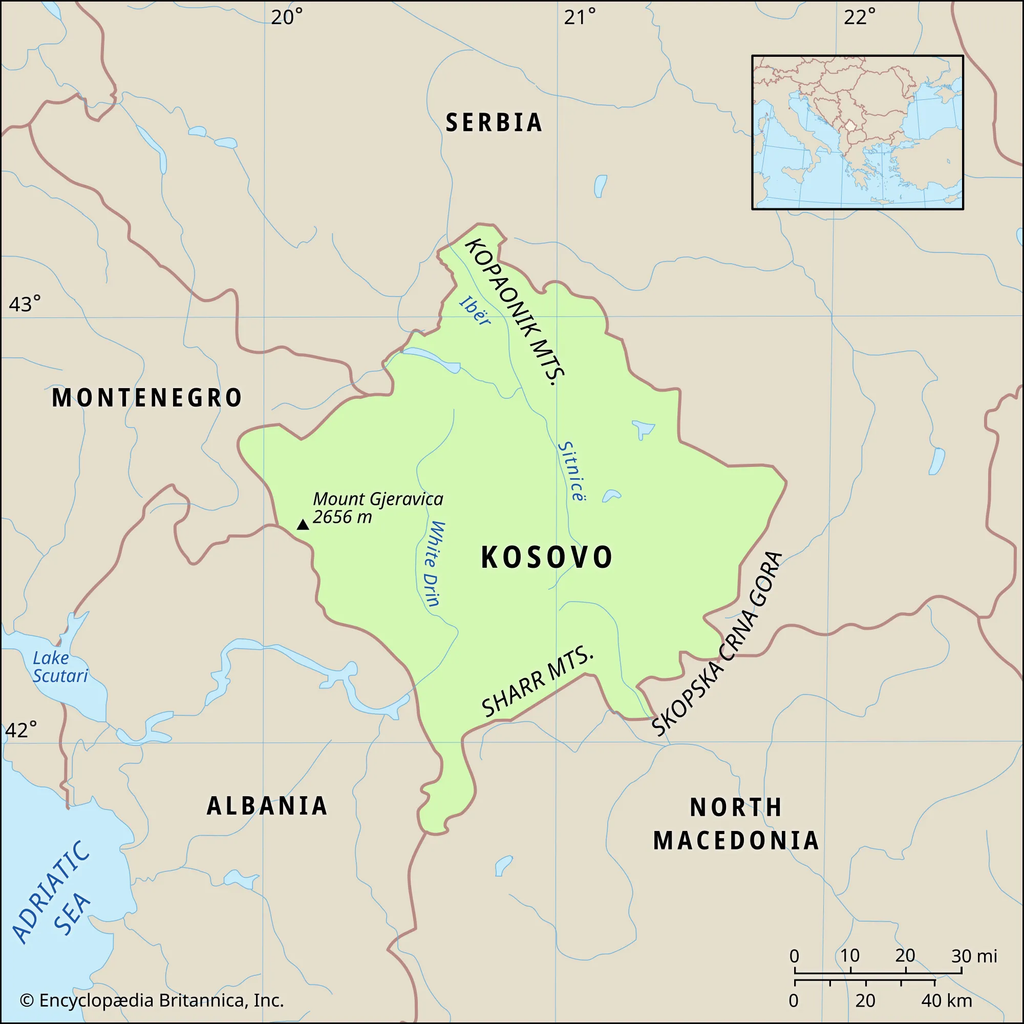
Location of Kosovo:
- Location: Landlocked territory with partially recognised statehood in the Balkan Peninsula, southeastern Europe.
- Capital: Pristina
- Neighbours: Serbia to the north and east; North Macedonia to the southeast; Albania to the southwest; Montenegro to the west.
- Map trap: It has no coastline, and does not border Greece, Bulgaria or Croatia.
- Population: Predominantly ethnic Albanian
- Drainage significance: Although landlocked, its rivers drain towards three seas: Adriatic, Black and Aegean.
Practice Prelims MCQ:
Q. With reference to Kosovo, consider the following statements:
- Kosovo shares a boundary with Albania and North Macedonia.
- It has a coastline on the Adriatic Sea.
- Its river systems drain towards the Adriatic, Black Sea, and Aegean Sea.
Which of the statements given above are correct?
(a) 1 and 2 only
(b) 1 and 3 only
(c) 2 and 3 only
(d) 1, 2 and 3
Answer: (b) Kosovo is landlocked; drainage into a sea does not imply a coastline.
Source: https://anantamias.com/current-affairs/ex-kosovo-president-convicted-by-the-hague/
