Why in news?
A pause in the monsoon has caused drought-like conditions in parts of Maharashtra’s Marathwada and Vidarbha regions, with 83 talukas across 19 districts recording rain breaks of 20 to over 40 days.
UPSC Relevance
GS1, Important Geophysical Phenomena such as earthquakes, Tsunami, Volcanic activity, cyclone etc.
GS3, Disaster and Disaster Management
Factors Driving Drought-Like Conditions In 2026
In 2026, widespread drought-like conditions across several regions in India—including Marathwada and Vidarbha in Maharashtra, as well as parts of Rajasthan, Haryana, Bihar, and the Northeast—have been driven by a combination of atmospheric, oceanic, and local factors.
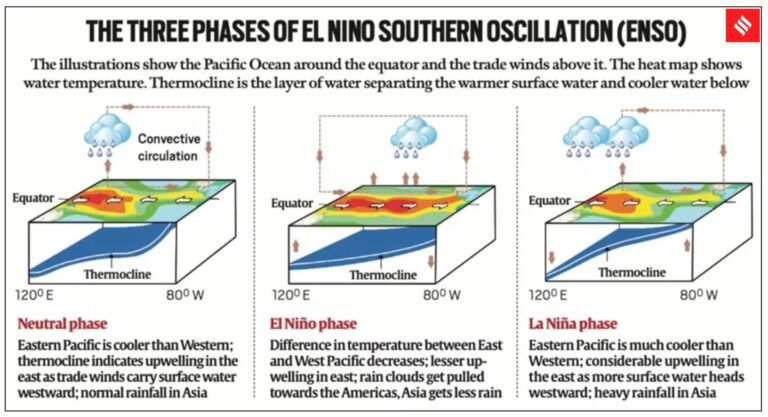
- El Niño Development: The active warming of the central and eastern Pacific Ocean disrupted global atmospheric wind circulation, weakening the Southwest Monsoon and reducing moisture flow toward the Indian subcontinent.
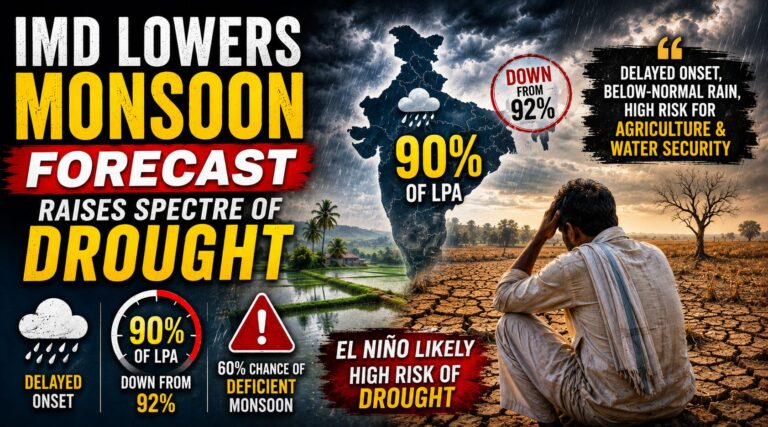
- Deficient Southwest Monsoon: Cumulative rainfall for the season remained around 15% below the Long Period Average (LPA), leading to significant rainfall shortages in major agricultural belts.
- Prolonged Rain Breaks: Long dry spells—in some talukas lasting 20 to over 40 days during critical kharif crop growth phases—severely depleted soil moisture and stressed rain-fed farming.
- Fewer Low-Pressure Systems: The North Indian Ocean saw a deficit in low-pressure areas and depressions, which normally act as the main engines driving rain across inland regions.
- Unfavourable Madden-Julian Oscillation (MJO): The MJO phase remained non-conducive during key monsoon months, failing to provide the periodic pulse needed for sustained rainfall.
- Uneven Spatial Distribution: Highly erratic monsoon behavior led to localized heavy rains in few districts while neighboring agrarian regions faced severe rainfall deficits.
Rain Breaks
A rain break (or monsoon break) refers to a temporary period during the Southwest Monsoon season when rainfall sharply decreases or stops altogether over the core agricultural belts (such as central, northern, and western India) for several days or weeks, even though the overall monsoon season remains active.
During a break, while central plains experience dry spells and high temperatures, rainfall gets heavily concentrated along the Himalayan foothills and Northeast India.

Why do Rain Breaks happen?
- Northward Shift of the Monsoon Trough: The primary cause is the displacement of the Monsoon Trough (an elongated low-pressure zone extending across India) away from the central plains toward the Himalayan foothills. This shift redirects moisture-laden winds away from the core landmass.
- Absence of Cyclonic Depressions: Low-pressure systems and depressions originating over the Bay of Bengal act as engines that drag rain inland. During a break, these cyclonic systems either fail to form or track north along the foothills instead of moving west across central India.
- Intrusion of Dry Mid-Latitude Winds: Upper-level westerly atmospheric currents sometimes blow dry, cool air over northern and central India. This stabilizes the troposphere, suppresses cloud formation, and halts rainfall.
- Parallel Coastal Winds: Along the Western Ghats and Arabian Sea coast, surface winds occasionally blow parallel to the coastline instead of perpendicularly striking the hills, preventing moisture convergence.
- Global Climate Oscillations: Planetary phenomena like El Niño or an unfavorable phase of the Madden-Julian Oscillation (MJO) create large-scale atmospheric conditions that weaken the monsoon’s strength, triggering more frequent or longer-lasting breaks.
Drought and its Types
The India Meteorological Department (IMD) primarily classifies drought into four distinct types based on the origin of the water shortage, its duration, and its impact on the surrounding environment and economy:
- Meteorological Drought: Defined by IMD when an area receives less than 75% of its normal long-term average rainfall (i.e., a seasonal rainfall deficit of >25%).
- Sub-categories:
- Moderate Drought: Rainfall deficiency between 26% and 50%.
- Severe Drought: Rainfall deficiency exceeding 50%.
- All-India Drought Year: Officially declared when the nationwide rainfall deficit exceeds 10% AND more than 20% of the country’s total area is affected.
- Sub-categories:
- Agricultural Drought: Occurs when soil moisture and rainfall are insufficient to meet the water requirements of crops throughout their growth cycle, leading to crop stress and yield losses.
- Triggered by consecutive dry spells when soil moisture levels fall below the permanent wilting point. An area is generally exempted from this category if more than 30% of its gross cropped area has access to irrigation.
- Hydrological Drought: Refers to a prolonged shortage of surface and subsurface water supplies (streams, rivers, reservoirs, lakes, and groundwater).
- It often develops following two or more consecutive meteorological droughts. It is marked by drying up of surface and subsurface water sources due to low recharge and excessive extraction.
- Socio-Economic Drought: Occurs when the physical water shortage directly impacts the supply and demand of economic goods and social well-being.
- It takes place when water scarcity affects power generation (hydroelectric), halts industrial operations, causes food grain shortages, or leads to distress migration of rural populations.
NDMA Guidelines
- Institutional Framework & Institutional Setup
- Drought Monitoring Cells (DMCs): States are instructed to set up dedicated Drought Monitoring Cells (DMCs) with expert staff under the State Disaster Management Authorities (SDMAs) to track real-time indicators like rainfall, soil moisture, and reservoir levels.
- Automatic Weather Stations (AWS): Recommends setting up network infrastructure—such as AWS and rain gauges—at the block and panchayat levels to capture granular hyper-local data.
- Assessment and Early Warning
- Standardized Assessment: Calls for unifying drought assessment indicators (combining meteorological, hydrological, agricultural, and socio-economic parameters) to streamline drought declaration across states.
- Real-time Monitoring & Advisories: Integrates satellite remote sensing (via ISRO) and ground data to generate early warnings and issue timely crop advisories to farmers.
- Prevention, Preparedness, and Water Conservation
- Watershed Development: Focuses on watershed management programs including contour bunding, check dams, and gully plugging to capture runoff and improve water tables.
- Groundwater Recharge & Regulation: Mandates strict regulation on over-extraction of groundwater alongside artificial recharge measures like percolation tanks and recharge wells.
- Efficient Irrigation: Encourages micro-irrigation techniques—such as drip and sprinkler systems—to achieve “more crop per drop”.
- Agricultural & Crop Contingency Planning
- Contingency Crop Plans: Districts are required to prepare pre-monsoon contingency plans to advise on short-duration, drought-tolerant, or alternative crops during delayed monsoons.
- Soil Moisture Conservation: Promotes conservation agriculture practices such as mulching, organic manuring, field bunding, and zero-tillage farming to reduce evaporation loss.
- Capacity Building and Community Engagement
- Community Participation: Involves local Panchayati Raj Institutions (PRIs) and self-help groups (SHGs) in water budgeting, local storage maintenance, and drought response.
- Fodder & Drinking Water Banks: Focuses on setting up advance fodder, seed, and drinking water reserves in chronic drought-prone districts to protect cattle and rural populations during lean periods.
Practice Question
“Intensifying rain breaks during the Southwest Monsoon have shifted drought management from an emergency relief operation to a structural climate resilience challenge.” In light of this statement, explain the key factors responsible for monsoon breaks and highlight the core interventions recommended by the NDMA for effective drought mitigation. (15 marks)
Tell Google you want more of this.
Add Anantam IAS as a preferred sourceOne tap, and this site shows up more often in your own Top Stories, AI Overviews and AI Mode. Remove it any time.