Why in News?
On 17 September 2026, PIB reported the first soil carbon payments under Grow Indigo’s Aadi programme, connecting verified agricultural outcomes with farmer income in Punjab and Haryana.
- The release announced over ₹2.9 crore for 2,550 farmers, with the first digital payments initiated at Punjab Agricultural University, Ludhiana.
- Credits followed measurement and independent verification of farm practices undertaken during 2019–2022; enrollment alone did not trigger payment.
- Grow Indigo paid from its own funds before all credits were sold; the transfer was not a new government income-support entitlement.
- Carbon finance can reward environmental outcomes beyond the crop sold, but only when those outcomes can be credibly accounted for.
- For smallholders, the time between changing a practice and receiving money matters alongside the eventual payment amount.
UPSC Relevance
Prelims Relevance
- Soil organic carbon: carbon contained in soil organic matter.
- MRV: measurement, reporting and verification of claimed outcomes.
- Additionality: climate benefit beyond the credible without-project scenario.
- Permanence: durability of stored carbon and management of reversal risk.
- Credit issuance and sale: distinct stages with different financial consequences.
Mains Relevance
GS Paper 3
- Agriculture: farmer incentives, soil management and transaction costs.
- Environment: credible carbon accounting and climate-finance integrity.
GS Paper 2
- Governance: transparent contracts, benefit sharing and accessible dispute resolution.
Essay
- Environmental value becomes an economic opportunity only when institutions make it measurable and fairly rewarded.
Background and Context
What a soil-carbon payment actually rewards
The asset being credited is an assessed climate outcome associated with management change, rather than simply the presence of carbon in a farmer’s soil.
- Soil organic carbon forms part of soil organic matter. Plant residues and roots contribute carbon, while decomposition releases some back; management affects this balance, but outcomes also depend on soil and climate.
- Regenerative practices in Aadi included direct-seeded rice, reduced tillage and residue management. These are management choices, not automatic certificates: their relevant greenhouse-gas reductions or soil-carbon gains must pass the programme’s assessment before credit issuance.
- A baseline represents conditions against which change is assessed. Credible accounting asks what would happen without the project, so maintaining an already existing carbon stock cannot automatically be described as newly achieved removal.
- Additionality asks whether the credited benefit goes beyond the without-project outcome. A farmer adopting a beneficial practice is not, by itself, sufficient proof that the carbon-market intervention produced an additional climate benefit.
- Net climate benefit requires attention to relevant emissions as well as storage. The IPCC assessment notes that extra fertiliser-related emissions can negate soil-carbon gains; counting only a growing carbon stock can mislead.

From field evidence to farmer payment
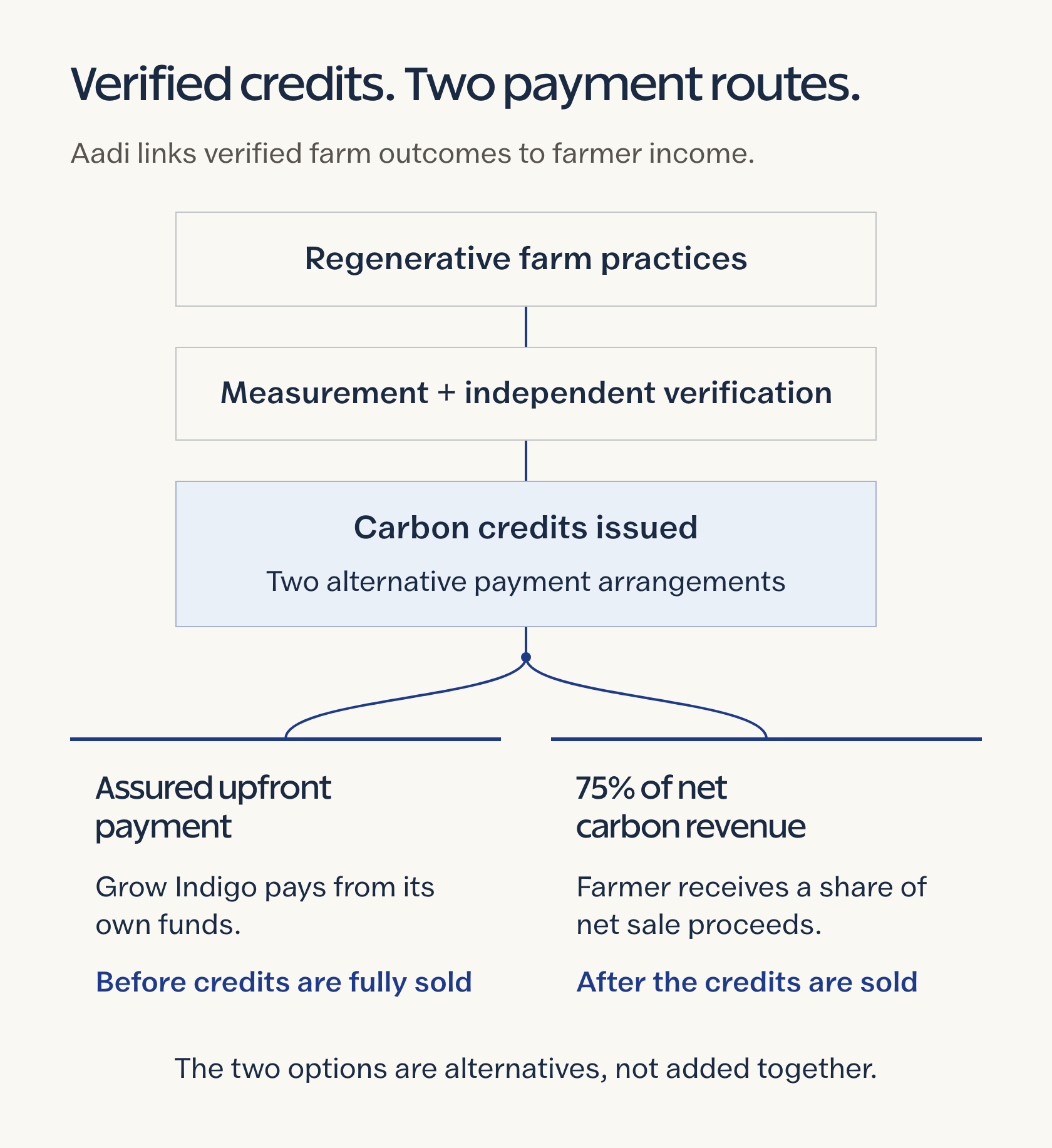
The programme separates scientific assessment, independent checking, issuance and financing; each stage answers a different question about whether a farmer can receive credible additional income.
- Measurement and reporting assemble evidence for the climate claim. PIB describes ICAR contributions involving soil-sampling protocols, greenhouse-gas accounting, modelling and remote sensing; these complementary inputs support assessment rather than turning every satellite observation into a credit.
- Independent verification checks the assessed results before issuance. Aadi credits used Verra’s VM0042 methodology; scientific support from ICAR does not convert that voluntary-credit arrangement into a government promise to purchase every farmer’s credits.
- Issuance is not sale: credits can exist before buyers have paid for them. In this case, Grow Indigo used its own money to bridge that interval, allowing farmer payments before complete sale of the credits.
- Payment choice involved an assured upfront amount or 75% of net carbon revenue after sale. The distinction matters because net proceeds depend on the contract’s deductions, while a percentage alone does not establish earnings.
- Monitoring cycles explain why enrollment and payment dates differ. Farmers joining after 2022 belong to the next cycle; the release links their payments to subsequent credit issuance, not immediate participation in the programme.
What can weaken the incentive
A credible credit and a worthwhile farm decision overlap, but neither guarantees the other; safeguards must protect both the climate claim and the cultivator.
- Permanence concerns how long carbon remains stored. Changed management or environmental stresses can reverse gains, so a payment today cannot by itself demonstrate durable storage; monitoring and responsibility for reversals need explicit treatment.
- Measurement uncertainty matters because soil carbon varies across locations and depths. A representative sampling design and consistent methods are essential; apparent changes caused by inconsistent sampling should not become claims of additional climate benefit.
- Transaction costs can absorb revenue through sampling, verification and administration. Collective arrangements may spread those costs, but farmers need to see deductions and bargaining terms, as the wider smallholder experience illustrates.
- Local suitability should guide practice adoption. Expected carbon income cannot replace assessment of water, labour and crop-management needs; the living-laboratories approach offers a useful model for connecting research with farmers’ field conditions.
- Evidence boundaries remain important: the release reports programme estimates of environmental benefits, not a controlled attribution study. Neither statewide farm-fire trends nor programme coverage proves that every enrolled farmer has achieved or received the same benefit.
Way Forward
Make the claim and the contract readable
- Provide a farmer payment statement showing credited outcomes, payment option, deductions, timing and whom to contact over a disputed amount.
- Use shared verification services to reduce avoidable costs while preserving independent assessment and access to the evidence supporting each claim.
- Explain reversal responsibilities and continuing obligations before enrollment, including how changing cultivation arrangements affects the contract.
- Combine carbon incentives with local agronomic advice, so adoption remains practical even when credit revenue is delayed or uncertain.
Conclusion
- Soil-carbon finance works through a chain of credible outcomes, verified credits and transparent payments. Its promise for farmers depends on both environmental integrity and the actual income left after participating in the programme.
- In an answer, distinguish practice adoption, credit issuance and payment. The Ludhiana case demonstrates financing before complete credit sale, while leaving wider questions about durable storage, costs and equitable participation open to scrutiny.
UPSC Practice Questions
Prelims MCQ 1
With reference to agricultural carbon-credit programmes, consider the following statements:
- Credit issuance necessarily means the credits have already been sold.
- Additionality examines the benefit relative to a credible without-project scenario.
- Changes in soil management can reverse previously achieved soil-carbon gains.
How many of the above statements are correct?
(a) Only one (b) Only two (c) All three (d) None
Answer: (b) Only two
Explanation:
Statements 2 and 3 are correct. Additionality uses a counterfactual, and soil-carbon storage can reverse. Aadi demonstrates that issuance can precede complete sale.
Prelims MCQ 2
Which statement best explains the financing arrangement reported for Aadi’s first soil-carbon payments?
(a) The Union government guaranteed a fixed payment to every farmer. (b) Grow Indigo paid from its own funds before all credits were sold. (c) Farmers were paid automatically upon enrollment. (d) Independent verification was postponed until after credit issuance.
Answer: (b) Grow Indigo paid from its own funds before all credits were sold.
Explanation:
PIB expressly identifies Grow Indigo’s own funds as the source of these advance payments. Measurement and independent verification preceded issuance; enrollment alone was insufficient.
UPSC Mains Questions
- How can agricultural carbon markets connect climate mitigation with smallholder incomes? Examine the roles of verification, payment timing and benefit sharing.
- Why are additionality and permanence central to the credibility of soil-carbon credits? Discuss safeguards suited to farmer participation.
Sources: PIB, Ministry of Agriculture and Farmers Welfare and FAO, Soil Carbon Sequestration for Improved Land Management.
Frequently Asked Questions
What are soil carbon payments?
They reward farmers for credited climate outcomes associated with soil and farm management. Payment depends on programme rules, assessed outcomes and financial arrangements; adopting a practice does not automatically generate a credit.
Is Aadi a new government cash-transfer entitlement?
No. PIB describes Grow Indigo’s farmer carbon programme with ICAR technical support. Grow Indigo used its own funds for the reported payments; digital transfer does not make it a universal government income-support entitlement.
Why can farmers wait years for carbon payments?
Evidence must be collected and assessed over a monitoring cycle, independently verified and followed by credit issuance. Sale proceeds may arrive later, although programme financing can bridge the interval after issuance.
Why does soil-carbon permanence matter?
Stored carbon can return to the atmosphere when management or environmental conditions change. Credible soil-carbon programmes must address that reversal risk rather than treating an observed increase as proof of permanent storage.
Did the payments prove a statewide reduction in stubble burning?
No. The release includes wider environmental trends and programme estimates, but these do not establish that the payments caused statewide changes. Such a claim requires evidence that separates the programme’s effect from other influences.
Tell Google you want more of this.
Add Anantam IAS as a preferred sourceOne tap, and this site shows up more often in your own Top Stories, AI Overviews and AI Mode. Remove it any time.