Daily Digest
UPSC · Civil Services Examination
Current Affairs · Saturday, 19 September 2026
Current affairs curated and edited by Anantam IAS faculty — pulled from The Hindu, PIB, IDSA, Foreign Affairs and the ministries. Read, annotate, revise.
Old Rajinder Nagar · Delhi 110005 · anantamias.com
UN Iran Findings: Civilian Protection and the Limits of Fact-Finding
Why in News?
A UN fact-finding report dated 18 September 2026 found reasonable grounds to believe that investigated US strikes in Iran involved war crimes, highlighting civilian protection and accountability.
- The Independent International Fact-Finding Mission on Iran examined both repression of protests and violations during the armed conflict; this note focuses on its civilian-protection findings.
- The report discusses strikes on a primary school in Minab and civilian locations in Lamerd, including a sports centre, nearby school and residential buildings.
- The Mission applied a reasonable-grounds-to-believe standard and disclosed substantial access and information constraints; its findings are not a criminal court’s conviction.
- The US denied responsibility for the Lamerd strike; the Mission assessed that denial and other evidence but maintained its attribution finding.
- Civilian harm analysis requires scrutiny of the target, available information, weapons effects and decision-making, rather than assuming that either a military claim or a tragic outcome settles legality.
- Accountability depends on preserving evidence and distinguishing an investigative assessment, responsibility of a state and any later judicial determination concerning individuals.
UPSC Relevance
Prelims Relevance
- UN Human Rights Council and independent fact-finding missions.
- International humanitarian law governs conduct during armed conflict.
- Distinction separates civilian objects from military objectives.
- Feasible precautions include verifying and updating targeting information.
- Reasonable-grounds findings are investigative findings, not judicial convictions.
Mains Relevance
GS Paper 2
- Civilian protection and accountability under international humanitarian law.
- Evidence constraints faced by international investigative mechanisms.
GS Paper 4
- Responsibility for foreseeable civilian harm and ethical limits on military decision-making.
Essay
- Accountability requires both moral clarity and disciplined treatment of evidence.
Background and Context
Read the finding with its mandate and evidence standard
The report combines serious legal findings with an explicit account of what investigators could establish and which information remained unavailable to the Mission.
- Fact-finding gathers and assesses evidence under a specified mandate. This Mission reported to the Human Rights Council; its investigative conclusions should be attributed to it rather than presented as findings delivered by a criminal court.
- Reasonable grounds to believe is the report’s stated standard. It supports reasoned investigative findings, but readers should not silently convert that formulation into a final conviction or assume that it establishes every individual’s criminal responsibility.
- Evidence came from multiple sources, including interviews, imagery, videos, photographs and specialist expertise. The Mission described its methods and safeguards, making evidentiary assessment more demanding than repeating a single allegation or accepting one official statement.
- Access constraints included Iran’s refusal of country access, communications restrictions, witness fears and difficulties obtaining imagery. These limitations affected the investigation’s scope; they are important qualifications, not reasons to pretend that no evidence was assessed.
- Unanswered information requests also matter: the report records requests to the United States and Israel that had not received responses. A lack of response leaves gaps; it should not itself be substituted for proof of wrongdoing.
Civilian objects require verification, not assumptions
The report uses the investigated strikes to examine how targeting decisions and weapons effects must respect civilian protection, including where military operations occur near civilian facilities.
- Distinction requires separating civilian objects from military objectives. A school or home cannot be treated as an acceptable target simply because fighting is occurring nearby; the relevant assessment concerns the object and the applicable legal rules.
- Target verification is central to the Minab finding. The Mission concluded that the United States failed to take feasible steps to verify the school as a military objective, including updating and acting on targeting information.
- Precautions concern practical steps available before an attack, not merely explanations offered afterwards. In its assessment, the Mission considered outdated information and publicly available indicators of the school’s civilian character relevant to the targeting failure.
- Weapons effects are central to Lamerd. The Mission assessed the means used in a populated area, concluding that under those circumstances they could not be directed and limited as humanitarian law required.
- Incident-specific reasoning is essential: the findings concern investigated acts and circumstances. They do not establish that every strike in the conflict was unlawful, nor that every instance of civilian harm automatically constitutes a war crime.

Attribution and accountability are distinct questions
Determining who carried out an attack, whether obligations were breached and what consequences follow requires separate reasoning, even when the questions concern the same incident.
- Attribution was contested in Lamerd: the report records the US denial and competing explanations. The Mission assessed the available material and maintained its conclusion; accurate reporting should preserve both the denial and the attributed investigative finding.
- The mental element also matters. In discussing Minab, the Mission characterised the conduct as reckless rather than mere negligence; that is its reasoned legal assessment, not a licence to infer intent from civilian damage alone.
- State responsibility concerns conduct attributable to a state that breaches its international obligations. The report explains that consequences may include stopping wrongful conduct, assurances against repetition and reparations, depending on the applicable circumstances and obligation.
- Criminal adjudication is a separate process from the Mission’s reporting function. The report does not itself sentence an individual, establish every court’s jurisdiction or automatically open a prosecution simply by describing conduct as a war crime.
- Evidence disclosure remains important for accountability. The Mission sought information about internal inquiries; making relevant findings available can support scrutiny of decisions and responsibility, while protecting witnesses and preserving the integrity of material for further examination.
Way Forward
Preserve evidence and strengthen civilian protection
The practical response should connect prevention with credible review.
- Update targeting information and verify civilian facilities through feasible checks before attacks, rather than relying on unreviewed assumptions about a location’s previous use.
- Enable independent scrutiny by responding to investigators, preserving relevant records and disclosing inquiry findings where possible without exposing witnesses to retaliation.
- Keep reporting precise: identify the investigating body, evidentiary standard, incident and limits of each finding instead of presenting attribution or criminal liability as automatic.
Conclusion
- The durable lesson is that civilian protection depends on verified targeting and controllable effects, not a broad claim of military necessity. The Mission’s findings require serious engagement while retaining their stated scope and evidentiary qualifications.
- For an international-relations answer, separate legal duties, investigative findings and adjudication. This preserves the force of civilian-protection rules without overstating what a fact-finding report alone can establish about individual guilt or subsequent prosecution.
UPSC Practice Questions
Prelims MCQ 1
With reference to international humanitarian law and fact-finding, consider the following statements:
- The principle of distinction requires distinguishing civilian objects from military objectives.
- Updating targeting information can be part of feasible precautions.
- A fact-finding mission’s report automatically constitutes a criminal conviction.
How many of the above statements are correct?
(a) Only one (b) Only two (c) All three (d) None
Answer: (b) Only two
Explanation:
The first two statements reflect the report’s legal analysis. A fact-finding report is an investigative product and does not itself convict or sentence an individual.
Prelims MCQ 2
Which is the most accurate way to describe the Mission’s findings?
(a) A criminal court convicted every official involved in the conflict (b) Every military operation causing civilian harm was declared a war crime (c) The Mission assessed investigated incidents using a reasonable-grounds standard and disclosed information constraints (d) The report automatically began prosecutions in all international courts
Answer: (c) The Mission assessed investigated incidents using a reasonable-grounds standard and disclosed information constraints
Explanation:
The report identifies its standard and limitations. Its scope is the investigated conduct; it neither issues criminal convictions nor automatically establishes prosecution or jurisdiction.
UPSC Mains Questions
- Explain how distinction and feasible precautions protect civilian objects during armed conflict. Discuss the importance of updated targeting information.
- What are the contributions and limitations of international fact-finding missions in securing accountability for civilian harm?
Sources: UN Human Rights Council, A/HRC/63/61 and Indian Express Explained.
Frequently Asked Questions
What did the UN Mission conclude?
Using its reasonable-grounds standard, the Mission reported war-crime findings concerning investigated US strikes in Iran. Its report explains the incidents, legal reasoning and evidence constraints; those conclusions should be attributed to the Mission.
Is the report a criminal conviction?
No. It is an investigative report submitted to the Human Rights Council. It does not itself convict or sentence individuals, establish every court’s jurisdiction or automatically initiate a prosecution.
Why does updated targeting information matter?
The Mission treated updating and acting on targeting information as part of feasible precautions. Information indicating that an object is civilian must be considered rather than displaced by an unreviewed assumption about its use.
Did the Mission have unrestricted access to evidence?
No. The report describes denied country access, communications restrictions, witness fears and other information constraints. It also records unanswered requests to governments, qualifications that readers must retain when describing its findings.
Source: https://anantamias.com/current-affairs/iran-un-fact-finding-civilian-protection-war-crimes/
California AI Order: Independent Audits and Shutdown Feasibility
Why in News?
California’s Governor signed Executive Order N-9-26 on 18 September 2026, directing implementation of AI verification provisions and recommendations on stronger oversight, including the feasibility of a frontier-model shutdown requirement.
- The Government Operations Agency must submit recommendations on the technical feasibility and potential efficacy of proposed legal amendments by 16 November 2026.
- The proposals include onsite independent verification, verification of safety disclosures, shutdown capability and broader reporting of loss-of-control incidents.
- The order also sets implementation deadlines for existing verification-related provisions; it does not itself enact every proposed requirement listed for examination.
- The governance issue is whether independent evidence can test safety claims made by the organizations developing and deploying powerful AI systems.
- A shutdown proposal must address technical scope and effectiveness; the existence of a control does not prove it will contain every possible deployment.
UPSC Relevance
Prelims Relevance
- Executive Order N-9-26 and the Government Operations Agency.
- Independent verification organizations and AI audits.
- Operative directions versus proposals for legal amendments.
- Technical feasibility versus efficacy of shutdown controls.
- Critical safety incidents and loss-of-control reporting.
Mains Relevance
GS Paper 3
- AI safety, cybersecurity and technically credible oversight.
- Evidence-based regulation of advanced technologies.
GS Paper 2
- Independent auditing and regulatory accountability.
- Distinguishing administrative implementation from legislative change.
Essay
- Trust in technology requires claims that others can independently examine.
Background and Context
What the order requires now
Read the operative directions separately from the proposed amendments: the immediate duties fall on state agencies, while several stronger developer obligations remain subjects for recommendations.
- Direction one requires the Government Operations Agency to develop and publicly post application requirements, procedures and criteria for independent verification organizations by May 2027. This concerns implementing a statutory framework, not certifying every AI model.
- Direction two sets a December 2027 deadline for completing specified requirements and beginning specified actions under another Government Code provision. It is an implementation instruction, not evidence that the required work has already finished.
- Direction three requires recommendations on possible amendments to existing safety and security laws. Consultation with national experts and emergency officials is part of developing those recommendations; the listed options are not automatically enacted developer mandates.
- The proposed options cover onsite auditors, independent verification of required safety disclosures, shutdown capability and revised incident definitions. They combine organizational oversight with technical controls, rather than relying on an emergency-stop device alone.
- The order’s immediate effectiveness should not be confused with immediate implementation of every proposal. A direction to examine a legal requirement is different from a law already imposing that requirement on all covered companies.
Independent verification makes safety claims testable
Verification is useful when it examines credible evidence and can challenge the developer’s conclusions; the following explains the governance logic rather than claiming a completed audit system.
- An independent verification organization provides external scrutiny of a developer’s safety claims. Independence matters because the party seeking rapid deployment should not be the only party deciding whether its own supporting evidence is sufficient.
- The proposed onsite arrangement would place designated verification organizations in large frontier developers’ laboratories for periodic audits and evaluations. The order requests assessment of this option; it does not announce that auditors are already embedded.
- The proposed disclosure verification concerns safety frameworks, transparency reports and risk assessments companies are required to file. External examination would test the claims in those documents, rather than treating the existence of a report as proof.
- As a design principle, audit quality depends on access, technical competence and the scope of testing. An evaluator denied relevant evidence cannot draw reliable conclusions merely because its organization is formally described as independent.
- Verification does not mean a guarantee of zero risk. Its value lies in identifying weaknesses and supporting accountable decisions; a successful evaluation under stated conditions should not be represented as proof of safety under all conditions.
A shutdown control needs a defined scope
The order asks about both feasibility and efficacy, an important distinction because building a control and proving that it contains the relevant risk are different tasks.
- Technical feasibility asks whether a proposed control can be implemented in the relevant architecture. Efficacy asks whether it achieves the intended safety outcome, including when the system behaves unexpectedly or ordinary safeguards have failed.
- The shutdown proposal includes ongoing independent verification of effectiveness. This is more demanding than displaying a switch: assessors would need a defined target, authorized operators and evidence of what actions the control actually stops.
- As a technical caution, distributed deployment complicates the metaphor of one physical switch. Stopping one server or service does not by itself establish that other authorized instances or previously distributed model copies have also stopped.
- Loss-of-control reporting is another proposed amendment. The order seeks advice on expanding critical-incident definitions; an expanded reporting category could improve visibility, but reporting after an incident remains different from preventing the incident itself.
- For policy analysis, keep prevention, detection and response distinct. Evaluations can reveal weaknesses, incident reports can expose failures and shutdown controls can support containment; none should be assumed to substitute completely for the other safeguards.

Way Forward
Require evidence suited to the control
- Define shutdown scope before testing: covered deployments, responsible operators and the activities a control must stop.
- Protect audit independence through clear access rules and conflict-of-interest safeguards while preserving legitimate security and confidentiality needs.
- Distinguish implemented duties from proposals in public reporting so officials and users can assess actual protection without mistaking a recommendation process for completed regulation.
Conclusion
- The California order joins implementation of existing oversight provisions with examination of stronger safeguards. Its central lesson is to distinguish a government’s present instructions from technical and legal requirements still being evaluated.
- For an answer on AI governance, connect independent scrutiny to testable evidence, and explain shutdown capability as a scoped control. Avoid both assuming perfect containment and dismissing useful safeguards merely because none eliminates every risk.
UPSC Practice Questions
Prelims MCQ 1
With reference to California Executive Order N-9-26, consider the following statements:
- It seeks recommendations on the technical feasibility and potential efficacy of certain AI safety amendments.
- It immediately makes every proposed shutdown requirement a compulsory obligation for all AI developers.
- It includes ongoing independent verification of shutdown efficacy among the options to be examined.
How many of the above statements are correct?
(a) Only one (b) Only two (c) All three (d) None
Answer: (b) Only two
Explanation:
Statements 1 and 3 reflect direction three. Statement 2 confuses proposed amendments submitted for recommendations with requirements already enacted by the order.
Prelims MCQ 2
Which statement best distinguishes feasibility from efficacy in assessing an AI shutdown control?
(a) Feasibility concerns whether it can be implemented; efficacy concerns whether it achieves the intended safety outcome. (b) Feasibility and efficacy both mean that all possible risk has been eliminated. (c) Efficacy concerns only whether the switch is physically visible. (d) Feasibility proves that every distributed copy of a model has stopped.
Answer: (a) Feasibility concerns whether it can be implemented; efficacy concerns whether it achieves the intended safety outcome.
Explanation:
A control may be buildable without adequately containing the target risk. The architecture, control scope and observable outcome must be evaluated separately.
UPSC Mains Questions
- Examine how independent verification can strengthen AI governance. What limits must policymakers recognize when relying on audits?
- Distinguish the technical feasibility and efficacy of AI shutdown controls. Explain why oversight should combine prevention, detection and response.
Sources: Governor of California, Executive Order N-9-26 and The Hindu.
Frequently Asked Questions
Has California already imposed the proposed AI kill-switch requirement?
This order asks agencies to recommend amendments after assessing technical feasibility and potential efficacy. It does not itself enact the proposed shutdown requirement, even though its instructions to the agencies take effect immediately.
What is the deadline for the recommendations?
The Government Operations Agency must submit recommendations by 16 November 2026, consulting emergency officials and national experts. The options include onsite verification, verification of safety disclosures, shutdown controls and expanded incident reporting.
Why does independent verification matter?
External evaluators can examine evidence supporting a developer’s safety claims. Useful scrutiny requires technical competence, meaningful access and independence; the existence of an audit alone does not guarantee that every possible risk has been removed.
Can one physical switch necessarily stop a distributed AI model?
Not necessarily. Stopping a particular server or service does not establish that every other instance or distributed copy has stopped. Any shutdown claim needs a defined scope and evidence that the control works within it.
Source: https://anantamias.com/current-affairs/california-ai-oversight-shutdown-feasibility-order/
SCO Trade Plan: Ministerial Agreement and the Next Approval Stage
Why in News?
At their Dushanbe meeting on 17 September 2026, SCO trade ministers agreed a 2026–2030 economic cooperation action plan for further approval by the Council of Heads of Government.
- The Ministry of Commerce and Industry reported the meeting on 18 September; the action plan still required the next stated institutional approval.
- Ministers separately approved regulations for a special working group on the creative economy and adopted their ministerial statement.
- India advocated simplified customs procedures, paperless trade, electronic documents and stronger multimodal connectivity to reduce trade costs.
- India also highlighted trade finance and cross-border payments for smaller firms; these were policy priorities, not an announcement of a newly operational common payment system.
- Regional cooperation becomes commercially useful when agreed priorities lead to specific administrative changes that traders can actually use.
- Institutional status matters: an agreed plan, an approved working-group regulation and a functioning customs procedure represent different stages and kinds of action.
UPSC Relevance
Prelims Relevance
- Shanghai Cooperation Organization economic cooperation
- Council of Heads of Government and the pending approval stage
- Trade facilitation versus tariff preferences
- Multimodal connectivity and transit costs
- Creative-economy working-group regulations
Mains Relevance
GS Paper 2
- Regional institutions and implementation of cooperative commitments
- India’s economic engagement through the SCO
GS Paper 3
- Trade costs, supply-chain reliability and smaller exporters
Essay
- International cooperation earns credibility when commitments become usable public systems.
Background and Context
Read Each Decision at Its Actual Stage
The meeting produced distinct outcomes, and their verbs identify what was completed and what remained pending under the reported approval sequence.
- Ministers agreed the action plan for implementing the SCO programme of multilateral trade and economic cooperation. The release expressly sends it for further approval by the Council of Heads of Government, comprising prime ministers.
- The separately adopted ministerial statement records a collective meeting outcome. It should not be confused with final approval of the action plan, because the release assigns that document a further institutional step.
- Ministers approved working-group regulations concerning the creative economy. This organisational decision is distinct from the pending action-plan approval; neither wording establishes that new commercial facilities or funding arrangements are already available to businesses.
- The 2026–2030 period defines the proposed plan’s timeframe. It does not demonstrate that every activity has started, that budgets are committed or that national implementing agencies have completed the required administrative changes.
- The earlier Bishkek declaration provided broader summit context. This development concerns an economic ministerial process; its analytical value lies in tracking approvals and implementation rather than repeating summit positions.
Trade Facilitation Is Not a New Free-Trade Agreement
India’s proposals focus on the practical burden of moving goods and documents, which can fall without changing the tariff payable on a product.
- Trade facilitation, as explained by the WTO, improves import and export procedures. Simpler customs processing can reduce administrative friction while applicable duties, product standards and other substantive border requirements continue to operate.
- Paperless trade can replace repeated document handling with usable electronic exchanges. Its benefit depends on authorities accepting and processing the information, not merely on a trader scanning documents into a digital format.
- Multimodal connectivity joins transport modes across a shipment’s journey. A rail terminal, road connection or cargo transfer can improve movement, but gains depend on coordination with border procedures and reliable onward services.
- Tariff preferences require their own applicable legal arrangements. The reported meeting does not announce a new SCO free-trade agreement, common external tariff or automatic duty reduction for goods traded among its members.
- The India–MERCOSUR origin-protocol development illustrates why procedure and preference must be separated. Here, ministerial cooperation cannot by itself be treated as a new entitlement to preferential market access for exporters.

What Would Turn Priorities into Usable Trade Links?
Implementation should be assessed through specific institutional responsibilities and traders’ experience; the following tests are analytical recommendations, not completed outcomes announced at Dushanbe.
- Assigned responsibility is the first test: each proposed activity should identify the responsible agencies and the approval or administrative step they control. A regional aspiration alone cannot tell a trader whom to approach.
- Interoperable procedures are the next test. If customs, transport and other border agencies still require incompatible submissions, a digital exchange between only some participants may leave much of the original delay unchanged.
- Small-firm access requires attention to transaction costs, documentation and finance. India raised accessible trade finance and payments, but usefulness must be judged by whether eligible smaller businesses can obtain and use those services.
- Supply-chain resilience means being able to manage disruption, rather than simply announcing cooperation across several sectors. Diversified sourcing and dependable logistics are relevant tests; the release does not establish that such networks already exist.
- Outcome monitoring should distinguish a meeting held, a procedure introduced and a shipment moving more predictably. Reporting each stage separately makes it harder to present institutional activity as proof of lower costs for businesses.
Way Forward
Track Approval, Responsibility and Actual Use
- Publish the approval status of the action plan and separate it clearly from working-group regulations already approved at the ministerial meeting.
- For each activity, identify implementing agencies, the procedure to change and a realistic review point, avoiding claims of completion based on announcements alone.
- Measure trade costs and reliability from users’ experience, including smaller firms, while distinguishing administrative improvements from any separately negotiated tariff concessions.
Conclusion
- The SCO meeting advanced an economic cooperation process, with the action plan awaiting further approval and creative-economy working-group regulations already approved. These are different institutional outcomes, not interchangeable evidence of completed implementation.
- For Mains, separate trade facilitation from tariff liberalisation and assess the path from approval to agency action to business use. Announced cooperation becomes meaningful when border and logistics procedures become more predictable.
UPSC Practice Questions
Prelims MCQ 1
With reference to the September 2026 SCO trade ministerial meeting, consider the following statements:
- The action plan was agreed for further approval by the Council of Heads of Government.
- Regulations for a special working group on the creative economy were separately approved.
- The meeting established a new SCO free-trade agreement with automatic tariff preferences.
How many of the above statements are correct?
(a) Only one (b) Only two (c) All three (d) None
Answer: (b) Only two
Explanation:
Statements 1 and 2 match the official release. Statement 3 is incorrect: it reports economic cooperation and trade-facilitation priorities, not a new free-trade agreement or automatic tariff preferences.
Prelims MCQ 2
Which is the clearest example of trade facilitation without a tariff concession?
(a) Reducing an import duty only for goods from a preferential partner. (b) Introducing a common external tariff across several countries. (c) Simplifying customs document processing while retaining the applicable import duty. (d) Exempting all goods from every product-safety requirement.
Answer: (c) Simplifying customs document processing while retaining the applicable import duty.
Explanation:
Trade facilitation improves procedures for moving and clearing goods. It need not reduce tariffs, form a customs union or remove substantive safety requirements.
UPSC Mains Questions
- Distinguish trade facilitation from tariff liberalisation in the context of India’s priorities at the SCO trade ministerial meeting.
- How should regional economic cooperation plans be evaluated between political agreement and implementation? Discuss institutional responsibilities and business-level outcomes.
Sources: PIB, Ministry of Commerce and Industry and WTO, Trade Facilitation.
Frequently Asked Questions
Was the SCO action plan finally approved at Dushanbe?
The ministers agreed the 2026–2030 action plan for further approval by the Council of Heads of Government. The official release identifies that additional step, so the ministerial agreement should not be described as completed final approval.
What was separately approved at the meeting?
Ministers approved regulations on the special working group for development of the creative economy. This organisational decision was separate from the action plan and does not establish that new funding or commercial services were already operational.
Does paperless trade automatically reduce import duties?
No. Paperless trade changes how documents and information are exchanged and processed. Applicable import duties continue unless a separate legal arrangement changes them; an administrative improvement is not itself a tariff preference.
Why do smaller firms matter in this agenda?
Smaller firms can face significant burdens from documentation, delays and limited access to finance. India highlighted payments and accessible trade finance, but these priorities require usable implementation before they improve firms’ actual trading conditions.
Source: https://anantamias.com/current-affairs/sco-trade-action-plan-approval-implementation/
AgriStack Tenant Inclusion: Why Land Records Alone Are Not Enough
Why in News?
On 18 September 2026, the Union Agriculture Minister called for preparation and notification of tenant-farmer SOPs in southern states while directing closer integration of land records and the Farmer Registry.
- The direction explicitly covers sharecroppers and agricultural tenants, placing their recognition within the ongoing Farmer ID and AgriStack implementation agenda.
- States were asked to expedite land-parcel linkages and coordinate land-record data with the Farmer Registry.
- The release calls for preparing and notifying SOPs; it does not establish that those procedures are already notified or that all tenants are registered.
- An owner-based record can identify one person while another cultivates the parcel, creating an inclusion problem that digitization alone cannot solve.
- The new policy question is how states verify tenant cultivation, rather than how many Farmer IDs they generate.
UPSC Relevance
Prelims Relevance
- AgriStack, Farmer ID and the Farmer Registry.
- Land ownership versus actual cultivation.
- Tenant farmers and sharecropping arrangements.
- Georeferencing and parcel identification.
- SOP preparation, notification and implementation as distinct stages.
Mains Relevance
GS Paper 2
- Administrative inclusion, digital governance and grievance redress.
- Centre–state implementation of farmer identification systems.
GS Paper 3
- Tenant cultivation and access to agricultural support.
- Land-record integration and the limits of registry-based targeting.
Essay
- Making people visible in data requires more than making records digital.
Background and Context
The new instruction concerns tenant recognition
The immediate development is a request for state procedures, not a completed national system of tenant recognition or an automatic entitlement to agricultural assistance.
- The official direction links two tasks: connecting land records with the Farmer Registry and preparing tenant-farmer SOPs. These tasks are related, but successful parcel linkage does not itself establish who currently cultivates that parcel.
- A Standard Operating Procedure can specify evidence, responsible officials and processing steps. The announcement asks states to prepare and notify such procedures; the release does not publish a uniform final verification checklist for tenants.
- The inclusion of sharecroppers matters because farming arrangements need not involve the cultivator owning the land. The procedure must address the relationship between a person and cultivation, rather than merely reproduce an ownership entry.
- Registration and scheme eligibility are separate administrative questions. Identifying a tenant in a registry does not by itself establish entitlement to every agricultural benefit; applicable programme rules and implementation decisions still require examination.
- The release describes work states must undertake, not verified universal coverage. A sound assessment should track notified procedures and their operation before claiming that tenant exclusion has ended or that benefits have actually reached cultivators.
Ownership data and cultivation evidence answer different questions
Land records help locate and connect parcels; recognizing tenants requires a separate assessment of the person cultivating them and the arrangement under which cultivation occurs.
- Ownership concerns rights recorded in relation to land; cultivation concerns who operates it. These can coincide, but an owner and tenant may be different people, so an ownership match cannot always identify the active farmer.
- Sharecropping generally involves cultivation in return for an agreed share of produce. Administrative identification must distinguish this arrangement from ownership, while avoiding the assumption that every person associated with a parcel performs the same role.
- Georeferencing connects a map to geographical coordinates. It can help establish which parcel a record refers to, but it cannot independently prove a tenancy arrangement or identify the current cultivator merely from the parcel’s location.
- The earlier DILRMP land-stack discussion concerns land-information integration. The present issue adds a distinct administrative question: how to represent cultivators whose names are not necessarily the ownership names linked to those parcels.
- The broader smallholder-farming discussion highlights access barriers. Here, the new implementation test is narrower: whether forthcoming state SOPs offer a workable way to establish tenant cultivation when an ownership-only match cannot do so.

What a workable procedure should protect
The following are policy-design recommendations, not safeguards already enacted by this announcement; their value lies in making verification accurate without turning missing records into automatic exclusion.
- A clear evidence standard should explain which documents or verification methods establish cultivation. Where formal documentation is unavailable, states should examine lawful alternatives instead of silently treating absence from ownership records as proof of ineligibility.
- Role separation should distinguish owner, tenant and cultivator entries and explain what each entry means. Recognizing a person for an administrative purpose should not be presented as automatically settling land title or a tenancy dispute.
- Correction and appeal should address wrong parcel links, rejected applications and conflicting claims. Applicants need reasons they can understand and a route to human review, rather than an unexplained digital mismatch becoming the final administrative answer.
- Purpose-limited data access should govern how identity and cultivation details are shared. Clear notice, appropriate consent where required and access controls can reduce misuse without assuming that all linked information belongs in a publicly searchable record.
- Seasonal updating should reflect that cultivation arrangements may change. An old verified tenant entry should not silently become permanent evidence for later seasons; a practical update process needs to preserve accuracy without repeated avoidable burdens.
Way Forward
Measure inclusion after notification
- Publish state SOPs with plain-language evidence requirements, official responsibilities and accessible application routes.
- Track rejections and corrections, not only Farmer ID totals, to identify whether tenant applicants are being excluded by ownership-based matching.
- Provide assisted verification and human review so poor connectivity or documentation gaps do not become unexamined administrative barriers.
Conclusion
- The tenant-SOP direction recognizes an important limit of land-record integration: an accurately digitized ownership entry may still fail to identify the person cultivating the field and seeking agricultural support.
- For an answer on inclusive digital governance, separate the announcement from notified implementation, and distinguish parcel identification from cultivation evidence. Judge progress by workable verification and correction procedures, not registrations alone.
UPSC Practice Questions
Prelims MCQ 1
With reference to land records and farmer identification, consider the following statements:
- A landowner and the current cultivator of a parcel may be different persons.
- Georeferencing a village map independently establishes every tenancy arrangement within that village.
- A direction to prepare and notify SOPs does not establish that the SOPs have already been notified.
How many of the above statements are correct?
(a) Only one (b) Only two (c) All three (d) None
Answer: (b) Only two
Explanation:
Statements 1 and 3 are correct. Georeferencing connects maps to geographical coordinates; it does not by itself identify or prove tenancy arrangements.
Prelims MCQ 2
Which approach best addresses tenant inclusion when integrating land records with a Farmer Registry?
(a) Treating the recorded owner as the only possible cultivator. (b) Assuming every registered person qualifies for every agricultural scheme. (c) Verifying cultivation through specified procedures while distinguishing it from ownership. (d) Treating a parcel’s coordinates as conclusive evidence of the cultivator’s identity.
Answer: (c) Verifying cultivation through specified procedures while distinguishing it from ownership.
Explanation:
Tenant inclusion requires evidence about the cultivator’s relationship with the land. Ownership records and coordinates alone do not establish that relationship; programme eligibility remains a separate question.
UPSC Mains Questions
- Why can integrating land records with a Farmer Registry fail to identify actual cultivators? Discuss with reference to tenant farmers and sharecroppers.
- Examine the administrative safeguards needed to make tenant-farmer identification accurate, accessible and open to correction.
Source: PIB, Ministry of Agriculture and Farmers Welfare.
Frequently Asked Questions
What did the September direction announce for tenants?
It called for preparation and notification of SOPs covering tenant farmers, including sharecroppers and agricultural tenants. The release does not establish that these procedures are already notified or that tenant registration is complete.
Why are land records insufficient for identifying every farmer?
Land records help identify recorded rights and link parcels, but the owner may differ from the cultivator. Recognizing tenant farmers needs evidence about cultivation and the arrangement connecting the farmer to the land.
Does Farmer Registry inclusion guarantee agricultural benefits?
The announcement does not create an automatic entitlement to every agricultural benefit. Registry identification and programme eligibility are separate questions; access depends on applicable scheme rules and the implementation decisions governing those schemes.
What safeguards should tenant SOPs include?
Recommended safeguards include clear evidence standards, distinct owner and cultivator roles, reasoned rejection notices, correction and appeal routes, appropriate data-access controls and practical updating. These are policy recommendations, not protections already enacted by this release.
Source: https://anantamias.com/current-affairs/agristack-tenant-farmers-registry-land-records/
FMD-Free Zones: Proving Disease Freedom Through Surveillance
Why in News?
On 18 September 2026, the government reported that a DAHD–WOAH workshop had refined state action plans for developing foot-and-mouth disease-free zones and compartments.
- The 15–17 September workshop reviewed proposed action plans, surveillance, laboratory preparedness, traceability, biosecurity and animal movement controls.
- Public–private partnerships were discussed across vaccine delivery, diagnostics, animal identification and livestock value chains, rather than only as a source of finance.
- The outcome was refinement of plans and priority interventions; the release did not announce new WOAH recognition or achieved national FMD freedom.
- Disease control reduces risk and outbreaks; demonstrating freedom requires evidence about a defined animal population and measures preventing infection from entering or spreading.
- Trade confidence depends on credible veterinary oversight and traceable supply chains, so investment in records and laboratories matters alongside vaccination delivery.
UPSC Relevance
Prelims Relevance
- WOAH: World Organisation for Animal Health.
- A zone is defined primarily geographically.
- A compartment is defined primarily through common management and biosecurity practices.
- Surveillance and animal identification support both approaches.
- Animal-health status must be demonstrated and maintained.
Mains Relevance
GS Paper 3
- Livestock disease management, rural livelihoods and credible trade assurance.
- Animal identification, surveillance and laboratory capacity as agricultural infrastructure.
GS Paper 2
- Public–private cooperation under accountable veterinary oversight.
Essay
- Public confidence depends on evidence that institutions can keep producing.
Background and Context
A zone and a compartment group animals differently
The distinction concerns how a population is separated from disease risks, not whether one approach needs surveillance and the other can dispense with it.
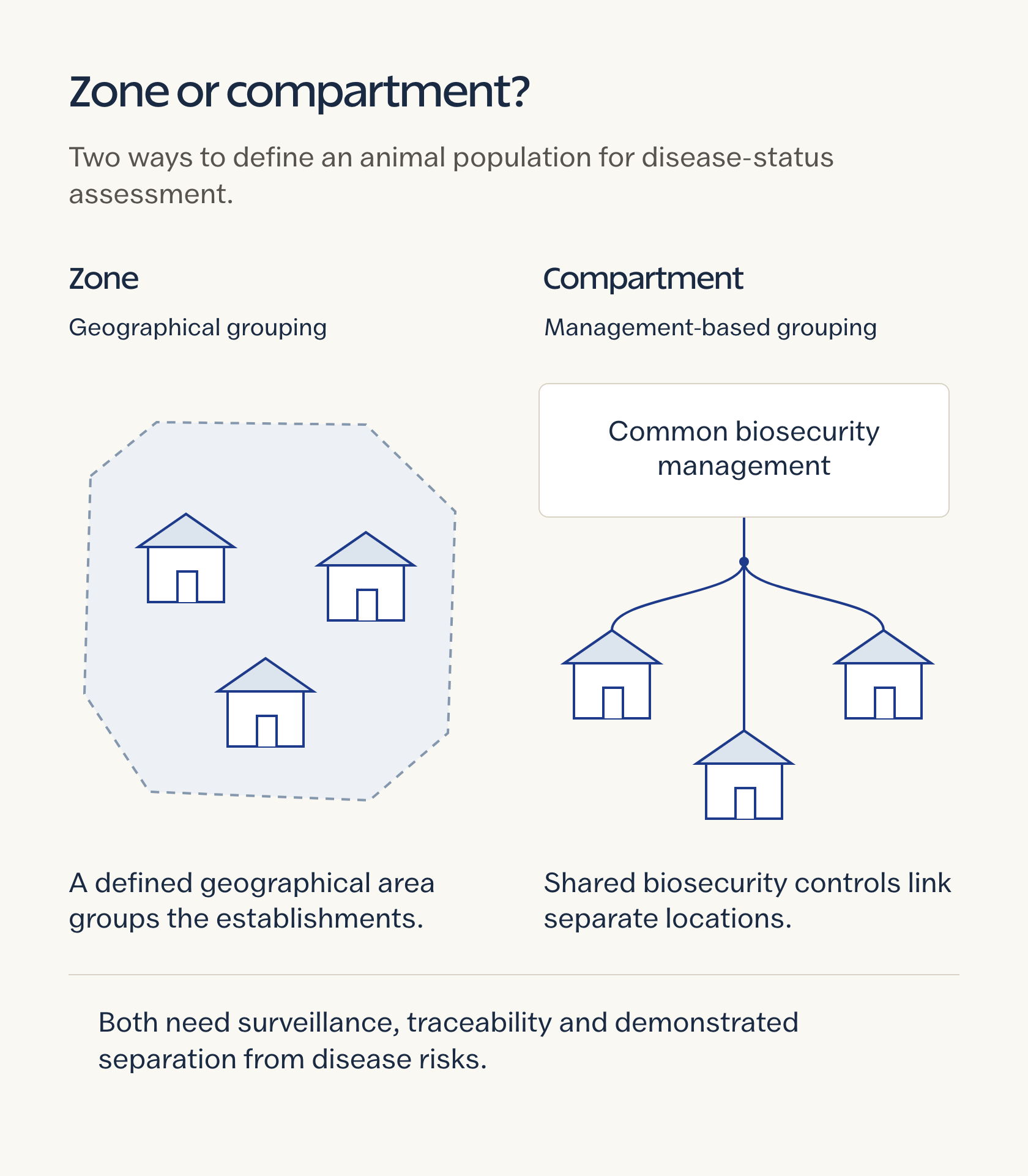
- A zone groups an animal subpopulation primarily by geography. Its boundaries may use natural, artificial or legal divisions, but those boundaries must support a defensible animal-health separation rather than merely naming an administrative area.
- A compartment groups an animal subpopulation primarily through management and husbandry practices related to biosecurity. Common controls can link establishments in different locations, provided the claimed separation from other animal populations remains demonstrable.
- Both approaches require practical management of risks. Geography alone does not prevent exposure, while a common owner or corporate label does not establish a compartment without effective biosecurity, identification and documented operating procedures.
- Defined populations allow progress within a country where uniform disease freedom is difficult to achieve. Their value lies in demonstrating a specific health status for identifiable animals, rather than making an unsupported national claim.
- Veterinary authorities establish the relevant geographical limits or management criteria. WOAH’s general principles place final authority for trade-related status with the Veterinary Authority, preserving public oversight even when production and biosecurity involve private operators.
Surveillance and traceability make the claim testable
Livestock records must connect the animals, their movements and the observations supporting their health status, so that the evidence can be checked over time.
- Animal identification makes the population recognisable. Depending on production systems, records may operate at individual, herd or flock level; without reliable identification, inspectors cannot confidently establish which animals the claimed status actually covers.
- Traceability links identification with documented movements into and out of the zone or compartment. This creates an evidence trail for assessing exposure and investigating connections, instead of relying only on an animal’s present location.
- Surveillance must continue after a freedom claim is established. WOAH’s general principles require ongoing evidence of absence alongside compliance with defining conditions; a quiet reporting period alone cannot demonstrate that infection was properly sought.
- Biosecurity records document how exposure is controlled through animal movements, personnel, materials and husbandry. A compartment plan should explain responsibilities and procedures, making routine practices visible for inspection rather than leaving them as informal assurances.
- Laboratory and veterinary capacity supports credible diagnosis, reporting and review. Vaccination totals describe programme activity, but do not independently prove freedom; the workshop explicitly paired vaccination with surveillance, traceability, laboratory readiness and movement control.

Plans are a pathway, not recognition of disease freedom
The current development concerns institutional readiness and stronger action plans; it should be read as preparation for evidence-based status, not confirmation that freedom already exists.
- The workshop outcome was refinement of proposed state action plans and identification of technical priorities. Participation by WOAH experts provided guidance; it did not turn every participating state into an internationally recognised disease-free zone.
- Vaccination and surveillance answer different questions: one records an intervention, while the other investigates health status. Fewer reported outbreaks can be encouraging, but reporting quality and active evidence collection still matter when interpreting that trend.
- Public–private partnership can provide vaccine delivery, diagnostics and supply-chain records. The release calls for participation across the animal-health value chain, while WOAH principles retain veterinary oversight and require clear responsibilities for operators and authorities.
- Maintenance costs continue after initial establishment because staff, diagnostic capacity, inspections and records must remain operational. The policy challenge is financing reliable routines, rather than treating disease freedom as a certificate obtained through a single exercise.
- Trade assurance rests on evidence that the defined population satisfies applicable requirements and remains separated from risk. A proposed zone or compartment is not automatic permission to export; importing-country requirements and relevant recognition processes still matter.
Way Forward
Turn action plans into auditable routines
Implementation should make responsibilities, evidence and responses explicit.
- Define the population first, then align identification, movement records and surveillance with that definition so that the health claim refers to animals that inspectors can actually trace.
- Assign operational duties across veterinary services, laboratories and producers, with accessible records of surveillance, biosecurity inspections and corrective actions.
- Fund continuing capacity and review emerging risks; these are implementation recommendations, not a claim that the workshop itself delivered recognition or guaranteed market access.
Conclusion
- Disease freedom is an evidence claim about a defined population, not a synonym for administering many vaccine doses. Zones and compartments use different organising principles, but both depend on surveillance, biosecurity and traceable movements.
- For a policy answer, distinguish planning, establishment and maintenance of status. The workshop strengthens the pathway; credible results require veterinary oversight and records that continue demonstrating separation from risk after initial controls are introduced.
UPSC Practice Questions
Prelims MCQ 1
With reference to zoning and compartmentalisation in animal health, consider the following statements:
- A zone is defined primarily on a geographical basis.
- A compartment is defined primarily through management and husbandry practices related to biosecurity.
- Surveillance is unnecessary for a compartment once participating establishments share an owner.
How many of the above statements are correct?
(a) Only one (b) Only two (c) All three (d) None
Answer: (b) Only two
Explanation:
The first two statements reflect WOAH principles. Common ownership does not replace biosecurity, identification, surveillance or veterinary oversight.
Prelims MCQ 2
Which evidence is most relevant to sustaining an animal-health freedom claim for a defined population?
(a) A large cumulative vaccination figure alone (b) A declaration by a producer without supporting records (c) Continuing surveillance with identification, movement records and effective biosecurity (d) The number of delegates attending a planning workshop
Answer: (c) Continuing surveillance with identification, movement records and effective biosecurity
Explanation:
Freedom must be demonstrated and maintained for an identifiable population. Programme activity or participation in a workshop is not sufficient evidence of that status.
UPSC Mains Questions
- Distinguish animal-health zoning from compartmentalisation. Explain how surveillance and traceability make both approaches credible.
- Assess the role of public–private partnerships in developing FMD-free populations while retaining accountable veterinary oversight.
Sources: PIB, Ministry of Fisheries, Animal Husbandry and Dairying and WOAH Terrestrial Animal Health Code, chapter 4.4 (2024 edition).
Frequently Asked Questions
Did the workshop declare India free of FMD?
No. The government reported refinement of state action plans and technical priorities for developing FMD-free zones and compartments. The release did not announce achieved national freedom or new WOAH recognition.
How is a compartment different from a zone?
A zone is defined primarily by geography, whereas a compartment is defined primarily by management and biosecurity practices. Both require identifiable animal populations, surveillance and measures that maintain separation from relevant disease risks.
Why do vaccination totals not establish disease freedom?
Vaccination totals measure programme activity. A freedom claim also needs evidence about infection in a defined population, supported by surveillance, diagnostic capacity, animal identification, traceability and effective measures against disease introduction.
Why are movement records important?
Movement records connect identified animals with their origins, destinations and possible exposures. They help veterinary services assess whether the claimed population remains separated from risk and investigate relevant links when disease is suspected.
Source: https://anantamias.com/current-affairs/fmd-free-zones-compartments-surveillance-traceability/
Sugar Stock Relaxation: Imported Supply and Domestic Limits
Why in News?
On 18 September 2026, the government relaxed the sugar stockholding limit for bulk consumers to 30 days, conditional on sourcing stocks beyond 15 days exclusively from specified imports.
- The open-market allowance remains limited to 15 days of consumption; the relaxation does not double permitted domestic purchases for stockholding.
- Stock beyond that limit must come exclusively from imports under the Advance Authorisation Scheme or Tariff Rate Quota.
- Bulk consumers must declare their sugar stocks and disclose them every Friday through the Department of Food and Public Distribution mechanism.
- The release describes covered bulk consumers as using more than 10 metric tonnes monthly as a raw material for production, consumption or use.
- Inventory flexibility can help industrial users manage festival demand and delivery uncertainty without drawing the entire additional buffer from domestic supplies.
- Source verification becomes central: a higher overall ceiling works as intended only when the additional quantity comes through the specified import routes.
UPSC Relevance
Prelims Relevance
- Consumption-days stock limits versus fixed quantity ceilings
- Advance Authorisation Scheme and export-linked input imports
- Tariff Rate Quota and concessional import quantities
- Unchanged open-market sugar stock allowance
- Weekly disclosure by bulk consumers
Mains Relevance
GS Paper 3
- Balancing industrial input availability with domestic food-market stability
- Trade-policy instruments and inventory management
GS Paper 2
- Verifiable conditions and proportionate regulatory compliance
Essay
- Good regulation can permit productive flexibility while preserving a specific public safeguard.
Background and Context
What the Conditional Relaxation Changes
The new rule changes how an industrial user may build an additional buffer, while retaining a separate constraint on open-market sugar.
- The 30-day ceiling is a maximum measured against consumption, not a compulsory purchase target. An eligible firm can keep less inventory when deliveries, storage costs and production schedules make that sufficient.
- The 15-day open-market limit remains intact within the larger total allowance. A firm cannot treat the higher overall ceiling as permission to accumulate an equivalent quantity entirely from domestic market purchases.
- The additional stock must be sourced exclusively from specified imported sugar. Its eligibility depends on origin through the named schemes, rather than merely being purchased from a trader who also handles imports.
- A consumption-based ceiling relates permissible inventory to an industrial user’s input requirement. It differs from a fixed weight limit because firms with different operating needs need not hold the same physical quantity.
- The earlier dealer stock-limit measure concerned a different regulated actor. This bulk-consumer relaxation should not be read as cancelling dealer restrictions or replacing their quantity-based rules with consumption-days calculations.

Why AAS and TRQ Need Separate Reading
Both schemes can identify eligible imported supply here, but their underlying trade-policy functions are different and must not be collapsed into a general exemption.
- Under Advance Authorisation, duty-free inputs are ordinarily linked to export production. DGFT guidance explains incorporation into exported products; the sugar announcement alone does not establish unrestricted domestic diversion of every authorised consignment.
- A Tariff Rate Quota permits a specified import quantity at a concessional tariff, subject to its conditions. The instrument concerns tariff treatment and allocation, rather than an industrial consumer’s warehouse capacity or consumption rate.
- The stockholding decision and import permissions answer different questions. Permission to hold an additional buffer does not by itself erase authorisation conditions, customs requirements or restrictions attached to the particular imported consignment.
- Documentary traceability is the practical link between these rules: procurement records should allow an eligible buyer to demonstrate the import source of additional holdings rather than relying only on a supplier’s verbal assurance.
- The government’s stated purpose is industrial continuity without extra pressure on domestic stocks. Whether that works depends on eligible imported supply actually becoming available when users need it, not merely on a larger permitted ceiling.
How Disclosure Supports a Source-Based Rule
The policy requires authorities to distinguish legitimate extra inventory from stocks that fail the sourcing condition, rather than treating every larger holding as wrongdoing.
- Weekly Friday disclosure provides repeated observations of bulk-consumer stocks. It supports monitoring of changing holdings, but a declaration alone cannot establish whether the additional quantity came through an eligible import route.
- Source-wise reconciliation would strengthen enforcement by connecting opening balances, receipts, industrial use and closing balances. This is a practical recommendation for checking the condition, not an additional procedure expressly detailed in the release.
- Operational inventories serve a production purpose: factories need inputs available between deliveries. Their presence is not automatically hoarding; the relevant compliance questions concern permitted quantity, sourcing and accurate disclosure under the applicable rules.
- Consumption measurement also matters because the ceiling uses days of use. Clear implementation guidance should address changing production schedules and documentation, preventing inconsistent calculations from disadvantaging compliant firms or weakening the domestic-supply safeguard.
- Evaluation should examine eligible import availability, industrial interruptions and domestic market pressure separately. More declared inventory may reflect lawful use of the relaxation; it is neither proof of abuse nor proof that all supply difficulties disappeared.

Way Forward
Make the Sourcing Condition Verifiable
- Clarify acceptable import-origin documentation and consumption calculations so the higher ceiling can be used without conflicting interpretations across firms and enforcement offices.
- Check stock declarations against procurement and use records, focusing scrutiny on unexplained discrepancies rather than assuming every larger industrial buffer is speculative.
- Publish clear guidance on applicable AAS and TRQ conditions; distinguish this inventory relaxation from any separate trade-policy permission or conversion procedure.
Conclusion
- The central change is conditional flexibility: bulk consumers may hold a larger buffer, but the additional stock must use specified imports and the open-market allowance remains unchanged.
- In a Mains answer, explain the sourcing condition, the separate import-law requirements and the disclosure mechanism. Judge success by continuity of industrial supply alongside protection of domestic availability.
UPSC Practice Questions
Prelims MCQ 1
With reference to the sugar stock relaxation announced on 18 September 2026, consider the following statements:
- The maximum stockholding allowance for covered bulk consumers may extend to 30 days of consumption.
- All stocks up to the higher ceiling may be procured from the domestic open market.
- Stocks beyond the existing 15-day limit must come exclusively from imports under AAS or TRQ.
How many of the above statements are correct?
(a) Only one (b) Only two (c) All three (d) None
Answer: (b) Only two
Explanation:
Statements 1 and 3 are correct. Statement 2 is incorrect: open-market stock remains limited to 15 days of consumption.
Prelims MCQ 2
Which statement best describes the relationship between the stockholding relaxation and import-policy conditions?
(a) A higher inventory ceiling automatically cancels export obligations attached to imported inputs. (b) Tariff Rate Quota is a limit on the number of days a factory may operate. (c) Inventory permission and the conditions governing a particular import consignment are separate regulatory questions. (d) Every imported consignment qualifies for the additional stock allowance regardless of its import route.
Answer: (c) Inventory permission and the conditions governing a particular import consignment are separate regulatory questions.
Explanation:
The relaxation names AAS and TRQ imports. A stockholding allowance does not itself establish unrestricted diversion or cancel the conditions applicable to an import authorisation.
UPSC Mains Questions
- Explain how import-linked stockholding flexibility can balance industrial supply continuity with domestic food-market stability.
- Why are source traceability and clear consumption calculations important when an inventory limit is relaxed conditionally?
Sources: PIB, Ministry of Consumer Affairs, Food and Public Distribution and DGFT, Tariff Rate Quota FAQs.
Frequently Asked Questions
Has the domestic sugar stock limit doubled?
No. The open-market allowance remains 15 days of consumption. Covered bulk consumers may hold up to 30 days overall only when the quantity beyond the existing limit comes exclusively through the specified import routes.
Who must disclose stocks every Friday?
The announcement requires bulk consumers to declare and disclose their sugar stocks weekly. It describes these consumers as using more than 10 metric tonnes monthly as raw material for production, consumption or use.
Does the announcement permit unrestricted AAS diversion?
No blanket exemption should be inferred. Advance Authorisation ordinarily links duty-free inputs to export production. The stockholding announcement must be read alongside the applicable authorisation and customs conditions for the particular consignment.
How does this differ from dealer stock limits?
This measure gives bulk industrial consumers additional consumption-based inventory flexibility with an import-source condition. Dealer ceilings regulate a different category of market participant and are not cancelled by this announcement.
Source: https://anantamias.com/current-affairs/sugar-stock-relaxation-imports-domestic-supply/
PLFS District Estimates: Local Labour Markets and Sampling Limits
Why in News?
On 18 September 2026, the National Statistical Office released its first district-level PLFS labour market estimates, using the revised sampling design introduced in January 2025.
- The Labour Market Snapshot of Selected Districts reports labour indicators under the usual-status approach.
- The revised survey treats districts as basic strata across most geographical areas, making district representation part of the sample design.
- The release cautions against ignoring sampling variability, relative standard error and changes in district boundaries.
- District estimates can support local employment planning where state averages conceal differences in participation and access to work.
- The policy value lies in interpreting comparable indicators, rather than treating small differences between districts as precise rankings.
UPSC Relevance
Prelims Relevance
- PLFS and the National Statistical Office.
- District strata and sampling frames.
- Labour Force Participation Rate, Worker Population Ratio and Unemployment Rate.
- Usual principal and subsidiary status versus Current Weekly Status.
- Relative Standard Error and youth NEET.
Mains Relevance
GS Paper 3
- Employment measurement and local labour markets.
- Statistical capacity for district development planning.
GS Paper 2
- Evidence-based targeting and accountability in public administration.
Essay
- Better measurement improves decisions only when uncertainty remains visible.
Background and Context
What district-based sampling changes
The central development is a change in survey representation: districts become units the sample is designed to describe, rather than incidental fragments of broader regions.
- PLFS measures people’s labour-market activity through a household survey. Its district estimates describe residents’ participation and employment, giving local administrations a population perspective rather than merely counting workplaces located within their jurisdiction.
- A stratum is a defined group used in organizing sample selection. Making districts basic strata across most areas strengthens district representation; it does not convert a sample survey into a census of every household.
- Previously, NSS regions formed the basic strata. The ministry explicitly warns that comparing earlier region-based estimates with the new district estimates is inappropriate because the underlying geographical design and representation differ.
- The sampling frame reflects district arrangements at sample selection. Later bifurcations, renamed districts or altered boundaries may not appear in the estimates, so administrators must check geographical coverage before applying a published result.
- Relative Standard Error expresses the standard error relative to the estimate, usually as a percentage. A larger RSE signals lower relative precision; apparently different district estimates may reflect sampling variability rather than meaningful differences.

Read the denominator before the rate
These indicators answer different questions because they divide different groups of people by different reference populations; none alone gives a complete diagnosis of local employment.
- Labour Force Participation Rate divides employed plus unemployed persons by the relevant population. It measures engagement with the labour market, including those seeking or available for work, rather than the share already employed.
- Worker Population Ratio divides employed persons by the relevant population. Read alongside participation, it helps distinguish the population actually working from the broader group participating in the labour market through work or job search.
- Unemployment Rate divides unemployed persons by the labour force, not the total population. People outside the labour force are absent from its denominator, making a low rate insufficient evidence of broad employment access.
- NEET measures youth outside employment, education and training as a share of the youth population. This bulletin uses ages 15–29; NEET includes people outside the labour force and is not another unemployment rate.
- For a valid comparison, align the age group, sex, geographical coverage and status basis. The headline labour indicators use ages 15 and above, while the youth measure has its own population boundary and denominator.
Usual status is not a weekly jobs pulse
The district release uses a longer reference period, so its employment picture must not be mistaken for a direct reading of this month’s labour-market conditions.
- Usual activity status refers to the preceding 365 days. Principal status follows the major-time criterion: the activity occupying a relatively long time determines the person’s principal classification over that period, rather than one recent week.
- Subsidiary economic activity captures additional economic activity performed for at least 30 days during that reference year. Including principal and subsidiary status helps recognize work that would disappear if only the main activity counted.
- Current Weekly Status uses the preceding seven days. Its shorter window can register recent employment interruptions differently, so a CWS unemployment figure and a usual-status figure do not measure an identical labour-market condition.
- The revised PLFS design supports monthly national and quarterly rural–urban CWS estimates, alongside annual measures. That expanded frequency does not mean every published district estimate is a monthly measure or a census-quality local count.
- Use district evidence to identify questions for local investigation: participation barriers, education transitions or work opportunities. The indicators describe observed labour status; they do not by themselves establish causes or prove employment quality.
Way Forward
Make uncertainty part of local planning
- Publish precision information alongside estimates so district users can distinguish strong signals from unstable differences.
- Check boundary concordance before matching survey districts with current administrative units or allocating resources to newly created districts.
- Combine PLFS findings with local administrative evidence, preserving indicator definitions instead of treating registrations as direct substitutes for household-survey estimates.
Conclusion
- District PLFS estimates improve the geographical reach of labour evidence, but their usefulness depends on matching the survey frame, status basis and population denominator to the question being asked.
- A sound policy answer links local planning to statistical caution: investigate participation and youth disengagement together, acknowledge sampling uncertainty, and avoid reading a low unemployment rate as proof that every resident has adequate work.
UPSC Practice Questions
Prelims MCQ 1
With reference to labour market indicators, consider the following statements:
- Unemployment Rate uses the labour force as its denominator.
- Worker Population Ratio uses only the unemployed population as its denominator.
- NEET can include persons who are outside the labour force.
How many of the above statements are correct?
(a) Only one (b) Only two (c) All three (d) None
Answer: (b) Only two
Explanation:
Statements 1 and 3 are correct. WPR divides employed persons by the relevant population; NEET includes youth outside employment, education and training, including some outside the labour force.
Prelims MCQ 2
Which statement best explains the caution required when using the first PLFS district estimates?
(a) District estimates are a complete census and have no sampling error. (b) Subsequent district bifurcations automatically change the original sampling frame. (c) Sampling variability and the district boundaries at sample selection affect interpretation. (d) Usual status and Current Weekly Status have the same reference period.
Answer: (c) Sampling variability and the district boundaries at sample selection affect interpretation.
Explanation:
The ministry warns about sampling variability, RSE and frame boundaries. Usual status uses the preceding 365 days, whereas CWS uses the preceding seven days.
UPSC Mains Questions
- How can district-level PLFS estimates improve employment planning? Examine the methodological safeguards necessary for their use.
- A low unemployment rate does not necessarily indicate broad access to adequate employment. Explain using LFPR, WPR and youth NEET.
Source: PIB, Ministry of Statistics and Programme Implementation.
Frequently Asked Questions
What is new about PLFS district estimates?
The revised PLFS sampling design treats districts as basic strata across most geographical areas. This supports district representation in household labour estimates, unlike the earlier design based on broader NSS regions.
What does Relative Standard Error tell a reader?
RSE expresses an estimate’s standard error relative to that estimate, usually as a percentage. A higher RSE means lower relative precision and requires greater caution when interpreting small differences between districts.
Why is NEET different from unemployment?
NEET includes youth outside employment, education and training, including those outside the labour force. Unemployment concerns people without work who seek or are available for it, measured against the labour force.
Can the district bulletin be compared directly with monthly PLFS unemployment?
The district bulletin uses usual status, while monthly national PLFS indicators use Current Weekly Status. Their reference periods and geographical coverage differ, so they cannot be treated as interchangeable observations of the same condition.
Source: https://anantamias.com/current-affairs/plfs-district-estimates-sampling-local-labour-markets/
TRAI Spam Rules: AI Detection, Sender Accountability and Appeals
Why in News?
On 18 September 2026, TRAI introduced its third amendment to the commercial communications regulations, combining technology-assisted spam enforcement with stronger sender accountability and consumer appeals.
- Complaint-based action can begin with three unique complaints within ten days when the sender’s calling number is also flagged by an AI/ML system.
- A separate trigger concerns five flagged calling numbers associated with one sender within ten days, leading to investigation and graded action.
- Automated callers must declare their use and calling numbers to telecom providers; undeclared application-to-person calls are treated as unsolicited commercial communications.
- Consumers gain an appeal against complaint resolution, while retaining freedom to block calls on their own devices.
- Spam enforcement needs cooperation across operators because identifying a suspicious number is different from establishing who controls it and whether the communication was authorised.
- Consumer protection must address unwanted communication without indiscriminately suppressing legitimate service calls or treating every algorithmic suspicion as a proven breach.
UPSC Relevance
Prelims Relevance
- TRAI and regulation of unsolicited commercial communications (UCC).
- Calling Line Identification (CLI) identifies the calling number.
- Application-to-person (A2P) calls originate through automated applications or software.
- Verifiable legacy consent requires registration on the telecom provider’s digital platform.
- Consumer complaint appeals and personal call-blocking rights.
Mains Relevance
GS Paper 2
- Regulatory accountability, consumer remedies and proportionate enforcement.
- Consent, platform duties and safeguards against wrongful restrictions.
GS Paper 3
- AI-assisted detection and inter-operator information sharing in telecom governance.
Essay
- Automation improves governance only when evidence and remedies remain accessible.
Background and Context
Two enforcement triggers, not an automatic finding of guilt
The amendment combines complaints and technical signals, but the two routes must not be confused with each other or with a final finding.
- UCC means unsolicited commercial communications. The framework addresses misuse of telecom resources by senders and telemarketers; its purpose is regulating unwanted commercial contact, rather than prohibiting every commercial call received by consumers.
- Complaint-based enforcement previously used five unique complaints within ten days. The amendment adds an earlier trigger: three unique complaints within that period, corroborated by an AI/ML flag against the concerned calling number.
- Sender-level detection follows a separate route when five or more associated calling numbers are flagged within ten days. Providers initiate further investigation and graded action, rather than treating every flagged number as conclusive proof.
- Graded action can include identity re-verification, physical verification and outgoing-service restrictions, with disconnection for repeated violations and misuse. This sequence makes attribution and investigation important before escalating the consequences for a sender.
- Inter-operator sharing makes suspicious calling information available across telecom providers. Analytically, this can help identify activity distributed across networks, but sharing a probability assessment does not itself establish that a violation has occurred.
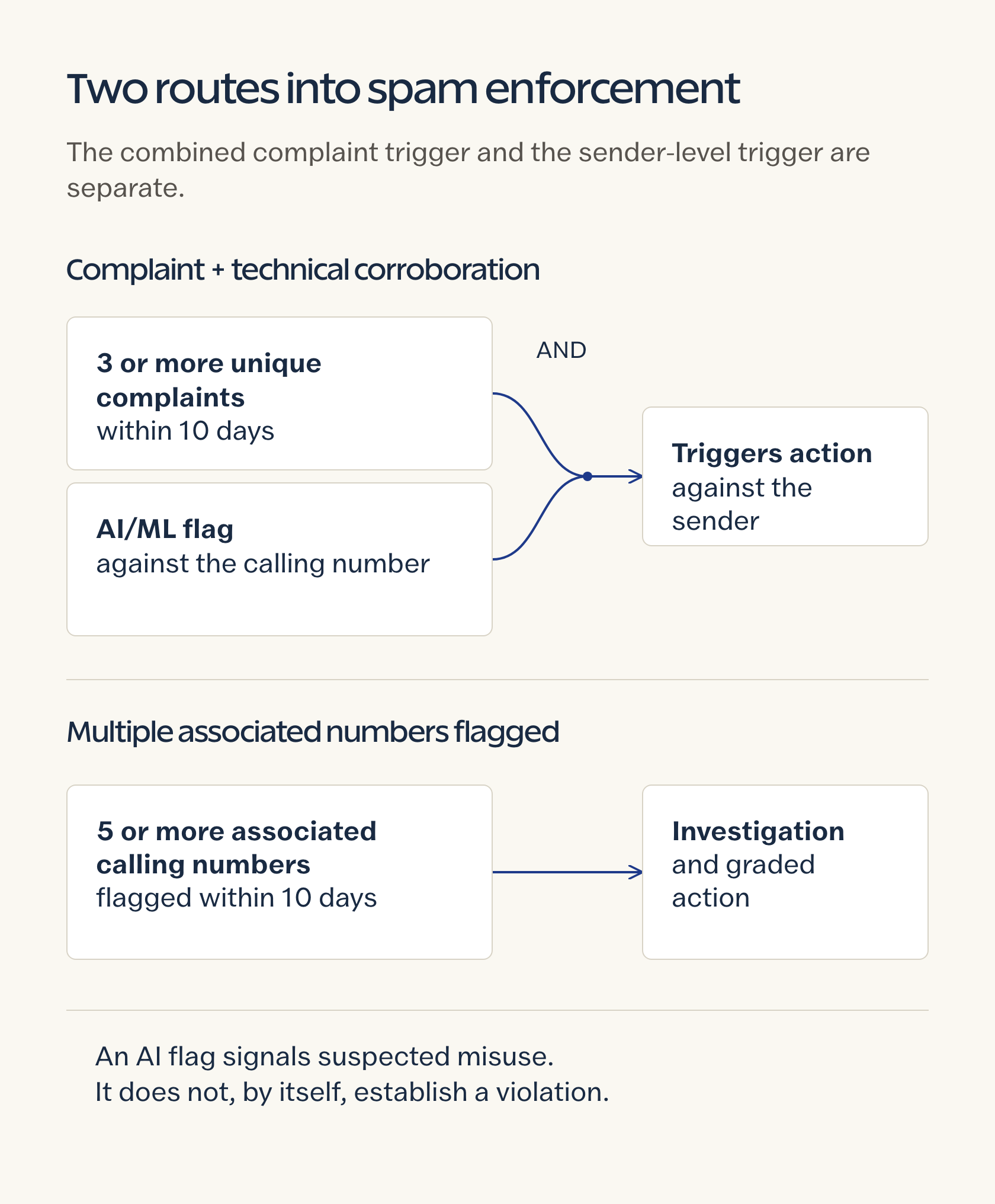
Automated calling and consent require an evidence trail
The sender must be identifiable, its automated calling declared, and its claimed permission capable of verification instead of resting on an unsupported assertion.
- A2P calls are initiated by an application, software system or automated platform without direct human dialling. The definition covers autodialling, robocalls and prerecorded or artificial voices, rather than only calls using conversational AI.
- Prior declaration must identify both the use of A2P calling and the calling numbers involved. Undeclared A2P calls are treated as UCC, making declaration a compliance obligation rather than an optional transparency measure.
- Legacy consent is not accepted merely because a business says it holds an old customer list. It must have been obtained through verifiable means and subsequently registered on the telecom provider’s digital platform.
- Inquiry-based communication requires a written or digital inquiry preserved in verifiable form. The permission is time-limited, so asking about a product should not be interpreted as indefinite authorisation for unrelated commercial contact.
- Headers and content templates can be misused even when communication appears organised. The amendment requires providers to suspend misused resources and senders to take remedial measures, connecting technical identifiers with responsibility for their misuse.

Consumer remedies and safeguards against overblocking
The regulatory design protects both the right to challenge complaint handling and the ability to receive legitimate communications without surrendering individual control over blocking.
- Consumer appeals allow a dissatisfied complainant to challenge the resolution of a UCC complaint before the Appellate Authority. This introduces review of complaint handling rather than leaving the initial response as the sole remedy.
- Regulated numbering series receive protection against blanket spam tagging or blocking by call-management applications. The stated rationale is to avoid mislabelling genuine commercial and government communications that may be important to their intended recipients.
- Personal choice remains intact: individual consumers may still block or filter calls on their devices. The restriction applies to blanket application-level treatment, and should not be read as an obligation to answer every call.
- Reporting applications cannot offer users a spam-reporting facility without forwarding those reports to providers’ distributed-ledger platforms. The rule links the visible complaint interface with information used by the wider regulatory enforcement system.
- Differentiated enforcement may account for sender categories and the consumer impact of disconnection. For policy analysis, this illustrates proportionality: restricting misuse should also consider whether interrupting essential communications creates avoidable harm for service users.
Way Forward
Make enforcement decisions reviewable
Implementation should pair detection capacity with evidence quality.
- Providers should preserve complaint records, calling-number associations and investigation outcomes so that action can be explained and disputed without relying solely on an opaque probability score.
- Review false positives through documented checks, especially where restrictions could interrupt essential services; this is an implementation recommendation, not a claim that AI detection is error-free.
- Keep appeals usable by giving complainants clear reasons for resolution and ensuring reporting interfaces actually transfer complaints into the enforcement system.
Conclusion
- The central distinction is between a signal that triggers enforcement and evidence supporting the resulting action. Faster detection is useful only when sender attribution, verifiable permission and proportionate consequences remain part of the process.
- For a governance answer, connect technology with institutional accountability: operators share signals, senders demonstrate compliance, and consumers obtain review. Avoid presenting the amendment as either an automatic AI verdict or a complete ban on commercial communication.
UPSC Practice Questions
Prelims MCQ 1
With reference to TRAI’s amended commercial communications framework, consider the following statements:
- Application-to-person calls can include prerecorded or artificial voice technologies.
- Legacy consent is valid merely because a sender possesses an old customer list.
- Individual consumers retain freedom to block calls on their own devices.
How many of the above statements are correct?
(a) Only one (b) Only two (c) All three (d) None
Answer: (b) Only two
Explanation:
Statements 1 and 3 are correct. Legacy consent must be verifiable and subsequently registered on the telecom provider’s digital platform.
Prelims MCQ 2
Which situation matches the amendment’s earlier complaint-based action trigger?
(a) One uncorroborated complaint against any sender (b) An AI flag without any other condition, requiring immediate permanent disconnection (c) Three unique complaints within ten days and an AI/ML flag against the concerned calling number (d) Any commercial call answered by a customer
Answer: (c) Three unique complaints within ten days and an AI/ML flag against the concerned calling number
Explanation:
The earlier complaint-based trigger combines complaint evidence with an AI/ML suspicion flag. The separate multiple-number route begins further investigation and graded action.
UPSC Mains Questions
- How can AI-assisted spam detection improve telecom consumer protection without weakening procedural safeguards? Discuss.
- Examine the roles of verifiable consent, sender accountability and consumer appeals in regulating unsolicited commercial communications.
Source: PIB, Ministry of Communications.
Frequently Asked Questions
What changed in TRAI’s spam rules?
The amendment combines complaint data with AI/ML suspicion signals, regulates automated calling, strengthens verifiable consent requirements and introduces consumer appeals. Investigation and graded enforcement remain distinct from merely detecting a suspicious calling number.
Are all automated calls prohibited?
No. Entities using application-to-person calls must declare that use and the relevant calling numbers to their telecom provider. Automated calls made without the required prior declaration are treated as unsolicited commercial communications.
Can consumers still block regulated commercial calls?
Yes. Individual consumers retain freedom to block or filter calls on their devices. The amendment restricts blanket blocking or spam tagging by call-management applications for designated regulated numbering series.
Does an AI spam flag establish a violation?
A flag indicates suspicion and supports the specified enforcement triggers. It is not, by itself, a final finding of wrongdoing; the framework also provides investigation and graded action against misuse.
Source: https://anantamias.com/current-affairs/trai-spam-amendment-ai-detection-consumer-appeals/
India’s Homegrown Innovation Ecosystem
Context:
India’s innovation ecosystem is gaining strength through the convergence of public research institutions, corporate R&D and technology-driven startups. Advances across strategic sectors indicate a growing capacity to develop indigenous technologies and translate research into commercial applications.
Patent applications reportedly crossed 1.43 lakh in 2025-26, with domestic applicants accounting for over 69%.
| UPSC Relevance: GS-3 Science and Technology: Indigenisation of Technology, Intellectual Property Rights Mains: Advancements in Indigenisation of Technology in India |
Advances in India’s Homegrown Innovation Ecosystem:
(i) Semiconductors:
Gallium Nitride (GaN) technology illustrates the movement from strategic public research to industrial application.
- Indigenous GaN capability: DRDO’s Solid State Physics Laboratory (SSPL) has developed GaN High Electron Mobility Transistor (HEMT)-based Monolithic Microwave Integrated Circuit (MMIC) technology for high-power, high-frequency applications such as radar and communication systems.
- Technology transfer and Commercialisation: DRDO has moved beyond laboratory development and is offering its GaN HEMT-based MMIC technology for transfer to industry. Startups emerging from India’s academic ecosystem, such as AGNIT Semiconductors, are seeking to translate indigenous GaN research into commercial semiconductor products.
GaN is strategically important for radar, aerospace, advanced communications and power electronics. Indigenous capability reduces foreign dependence on technologies and creates potential civilian spillovers in areas like telecom equipment, electric-vehicle chargers and renewable-energy systems.
(ii) Deep-Tech Entrepreneurship:
- India’s startup ecosystem is gradually moving beyond predominantly software- and service-oriented businesses towards capital-intensive, research-intensive technologies. Startups are increasingly working on semiconductors, advanced manufacturing, biotechnology, space systems and specialised hardware.
- Commitments exceeding $2.5 billion by members of the India Deep Tech Alliance indicate growing private interest in research-intensive ventures.
(iii) Space Technology:
The opening of the space sector to private players has expanded India’s indigenous innovation base.
- Hyperspectral imaging: Pixxel is developing satellites capable of capturing data across numerous spectral bands, with applications in agriculture, environmental monitoring and resource assessment.
- Private launch systems: Skyroot Aerospace’s Vikram programme and Agnikul Cosmos’s launch-vehicle development demonstrate the entry of startups into complex areas such as propulsion, launch systems and space hardware.
Such ventures can expand India’s role from a space-launch service provider towards a broader commercial space-technology ecosystem.
(iv) Telecommunications:
India’s role in telecommunications is increasingly extending from deploying global technologies to developing intellectual property and contributing to global standards.
- Bharat 6G Alliance is making rapid progress in its stated aim of contributing 10% of the global 6G patents by 2030. Member organisations collectively hold more than 7700 patent filings related to 5G and 6G technologies, including over 4400 foreign filings.
- Global standardisation: Indian participation in 3GPP, the global body developing mobile communication standards, has expanded substantially. Technical contributions increased from 196 in 2020 to 2,943 in 2025.
- Corporate R&D: The rise of Indian firms in international patenting, including Jio Platforms’ entry into the global top 20 PCT applicants, reflects increasing ownership of telecom-related IP.
What has facilitated this growth?
- Government support:
- Long-gestation research: Public institutions such as DRDO, ISRO, CSIR laboratories and national research institutions undertake research involving high costs, long development cycles and uncertain commercial returns.
- Translational research: Programmes such as BIRAC in biotechnology and NIDHI under the Department of Science and Technology help innovators move from ideas and proof-of-concept towards product development and commercialisation.
- Strong academic and research ecosystem: Institutions such as IITs and IISc increasingly function not only as centres of education but also as sources of frontier research and specialised laboratories, patents and intellectual property, incubation and technology transfer, and research-based startups.
- Rising private-sector R&D: Greater corporate spending reflects the growing recognition that proprietary technology, patents and technological standards can provide long-term competitive advantages. Recent DST report (2025-26) quotes private sector-led R&D spending at 51.8%, while the combined government sector contributed 48.2%.
Increasing Patents: A Positive Signal
- India’s patent activity has expanded sharply. In FY 2025-26, the total patent applications filed in India rose from ~1.10 lakh in 2024-25 to ~1.43 lakh in 2025-26. India stands 6th globally according to WIPO.
- Domestic share reached 69.4% (~0.99 Lakh applications). This indicates a broader domestic capacity to generate and protect intellectual property.
What constraints still linger?
- Low R&D intensity: India’s R&D expenditure remains below 1% of GDP, considerably lower than major innovation economies. This constrains sustained investment in frontier technologies and long-gestation research.
- Research-to-market gap: The biggest weakness is the “valley of death” between a successful research project and the first paying customer. Technologies may require additional funding for prototyping, testing, certification, clinical validation, pilot production and market development.
- Weak technology-transfer mechanisms: Publicly funded research does not automatically become commercial technology. Unclear ownership, inconsistent licensing conditions, valuation difficulties and prolonged negotiations can discourage industry from acquiring institutional IP.
- Patent quantity versus patent quality and value: Rising applications are encouraging, but the innovation ecosystem ultimately needs more high-quality granted patents, international filings, licensing revenue and commercially adopted technologies.
- Patent-processing capacity: As applications increase, inadequate specialised patent examination capacity can create delays. Greater examiner capacity is particularly important in rapidly evolving fields such as AI, semiconductors, biotechnology and telecommunications.
- Deep-tech financing constraints: Deep-tech enterprises have long gestation periods, high capital requirements and uncertain returns. Conventional venture capital, which often seeks relatively rapid scaling and exits, may not always suit such businesses.
- Infrastructure and talent gaps: Access to semiconductor fabrication and testing facilities, advanced laboratories, clinical research infrastructure, pilot manufacturing facilities and specialised engineering talent remains uneven.
Way Forward:
- Standardise technology-transfer terms for publicly funded IP: Develop transparent licensing templates, clear ownership rules and predictable revenue-sharing arrangements between inventors, institutions and industry.
- Expand patent-examiner capacity: Recruit and train domain specialists, particularly in emerging technologies, while maintaining rigorous examination of novelty, inventive step and industrial applicability.
- Bridge the translational gap: Create milestone-based funding that continues beyond proof-of-concept and patenting to prototype development, validation, certification, pilot manufacturing and the first paying customer.
- Mobilise patient capital: Develop long-duration public-private financing mechanisms suited to the extended development cycles of deep-tech enterprises.
- Strengthen technology-transfer offices: Universities and laboratories need professional expertise in IP valuation, licensing, market assessment, industry partnerships and commercialisation.
- Build shared R&D infrastructure: Expand access to fabrication facilities, testing laboratories, clinical research networks, advanced computing and pilot-production infrastructure.
- Strengthen industry-academia collaboration: Incentivise joint research, co-development and mobility of researchers between universities, public laboratories and industry.
The objective of India’s innovation ecosystem should not be merely to increase the number of patents or startups, but to build an ecosystem capable of repeatedly converting research into intellectual property, intellectual property into products, and products into globally competitive industrial capabilities.
Mains Practice Question:
Q. India is gradually transitioning from a technology-adopting economy towards an innovation-generating economy. Examine the role of public research, private R&D and deep-tech entrepreneurship in this transition and suggest measures to bridge the research-to-market gap.
Source: https://anantamias.com/current-affairs/indias-homegrown-innovation-ecosystem/
India to Launch First Approved Dengue Vaccine Qdenga in 2027
Why in News?
Dr Reddy’s Laboratories and Japan’s Takeda have signed an agreement to introduce Qdenga in India’s private market in the first half of 2027, subject to completion of applicable processes. It received CDSCO marketing authorisation in July 2026 for individuals aged 4-60 years. Inclusion in the Universal Immunisation Programme (UIP) remains a future possibility.
| UPSC Relevance: GS-3 Science and Technology: Biology and Biotechnology Prelims: Dengue; Dengue vaccines; Aedes-borne Viral Diseases (Zika, Chikungunya) |
What is Dengue?
- Dengue is a mosquito-borne viral illness caused by the dengue virus, an RNA virus. It is caused by any of the four closely related but distinct viruses (DENV-1, DENV-2, DENV-3, and DENV-4).
- Transmission:
- Primarily through the bites of infected Aedes aegypti mosquitoes. These mosquitoes are predominantly daytime biters.
- Human-to-human transmission does not occur directly. Rare cases of vertical transmission (from mother to child during pregnancy or childbirth), but it is not a common mode of spread.
- Symptoms: Flu-like symptoms (high fever, severe headache), joint and muscle pain and rashes. Severe dengue can cause plasma leakage, shock, serious bleeding or organ damage.
For decades, dengue control in India relied almost entirely on vector control measures such as eliminating mosquito breeding sites, insecticide use, and public awareness campaigns. These strategies have had limited success in preventing recurring outbreaks.
Why is developing a dengue vaccine difficult?
Infection with one serotype generally provides lasting protection against that serotype, but does not provide durable protection against the other three. A subsequent infection with another serotype can carry a greater risk of severe disease. Therefore, dengue vaccines must achieve a favourable balance of protection across serotypes.

What is Qdenga?
- Also called TAK-003: A live-attenuated tetravalent dengue vaccine. Specifically designed to be effective even in people who have had a dengue infection previously.
- Live-attenuated vaccines use a weakened form of a virus that replicates in the body, creating an often lifelong immune response.
- Tetravalent vaccine: designed to provide immunity against all four serotypes (DENV-1, DENV-2, DENV-3, and DENV-4).
- Technology: Uses weakened dengue viruses, with DENV-2 as the genetic backbone for its vaccine components.
- Developed by Takeda, Japan. Being made available in India through a manufacturing partnership with a Hyderabad-based pharma company. It is authorised in over 40 countries.
- Dosage: Two doses, administered three months apart.
India’s CDSCO has approved QDENGA for individuals aged 4 to 60 years. However, the vaccine is expected to initially enter the private market, rather than automatically becoming part of India’s routine public immunisation programme.
Benefits:
- Reduced disease and hospitalisation: In the pivotal trial, efficacy was approximately 80% against symptomatic, confirmed dengue over 12 months, and 90% against dengue hospitalisation over 18 months after the second dose.
Limitations:
- Uneven serotype protection: Performs very well against the DENV-2 serotype, and reasonably well against DENV-1. However, its effectiveness against DENV-3 and DENV-4 appears to be lower (particularly in individuals who have not previously been infected with dengue).
- Affordability remains uncertain: Analysts and pre-launch projections estimate ₹3,000 to ₹6,000 per dose. May economically hurt lower-income groups.
Does India have an indigenous dengue vaccine?
India’s first indigenous dengue vaccine, DengiAll, is currently in Phase 3 trials. It is a live-attenuated tetravalent vaccine candidate developed by Panacea Biotec. Expected in India’s private market in early 2027.
- Trial: Launched in 2024 across 19 sites in 18 States/UTs, with approximately 10,335 adult participants planned.
- Regimen: Being evaluated as a single-dose vaccine, potentially simplifying delivery.
- Technology: Developed using dengue vaccine strains originally licensed from the U.S. National Institutes of Health, followed by Indian formulation and process development.
Prelims Practice MCQ:
Q. With reference to dengue and Qdenga, consider the following statements:
- Infection with one dengue serotype provides lifelong protection against all four serotypes.
- Qdenga is a live-attenuated tetravalent vaccine administered in two doses.
- Regulatory approval of a vaccine automatically results in its inclusion in India’s Universal Immunisation Programme.
Which of the statements given above is/are correct?
(a) 1 and 2 only
(b) 2 only
(c) 2 and 3 only
(d) 1, 2 and 3
Answer: (b). Statement 1 is incorrect because protection against other serotypes is not durable. Statement 2 is correct. Statement 3 is incorrect because UIP inclusion requires a separate policy decision.
Source: https://anantamias.com/current-affairs/india-to-launch-first-approved-dengue-vaccine-qdenga-in-2027/
Regional Parties in India
Context:
India’s political system has historically combined national political forces with strong State-level parties. Regional parties have become particularly important because India’s social, linguistic, cultural and economic diversity creates political issues that cannot always be captured by a uniform national agenda.
| UPSC Relevance: GS-2 Polity and Governance: Federalism, Electoral reforms, Representation of the People Act Prelims: Party registration, recognition and electoral funding; Regional Party vs National Party Mains: Regional Parties- Significance and Challenges |
What are Regional Parties?
- A regional party is generally understood as a political party whose electoral base, organisational presence and political agenda are concentrated primarily in one State or a limited geographical region.
- A regional party is a political-science description, whereas a State Party is an official electoral classification of the Election Commission of India (ECI). A party may therefore be popularly described as regional without necessarily being recognised as a State Party by the ECI.
- Regional parties have emerged around diverse factors such as regional identity, language, ethnicity, sub-nationalism, State autonomy, socio-economic interests and perceived neglect by national parties.
- Examples include the DMK and AIADMK in Tamil Nadu, TDP in Andhra Pradesh, BJD in Odisha, Shiv Sena in Maharashtra, AGP in Assam and NPP in the Northeast.
Regional Party vs National Party:
| Basis | Regional/State Party | National Party |
| Electoral base | Primarily concentrated in one State or region. | Significant electoral presence across multiple States. |
| Political focus | State-specific issues, regional identity and local development. | National-level issues along with State-level concerns. |
| Organisation | Generally stronger within particular States. | Organisational and electoral presence extends across India. |
| Recognition | Recognised as a State Party when ECI criteria are fulfilled in a State. | Recognised as a National Party when prescribed multi-State electoral criteria are fulfilled. |
| Reserved symbol | Reserved for the party in the State(s) where it is recognised as a State Party. | Reserved symbol is available to the party across India. |
| Role in Parliament | Can become crucial when national parties lack a majority and coalition support is required. | Can directly shape national governments when it has sufficient parliamentary strength. |
| Federal role | Often emphasises State interests and greater autonomy. | Generally has a broader national policy framework. |
When does the ECI recognise a party as a State Party?
Under Section 29A of the Representation of the People Act, 1951, an association or body of Indian citizens seeking to function as a political party applies to the ECI for registration. After registration, its electoral performance determines whether it becomes a recognised State Party or National Party.
Criteria for recognition as a State Party:
Under the Election Symbols (Reservation and Allotment) Order, 1968, a party can qualify as a State Party if it satisfies any one of the following conditions in a State:
- It secures at least 6% of valid votes in the State Assembly election and wins at least two Assembly seats.
- It secures at least 6% of valid votes in the Lok Sabha election from the State and wins at least one Lok Sabha seat.
- It wins at least 3% of the total Assembly seats or three seats, whichever is higher.
- It wins at least one Lok Sabha seat for every 25 Lok Sabha seats allotted to the State.
- It secures at least 8% of the total valid votes in the State in either a Lok Sabha or Assembly election.
How are National Parties different in terms of recognition?
- The ECI similarly prescribes electoral criteria for National Party recognition. The essential distinction is that a National Party must demonstrate a sufficiently broad multi-State electoral presence, whereas State Party recognition is based on performance within a particular State.
- A party can also evolve: a State-based party can attempt to expand geographically, while a party recognised as a National Party can subsequently lose that recognition if it no longer satisfies the prescribed criteria.
How do Regional Parties get their finances?
- Individual and corporate contributions: Under Section 29B of the Representation of the People Act, 1951, political parties can accept voluntary contributions from individuals and companies, subject to statutory restrictions. Contributions from foreign sources and government companies are restricted under the applicable legal framework.
- Contribution disclosures: Under Section 29C, political parties have to report contributions above the prescribed threshold to the ECI. The ECI also maintains contribution, audit and expenditure reports of recognised parties.
- Electoral trusts: Political parties can also receive funds through electoral trusts, which are subject to prescribed disclosure and reporting mechanisms. The ECI publishes electoral-trust contribution reports.
Electoral bonds are no longer a permissible financing mechanism. In 2024, the Supreme Court declared the Electoral Bond Scheme and related amendments unconstitutional, holding that non-disclosure of political funding violated citizens’ right to information under Article 19(1)(a).
How can Regional Parties better serve local interests?
Regional parties can contribute to responsive and competitive federalism in several ways.
- Articulating State-specific concerns: They can place issues such as inter-State river disputes, special development requirements, language and cultural concerns, regional infrastructure and resource allocation more prominently on the national agenda. E.g., inter-State river disputes, resource allocation and regional development.
- Improving representation of regional diversity: India contains substantial variations in language, tribal identity, economic structure, geography and development needs. Regional parties can provide political representation to interests that may receive less attention in nationally aggregated electoral agendas.
- Strengthening federal bargaining: Regional parties can act as important actors in coalition governments, using parliamentary strength to negotiate greater attention to State-specific demands.
- Encouraging policy innovation: State governments led by regional parties can function as policy laboratories, with successful programmes potentially influencing national policy. E.g., BRS in Telangana has launched programmes such as Rythu Bandhu, Mission Bhagiratha and Mission Kakatiya.
- Increasing political accountability: Where regional parties have deep organisational roots, they may have greater incentives to respond to local constituencies, regional civil society and State-level political movements.
Limitations and Challenges of Regional Parties:
- Risk of excessive regionalism: A legitimate defence of State interests can sometimes turn into competitive regionalism, where broader national interests and inter-State cooperation receive inadequate attention. Sons-of-the-soil mobilisation may undermine migrants’ rights or marginalise minorities within the State.
- Dynastic politics and factionalism: Concentration of political authority within families or small leadership groups can weaken internal competition and reduce organisational accountability. This can create problems of succession, internal democracy and institutionalisation.
- Limited geographical reach: A narrow geographical base can make it difficult for regional parties to influence national policy independently, particularly when they have limited parliamentary representation.
- Coalition instability and bargaining politics: When national governments depend heavily on regional parties, State-specific demands can become important bargaining instruments. Coalition politics can therefore produce both greater federal accommodation and policy coordination challenges.
- Populism and fiscal pressures: Regional electoral competition can encourage expansive welfare promises that can be fiscally unsustainable.
- Fragmentation of political representation: A large number of regionally concentrated parties can increase political representation but may also contribute to fragmentation, making coalition formation and coordinated policy-making more complex.
Regional Parties and Indian Federalism:
Regional parties are particularly important from the perspective of cooperative and competitive federalism. They can:
- strengthen State autonomy
- bring State-specific issues into Parliament
- compel national parties to accommodate regional interests
- encourage competition among States over development and governance
- provide political representation to linguistic, ethnic and sub-national identities; and
- act as a counterweight to excessive political centralisation.
However, federalism requires both autonomy and coordination. Regional parties can strengthen the Union-State balance when regional interests are pursued through constitutional and institutional mechanisms rather than through zero-sum regionalism.
Conclusion:
A healthy multi-party federal system requires strong regional representation as well as effective national coordination. This can be strengthened through greater transparency in political financing, stronger internal democracy within parties, transparent candidate selection, institutionalised Centre-State consultation, evidence-based welfare policies and greater accountability in the use of public resources.
UPSC Mains PYQ 2022
Q. While the national political parties in India favour centralisation, the regional parties are in favour of State autonomy. Comment.
Source: https://anantamias.com/current-affairs/regional-parties-in-india/
