
Why in News?
Dr Reddy’s Laboratories and Japan’s Takeda have signed an agreement to introduce Qdenga in India’s private market in the first half of 2027, subject to completion of applicable processes. It received CDSCO marketing authorisation in July 2026 for individuals aged 4-60 years. Inclusion in the Universal Immunisation Programme (UIP) remains a future possibility.
| UPSC Relevance: GS-3 Science and Technology: Biology and Biotechnology Prelims: Dengue; Dengue vaccines; Aedes-borne Viral Diseases (Zika, Chikungunya) |
What is Dengue?
- Dengue is a mosquito-borne viral illness caused by the dengue virus, an RNA virus. It is caused by any of the four closely related but distinct viruses (DENV-1, DENV-2, DENV-3, and DENV-4).
- Transmission:
- Primarily through the bites of infected Aedes aegypti mosquitoes. These mosquitoes are predominantly daytime biters.
- Human-to-human transmission does not occur directly. Rare cases of vertical transmission (from mother to child during pregnancy or childbirth), but it is not a common mode of spread.
- Symptoms: Flu-like symptoms (high fever, severe headache), joint and muscle pain and rashes. Severe dengue can cause plasma leakage, shock, serious bleeding or organ damage.
For decades, dengue control in India relied almost entirely on vector control measures such as eliminating mosquito breeding sites, insecticide use, and public awareness campaigns. These strategies have had limited success in preventing recurring outbreaks.
Why is developing a dengue vaccine difficult?
Infection with one serotype generally provides lasting protection against that serotype, but does not provide durable protection against the other three. A subsequent infection with another serotype can carry a greater risk of severe disease. Therefore, dengue vaccines must achieve a favourable balance of protection across serotypes.
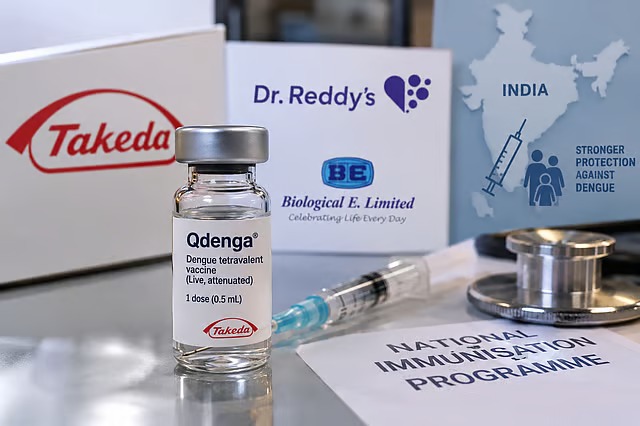
What is Qdenga?
- Also called TAK-003: A live-attenuated tetravalent dengue vaccine. Specifically designed to be effective even in people who have had a dengue infection previously.
- Live-attenuated vaccines use a weakened form of a virus that replicates in the body, creating an often lifelong immune response.
- Tetravalent vaccine: designed to provide immunity against all four serotypes (DENV-1, DENV-2, DENV-3, and DENV-4).
- Technology: Uses weakened dengue viruses, with DENV-2 as the genetic backbone for its vaccine components.
- Developed by Takeda, Japan. Being made available in India through a manufacturing partnership with a Hyderabad-based pharma company. It is authorised in over 40 countries.
- Dosage: Two doses, administered three months apart.
India’s CDSCO has approved QDENGA for individuals aged 4 to 60 years. However, the vaccine is expected to initially enter the private market, rather than automatically becoming part of India’s routine public immunisation programme.
Benefits:
- Reduced disease and hospitalisation: In the pivotal trial, efficacy was approximately 80% against symptomatic, confirmed dengue over 12 months, and 90% against dengue hospitalisation over 18 months after the second dose.
Limitations:
- Uneven serotype protection: Performs very well against the DENV-2 serotype, and reasonably well against DENV-1. However, its effectiveness against DENV-3 and DENV-4 appears to be lower (particularly in individuals who have not previously been infected with dengue).
- Affordability remains uncertain: Analysts and pre-launch projections estimate ₹3,000 to ₹6,000 per dose. May economically hurt lower-income groups.
Does India have an indigenous dengue vaccine?
India’s first indigenous dengue vaccine, DengiAll, is currently in Phase 3 trials. It is a live-attenuated tetravalent vaccine candidate developed by Panacea Biotec. Expected in India’s private market in early 2027.
- Trial: Launched in 2024 across 19 sites in 18 States/UTs, with approximately 10,335 adult participants planned.
- Regimen: Being evaluated as a single-dose vaccine, potentially simplifying delivery.
- Technology: Developed using dengue vaccine strains originally licensed from the U.S. National Institutes of Health, followed by Indian formulation and process development.
Prelims Practice MCQ:
Q. With reference to dengue and Qdenga, consider the following statements:
- Infection with one dengue serotype provides lifelong protection against all four serotypes.
- Qdenga is a live-attenuated tetravalent vaccine administered in two doses.
- Regulatory approval of a vaccine automatically results in its inclusion in India’s Universal Immunisation Programme.
Which of the statements given above is/are correct?
(a) 1 and 2 only
(b) 2 only
(c) 2 and 3 only
(d) 1, 2 and 3
Answer: (b). Statement 1 is incorrect because protection against other serotypes is not durable. Statement 2 is correct. Statement 3 is incorrect because UIP inclusion requires a separate policy decision.
Tell Google you want more of this.
Add Anantam IAS as a preferred sourceOne tap, and this site shows up more often in your own Top Stories, AI Overviews and AI Mode. Remove it any time.