Why in News?
On 18 September 2026, TRAI introduced its third amendment to the commercial communications regulations, combining technology-assisted spam enforcement with stronger sender accountability and consumer appeals.
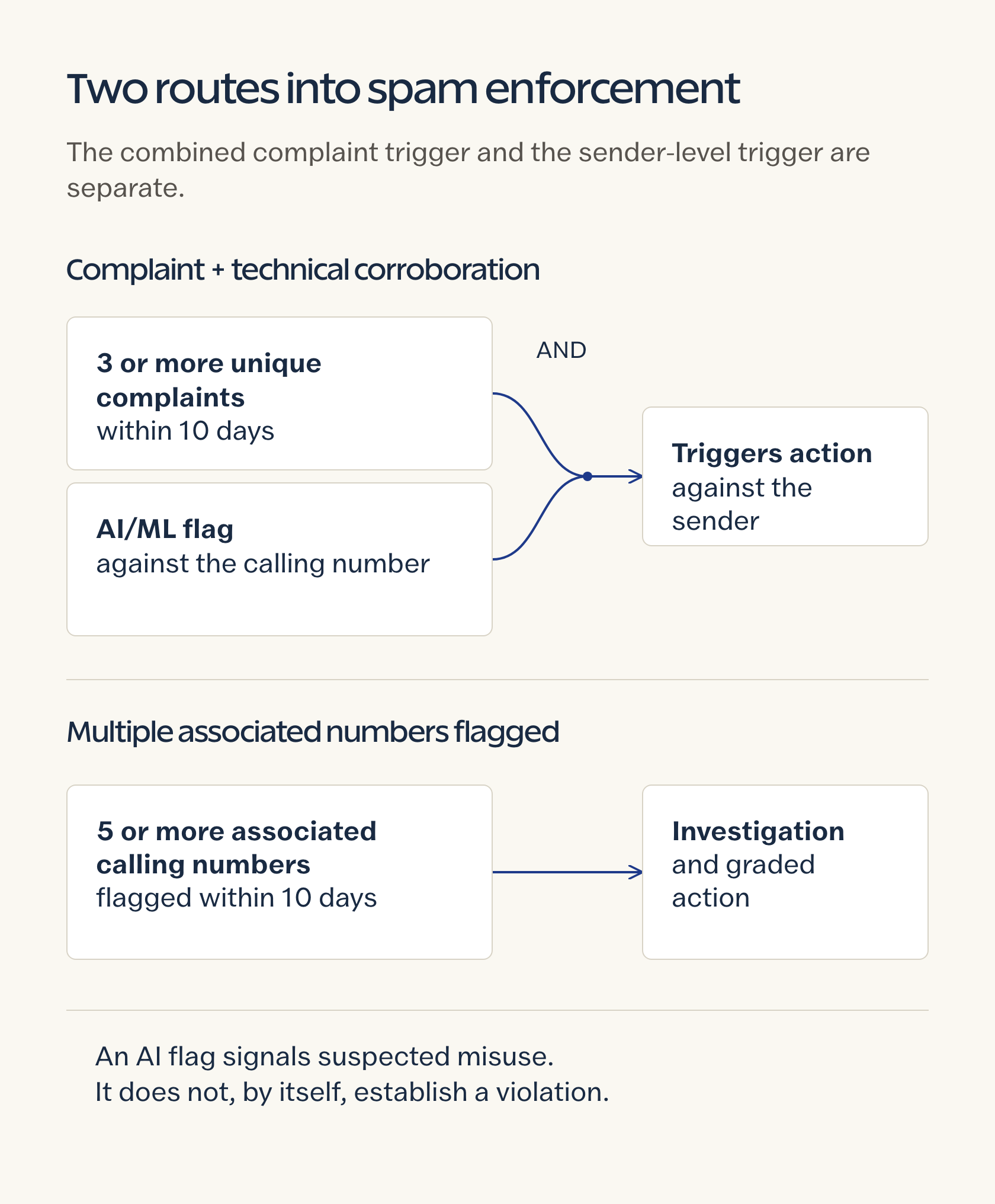
- Complaint-based action can begin with three unique complaints within ten days when the sender’s calling number is also flagged by an AI/ML system.
- A separate trigger concerns five flagged calling numbers associated with one sender within ten days, leading to investigation and graded action.
- Automated callers must declare their use and calling numbers to telecom providers; undeclared application-to-person calls are treated as unsolicited commercial communications.
- Consumers gain an appeal against complaint resolution, while retaining freedom to block calls on their own devices.
- Spam enforcement needs cooperation across operators because identifying a suspicious number is different from establishing who controls it and whether the communication was authorised.
- Consumer protection must address unwanted communication without indiscriminately suppressing legitimate service calls or treating every algorithmic suspicion as a proven breach.
UPSC Relevance
Prelims Relevance
- TRAI and regulation of unsolicited commercial communications (UCC).
- Calling Line Identification (CLI) identifies the calling number.
- Application-to-person (A2P) calls originate through automated applications or software.
- Verifiable legacy consent requires registration on the telecom provider’s digital platform.
- Consumer complaint appeals and personal call-blocking rights.
Mains Relevance
GS Paper 2
- Regulatory accountability, consumer remedies and proportionate enforcement.
- Consent, platform duties and safeguards against wrongful restrictions.
GS Paper 3
- AI-assisted detection and inter-operator information sharing in telecom governance.
Essay
- Automation improves governance only when evidence and remedies remain accessible.
Background and Context
Two enforcement triggers, not an automatic finding of guilt
The amendment combines complaints and technical signals, but the two routes must not be confused with each other or with a final finding.
- UCC means unsolicited commercial communications. The framework addresses misuse of telecom resources by senders and telemarketers; its purpose is regulating unwanted commercial contact, rather than prohibiting every commercial call received by consumers.
- Complaint-based enforcement previously used five unique complaints within ten days. The amendment adds an earlier trigger: three unique complaints within that period, corroborated by an AI/ML flag against the concerned calling number.
- Sender-level detection follows a separate route when five or more associated calling numbers are flagged within ten days. Providers initiate further investigation and graded action, rather than treating every flagged number as conclusive proof.
- Graded action can include identity re-verification, physical verification and outgoing-service restrictions, with disconnection for repeated violations and misuse. This sequence makes attribution and investigation important before escalating the consequences for a sender.
- Inter-operator sharing makes suspicious calling information available across telecom providers. Analytically, this can help identify activity distributed across networks, but sharing a probability assessment does not itself establish that a violation has occurred.
Automated calling and consent require an evidence trail
The sender must be identifiable, its automated calling declared, and its claimed permission capable of verification instead of resting on an unsupported assertion.
- A2P calls are initiated by an application, software system or automated platform without direct human dialling. The definition covers autodialling, robocalls and prerecorded or artificial voices, rather than only calls using conversational AI.
- Prior declaration must identify both the use of A2P calling and the calling numbers involved. Undeclared A2P calls are treated as UCC, making declaration a compliance obligation rather than an optional transparency measure.
- Legacy consent is not accepted merely because a business says it holds an old customer list. It must have been obtained through verifiable means and subsequently registered on the telecom provider’s digital platform.
- Inquiry-based communication requires a written or digital inquiry preserved in verifiable form. The permission is time-limited, so asking about a product should not be interpreted as indefinite authorisation for unrelated commercial contact.
- Headers and content templates can be misused even when communication appears organised. The amendment requires providers to suspend misused resources and senders to take remedial measures, connecting technical identifiers with responsibility for their misuse.

Consumer remedies and safeguards against overblocking
The regulatory design protects both the right to challenge complaint handling and the ability to receive legitimate communications without surrendering individual control over blocking.
- Consumer appeals allow a dissatisfied complainant to challenge the resolution of a UCC complaint before the Appellate Authority. This introduces review of complaint handling rather than leaving the initial response as the sole remedy.
- Regulated numbering series receive protection against blanket spam tagging or blocking by call-management applications. The stated rationale is to avoid mislabelling genuine commercial and government communications that may be important to their intended recipients.
- Personal choice remains intact: individual consumers may still block or filter calls on their devices. The restriction applies to blanket application-level treatment, and should not be read as an obligation to answer every call.
- Reporting applications cannot offer users a spam-reporting facility without forwarding those reports to providers’ distributed-ledger platforms. The rule links the visible complaint interface with information used by the wider regulatory enforcement system.
- Differentiated enforcement may account for sender categories and the consumer impact of disconnection. For policy analysis, this illustrates proportionality: restricting misuse should also consider whether interrupting essential communications creates avoidable harm for service users.
Way Forward
Make enforcement decisions reviewable
Implementation should pair detection capacity with evidence quality.
- Providers should preserve complaint records, calling-number associations and investigation outcomes so that action can be explained and disputed without relying solely on an opaque probability score.
- Review false positives through documented checks, especially where restrictions could interrupt essential services; this is an implementation recommendation, not a claim that AI detection is error-free.
- Keep appeals usable by giving complainants clear reasons for resolution and ensuring reporting interfaces actually transfer complaints into the enforcement system.
Conclusion
- The central distinction is between a signal that triggers enforcement and evidence supporting the resulting action. Faster detection is useful only when sender attribution, verifiable permission and proportionate consequences remain part of the process.
- For a governance answer, connect technology with institutional accountability: operators share signals, senders demonstrate compliance, and consumers obtain review. Avoid presenting the amendment as either an automatic AI verdict or a complete ban on commercial communication.
UPSC Practice Questions
Prelims MCQ 1
With reference to TRAI’s amended commercial communications framework, consider the following statements:
- Application-to-person calls can include prerecorded or artificial voice technologies.
- Legacy consent is valid merely because a sender possesses an old customer list.
- Individual consumers retain freedom to block calls on their own devices.
How many of the above statements are correct?
(a) Only one (b) Only two (c) All three (d) None
Answer: (b) Only two
Explanation:
Statements 1 and 3 are correct. Legacy consent must be verifiable and subsequently registered on the telecom provider’s digital platform.
Prelims MCQ 2
Which situation matches the amendment’s earlier complaint-based action trigger?
(a) One uncorroborated complaint against any sender (b) An AI flag without any other condition, requiring immediate permanent disconnection (c) Three unique complaints within ten days and an AI/ML flag against the concerned calling number (d) Any commercial call answered by a customer
Answer: (c) Three unique complaints within ten days and an AI/ML flag against the concerned calling number
Explanation:
The earlier complaint-based trigger combines complaint evidence with an AI/ML suspicion flag. The separate multiple-number route begins further investigation and graded action.
UPSC Mains Questions
- How can AI-assisted spam detection improve telecom consumer protection without weakening procedural safeguards? Discuss.
- Examine the roles of verifiable consent, sender accountability and consumer appeals in regulating unsolicited commercial communications.
Source: PIB, Ministry of Communications.
Frequently Asked Questions
What changed in TRAI’s spam rules?
The amendment combines complaint data with AI/ML suspicion signals, regulates automated calling, strengthens verifiable consent requirements and introduces consumer appeals. Investigation and graded enforcement remain distinct from merely detecting a suspicious calling number.
Are all automated calls prohibited?
No. Entities using application-to-person calls must declare that use and the relevant calling numbers to their telecom provider. Automated calls made without the required prior declaration are treated as unsolicited commercial communications.
Can consumers still block regulated commercial calls?
Yes. Individual consumers retain freedom to block or filter calls on their devices. The amendment restricts blanket blocking or spam tagging by call-management applications for designated regulated numbering series.
Does an AI spam flag establish a violation?
A flag indicates suspicion and supports the specified enforcement triggers. It is not, by itself, a final finding of wrongdoing; the framework also provides investigation and graded action against misuse.
Tell Google you want more of this.
Add Anantam IAS as a preferred sourceOne tap, and this site shows up more often in your own Top Stories, AI Overviews and AI Mode. Remove it any time.