Why in News?
On 18 September 2026, the government reported that a DAHD–WOAH workshop had refined state action plans for developing foot-and-mouth disease-free zones and compartments.
- The 15–17 September workshop reviewed proposed action plans, surveillance, laboratory preparedness, traceability, biosecurity and animal movement controls.
- Public–private partnerships were discussed across vaccine delivery, diagnostics, animal identification and livestock value chains, rather than only as a source of finance.
- The outcome was refinement of plans and priority interventions; the release did not announce new WOAH recognition or achieved national FMD freedom.
- Disease control reduces risk and outbreaks; demonstrating freedom requires evidence about a defined animal population and measures preventing infection from entering or spreading.
- Trade confidence depends on credible veterinary oversight and traceable supply chains, so investment in records and laboratories matters alongside vaccination delivery.
UPSC Relevance
Prelims Relevance
- WOAH: World Organisation for Animal Health.
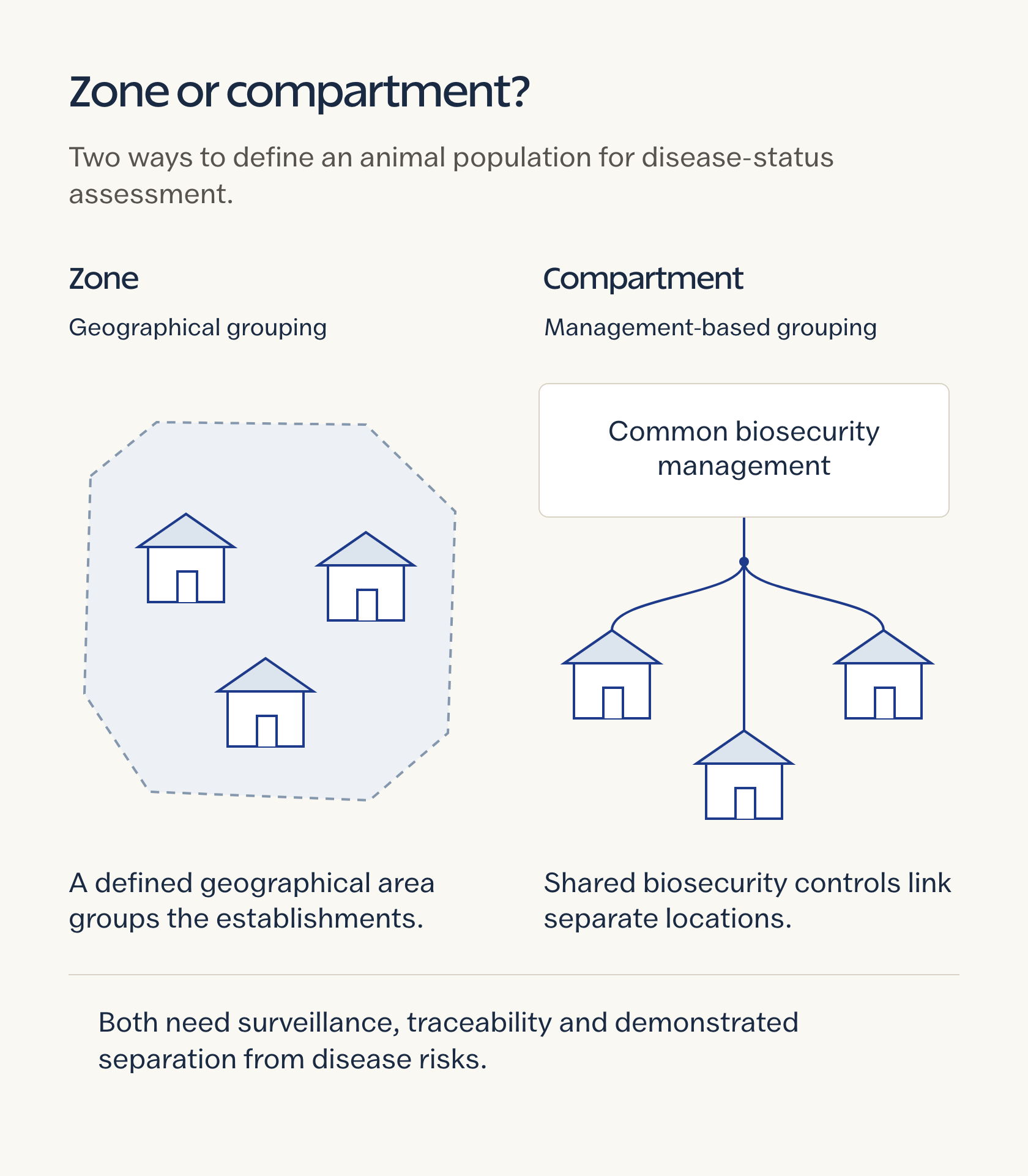
- A zone is defined primarily geographically.
- A compartment is defined primarily through common management and biosecurity practices.
- Surveillance and animal identification support both approaches.
- Animal-health status must be demonstrated and maintained.
Mains Relevance
GS Paper 3
- Livestock disease management, rural livelihoods and credible trade assurance.
- Animal identification, surveillance and laboratory capacity as agricultural infrastructure.
GS Paper 2
- Public–private cooperation under accountable veterinary oversight.
Essay
- Public confidence depends on evidence that institutions can keep producing.
Background and Context
A zone and a compartment group animals differently
The distinction concerns how a population is separated from disease risks, not whether one approach needs surveillance and the other can dispense with it.
- A zone groups an animal subpopulation primarily by geography. Its boundaries may use natural, artificial or legal divisions, but those boundaries must support a defensible animal-health separation rather than merely naming an administrative area.
- A compartment groups an animal subpopulation primarily through management and husbandry practices related to biosecurity. Common controls can link establishments in different locations, provided the claimed separation from other animal populations remains demonstrable.
- Both approaches require practical management of risks. Geography alone does not prevent exposure, while a common owner or corporate label does not establish a compartment without effective biosecurity, identification and documented operating procedures.
- Defined populations allow progress within a country where uniform disease freedom is difficult to achieve. Their value lies in demonstrating a specific health status for identifiable animals, rather than making an unsupported national claim.
- Veterinary authorities establish the relevant geographical limits or management criteria. WOAH’s general principles place final authority for trade-related status with the Veterinary Authority, preserving public oversight even when production and biosecurity involve private operators.
Surveillance and traceability make the claim testable
Livestock records must connect the animals, their movements and the observations supporting their health status, so that the evidence can be checked over time.
- Animal identification makes the population recognisable. Depending on production systems, records may operate at individual, herd or flock level; without reliable identification, inspectors cannot confidently establish which animals the claimed status actually covers.
- Traceability links identification with documented movements into and out of the zone or compartment. This creates an evidence trail for assessing exposure and investigating connections, instead of relying only on an animal’s present location.
- Surveillance must continue after a freedom claim is established. WOAH’s general principles require ongoing evidence of absence alongside compliance with defining conditions; a quiet reporting period alone cannot demonstrate that infection was properly sought.
- Biosecurity records document how exposure is controlled through animal movements, personnel, materials and husbandry. A compartment plan should explain responsibilities and procedures, making routine practices visible for inspection rather than leaving them as informal assurances.
- Laboratory and veterinary capacity supports credible diagnosis, reporting and review. Vaccination totals describe programme activity, but do not independently prove freedom; the workshop explicitly paired vaccination with surveillance, traceability, laboratory readiness and movement control.
Plans are a pathway, not recognition of disease freedom
The current development concerns institutional readiness and stronger action plans; it should be read as preparation for evidence-based status, not confirmation that freedom already exists.
- The workshop outcome was refinement of proposed state action plans and identification of technical priorities. Participation by WOAH experts provided guidance; it did not turn every participating state into an internationally recognised disease-free zone.
- Vaccination and surveillance answer different questions: one records an intervention, while the other investigates health status. Fewer reported outbreaks can be encouraging, but reporting quality and active evidence collection still matter when interpreting that trend.
- Public–private partnership can provide vaccine delivery, diagnostics and supply-chain records. The release calls for participation across the animal-health value chain, while WOAH principles retain veterinary oversight and require clear responsibilities for operators and authorities.
- Maintenance costs continue after initial establishment because staff, diagnostic capacity, inspections and records must remain operational. The policy challenge is financing reliable routines, rather than treating disease freedom as a certificate obtained through a single exercise.
- Trade assurance rests on evidence that the defined population satisfies applicable requirements and remains separated from risk. A proposed zone or compartment is not automatic permission to export; importing-country requirements and relevant recognition processes still matter.
Way Forward
Turn action plans into auditable routines
Implementation should make responsibilities, evidence and responses explicit.
- Define the population first, then align identification, movement records and surveillance with that definition so that the health claim refers to animals that inspectors can actually trace.
- Assign operational duties across veterinary services, laboratories and producers, with accessible records of surveillance, biosecurity inspections and corrective actions.
- Fund continuing capacity and review emerging risks; these are implementation recommendations, not a claim that the workshop itself delivered recognition or guaranteed market access.
Conclusion
- Disease freedom is an evidence claim about a defined population, not a synonym for administering many vaccine doses. Zones and compartments use different organising principles, but both depend on surveillance, biosecurity and traceable movements.
- For a policy answer, distinguish planning, establishment and maintenance of status. The workshop strengthens the pathway; credible results require veterinary oversight and records that continue demonstrating separation from risk after initial controls are introduced.
UPSC Practice Questions
Prelims MCQ 1
With reference to zoning and compartmentalisation in animal health, consider the following statements:
- A zone is defined primarily on a geographical basis.
- A compartment is defined primarily through management and husbandry practices related to biosecurity.
- Surveillance is unnecessary for a compartment once participating establishments share an owner.
How many of the above statements are correct?
(a) Only one (b) Only two (c) All three (d) None
Answer: (b) Only two
Explanation:
The first two statements reflect WOAH principles. Common ownership does not replace biosecurity, identification, surveillance or veterinary oversight.
Prelims MCQ 2
Which evidence is most relevant to sustaining an animal-health freedom claim for a defined population?
(a) A large cumulative vaccination figure alone (b) A declaration by a producer without supporting records (c) Continuing surveillance with identification, movement records and effective biosecurity (d) The number of delegates attending a planning workshop
Answer: (c) Continuing surveillance with identification, movement records and effective biosecurity
Explanation:
Freedom must be demonstrated and maintained for an identifiable population. Programme activity or participation in a workshop is not sufficient evidence of that status.
UPSC Mains Questions
- Distinguish animal-health zoning from compartmentalisation. Explain how surveillance and traceability make both approaches credible.
- Assess the role of public–private partnerships in developing FMD-free populations while retaining accountable veterinary oversight.
Sources: PIB, Ministry of Fisheries, Animal Husbandry and Dairying and WOAH Terrestrial Animal Health Code, chapter 4.4 (2024 edition).
Frequently Asked Questions
Did the workshop declare India free of FMD?
No. The government reported refinement of state action plans and technical priorities for developing FMD-free zones and compartments. The release did not announce achieved national freedom or new WOAH recognition.
How is a compartment different from a zone?
A zone is defined primarily by geography, whereas a compartment is defined primarily by management and biosecurity practices. Both require identifiable animal populations, surveillance and measures that maintain separation from relevant disease risks.
Why do vaccination totals not establish disease freedom?
Vaccination totals measure programme activity. A freedom claim also needs evidence about infection in a defined population, supported by surveillance, diagnostic capacity, animal identification, traceability and effective measures against disease introduction.
Why are movement records important?
Movement records connect identified animals with their origins, destinations and possible exposures. They help veterinary services assess whether the claimed population remains separated from risk and investigate relevant links when disease is suspected.
Tell Google you want more of this.
Add Anantam IAS as a preferred sourceOne tap, and this site shows up more often in your own Top Stories, AI Overviews and AI Mode. Remove it any time.