Daily Digest
UPSC · Civil Services Examination
Current Affairs · Wednesday, 2 September 2026
Current affairs curated and edited by Anantam IAS faculty — pulled from The Hindu, PIB, IDSA, Foreign Affairs and the ministries. Read, annotate, revise.
Old Rajinder Nagar · Delhi 110005 · anantamias.com
Sugar Stock Limits and Price Stabilisation
Why in News?
On 1 September 2026, the Union government announced a lower sugar stock ceiling for dealers, operative from 15 September through 30 November 2026.
- The nationwide dealer ceiling falls from 4,000 quintals to 2,000 quintals during the notified window.
- A dealer may not retain received sugar for more than 30 days or exceed the applicable ceiling at any place.
- Kolkata and its extended metropolitan areas retain the 4,000-quintal ceiling because they serve eastern and North-Eastern distribution routes.
- The government linked the measure to anti-hoarding, orderly movement, domestic availability and price stability.
- A stock ceiling targets inventory concentration; it does not directly fix the retail price charged to consumers.
- Its effect depends on production, mill releases, transport, trade margins, demand and credible enforcement across the supply chain.
UPSC Relevance
Prelims Relevance
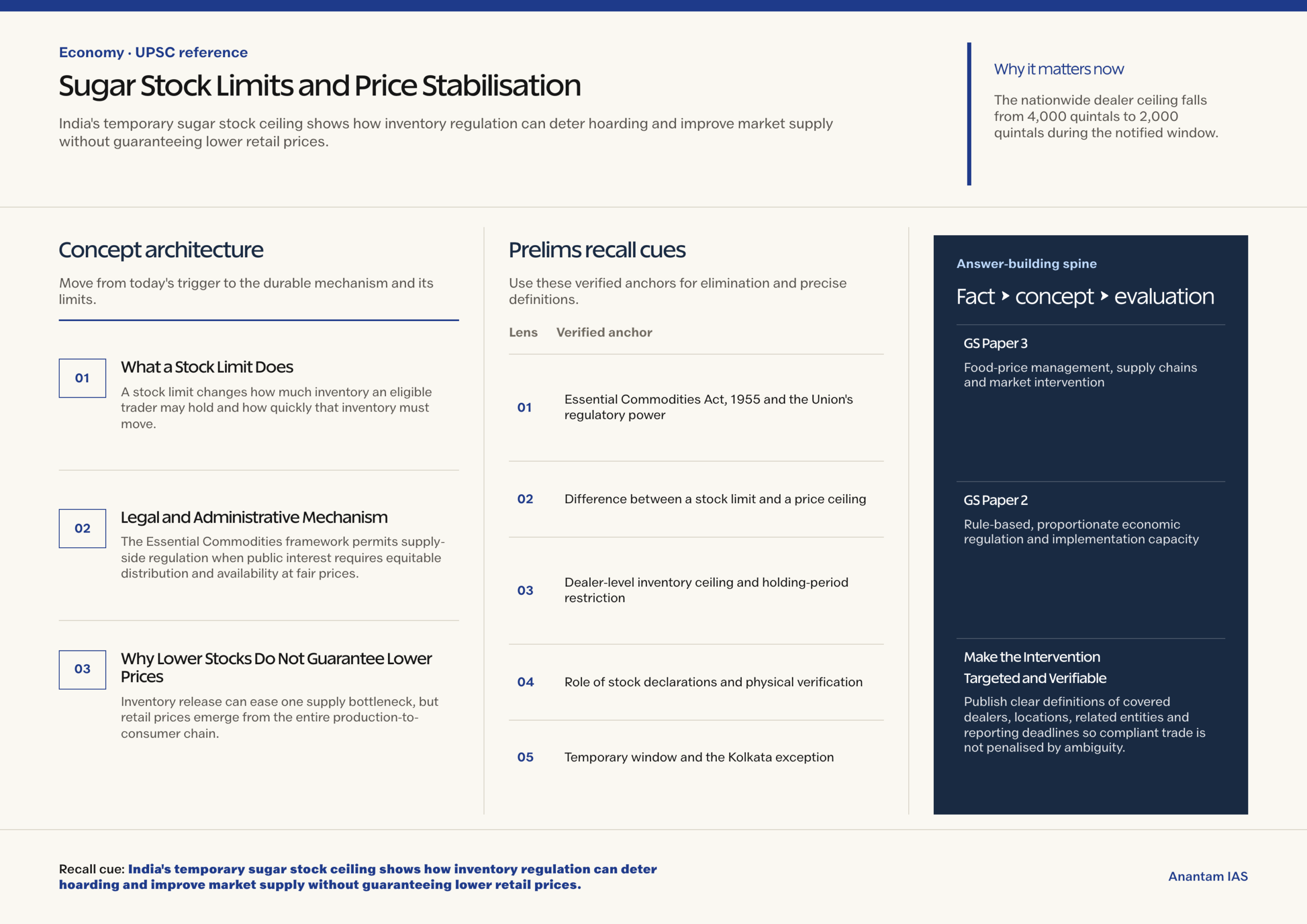
- Essential Commodities Act, 1955 and the Union’s regulatory power
- Difference between a stock limit and a price ceiling
- Dealer-level inventory ceiling and holding-period restriction
- Role of stock declarations and physical verification
- Temporary window and the Kolkata exception
Mains Relevance
GS Paper 3
- Food-price management, supply chains and market intervention
- Trade-offs between anti-hoarding enforcement and efficient wholesale distribution
GS Paper 2
- Rule-based, proportionate economic regulation and implementation capacity
Essay
- Markets need both freedom of exchange and credible safeguards against artificial scarcity.
Background and Context
What a Stock Limit Does
A stock limit changes how much inventory an eligible trader may hold and how quickly that inventory must move.
- By restricting large accumulation, the ceiling seeks to reduce market withholding that can create artificial scarcity during supply stress even when aggregate availability remains adequate.
- The accompanying 30-day holding rule targets duration as well as quantity, encouraging dealers to rotate stocks across warehouses instead of waiting for a more favourable price.
- Faster release can improve wholesale availability, narrow temporary supply gaps and weaken the bargaining power created by concentrated inventories where relatively few traders dominate local supply.
- The rule operates on stocks held by dealers; it should not be confused with separately notified mill-wise release controls governing how producers sell sugar into the domestic market.
- A temporary ceiling allows the government to respond to a perceived disruption while limiting interference with ordinary storage and distribution decisions once market conditions normalise.
Legal and Administrative Mechanism
The Essential Commodities framework permits supply-side regulation when public interest requires equitable distribution and availability at fair prices.
- Section 3 of the Essential Commodities Act, 1955 empowers the Union to regulate production, supply, distribution and trade to maintain supplies and secure equitable availability at fair prices.
- Its regulatory tools include controls over storage, transport, distribution and disposal, making inventory ceilings a time-bound supply-management instrument rather than a conventional tax or consumer subsidy.
- Compliance depends on regular stock declarations, inspection of premises and reconciliation of reported receipts, holdings and sales across mills, dealers and traders to detect unexplained inventory gaps.
- Physical verification addresses non-disclosure, excess holding and irregular stock movement; without credible checks, inventories can be fragmented, concealed or shifted to evade the ceiling.
- The Kolkata exception illustrates calibrated regulation: a uniform national ceiling may obstruct a hub that aggregates distant supplies and supports longer distribution routes across several downstream regions.
Why Lower Stocks Do Not Guarantee Lower Prices
Inventory release can ease one supply bottleneck, but retail prices emerge from the entire production-to-consumer chain.
- Retail sugar prices also reflect cane and sugar output expectations, mill release volumes, transport costs, regional demand, taxes and margins charged by wholesalers and retailers.
- A ceiling may increase near-term market arrivals, yet its effect can fade if underlying supply is tight or released stocks do not reach deficit locations efficiently.
- Dealers may respond by reducing procurement, splitting inventories or raising transaction frequency, creating compliance costs and coordination failures that partly offset gains from faster circulation.
- Price stability is an intended outcome, not an assured result; authorities must compare stock, arrival and retail-price data against prior trends before attributing any movement to the order.
- The best test throughout the notified period is whether availability improves without disrupting genuine distribution, especially in regions dependent on distant mills and a small number of logistical hubs.
Way Forward
Make the Intervention Targeted and Verifiable
- Publish clear definitions of covered dealers, locations, related entities and reporting deadlines so compliant trade is not penalised by ambiguity.
- Use risk-based inspections and digital stock reconciliation to detect concentration and non-disclosure without imposing equal compliance burdens on every trader.
- Track wholesale arrivals, regional availability and retail margins separately; revise or withdraw the ceiling if evidence shows disruption without consumer benefit.
- Coordinate mill releases and transport logistics so additional sugar moves toward deficit markets instead of merely changing ownership within surplus centres.
Conclusion
- A stock limit is a temporary anti-hoarding and supply-circulation tool; its success must be judged by verified availability and orderly trade, not by the notification alone.
- In a Mains answer, separate the mechanism from the outcome: reduced inventory concentration may support price stability, but cannot guarantee cheaper retail sugar.
UPSC Practice Questions
Prelims MCQ 1
With reference to the sugar stock-limit measure announced in September 2026, consider the following statements:
- The 2,000-quintal dealer ceiling is operative from 15 September through 30 November 2026.
- A dealer may hold a received stock for any duration if the quantity remains below the ceiling.
- Kolkata and its extended metropolitan areas retain a 4,000-quintal ceiling.
How many of the above statements are correct?
(a) Only one (b) Only two (c) All three (d) None
Answer: (b) Only two
Explanation:
Statements 1 and 3 are correct. Statement 2 is incorrect because the amended provisions also bar holding received stock for more than 30 days.
Prelims MCQ 2
Which one of the following best describes a commodity stock limit?
(a) A guaranteed maximum retail price (b) A compulsory subsidy paid to consumers (c) A ceiling on inventory held by a covered market participant (d) A minimum procurement price for producers
Answer: (c) A ceiling on inventory held by a covered market participant
Explanation:
A stock limit regulates inventory quantity or duration. It may influence availability, but it neither fixes a retail price nor guarantees that prices will fall.
UPSC Mains Questions
- Explain how commodity stock limits seek to curb hoarding. Why does a lower inventory ceiling not automatically guarantee lower retail prices?
- Temporary market interventions should be proportionate, evidence-based and sensitive to supply-chain geography. Discuss with reference to sugar stock regulation.
Sources: PIB, Department of Food and Public Distribution and India Code, Essential Commodities Act, 1955.
Frequently Asked Questions
What is the new sugar stock limit for dealers?
The ceiling is 2,000 quintals across most of India from 15 September through 30 November 2026, alongside a 30-day maximum holding period for received stock.
Why does Kolkata have a different ceiling?
Kolkata and its extended metropolitan areas retain 4,000 quintals because the hub receives sugar from distant producing states and supplies eastern and North-Eastern markets.
Does the order guarantee cheaper retail sugar?
No. It may improve circulation and availability, but retail prices also depend on output, mill releases, logistics, regional demand, taxes, trade margins and enforcement.
How are stock limits enforced?
Authorities use dealer declarations, stock updates, physical verification and checks of receipts, holdings and sales to identify excess stocks, non-disclosure and irregular movement.
What is the UPSC takeaway from this measure?
Treat stock limits as temporary supply-management tools under the Essential Commodities framework, and distinguish their anti-hoarding mechanism from the uncertain final effect on consumer prices.
Source: https://anantamias.com/current-affairs/sugar-stock-limit-price-stabilisation/
PM-DDKY Moves Toward Outcome Monitoring
Why in News?
On September 1, 2026, the Agriculture Ministry reviewed PM-DDKY and detailed a monitoring framework intended to connect scheme convergence, financial progress and beneficiary-level outcomes across 100 low-performing districts.
- The framework uses 121 indicators: 74 output indicators and 47 outcome indicators across converging schemes.
- The Financial Progress Module was implemented on August 31, 2026 to consolidate expenditure and investment information.
- A Beneficiary Progress Module was only targeted for mid-September 2026; it was not yet reported as implemented.
- The review considered the proposed nomination of two progressive farmers to each District Dhan-Dhaanya Committee.
- The dashboard’s average district score rose from 22.54 to 38.85 between April and July, but this is not an independent impact estimate.
- PM-DDKY applies convergence governance, coordinating existing interventions rather than operating as one isolated agricultural subsidy.
- Separating outputs from outcomes can reveal whether administrative activity produces measurable farmer-level change rather than merely higher spending or completed tasks.
- Credible outcome claims still require data quality, baseline comparability and attribution; a dashboard score alone cannot establish that the programme caused observed change.
UPSC Relevance
Prelims Relevance
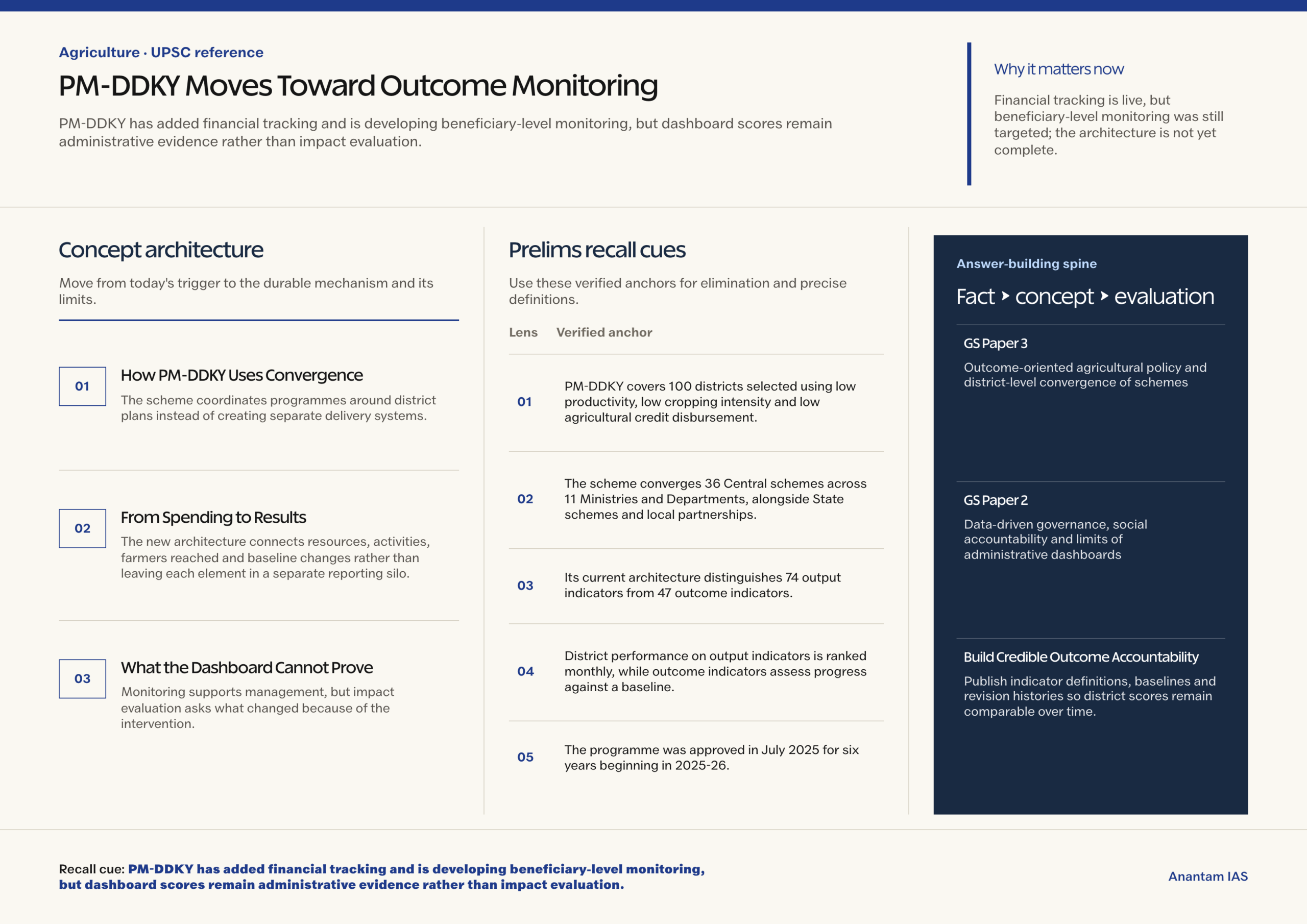
- PM-DDKY covers 100 districts selected using low productivity, low cropping intensity and low agricultural credit disbursement.
- The scheme converges 36 Central schemes across 11 Ministries and Departments, alongside State schemes and local partnerships.
- Its current architecture distinguishes 74 output indicators from 47 outcome indicators.
- District performance on output indicators is ranked monthly, while outcome indicators assess progress against a baseline.
- The programme was approved in July 2025 for six years beginning in 2025-26.
Mains Relevance
GS Paper 3
- Outcome-oriented agricultural policy and district-level convergence of schemes
- Using beneficiary evidence to connect public investment with productivity, resilience and access
GS Paper 2
- Data-driven governance, social accountability and limits of administrative dashboards
Essay
- What governments count shapes what administrations pursue, but measurement becomes meaningful only when it captures people’s outcomes.
Background and Context
How PM-DDKY Uses Convergence
The scheme coordinates programmes around district plans instead of creating separate delivery systems, linking multiple funding streams to shared agricultural goals.
- The Cabinet approved PM-DDKY for six years from 2025-26, drawing on the Aspirational Districts Programme’s district focus and scope for local problem-solving under coordinated plans.
- Districts were chosen using three structural gaps: low productivity, low cropping intensity and weak credit disbursement, which signal persistent underperformance rather than a one-season shock.
- The programme brings 36 Central schemes, State schemes and other interventions into District Action Plans, allowing connected constraints to be addressed through common agricultural objectives.
- Those six linked objectives cover productivity, diversification and sustainability, storage, irrigation, credit, and stronger governance and service delivery.
- District, State and national committees provide review layers, while Central Nodal Officers conduct field-level monitoring against plans and reported indicator data.
From Spending to Results
The new architecture connects resources, activities, farmers reached and baseline changes rather than leaving each element in a separate reporting silo.
- The Financial Progress Module, implemented on August 31, consolidates investments and spending from participating sources, allowing resources to be examined alongside actions rather than separately.
- The dashboard separates 74 output indicators, which record delivered activity, from 47 outcome indicators tracking baseline change; completed tasks should not be mislabeled as benefits.
- Monthly ranking currently uses output performance; it can compare reported administrative progress but cannot prove farmer welfare gains or show whether changes persist.
- The planned Beneficiary Progress Module is meant to capture who received benefits and link programme activity more systematically to beneficiary-level progress across schemes and districts.
- Because that module was only targeted for mid-September, the beneficiary-tracking layer should be treated as forthcoming, not operational; its actual functionality was not yet reported.
What the Dashboard Cannot Prove
Monitoring supports management, but impact evaluation asks what changed because of the intervention, especially when rankings create pressure to report progress.
- The score increase from 22.54 to 38.85 reflects the programme dashboard’s reported output framework, not an independently audited impact study; the release claimed no causal evaluation.
- Administrative rankings may improve because of execution, reporting, data completeness or indicator design; they can change without equivalent field outcomes, so causal attribution requires separate analysis.
- Outcome data need consistent definitions, comparable baselines, verification and disaggregation by landholding, gender, tenancy and geography so averages do not conceal unequal access.
- The 2025 Cabinet design envisaged progressive farmers on district committees; the latest review discussed proposing two nominees, leaving representation details and selection procedures unsettled.
- Farmer participation should influence planning and grievance correction, not become symbolic presence added after dashboard decisions; committee records should show how field feedback receives a response.
Way Forward
Build Credible Outcome Accountability
- Publish indicator definitions, baselines and revision histories so district scores remain comparable over time.
- Add beneficiary verification and grievance channels before treating enrolment or receipt records as evidence of improved outcomes.
- Use periodic independent evaluation, comparison strategies and field audits to test attribution beyond routine dashboard monitoring.
- Give farmer representatives transparent selection rules, meeting access and recorded responses to their district-level recommendations.
Conclusion
- PM-DDKY’s key governance shift is the attempt to join financial, output, outcome and beneficiary data across converging agricultural schemes at district level, making delivery gaps easier to locate and correct.
- In a Mains answer, distinguish monitoring from evaluation: dashboards guide implementation, while credible impact claims need verified baselines, beneficiary evidence, independent checks and causal assessment.
UPSC Practice Questions
Prelims MCQ 1
With reference to the PM Dhan-Dhaanya Krishi Yojana monitoring framework, consider the following statements:
- District performance is ranked monthly using output indicators.
- The Beneficiary Progress Module was fully operational by August 31, 2026.
- Outcome indicators are intended to assess progress against baseline conditions.
How many of the above statements are correct?
(a) Only one (b) Only two (c) All three (d) None
Answer: (b) Only two
Explanation:
Statements 1 and 3 are correct. The Financial Progress Module was implemented on August 31; the Beneficiary Progress Module was only targeted for mid-September 2026.
Prelims MCQ 2
Which set correctly states the three criteria used to identify PM-DDKY districts?
(a) Low productivity, low cropping intensity and low agricultural credit disbursement (b) Low rainfall, high tenancy and low fertilizer consumption (c) High irrigation coverage, low storage and high credit disbursement (d) Low forest cover, high rural population and low market access
Answer: (a) Low productivity, low cropping intensity and low agricultural credit disbursement
Explanation:
The scheme identifies districts using low agricultural productivity, low cropping intensity and low agricultural credit disbursement.
UPSC Mains Questions
- PM-DDKY seeks to move agricultural governance from tracking expenditure and activities toward measuring outcomes. Explain its monitoring architecture and the safeguards needed for credible evaluation.
- Administrative dashboards are useful management tools but weak substitutes for independent impact evaluation. Discuss with reference to district-level agricultural programmes.
Sources: PIB, Ministry of Agriculture and Farmers Welfare and PIB, Cabinet Committee on Economic Affairs.
Frequently Asked Questions
What is the main change in PM-DDKY monitoring?
The framework is joining financial, output and outcome data, with a planned beneficiary module intended to connect scheme activity more systematically to farmer-level progress.
Was the Beneficiary Progress Module operational on September 1, 2026?
No. PIB said it was targeted for implementation by mid-September; only the Financial Progress Module was reported as implemented on August 31.
What is the difference between an output and an outcome?
An output records what an administration delivered, while an outcome captures a change in conditions or benefits associated with those interventions and assessed against a baseline.
Does a higher dashboard score prove that PM-DDKY caused better farmer outcomes?
No. The reported score tracks dashboard performance; causal impact requires verified data, comparable baselines and an evaluation design that separates programme effects from other influences.
How is farmer representation being strengthened?
The latest review considered the proposed nomination of two progressive farmers to each District Dhan-Dhaanya Committee; the proposal should not be described as completed implementation.
Source: https://anantamias.com/current-affairs/pm-ddky-outcome-monitoring-framework/
DGFT Automates Free Sale and Commerce Certificates
Why in News?
On September 1, 2026, DGFT enabled automated issuance of Free Sale and Commerce Certificates for eligible export applications outside the Drugs and Cosmetics Act route.
- Eligible applications can receive system-generated certificates without first being routed to a Regional Authority for manual scrutiny.
- Applications needing verification or failing automated parameters may still move to the concerned Regional Authority for manual processing.
- Some auto-approved cases can be flagged later under risk-management parameters, preserving post-issuance oversight.
- The change implements a rule-based workflow; it does not extend automation to products governed through the Drugs and Cosmetics Act route.
- The reform targets processing friction, replacing routine file movement with automated decisions where pre-set eligibility conditions are satisfied.
- It illustrates risk-based regulation: low-risk eligible cases move faster, while uncertain or selected cases receive human review.
- The policy question is not automation versus oversight, but how transparent rules, audit trails and accountable review can combine both.
UPSC Relevance
Prelims Relevance
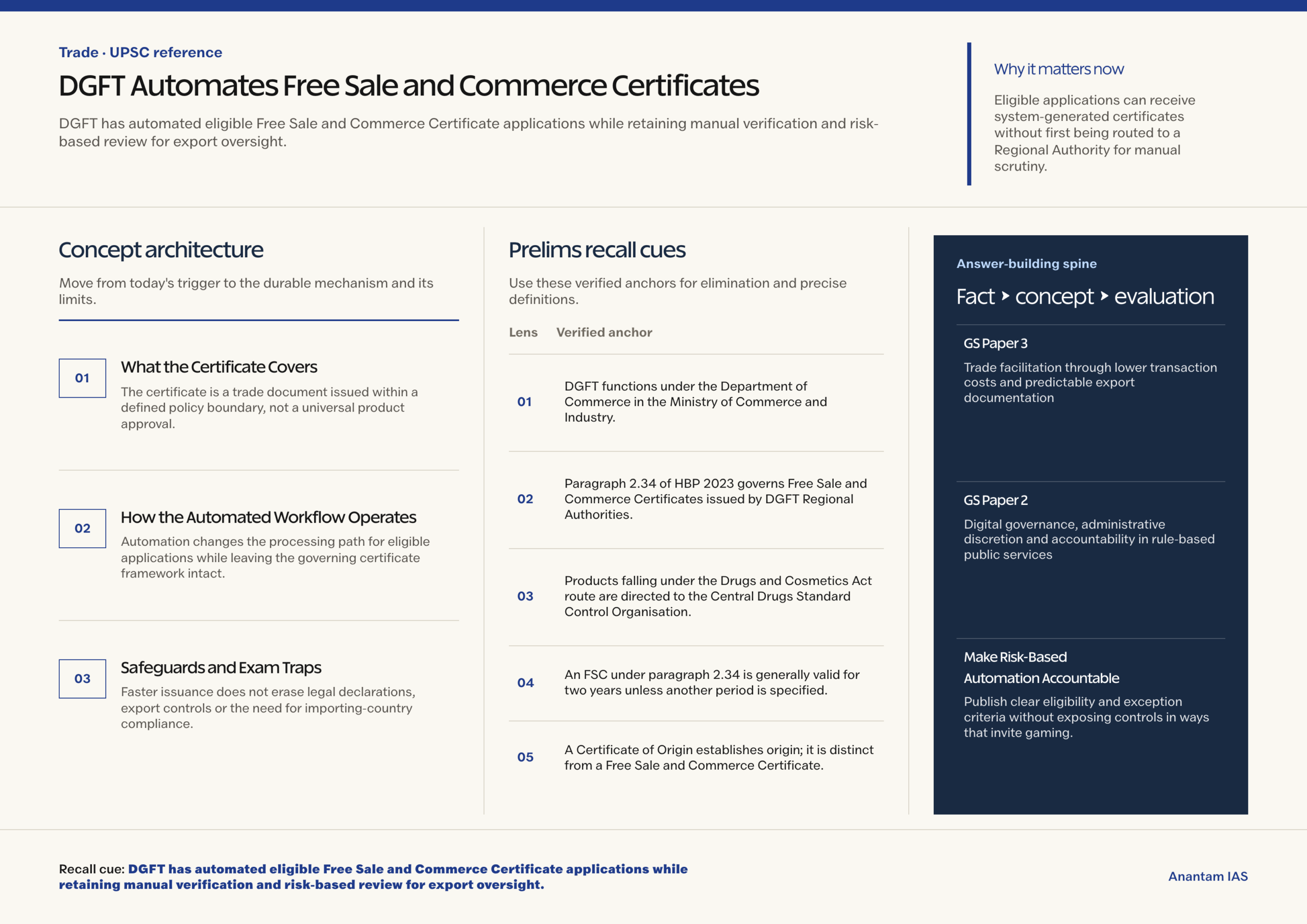
- DGFT functions under the Department of Commerce in the Ministry of Commerce and Industry.
- Paragraph 2.34 of HBP 2023 governs Free Sale and Commerce Certificates issued by DGFT Regional Authorities.
- Products falling under the Drugs and Cosmetics Act route are directed to the Central Drugs Standard Control Organisation.
- An FSC under paragraph 2.34 is generally valid for two years unless another period is specified.
- A Certificate of Origin establishes origin; it is distinct from a Free Sale and Commerce Certificate.
Mains Relevance
GS Paper 3
- Trade facilitation through lower transaction costs and predictable export documentation
- Balancing automated approvals with risk-based compliance checks
GS Paper 2
- Digital governance, administrative discretion and accountability in rule-based public services
Essay
- Good digital governance removes avoidable discretion without removing institutional responsibility.
Background and Context
What the Certificate Covers
The certificate is a trade document issued within a defined policy boundary, not a universal product approval.
- Under HBP paragraph 2.34, Regional Authorities may issue FSCs on application for qualifying exports not covered by the Drugs and Cosmetics Act, within the provision’s defined policy framework.
- The provision includes specified medical and surgical-use items outside that Act, provided they are not prohibited for export and satisfy the applicable certificate conditions.
- Regional Authorities may also issue FSCs for other items that are neither restricted nor prohibited for export, showing that the framework extends beyond health-linked goods.
- Items within the Drugs and Cosmetics Act framework follow the CDSCO route rather than this DGFT route because the sectoral regulator handles certification within that statute.
- Unless specified otherwise, an FSC issued under paragraph 2.34 has a two-year validity from its issue date, making validity a separate question from automated eligibility.
How the Automated Workflow Operates
Automation changes the processing path for eligible applications while leaving the governing certificate framework intact.
- The exporter applies through the DGFT portal using the electronic ANF-2H framework, which structures applicant, product, buyer and manufacturer information for paperless processing.
- When an application meets the prevailing automated parameters, the system can issue the certificate without initial manual scrutiny or routine officer-by-officer file movement.
- A case requiring verification can be diverted to the concerned Regional Authority, which retains manual scrutiny where declarations, documents or eligibility signals require examination.
- An auto-approved case may later enter risk-based review, so faster issuance does not give the application permanent immunity from administrative examination.
- This two-track design separates routine eligible cases from exception cases, concentrating officer time on applications carrying greater uncertainty instead of scrutinising every file identically.
Safeguards and Exam Traps
Faster issuance does not erase legal declarations, export controls or the need for importing-country compliance.
- ANF-2H asks for the applicant’s IEC, product, buyer, manufacturer and ITC(HS) details, including product use and technical description, supporting structured eligibility and verification checks.
- The applicant declares that listed goods are free for export and accepts legal consequences for false information, so automation still rests on attributable declarations.
- Automation is not blanket approval: verification cases and applications outside system parameters remain manually processed, making automation a conditional routing rule rather than universal entitlement.
- An FSC is distinct from a Certificate of Origin, which identifies where goods originate and may support preferential tariff claims; the two documents answer different trade questions.
- The reform changes DGFT’s workflow; it does not replace foreign-market requirements, product standards or sector-specific regulators that may govern sale or use in the destination jurisdiction.
Way Forward
Make Risk-Based Automation Accountable
- Publish clear eligibility and exception criteria without exposing controls in ways that invite gaming.
- Maintain complete digital audit trails linking application data, automated decisions, flags and Regional Authority action.
- Review false approvals and unnecessary referrals to improve risk parameters while protecting legitimate exporters from repeated delays.
- Provide a time-bound grievance channel for applicants routed to manual scrutiny or affected by an erroneous system decision.
Conclusion
- DGFT’s FSC reform shows how rule-based automation can reduce routine export compliance costs while preserving manual scrutiny for uncertain or risky cases.
- In a Mains answer, present it as calibrated digital governance: eligibility-based speed, human review for exceptions, post-approval risk checks and auditable accountability.
UPSC Practice Questions
Prelims MCQ 1
With reference to the automated issuance of Free Sale and Commerce Certificates, consider the following statements:
- Every application is issued automatically without scrutiny by a Regional Authority.
- Products governed through the Drugs and Cosmetics Act route are outside this DGFT automation route.
- Some auto-approved applications may later be flagged for risk-based review.
How many of the above statements are correct?
(a) Only one (b) Only two (c) All three (d) None
Answer: (b) Only two
Explanation:
Statements 2 and 3 are correct. Applications requiring verification or failing automated parameters may still be sent to a DGFT Regional Authority for manual processing.
Prelims MCQ 2
Under paragraph 2.34 of the Handbook of Procedures 2023, which authority may issue a Free Sale and Commerce Certificate for eligible items outside the Drugs and Cosmetics Act route?
(a) DGFT Regional Authority (b) Reserve Bank of India (c) Central Board of Indirect Taxes and Customs (d) Bureau of Indian Standards
Answer: (a) DGFT Regional Authority
Explanation:
Paragraph 2.34 authorises DGFT Regional Authorities to issue FSCs on application for eligible goods within its stated scope.
UPSC Mains Questions
- How can risk-based automation reduce export transaction costs without weakening regulatory accountability? Discuss with reference to DGFT’s automated Free Sale and Commerce Certificate workflow.
- Rule-based digital governance should reduce avoidable discretion, not eliminate human responsibility. Examine the statement using trade facilitation as an example.
Sources: PIB, Ministry of Commerce and Industry and DGFT Handbook of Procedures 2023, Chapter 2.
Frequently Asked Questions
What is a Free Sale and Commerce Certificate?
It is a DGFT trade document issued under paragraph 2.34 of the Handbook of Procedures for eligible export items within the provision’s defined scope.
Are all FSC applications now approved automatically?
No. Only eligible applications meeting automated parameters can bypass initial manual scrutiny; verification cases and exceptions may still go to a Regional Authority.
Does this automation cover products under the Drugs and Cosmetics Act?
No. Products within that statutory route are directed to CDSCO; the announced DGFT automation concerns eligible products outside that route.
Can DGFT review a certificate after automatic issuance?
Yes. The system may flag certain auto-approved applications to the concerned Regional Authority for subsequent review under risk-management parameters.
How long is a DGFT Free Sale and Commerce Certificate valid?
Paragraph 2.34 generally provides a two-year validity from the date of issue unless the certificate specifies a different period.
Source: https://anantamias.com/current-affairs/dgft-automated-free-sale-certificates/
SCO Bishkek Declaration: Outcomes and India’s Sovereignty Test
Why in News?
At the 26th SCO summit in Bishkek on September 1, 2026, member states adopted the Bishkek Declaration and a package of institutional, security and cooperation instruments.
- The SCO Secretariat reported 28 approved documents, including the Declaration, a Charter-amendment protocol and an emergency-assistance statement.
- PIB described the package as four MoUs plus over twenty decisions and statements covering climate, nuclear safety, energy conservation and drug control.
- The summit approved provisions for a Universal Security Centre and the Executive Committee of an SCO Anti-Drug Centre.
- India-backed proposals recorded in the Declaration included an English-language Charter change, a Civilisation Dialogue Forum, Young Scientist Forum and Young Authors’ Conclave.
- The outcome matters because the SCO moved from broad summit messaging toward institutional rules, specialised centres and external partnerships.
- For India, the test is whether collective language produces non-selective counter-terrorism and connectivity that respects sovereignty and territorial integrity.
UPSC Relevance
Prelims Relevance
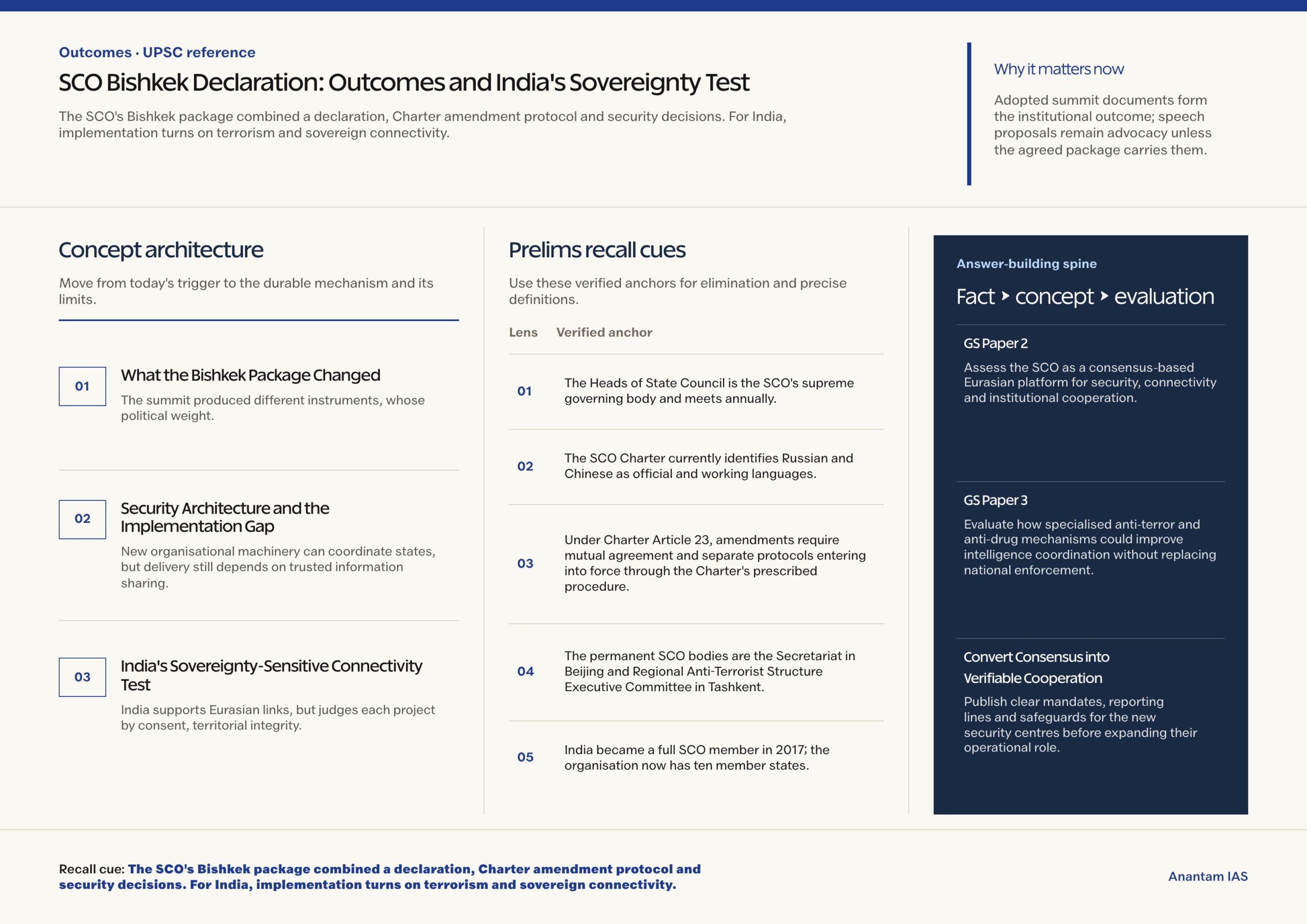
- The Heads of State Council is the SCO’s supreme governing body and meets annually.
- The SCO Charter currently identifies Russian and Chinese as official and working languages.
- Under Charter Article 23, amendments require mutual agreement and separate protocols entering into force through the Charter’s prescribed procedure.
- The permanent SCO bodies are the Secretariat in Beijing and Regional Anti-Terrorist Structure Executive Committee in Tashkent.
- India became a full SCO member in 2017; the organisation now has ten member states.
Mains Relevance
GS Paper 2
- Assess the SCO as a consensus-based Eurasian platform for security, connectivity and institutional cooperation.
- Examine India’s strategy of participating in regional connectivity while insisting on sovereignty and territorial integrity.
GS Paper 3
- Evaluate how specialised anti-terror and anti-drug mechanisms could improve intelligence coordination without replacing national enforcement.
Essay
- Regional institutions become credible when shared declarations are converted into rules, capacity and even-handed implementation.
Background and Context
What the Bishkek Package Changed
The summit produced different instruments, whose political weight, legal route and implementation requirements must not be conflated.
- The Bishkek Declaration records negotiated common positions on regional and international questions; it guides subsequent cooperation but does not itself supply domestic enforcement powers.
- A separate Charter protocol addresses amendments to the organisation’s constitutive document, making it legally and procedurally distinct from a summit declaration.
- Charter Article 23 says amendment protocols form an integral part of the Charter but enter into force through the Article 21 ratification procedure.
- The summit also approved an emergency-assistance statement, extending the package beyond conventional security into disaster response, mutual support and practical humanitarian coordination among member states.
- A decision authorising an SCO Secretariat-African Union Commission MoU widened external institutional cooperation and created a bridge to another major regional organisation.
Security Architecture and the Implementation Gap
New organisational machinery can coordinate states, but delivery still depends on trusted information sharing, compatible procedures and national action.
- Approved provisions for the Universal Centre create a framework for addressing multiple security challenges rather than treating terrorism, cyber risks and organised crime in isolated silos.
- The Anti-Drug Centre’s Executive Committee can support operational coordination against trafficking networks that connect narcotics, organised crime, illicit finance and terrorist activity.
- The Declaration rejected using terrorist, separatist or extremist groups for strategic advantage, reinforcing India’s demand against double standards and selective naming of threats.
- The Declaration also sought an inclusive Afghan government; this remains a collective political position, not evidence that governance conditions or political representation inside Afghanistan have changed.
- Centres and statements cannot independently prosecute offenders; their value rests on timely intelligence, agreed definitions, evidentiary cooperation and consistent national follow-through.
India's Sovereignty-Sensitive Connectivity Test
India supports Eurasian links, but judges each project by consent, territorial integrity, financial credibility and practical access.
- India accepts connectivity that links markets, expands trade and creates development opportunities across a Eurasian region where several members lack direct sea access.
- Its red line is that routes and infrastructure must respect each state’s sovereignty and territorial integrity, rather than normalise disputed territorial alignments.
- This distinguishes support for connectivity as a principle from automatic endorsement of every proposed corridor, financing model, transit condition or route within the SCO space.
- The proposed SCO Development Bank remained under consultation; welcoming work on it does not equal a completed founding agreement, subscribed capital or operational financing.
- India can use the SCO to advance access through transparent, consent-based projects while keeping alternative corridors, maritime options and bilateral partnerships open.
Way Forward
Convert Consensus into Verifiable Cooperation
- Publish clear mandates, reporting lines and safeguards for the new security centres before expanding their operational role.
- Create measurable cooperation on terrorist financing, safe havens, recruitment and narcotics flows without selective exemptions.
- Apply transparent project appraisal, host-state consent and territorial-integrity tests to every connectivity proposal.
- Complete domestic procedures for Charter amendments before presenting political endorsement as an institutional change already in force.
Conclusion
- The Bishkek outcome is significant because it combines political consensus with Charter, security-centre and partnership instruments rather than offering a speech-only summit record without institutional mandates or follow-through.
- A strong answer should separate adoption, entry into force and implementation, then judge India’s gains through even-handed security cooperation, institutional delivery and sovereignty-respecting connectivity.
- The durable exam trap is to treat a Declaration, Charter protocol, institutional decision and proposal under consultation as equivalent outcomes; each demands separate legal and implementation analysis.
UPSC Practice Questions
Prelims MCQ 1
With reference to the Shanghai Cooperation Organisation, consider the following statements:
- The Heads of State Council is the SCO’s supreme governing body.
- Russian and Chinese are the official and working languages under the existing SCO Charter.
- The Regional Anti-Terrorist Structure Executive Committee is based in Beijing.
How many of the above statements are correct?
(a) Only one (b) Only two (c) All three (d) None
Answer: (b) Only two
Explanation:
Statements 1 and 2 are correct. The SCO Secretariat is in Beijing, while the Regional Anti-Terrorist Structure Executive Committee is based in Tashkent.
Prelims MCQ 2
Under the SCO Charter, a change or amendment to the Charter is made through which instrument?
(a) A unilateral Secretariat notification (b) A simple press communique (c) A separate protocol agreed by member states (d) A resolution of the SCO Business Council
Answer: (c) A separate protocol agreed by member states
Explanation:
Article 23 provides for changes by mutual agreement through separate protocols, which form part of the Charter and enter into force under its prescribed procedure.
UPSC Mains Questions
- The Bishkek summit shows both the potential and limits of consensus-based regionalism. Examine with reference to the SCO’s new institutional outcomes.
- How can India pursue Eurasian connectivity through the SCO while protecting sovereignty, territorial integrity and security interests?
Sources: PIB, Prime Minister's Office and The Hindu.
Frequently Asked Questions
What was adopted at the 2026 SCO Bishkek summit?
The SCO Secretariat reported 28 approved documents, including the Bishkek Declaration, a Charter-amendment protocol, an emergency-assistance statement and decisions concerning new security and anti-drug bodies.
Did English immediately become an SCO official language?
PIB said India’s English-language proposal entered the Declaration, and a Charter-amendment protocol was approved. Entry into force still follows the Charter’s amendment and ratification procedure.
What is India’s main connectivity condition in the SCO?
India supports links that expand markets, trade and development, provided each initiative respects national sovereignty and territorial integrity and does not prejudge contested territorial claims.
Why do the new SCO security bodies matter?
They can institutionalise coordination against linked threats such as terrorism, narcotics and organised crime, but results depend on member states sharing intelligence and acting without selective standards.
Is the Bishkek Declaration the same as a binding treaty?
No. It records agreed political positions. Separate protocols, agreements and decisions have their own legal procedures, so adoption and domestic or institutional implementation must be analysed separately.
Source: https://anantamias.com/current-affairs/sco-bishkek-declaration-india-priorities/
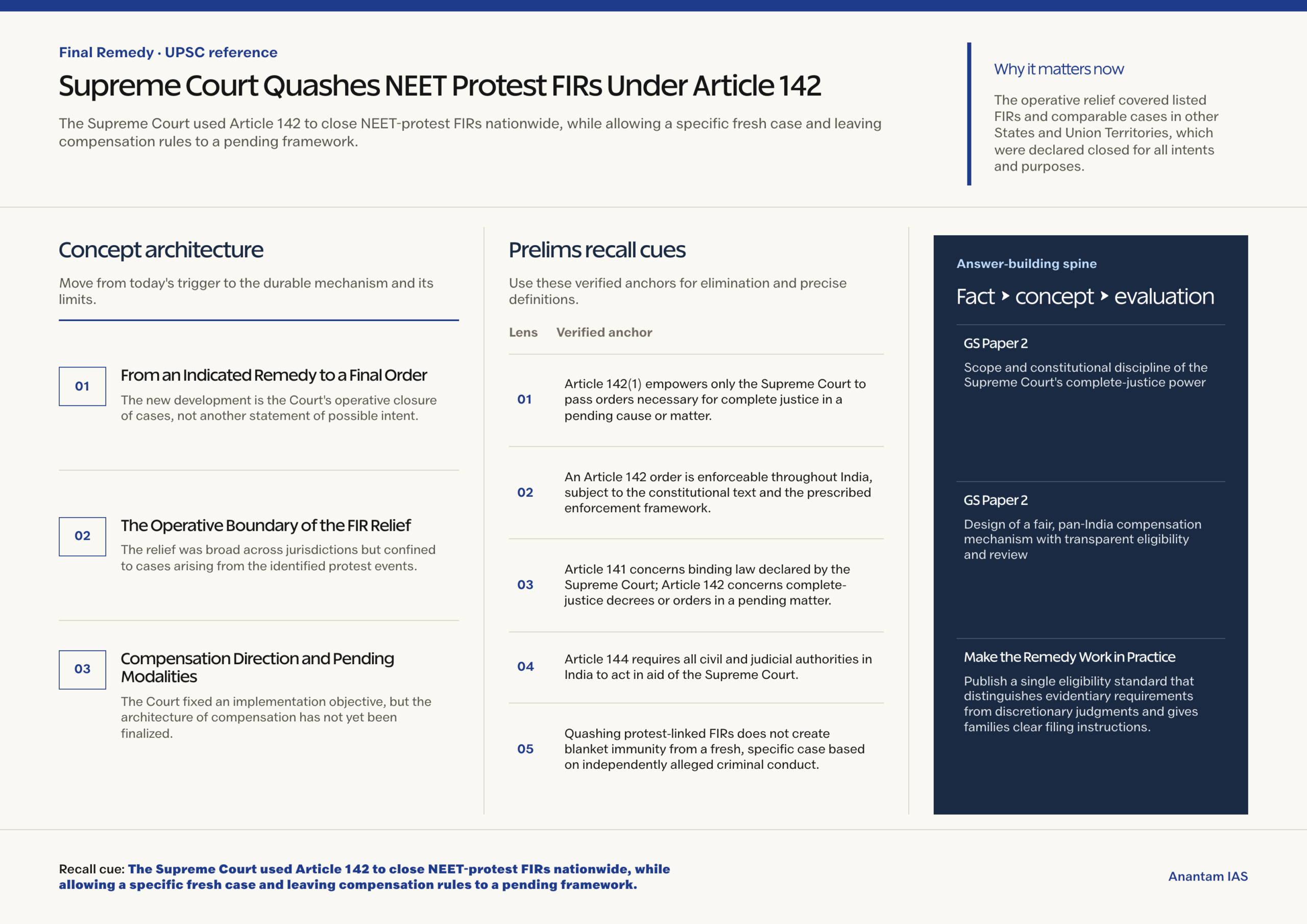
Supreme Court Quashes NEET Protest FIRs Under Article 142
Why in News?
On September 1, the Supreme Court invoked Article 142 to close FIRs linked to the July NEET-UG protests nationwide and directed a pan-India compensation framework.
- The operative relief covered listed FIRs and comparable cases in other States and Union Territories, which were declared closed for all intents and purposes.
- Authorities were restrained from registering fresh FIRs concerning the same July 20-25 protest events, preventing the relief from being defeated through re-registration.
- Delhi Police retained liberty to file a fresh and specific FIR concerning 2,873 identified persons, without prejudicing their right to contest allegations.
- The Centre must formulate compensation modalities with States and Union Territories and make eligible payments within three months; the detailed claims framework remains pending.
- The order converts the Court’s earlier indicated relief into a final operative remedy with nationwide effect.
- It separates bona fide participation in protest from specific allegations of bodily harm, property destruction, or other independently prosecutable conduct.
- Its compensation direction recognizes remedial responsibility but leaves crucial questions of causation, eligibility, quantum, proof, and review to the forthcoming framework.
UPSC Relevance
Prelims Relevance
- Article 142(1) empowers only the Supreme Court to pass orders necessary for complete justice in a pending cause or matter.
- An Article 142 order is enforceable throughout India, subject to the constitutional text and the prescribed enforcement framework.
- Article 141 concerns binding law declared by the Supreme Court; Article 142 concerns complete-justice decrees or orders in a pending matter.
- Article 144 requires all civil and judicial authorities in India to act in aid of the Supreme Court.
- Quashing protest-linked FIRs does not create blanket immunity from a fresh, specific case based on independently alleged criminal conduct.
Mains Relevance
GS Paper 2
- Scope and constitutional discipline of the Supreme Court’s complete-justice power
- Protection of peaceful protest while preserving investigation of specific criminal allegations
GS Paper 2
- Design of a fair, pan-India compensation mechanism with transparent eligibility and review
- Cooperative implementation by the Union, States, Union Territories, police, and claims authorities
Essay
- Justice becomes complete only when relief is both principled and practically enforceable.
Background and Context
From an Indicated Remedy to a Final Order
The new development is the Court’s operative closure of cases, not another statement of possible intent.
- An August 19 update recorded the Court’s stated intention to consider composite relief after seeking information on protest-related FIRs, but had not yet closed any case.
- On September 1, applications from the Centre and participating States enabled the Court to issue a final, enforceable direction rather than await separate withdrawals or multiple jurisdiction-specific quashing proceedings.
- The order closed FIRs before the Court and extended equivalent protection to comparable protest cases elsewhere, giving the remedy a pan-India reach without requiring each accused to litigate separately.
- The Court linked this exceptional relief to the future prospects of bona fide young protesters and the parties’ assurances, rather than announcing a general rule for every demonstration.
- The sequence matters: a judicial observation signals a possible course, while an operative order fixes legal consequences that authorities must implement.
The Operative Boundary of the FIR Relief
The relief was broad across jurisdictions but confined to cases arising from the identified protest events.
- Existing protest-linked FIRs covered by the direction cannot continue through investigation; they are treated as closed for all purposes.
- The bar on fresh FIRs prevents authorities from recreating substantially the same cases under a new number or in another jurisdiction.
- A fresh case against the identified 2,873 persons must be specific; criminal antecedents or facial-recognition identification do not themselves establish guilt.
- The affected persons retain opportunities to defend themselves and pursue legal remedies, so the exception authorizes process without predetermining liability.
- The order does not declare every protest act lawful; independently supported allegations of violence or property damage remain legally distinguishable from mere participation.
Compensation Direction and Pending Modalities
The Court fixed an implementation objective, but the architecture of compensation has not yet been finalized.
- The Centre must consult States and Union Territories to create a pan-India mechanism for compensatory measures linked to the NEET-UG 2026 crisis.
- Reported directions require payment within three months in eligible suicide cases connected to NEET-UG 2026, making time-bound execution part of the remedy.
- The forthcoming framework must still specify eligibility evidence, causal assessment, compensation quantum, the deciding authority, application procedure, and a review or appeal route.
- A regular mechanism can reduce unequal outcomes across States, but national uniformity must coexist with accessible local claims processing and reliable fact verification.
- The compensation direction is not a completed payout scheme; presenting its unsettled modalities as final would overstate what the Court decided.
Way Forward
Make the Remedy Work in Practice
- Publish a single eligibility standard that distinguishes evidentiary requirements from discretionary judgments and gives families clear filing instructions.
- Create a time-bound nodal process across States and Union Territories, with written reasons for acceptance, rejection, or requests for additional material.
- Provide an independent review channel so contested causation or eligibility decisions do not force families into fresh constitutional litigation.
- Audit police compliance with FIR closure and the fresh-case exception to prevent relabeling of barred cases or prejudice against identified persons.
Conclusion
- The September 1 order is important because Article 142 moved from a proposed solution to a nationwide, operative closure of protest-linked criminal cases.
- A balanced answer should pair the broad FIR relief with its specific exception and describe compensation as a binding direction whose modalities remain pending.
- Complete justice will ultimately be measured by lawful police compliance, fair claims rules, reasoned decisions, and timely payment across every affected jurisdiction and for every eligible claimant in practice.
UPSC Practice Questions
Prelims MCQ 1
With reference to Articles 141, 142 and 144 of the Constitution, consider the following statements:
- Article 141 makes the law declared by the Supreme Court binding on all courts within India.
- Article 142 permits the Supreme Court to order what is necessary for complete justice in a pending cause or matter.
- Article 144 requires civil and judicial authorities to act in aid of the Supreme Court.
How many of the above statements are correct?
(a) Only one (b) Only two (c) All three (d) None
Answer: (c) All three
Explanation:
All three statements reproduce the distinct constitutional functions of Articles 141, 142 and 144.
Prelims MCQ 2
Which description best captures the Supreme Court’s September 1 order on the NEET protest FIRs?
(a) It granted unconditional immunity for every act committed during any student protest. (b) It closed identified protest-linked FIRs nationwide while allowing a fresh, specific case against identified persons. (c) It transferred all protest cases to a single trial court in Delhi. (d) It finalized compensation amounts and eligibility rules for every affected family.
Answer: (b) It closed identified protest-linked FIRs nationwide while allowing a fresh, specific case against identified persons.
Explanation:
The operative relief closed the protest-linked cases but preserved a narrow fresh-FIR route and left compensation modalities to a forthcoming framework.
UPSC Mains Questions
- The Supreme Court’s complete-justice power can protect citizens from abusive criminal process without erasing accountability for specific offences. Discuss with reference to the NEET protest FIR order.
- What safeguards should a pan-India compensation framework include to convert a judicial remedial direction into fair, timely, and reviewable relief?
Sources: The Hindu and Legislative Department, Ministry of Law and Justice.
Frequently Asked Questions
What did the Supreme Court finally decide on the NEET protest FIRs?
It invoked Article 142 to close protest-linked FIRs across India and bar fresh cases for the same events, subject to a narrow exception for a fresh, specific FIR.
Did the order give every protester blanket criminal immunity?
No. The relief concerned identified protest events and preserved investigation through a specific fresh FIR. Mere protest participation and independently alleged criminal conduct remain legally distinct.
Why was Article 142 used?
Article 142 allowed the Supreme Court to issue a uniform complete-justice remedy in the pending matter, avoiding fragmented withdrawals and continuing investigations across multiple jurisdictions.
Has the compensation scheme been finalized?
No. The Court directed a pan-India framework and time-bound payment for eligible cases, but eligibility proof, causal assessment, quantum, procedure, deciding authority, and review remain to be specified.
What is the key difference from the Court’s August position?
The August development indicated possible composite relief and sought case information. The September order supplied the final operative remedy: nationwide closure, a defined exception, and compensation directions.
Source: https://anantamias.com/current-affairs/supreme-court-article-142-neet-protest-firs/
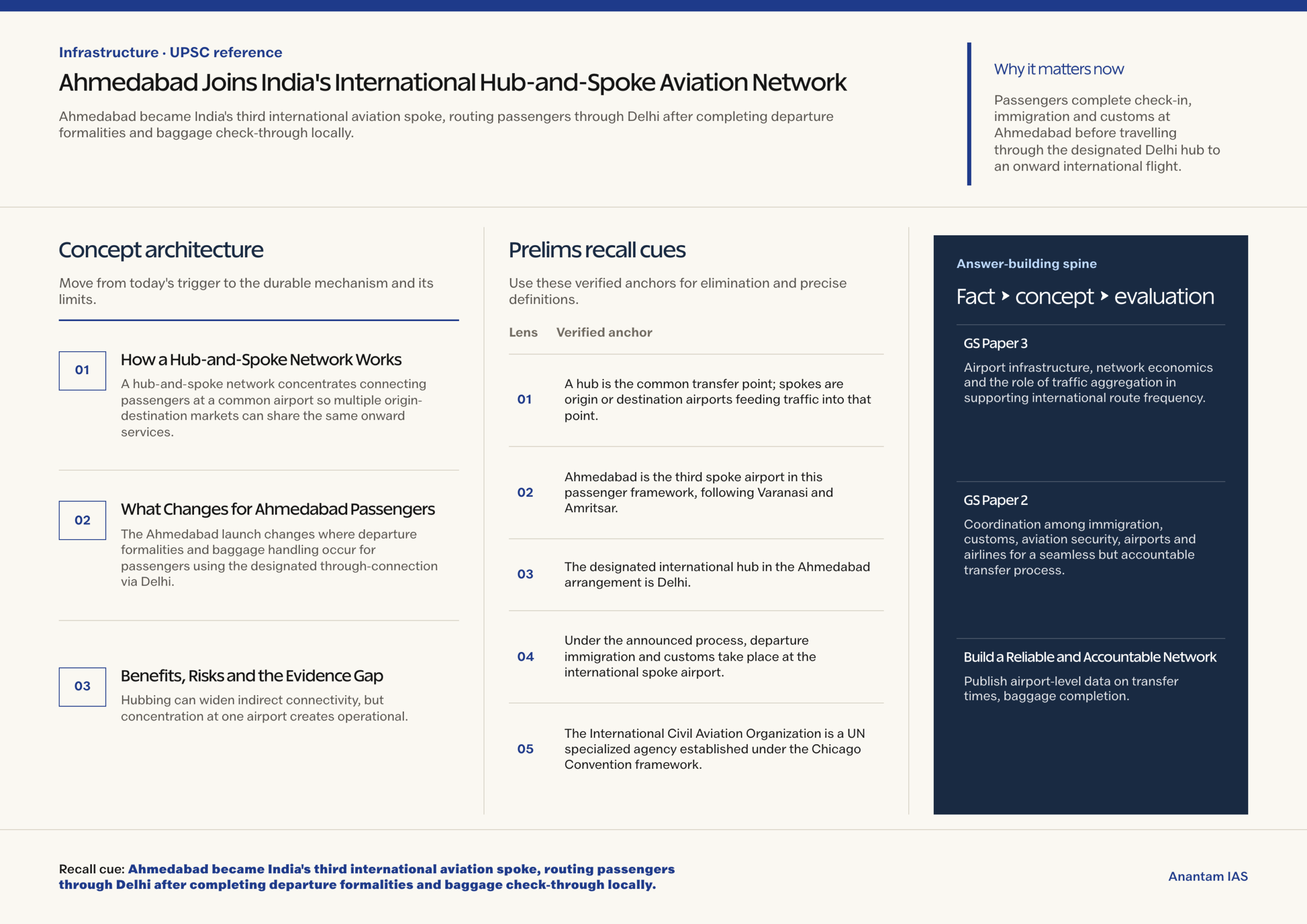
Ahmedabad Joins India’s International Hub-and-Spoke Aviation Network
Why in News?
On 1 September 2026, the Ministry of Civil Aviation launched international hub-and-spoke operations from Ahmedabad, making it the third spoke airport after Varanasi and Amritsar.
- Passengers complete check-in, immigration and customs at Ahmedabad before travelling through the designated Delhi hub to an onward international flight.
- Checked baggage is tagged through to the final international destination, so eligible connecting passengers need not reclaim it at Delhi.
- The Ministry says this phase is planned to extend to 22 more airports, including Surat; this is a forward plan, not an operating network today.
- Ministry studies project about 0.4 million jobs and USD 30 billion in additional GDP by 2030; these are estimates, not measured Ahmedabad outcomes.
- The model seeks to aggregate traffic from regional airports at an Indian hub, supporting international connections that individual spoke markets may not sustain alone.
- Its public-value test is whether shorter, reliable transfers reduce dependence on overseas transit hubs without weakening facilitation, security or border-control standards.
- The passenger initiative complements India’s separate work on secure cargo transshipment through Delhi, but the two processes govern different traffic and safeguards.
UPSC Relevance
Prelims Relevance
- A hub is the common transfer point; spokes are origin or destination airports feeding traffic into that point.
- Ahmedabad is the third spoke airport in this passenger framework, following Varanasi and Amritsar.
- The designated international hub in the Ahmedabad arrangement is Delhi.
- Under the announced process, departure immigration and customs take place at the international spoke airport.
- The International Civil Aviation Organization is a UN specialized agency established under the Chicago Convention framework.
Mains Relevance
GS Paper 3
- Airport infrastructure, network economics and the role of traffic aggregation in supporting international route frequency.
- Potential gains for tourism, trade and regional access, assessed against congestion, missed connections and concentration risk at the hub.
GS Paper 2
- Coordination among immigration, customs, aviation security, airports and airlines for a seamless but accountable transfer process.
- Distinguishing an operational launch from ministry projections and announced expansion plans in evidence-based policy evaluation.
Essay
- Infrastructure creates value when institutions make a network work as one system rather than as disconnected assets.
Background and Context
How a Hub-and-Spoke Network Works
A hub-and-spoke network concentrates connecting passengers at a common airport so multiple origin-destination markets can share the same onward services.
- Flights from several spoke airports feed passengers into a hub, where they transfer to services serving a wider set of domestic or international destinations on coordinated schedules.
- ICAO describes hubbing as arrivals and departures organized within a short period so traffic from one point can connect efficiently to flights serving numerous other points.
- By combining passengers from many city-pair markets, the hub can support a route or frequency that a single spoke’s demand may not make commercially viable on its own.
- Airlines commonly organize flights in banks or waves; poorly synchronized arrivals and departures create long waits, stranded passengers or missed connections instead of useful connectivity.
- This differs from a pure point-to-point network, which emphasizes direct links and avoids transfers but may offer fewer viable long-haul choices from smaller markets.
What Changes for Ahmedabad Passengers
The Ahmedabad launch changes where departure formalities and baggage handling occur for passengers using the designated through-connection via Delhi.
- Ahmedabad functions as an international spoke, not the central hub: passengers originate there, while the onward international connection and traffic aggregation are organized through Delhi.
- Check-in, departure immigration and customs are completed at Ahmedabad, placing border formalities before the feeder leg rather than during the Delhi transfer and reducing repeated processing.
- At Delhi, eligible passengers proceed to the onward international flight without repeating immigration or customs, while checked baggage moves through to the final destination under the transfer arrangement.
- The operational benefit depends on through-ticketing, baggage reconciliation and schedule coordination; the announcement should not be read as covering every itinerary or airline ticket sold from Ahmedabad.
- A comparable systems perspective appears in the debate over airport-airline coordination and competition safeguards, where integration benefits must be weighed against conflicts of interest.
Benefits, Risks and the Evidence Gap
Hubbing can widen indirect connectivity, but concentration at one airport creates operational, competitive and resilience trade-offs that projections alone cannot resolve.
- Regional passengers may gain more international choices through one coordinated transfer, while airlines gain a larger pooled market and steadier feeder demand for long-haul services that need scale.
- The hub must provide sufficient transfer capacity, baggage reliability and realistic minimum connection times; congestion, delay or disruption can propagate across many spokes at once.
- Concentrating traffic can strengthen a dominant airline or airport position, making transparent slot allocation, service standards and competition oversight important.
- Successful facilitation still requires immigration, customs and security agencies to maintain clear accountability; fewer repeated steps must not mean uncertain control responsibility.
- The jobs and GDP figures are scenario-based projections. Evaluation needs observed transfer volumes, completion rates, delays, missed connections, baggage outcomes and passenger experience after implementation.
Way Forward
Build a Reliable and Accountable Network
- Publish airport-level data on transfer times, baggage completion, missed connections and complaints so expansion decisions rest on observed performance.
- Coordinate flight banks with realistic minimum connection times and contingency capacity for weather, technical failures and peak-hour congestion at the hub.
- Define hand-offs among airlines, airport operators, immigration, customs and security agencies, with auditable procedures for through-passengers and baggage.
- Phase the proposed airport expansion against demand and operational readiness rather than treating inclusion in a plan as proof of a functioning connection.
Conclusion
- Ahmedabad’s launch is a concrete process integration: departure formalities and baggage check-through occur at the spoke, while Delhi supplies the wider international connection network.
- For policy analysis, separate that implemented arrangement from proposed airport expansion and macroeconomic forecasts, then judge success through connectivity, reliability, safeguards, competition and resilience.
UPSC Practice Questions
Prelims MCQ 1
With reference to the international hub-and-spoke operations launched from Ahmedabad, consider the following statements:
- Ahmedabad operates as a spoke and Delhi as the designated hub in the announced arrangement.
- Passengers complete departure immigration and customs at Ahmedabad before the feeder flight.
- The announced extension to 22 more airports had already become operational when Ahmedabad joined.
How many of the above statements are correct?
(a) Only one (b) Only two (c) All three (d) None
Answer: (b) Only two
Explanation:
Statements 1 and 2 are correct. The Ministry described extension to 22 more airports as the next phase, not as an already operational network.
Prelims MCQ 2
What is the central network-economic feature of a hub-and-spoke aviation system?
(a) Every spoke must have a direct flight to every other spoke (b) Traffic from several markets is combined at a common transfer point (c) International formalities are abolished for connecting passengers (d) Airport capacity ceases to affect route reliability
Answer: (b) Traffic from several markets is combined at a common transfer point
Explanation:
A hub aggregates traffic arriving from multiple spokes and redistributes it to onward flights. Formalities and capacity constraints remain; the model reorganizes connections rather than abolishing controls.
UPSC Mains Questions
- Explain how a hub-and-spoke aviation network can improve international connectivity from regional airports. What operational and regulatory safeguards determine its success?
- India’s aviation-hub ambitions should be judged by observed passenger outcomes rather than projections alone. Discuss with reference to the Ahmedabad launch.
Sources: PIB, Ministry of Civil Aviation and International Civil Aviation Organization.
Frequently Asked Questions
What is a hub-and-spoke aviation network?
It channels passengers from several spoke airports through a common hub, where coordinated onward flights can connect many markets while pooling demand for routes and frequencies.
Is Ahmedabad the international hub in this arrangement?
No. Ahmedabad is the third spoke airport in the framework, after Varanasi and Amritsar. Delhi is the designated hub for the announced onward international connections.
Where do Ahmedabad passengers complete immigration and customs?
Under the launched process, passengers complete check-in, departure immigration and customs at Ahmedabad, then transfer at Delhi without repeating immigration or customs for the onward international flight.
Are 22 additional spoke airports already operational?
No. The Ministry announced that connectivity would next extend to 22 more airports in this phase. That statement describes planned expansion, not completed implementation.
Are the jobs and GDP figures measured outcomes?
No. The Ministry attributed them to studies of potential aviation-hub development. They are projections and should not be presented as jobs created or GDP already added by Ahmedabad operations.
Source: https://anantamias.com/current-affairs/india-aviation-hub-spoke-ahmedabad/
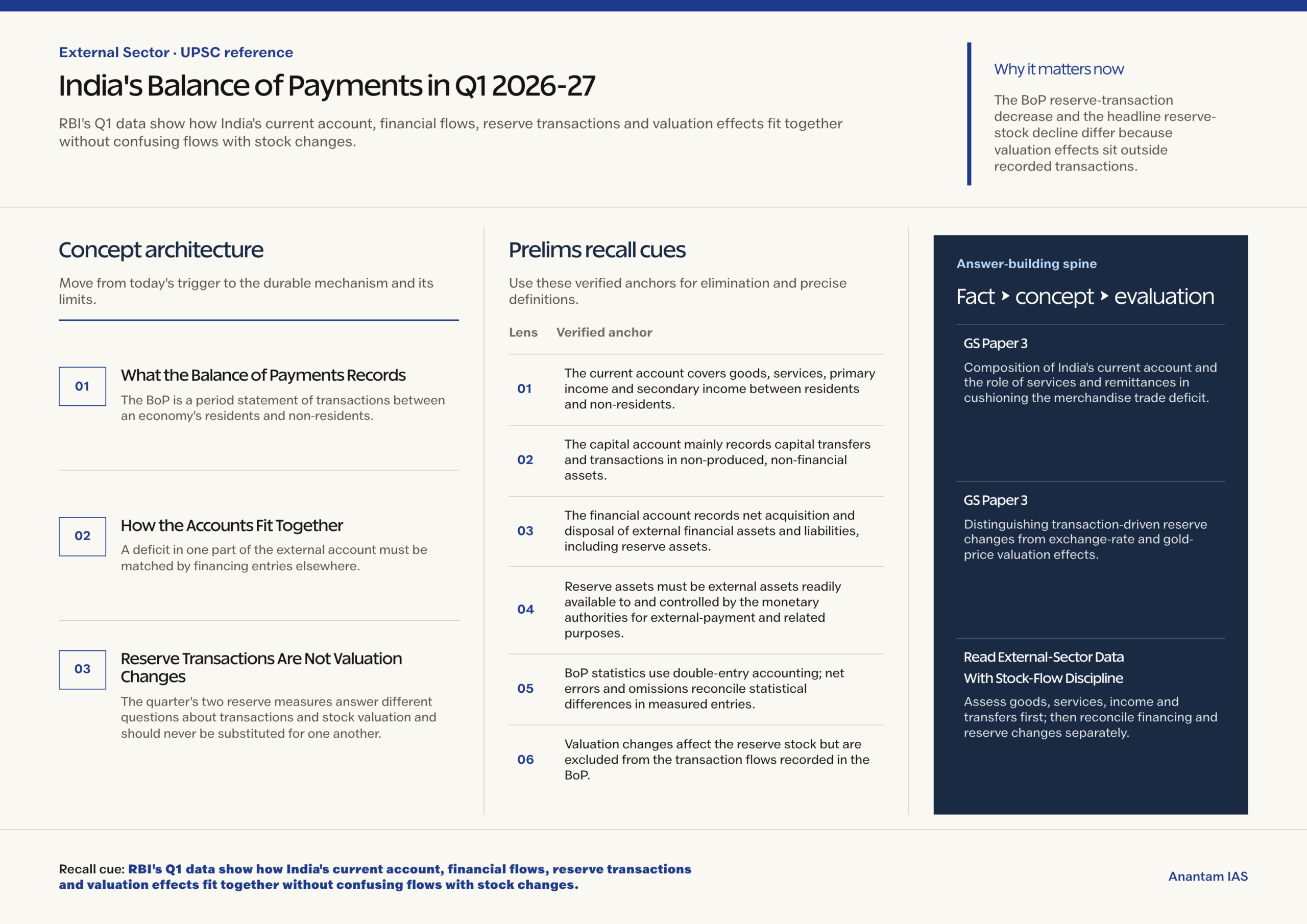
India’s Balance of Payments in Q1 2026-27
Why in News?
On September 1, the Reserve Bank of India released preliminary balance-of-payments data for April-June 2026 and separately explained the quarter’s change in foreign-exchange reserves.
- India recorded a current account deficit of US$4.2 billion, equal to 0.5 per cent of GDP, during Q1 2026-27.
- The merchandise trade gap widened, while stronger net services receipts and personal transfers partly cushioned the current account.
- On a BoP transaction basis, which excludes valuation effects, foreign-exchange reserves decreased by US$8.1 billion.
- The reserve stock fell by US$22.5 billion in nominal terms; a US$14.4 billion valuation loss explains the difference from the transaction measure.
- The releases show why a modest current account deficit cannot, by itself, explain the reserve movement: financial-account transactions and other recorded items also matter.
- They also expose a common analytical error: treating every change in the dollar value of reserves as a cross-border transaction or central-bank sale.
- The quarter should be read as an accounting map of external transactions, not as a single score of economic strength or weakness.
UPSC Relevance
Prelims Relevance
- The current account covers goods, services, primary income and secondary income between residents and non-residents.
- The capital account mainly records capital transfers and transactions in non-produced, non-financial assets.
- The financial account records net acquisition and disposal of external financial assets and liabilities, including reserve assets.
- Reserve assets must be external assets readily available to and controlled by the monetary authorities for external-payment and related purposes.
- BoP statistics use double-entry accounting; net errors and omissions reconcile statistical differences in measured entries.
- Valuation changes affect the reserve stock but are excluded from the transaction flows recorded in the BoP.
Mains Relevance
GS Paper 3
- Composition of India’s current account and the role of services and remittances in cushioning the merchandise trade deficit.
- Financing of external imbalances through financial flows and reserve-asset transactions.
GS Paper 3
- Distinguishing transaction-driven reserve changes from exchange-rate and gold-price valuation effects.
- Using stock-flow discipline and sign conventions when interpreting RBI external-sector releases.
Essay
- Good economic judgment begins by separating transactions from price-driven changes in the value of accumulated assets.
Background and Context
What the Balance of Payments Records
The BoP is a period statement of transactions between an economy’s residents and non-residents, organized through linked accounts.
- Its current account combines trade in goods and services with primary income, such as investment income, and secondary income, such as personal transfers.
- A current account deficit means payments for these current transactions exceed receipts during the period; it also corresponds to the economy’s saving-investment gap in macroeconomic accounting.
- The distinct capital account is usually narrower than everyday references to capital flows, covering capital transfers and non-produced, non-financial assets such as certain leases or licences.
- The financial account tracks transactions in direct investment, portfolio investment, derivatives, other investment and reserve assets through changes in external assets and liabilities.
- Every transaction has two entries under double-entry accounting, while net errors and omissions reconcile timing, coverage and measurement differences in real-world data.
How the Accounts Fit Together
A deficit in one part of the external account must be matched by financing entries elsewhere, subject to statistical discrepancies.
- The combined current and capital account balance represents the economy’s net lending to or borrowing from the rest of the world during the period.
- A current account deficit can be financed through greater external liabilities, lower external assets, or a combination; it does not automatically imply an equal reserve sale.
- In this quarter, net foreign direct investment remained positive while portfolio investment recorded a net outflow, illustrating why the composition and stability of financing matter.
- Reserve assets are readily available external assets controlled by monetary authorities; their transactions form part of the financial account and may reflect financing needs, market intervention or other official operations.
- RBI tables use stated sign conventions that can differ by presentation; readers should first check whether an increase in reserve assets appears with a positive or negative sign.
Reserve Transactions Are Not Valuation Changes
The quarter’s two reserve measures answer different questions about transactions and stock valuation and should never be substituted for one another.
- The BoP-basis change captures transactions in reserve assets and excludes gains or losses caused only by changing exchange rates, gold prices or other market prices.
- The nominal stock change compares the dollar value of reserve holdings across two dates, so it includes both transactions and valuation effects during the interval.
- RBI attributed the quarter’s valuation loss mainly to lower gold prices and appreciation of the US dollar against major currencies held in the reserve portfolio.
- Dollar appreciation can lower the reported dollar value of euro, sterling or yen assets without any sale; lower gold prices can similarly reduce the value of unchanged holdings.
- The identity for this release is practical: nominal reserve change equals the BoP-basis transaction change plus valuation change, allowing rounding differences.
Way Forward
Read External-Sector Data With Stock-Flow Discipline
- Assess the current account through the drivers of goods, services, income and transfers instead of treating the headline deficit as a standalone verdict.
- Examine the mix and maturity of financial flows because stable long-term financing and volatile portfolio flows carry different external-risk implications.
- Compare reserve adequacy with import cover and short-term external obligations, not merely with one quarter’s dollar change.
- State the measurement basis and sign convention whenever using reserve data, especially when comparing BoP transactions with weekly reserve-stock figures.
Conclusion
- India’s Q1 release is best understood as a linked external-account system: a contained current deficit, mixed financial flows and reserve transactions together produce the BoP outcome.
- In an answer, separate flows from stocks and transaction effects from valuation effects before drawing conclusions about reserve use, external vulnerability or policy pressure.
UPSC Practice Questions
Prelims MCQ 1
With reference to the balance of payments, consider the following statements:
- The current account includes trade in goods and services as well as primary and secondary income.
- The financial account records transactions in reserve assets.
- Exchange-rate valuation changes in reserve holdings are recorded as BoP transactions.
How many of the above statements are correct?
(a) Only one (b) Only two (c) All three (d) None
Answer: (b) Only two
Explanation:
Statements 1 and 2 are correct. Valuation changes alter the reserve stock but are excluded from BoP transaction flows.
Prelims MCQ 2
Which one of the following best explains why the nominal change in foreign-exchange reserves can differ from the change on a BoP basis?
(a) The nominal measure excludes reserve assets held by the monetary authority (b) The BoP measure includes only merchandise trade transactions (c) The nominal measure also reflects exchange-rate, gold-price and other valuation effects (d) The BoP measure treats every current account deficit as an equal reserve loss
Answer: (c) The nominal measure also reflects exchange-rate, gold-price and other valuation effects
Explanation:
The BoP-basis reserve change isolates transactions, while the change in the nominal reserve stock also includes valuation gains or losses.
UPSC Mains Questions
- Explain the accounting relationship among the current account, financial account and reserve assets in India’s balance of payments.
- Why must transaction-driven and valuation-driven changes in foreign-exchange reserves be separated when assessing external-sector vulnerability?
Sources: Reserve Bank of India, Balance of Payments and Reserve Bank of India, Sources of Reserve Variation.
Frequently Asked Questions
What does India’s current account include?
It includes transactions in goods, services, primary income and secondary income between residents and non-residents during the reporting period.
Does a current account deficit always reduce reserves by the same amount?
No. Financial inflows, changes in other external assets and liabilities, reserve transactions, and statistical discrepancies determine how the deficit is financed.
What is a BoP-basis change in foreign-exchange reserves?
It is the change attributable to transactions in reserve assets, excluding valuation effects caused by exchange rates, gold prices or other market-price movements.
Why did the two RBI reserve-change figures differ in Q1 2026-27?
The nominal reserve stock included a valuation loss, while the BoP-basis figure excluded valuation effects and measured only transactions.
What are net errors and omissions in the BoP?
They are the balancing item for timing, valuation, coverage and measurement differences that prevent independently collected credit and debit entries from matching exactly.
Source: https://anantamias.com/current-affairs/india-balance-payments-q1-2026-27/
Two Balance Sheets behind every E-Waste Decision
Context:
The routine replacement of computers, servers, batteries and networking equipment creates not merely waste but a valuable urban mine. Discarded electronics contain copper, aluminium, gold, silver, palladium and several critical minerals essential for renewable energy, electronics, defence and advanced manufacturing.
However, recycling them safely requires collection networks, secure data destruction, sophisticated recovery technology, pollution-control systems and traceable supply chains.
This produces a policy dilemma: should e-waste decisions be governed by the lowest immediate cost or by their wider strategic and environmental value?
| UPSC Relevance: GS-2 Polity and Governance: Govt policies; Urban governance; GS-3: Environment: Pollution, Conservation, E-waste recycling, Circular economy Prelims: e-waste in India (Key facts, Policies); E-Waste (Management) Rules, 2022 Mains: Challenges associated with e-waste & e-waste recycling |
What is E-Waste?
- Under the E-Waste (Management) Rules, 2022, e-waste includes:
- electrical and electronic equipment, including solar photovoltaic modules, panels or cells, discarded as waste wholly or partly, as well as waste arising from manufacturing, refurbishment and repair.
- Computers, mobile phones, televisions, refrigerators, air conditioners, washing machines, medical devices and communication equipment. However, waste batteries are governed separately by the Battery Waste Management Rules, 2022.
- E-waste has a dual character:
- Resource value: Copper, aluminium, iron, plastics, glass, gold, silver, palladium, indium and rare-earth elements.
- Hazardous content: Lead, mercury, cadmium, hexavalent chromium, polychlorinated biphenyls and brominated flame retardants.
Open burning, crude dismantling and acid leaching can release toxic fumes and contaminate soil and groundwater, exposing workers and nearby communities to neurological, respiratory, renal and developmental risks.
How large is India’s E-Waste Problem?
- India is generally identified as the third-largest e-waste generator globally, after China and the United States. However, different sources employ different definitions and estimation methods.
- Under CPCB’s notified-equipment methodology, India generated:
- 12.54 lakh tonnes in 2023-24, of which ~62% was reported as collected, dismantled, recycled or disposed of
- 13.98 lakh tonnes in 2024-25, of which 70.7% was reported as collected, dismantled, recycled or disposed of.
Registered recyclers, however, were present in only 19 States, indicating significant regional inequality in processing capacity.
Economics of Urban Mining:
Safe recovery of materials from e-waste involves substantial costs:
- collection, segregation and transportation
- secure destruction of sensitive data
- sophisticated mineral-recovery technology
- pollution-control systems; and
- traceable and environmentally compliant supply chains.
However, its benefits extend beyond the resale value of recovered metals. Urban mining can reduce virgin mining, lower import dependence, strengthen critical-mineral security and prevent toxic substances such as lead and mercury from contaminating air, soil and water.
The Two Balance Sheets:
- Every major e-waste decision creates two balance sheets:
- The financial balance sheet: Records immediate costs, resale value and budgetary savings. It is visible, measurable and auditable.
- The strategic balance sheet: Records long-term consequences for resource security, public health, data protection, domestic industrial capacity, environmental sustainability and supply-chain resilience.
- Procurement systems generally prioritise the first balance sheet by selecting the buyer or recycler offering the highest resale value or lowest processing cost.
- But this may ignore whether data is securely erased, functional equipment is refurbished before recycling, critical minerals are efficiently recovered, or hazardous residues are safely managed.
- Consequently, a small financial gain today may later reappear as cybersecurity risks, health expenditure, pollution remediation costs, import dependence, and reputational damage.
The experience of solar energy demonstrates that investments that initially appear costly may become economically transformative once scale, innovation and wider public benefits are considered.
Rethinking Procurement and EPR:
- Governments and businesses must move from the lowest acquisition cost to the lowest lifetime cost and greatest long-term public value. Procurement criteria should therefore assign weight to:
- refurbishment and extension of product life
- certified data destruction
- recovery efficiency for critical minerals
- end-to-end digital traceability
- environmental and labour standards; and
- technological capability of recyclers.
- The same principle applies to Extended Producer Responsibility (EPR). Purchasing the cheapest EPR certificate can encourage superficial compliance rather than high-quality recycling. Certificates should reflect the actual quantity and quality of material recovered, supported by independent audits.
Back to Basics:
India’s E-Waste Regulatory Framework:
The E-Waste (Management) Rules, 2022, framed under the Environment (Protection) Act, 1986, came into force on April 1, 2023. They cover 106 categories of electrical and electronic equipment.
Their major provisions include:
- mandatory CPCB portal registration of manufacturers, producers, refurbishers and recyclers
- prohibition on registered entities dealing with unregistered entities
- quarterly and annual compliance returns
- Extended Producer Responsibility targets
- generation and exchange of EPR certificates
- environmental compensation for non-compliance
- reduction of hazardous substances in electronic equipment; and
- audit, inspection and verification by CPCB or designated agencies.
How does EPR work?
- Under Extended Producer Responsibility, producers remain responsible for ensuring that a prescribed proportion of products placed in the market is ultimately recycled.
- Registered recyclers generate EPR certificates based on e-waste processed. Producers purchase these certificates to fulfil their obligations. The recycling targets rise progressively:
- 60% during 2023-24 and 2024-25
- 70% during 2025-26 and 2026-27
- 80% from 2027-28 onwards.
Refurbishment certificates can defer a producer’s recycling obligation by extending the useful life of equipment: reflecting the principle that reuse should precede recycling.
Whether India’s discarded electronics become a strategic resource or an environmental liability depends on decisions made today. The best decision is therefore not necessarily the cheapest one, but the one that leaves behind the smallest unpaid social, environmental and strategic bill.
UPSC PYQ 2018
Q. What are the impediments in disposing of the huge quantities of discarded solid wastes which are continuously being generated? How do we remove safely the toxic wastes that have been accumulating in our habitable environment?
Source: https://anantamias.com/current-affairs/two-balance-sheets-behind-every-e-waste-decision/
Robots to Combat Water Hyacinth in Vembanad Lake
Why in News?
Kumarakom, a major backwater destination on Kerala’s Vembanad Lake, will launch a one-month robotic water hyacinth removal pilot project.
- An unmanned surface vehicle fitted with a robotic harvesting mechanism will collect water hyacinth. The project will also examine its conversion into marketable products such as compost and handicrafts.
- The project is being undertaken by the State Wetland Authority, Kerala, with the Centre for Water Resources Development and Management (CWRDM) as the technical lead.
| UPSC Relevance: GS-3: Environment: Conservation, Invasive Species, Wetlands Prelims: Vembanad-Kol Wetland, Water Hyacinth |
About Vembanad-Kol Wetland:
- Vembanad is Kerala’s largest lake and part of the Vembanad-Kol wetland system. It is spread across Alappuzha, Kottayam, Ernakulam and Thrissur districts.
- The wetland includes freshwater and brackish-water zones, estuaries, canals, marshes and low-lying paddy fields.
- Ten rivers feed the system, including: Pamba, Meenachil, Manimala and Achankovil.
- The Vembanad-Kol Wetland, covering approximately 1,51,250 hectares, was designated a Ramsar Site in 2002.
- It supports fisheries, inland navigation, flood regulation, tourism and the below-sea-level agriculture of Kuttanad.

What is Water Hyacinth?
- Water hyacinth is a free-floating aquatic plant native to South America.
- Introduced outside its native habitat as an ornamental plant, it has become one of the world’s most damaging invasive aquatic weeds.
- It reproduces rapidly through vegetative offshoots and forms dense floating mats, especially in warm, slow-moving and nutrient-rich water.
- Its proliferation is aided by:
- untreated domestic sewage
- fertiliser-rich agricultural run-off
- organic and septic waste from settlements and tourism
- slow water circulation in canals
- siltation and narrowing of waterways; and
- hydrological alterations, including the operation of the Thanneermukkom barrage.
Thus, water hyacinth is not merely a weed problem; it is also an indicator of nutrient pollution and ecological imbalance.
Impacts of the Weed Invasion:
- Ecological impacts:
- Dense mats prevent sunlight from reaching submerged vegetation.
- They restrict air-water exchange and reduce dissolved oxygen.
- Decaying biomass further consumes oxygen, affecting fish and other aquatic organisms.
- They displace native aquatic plants and alter wetland food webs.
- Stagnant mats can provide breeding habitats for mosquitoes and other disease vectors.
- Livelihood impacts
- Fishing nets become entangled and fishing grounds inaccessible.
- Dense growth obstructs the movement of fishers and agricultural produce.
- Infestation affects paddy-dependent communities in north Kuttanad.
- Drinking-water collection and irrigation channels may become clogged.
- Transport and tourism:
- Hyacinth mats obstruct houseboats, ferries and smaller country boats. The weed becomes entangled in and damages the boat propellers. This affects commuters as well as Kumarakom’s houseboat, homestay and leisure-tourism economy.
Robotic Removal of Water Hyacinth:
The unmanned robotic system may offer several advantages:
- faster harvesting of dense mats
- reduced dependence on hazardous manual removal
- access to difficult or heavily infested areas
- repeated and geographically targeted operations
- reduced risk to boat operators; and
- systematic estimation of the biomass removed.
Conversion of the weed into marketable products:
The pilot can also test whether harvesting can support local livelihoods by converting the weed into:
- handicrafts and woven products
- paper, boards and packaging material
- compost and soil conditioners
- biogas, biochar and fuel briquettes.
Limitations of the Approach:
Robotic harvesting addresses the visible symptom rather than the underlying causes.
- Hyacinth can regenerate rapidly if nutrient pollution continues.
- Broken plant fragments may be dispersed to new areas during removal.
- Fresh biomass contains very high moisture, making transportation and drying expensive.
- Dumped biomass can produce foul odour, leachate and methane.
- Plants collected from polluted water may contain heavy metals or other contaminants. Their use as compost must therefore follow chemical testing.
- High equipment, maintenance and operating costs may constrain large-scale deployment.
- Creating a commercial market should not produce a perverse incentive to retain or cultivate the invasive weed.
Way Forward- Integrated Weed Management:
- Control nutrient inflows: Expand sewage and septage treatment and prevent waste discharge from settlements and houseboats.
- Reduce agricultural run-off: Promote balanced fertiliser use, vegetated buffer strips and sustainable farming in the catchment.
- Restore water circulation: Scientifically manage canals, siltation and barrage operations to improve flushing while protecting agriculture.
- Map infestations: Use drones, satellite imagery and community reporting for early detection and seasonal forecasting.
- Remove biomass continuously: One-time clearance should be replaced by scheduled removal before dense mats develop.
Long-term success requires combining technology with pollution control, hydrological restoration, biological management and community participation.
Source: https://anantamias.com/current-affairs/robots-to-combat-water-hyacinth-in-vembanad-lake/
The South’s Muted Voice as Political Power Shifts North
Context:
At the 31st Southern Zonal Council meeting, concerns were raised that population-based delimitation could reduce the relative political influence of southern States, despite their better performance in population control and human development.
| UPSC Relevance: GS-2 Polity and Governance: Federalism, Delimitation Prelims: Delimitation process, Delimitation Commission Mains: Delimitation: Need, Significance and Challenges; Centre-State relations |
Declining Southern Influence in National Politics:
- Although the national movement was led largely by leaders from northern, western and eastern India, leaders such as C. Rajagopalachari, T. Prakasam, K. Kamaraj, S. Nijalingappa and E.M.S. Namboodiripad ensured substantial southern participation in national politics.
- After Independence, national parties continued to produce influential southern leaders. However, only P.V. Narasimha Rao became a Prime Minister from southern India who completed a full five-year term.
- Much of the South’s subsequent influence came through regional leaders such as M.G. Ramachandran, Jayalalithaa, N.T. Rama Rao, H.D. Deve Gowda and N. Chandrababu Naidu. During the coalition era, regional parties exercised considerable influence over national policymaking. The return of strong parliamentary majorities and centralised party leadership has reduced this bargaining space.
The 2026 Legislative Attempt:
In April 2026, the government introduced proposals to:
- increase the Lok Sabha’s maximum strength from 550 to 850
- allow delimitation using the latest published Census, which would then have meant the 2011 Census
- operationalise women’s reservation through this exercise.
However, the 131st Constitutional Amendment Bill was defeated in the Lok Sabha in April 2026. Thus, the constitutional issue remains unresolved.
The Delimitation Question:
- At the Southern Zonal Council meeting, Karnataka sought the continuation of the 1971 Census as the basis for inter-State allocation of Lok Sabha seats for another 25 years. It also demanded that the strength of the Lok Sabha remain at 543 and that women’s reservation be implemented without altering the regional balance.
- However, the southern States did not present a completely united position. While some supported retaining the present distribution, others merely sought protection against any reduction in their existing proportional share. Differences over river waters, party politics and dependence on Union assistance have inhibited the emergence of a common southern platform.
Constitutional Background:
- Article 81 provides for allocation of Lok Sabha seats among States broadly according to population.
- Article 82 requires readjustment of parliamentary constituencies after every Census through parliamentary law.
- Article 170: Delimitation of State Assembly constituencies.
- The 42nd Amendment, 1976 froze inter-State allocation based on the 1971 Census to avoid penalising States implementing population control.
- The 84th Amendment, 2001 extended the freeze until publication of the first Census conducted after 2026.
- The 87th Amendment, 2003 allowed internal constituency boundaries to be readjusted using the 2001 Census without altering each State’s total seats.
- The 106th Amendment, 2023 links one-third reservation for women in legislatures to delimitation following the first Census after its commencement.
Delimitation and the Wider North-South Federal Unease:
- Demographic success and redistribution of political power:
- Southern States fear being penalised for successfully implementing national population-stabilisation policies. The latest SRS data show TFRs of 1.3 in Tamil Nadu and Kerala and 1.5 in Karnataka and Telangana, compared with 2.9 in Bihar and 2.6 in Uttar Pradesh.
- The five southern States currently hold 129 of 543 Lok Sabha seats. Under a population-based redistribution using the 2011 Census:
- Tamil Nadu could decline from 39 to 32 seats and Kerala from 20 to 15
- Uttar Pradesh could rise from 80 to 89, Bihar from 40 to 46, and Rajasthan from 25 to 30.
- Even if every State gains seats after expanding the Lok Sabha, the South’s relative share and bargaining power could decline.
- Weakening of the federal chamber: The 2026 proposal could have increased the Lok Sabha-Rajya Sabha ratio from approximately 2.2:1 to 3.3:1, without increasing the Rajya Sabha’s maximum strength of 250. This would strengthen the Lok Sabha during joint sittings and diminish the relative role of the Rajya Sabha in presidential and vice-presidential elections.
- Fiscal federalism: The five southern States’ combined share in divisible central taxes declined from approximately 17.98% under the 14th Finance Commission to 15.80% under the 15th. The 16th Finance Commission partially corrected this to about 17% by introducing a 10% weight for contribution to GDP and redefining demographic performance. Nevertheless, concerns remain because cesses and surcharges are excluded from the divisible pool.
- Weak federal dialogue and fragmented southern response: The Inter-State Council has met only 11 times since 1990, most recently in 2016, while the National Development Council last met in 2012. At the same time, disputes over the Cauvery, Krishna and Mullaperiyar waters, contrasting political alliances and varying dependence on Union assistance prevent southern States from developing a unified federal position.
However, a continued freeze also conflicts with “one person, one vote, one value.” Based on the 2011 population, a Bihar MP represented approximately 26 lakh people, compared with around 17 lakh for a Kerala MP. The dilemma is therefore between equal voting power for citizens and protection of States that achieved national demographic objectives.
Way Forward:
- Reach a consensus-based delimitation settlement that prevents any State from losing its existing representation or relative share during the next cycle.
- Develop a consensus formula combining population with demographic performance and federal balance.
- Expand or strengthen the Rajya Sabha alongside the Lok Sabha to prevent dilution of its federal role.
- Ensure an independent Delimitation Commission, transparent criteria, public hearings and safeguards against partisan gerrymandering.
- Delink women’s representation from avoidable federal disputes through a consensual constitutional route.
- Convene the Inter-State Council regularly and use it for advance consultation on delimitation.
- Continue rewarding demographic performance and economic contribution through Finance Commission transfers.
The concern over the South’s declining political influence is not merely a regional grievance. It concerns the balance between representative democracy and cooperative federalism.
A durable settlement must respect the equality of citizens while ensuring that States are not penalised for successfully achieving national development and population objectives.
Source: https://anantamias.com/current-affairs/the-souths-muted-voice-as-political-power-shifts-north/
Majority of India’s Gig Workers remain beyond the Welfare Net
Context: Despite a sharp rise in registrations on the e-Shram portal, only a small proportion of India’s rapidly growing gig and platform workforce has entered the government’s social-security database.
| UPSC Relevance: GS-2 Social Justice: Human Resources (Labour Welfare) Prelims: e-Shram portal, gig and platform workers, Code on Social Security, 2020. Mains: Informal employment, social security, digital economy and labour reforms. |
Who are Gig and Platform Workers?
The Code on Social Security, 2020 defines:
- Gig worker: A person earning through work arrangements outside the traditional employer-employee relationship. The above definition separates gig workers from both formal and informal categories.
- Platform worker: A person accessing work through an online platform, such as a food-delivery, ride-hailing, e-commerce or home-services application.
Thus, platform workers form the digitally mediated segment of the wider gig economy.
A Rapidly Growing Workforce:
NITI Aayog’s 2022 report, India’s Booming Gig and Platform Economy, estimated that:
- India had 77 lakh gig workers in 2020-21.
- Their number was projected to reach 1.43 crore in 2025-26 and 2.35 crore by 2029-30.
- By 2029-30, they could constitute 4.1% of India’s total workforce and 6.7% of its non-agricultural workforce.
However, these are indirect projections rather than results of a dedicated official survey.
The Registration Gap:
- The e-Shram portal, launched in 2021, is an Aadhaar-seeded National Database of Unorganised Workers. A separate aggregator module was introduced in 2024 to facilitate the onboarding of platforms and their workers.
- Registrations have accelerated, especially after the announcement of healthcare benefits. Around 10.8 lakh platform workers are registered by July 2026.
Nevertheless, this represents only about 7% of NITI Aayog’s projected gig workforce for 2026-27. The comparison is indicative because e-Shram primarily counts registered platform workers, while NITI Aayog’s estimate covers the broader gig economy.
Uneven State-wise Registration:
- As of January 2026, Maharashtra, Uttar Pradesh and Bihar recorded the highest registrations. In contrast, highly urbanised States such as Tamil Nadu, Telangana and Kerala recorded relatively low numbers. This suggests that e-Shram registrations may reflect awareness, administrative mobilisation and aggregator cooperation, rather than the actual geographical distribution of gig work.
- Registrations were concentrated in:
- food-related services: 32.8%
- automobile and transportation: 25.4%
- domestic and household work
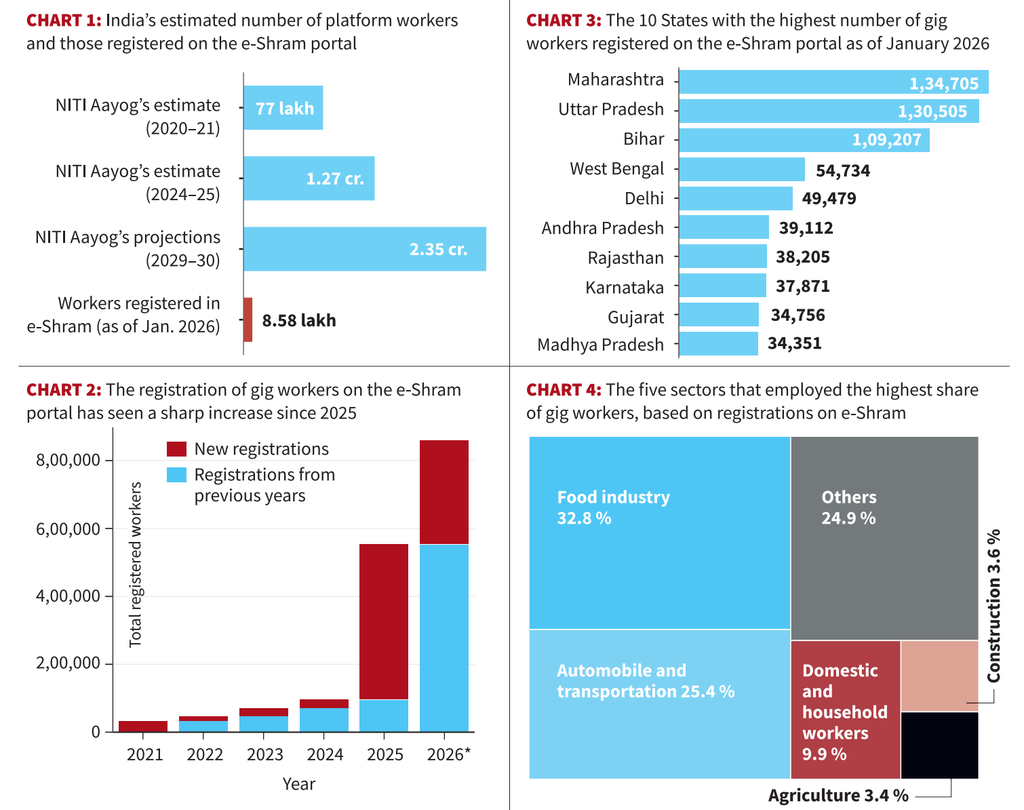
Existing Social-Security Framework:
- The Union Budget 2025-26 announced:
- identity cards and e-Shram registration for online platform workers
- healthcare coverage under Ayushman Bharat-PM Jan Arogya Yojana, providing up to ₹5 lakh per family annually for secondary and tertiary hospitalisation
- An expected coverage of nearly one crore workers.
- The Code on Social Security, 2020, which came into force in 2025, provides for life and disability cover, accident insurance, health and maternity benefits, old-age protection and a dedicated Social Security Fund. Aggregators may be required to contribute 1-2% of their annual turnover, subject to a ceiling of 5% of the amount paid or payable to gig and platform workers.
However, many benefits depend upon the formulation and effective implementation of individual schemes.
Why do Gig Workers Remain Outside the System?
- Voluntary registration: Workers must register themselves or depend on aggregators to upload their information.
- High workforce churn: Workers frequently enter or exit platforms and may work simultaneously for several applications.
- Digital barriers: Aadhaar-linked mobile numbers, bank details and inaccurate occupational classification can impede registration.
- Weak incentive: Workers may not register when the benefits promised through e-Shram remain uncertain or are still being operationalised.
- Narrow platform focus: Freelancers and non-platform gig workers may remain outside aggregator-based registration.
- Data limitations: Multiple accounts can create duplication, while inactive, part-time and seasonal workers are difficult to classify.
The Periodic Labour Force Survey does not yet identify gig workers as a separate category. Most official estimates continue to rely on NITI Aayog’s 2022 report.
Challenges Beyond Registration:
Registration alone cannot address deeper problems such as:
- Employment ambiguity: Independent-contractor status excludes workers from many wage, working-hour and labour protections.
- Income insecurity: Piece-rate earnings are low, unstable and lack minimum earning guarantees.
- Cost shifting: Workers bear vehicle, fuel, maintenance, smartphone, data and insurance expenses.
- Health and safety risks: Long hours, fatigue and delivery deadlines increase accidents and occupational stress.
- Algorithmic control: Opaque algorithms determine work allocation, incentives, ratings and penalties.
- Arbitrary deactivation: Accounts may be suspended without explanation, human review or effective appeal.
- Weak collective voice: Workers lack collective bargaining rights and effective grievance-redressal mechanisms.
- Limited social security: Accident cover, maternity benefits, pensions and paid leave remain inadequate.
- Unequal access: Women and persons with disabilities face safety, mobility, asset and accessibility barriers.
Way Forward:
- Make aggregator-assisted registration automatic and portable across platforms and States.
- Introduce a dedicated gig-work module in the PLFS and require platforms to submit anonymised workforce data.
- Adopt NITI Aayog’s RAISE framework: Recognise diverse work arrangements; Allow innovative financing; Incorporate stakeholder interests; Support enrolment; and Ensure easy access to benefits.
- Prescribe transparent payment structures and minimum earning standards after deducting work-related expenses.
- Provide universal accident insurance, maternity support, disability cover and pension options.
- Ensure algorithmic transparency, human review of automated decisions and a right to appeal against deactivation.
- Discourage unsafe delivery deadlines and include platform work within occupational-safety standards.
- Launch a Platform India initiative, similar to Start-up India, to support skilling, financial inclusion and micro-entrepreneurship.
- Promote collaboration between platforms, the Ministry of Skill Development, NSDC and civil-society organisations, particularly for women and persons with disabilities.
India has legally recognised gig workers, but most remain statistically and socially invisible. The objective must move beyond merely counting workers to providing portable, enforceable and adequately financed social security suited to the realities of platform-based employment.
Source: https://anantamias.com/current-affairs/majority-of-indias-gig-workers-remain-beyond-the-welfare-net/
Untouchability and the idea of Purity
Context:
A shuddhikaran or purification ritual was performed at Haldwani’s Ramlila ground, two days after Congress president Mallikarjun Kharge, a Dalit leader, addressed a rally there.
Mr. Kharge alleged that the act reflected untouchability, while the organisers claimed that it concerned slogans and political remarks made during the rally, not his caste.
The controversy raises a significant constitutional question: when does symbolic “purification” become caste-based untouchability?
| UPSC Relevance: GS-2 Polity and Governance: Fundamental Rights Prelims: Article 17, Protection of Civil Rights Act, 1955, SC/ST Act Mains: Fundamental Rights, social justice, caste discrimination and constitutional morality. |
How does Indian Law Address Untouchability?
1. Article 17 of the Indian Constitution:
- Article 17:
- abolishes untouchability;
- prohibits its practice in any form; and
- makes the enforcement of any resulting disability punishable by law.
- Unlike most Fundamental Rights, Article 17 operates horizontally against private individuals as well as the State.
However, the Constitution deliberately does not define untouchability, allowing courts to address its evolving manifestations.
2. Protection of Civil Rights Act, 1955:
- Parliament initially enacted the Untouchability (Offences) Act, 1955, which was strengthened and renamed the Protection of Civil Rights Act in 1976. It punishes:
- denial of entry into temples and public places
- discrimination in shops, services, hospitals and educational institutions
- enforcement of social or religious disabilities
- justification or encouragement of untouchability; and
- under Section 7(1)(d), insulting an SC member “on the ground of untouchability”.
- Thus, physical exclusion is not essential. A symbolic act implying that a person’s touch or presence causes pollution may also attract the law.
However, merely insulting an SC person is insufficient: the insult must have a demonstrable connection with untouchability.
3. SC/ST (Prevention of Atrocities) Act, 1989:
- The Protection of Civil Rights Act specifically addresses untouchability, while the SC/ST Act covers a wider range of caste-based atrocities.
- Under Section 3(1)(r) of the SC/ST Act, a non-SC/ST person commits an offence by:
- intentionally insulting or intimidating an SC/ST member
- intending to humiliate the person
- because of their protected identity; and
- doing so at a place within public view.
Judicial Rulings:
- In Sukanya Shantha v. Union of India (2024), the Supreme Court struck down caste-discriminatory provisions in prison manuals that assigned work and segregated prisoners according to caste. The Court observed that untouchability is rooted in the caste system and its interconnected notions of purity and pollution. Article 17 rejects practices that stigmatise a person’s touch, presence or existence. It consequently held that Article 17 must therefore be interpreted broadly enough to address indirect and symbolic forms of caste exclusion, not merely the traditional denial of physical access.
- In Surya Narayan Choudhary v. State of Rajasthan (1988), Dalit devotees visiting the Shrinathji Temple at Nathdwara were reportedly required to undergo purification through sprinkling of Gangajal, wearing a kanthimala and receiving tulsidal. The Rajasthan High Court ordered the practice to be discontinued because this additional condition applied only to Dalits. It held that the practice violated Articles 14, 15 and 17.
- In Hitesh Verma v. State of Uttarakhand (2020), the Supreme Court clarified that every insult directed at an SC/ST person is not an atrocity unless it is connected with their caste identity.
- In Gunjan v. State (NCT of Delhi), 2026, the Supreme Court reiterated that public view is an indispensable ingredient under Sections 3(1)(r) and 3(1)(s).
The term shuddhikaran by itself neither establishes nor rules out untouchability. Religious rituals may have varied purposes; they become constitutionally objectionable when selectively used to suggest that a person or community is inherently polluting.
The decisive legal question is therefore not simply whether purification occurred, but whether it was motivated by caste-based notions of purity and pollution.
Source: https://anantamias.com/current-affairs/untouchability-and-the-idea-of-purity/
India’s Data Centre Boom meets its Climate Reality
Context:
India’s rapidly expanding data-centre industry is attracting large investments and strengthening its digital sovereignty. However, its growing demand for electricity, water and land could intensify grid congestion, water scarcity and urban heat unless supported by enforceable sustainability standards.
| UPSC Relevance: GS-3 Economy: Critical Infrastructure; GS-3 Environment: Energy Trasition; Climate-resilient urbanisation Prelims: Data centres and cooling technologies. Mains: Digital infrastructure, energy transition, water security and climate-resilient urbanisation. |
Why are Data Centres Important?
- Data centres are specialised facilities that store, process, and manage digital information, forming the backbone of cloud computing, artificial intelligence (AI), fintech, e-commerce, and digital governance.
- Data centres house servers, storage and networking equipment required to process and store digital information. Their expansion is being driven by:
- Artificial intelligence and cloud computing
- Digital India, UPI, e-commerce, 5G and Internet of Things
- RBI’s payment-data localisation requirements
- Cybersecurity and strategic data sovereignty
- Demand for low-latency digital services.
They generate investment, support digital businesses and provide the infrastructure necessary for India’s emerging AI economy.
Rapid Expansion:
- India’s installed data-centre capacity increased from around 375-520 MW in 2020 to nearly 1.5 GW in 2025. It is estimated to reach 4.5-6.5 GW by 2030. Committed investments during 2019-25 were estimated at approximately $95 billion.
However, the economic opportunity carries high environmental and infrastructural costs.
Major Sustainability Challenges:
- Rising electricity demand: Data centres require uninterrupted electricity for servers, cooling and backup systems. The Ministry of Power estimates their electricity demand could reach 13.56 GW by 2031-32. If this demand is met through coal-based power or diesel generators, it could increase emissions and undermine India’s climate commitments.
- Transmission bottlenecks: Renewable capacity is being added faster than the grid’s ability to transmit it. India reportedly curtailed nearly 300 GWh of renewable electricity in the first quarter of 2026 because of transmission constraints, while meeting only around 80% of its transmission-expansion targets in recent years.
- Large water footprint: Water is used directly in cooling and indirectly in electricity generation. One estimate cited by CEEW places India’s data-centre water use at around 150 billion litres in 2025, potentially more than doubling by 2030. Clustering facilities around water-stressed cities such as Mumbai, Hyderabad, Bengaluru and the National Capital Region could create competition with domestic and agricultural users.
- Local heat generation: Servers convert most of the electricity they consume into heat, which must be released into the surrounding environment. A 2026 remote-sensing preprint reported an average rise of about 2°C in land-surface temperature around selected AI hyperscale centres.
- Climate vulnerability: Data centres themselves face risks from heatwaves, urban floods, coastal storms and water shortages. Higher ambient temperatures increase cooling requirements, creating a feedback loop of greater power consumption and waste-heat generation.
- Wider environmental footprint: Data centres also generate electronic waste, require land and construction materials, use refrigerants and depend on batteries and diesel generators for backup power.
Governance Gap:
- India does not yet have a binding national data-centre sustainability framework. Around 15 States have introduced dedicated or related policies, but CEEW found that only five explicitly contained sustainability provisions.
- Most State policies emphasise tax and stamp-duty exemptions, concessional land and electricity, transmission-charge waivers, uninterrupted power and fast-track clearances. Requirements relating to water disclosure, renewable energy sourcing, grid impact assessments and thermal effects remain uneven.
- Gujarat’s 2026 policy requires eligible projects to source at least 51% electricity from renewable energy, while Maharashtra reduced its earlier green-power requirement from 100% to 51%.
General groundwater and environmental regulations continue to apply, but data centres require sector-specific standards reflecting their concentrated and continuous resource demand.
Way Forward:
- National sustainability framework: Establish enforceable standards for energy, water, emissions, e-waste and thermal impacts.
- Mandatory disclosure: Require public reporting of electricity use, water sources, carbon emissions and backup fuel consumption.
- Efficiency benchmarks: Prescribe limits based on Power Usage Effectiveness (PUE) and Water Usage Effectiveness (WUE).
- Climate-sensitive siting: Assess water stress, grid capacity, heat, flooding, seismic risk and proximity to renewable energy sources before approval.
- Cleaner cooling: Promote treated wastewater, closed-loop systems, dry cooling, direct-to-chip liquid cooling and immersion cooling.
- Round-the-clock clean power: Combine solar and wind with battery storage, pumped storage and demand response instead of relying merely on annual renewable energy certificates.
- Grid-cost accountability: Large users should bear an appropriate share of dedicated transmission and storage costs so that these are not transferred to ordinary electricity consumers.
- Flexible computing: Non-urgent computational workloads can be shifted to periods of high renewable generation or lower grid demand.
- Circular economy: Encourage longer server life, refurbishment, recovery of critical minerals and scientific disposal of electronic waste.
Data centres are indispensable to India’s digital and AI ambitions. The choice is not between digitalisation and environmental protection, but between unplanned expansion and climate-resilient digital infrastructure.
Practice Question:
Q. Examine the locational advantages and constraints for developing a world-class data centre industry in India. How can renewable energy integration address the sustainability and energy security challenges faced by this sector? (15)
Source: https://anantamias.com/current-affairs/indias-data-centre-boom-meets-its-climate-reality/
SC seeks Centre’s response on use of EVM Totalisers
Why in News?
The Supreme Court has sought the Union government’s response on introducing totaliser machines for counting votes recorded in Electronic Voting Machines (EVMs).
The proposal seeks to conceal polling-station-wise voting patterns and protect communities from intimidation, discrimination or post-election reprisals. The Election Commission of India (ECI), however, has raised legal, technical and transparency concerns.
| UPSC Relevance: GS-2 Polity and Governance: Electoral reforms, Election Commission Prelims: EVM Totalisers Mains: Electoral reforms, Right to privacy, free and fair elections. |
What is a Totaliser?
- A totaliser connects the control units of several EVMs and displays only the consolidated votes received by each candidate. Unlike the present system, it does not publicly disclose how voters at a particular polling station voted.
- It protects locational or community anonymity, although the existing EVM system already maintains the secrecy of each individual vote.
Why are Totalisers Proposed?
- Protection against reprisals: Booth-wise results may enable candidates to identify villages or neighbourhoods that voted against them and allegedly discriminate in welfare delivery or development works.
- Protection of vulnerable communities: Voting patterns in small or socially homogeneous booths may indirectly reveal the political preference of particular caste, religious or tribal groups.
- Free voter choice: Greater anonymity can reduce intimidation, vote-buying and pressure from locally dominant groups.
- Parity with paper ballots: Rule 59A of the Conduct of Elections Rules, 1961, permits ballot papers from different booths to be mixed where intimidation or victimisation is apprehended.
- Institutional support: The ECI proposed totalisers in 2008. The 255th Law Commission Report (2015) subsequently endorsed their selective use where intimidation or victimisation was feared.
Concerns Raised by the Election Commission:
- Absence of a legal framework: Neither the Representation of the People Act, 1951 nor the Conduct of Elections Rules presently regulates totaliser-based counting.
- Reduced auditability: Form 17C currently allows candidates and their agents to match the votes recorded at each polling station with the corresponding EVM result.
- Masking of errors: Aggregation may make it difficult to identify a malfunction, procedural mistake or discrepancy associated with an individual EVM.
- VVPAT reconciliation: The system must preserve the linkage between every EVM and its VVPAT slips for verification and election disputes.
- Public confidence: Introducing another device amid existing doubts about EVMs may create fresh allegations unless its operation is transparent.
- Political opposition: According to the ECI, half the national parties and around 68% of the consulted State parties opposed the proposal.
Constitutional Dimensions:
- Article 324 entrusts the ECI with the superintendence, direction and control of elections.
- Sections 94 and 128 of the Representation of the People Act, 1951 protect voting secrecy.
- The Supreme Court has recognised the secret ballot as integral to free and fair elections and the voter’s freedom of expression under Article 19(1)(a).
However, electoral integrity also requires transparency, verifiability and access to evidence for candidates and election tribunals. Thus, the issue is not simply secrecy versus disclosure, but community anonymity versus machine-level auditability.
Way Forward:
- Amend the Conduct of Elections Rules to create a Rule 59A-like provision for EVMs.
- Initially employ totalisers only in constituencies where intimidation, communal tension or post-poll victimisation is credibly apprehended.
- Publish consolidated results while preserving booth-wise Form 17C and EVM data confidentially for authorised audits and judicial scrutiny.
- Complete EVM-VVPAT verification before votes are aggregated.
- Mandate independent technical certification, mock demonstrations, audit logs and candidate-agent participation.
- Constitute clusters through transparent or random criteria to prevent politically motivated grouping.
- Undertake pilot projects and build all-party confidence before nationwide adoption.
Totalisers can strengthen the substantive secrecy of elections by preventing the political profiling of neighbourhoods and communities. However, voter privacy cannot come at the cost of verifiable counting.
A legally regulated, selectively deployed and fully auditable totaliser system can reconcile the two essential foundations of electoral democracy: a fearless voter and a transparent count.
Source: https://anantamias.com/current-affairs/sc-seeks-centres-response-on-use-of-evm-totalisers/
Over 7200 CBI cases under Prevention of Corruption Act pending trial
Context:
The Central Vigilance Commission’s Annual Report 2025 shows that 7229 Prevention of Corruption (PC) Act cases investigated by the CBI were pending trial as of December 31, 2025. Of these, 409 had remained pending for over 20 years.
| UPSC Relevance: GS-2 Polity and Governance: Statutory Bodies, Transparency and accountability in governance. Prelims: Central Vigilance Commission, Prevention of Corruption Act Mains: Anti-corruption framework, transparency and accountability in governance. |
Major Findings of the CVC’s Report:
- Pending trials: 7229 PC Act cases, including 2447 pending for 10-20 years and 409 for over 20 years.
- Appellate backlog: 14,083 appeals, revisions and writ petitions were pending before High Courts and the Supreme Court; over 5200 were more than ten years old.
- Overall pendency: Including non-PC Act offences, 11,510 CBI cases were under trial.
- Improved conviction: CBI’s conviction rate increased from 69.14% in 2024 to 71.71% in 2025.
- Investigation pendency: Of 679 regular corruption cases awaiting investigation, 274 had crossed one year.
- Staff shortage: Against a sanctioned CBI strength of 7300, nearly 15% were vacant, including 672 executive posts.
Thus, a high conviction rate indicates reasonably effective prosecution in completed cases, but the enormous backlog considerably delays final accountability.
Prevention of Corruption Act, 1988: Key Provisions:
The Act is India’s principal legislation against corruption involving public servants. It was substantially amended in 2018.
- Section 7: Punishes a public servant for accepting or attempting to obtain an “undue advantage”.
- Section 8: Criminalises giving or promising a bribe, while protecting persons compelled to pay who report it within seven days.
- Section 9: Makes commercial organisations liable for bribing public servants.
- Section 13: Covers criminal misconduct, including misappropriation and illicit enrichment by public servants.
- Section 17A: Generally requires prior government approval before investigating official decisions, except in trap cases involving acceptance of bribes.
- Section 19: Requires sanction from the competent authority before prosecuting a public servant.
- Special Judges: PC Act offences are tried by specially designated judges.
- Time limit: Trials should ordinarily be completed within two years; recorded extensions should generally not take the total beyond four years.
The existence of cases pending for over two decades contrasts sharply with this statutory objective.
Why do Cases Remain Pending?
- Judicial backlog: Insufficient Special Courts and judges delay trials and appeals.
- Institutional vacancies: Shortages of investigators, prosecutors, forensic experts and support staff slow investigation and prosecution.
- Delayed sanctions: The report recorded 521 prosecution-sanction requests in 201 cases pending with 51 government departments.
- Complex investigations: Bank frauds, disproportionate-assets cases and procurement scams involve voluminous records and digital evidence.
- Overseas evidence: Responses to Letters Rogatory and mutual legal-assistance requests can take years.
- Procedural delays: Frequent adjournments, interlocutory applications, stays and successive appeals prolong proceedings.
- Witness-related problems: Witnesses may retire, relocate, die or become unavailable during prolonged trials.
- Safeguard-accountability tension: Prior approval protects honest officials from vexatious investigations but may also delay legitimate inquiries.
Consequences:
- Weakens the deterrent effect of anti-corruption law.
- Erodes public confidence in investigative and judicial institutions.
- Increases the possibility of evidence degradation and witness hostility.
- Delays confiscation and recovery of illegally acquired assets.
- Violates the right to a speedy trial under Article 21.
- Causes prolonged reputational and professional harm to officials who may eventually be acquitted.
Thus, delay harms both the fight against corruption and the rights of the accused.
About the Central Vigilance Commission:
- Created in 1964 on the recommendations of the Santhanam Committee.
- Accorded statutory status through the Central Vigilance Commission Act, 2003.
- Exercises superintendence over CBI investigations under the PC Act.
- Reviews vigilance administration and advises Union government organisations.
- It is primarily a supervisory and advisory body; investigation and prosecution remain with agencies such as the CBI.
Way Forward:
- Establish more exclusive Special Courts and prioritise cases according to age.
- Fill CBI, prosecution and forensic vacancies through time-bound recruitment.
- Introduce digital tracking of investigation, sanction, trial and appeal stages.
- Ensure reasoned, time-bound decisions under Sections 17A and 19.
- Conduct day-to-day trials and restrict unnecessary adjournments.
- Strengthen international cooperation for obtaining evidence and recovering assets.
- Publish department-wise dashboards on pending investigations and sanctions.
- Complement prosecution with preventive measures such as e-procurement, audit trails, whistle-blower protection and transparent public-service delivery.
The effectiveness of an anti-corruption system cannot be measured merely by complaints registered or conviction rates. It must also be judged by how quickly investigations, trials and appeals reach finality.
