Why in News?
On 1 September 2026, the Ministry of Civil Aviation launched international hub-and-spoke operations from Ahmedabad, making it the third spoke airport after Varanasi and Amritsar.
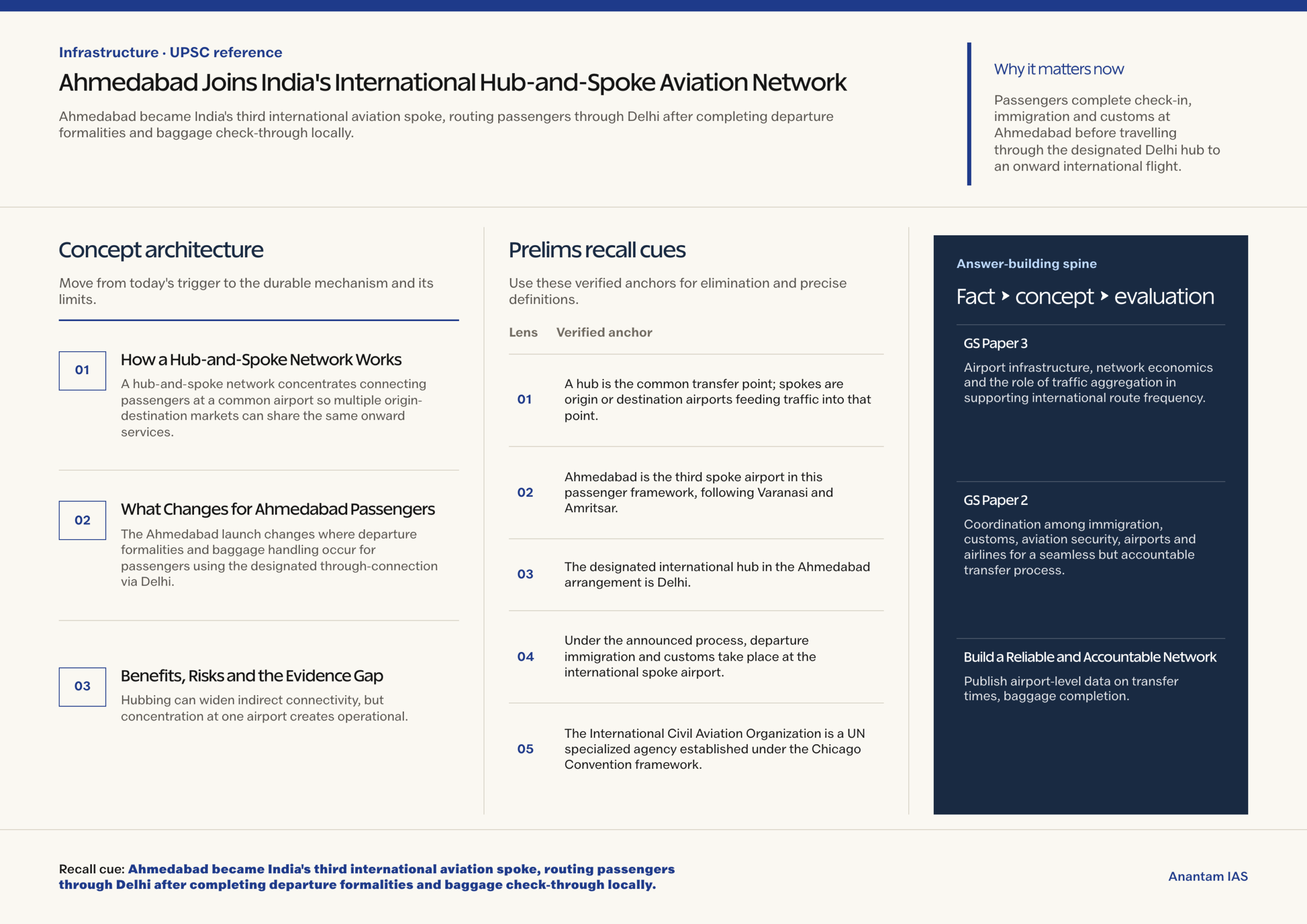
- Passengers complete check-in, immigration and customs at Ahmedabad before travelling through the designated Delhi hub to an onward international flight.
- Checked baggage is tagged through to the final international destination, so eligible connecting passengers need not reclaim it at Delhi.
- The Ministry says this phase is planned to extend to 22 more airports, including Surat; this is a forward plan, not an operating network today.
- Ministry studies project about 0.4 million jobs and USD 30 billion in additional GDP by 2030; these are estimates, not measured Ahmedabad outcomes.
- The model seeks to aggregate traffic from regional airports at an Indian hub, supporting international connections that individual spoke markets may not sustain alone.
- Its public-value test is whether shorter, reliable transfers reduce dependence on overseas transit hubs without weakening facilitation, security or border-control standards.
- The passenger initiative complements India’s separate work on secure cargo transshipment through Delhi, but the two processes govern different traffic and safeguards.
UPSC Relevance
Prelims Relevance
- A hub is the common transfer point; spokes are origin or destination airports feeding traffic into that point.
- Ahmedabad is the third spoke airport in this passenger framework, following Varanasi and Amritsar.
- The designated international hub in the Ahmedabad arrangement is Delhi.
- Under the announced process, departure immigration and customs take place at the international spoke airport.
- The International Civil Aviation Organization is a UN specialized agency established under the Chicago Convention framework.
Mains Relevance
GS Paper 3
- Airport infrastructure, network economics and the role of traffic aggregation in supporting international route frequency.
- Potential gains for tourism, trade and regional access, assessed against congestion, missed connections and concentration risk at the hub.
GS Paper 2
- Coordination among immigration, customs, aviation security, airports and airlines for a seamless but accountable transfer process.
- Distinguishing an operational launch from ministry projections and announced expansion plans in evidence-based policy evaluation.
Essay
- Infrastructure creates value when institutions make a network work as one system rather than as disconnected assets.
Background and Context
How a Hub-and-Spoke Network Works
A hub-and-spoke network concentrates connecting passengers at a common airport so multiple origin-destination markets can share the same onward services.
- Flights from several spoke airports feed passengers into a hub, where they transfer to services serving a wider set of domestic or international destinations on coordinated schedules.
- ICAO describes hubbing as arrivals and departures organized within a short period so traffic from one point can connect efficiently to flights serving numerous other points.
- By combining passengers from many city-pair markets, the hub can support a route or frequency that a single spoke’s demand may not make commercially viable on its own.
- Airlines commonly organize flights in banks or waves; poorly synchronized arrivals and departures create long waits, stranded passengers or missed connections instead of useful connectivity.
- This differs from a pure point-to-point network, which emphasizes direct links and avoids transfers but may offer fewer viable long-haul choices from smaller markets.
What Changes for Ahmedabad Passengers
The Ahmedabad launch changes where departure formalities and baggage handling occur for passengers using the designated through-connection via Delhi.
- Ahmedabad functions as an international spoke, not the central hub: passengers originate there, while the onward international connection and traffic aggregation are organized through Delhi.
- Check-in, departure immigration and customs are completed at Ahmedabad, placing border formalities before the feeder leg rather than during the Delhi transfer and reducing repeated processing.
- At Delhi, eligible passengers proceed to the onward international flight without repeating immigration or customs, while checked baggage moves through to the final destination under the transfer arrangement.
- The operational benefit depends on through-ticketing, baggage reconciliation and schedule coordination; the announcement should not be read as covering every itinerary or airline ticket sold from Ahmedabad.
- A comparable systems perspective appears in the debate over airport-airline coordination and competition safeguards, where integration benefits must be weighed against conflicts of interest.
Benefits, Risks and the Evidence Gap
Hubbing can widen indirect connectivity, but concentration at one airport creates operational, competitive and resilience trade-offs that projections alone cannot resolve.
- Regional passengers may gain more international choices through one coordinated transfer, while airlines gain a larger pooled market and steadier feeder demand for long-haul services that need scale.
- The hub must provide sufficient transfer capacity, baggage reliability and realistic minimum connection times; congestion, delay or disruption can propagate across many spokes at once.
- Concentrating traffic can strengthen a dominant airline or airport position, making transparent slot allocation, service standards and competition oversight important.
- Successful facilitation still requires immigration, customs and security agencies to maintain clear accountability; fewer repeated steps must not mean uncertain control responsibility.
- The jobs and GDP figures are scenario-based projections. Evaluation needs observed transfer volumes, completion rates, delays, missed connections, baggage outcomes and passenger experience after implementation.
Way Forward
Build a Reliable and Accountable Network
- Publish airport-level data on transfer times, baggage completion, missed connections and complaints so expansion decisions rest on observed performance.
- Coordinate flight banks with realistic minimum connection times and contingency capacity for weather, technical failures and peak-hour congestion at the hub.
- Define hand-offs among airlines, airport operators, immigration, customs and security agencies, with auditable procedures for through-passengers and baggage.
- Phase the proposed airport expansion against demand and operational readiness rather than treating inclusion in a plan as proof of a functioning connection.
Conclusion
- Ahmedabad’s launch is a concrete process integration: departure formalities and baggage check-through occur at the spoke, while Delhi supplies the wider international connection network.
- For policy analysis, separate that implemented arrangement from proposed airport expansion and macroeconomic forecasts, then judge success through connectivity, reliability, safeguards, competition and resilience.
UPSC Practice Questions
Prelims MCQ 1
With reference to the international hub-and-spoke operations launched from Ahmedabad, consider the following statements:
- Ahmedabad operates as a spoke and Delhi as the designated hub in the announced arrangement.
- Passengers complete departure immigration and customs at Ahmedabad before the feeder flight.
- The announced extension to 22 more airports had already become operational when Ahmedabad joined.
How many of the above statements are correct?
(a) Only one (b) Only two (c) All three (d) None
Answer: (b) Only two
Explanation:
Statements 1 and 2 are correct. The Ministry described extension to 22 more airports as the next phase, not as an already operational network.
Prelims MCQ 2
What is the central network-economic feature of a hub-and-spoke aviation system?
(a) Every spoke must have a direct flight to every other spoke (b) Traffic from several markets is combined at a common transfer point (c) International formalities are abolished for connecting passengers (d) Airport capacity ceases to affect route reliability
Answer: (b) Traffic from several markets is combined at a common transfer point
Explanation:
A hub aggregates traffic arriving from multiple spokes and redistributes it to onward flights. Formalities and capacity constraints remain; the model reorganizes connections rather than abolishing controls.
UPSC Mains Questions
- Explain how a hub-and-spoke aviation network can improve international connectivity from regional airports. What operational and regulatory safeguards determine its success?
- India’s aviation-hub ambitions should be judged by observed passenger outcomes rather than projections alone. Discuss with reference to the Ahmedabad launch.
Sources: PIB, Ministry of Civil Aviation and International Civil Aviation Organization.
Frequently Asked Questions
What is a hub-and-spoke aviation network?
It channels passengers from several spoke airports through a common hub, where coordinated onward flights can connect many markets while pooling demand for routes and frequencies.
Is Ahmedabad the international hub in this arrangement?
No. Ahmedabad is the third spoke airport in the framework, after Varanasi and Amritsar. Delhi is the designated hub for the announced onward international connections.
Where do Ahmedabad passengers complete immigration and customs?
Under the launched process, passengers complete check-in, departure immigration and customs at Ahmedabad, then transfer at Delhi without repeating immigration or customs for the onward international flight.
Are 22 additional spoke airports already operational?
No. The Ministry announced that connectivity would next extend to 22 more airports in this phase. That statement describes planned expansion, not completed implementation.
Are the jobs and GDP figures measured outcomes?
No. The Ministry attributed them to studies of potential aviation-hub development. They are projections and should not be presented as jobs created or GDP already added by Ahmedabad operations.
Tell Google you want more of this.
Add Anantam IAS as a preferred sourceOne tap, and this site shows up more often in your own Top Stories, AI Overviews and AI Mode. Remove it any time.