Why in News?
Kumarakom, a major backwater destination on Kerala’s Vembanad Lake, will launch a one-month robotic water hyacinth removal pilot project.
- An unmanned surface vehicle fitted with a robotic harvesting mechanism will collect water hyacinth. The project will also examine its conversion into marketable products such as compost and handicrafts.
- The project is being undertaken by the State Wetland Authority, Kerala, with the Centre for Water Resources Development and Management (CWRDM) as the technical lead.
| UPSC Relevance: GS-3: Environment: Conservation, Invasive Species, Wetlands Prelims: Vembanad-Kol Wetland, Water Hyacinth |
About Vembanad-Kol Wetland:
- Vembanad is Kerala’s largest lake and part of the Vembanad-Kol wetland system. It is spread across Alappuzha, Kottayam, Ernakulam and Thrissur districts.
- The wetland includes freshwater and brackish-water zones, estuaries, canals, marshes and low-lying paddy fields.
- Ten rivers feed the system, including: Pamba, Meenachil, Manimala and Achankovil.
- The Vembanad-Kol Wetland, covering approximately 1,51,250 hectares, was designated a Ramsar Site in 2002.
- It supports fisheries, inland navigation, flood regulation, tourism and the below-sea-level agriculture of Kuttanad.
What is Water Hyacinth?
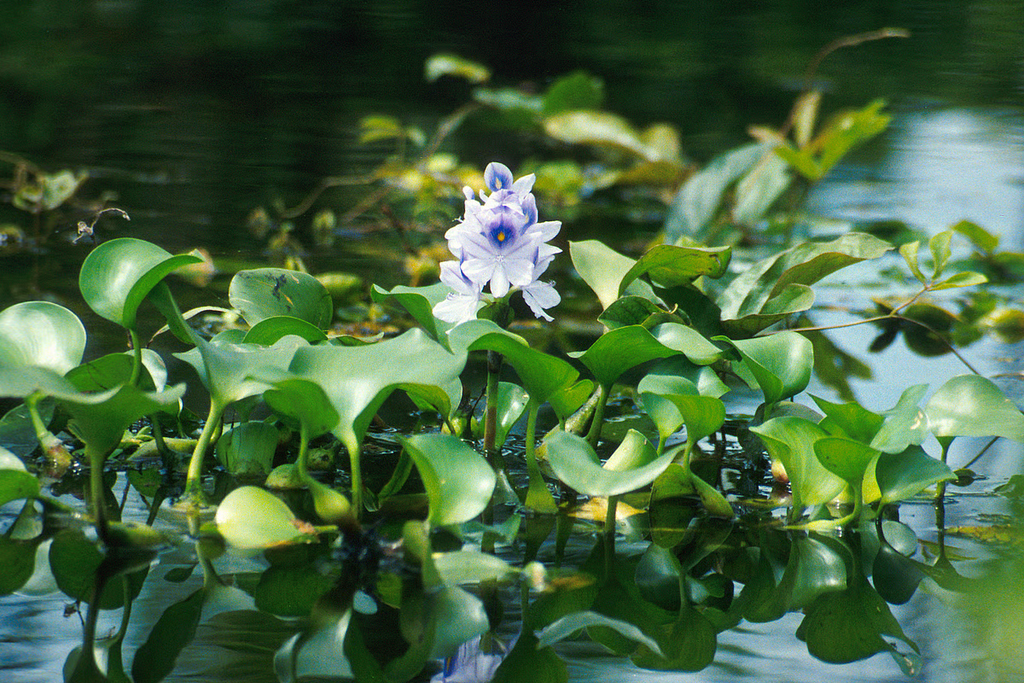
- Water hyacinth is a free-floating aquatic plant native to South America.
- Introduced outside its native habitat as an ornamental plant, it has become one of the world’s most damaging invasive aquatic weeds.
- It reproduces rapidly through vegetative offshoots and forms dense floating mats, especially in warm, slow-moving and nutrient-rich water.
- Its proliferation is aided by:
- untreated domestic sewage
- fertiliser-rich agricultural run-off
- organic and septic waste from settlements and tourism
- slow water circulation in canals
- siltation and narrowing of waterways; and
- hydrological alterations, including the operation of the Thanneermukkom barrage.
Thus, water hyacinth is not merely a weed problem; it is also an indicator of nutrient pollution and ecological imbalance.
Impacts of the Weed Invasion:
- Ecological impacts:
- Dense mats prevent sunlight from reaching submerged vegetation.
- They restrict air-water exchange and reduce dissolved oxygen.
- Decaying biomass further consumes oxygen, affecting fish and other aquatic organisms.
- They displace native aquatic plants and alter wetland food webs.
- Stagnant mats can provide breeding habitats for mosquitoes and other disease vectors.
- Livelihood impacts
- Fishing nets become entangled and fishing grounds inaccessible.
- Dense growth obstructs the movement of fishers and agricultural produce.
- Infestation affects paddy-dependent communities in north Kuttanad.
- Drinking-water collection and irrigation channels may become clogged.
- Transport and tourism:
- Hyacinth mats obstruct houseboats, ferries and smaller country boats. The weed becomes entangled in and damages the boat propellers. This affects commuters as well as Kumarakom’s houseboat, homestay and leisure-tourism economy.
Robotic Removal of Water Hyacinth:
The unmanned robotic system may offer several advantages:
- faster harvesting of dense mats
- reduced dependence on hazardous manual removal
- access to difficult or heavily infested areas
- repeated and geographically targeted operations
- reduced risk to boat operators; and
- systematic estimation of the biomass removed.
Conversion of the weed into marketable products:
The pilot can also test whether harvesting can support local livelihoods by converting the weed into:
- handicrafts and woven products
- paper, boards and packaging material
- compost and soil conditioners
- biogas, biochar and fuel briquettes.
Limitations of the Approach:
Robotic harvesting addresses the visible symptom rather than the underlying causes.
- Hyacinth can regenerate rapidly if nutrient pollution continues.
- Broken plant fragments may be dispersed to new areas during removal.
- Fresh biomass contains very high moisture, making transportation and drying expensive.
- Dumped biomass can produce foul odour, leachate and methane.
- Plants collected from polluted water may contain heavy metals or other contaminants. Their use as compost must therefore follow chemical testing.
- High equipment, maintenance and operating costs may constrain large-scale deployment.
- Creating a commercial market should not produce a perverse incentive to retain or cultivate the invasive weed.
Way Forward- Integrated Weed Management:
- Control nutrient inflows: Expand sewage and septage treatment and prevent waste discharge from settlements and houseboats.
- Reduce agricultural run-off: Promote balanced fertiliser use, vegetated buffer strips and sustainable farming in the catchment.
- Restore water circulation: Scientifically manage canals, siltation and barrage operations to improve flushing while protecting agriculture.
- Map infestations: Use drones, satellite imagery and community reporting for early detection and seasonal forecasting.
- Remove biomass continuously: One-time clearance should be replaced by scheduled removal before dense mats develop.
Long-term success requires combining technology with pollution control, hydrological restoration, biological management and community participation.
Tell Google you want more of this.
Add Anantam IAS as a preferred sourceOne tap, and this site shows up more often in your own Top Stories, AI Overviews and AI Mode. Remove it any time.