Why in News?
On September 1, 2026, DGFT enabled automated issuance of Free Sale and Commerce Certificates for eligible export applications outside the Drugs and Cosmetics Act route.
- Eligible applications can receive system-generated certificates without first being routed to a Regional Authority for manual scrutiny.
- Applications needing verification or failing automated parameters may still move to the concerned Regional Authority for manual processing.
- Some auto-approved cases can be flagged later under risk-management parameters, preserving post-issuance oversight.
- The change implements a rule-based workflow; it does not extend automation to products governed through the Drugs and Cosmetics Act route.
- The reform targets processing friction, replacing routine file movement with automated decisions where pre-set eligibility conditions are satisfied.
- It illustrates risk-based regulation: low-risk eligible cases move faster, while uncertain or selected cases receive human review.
- The policy question is not automation versus oversight, but how transparent rules, audit trails and accountable review can combine both.
UPSC Relevance
Prelims Relevance
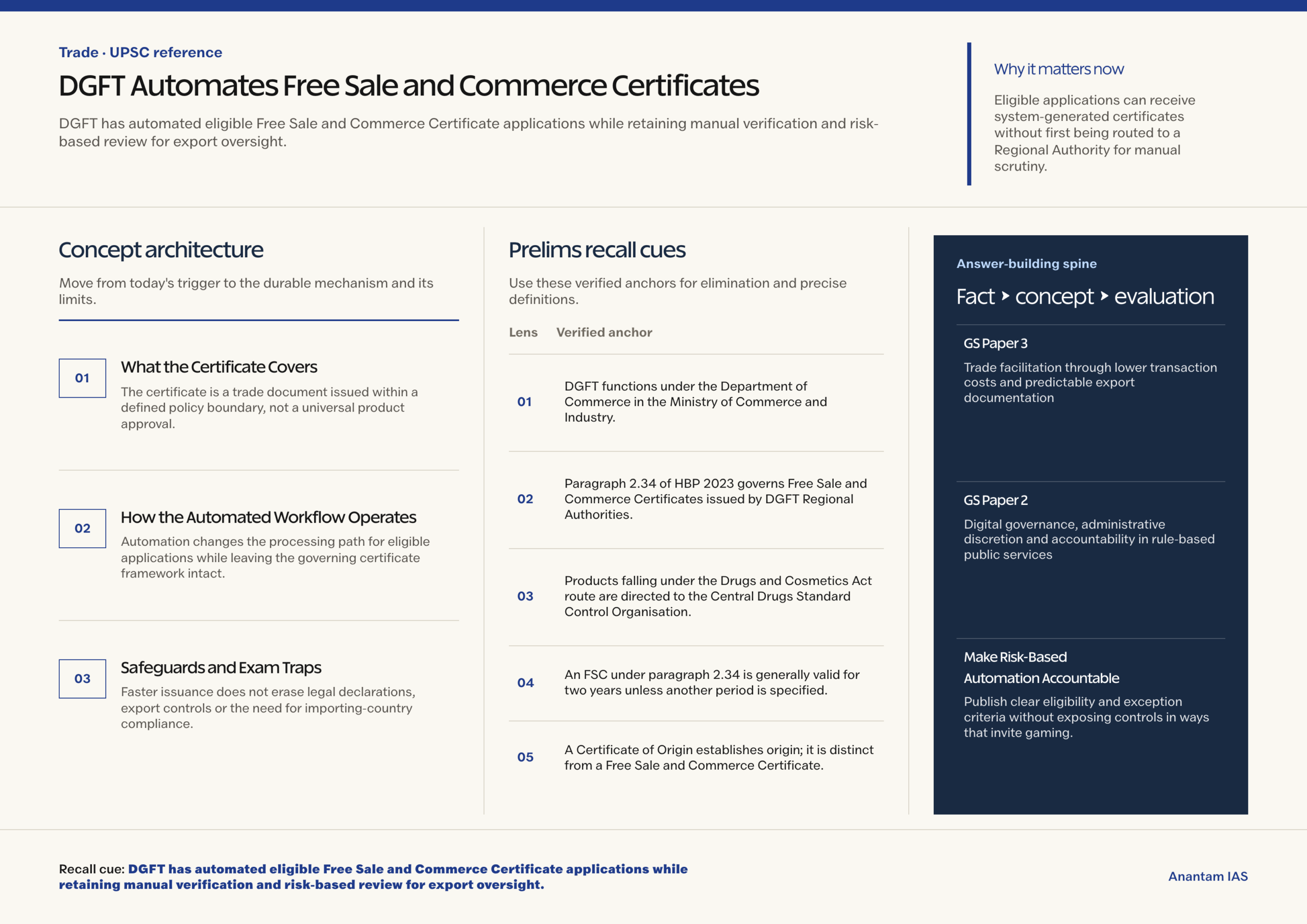
- DGFT functions under the Department of Commerce in the Ministry of Commerce and Industry.
- Paragraph 2.34 of HBP 2023 governs Free Sale and Commerce Certificates issued by DGFT Regional Authorities.
- Products falling under the Drugs and Cosmetics Act route are directed to the Central Drugs Standard Control Organisation.
- An FSC under paragraph 2.34 is generally valid for two years unless another period is specified.
- A Certificate of Origin establishes origin; it is distinct from a Free Sale and Commerce Certificate.
Mains Relevance
GS Paper 3
- Trade facilitation through lower transaction costs and predictable export documentation
- Balancing automated approvals with risk-based compliance checks
GS Paper 2
- Digital governance, administrative discretion and accountability in rule-based public services
Essay
- Good digital governance removes avoidable discretion without removing institutional responsibility.
Background and Context
What the Certificate Covers
The certificate is a trade document issued within a defined policy boundary, not a universal product approval.
- Under HBP paragraph 2.34, Regional Authorities may issue FSCs on application for qualifying exports not covered by the Drugs and Cosmetics Act, within the provision’s defined policy framework.
- The provision includes specified medical and surgical-use items outside that Act, provided they are not prohibited for export and satisfy the applicable certificate conditions.
- Regional Authorities may also issue FSCs for other items that are neither restricted nor prohibited for export, showing that the framework extends beyond health-linked goods.
- Items within the Drugs and Cosmetics Act framework follow the CDSCO route rather than this DGFT route because the sectoral regulator handles certification within that statute.
- Unless specified otherwise, an FSC issued under paragraph 2.34 has a two-year validity from its issue date, making validity a separate question from automated eligibility.
How the Automated Workflow Operates
Automation changes the processing path for eligible applications while leaving the governing certificate framework intact.
- The exporter applies through the DGFT portal using the electronic ANF-2H framework, which structures applicant, product, buyer and manufacturer information for paperless processing.
- When an application meets the prevailing automated parameters, the system can issue the certificate without initial manual scrutiny or routine officer-by-officer file movement.
- A case requiring verification can be diverted to the concerned Regional Authority, which retains manual scrutiny where declarations, documents or eligibility signals require examination.
- An auto-approved case may later enter risk-based review, so faster issuance does not give the application permanent immunity from administrative examination.
- This two-track design separates routine eligible cases from exception cases, concentrating officer time on applications carrying greater uncertainty instead of scrutinising every file identically.
Safeguards and Exam Traps
Faster issuance does not erase legal declarations, export controls or the need for importing-country compliance.
- ANF-2H asks for the applicant’s IEC, product, buyer, manufacturer and ITC(HS) details, including product use and technical description, supporting structured eligibility and verification checks.
- The applicant declares that listed goods are free for export and accepts legal consequences for false information, so automation still rests on attributable declarations.
- Automation is not blanket approval: verification cases and applications outside system parameters remain manually processed, making automation a conditional routing rule rather than universal entitlement.
- An FSC is distinct from a Certificate of Origin, which identifies where goods originate and may support preferential tariff claims; the two documents answer different trade questions.
- The reform changes DGFT’s workflow; it does not replace foreign-market requirements, product standards or sector-specific regulators that may govern sale or use in the destination jurisdiction.
Way Forward
Make Risk-Based Automation Accountable
- Publish clear eligibility and exception criteria without exposing controls in ways that invite gaming.
- Maintain complete digital audit trails linking application data, automated decisions, flags and Regional Authority action.
- Review false approvals and unnecessary referrals to improve risk parameters while protecting legitimate exporters from repeated delays.
- Provide a time-bound grievance channel for applicants routed to manual scrutiny or affected by an erroneous system decision.
Conclusion
- DGFT’s FSC reform shows how rule-based automation can reduce routine export compliance costs while preserving manual scrutiny for uncertain or risky cases.
- In a Mains answer, present it as calibrated digital governance: eligibility-based speed, human review for exceptions, post-approval risk checks and auditable accountability.
UPSC Practice Questions
Prelims MCQ 1
With reference to the automated issuance of Free Sale and Commerce Certificates, consider the following statements:
- Every application is issued automatically without scrutiny by a Regional Authority.
- Products governed through the Drugs and Cosmetics Act route are outside this DGFT automation route.
- Some auto-approved applications may later be flagged for risk-based review.
How many of the above statements are correct?
(a) Only one (b) Only two (c) All three (d) None
Answer: (b) Only two
Explanation:
Statements 2 and 3 are correct. Applications requiring verification or failing automated parameters may still be sent to a DGFT Regional Authority for manual processing.
Prelims MCQ 2
Under paragraph 2.34 of the Handbook of Procedures 2023, which authority may issue a Free Sale and Commerce Certificate for eligible items outside the Drugs and Cosmetics Act route?
(a) DGFT Regional Authority (b) Reserve Bank of India (c) Central Board of Indirect Taxes and Customs (d) Bureau of Indian Standards
Answer: (a) DGFT Regional Authority
Explanation:
Paragraph 2.34 authorises DGFT Regional Authorities to issue FSCs on application for eligible goods within its stated scope.
UPSC Mains Questions
- How can risk-based automation reduce export transaction costs without weakening regulatory accountability? Discuss with reference to DGFT’s automated Free Sale and Commerce Certificate workflow.
- Rule-based digital governance should reduce avoidable discretion, not eliminate human responsibility. Examine the statement using trade facilitation as an example.
Sources: PIB, Ministry of Commerce and Industry and DGFT Handbook of Procedures 2023, Chapter 2.
Frequently Asked Questions
What is a Free Sale and Commerce Certificate?
It is a DGFT trade document issued under paragraph 2.34 of the Handbook of Procedures for eligible export items within the provision’s defined scope.
Are all FSC applications now approved automatically?
No. Only eligible applications meeting automated parameters can bypass initial manual scrutiny; verification cases and exceptions may still go to a Regional Authority.
Does this automation cover products under the Drugs and Cosmetics Act?
No. Products within that statutory route are directed to CDSCO; the announced DGFT automation concerns eligible products outside that route.
Can DGFT review a certificate after automatic issuance?
Yes. The system may flag certain auto-approved applications to the concerned Regional Authority for subsequent review under risk-management parameters.
How long is a DGFT Free Sale and Commerce Certificate valid?
Paragraph 2.34 generally provides a two-year validity from the date of issue unless the certificate specifies a different period.
Tell Google you want more of this.
Add Anantam IAS as a preferred sourceOne tap, and this site shows up more often in your own Top Stories, AI Overviews and AI Mode. Remove it any time.