Why in News?
On September 1, the Reserve Bank of India released preliminary balance-of-payments data for April-June 2026 and separately explained the quarter’s change in foreign-exchange reserves.
- India recorded a current account deficit of US$4.2 billion, equal to 0.5 per cent of GDP, during Q1 2026-27.
- The merchandise trade gap widened, while stronger net services receipts and personal transfers partly cushioned the current account.
- On a BoP transaction basis, which excludes valuation effects, foreign-exchange reserves decreased by US$8.1 billion.
- The reserve stock fell by US$22.5 billion in nominal terms; a US$14.4 billion valuation loss explains the difference from the transaction measure.
- The releases show why a modest current account deficit cannot, by itself, explain the reserve movement: financial-account transactions and other recorded items also matter.
- They also expose a common analytical error: treating every change in the dollar value of reserves as a cross-border transaction or central-bank sale.
- The quarter should be read as an accounting map of external transactions, not as a single score of economic strength or weakness.
UPSC Relevance
Prelims Relevance
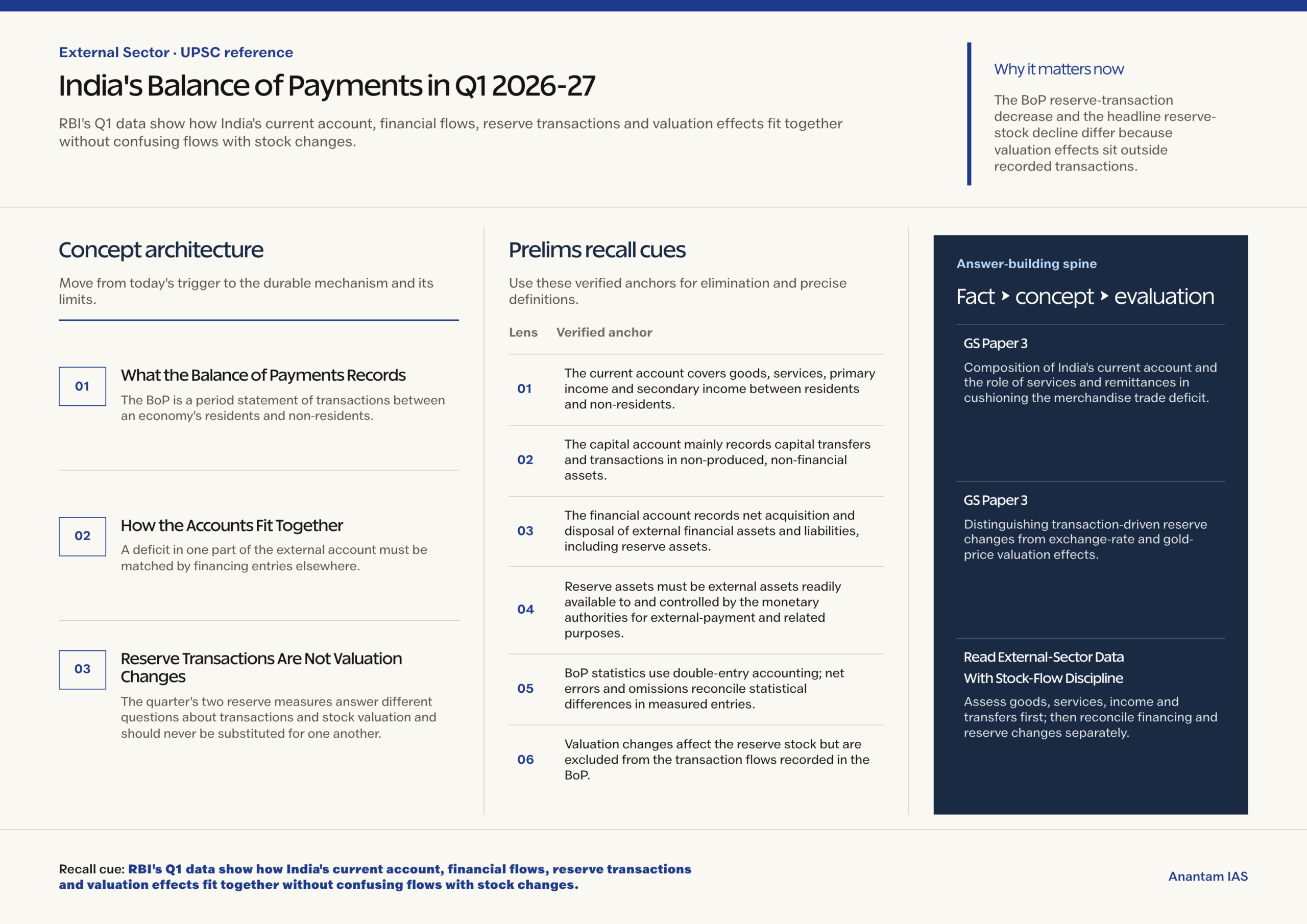
- The current account covers goods, services, primary income and secondary income between residents and non-residents.
- The capital account mainly records capital transfers and transactions in non-produced, non-financial assets.
- The financial account records net acquisition and disposal of external financial assets and liabilities, including reserve assets.
- Reserve assets must be external assets readily available to and controlled by the monetary authorities for external-payment and related purposes.
- BoP statistics use double-entry accounting; net errors and omissions reconcile statistical differences in measured entries.
- Valuation changes affect the reserve stock but are excluded from the transaction flows recorded in the BoP.
Mains Relevance
GS Paper 3
- Composition of India’s current account and the role of services and remittances in cushioning the merchandise trade deficit.
- Financing of external imbalances through financial flows and reserve-asset transactions.
GS Paper 3
- Distinguishing transaction-driven reserve changes from exchange-rate and gold-price valuation effects.
- Using stock-flow discipline and sign conventions when interpreting RBI external-sector releases.
Essay
- Good economic judgment begins by separating transactions from price-driven changes in the value of accumulated assets.
Background and Context
What the Balance of Payments Records
The BoP is a period statement of transactions between an economy’s residents and non-residents, organized through linked accounts.
- Its current account combines trade in goods and services with primary income, such as investment income, and secondary income, such as personal transfers.
- A current account deficit means payments for these current transactions exceed receipts during the period; it also corresponds to the economy’s saving-investment gap in macroeconomic accounting.
- The distinct capital account is usually narrower than everyday references to capital flows, covering capital transfers and non-produced, non-financial assets such as certain leases or licences.
- The financial account tracks transactions in direct investment, portfolio investment, derivatives, other investment and reserve assets through changes in external assets and liabilities.
- Every transaction has two entries under double-entry accounting, while net errors and omissions reconcile timing, coverage and measurement differences in real-world data.
How the Accounts Fit Together
A deficit in one part of the external account must be matched by financing entries elsewhere, subject to statistical discrepancies.
- The combined current and capital account balance represents the economy’s net lending to or borrowing from the rest of the world during the period.
- A current account deficit can be financed through greater external liabilities, lower external assets, or a combination; it does not automatically imply an equal reserve sale.
- In this quarter, net foreign direct investment remained positive while portfolio investment recorded a net outflow, illustrating why the composition and stability of financing matter.
- Reserve assets are readily available external assets controlled by monetary authorities; their transactions form part of the financial account and may reflect financing needs, market intervention or other official operations.
- RBI tables use stated sign conventions that can differ by presentation; readers should first check whether an increase in reserve assets appears with a positive or negative sign.
Reserve Transactions Are Not Valuation Changes
The quarter’s two reserve measures answer different questions about transactions and stock valuation and should never be substituted for one another.
- The BoP-basis change captures transactions in reserve assets and excludes gains or losses caused only by changing exchange rates, gold prices or other market prices.
- The nominal stock change compares the dollar value of reserve holdings across two dates, so it includes both transactions and valuation effects during the interval.
- RBI attributed the quarter’s valuation loss mainly to lower gold prices and appreciation of the US dollar against major currencies held in the reserve portfolio.
- Dollar appreciation can lower the reported dollar value of euro, sterling or yen assets without any sale; lower gold prices can similarly reduce the value of unchanged holdings.
- The identity for this release is practical: nominal reserve change equals the BoP-basis transaction change plus valuation change, allowing rounding differences.
Way Forward
Read External-Sector Data With Stock-Flow Discipline
- Assess the current account through the drivers of goods, services, income and transfers instead of treating the headline deficit as a standalone verdict.
- Examine the mix and maturity of financial flows because stable long-term financing and volatile portfolio flows carry different external-risk implications.
- Compare reserve adequacy with import cover and short-term external obligations, not merely with one quarter’s dollar change.
- State the measurement basis and sign convention whenever using reserve data, especially when comparing BoP transactions with weekly reserve-stock figures.
Conclusion
- India’s Q1 release is best understood as a linked external-account system: a contained current deficit, mixed financial flows and reserve transactions together produce the BoP outcome.
- In an answer, separate flows from stocks and transaction effects from valuation effects before drawing conclusions about reserve use, external vulnerability or policy pressure.
UPSC Practice Questions
Prelims MCQ 1
With reference to the balance of payments, consider the following statements:
- The current account includes trade in goods and services as well as primary and secondary income.
- The financial account records transactions in reserve assets.
- Exchange-rate valuation changes in reserve holdings are recorded as BoP transactions.
How many of the above statements are correct?
(a) Only one (b) Only two (c) All three (d) None
Answer: (b) Only two
Explanation:
Statements 1 and 2 are correct. Valuation changes alter the reserve stock but are excluded from BoP transaction flows.
Prelims MCQ 2
Which one of the following best explains why the nominal change in foreign-exchange reserves can differ from the change on a BoP basis?
(a) The nominal measure excludes reserve assets held by the monetary authority (b) The BoP measure includes only merchandise trade transactions (c) The nominal measure also reflects exchange-rate, gold-price and other valuation effects (d) The BoP measure treats every current account deficit as an equal reserve loss
Answer: (c) The nominal measure also reflects exchange-rate, gold-price and other valuation effects
Explanation:
The BoP-basis reserve change isolates transactions, while the change in the nominal reserve stock also includes valuation gains or losses.
UPSC Mains Questions
- Explain the accounting relationship among the current account, financial account and reserve assets in India’s balance of payments.
- Why must transaction-driven and valuation-driven changes in foreign-exchange reserves be separated when assessing external-sector vulnerability?
Sources: Reserve Bank of India, Balance of Payments and Reserve Bank of India, Sources of Reserve Variation.
Frequently Asked Questions
What does India’s current account include?
It includes transactions in goods, services, primary income and secondary income between residents and non-residents during the reporting period.
Does a current account deficit always reduce reserves by the same amount?
No. Financial inflows, changes in other external assets and liabilities, reserve transactions, and statistical discrepancies determine how the deficit is financed.
What is a BoP-basis change in foreign-exchange reserves?
It is the change attributable to transactions in reserve assets, excluding valuation effects caused by exchange rates, gold prices or other market-price movements.
Why did the two RBI reserve-change figures differ in Q1 2026-27?
The nominal reserve stock included a valuation loss, while the BoP-basis figure excluded valuation effects and measured only transactions.
What are net errors and omissions in the BoP?
They are the balancing item for timing, valuation, coverage and measurement differences that prevent independently collected credit and debit entries from matching exactly.
Tell Google you want more of this.
Add Anantam IAS as a preferred sourceOne tap, and this site shows up more often in your own Top Stories, AI Overviews and AI Mode. Remove it any time.