Why in News?
On 19 August 2026, the Ministry of Civil Aviation scaled up Delhi airport’s secure domestic-to-international cargo transshipment model after a route-specific proof of concept.
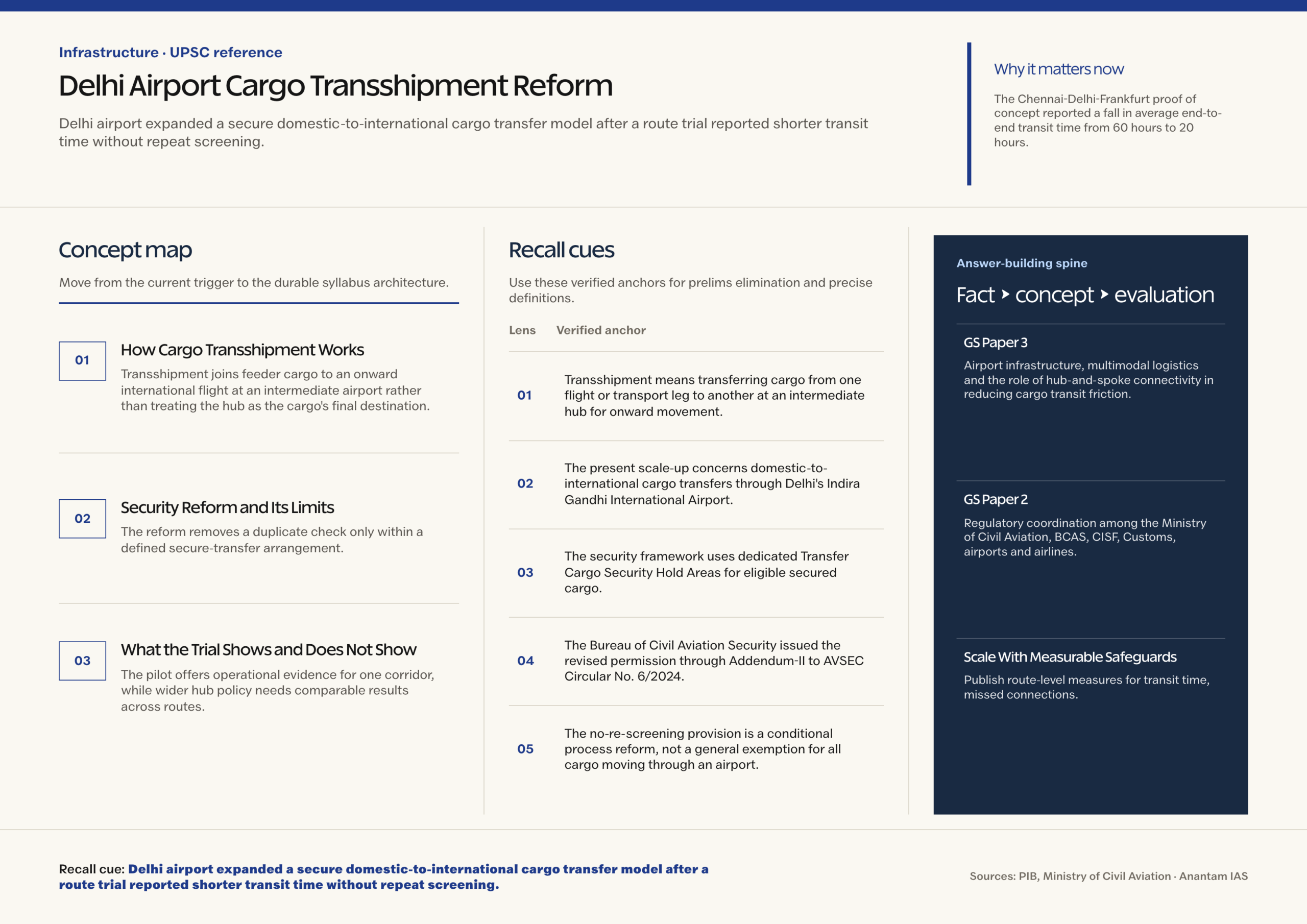
- The Chennai-Delhi-Frankfurt proof of concept reported a fall in average end-to-end transit time from 60 hours to 20 hours.
- The result belongs to this particular route and trial; the PIB release does not establish an audited national average for cargo transit.
- The expanded network added four domestic origins: Bengaluru, Ahmedabad, Mumbai and Hyderabad, and two international destinations: London and Copenhagen.
- Repeat screening may be omitted only for secured transshipment cargo handled through the approved process and subject to prescribed safeguards.
- Air cargo hubs depend on fast, predictable transfers between arriving feeder flights and departing long-haul services; unnecessary terminal steps can weaken the connection.
- The reform tests whether India can combine logistics efficiency with aviation security while building hub-and-spoke cargo connectivity.
UPSC Relevance
Prelims Relevance
- Transshipment means transferring cargo from one flight or transport leg to another at an intermediate hub for onward movement.
- The present scale-up concerns domestic-to-international cargo transfers through Delhi’s Indira Gandhi International Airport.
- The security framework uses dedicated Transfer Cargo Security Hold Areas for eligible secured cargo.
- The Bureau of Civil Aviation Security issued the revised permission through Addendum-II to AVSEC Circular No. 6/2024.
- The no-re-screening provision is a conditional process reform, not a general exemption for all cargo moving through an airport.
Mains Relevance
GS Paper 3
- Airport infrastructure, multimodal logistics and the role of hub-and-spoke connectivity in reducing cargo transit friction.
- Balancing time and cost gains with secure custody, terminal design and reliable onward flight connections.
GS Paper 2
- Regulatory coordination among the Ministry of Civil Aviation, BCAS, CISF, Customs, airports and airlines.
- Evidence-based scaling of a pilot without presenting route-specific results as system-wide performance.
Essay
- Good infrastructure reform removes duplication without weakening the safeguards that make speed trustworthy.
Background and Context
How Cargo Transshipment Works
Transshipment joins feeder cargo to an onward international flight at an intermediate airport rather than treating the hub as the cargo’s final destination.
- A shipment arriving from a domestic origin enters the hub’s transfer chain, is sorted for its onward service and moves toward the designated international departure.
- The hub combines cargo from several origins, helping an airline support long-haul connectivity even when each origin alone cannot fill a direct international service.
- A useful transfer depends on synchronized schedules, adequate handling capacity and a protected path between flights; a missed connection can erase the expected time advantage.
- For shippers, the practical gain is not merely a shorter headline time but greater predictability for inventory, cold-chain planning and delivery commitments.
- For airports and airlines, successful consolidation can improve network use, but it also concentrates operational risk at the hub and requires disciplined terminal coordination.
Security Reform and Its Limits
The reform removes a duplicate check only within a defined secure-transfer arrangement; it does not dilute the requirement that cargo remain protected.
- BCAS permitted eligible secured cargo to move through dedicated Transfer Cargo Security Hold Areas without repeat screening, subject to the safeguards prescribed in its framework.
- The permission was notified through Addendum-II to AVSEC Circular No. 6/2024 on 21 July 2025, before the proof of concept began.
- Security rests on maintaining an unbroken protected process: cargo eligibility, controlled access, custody records and handling discipline must prevent interference between the first screening and onward loading.
- If cargo leaves the approved secure chain or no longer meets its conditions, the logic for skipping repeat screening no longer applies; process integrity is the boundary.
- The participating agencies include BCAS, CISF, Customs, the airport operator and the airline, making inter-agency coordination part of the security design rather than an administrative afterthought.
What the Trial Shows and Does Not Show
The pilot offers operational evidence for one corridor, while wider hub policy needs comparable results across routes, cargo types and disruption conditions.
- The proof of concept began on 20 June 2026 on the Chennai-Delhi-Frankfurt sector, with Air India operating the route end to end through Delhi’s transfer facility.
- PIB reported the route’s average end-to-end transit time declining from 60 to 20 hours; this is a reported trial outcome, not a universal airport benchmark.
- Adding domestic feeder cities and international destinations tests whether the process works across a broader network, where schedules, volumes and handling conditions may differ from the first corridor.
- The reform concerns secure transfer and connectivity. It does not change the cargo’s origin, authorize false declarations or create a route for avoiding applicable customs controls.
- India’s hub ambition will be credible only if faster transfers remain reliable during peaks and disruptions while security exceptions stay limited to cargo that satisfies the approved conditions.
Way Forward
Scale With Measurable Safeguards
- Publish route-level measures for transit time, missed connections, handling exceptions and security incidents so that scale-up decisions rest on comparable evidence.
- Use interoperable custody records and clearly assigned hand-offs among airlines, terminal operators and security agencies to protect the secure chain.
- Expand only after stress-testing the process during congestion, schedule disruption and mixed cargo flows, when shortcuts and custody gaps are most likely to appear.
- Keep customs compliance, cargo-origin documentation and security screening rules distinct in guidance so efficiency reform cannot be misread as an origin or duty exemption.
Conclusion
- Delhi’s reform shows how process redesign can remove duplicate handling while retaining a security boundary around eligible cargo, improving the conditions for a functional air-cargo hub.
- In an answer, treat the 60-to-20-hour result as route-specific evidence and evaluate wider success through reliability, security integrity, customs compliance and network connectivity.
UPSC Practice Questions
Prelims MCQ 1
With reference to the Delhi airport cargo transshipment reform, consider the following statements:
- It presently concerns domestic-to-international cargo transfers through Delhi airport.
- It permits all cargo to bypass screening regardless of its custody status.
- Eligible secured cargo uses dedicated Transfer Cargo Security Hold Areas under prescribed safeguards.
How many of the above statements are correct?
(a) Only one (b) Only two (c) All three (d) None
Answer: (b) Only two
Explanation:
Statements 1 and 3 are correct. The no-re-screening treatment is conditional on eligible secured cargo remaining within the approved protected process; it is not a blanket waiver.
Prelims MCQ 2
What is the main logistics purpose of air-cargo transshipment at a hub airport?
(a) To change the declared country of origin of goods (b) To exempt transferred goods from every customs control (c) To connect feeder cargo to an onward flight through an intermediate airport (d) To replace aviation-security screening with airline self-certification
Answer: (c) To connect feeder cargo to an onward flight through an intermediate airport
Explanation:
Transshipment connects transport legs at an intermediate hub. It does not alter origin, remove all customs controls or replace the approved aviation-security process.
UPSC Mains Questions
- Explain how secure cargo transshipment can strengthen airport hub connectivity. What institutional safeguards are needed when duplicate screening is removed?
- A successful pilot is evidence for scaling, not proof of universal performance. Discuss with reference to India’s air-cargo transshipment reform.
Source: PIB, Ministry of Civil Aviation.
Frequently Asked Questions
What is air-cargo transshipment?
It is the transfer of cargo from one flight or transport leg to another at an intermediate airport, allowing the shipment to continue toward its final destination.
Did Delhi airport remove screening for all cargo?
No. Repeat screening may be omitted only for eligible secured transshipment cargo moving through dedicated security-hold areas under the prescribed protected process and its security safeguards.
What does the 60-to-20-hour figure represent?
It is the average end-to-end transit-time result reported by PIB for the Chennai-Delhi-Frankfurt proof of concept. The release does not present it as an audited national average.
Which institution issued the revised security permission?
The Bureau of Civil Aviation Security issued it through Addendum-II to AVSEC Circular No. 6/2024. The permission applies subject to the prescribed security safeguards.
Does transshipment change the origin of cargo?
No. It changes the transfer route between transport legs; it does not lawfully alter origin declarations. Applicable customs controls and documentation requirements continue to govern the cargo.
Tell Google you want more of this.
Add Anantam IAS as a preferred sourceOne tap, and this site shows up more often in your own Top Stories, AI Overviews and AI Mode. Remove it any time.