Daily Digest
UPSC · Civil Services Examination
Current Affairs · Sunday, 23 August 2026
Current affairs curated and edited by Anantam IAS faculty — pulled from The Hindu, PIB, IDSA, Foreign Affairs and the ministries. Read, annotate, revise.
Old Rajinder Nagar · Delhi 110005 · anantamias.com
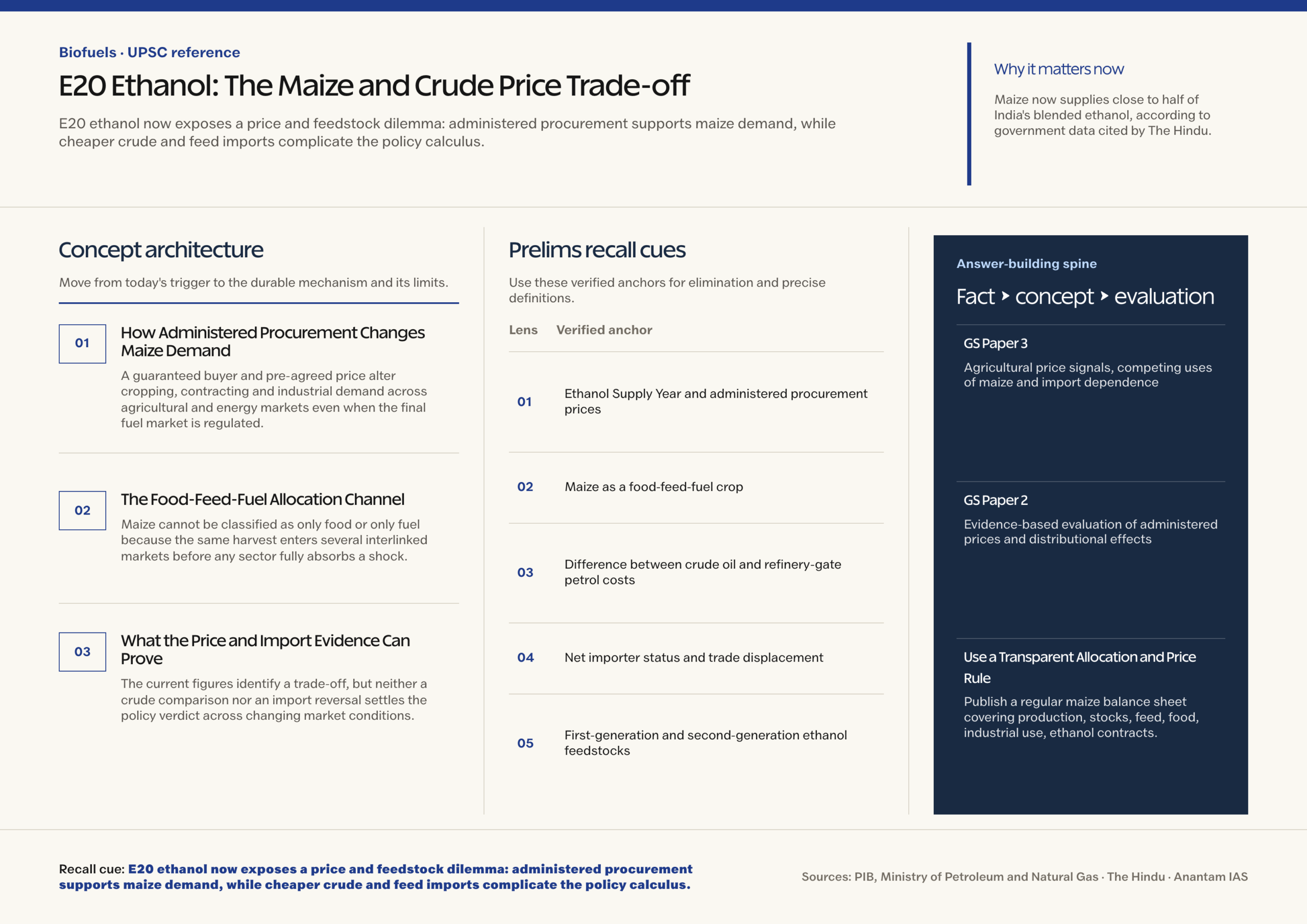
E20 Ethanol: The Maize and Crude Price Trade-off
Why in News?
A 22 August report found that cheaper crude now contrasts with administered E20 ethanol procurement as maize use, domestic prices and feed-sector imports rise.
- Maize now supplies close to half of India’s blended ethanol, according to government data cited by The Hindu.
- For Ethanol Supply Year 2025-26, oil marketing companies pay an approved maize-ethanol price of ₹71.86 per litre.
- India became a net maize importer in 2024 after having exported the grain until recently.
- The report links higher distillery demand with feed-sector import pressure, but that relationship does not by itself prove single-cause attribution.
- The issue is an allocation problem: maize serves food processing, poultry and animal feed, starch industries, seed and fuel markets.
- The policy question is not simply whether ethanol or crude is cheaper today, but how to value price stability, import risk and domestic opportunity costs.
- This note extends the earlier E20 policy debate without repeating vehicle compatibility or general blending basics.
UPSC Relevance
Prelims Relevance
- Ethanol Supply Year and administered procurement prices
- Maize as a food-feed-fuel crop
- Difference between crude oil and refinery-gate petrol costs
- Net importer status and trade displacement
- First-generation and second-generation ethanol feedstocks
Mains Relevance
GS Paper 3
- Agricultural price signals, competing uses of maize and import dependence
- Biofuel procurement, oil-price cycles and public-policy trade-offs
GS Paper 2
- Evidence-based evaluation of administered prices and distributional effects
Essay
- A policy that reduces one external dependence can create another unless its resource costs are measured across the whole economy.
Background and Context
How Administered Procurement Changes Maize Demand
A guaranteed buyer and pre-agreed price alter cropping, contracting and industrial demand across agricultural and energy markets even when the final fuel market is regulated.
- Oil marketing companies procure ethanol from approved feedstocks at feedstock-specific prices, rather than buying all ethanol through a single spot market.
- The maize rate is the highest in the official 2025-26 schedule, creating a strong demand signal for distillers and suppliers.
- A stable procurement price can protect producers from oil-market volatility, but it can also weaken the immediate adjustment when crude prices fall.
- The benefit to growers or distillers is not costless: other maize users may face higher prices, reduced availability, thinner inventories or the need to source imports.
- Policy assessment must track who gains the stable market, who bears adjustment costs across the value chain, and how incentives evolve over successive procurement seasons.
The Food-Feed-Fuel Allocation Channel
Maize cannot be classified as only food or only fuel because the same harvest enters several interlinked markets before any sector fully absorbs a shock.
- Distilleries, poultry farms and animal-feed makers compete for grain with food processors, starch makers and other industrial users; supply is not infinitely elastic.
- When fuel demand expands faster than output, the adjustment may appear through higher domestic prices, crop switching, lower use elsewhere or additional imports.
- Feed is a major poultry cost, so a maize-price increase can transmit beyond grain markets to eggs, meat and livestock production through input costs.
- Imports can relieve a domestic shortage, but they also replace part of the crude-import saving with another external exposure and transmit global grain shocks.
- The right metric is the net resource effect across fuel, farms, food and feed, including substitution responses, not the volume of ethanol procured in isolation.
What the Price and Import Evidence Can Prove
The current figures identify a trade-off, but neither a crude comparison nor an import reversal settles the policy verdict across changing market conditions.
- A litre of crude is an input, while ethanol is a usable blending component; refining, transport, marketing, taxes and energy content make direct litre comparisons incomplete.
- Low crude prices can make administered ethanol relatively expensive today, while fixed procurement may act as insurance during an oil-price spike.
- Rising maize imports alongside ethanol expansion are observed facts; proving causation requires output, stocks, feed demand, weather, trade restrictions and price-counterfactual data.
- The government’s food-security safeguard for public grain does not remove the wider allocation question for marketed maize used by private buyers.
- A defensible conclusion is conditional: ethanol demand likely adds pressure, but its exact share in price and import changes remains contested.
Way Forward
Use a Transparent Allocation and Price Rule
- Publish a regular maize balance sheet covering production, stocks, feed, food, industrial use, ethanol contracts, exports and imports.
- Review procurement formulas against crude cycles, farm costs and competing-user impacts instead of treating one administered price as permanently optimal.
- Set feedstock-diversification triggers when food-feed indicators tighten, including faster movement toward residue-based ethanol where technically and economically viable.
- Evaluate the programme through net import savings, fiscal effects, farm incomes, feed costs and emissions rather than a single headline metric.
Conclusion
- E20’s maize bind is a resource-allocation test: a stable domestic fuel input can still shift costs and import exposure to feed and food-linked sectors.
- In a Mains answer, separate observed market changes from causal claims, then judge the policy using whole-economy costs, distribution and resilience across price cycles.
UPSC Practice Questions
Prelims MCQ 1
With reference to ethanol procurement and maize markets in India, consider the following statements:
- Oil marketing companies procure ethanol at feedstock-specific administered prices.
- A rise in maize imports by itself proves that ethanol demand caused the entire increase.
- Maize has competing uses in food processing, animal feed and fuel production.
How many of the above statements are correct?
(a) Only one (b) Only two (c) All three (d) None
Answer: (b) Only two
Explanation:
Statements 1 and 3 are correct. Import data establish an outcome, not complete causation; output, inventories, feed demand, weather and trade conditions must also be examined.
Prelims MCQ 2
Why is a direct per-litre comparison between crude oil and procured ethanol analytically incomplete?
(a) Crude oil is never imported by India (b) Ethanol cannot be used in transport fuel (c) Crude is a refinery input, while ethanol is a blending component with different processing, tax and energy characteristics (d) Both commodities always have identical administered prices
Answer: (c) Crude is a refinery input, while ethanol is a blending component with different processing, tax and energy characteristics
Explanation:
The compared litres are not equivalent products. A useful cost comparison must account for conversion, delivery, taxation, energy content and the value of protection against oil-price volatility.
UPSC Mains Questions
- Administered ethanol procurement can reduce one import dependence while creating pressure elsewhere in the economy. Examine with reference to India’s maize market.
- How should India compare the costs and benefits of ethanol blending when crude prices fall? Suggest an evidence-based evaluation framework.
Sources: PIB, Ministry of Petroleum and Natural Gas and The Hindu.
Frequently Asked Questions
Why does administered ethanol pricing matter?
It gives suppliers a predictable buyer and price, encouraging production. The same stability can delay adjustment when crude becomes cheaper and can raise demand pressure on competing maize users.
Does maize import growth prove ethanol policy caused it?
No. The timing makes ethanol demand a plausible contributor, but attribution also requires evidence on harvests, stocks, feed demand, weather, trade restrictions and prices without the policy.
What is the food-feed-fuel trade-off?
The same maize supply serves human consumption, livestock and poultry feed, industrial processing and ethanol. More demand from one use can affect availability, prices or imports for others.
Why can ethanol still have value when crude is cheaper?
A stable domestic procurement price can insure against future oil spikes and support farm demand. Its value must be weighed against current fiscal, feedstock and distributional costs.
What data would improve policy evaluation?
A transparent maize balance sheet, feedstock-wise ethanol procurement, capacity use, import substitution, farm returns, feed costs, fiscal effects and lifecycle emissions would allow a whole-economy assessment.
Source: https://anantamias.com/current-affairs/e20-ethanol-maize-crude-price-tradeoff/
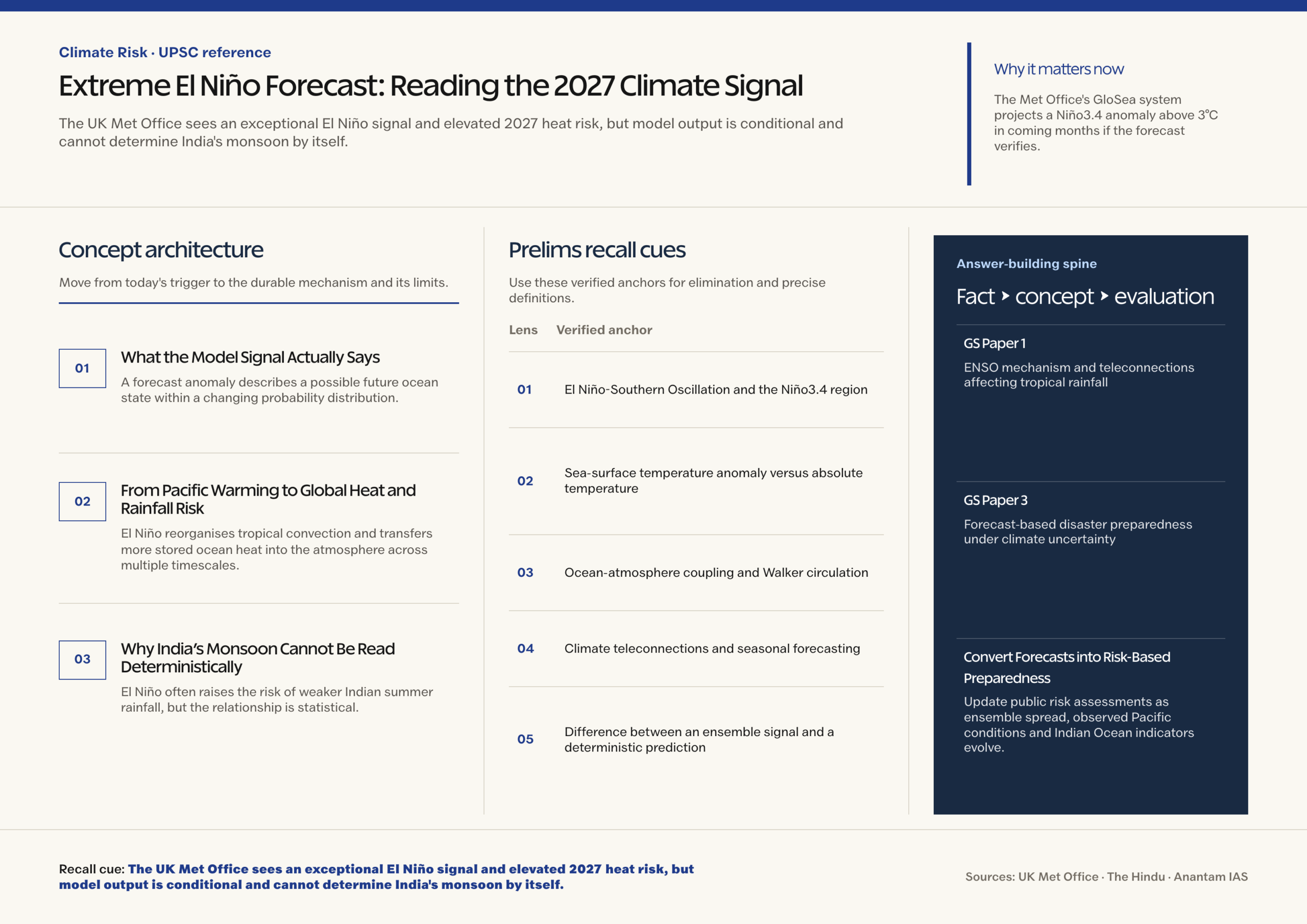
Extreme El Niño Forecast: Reading the 2027 Climate Signal
Why in News?
On 21 August, the UK Met Office reported an exceptionally intense El Niño forecast signal, with potentially major rainfall impacts and elevated global heat risk in 2027.
- The Met Office’s GloSea system projects a Niño3.4 anomaly above 3°C in coming months if the forecast verifies.
- It describes 1-2°C warming as typical for El Niño, making the current model signal exceptionally large by recent standards.
- The agency says ocean heat release during a large event could make 2027 very likely to become the warmest year on record.
- These are probabilistic forecasts, not observations of the event’s eventual peak or guarantees of any regional impact.
- El Niño changes tropical Pacific convection and atmospheric circulation, creating teleconnections that shift weather probabilities far from the ocean basin.
- Forecast value lies in earlier risk preparation, but uncertainty must remain visible because model spread, timing and other climate drivers can alter regional outcomes.
- For India, El Niño is a risk factor for monsoon weakness, not a rule that predetermines the country’s seasonal rainfall total.
UPSC Relevance
Prelims Relevance
- El Niño-Southern Oscillation and the Niño3.4 region
- Sea-surface temperature anomaly versus absolute temperature
- Ocean-atmosphere coupling and Walker circulation
- Climate teleconnections and seasonal forecasting
- Difference between an ensemble signal and a deterministic prediction
Mains Relevance
GS Paper 1
- ENSO mechanism and teleconnections affecting tropical rainfall
- Limits of using one oceanic index to predict the Indian monsoon
GS Paper 3
- Forecast-based disaster preparedness under climate uncertainty
- Interaction between natural variability and human-driven warming
Essay
- Good climate governance acts early on credible risk without presenting uncertainty as either ignorance or certainty.
Background and Context
What the Model Signal Actually Says
A forecast anomaly describes a possible future ocean state within a changing probability distribution; it is not yet the observed seasonal peak.
- The Met Office signal concerns sea-surface temperatures in the Niño3.4 region, a central equatorial Pacific zone used to monitor ENSO rather than the entire ocean basin.
- An anomaly above 3°C would be far beyond ordinary El Niño conditions, so the model raises a high-impact risk deserving close monitoring.
- Other forecast systems reportedly show similarly extreme values, which strengthens concern but does not eliminate common errors or prove the exact magnitude, timing or duration.
- Long-range systems simulate many plausible evolutions; forecasters assess the distribution, consistency and physical credibility rather than treating one trajectory as destiny.
- The conditional phrase if the forecast is accurate is central: future updates may change peak strength, timing, duration and downstream impacts.
From Pacific Warming to Global Heat and Rainfall Risk
El Niño reorganises tropical convection and transfers more stored ocean heat into the atmosphere across multiple timescales, affecting both circulation and global temperature.
- Warm central and eastern Pacific waters shift rising air and rainfall eastward over many months, altering the Walker circulation and connected pressure patterns.
- These changes modify the probability, timing and persistence of drought or excess rainfall across several regions; they do not make every location experience the same impact.
- A strong event can release additional ocean heat into the atmosphere, often lifting global average temperature most clearly in the following calendar year.
- This natural variability acts on top of human-driven warming, so El Niño can amplify near-term records without causing the long-term greenhouse trend.
- A globally warm year remains a climate average, not a promise that every month and region will be warmer than its previous record.
Why India’s Monsoon Cannot Be Read Deterministically
El Niño often raises the risk of weaker Indian summer rainfall, but the relationship is statistical, variable from month to month and mediated by other systems.
- Pacific warming can weaken the normal east-west tropical circulation and alter moisture-bearing winds during key growing months, creating an important monsoon risk signal.
- The Met Office noted below-normal Indian rainfall while the event was growing, but concurrent timing alone cannot assign every deficit to El Niño.
- Indian Ocean conditions, Eurasian snow, land heating, intraseasonal oscillations and the timing of Pacific warming can strengthen, offset, delay or redistribute the seasonal effect.
- An all-India seasonal total can also conceal floods in one region, dry spells elsewhere and major differences in onset, breaks and rainfall distribution.
- The correct exam statement is that El Niño changes monsoon probabilities; it does not mechanically fix India’s rainfall before the season unfolds.
Way Forward
Convert Forecasts into Risk-Based Preparedness
- Update public risk assessments as ensemble spread, observed Pacific conditions and Indian Ocean indicators evolve, while showing confidence levels clearly.
- Use scenario plans for water storage, crop advisories, heat-health action, wildfire readiness and power demand rather than waiting for forecast certainty.
- Issue regional and sub-seasonal guidance because national seasonal averages can hide dangerous dry spells, intense rainfall and spatial contrasts.
- Review forecasts against outcomes after the season to improve models, communication and institutional decisions through forecast verification.
Conclusion
- The extreme El Niño signal is a credible and actionable warning, not a settled description of the coming peak, global temperature record or India’s rainfall outcome.
- A strong UPSC answer should explain the Pacific mechanism, preserve forecast uncertainty and recommend no-regret preparedness proportionate to the risk.
UPSC Practice Questions
Prelims MCQ 1
With reference to El Niño and seasonal climate forecasts, consider the following statements:
- The Niño3.4 region lies in the equatorial Pacific and is used to monitor ENSO conditions.
- A strong ensemble forecast proves the exact future peak of an El Niño event.
- El Niño can influence weather outside the Pacific through atmospheric teleconnections.
How many of the above statements are correct?
(a) Only one (b) Only two (c) All three (d) None
Answer: (b) Only two
Explanation:
Statements 1 and 3 are correct. Forecast agreement can increase confidence, but it cannot prove the exact peak because models, initial conditions and later ocean-atmosphere evolution remain uncertain.
Prelims MCQ 2
Which statement best describes the relationship between El Niño and the Indian summer monsoon?
(a) Every El Niño necessarily causes an all-India drought (b) El Niño has no relationship with Indian rainfall (c) El Niño changes drought and rainfall probabilities, while other ocean-atmosphere factors shape the final outcome (d) El Niño determines rainfall equally across every Indian region
Answer: (c) El Niño changes drought and rainfall probabilities, while other ocean-atmosphere factors shape the final outcome
Explanation:
The ENSO-monsoon link is a probabilistic teleconnection. Event timing, Indian Ocean conditions and intraseasonal processes can modify national and regional rainfall outcomes.
UPSC Mains Questions
- Explain how an extreme El Niño signal can affect global temperature and rainfall. Why should its regional impacts be communicated probabilistically?
- El Niño is an important predictor of the Indian summer monsoon, but not a deterministic one. Discuss the implications for climate-risk governance.
Sources: UK Met Office and The Hindu.
Frequently Asked Questions
What is the new El Niño forecast signal?
The UK Met Office’s GloSea system projects an exceptionally large Niño3.4 sea-surface temperature anomaly in coming months. It is a conditional model forecast, not the observed final peak.
Why could 2027 become unusually warm?
Large El Niño events release more ocean heat into the atmosphere, often raising global average temperature after their winter peak. Human-driven warming lifts the baseline on which this variability acts.
Does the forecast guarantee a record-hot 2027?
No. The Met Office assesses that outcome as very likely, but the event’s realised strength, duration and interaction with other climate factors will determine the eventual global average.
Will El Niño definitely cause an Indian drought?
No. It can increase the probability of weak monsoon rainfall, but Indian Ocean conditions, event timing, intraseasonal variability and regional circulation can alter the final pattern.
How should governments use an uncertain seasonal forecast?
They should prepare proportionately through scenarios, update decisions as observations change and favour no-regret measures in water, agriculture, health, energy and disaster management.
Source: https://anantamias.com/current-affairs/extreme-el-nino-forecast-2027-climate-risk/
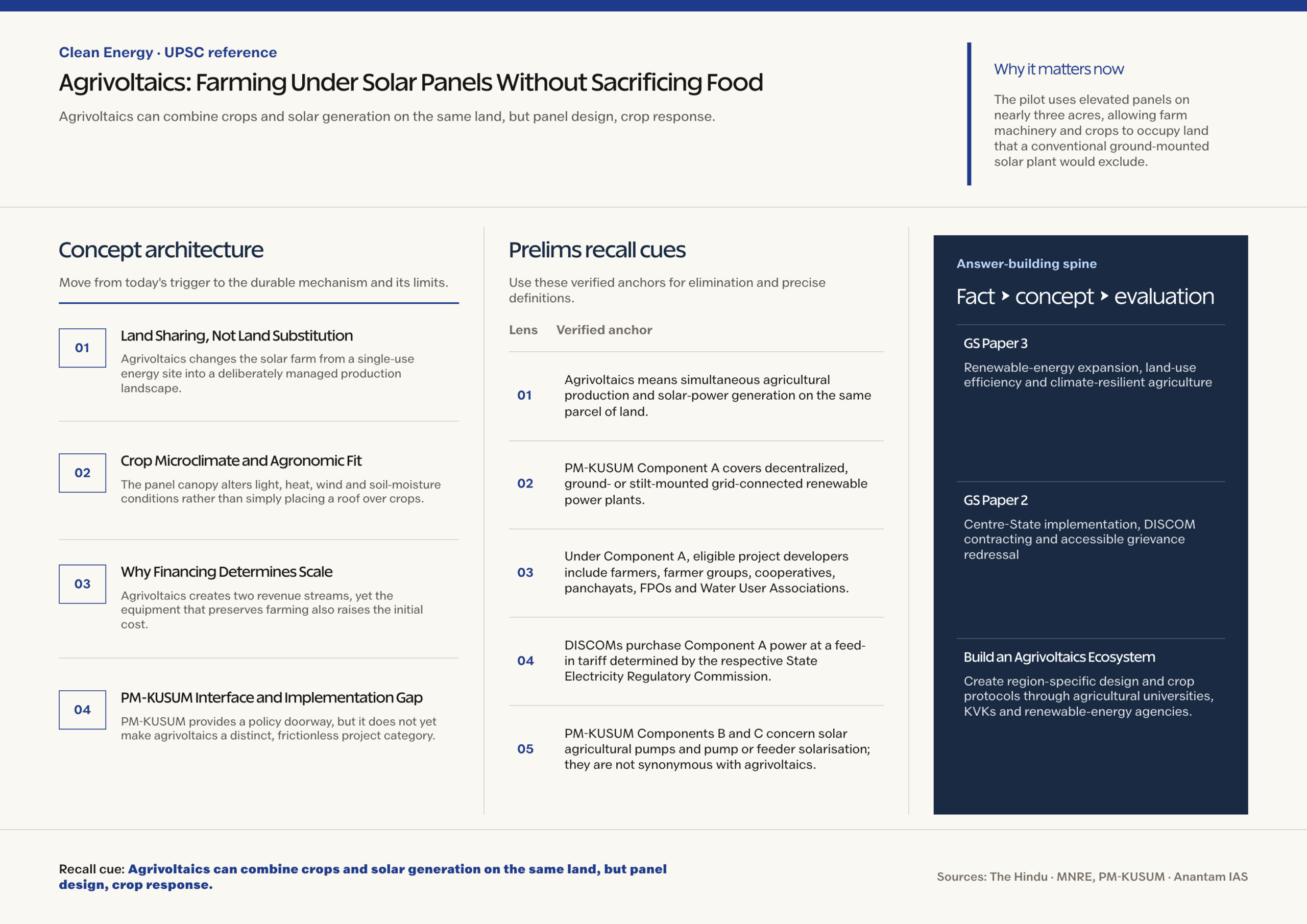
Agrivoltaics: Farming Under Solar Panels Without Sacrificing Food
Why in News?
A Rajasthan field report published on August 23 documented a farmer-owned agrivoltaics pilot that grows maize beneath an operating solar plant while exposing the financing and policy barriers to wider adoption.
- The pilot uses elevated panels on nearly three acres, allowing farm machinery and crops to occupy land that a conventional ground-mounted solar plant would exclude.
- Its 600 kW plant supplies the local grid while maize is cultivated beneath the array, making land-sharing rather than land conversion the central design choice.
- The field account links partial shade with a cooler crop environment and lower water use, but these results remain site- and crop-specific evidence.
- Retrofitting added ₹35.3 lakh to the project, showing why farmer interest does not automatically translate into adoption without suitable credit and procurement support.
- Agrivoltaics can reduce the land-use conflict between food production and utility-scale renewable energy, especially where cultivable land and solar resources overlap.
- Its value comes from combined output: electricity revenue can steady farm income, while continued cultivation protects the agricultural function of the land.
- The model succeeds only when engineering, crop choice, grid capacity, contracts and finance work together; installing pumps or panels alone does not create an agrivoltaic system.
UPSC Relevance
Prelims Relevance
- Agrivoltaics means simultaneous agricultural production and solar-power generation on the same parcel of land.
- PM-KUSUM Component A covers decentralized, ground- or stilt-mounted grid-connected renewable power plants.
- Under Component A, eligible project developers include farmers, farmer groups, cooperatives, panchayats, FPOs and Water User Associations.
- DISCOMs purchase Component A power at a feed-in tariff determined by the respective State Electricity Regulatory Commission.
- PM-KUSUM Components B and C concern solar agricultural pumps and pump or feeder solarisation; they are not synonymous with agrivoltaics.
Mains Relevance
GS Paper 3
- Renewable-energy expansion, land-use efficiency and climate-resilient agriculture
- Farm-income diversification, rural credit and decentralized electricity
GS Paper 2
- Centre-State implementation, DISCOM contracting and accessible grievance redressal
Essay
- The energy transition is durable when infrastructure adapts to livelihoods rather than displacing them.
Background and Context
Land Sharing, Not Land Substitution
Agrivoltaics changes the solar farm from a single-use energy site into a deliberately managed production landscape.
- Panels are raised and spaced so sunlight, rainfall, workers and machinery can reach the crop area; the correct geometry depends on local farming operations.
- A conventional array usually optimizes electricity per unit of land, while agrivoltaics optimizes the combined value of electricity, crops and ecosystem services.
- Panel height, row spacing and orientation affect both power yield and cultivation; copying one pilot design across agro-climatic regions can produce poor results.
- Land-sharing can protect productive farmland from complete conversion, but enforceable cultivation conditions are needed to prevent an agricultural label from masking an ordinary solar park.
Crop Microclimate and Agronomic Fit
The panel canopy alters light, heat, wind and soil-moisture conditions rather than simply placing a roof over crops.
- Partial shade can reduce heat stress and evaporation in hot, dry settings, creating a more stable microclimate beneath and between panel rows.
- The same shade can reduce photosynthesis for light-demanding crops, so crop selection, seasonal timing and panel density must follow field trials instead of assumption.
- Water savings are not automatic: irrigation scheduling must respond to soil moisture, and cheap daytime power must not encourage unsustainable groundwater extraction.
- The Rajasthan maize result shows practical promise, including off-season cultivation, but one farm cannot establish universal yield effects across soils, crops and rainfall regimes.
Why Financing Determines Scale
Agrivoltaics creates two revenue streams, yet the equipment that preserves farming also raises the initial cost.
- Elevated structures, wider spacing, stronger foundations and machinery clearance cost more than low-mounted solar, while revenue arrives gradually through crops and electricity sales.
- A farmer faces construction risk, crop risk, interest payments and the possibility of delayed grid connection; collateral and long loan tenures can exclude smallholders.
- The Rajasthan pilot’s modelling cut payback from nearly 12 years to just over six with viability-gap support, illustrating how capital support changes bankability.
- FPO aggregation, partial credit guarantees, standardized project appraisal and payment security can spread risk without treating every project as a grant-funded demonstration.
PM-KUSUM Interface and Implementation Gap
PM-KUSUM provides a policy doorway, but it does not yet make agrivoltaics a distinct, frictionless project category.
- Component A permits decentralized grid-connected plants by farmers and collectives, while DISCOMs notify available substation capacity and procure power under State-regulated tariffs.
- Agrivoltaic projects may still compete in procurement with cheaper conventional solar even though elevated structures preserve cultivation and create additional public benefits.
- State agencies control approvals, grid access and contracts, so uneven procedures, weak rural networks and delayed power-purchase agreements can defeat a sound central scheme.
- A credible interface needs agronomic standards, time-bound approvals, transparent grid-capacity data, model contracts and a grievance channel that farmers can actually reach.
Way Forward
Build an Agrivoltaics Ecosystem
- Create region-specific design and crop protocols through agricultural universities, KVKs and renewable-energy agencies, with multi-season yield and water measurements.
- Establish a distinct PM-KUSUM pathway for genuine dual-use projects, tied to continued cultivation and suitable procurement valuation.
- Use NABARD-linked credit guarantees, FPO aggregation and standard bankable contracts to reduce collateral, appraisal and transaction barriers for smaller farmers.
- Coordinate solar expansion with feeder capacity, metering, groundwater safeguards and predictable DISCOM payments before inviting farmer investment.
Conclusion
- Agrivoltaics is not a solar pump scheme with crops nearby; it is a co-designed land system whose engineering must preserve farm production while generating power.
- In a Mains answer, connect its promise to three conditions: crop-specific evidence, affordable long-term finance and State institutions capable of procuring and absorbing decentralized electricity.
UPSC Practice Questions
Prelims MCQ 1
With reference to agrivoltaics, consider the following statements:
- It combines agricultural production and solar-power generation on the same parcel of land.
- Partial shading invariably increases the yield of every crop.
- Panel height and spacing can affect both cultivation and electricity generation.
How many of the above statements are correct?
(a) Only one (b) Only two (c) All three (d) None
Answer: (b) Only two
Explanation:
Statements 1 and 3 are correct. Crop response to shade varies with species, season, climate and system design, so statement 2 is incorrect.
Prelims MCQ 2
Which PM-KUSUM component most directly provides for decentralized grid-connected renewable power plants by farmers, farmer groups and eligible rural institutions?
(a) Component A (b) Component B (c) Component C only (d) None of the components
Answer: (a) Component A
Explanation:
Component A covers decentralized ground- or stilt-mounted grid-connected renewable power plants. Components B and C focus on standalone pumps and pump or feeder solarisation.
UPSC Mains Questions
- Agrivoltaics can reduce the conflict between India’s food and renewable-energy goals, but its success depends on design rather than land use alone. Discuss.
- Examine the financial and institutional changes required to connect farmer-owned agrivoltaics with the PM-KUSUM framework.
Sources: The Hindu and MNRE, PM-KUSUM.
Frequently Asked Questions
What is agrivoltaics?
Agrivoltaics is the planned use of the same land for crop or livestock production and solar-power generation, using panel height, spacing and management that preserve agricultural activity.
How can solar panels help crops?
In hot, dry conditions, partial shade may reduce heat stress and evaporation. Benefits depend on crop, season, soil, water management and panel geometry; yield gains are not automatic.
Why is agrivoltaics more expensive than conventional solar?
Elevated structures, wider spacing, stronger foundations and access for farm machinery add capital costs. Farmers also face lending, grid-connection and power-purchase risks before revenues stabilize.
How does PM-KUSUM relate to agrivoltaics?
Component A can support decentralized grid-connected projects by farmers and rural collectives, but agrivoltaics still needs suitable State procurement, agronomic standards and finance tailored to dual use.
What is the main policy safeguard for agrivoltaics?
Support should be conditional on continued, measurable agricultural production, preventing ordinary solar parks from claiming dual-use benefits while productive farmland is effectively removed from cultivation.
Source: https://anantamias.com/current-affairs/agrivoltaics-solar-farming-land-use/
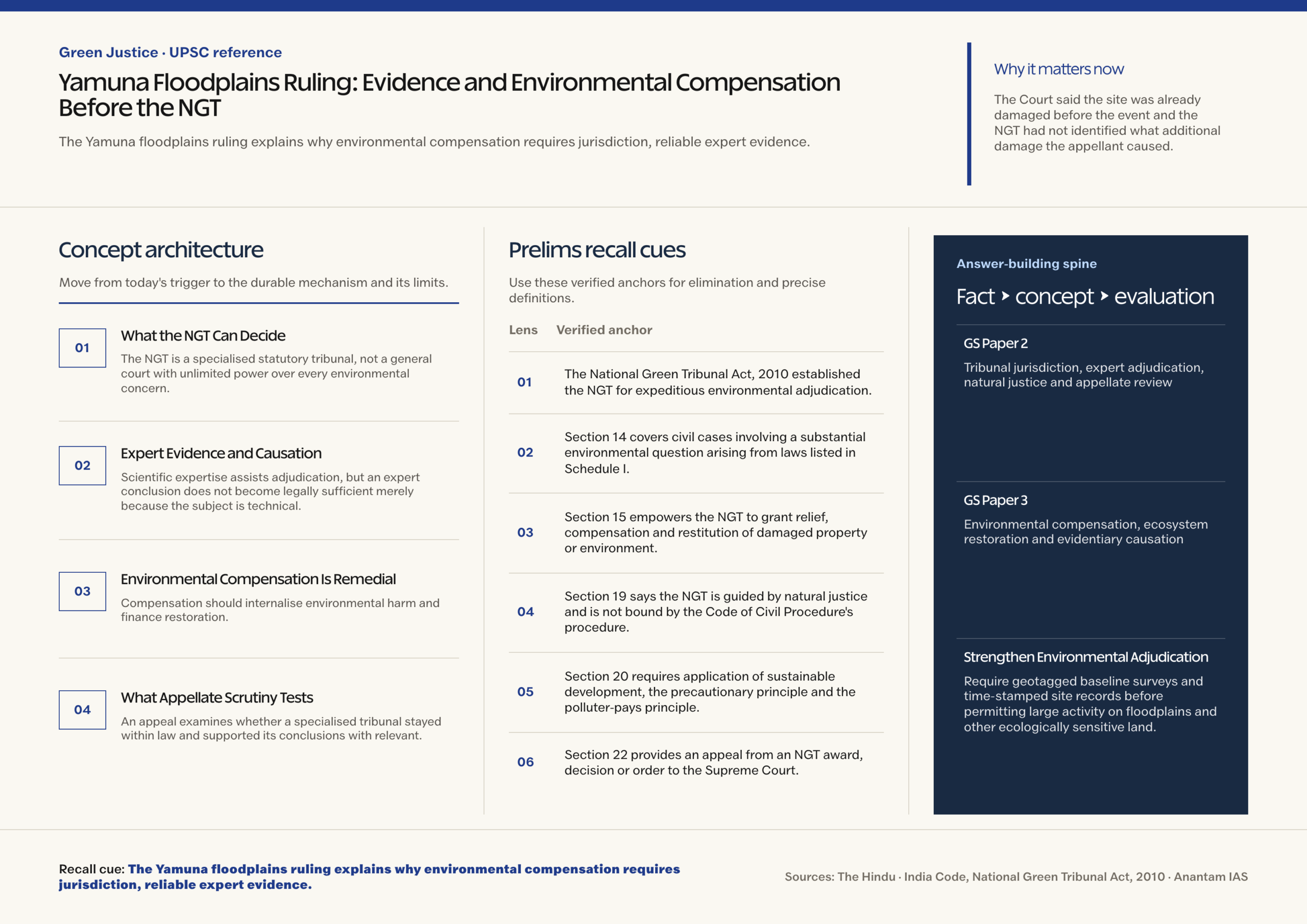
Yamuna Floodplains Ruling: Evidence and Environmental Compensation Before the NGT
Why in News?
On August 22, the Supreme Court set aside an NGT finding of damage to the Yamuna floodplains because the tribunal had not adequately established additional harm attributable to the appellant.
- The Court said the site was already damaged before the event and the NGT had not identified what additional damage the appellant caused.
- It found that the tribunal relied heavily on an expert report and a solitary satellite image without testing them against other contemporaneous evidence.
- The Court still criticised permission for an event on an active floodplain as inconsistent with the precautionary principle and public trust doctrine.
- The Delhi Development Authority’s continuing responsibility to manage and rehabilitate the floodplain remained unchanged, separating restoration duty from disputed private liability.
- Environmental adjudication must protect vulnerable ecosystems quickly, but urgency does not remove the need for a reasoned link between an actor, an act and proven damage.
- The ruling distinguishes prevention and public restoration from compensation imposed on a particular party; each may rest on a different legal and evidentiary basis.
- Floodplains store water, moderate floods and support ecological processes, making permission, monitoring and baseline documentation central to the public trust obligation.
UPSC Relevance
Prelims Relevance
- The National Green Tribunal Act, 2010 established the NGT for expeditious environmental adjudication.
- Section 14 covers civil cases involving a substantial environmental question arising from laws listed in Schedule I.
- Section 15 empowers the NGT to grant relief, compensation and restitution of damaged property or environment.
- Section 19 says the NGT is guided by natural justice and is not bound by the Code of Civil Procedure’s procedure.
- Section 20 requires application of sustainable development, the precautionary principle and the polluter-pays principle.
- Section 22 provides an appeal from an NGT award, decision or order to the Supreme Court.
Mains Relevance
GS Paper 2
- Tribunal jurisdiction, expert adjudication, natural justice and appellate review
- Reasoned orders, institutional accountability and the public trust doctrine
GS Paper 3
- Environmental compensation, ecosystem restoration and evidentiary causation
Essay
- Good environmental governance joins ecological urgency with procedural fairness; weakening either makes protection less durable.
Background and Context
What the NGT Can Decide
The NGT is a specialised statutory tribunal, not a general court with unlimited power over every environmental concern.
- Its original jurisdiction under Section 14 requires a civil case, a substantial environmental question and a connection to an enactment listed in Schedule I.
- Section 15 authorises relief to victims, compensation for damaged property and restitution of the environment, allowing adjudication to combine individual and ecological remedies.
- The tribunal may regulate its own procedure, receive evidence and draw on expert members, but flexibility must remain consistent with natural justice and reasoned decision-making.
- A tribunal should identify the dispute, statutory source of power, liable actor, proved harm and legal basis of each remedy before fixing responsibility.
Expert Evidence and Causation
Scientific expertise assists adjudication, but an expert conclusion does not become legally sufficient merely because the subject is technical.
- A damage assessment needs a credible baseline: the condition of the site before the disputed activity, measured against its condition afterward.
- Satellite images can reveal land-cover change, but date, resolution, interpretation and corroboration determine whether they establish who caused a specific ecological alteration.
- Contemporaneous letters, inspections, photographs, prior restoration orders and site records must be reconciled rather than displaced by one later expert inference.
- Where several actors or pre-existing pressures contributed to degradation, the order must explain incremental harm, attribution and uncertainty instead of assigning the whole condition to one event.
Environmental Compensation Is Remedial
Compensation should internalise environmental harm and finance restoration, not operate as an unexplained penalty detached from proven damage.
- The polluter-pays principle makes a polluter bear prevention and remediation costs, but it still requires a defensible finding that the party caused or contributed to pollution.
- A sound computation connects the affected area, ecological functions, duration, restoration measures and responsible share to the amount imposed.
- The precautionary principle can justify preventive controls amid scientific uncertainty; it does not automatically prove retrospective causation against a named party.
- Public authorities may retain independent restoration duties under the public trust doctrine even when compensation against a private actor is set aside.
What Appellate Scrutiny Tests
An appeal examines whether a specialised tribunal stayed within law and supported its conclusions with relevant, tested material.
- Section 22 permits an aggrieved person to appeal an NGT award, decision or order to the Supreme Court on specified legal grounds.
- Appellate review asks whether relevant evidence was ignored, irrelevant material dominated, findings lacked reasons or the remedy exceeded the dispute actually adjudicated.
- Judicial correction of a liability finding does not erase the ecological problem; it can leave regulatory criticism and restoration directions intact while correcting attribution.
- For durable green justice, a tribunal order must be both scientifically credible and legally reviewable, with a clear chain from evidence to finding to remedy.
Way Forward
Strengthen Environmental Adjudication
- Require geotagged baseline surveys and time-stamped site records before permitting large activity on floodplains and other ecologically sensitive land.
- Use multidisciplinary expert panels with disclosed methods, competing evidence, uncertainty ranges and opportunities for affected parties to respond.
- Adopt transparent compensation protocols that separate proven incremental damage, restoration cost, deterrence and each actor’s contribution.
- Track compliance with restoration orders independently of compensation litigation so ecosystem repair does not wait for final allocation of liability.
Conclusion
- The ruling’s durable lesson is not weaker floodplain protection; it is that environmental liability must be evidenced, causally attributed and matched to a reasoned remedy.
- A balanced Mains answer should defend precautionary regulation and public restoration while insisting that expert material be tested before imposing compensation on a specific party.
UPSC Practice Questions
Prelims MCQ 1
With reference to the National Green Tribunal Act, 2010, consider the following statements:
- The NGT may order restitution of a damaged environment.
- The NGT is bound by the procedure laid down in the Code of Civil Procedure, 1908.
- The NGT must apply the precautionary principle and polluter-pays principle while passing orders or awards.
How many of the above statements are correct?
(a) Only one (b) Only two (c) All three (d) None
Answer: (b) Only two
Explanation:
Statements 1 and 3 are correct under Sections 15 and 20. Under Section 19, the NGT is guided by natural justice and is not bound by CPC procedure.
Prelims MCQ 2
An appeal against an award, decision or order of the National Green Tribunal lies directly to which institution under Section 22 of the NGT Act?
(a) The concerned High Court (b) The Central Pollution Control Board (c) The Supreme Court of India (d) The Ministry of Environment, Forest and Climate Change
Answer: (c) The Supreme Court of India
Explanation:
Section 22 provides a statutory appeal from an NGT award, decision or order to the Supreme Court.
UPSC Mains Questions
- Environmental compensation must be restorative, but it cannot be detached from proof of causation. Discuss with reference to the powers of the National Green Tribunal.
- How can expert evidence and appellate review strengthen rather than weaken environmental justice in India?
Sources: The Hindu and India Code, National Green Tribunal Act, 2010.
Frequently Asked Questions
What was the central evidentiary issue in the Yamuna floodplains ruling?
The Court found that pre-existing degradation and other contemporaneous material were not adequately tested before attributing additional damage to the appellant.
Can the NGT order environmental restoration?
Yes. Section 15 empowers the NGT to order restitution of damaged property and the environment, alongside relief and compensation within its statutory jurisdiction.
Does the polluter-pays principle remove the need to prove causation?
No. It determines who should bear prevention and remediation costs after responsibility is established; it does not replace evidence connecting a party to the harm.
Why does baseline evidence matter in environmental cases?
A reliable baseline separates pre-existing degradation from incremental harm, allowing experts and adjudicators to identify change, attribute responsibility and design proportionate restoration.
Can restoration continue when private compensation is set aside?
Yes. A public authority’s management and restoration duties may survive because they arise from regulatory obligations and public trust, independently of disputed private liability.
Source: https://anantamias.com/current-affairs/yamuna-floodplains-ngt-evidence-compensation/
Drug-Resistant Shigella: Kerala’s Surveillance Warning for Diarrhoeal Disease
Why in News?
Kerala’s AMR surveillance data, highlighted on August 23 alongside a recent tertiary-centre study, showed that commonly used antibiotics are becoming unreliable against local Shigella isolates.
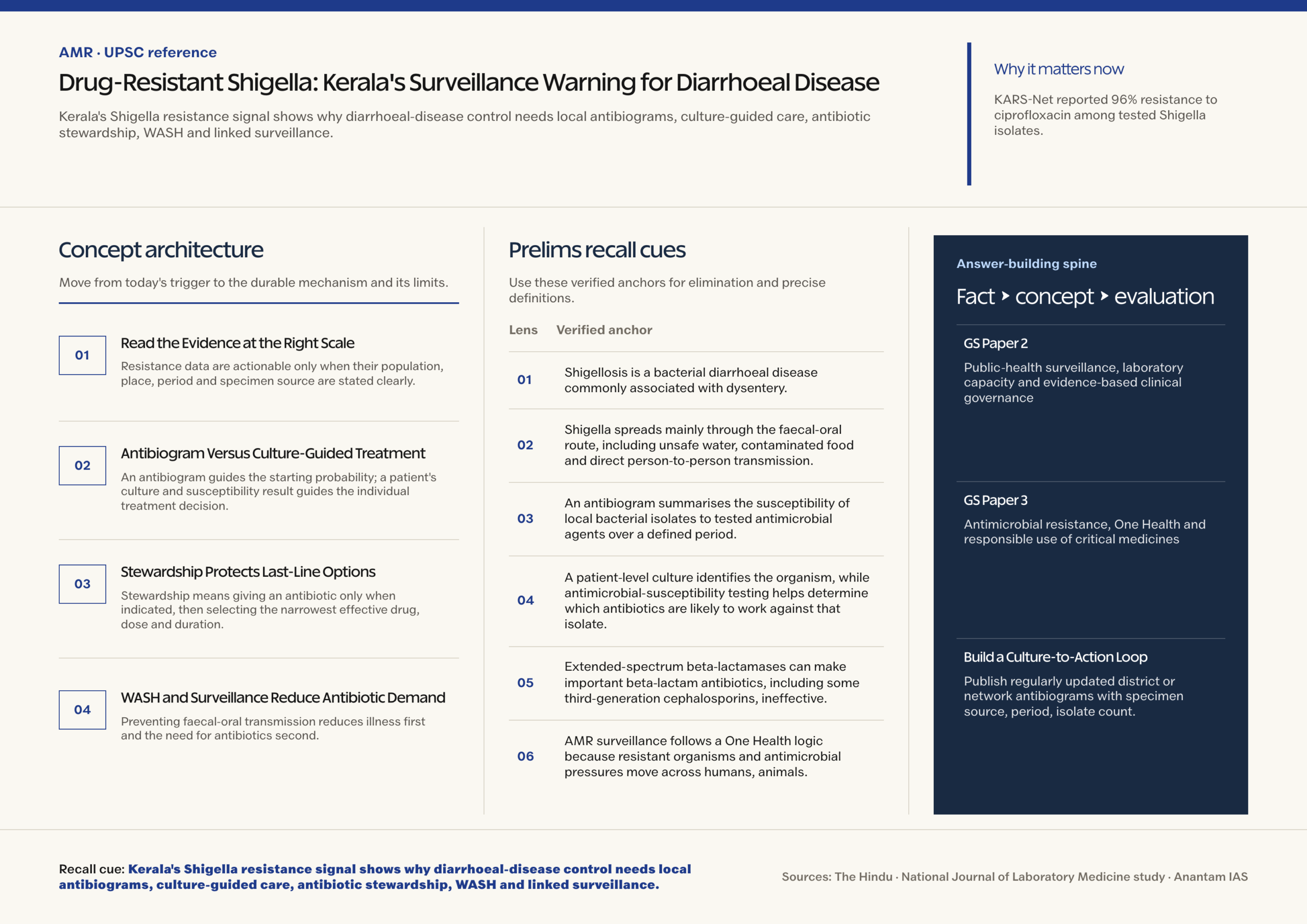
- KARS-Net reported 96% resistance to ciprofloxacin among tested Shigella isolates, making routine empirical reliance on this older option unsafe in that surveillance context.
- Resistance to ceftriaxone was reported at 36%, narrowing options for serious hospitalized cases that require timely effective treatment.
- A July study using historical isolates from a tertiary centre in north Kerala also found multidrug resistance and supported the need for regional monitoring.
- These datasets describe tested isolates and clinical settings; they do not establish the prevalence of resistant Shigella across Kerala’s entire population.
- Shigella is an enteric bacterium transmitted through the faecal-oral route, including contaminated food or water and person-to-person spread.
- Many diarrhoeal illnesses improve with appropriate rehydration, while selected severe or high-risk cases may need antibiotics based on clinical assessment and local resistance evidence.
- Resistance increases the risk of treatment failure, longer illness, costlier care and greater dependence on reserve antibiotics, linking community infection control with AMR governance.
UPSC Relevance
Prelims Relevance
- Shigellosis is a bacterial diarrhoeal disease commonly associated with dysentery.
- Shigella spreads mainly through the faecal-oral route, including unsafe water, contaminated food and direct person-to-person transmission.
- An antibiogram summarises the susceptibility of local bacterial isolates to tested antimicrobial agents over a defined period.
- A patient-level culture identifies the organism, while antimicrobial-susceptibility testing helps determine which antibiotics are likely to work against that isolate.
- Extended-spectrum beta-lactamases can make important beta-lactam antibiotics, including some third-generation cephalosporins, ineffective.
- AMR surveillance follows a One Health logic because resistant organisms and antimicrobial pressures move across humans, animals, food and the environment.
Mains Relevance
GS Paper 2
- Public-health surveillance, laboratory capacity and evidence-based clinical governance
- WASH services, outbreak response and equitable access to diagnostics
GS Paper 3
- Antimicrobial resistance, One Health and responsible use of critical medicines
Essay
- A medicine remains a public good only when institutions protect its effectiveness from avoidable misuse.
Background and Context
Read the Evidence at the Right Scale
Resistance data are actionable only when their population, place, period and specimen source are stated clearly.
- KARS-Net combines laboratory observations to identify changing susceptibility patterns, helping clinicians and health authorities detect when standard empirical choices are losing reliability across reporting sites.
- A tertiary-centre study captures patients reaching a referral hospital and may over-represent complicated illness, prior antibiotic exposure or treatment failure compared with community cases.
- The July study examined older specimens, so it supports a historical local signal rather than independently measuring the current statewide burden or present community transmission.
- Outbreak severity and resistance can occur together without proving that resistance caused particular deaths; that link needs patient-level clinical, microbiological and treatment data.
Antibiogram Versus Culture-Guided Treatment
An antibiogram guides the starting probability; a patient’s culture and susceptibility result guides the individual treatment decision.
- A local antibiogram aggregates recent isolates and shows how often each tested drug remained active within a hospital, district or surveillance network.
- For severe dysentery or an outbreak, collecting an appropriate stool specimen before antibiotics can improve organism identification and resistance tracking when clinically feasible.
- Empirical treatment may be necessary before results in a critically ill patient, but its choice should reflect local data, clinical severity and current guidelines.
- Once susceptibility results arrive, clinicians can confirm, narrow, change or stop therapy, reducing ineffective exposure, avoidable adverse effects and unnecessary pressure on broader-spectrum drugs.
Stewardship Protects Last-Line Options
Stewardship means giving an antibiotic only when indicated, then selecting the narrowest effective drug, dose and duration.
- Routine antibiotics for self-limiting watery diarrhoea create selective pressure without reliable benefit and can obscure the pathogen before a needed culture is obtained.
- Escalating every suspected case to a reserve drug would accelerate resistance and expose patients to avoidable harms; restricted agents need specialist and microbiology oversight.
- Hospitals should audit empirical prescriptions against culture results, provide rapid feedback and update treatment pathways when the local antibiogram changes materially over successive reporting periods.
- Community messaging should pair rehydration guidance and danger-sign recognition with a clear warning against self-medication and incomplete or shared antibiotic courses.
WASH and Surveillance Reduce Antibiotic Demand
Preventing faecal-oral transmission reduces illness first and the need for antibiotics second.
- Safe drinking water, functional sanitation, handwashing with soap and hygienic food preparation interrupt transmission without depending on an organism’s drug-susceptibility profile.
- Outbreak investigation should connect patient interviews, water and food testing, laboratory typing and sanitation inspection to locate a shared source or transmission chain.
- Laboratories need standard methods, quality assurance and timely reporting so district, State and national systems can compare trends without mixing incompatible data.
- Surveillance should include community and secondary-care sites, not only tertiary hospitals, to reveal geographic variation and make the denominator more representative.
Way Forward
Build a Culture-to-Action Loop
- Publish regularly updated district or network antibiograms with specimen source, period, isolate count, laboratory method and clear limits on interpretation.
- Expand stool-culture and susceptibility capacity during clusters, with rapid sample transport and results returned to treating clinicians and surveillance teams.
- Link stewardship committees to KARS-Net alerts so empirical protocols change when resistance thresholds make an existing first choice unreliable.
- Treat safe water, sanitation inspection and food hygiene as core AMR interventions because preventing infection lowers antibiotic consumption and transmission together.
Conclusion
- Kerala’s signal is not proof of uniform statewide prevalence; it is a warning that local susceptibility evidence must shape treatment and surveillance priorities.
- A strong Mains answer should join culture-guided care and stewardship with WASH prevention, because better prescribing cannot compensate for continued faecal-oral transmission.
UPSC Practice Questions
Prelims MCQ 1
With reference to an antibiogram, consider the following statements:
- It summarises antimicrobial susceptibility among bacterial isolates from a defined setting and period.
- It replaces the need for culture and susceptibility testing in every severe individual case.
- Its interpretation depends on factors such as specimen source, patient population and laboratory methods.
How many of the above statements are correct?
(a) Only one (b) Only two (c) All three (d) None
Answer: (b) Only two
Explanation:
Statements 1 and 3 are correct. An antibiogram informs empirical choices but does not replace patient-specific testing when culture is indicated and feasible.
Prelims MCQ 2
Which intervention most directly reduces both faecal-oral transmission of Shigella and the resulting demand for antibiotics?
(a) Routine prophylactic antibiotics for all contacts (b) Safe water, sanitation and hand hygiene (c) Automatic use of reserve antibiotics (d) Suspending stool cultures during outbreaks
Answer: (b) Safe water, sanitation and hand hygiene
Explanation:
WASH measures interrupt transmission and prevent illness, reducing both infection burden and antibiotic demand without adding antimicrobial selection pressure.
UPSC Mains Questions
- Why must local antibiograms be interpreted alongside patient-level culture results and the limits of surveillance data? Explain using Shigellosis as an example.
- Antimicrobial stewardship alone cannot control drug-resistant enteric disease. Discuss the complementary roles of WASH, laboratories and public-health surveillance.
Sources: The Hindu and National Journal of Laboratory Medicine study.
Frequently Asked Questions
What is Shigellosis?
Shigellosis is a bacterial intestinal infection that can cause diarrhoea or dysentery. It spreads mainly through faecally contaminated hands, food or water.
What does a local antibiogram show?
It summarises how frequently local bacterial isolates were susceptible to tested antibiotics during a defined period, helping clinicians choose evidence-based empirical therapy.
Why can a tertiary-centre study not establish statewide prevalence?
Referral hospitals see a selected patient population, often with more severe disease or prior treatment. Their isolates may not represent infections across all communities and facilities.
When is culture-guided treatment useful?
Culture and susceptibility testing are especially valuable in severe disease, outbreaks or suspected treatment failure because they identify the organism and drugs likely to remain effective.
How does WASH help control antimicrobial resistance?
Safe water, sanitation, hand hygiene and food safety prevent enteric infections, lowering antibiotic use and limiting transmission of both susceptible and resistant organisms.
Source: https://anantamias.com/current-affairs/drug-resistant-shigella-kerala-amr-surveillance/
Iran’s Threat to Alternative Gulf Shipping Routes
Why in News?
On August 23, Iran’s security chief threatened neighbors’ alternative oil-shipping routes if they joined new U.S. economic pressure, but no route closure or attack was reported.
- The statement, reported by The Hindu, referred to export routes built to avoid the Strait of Hormuz and described retaliation as conditional on neighboring states joining U.S. measures.
- The threat was an attributed contingency, not evidence that Iran had begun an attack, imposed a blockade, or disabled a pipeline or terminal.
- The exposed network includes the UAE’s route to Fujairah on the Gulf of Oman and Saudi Arabia’s cross-country route to Yanbu on the Red Sea.
- The episode shifts analysis from one narrow strait to network resilience: pipelines, export terminals, storage, insurance, naval security, and destination-market access must work together.
- A bypass reduces dependence on one maritime exit, but its fixed capacity, pumping stations, storage sites, and terminal infrastructure create new concentrated points of failure.
- For India, disruption can transmit through freight premiums, war-risk insurance, delivery delays, crude benchmarks, LPG and LNG availability, and pressure on refinery sourcing plans.
- Diplomatic signaling can raise commercial risk before physical disruption because shipowners, insurers, lenders, and charterers price the probability of escalation.
UPSC Relevance
Prelims Relevance
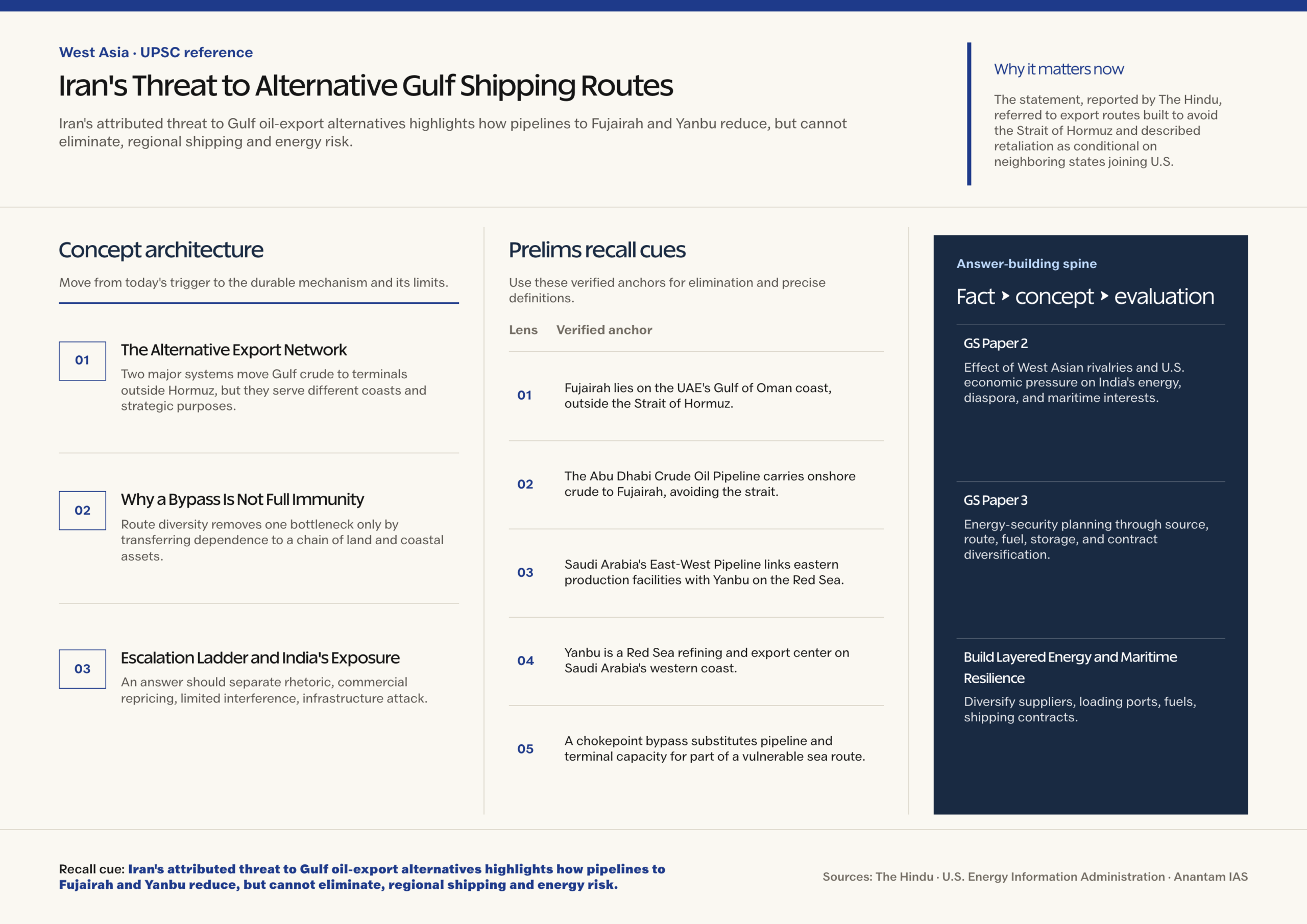
- Fujairah lies on the UAE’s Gulf of Oman coast, outside the Strait of Hormuz.
- The Abu Dhabi Crude Oil Pipeline carries onshore crude to Fujairah, avoiding the strait.
- Saudi Arabia’s East-West Pipeline links eastern production facilities with Yanbu on the Red Sea.
- Yanbu is a Red Sea refining and export center on Saudi Arabia’s western coast.
- A chokepoint bypass substitutes pipeline and terminal capacity for part of a vulnerable sea route; it does not automatically replace all flows.
Mains Relevance
GS Paper 2
- Effect of West Asian rivalries and U.S. economic pressure on India’s energy, diaspora, and maritime interests.
- Role of calibrated diplomacy with Iran, Gulf Arab partners, the United States, and regional mediators.
GS Paper 3
- Energy-security planning through source, route, fuel, storage, and contract diversification.
- Protection of critical pipeline-terminal networks and management of freight, insurance, and supply-chain shocks.
Essay
- Resilience comes from diverse systems and trusted relationships, not from replacing one dependency with another.
Background and Context
The Alternative Export Network
Two major systems move Gulf crude to terminals outside Hormuz, but they serve different coasts and strategic purposes.
- The UAE’s Abu Dhabi Crude Oil Pipeline moves crude from inland fields to Fujairah, where tankers load on the Gulf of Oman side of the strait.
- The U.S. Energy Information Administration describes the UAE pipeline as a 1.8 million-barrel-per-day route, while operational use limits how much additional oil it can absorb during disruption.
- Saudi Arabia’s East-West Pipeline carries crude from the Abqaiq area across the peninsula to Yanbu, shifting the loading point from the Persian Gulf to the Red Sea.
- EIA lists its normal capacity at 5 million barrels per day, with temporary expansion possible; existing use means nameplate capacity is not the same as spare capacity.
- Iran’s own Goreh-Jask system reaches the Gulf of Oman, showing that bypass infrastructure is also part of Iran’s strategy, although EIA records limited historical use.
Why a Bypass Is Not Full Immunity
Route diversity removes one bottleneck only by transferring dependence to a chain of land and coastal assets.
- A pipeline requires functioning pumping stations, power, control systems, storage, maintenance, and a secure export terminal; failure at any critical node can reduce usable throughput.
- Fujairah avoids Hormuz, but cargoes still enter the Gulf of Oman and Arabian Sea; maritime security beyond the strait remains necessary.
- Yanbu avoids Hormuz through a land bridge, yet westbound cargoes may face separate Red Sea routing and security constraints depending on their final destination.
- EIA estimated the combined Saudi-UAE effective unused bypass capacity at about 2.6 million barrels per day in its 2025 assessment, far below total regional export requirements.
- The strategic value is partial continuity: preserve some exports, improve bargaining space, and reduce shock severity rather than promise complete substitution.
Escalation Ladder and India's Exposure
An answer should separate rhetoric, commercial repricing, limited interference, infrastructure attack, and sustained regional disruption.
- At the first rung, a conditional threat changes expectations; insurers and shipowners may demand higher premiums or alter charter terms without any physical incident.
- The next rung could involve harassment, cyber interference, sabotage, or a localized strike; each has different evidence requirements and should not be inferred from rhetoric alone.
- A wider confrontation could threaten pipelines, storage tanks, loading berths, and nearby sea lanes simultaneously, defeating the assumption that a single bypass guarantees continuity.
- India’s exposure is a portfolio problem: crude, LNG, LPG, fertiliser inputs, shipping services, and millions of citizens in the Gulf connect energy security with external affairs.
- Policy should track delivered cost and reliability, not only the source country’s crude price, because freight, insurance, voyage time, and terminal access shape the final shock.
Way Forward
Build Layered Energy and Maritime Resilience
- Diversify suppliers, loading ports, fuels, shipping contracts, and payment channels so one regional disruption does not disable the whole import portfolio.
- Coordinate strategic petroleum reserves, refinery inventories, demand management, and government-industry contingency drills against short, medium, and prolonged disruption scenarios.
- Use diplomacy and maritime information-sharing to protect Indian seafarers, maintain communication with regional states, and prevent commercial warnings from becoming uncontrolled escalation.
- Stress-test contracts for force majeure, war-risk insurance, rerouting, terminal substitution, and emergency cargo swaps before a crisis activates those clauses.
Conclusion
- Alternative routes to Fujairah and Yanbu create resilience, but limited spare capacity and concentrated infrastructure prevent them from becoming complete substitutes for Gulf maritime flows.
- In a Mains answer, separate the conditional Iranian statement from verified action, then evaluate exposure through the chain of pipelines, terminals, shipping, insurance, storage, and Indian demand.
UPSC Practice Questions
Prelims MCQ 1
With reference to alternative oil-export routes in the Gulf region, consider the following statements:
- The Abu Dhabi Crude Oil Pipeline carries crude to Fujairah on the Gulf of Oman coast.
- Saudi Arabia’s East-West Pipeline carries crude to Yanbu on the Red Sea coast.
- Both routes terminate inside the Persian Gulf and require tankers to cross the Strait of Hormuz.
How many of the above statements are correct?
(a) Only one (b) Only two (c) All three (d) None
Answer: (b) Only two
Explanation:
Statements 1 and 2 are correct. Fujairah and Yanbu provide loading points outside the Persian Gulf; the third statement reverses their strategic purpose.
Prelims MCQ 2
Which one of the following best explains why a bypass pipeline cannot provide complete immunity from a maritime chokepoint shock?
(a) Pipelines can transport only natural gas (b) Export terminals cannot load seagoing tankers (c) Spare capacity is limited and the pipeline-terminal chain has its own vulnerable nodes (d) International law prohibits pipelines from crossing deserts
Answer: (c) Spare capacity is limited and the pipeline-terminal chain has its own vulnerable nodes
Explanation:
Bypasses can preserve part of export capacity, but pumps, power, storage, terminals, sea approaches, and limited spare throughput remain constraints.
UPSC Mains Questions
- Alternative Gulf export routes reduce chokepoint dependence but do not eliminate systemic energy risk. Discuss with reference to pipeline-terminal networks and India’s exposure.
- How should India combine diplomacy, strategic reserves, import diversification, and maritime preparedness when geopolitical threats raise commercial risk before physical disruption occurs?
Sources: The Hindu and U.S. Energy Information Administration.
Frequently Asked Questions
Did Iran close or attack an alternative Gulf shipping route?
No. The August 23 report described a conditional threat attributed to Iran’s security chief. It did not report an implemented closure, blockade, or attack on a route.
Which UAE route bypasses the Strait of Hormuz?
The Abu Dhabi Crude Oil Pipeline carries onshore crude to Fujairah on the Gulf of Oman, allowing tankers to load outside the strait.
How does Saudi Arabia move crude to the Red Sea?
The East-West Pipeline links eastern oil facilities with Yanbu, creating a land route to a western export terminal instead of loading all cargoes on the Gulf coast.
Why can insurance costs rise before any attack?
Insurers and shipowners price expected danger. A credible escalation threat can increase war-risk premiums, charter costs, and caution even while routes remain physically open.
What is the main lesson for India’s energy security?
India needs diversification across suppliers, routes, fuels, contracts, storage, and shipping support because a bypass route reduces one dependency but creates other concentrated infrastructure risks.
Source: https://anantamias.com/current-affairs/iran-alternative-shipping-routes-gulf-chokepoints/
Child Cold Medicines and India’s Wider FDC Warning Rule
Why in News?
A Gazette notification broadened India’s restriction on fixed-dose combinations containing chlorpheniramine maleate and phenylephrine hydrochloride by mandating an under-four warning across all such formulations.
- The measure covers all FDC formulations containing both compounds, including formulations with additional ingredients, rather than only the earlier two-ingredient combination.
- Manufacturers must state that the FDC shall not be used in children below four years on the label, package insert, or promotional literature.
- The notification restricts manufacture, sale, or distribution subject to this condition; it does not prohibit every sale or adult use of these formulations.
- The rule took effect from publication in the Official Gazette and followed review by a Health Ministry expert committee and the Drugs Technical Advisory Board.
- Multi-ingredient cold medicines can expose young children to dosing errors and overlapping active ingredients while offering limited benefit for uncomplicated, self-limiting viral colds.
- The case illustrates risk-proportionate regulation: identify a vulnerable population, assess benefit and safer alternatives, impose a targeted condition, and communicate it throughout the product chain.
- Effective labeling needs enforcement, pharmacist counseling, prescriber compliance, caregiver literacy, and adverse-event reporting; a printed warning alone cannot prevent every unsafe use.
UPSC Relevance
Prelims Relevance
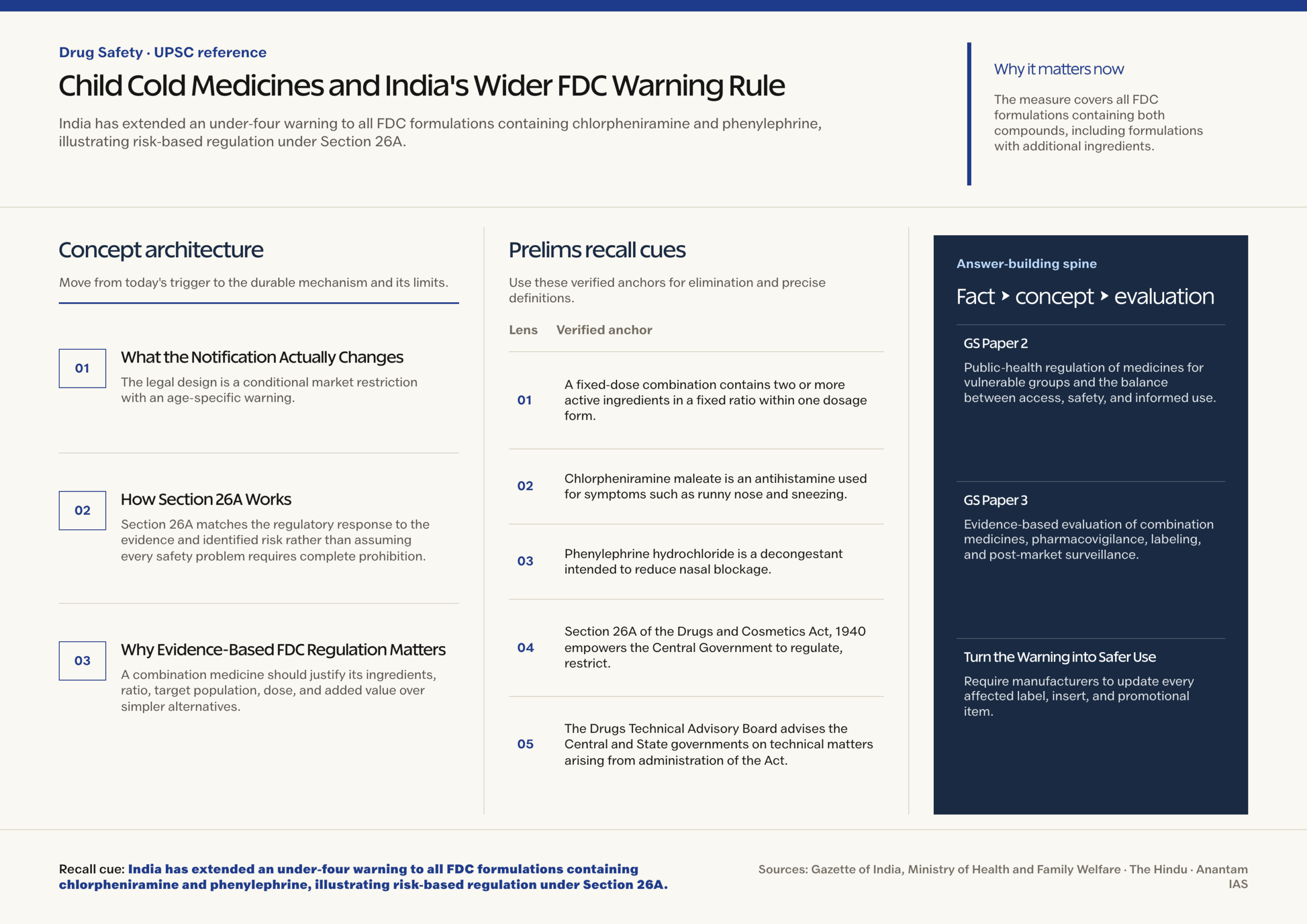
- A fixed-dose combination contains two or more active ingredients in a fixed ratio within one dosage form.
- Chlorpheniramine maleate is an antihistamine used for symptoms such as runny nose and sneezing.
- Phenylephrine hydrochloride is a decongestant intended to reduce nasal blockage.
- Section 26A of the Drugs and Cosmetics Act, 1940 empowers the Central Government to regulate, restrict, or prohibit specified drugs in public interest.
- The Drugs Technical Advisory Board advises the Central and State governments on technical matters arising from administration of the Act.
Mains Relevance
GS Paper 2
- Public-health regulation of medicines for vulnerable groups and the balance between access, safety, and informed use.
- Coordination among the Union government, expert bodies, manufacturers, prescribers, pharmacists, and State enforcement agencies.
GS Paper 3
- Evidence-based evaluation of combination medicines, pharmacovigilance, labeling, and post-market surveillance.
- Regulatory science as a bridge between clinical evidence, product design, manufacturing conditions, and consumer protection.
Essay
- Public health improves when regulation converts scientific uncertainty into clear, proportionate, and enforceable protection for vulnerable citizens.
Background and Context
What the Notification Actually Changes
The legal design is a conditional market restriction with an age-specific warning, not a complete prohibition for older patients under applicable controls.
- An April 2025 notification covered the fixed combination of chlorpheniramine maleate plus phenylephrine hydrochloride and required the same under-four warning.
- The new notification extends that safeguard to all FDC formulations containing both ingredients, closing a gap where additional ingredients could place a product outside the narrower description.
- The condition attaches to manufacture, sale, or distribution: manufacturers must carry the warning on the label, package insert, or promotional literature.
- The wording creates a clear pediatric exclusion below four years while leaving compliant formulations available for other indicated users under applicable drug-control rules.
- Exam trap: restriction can impose conditions, populations, warnings, or channels; it should not be automatically rewritten as a nationwide ban on the product.
How Section 26A Works
Section 26A matches the regulatory response to the evidence and identified risk rather than assuming every safety problem requires complete prohibition.
- The Central Government may act when a drug is likely to risk humans or animals, lacks claimed therapeutic value, or contains ingredients without therapeutic justification.
- When public interest requires action, the government may regulate, restrict, or prohibit manufacture, sale, or distribution through a notification in the Official Gazette.
- These are distinct choices: regulation may prescribe controls, restriction may allow use subject to conditions, and prohibition removes the specified product or activity from the market.
- Here, an expert committee found likely risk to children below four and noted safer alternatives; DTAB later agreed that such formulations should not be used in that group.
- The notification records reasons, the covered formulations, the mandatory warning, and commencement, creating a reviewable public instrument rather than an informal advisory.
Why Evidence-Based FDC Regulation Matters
A combination medicine should justify its ingredients, ratio, target population, dose, and added value over simpler alternatives, especially for self-limiting symptoms.
- An FDC can improve convenience and adherence when ingredients have compatible doses and a sound therapeutic purpose, but convenience alone does not establish pediatric safety.
- Young children differ in drug metabolism, body size, and dosing tolerance; combining ingredients can make adverse effects and accidental duplication harder to identify.
- Chlorpheniramine may cause drowsiness or paradoxical excitability, while phenylephrine can affect heart rate and blood pressure; risk-benefit assessment must be age-specific.
- Evidence review should ask whether each ingredient contributes meaningful benefit, whether the fixed ratio fits the patient group, and whether safer non-drug or single-ingredient options exist.
- Post-market pharmacovigilance completes the cycle: adverse-event signals, prescribing patterns, labeling compliance, and new evidence should trigger reassessment rather than remain static.
Way Forward
Turn the Warning into Safer Use
- Require manufacturers to update every affected label, insert, and promotional item, with batch-level transition plans and regulatory checks against misleading pediatric claims.
- Train prescribers and pharmacists to verify age, weight, active ingredients, duplicate medicines, dosing devices, and red-flag symptoms before recommending symptomatic treatment.
- Strengthen pharmacovigilance by linking adverse-event reports with product formulation, age, dose, co-medication, and outcome so future decisions rest on usable evidence.
- Communicate that common colds are usually self-limiting while directing caregivers toward medical evaluation for breathing difficulty, dehydration, persistent fever, or other danger signs.
Conclusion
- The under-four warning is a targeted restriction: it broadens coverage across relevant FDC formulations without a blanket market ban and preserves compliant availability for other indicated users in practice.
- In a Mains answer, connect Section 26A’s graded powers with expert review, age-specific evidence, clear labeling, enforcement, and pharmacovigilance as one continuous drug-safety system.
UPSC Practice Questions
Prelims MCQ 1
With reference to Section 26A of the Drugs and Cosmetics Act, 1940, consider the following statements:
- It empowers the Central Government to regulate, restrict, or prohibit specified drugs in public interest.
- Action under it may be based on risk, lack of claimed therapeutic value, or absence of therapeutic justification for ingredients.
- Every notification under it must impose a complete nationwide ban.
How many of the above statements are correct?
(a) Only one (b) Only two (c) All three (d) None
Answer: (b) Only two
Explanation:
Statements 1 and 2 reflect Section 26A. The power is graded: a notification may regulate or restrict instead of completely prohibiting a drug.
Prelims MCQ 2
What is the principal requirement of the 2026 notification concerning FDC formulations containing chlorpheniramine maleate and phenylephrine hydrochloride?
(a) Complete prohibition of their manufacture for every age group (b) Sale only through government hospitals (c) A warning that the FDC shall not be used in children below four years (d) Replacement of both ingredients with an antibiotic
Answer: (c) A warning that the FDC shall not be used in children below four years
Explanation:
Manufacture, sale, or distribution is restricted subject to carrying the specified warning on the label, package insert, or promotional literature.
UPSC Mains Questions
- The child cold-medicine notification illustrates risk-proportionate rather than binary drug regulation. Explain with reference to Section 26A and fixed-dose combinations.
- Why must pediatric drug safety combine pre-market evidence, clear labeling, professional counseling, enforcement, and post-market pharmacovigilance? Discuss.
Sources: Gazette of India, Ministry of Health and Family Welfare and The Hindu.
Frequently Asked Questions
Has India completely banned these cold-medicine combinations?
No. Manufacture, sale, or distribution is restricted subject to a mandatory warning that the FDC shall not be used in children below four years.
Which formulations does the 2026 warning cover?
It covers all fixed-dose combination formulations containing both chlorpheniramine maleate and phenylephrine hydrochloride, including formulations that may also contain additional ingredients.
What is a fixed-dose combination?
An FDC places two or more active ingredients in a fixed ratio within one dosage form, such as one tablet or measured liquid preparation.
What does Section 26A authorize?
It allows the Central Government, through an Official Gazette notification, to regulate, restrict, or prohibit a drug’s manufacture, sale, or distribution when statutory public-interest grounds are met.
Why is a label warning not enough by itself?
Safer use also depends on compliant packaging, prescriber and pharmacist counseling, caregiver understanding, enforcement, and adverse-event reporting that can identify new safety signals.
Source: https://anantamias.com/current-affairs/child-cold-medicine-fdc-warning-rule/
Testing Ervebo Against Bundibugyo Virus During an Ebola Outbreak
Why in News?
The ICG allocated 70,000 Ervebo doses to the DRC’s Bundibugyo virus outbreak, including 20,000 for a Phase 3 trial and 50,000 for frontline and health workers.
- Ervebo is licensed and recommended for Ebola virus disease caused by Ebola virus, previously called Zaire ebolavirus, not specifically for disease caused by Bundibugyo virus.
- WHO states that it is unknown whether Ervebo protects humans against Bundibugyo virus; early laboratory and animal evidence suggests possible protection but does not establish human efficacy.
- The Phase 3 clinical trial is intended to generate evidence on the vaccine’s impact during the outbreak, not to confirm a benefit already proven.
- WHO requires people offered the vaccine, inside or outside the trial, to receive information on risks, potential benefits, and limitations and provide informed consent.
- Emergency decisions must balance two duties: protect exposed communities with the best available option and avoid overstating uncertain cross-protection between different viruses.
- A stockpile solves allocation and speed problems, but scientific validity still depends on diagnostic confirmation, protocol quality, ethical oversight, follow-up, and interpretable outcome data.
- Vaccination remains one part of outbreak control alongside surveillance, laboratory testing, contact tracing, infection prevention, clinical care, community engagement, and safe burial practices.
UPSC Relevance
Prelims Relevance
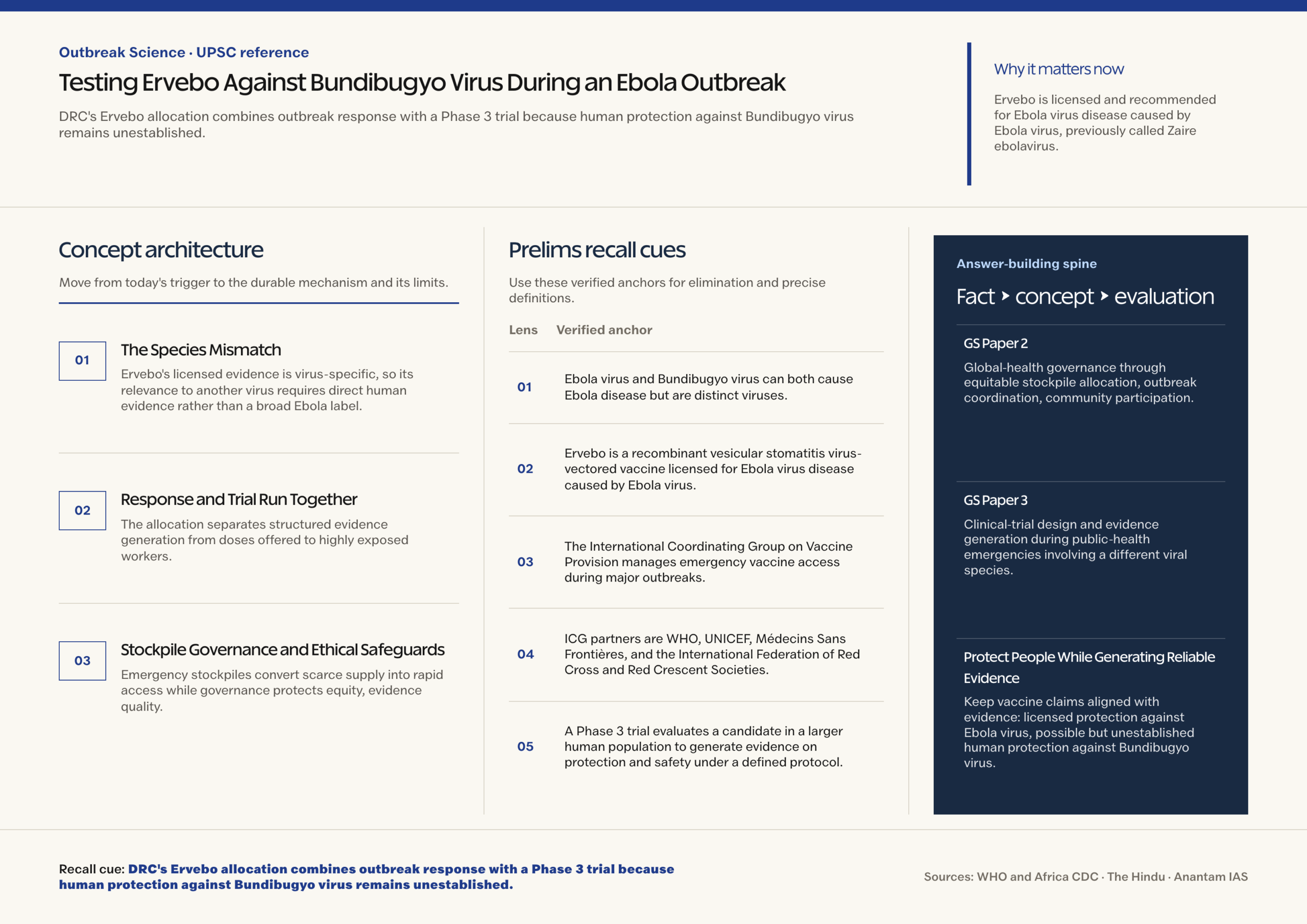
- Ebola virus and Bundibugyo virus can both cause Ebola disease but are distinct viruses; vaccine evidence for one cannot be automatically transferred to the other.
- Ervebo is a recombinant vesicular stomatitis virus-vectored vaccine licensed for Ebola virus disease caused by Ebola virus.
- The International Coordinating Group on Vaccine Provision manages emergency vaccine access during major outbreaks.
- ICG partners are WHO, UNICEF, Médecins Sans Frontières, and the International Federation of Red Cross and Red Crescent Societies.
- A Phase 3 trial evaluates a candidate in a larger human population to generate evidence on protection and safety under a defined protocol.
Mains Relevance
GS Paper 2
- Global-health governance through equitable stockpile allocation, outbreak coordination, community participation, and institutional trust.
- Ethical obligations of informed consent and transparent risk communication when emergency use extends beyond established human evidence.
GS Paper 3
- Clinical-trial design and evidence generation during public-health emergencies involving a different viral species.
- Integration of vaccines with diagnostics, surveillance, infection prevention, cold chains, and field data systems.
Essay
- In a crisis, scientific honesty is not an obstacle to action; it is the condition for legitimate and trusted action.
Background and Context
The Species Mismatch
Ervebo’s licensed evidence is virus-specific, so its relevance to another virus requires direct human evidence rather than a broad Ebola label.
- Ebola disease is a clinical syndrome that can be caused by different orthoebolaviruses; naming the disease does not make the causative viruses biologically interchangeable.
- Ervebo targets Ebola virus, historically called Zaire ebolavirus, and has established use against outbreaks caused by that virus.
- The current DRC outbreak involves Bundibugyo virus; WHO says human protection from Ervebo against this virus is not known.
- Early laboratory and animal findings can justify studying possible cross-protection, but they cannot substitute for human evidence on clinical protection in the affected population.
- Exam trap: do not call Bundibugyo a mere strain covered by the licence or convert biological plausibility into a statement of proven vaccine efficacy.
Response and Trial Run Together
The allocation separates structured evidence generation from doses offered to highly exposed workers, with distinct ethical and scientific safeguards for each pathway.
- The ICG approved an initial 70,000-dose release after the DRC requested stockpile support for the Bundibugyo outbreak.
- Of these, 20,000 doses support a Phase 3 clinical trial designed to clarify the vaccine’s impact against Bundibugyo virus in humans.
- The remaining 50,000 doses are for frontline and health workers under current WHO immunization-expert recommendations, reflecting their high occupational exposure.
- Allocation does not equal demonstrated efficacy: trial and response teams must record vaccination, exposure, outcomes, adverse events, and follow-up using predefined methods.
- All recipients need an honest explanation of the knowns, unknowns, potential benefits, and risks; consent cannot be reduced to a signature obtained during fear or urgency.
Stockpile Governance and Ethical Safeguards
Emergency stockpiles convert scarce supply into rapid access while governance protects equity, evidence quality, and legitimacy when urgency and evidence gaps coexist.
- The ICG coordinates emergency allocations through WHO, UNICEF, Médecins Sans Frontières, and the International Federation of Red Cross and Red Crescent Societies; allocation does not establish efficacy or replace independent national ethical and regulatory review.
- Its Ebola vaccine stockpile has operated since 2021, providing a pooled mechanism instead of forcing an affected country to negotiate scarce doses alone during an outbreak.
- Allocation should follow epidemiological need, operational capacity, equity, cold-chain readiness, and a feasible deployment plan rather than purchasing power or geopolitical influence.
- Trial participants require protocol review, voluntary consent, confidentiality, safety monitoring, and access to appropriate care; emergency conditions do not suspend research ethics.
- Community-led communication should explain why recipients may receive a vaccine with uncertain cross-protection while maintaining confidence in proven outbreak-control measures.
Way Forward
Protect People While Generating Reliable Evidence
- Keep vaccine claims aligned with evidence: licensed protection against Ebola virus, possible but unestablished human protection against Bundibugyo virus, and no promise of individual immunity.
- Use independent ethical oversight, plain-language consent, adverse-event monitoring, transparent trial registration, and rapid publication of interpretable positive, negative, or inconclusive results.
- Integrate vaccination with case finding, diagnostics, isolation, contact tracing, protective equipment, treatment, safe burials, and trusted local leadership.
- Invest in species-matched vaccine candidates and regional manufacturing while retaining global stockpiles for rapid, equitable access to licensed outbreak tools.
Conclusion
- The DRC allocation is a dual-purpose emergency decision: offer a plausible tool to exposed workers while a Phase 3 trial tests the unresolved Bundibugyo question without presenting possible cross-protection as established human efficacy.
- A strong Mains answer should separate licence, biological plausibility, human efficacy, emergency recommendation, consent, and stockpile allocation instead of treating them as one proof or overlooking non-vaccine controls essential to outbreak response.
UPSC Practice Questions
Prelims MCQ 1
With reference to Ervebo and the 2026 Bundibugyo virus outbreak response, consider the following statements:
- Ervebo is licensed for Ebola virus disease caused by Ebola virus, previously called Zaire ebolavirus.
- Human protection against Bundibugyo virus has already been conclusively established.
- Part of the DRC allocation is intended for a Phase 3 clinical trial.
How many of the above statements are correct?
(a) Only one (b) Only two (c) All three (d) None
Answer: (b) Only two
Explanation:
Statements 1 and 3 are correct. WHO explicitly says it is not known whether Ervebo protects humans against Bundibugyo virus.
Prelims MCQ 2
What is the principal role of the International Coordinating Group on Vaccine Provision during major outbreaks?
(a) Granting national marketing licences to every vaccine (b) Managing and coordinating equitable access to emergency vaccine supplies (c) Replacing national disease-surveillance systems (d) Conducting all clinical trials without national authorities
Answer: (b) Managing and coordinating equitable access to emergency vaccine supplies
Explanation:
The ICG manages coordinated emergency access to vaccine stockpiles; it does not replace national regulators, surveillance, or research-governance systems.
UPSC Mains Questions
- How should public-health authorities act when a licensed vaccine is biologically plausible but not proven against the virus causing the current outbreak? Discuss.
- Emergency vaccine stockpiles are institutions of both logistics and justice. Examine with reference to equitable allocation, informed consent, and evidence generation.
Sources: WHO and Africa CDC and The Hindu.
Frequently Asked Questions
Is Ervebo proven to protect humans against Bundibugyo virus?
No. WHO says human protection is unknown. Laboratory and animal findings suggest possible cross-protection, but the Phase 3 trial is needed to generate human evidence.
Why was Ervebo allocated during this outbreak?
Authorities are balancing possible benefit for highly exposed workers with urgent evidence generation, while disclosing that the vaccine’s protection against Bundibugyo virus remains unestablished.
How are the 70,000 allocated doses divided?
WHO states that 20,000 doses are for a Phase 3 clinical trial and 50,000 are for frontline and health workers under current recommendations.
What must informed consent cover in this response?
Recipients inside and outside the trial should understand known risks, potential benefits, evidence limitations, alternatives, and the uncertainty about protection against Bundibugyo virus.
What does the ICG do?
The ICG manages and coordinates emergency vaccine supplies so outbreak-affected countries can receive timely and equitable access through a pooled global mechanism.
Source: https://anantamias.com/current-affairs/ebola-ervebo-bundibugyo-vaccine-trial/