Why in News?
On 21 August, the UK Met Office reported an exceptionally intense El Niño forecast signal, with potentially major rainfall impacts and elevated global heat risk in 2027.
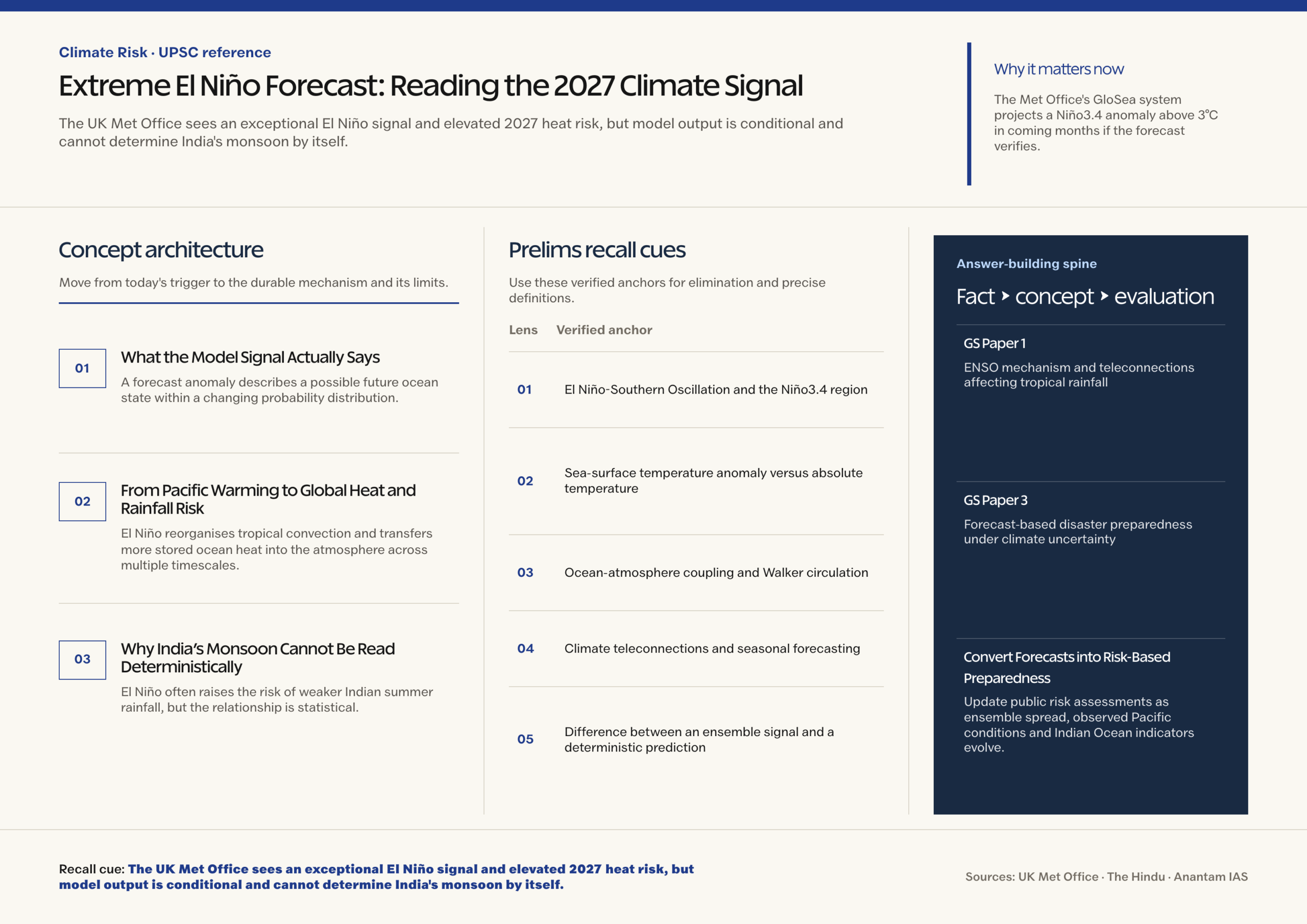
- The Met Office’s GloSea system projects a Niño3.4 anomaly above 3°C in coming months if the forecast verifies.
- It describes 1-2°C warming as typical for El Niño, making the current model signal exceptionally large by recent standards.
- The agency says ocean heat release during a large event could make 2027 very likely to become the warmest year on record.
- These are probabilistic forecasts, not observations of the event’s eventual peak or guarantees of any regional impact.
- El Niño changes tropical Pacific convection and atmospheric circulation, creating teleconnections that shift weather probabilities far from the ocean basin.
- Forecast value lies in earlier risk preparation, but uncertainty must remain visible because model spread, timing and other climate drivers can alter regional outcomes.
- For India, El Niño is a risk factor for monsoon weakness, not a rule that predetermines the country’s seasonal rainfall total.
UPSC Relevance
Prelims Relevance
- El Niño-Southern Oscillation and the Niño3.4 region
- Sea-surface temperature anomaly versus absolute temperature
- Ocean-atmosphere coupling and Walker circulation
- Climate teleconnections and seasonal forecasting
- Difference between an ensemble signal and a deterministic prediction
Mains Relevance
GS Paper 1
- ENSO mechanism and teleconnections affecting tropical rainfall
- Limits of using one oceanic index to predict the Indian monsoon
GS Paper 3
- Forecast-based disaster preparedness under climate uncertainty
- Interaction between natural variability and human-driven warming
Essay
- Good climate governance acts early on credible risk without presenting uncertainty as either ignorance or certainty.
Background and Context
What the Model Signal Actually Says
A forecast anomaly describes a possible future ocean state within a changing probability distribution; it is not yet the observed seasonal peak.
- The Met Office signal concerns sea-surface temperatures in the Niño3.4 region, a central equatorial Pacific zone used to monitor ENSO rather than the entire ocean basin.
- An anomaly above 3°C would be far beyond ordinary El Niño conditions, so the model raises a high-impact risk deserving close monitoring.
- Other forecast systems reportedly show similarly extreme values, which strengthens concern but does not eliminate common errors or prove the exact magnitude, timing or duration.
- Long-range systems simulate many plausible evolutions; forecasters assess the distribution, consistency and physical credibility rather than treating one trajectory as destiny.
- The conditional phrase if the forecast is accurate is central: future updates may change peak strength, timing, duration and downstream impacts.
From Pacific Warming to Global Heat and Rainfall Risk
El Niño reorganises tropical convection and transfers more stored ocean heat into the atmosphere across multiple timescales, affecting both circulation and global temperature.
- Warm central and eastern Pacific waters shift rising air and rainfall eastward over many months, altering the Walker circulation and connected pressure patterns.
- These changes modify the probability, timing and persistence of drought or excess rainfall across several regions; they do not make every location experience the same impact.
- A strong event can release additional ocean heat into the atmosphere, often lifting global average temperature most clearly in the following calendar year.
- This natural variability acts on top of human-driven warming, so El Niño can amplify near-term records without causing the long-term greenhouse trend.
- A globally warm year remains a climate average, not a promise that every month and region will be warmer than its previous record.
Why India’s Monsoon Cannot Be Read Deterministically
El Niño often raises the risk of weaker Indian summer rainfall, but the relationship is statistical, variable from month to month and mediated by other systems.
- Pacific warming can weaken the normal east-west tropical circulation and alter moisture-bearing winds during key growing months, creating an important monsoon risk signal.
- The Met Office noted below-normal Indian rainfall while the event was growing, but concurrent timing alone cannot assign every deficit to El Niño.
- Indian Ocean conditions, Eurasian snow, land heating, intraseasonal oscillations and the timing of Pacific warming can strengthen, offset, delay or redistribute the seasonal effect.
- An all-India seasonal total can also conceal floods in one region, dry spells elsewhere and major differences in onset, breaks and rainfall distribution.
- The correct exam statement is that El Niño changes monsoon probabilities; it does not mechanically fix India’s rainfall before the season unfolds.
Way Forward
Convert Forecasts into Risk-Based Preparedness
- Update public risk assessments as ensemble spread, observed Pacific conditions and Indian Ocean indicators evolve, while showing confidence levels clearly.
- Use scenario plans for water storage, crop advisories, heat-health action, wildfire readiness and power demand rather than waiting for forecast certainty.
- Issue regional and sub-seasonal guidance because national seasonal averages can hide dangerous dry spells, intense rainfall and spatial contrasts.
- Review forecasts against outcomes after the season to improve models, communication and institutional decisions through forecast verification.
Conclusion
- The extreme El Niño signal is a credible and actionable warning, not a settled description of the coming peak, global temperature record or India’s rainfall outcome.
- A strong UPSC answer should explain the Pacific mechanism, preserve forecast uncertainty and recommend no-regret preparedness proportionate to the risk.
UPSC Practice Questions
Prelims MCQ 1
With reference to El Niño and seasonal climate forecasts, consider the following statements:
- The Niño3.4 region lies in the equatorial Pacific and is used to monitor ENSO conditions.
- A strong ensemble forecast proves the exact future peak of an El Niño event.
- El Niño can influence weather outside the Pacific through atmospheric teleconnections.
How many of the above statements are correct?
(a) Only one (b) Only two (c) All three (d) None
Answer: (b) Only two
Explanation:
Statements 1 and 3 are correct. Forecast agreement can increase confidence, but it cannot prove the exact peak because models, initial conditions and later ocean-atmosphere evolution remain uncertain.
Prelims MCQ 2
Which statement best describes the relationship between El Niño and the Indian summer monsoon?
(a) Every El Niño necessarily causes an all-India drought (b) El Niño has no relationship with Indian rainfall (c) El Niño changes drought and rainfall probabilities, while other ocean-atmosphere factors shape the final outcome (d) El Niño determines rainfall equally across every Indian region
Answer: (c) El Niño changes drought and rainfall probabilities, while other ocean-atmosphere factors shape the final outcome
Explanation:
The ENSO-monsoon link is a probabilistic teleconnection. Event timing, Indian Ocean conditions and intraseasonal processes can modify national and regional rainfall outcomes.
UPSC Mains Questions
- Explain how an extreme El Niño signal can affect global temperature and rainfall. Why should its regional impacts be communicated probabilistically?
- El Niño is an important predictor of the Indian summer monsoon, but not a deterministic one. Discuss the implications for climate-risk governance.
Sources: UK Met Office and The Hindu.
Frequently Asked Questions
What is the new El Niño forecast signal?
The UK Met Office’s GloSea system projects an exceptionally large Niño3.4 sea-surface temperature anomaly in coming months. It is a conditional model forecast, not the observed final peak.
Why could 2027 become unusually warm?
Large El Niño events release more ocean heat into the atmosphere, often raising global average temperature after their winter peak. Human-driven warming lifts the baseline on which this variability acts.
Does the forecast guarantee a record-hot 2027?
No. The Met Office assesses that outcome as very likely, but the event’s realised strength, duration and interaction with other climate factors will determine the eventual global average.
Will El Niño definitely cause an Indian drought?
No. It can increase the probability of weak monsoon rainfall, but Indian Ocean conditions, event timing, intraseasonal variability and regional circulation can alter the final pattern.
How should governments use an uncertain seasonal forecast?
They should prepare proportionately through scenarios, update decisions as observations change and favour no-regret measures in water, agriculture, health, energy and disaster management.
Tell Google you want more of this.
Add Anantam IAS as a preferred sourceOne tap, and this site shows up more often in your own Top Stories, AI Overviews and AI Mode. Remove it any time.