Why in News?
The ICG allocated 70,000 Ervebo doses to the DRC’s Bundibugyo virus outbreak, including 20,000 for a Phase 3 trial and 50,000 for frontline and health workers.
- Ervebo is licensed and recommended for Ebola virus disease caused by Ebola virus, previously called Zaire ebolavirus, not specifically for disease caused by Bundibugyo virus.
- WHO states that it is unknown whether Ervebo protects humans against Bundibugyo virus; early laboratory and animal evidence suggests possible protection but does not establish human efficacy.
- The Phase 3 clinical trial is intended to generate evidence on the vaccine’s impact during the outbreak, not to confirm a benefit already proven.
- WHO requires people offered the vaccine, inside or outside the trial, to receive information on risks, potential benefits, and limitations and provide informed consent.
- Emergency decisions must balance two duties: protect exposed communities with the best available option and avoid overstating uncertain cross-protection between different viruses.
- A stockpile solves allocation and speed problems, but scientific validity still depends on diagnostic confirmation, protocol quality, ethical oversight, follow-up, and interpretable outcome data.
- Vaccination remains one part of outbreak control alongside surveillance, laboratory testing, contact tracing, infection prevention, clinical care, community engagement, and safe burial practices.
UPSC Relevance
Prelims Relevance
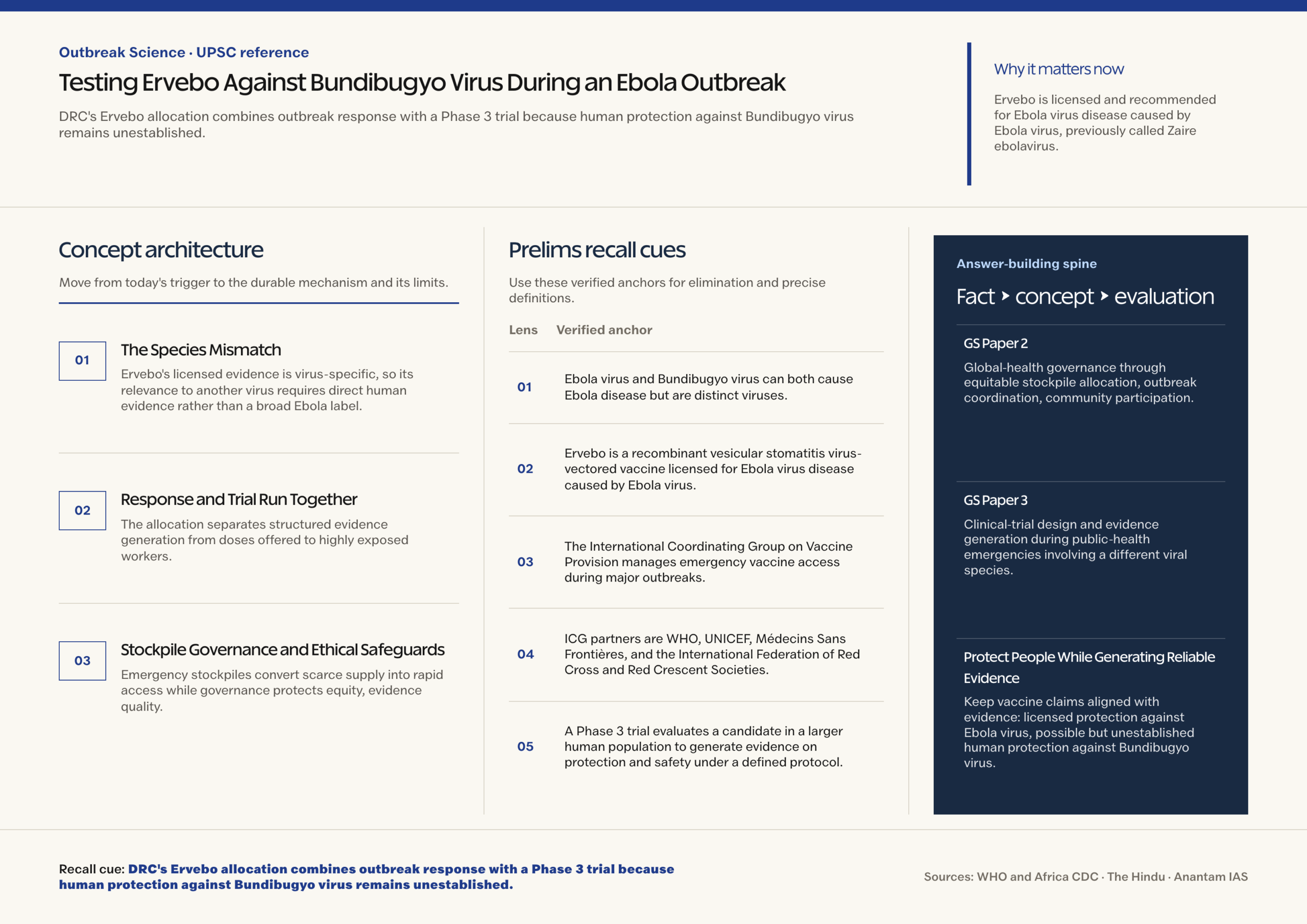
- Ebola virus and Bundibugyo virus can both cause Ebola disease but are distinct viruses; vaccine evidence for one cannot be automatically transferred to the other.
- Ervebo is a recombinant vesicular stomatitis virus-vectored vaccine licensed for Ebola virus disease caused by Ebola virus.
- The International Coordinating Group on Vaccine Provision manages emergency vaccine access during major outbreaks.
- ICG partners are WHO, UNICEF, Médecins Sans Frontières, and the International Federation of Red Cross and Red Crescent Societies.
- A Phase 3 trial evaluates a candidate in a larger human population to generate evidence on protection and safety under a defined protocol.
Mains Relevance
GS Paper 2
- Global-health governance through equitable stockpile allocation, outbreak coordination, community participation, and institutional trust.
- Ethical obligations of informed consent and transparent risk communication when emergency use extends beyond established human evidence.
GS Paper 3
- Clinical-trial design and evidence generation during public-health emergencies involving a different viral species.
- Integration of vaccines with diagnostics, surveillance, infection prevention, cold chains, and field data systems.
Essay
- In a crisis, scientific honesty is not an obstacle to action; it is the condition for legitimate and trusted action.
Background and Context
The Species Mismatch
Ervebo’s licensed evidence is virus-specific, so its relevance to another virus requires direct human evidence rather than a broad Ebola label.
- Ebola disease is a clinical syndrome that can be caused by different orthoebolaviruses; naming the disease does not make the causative viruses biologically interchangeable.
- Ervebo targets Ebola virus, historically called Zaire ebolavirus, and has established use against outbreaks caused by that virus.
- The current DRC outbreak involves Bundibugyo virus; WHO says human protection from Ervebo against this virus is not known.
- Early laboratory and animal findings can justify studying possible cross-protection, but they cannot substitute for human evidence on clinical protection in the affected population.
- Exam trap: do not call Bundibugyo a mere strain covered by the licence or convert biological plausibility into a statement of proven vaccine efficacy.
Response and Trial Run Together
The allocation separates structured evidence generation from doses offered to highly exposed workers, with distinct ethical and scientific safeguards for each pathway.
- The ICG approved an initial 70,000-dose release after the DRC requested stockpile support for the Bundibugyo outbreak.
- Of these, 20,000 doses support a Phase 3 clinical trial designed to clarify the vaccine’s impact against Bundibugyo virus in humans.
- The remaining 50,000 doses are for frontline and health workers under current WHO immunization-expert recommendations, reflecting their high occupational exposure.
- Allocation does not equal demonstrated efficacy: trial and response teams must record vaccination, exposure, outcomes, adverse events, and follow-up using predefined methods.
- All recipients need an honest explanation of the knowns, unknowns, potential benefits, and risks; consent cannot be reduced to a signature obtained during fear or urgency.
Stockpile Governance and Ethical Safeguards
Emergency stockpiles convert scarce supply into rapid access while governance protects equity, evidence quality, and legitimacy when urgency and evidence gaps coexist.
- The ICG coordinates emergency allocations through WHO, UNICEF, Médecins Sans Frontières, and the International Federation of Red Cross and Red Crescent Societies; allocation does not establish efficacy or replace independent national ethical and regulatory review.
- Its Ebola vaccine stockpile has operated since 2021, providing a pooled mechanism instead of forcing an affected country to negotiate scarce doses alone during an outbreak.
- Allocation should follow epidemiological need, operational capacity, equity, cold-chain readiness, and a feasible deployment plan rather than purchasing power or geopolitical influence.
- Trial participants require protocol review, voluntary consent, confidentiality, safety monitoring, and access to appropriate care; emergency conditions do not suspend research ethics.
- Community-led communication should explain why recipients may receive a vaccine with uncertain cross-protection while maintaining confidence in proven outbreak-control measures.
Way Forward
Protect People While Generating Reliable Evidence
- Keep vaccine claims aligned with evidence: licensed protection against Ebola virus, possible but unestablished human protection against Bundibugyo virus, and no promise of individual immunity.
- Use independent ethical oversight, plain-language consent, adverse-event monitoring, transparent trial registration, and rapid publication of interpretable positive, negative, or inconclusive results.
- Integrate vaccination with case finding, diagnostics, isolation, contact tracing, protective equipment, treatment, safe burials, and trusted local leadership.
- Invest in species-matched vaccine candidates and regional manufacturing while retaining global stockpiles for rapid, equitable access to licensed outbreak tools.
Conclusion
- The DRC allocation is a dual-purpose emergency decision: offer a plausible tool to exposed workers while a Phase 3 trial tests the unresolved Bundibugyo question without presenting possible cross-protection as established human efficacy.
- A strong Mains answer should separate licence, biological plausibility, human efficacy, emergency recommendation, consent, and stockpile allocation instead of treating them as one proof or overlooking non-vaccine controls essential to outbreak response.
UPSC Practice Questions
Prelims MCQ 1
With reference to Ervebo and the 2026 Bundibugyo virus outbreak response, consider the following statements:
- Ervebo is licensed for Ebola virus disease caused by Ebola virus, previously called Zaire ebolavirus.
- Human protection against Bundibugyo virus has already been conclusively established.
- Part of the DRC allocation is intended for a Phase 3 clinical trial.
How many of the above statements are correct?
(a) Only one (b) Only two (c) All three (d) None
Answer: (b) Only two
Explanation:
Statements 1 and 3 are correct. WHO explicitly says it is not known whether Ervebo protects humans against Bundibugyo virus.
Prelims MCQ 2
What is the principal role of the International Coordinating Group on Vaccine Provision during major outbreaks?
(a) Granting national marketing licences to every vaccine (b) Managing and coordinating equitable access to emergency vaccine supplies (c) Replacing national disease-surveillance systems (d) Conducting all clinical trials without national authorities
Answer: (b) Managing and coordinating equitable access to emergency vaccine supplies
Explanation:
The ICG manages coordinated emergency access to vaccine stockpiles; it does not replace national regulators, surveillance, or research-governance systems.
UPSC Mains Questions
- How should public-health authorities act when a licensed vaccine is biologically plausible but not proven against the virus causing the current outbreak? Discuss.
- Emergency vaccine stockpiles are institutions of both logistics and justice. Examine with reference to equitable allocation, informed consent, and evidence generation.
Sources: WHO and Africa CDC and The Hindu.
Frequently Asked Questions
Is Ervebo proven to protect humans against Bundibugyo virus?
No. WHO says human protection is unknown. Laboratory and animal findings suggest possible cross-protection, but the Phase 3 trial is needed to generate human evidence.
Why was Ervebo allocated during this outbreak?
Authorities are balancing possible benefit for highly exposed workers with urgent evidence generation, while disclosing that the vaccine’s protection against Bundibugyo virus remains unestablished.
How are the 70,000 allocated doses divided?
WHO states that 20,000 doses are for a Phase 3 clinical trial and 50,000 are for frontline and health workers under current recommendations.
What must informed consent cover in this response?
Recipients inside and outside the trial should understand known risks, potential benefits, evidence limitations, alternatives, and the uncertainty about protection against Bundibugyo virus.
What does the ICG do?
The ICG manages and coordinates emergency vaccine supplies so outbreak-affected countries can receive timely and equitable access through a pooled global mechanism.
Tell Google you want more of this.
Add Anantam IAS as a preferred sourceOne tap, and this site shows up more often in your own Top Stories, AI Overviews and AI Mode. Remove it any time.