Why in News?
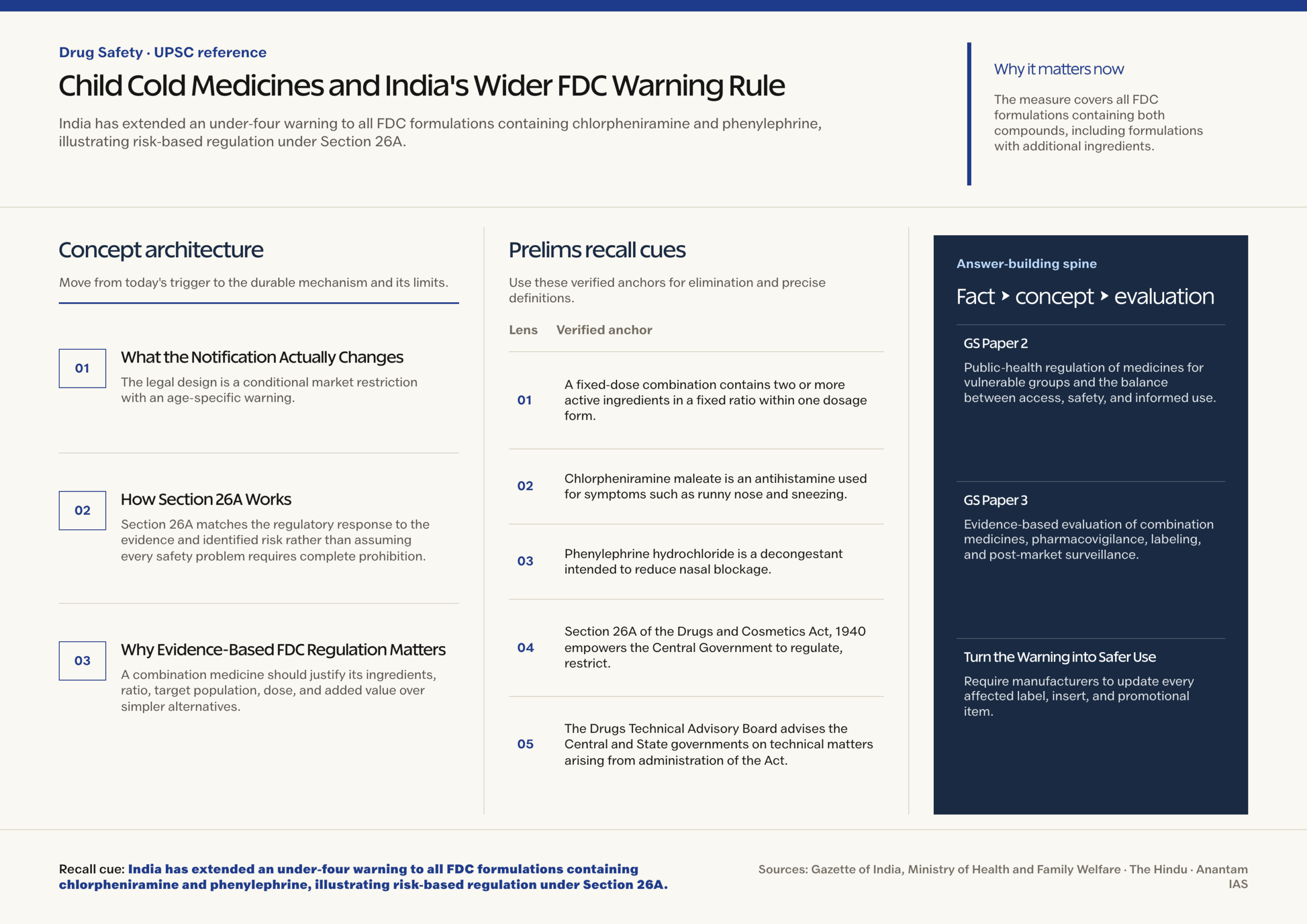
A Gazette notification broadened India’s restriction on fixed-dose combinations containing chlorpheniramine maleate and phenylephrine hydrochloride by mandating an under-four warning across all such formulations.
- The measure covers all FDC formulations containing both compounds, including formulations with additional ingredients, rather than only the earlier two-ingredient combination.
- Manufacturers must state that the FDC shall not be used in children below four years on the label, package insert, or promotional literature.
- The notification restricts manufacture, sale, or distribution subject to this condition; it does not prohibit every sale or adult use of these formulations.
- The rule took effect from publication in the Official Gazette and followed review by a Health Ministry expert committee and the Drugs Technical Advisory Board.
- Multi-ingredient cold medicines can expose young children to dosing errors and overlapping active ingredients while offering limited benefit for uncomplicated, self-limiting viral colds.
- The case illustrates risk-proportionate regulation: identify a vulnerable population, assess benefit and safer alternatives, impose a targeted condition, and communicate it throughout the product chain.
- Effective labeling needs enforcement, pharmacist counseling, prescriber compliance, caregiver literacy, and adverse-event reporting; a printed warning alone cannot prevent every unsafe use.
UPSC Relevance
Prelims Relevance
- A fixed-dose combination contains two or more active ingredients in a fixed ratio within one dosage form.
- Chlorpheniramine maleate is an antihistamine used for symptoms such as runny nose and sneezing.
- Phenylephrine hydrochloride is a decongestant intended to reduce nasal blockage.
- Section 26A of the Drugs and Cosmetics Act, 1940 empowers the Central Government to regulate, restrict, or prohibit specified drugs in public interest.
- The Drugs Technical Advisory Board advises the Central and State governments on technical matters arising from administration of the Act.
Mains Relevance
GS Paper 2
- Public-health regulation of medicines for vulnerable groups and the balance between access, safety, and informed use.
- Coordination among the Union government, expert bodies, manufacturers, prescribers, pharmacists, and State enforcement agencies.
GS Paper 3
- Evidence-based evaluation of combination medicines, pharmacovigilance, labeling, and post-market surveillance.
- Regulatory science as a bridge between clinical evidence, product design, manufacturing conditions, and consumer protection.
Essay
- Public health improves when regulation converts scientific uncertainty into clear, proportionate, and enforceable protection for vulnerable citizens.
Background and Context
What the Notification Actually Changes
The legal design is a conditional market restriction with an age-specific warning, not a complete prohibition for older patients under applicable controls.
- An April 2025 notification covered the fixed combination of chlorpheniramine maleate plus phenylephrine hydrochloride and required the same under-four warning.
- The new notification extends that safeguard to all FDC formulations containing both ingredients, closing a gap where additional ingredients could place a product outside the narrower description.
- The condition attaches to manufacture, sale, or distribution: manufacturers must carry the warning on the label, package insert, or promotional literature.
- The wording creates a clear pediatric exclusion below four years while leaving compliant formulations available for other indicated users under applicable drug-control rules.
- Exam trap: restriction can impose conditions, populations, warnings, or channels; it should not be automatically rewritten as a nationwide ban on the product.
How Section 26A Works
Section 26A matches the regulatory response to the evidence and identified risk rather than assuming every safety problem requires complete prohibition.
- The Central Government may act when a drug is likely to risk humans or animals, lacks claimed therapeutic value, or contains ingredients without therapeutic justification.
- When public interest requires action, the government may regulate, restrict, or prohibit manufacture, sale, or distribution through a notification in the Official Gazette.
- These are distinct choices: regulation may prescribe controls, restriction may allow use subject to conditions, and prohibition removes the specified product or activity from the market.
- Here, an expert committee found likely risk to children below four and noted safer alternatives; DTAB later agreed that such formulations should not be used in that group.
- The notification records reasons, the covered formulations, the mandatory warning, and commencement, creating a reviewable public instrument rather than an informal advisory.
Why Evidence-Based FDC Regulation Matters
A combination medicine should justify its ingredients, ratio, target population, dose, and added value over simpler alternatives, especially for self-limiting symptoms.
- An FDC can improve convenience and adherence when ingredients have compatible doses and a sound therapeutic purpose, but convenience alone does not establish pediatric safety.
- Young children differ in drug metabolism, body size, and dosing tolerance; combining ingredients can make adverse effects and accidental duplication harder to identify.
- Chlorpheniramine may cause drowsiness or paradoxical excitability, while phenylephrine can affect heart rate and blood pressure; risk-benefit assessment must be age-specific.
- Evidence review should ask whether each ingredient contributes meaningful benefit, whether the fixed ratio fits the patient group, and whether safer non-drug or single-ingredient options exist.
- Post-market pharmacovigilance completes the cycle: adverse-event signals, prescribing patterns, labeling compliance, and new evidence should trigger reassessment rather than remain static.
Way Forward
Turn the Warning into Safer Use
- Require manufacturers to update every affected label, insert, and promotional item, with batch-level transition plans and regulatory checks against misleading pediatric claims.
- Train prescribers and pharmacists to verify age, weight, active ingredients, duplicate medicines, dosing devices, and red-flag symptoms before recommending symptomatic treatment.
- Strengthen pharmacovigilance by linking adverse-event reports with product formulation, age, dose, co-medication, and outcome so future decisions rest on usable evidence.
- Communicate that common colds are usually self-limiting while directing caregivers toward medical evaluation for breathing difficulty, dehydration, persistent fever, or other danger signs.
Conclusion
- The under-four warning is a targeted restriction: it broadens coverage across relevant FDC formulations without a blanket market ban and preserves compliant availability for other indicated users in practice.
- In a Mains answer, connect Section 26A’s graded powers with expert review, age-specific evidence, clear labeling, enforcement, and pharmacovigilance as one continuous drug-safety system.
UPSC Practice Questions
Prelims MCQ 1
With reference to Section 26A of the Drugs and Cosmetics Act, 1940, consider the following statements:
- It empowers the Central Government to regulate, restrict, or prohibit specified drugs in public interest.
- Action under it may be based on risk, lack of claimed therapeutic value, or absence of therapeutic justification for ingredients.
- Every notification under it must impose a complete nationwide ban.
How many of the above statements are correct?
(a) Only one (b) Only two (c) All three (d) None
Answer: (b) Only two
Explanation:
Statements 1 and 2 reflect Section 26A. The power is graded: a notification may regulate or restrict instead of completely prohibiting a drug.
Prelims MCQ 2
What is the principal requirement of the 2026 notification concerning FDC formulations containing chlorpheniramine maleate and phenylephrine hydrochloride?
(a) Complete prohibition of their manufacture for every age group (b) Sale only through government hospitals (c) A warning that the FDC shall not be used in children below four years (d) Replacement of both ingredients with an antibiotic
Answer: (c) A warning that the FDC shall not be used in children below four years
Explanation:
Manufacture, sale, or distribution is restricted subject to carrying the specified warning on the label, package insert, or promotional literature.
UPSC Mains Questions
- The child cold-medicine notification illustrates risk-proportionate rather than binary drug regulation. Explain with reference to Section 26A and fixed-dose combinations.
- Why must pediatric drug safety combine pre-market evidence, clear labeling, professional counseling, enforcement, and post-market pharmacovigilance? Discuss.
Sources: Gazette of India, Ministry of Health and Family Welfare and The Hindu.
Frequently Asked Questions
Has India completely banned these cold-medicine combinations?
No. Manufacture, sale, or distribution is restricted subject to a mandatory warning that the FDC shall not be used in children below four years.
Which formulations does the 2026 warning cover?
It covers all fixed-dose combination formulations containing both chlorpheniramine maleate and phenylephrine hydrochloride, including formulations that may also contain additional ingredients.
What is a fixed-dose combination?
An FDC places two or more active ingredients in a fixed ratio within one dosage form, such as one tablet or measured liquid preparation.
What does Section 26A authorize?
It allows the Central Government, through an Official Gazette notification, to regulate, restrict, or prohibit a drug’s manufacture, sale, or distribution when statutory public-interest grounds are met.
Why is a label warning not enough by itself?
Safer use also depends on compliant packaging, prescriber and pharmacist counseling, caregiver understanding, enforcement, and adverse-event reporting that can identify new safety signals.
Tell Google you want more of this.
Add Anantam IAS as a preferred sourceOne tap, and this site shows up more often in your own Top Stories, AI Overviews and AI Mode. Remove it any time.