

Why in News?
A 22 August report found that cheaper crude now contrasts with administered E20 ethanol procurement as maize use, domestic prices and feed-sector imports rise.
- Maize now supplies close to half of India’s blended ethanol, according to government data cited by The Hindu.
- For Ethanol Supply Year 2025-26, oil marketing companies pay an approved maize-ethanol price of ₹71.86 per litre.
- India became a net maize importer in 2024 after having exported the grain until recently.
- The report links higher distillery demand with feed-sector import pressure, but that relationship does not by itself prove single-cause attribution.
- The issue is an allocation problem: maize serves food processing, poultry and animal feed, starch industries, seed and fuel markets.
- The policy question is not simply whether ethanol or crude is cheaper today, but how to value price stability, import risk and domestic opportunity costs.
- This note extends the earlier E20 policy debate without repeating vehicle compatibility or general blending basics.
UPSC Relevance
Prelims Relevance
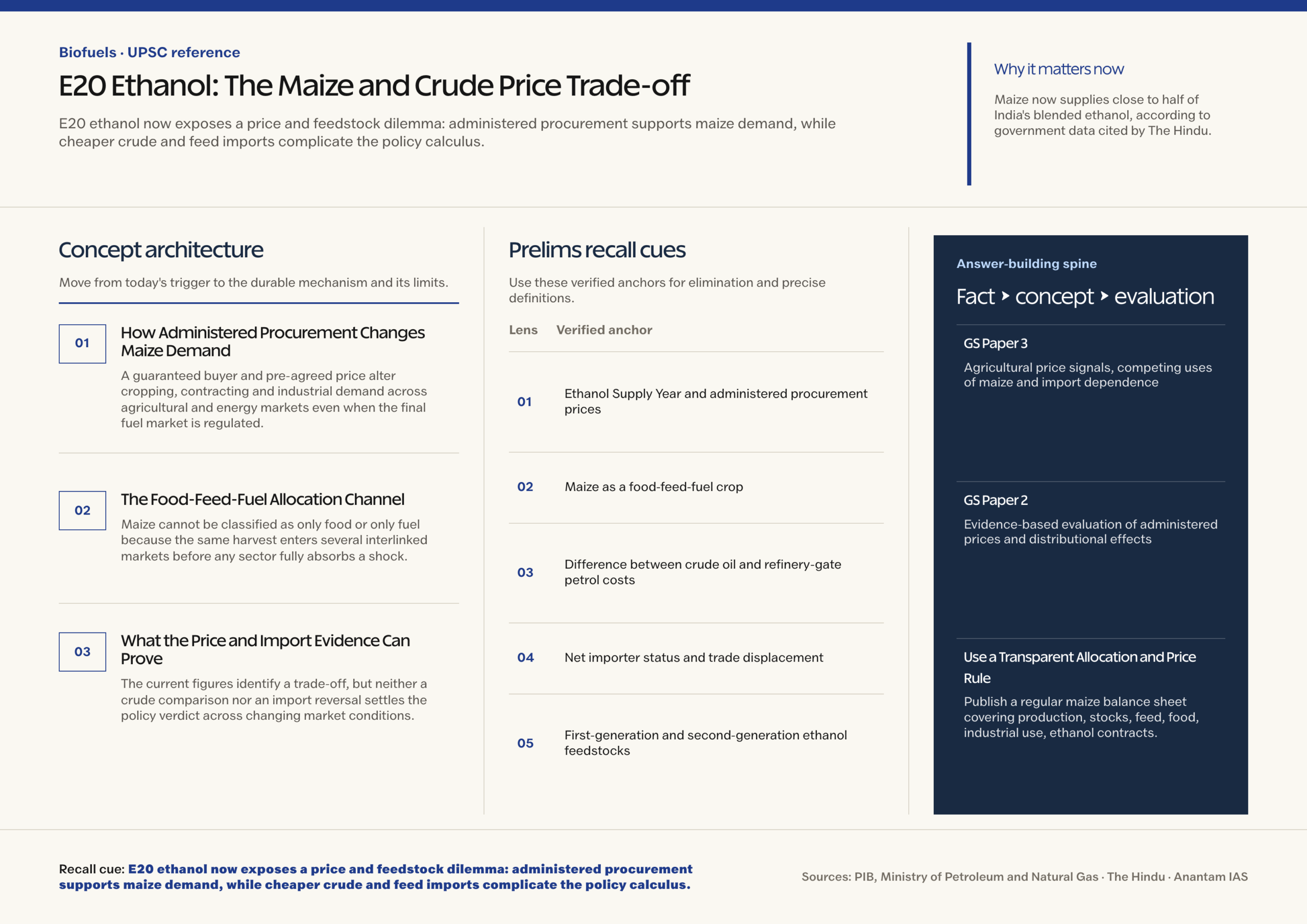
- Ethanol Supply Year and administered procurement prices
- Maize as a food-feed-fuel crop
- Difference between crude oil and refinery-gate petrol costs
- Net importer status and trade displacement
- First-generation and second-generation ethanol feedstocks
Mains Relevance
GS Paper 3
- Agricultural price signals, competing uses of maize and import dependence
- Biofuel procurement, oil-price cycles and public-policy trade-offs
GS Paper 2
- Evidence-based evaluation of administered prices and distributional effects
Essay
- A policy that reduces one external dependence can create another unless its resource costs are measured across the whole economy.
Background and Context
How Administered Procurement Changes Maize Demand
A guaranteed buyer and pre-agreed price alter cropping, contracting and industrial demand across agricultural and energy markets even when the final fuel market is regulated.
- Oil marketing companies procure ethanol from approved feedstocks at feedstock-specific prices, rather than buying all ethanol through a single spot market.
- The maize rate is the highest in the official 2025-26 schedule, creating a strong demand signal for distillers and suppliers.
- A stable procurement price can protect producers from oil-market volatility, but it can also weaken the immediate adjustment when crude prices fall.
- The benefit to growers or distillers is not costless: other maize users may face higher prices, reduced availability, thinner inventories or the need to source imports.
- Policy assessment must track who gains the stable market, who bears adjustment costs across the value chain, and how incentives evolve over successive procurement seasons.
The Food-Feed-Fuel Allocation Channel
Maize cannot be classified as only food or only fuel because the same harvest enters several interlinked markets before any sector fully absorbs a shock.
- Distilleries, poultry farms and animal-feed makers compete for grain with food processors, starch makers and other industrial users; supply is not infinitely elastic.
- When fuel demand expands faster than output, the adjustment may appear through higher domestic prices, crop switching, lower use elsewhere or additional imports.
- Feed is a major poultry cost, so a maize-price increase can transmit beyond grain markets to eggs, meat and livestock production through input costs.
- Imports can relieve a domestic shortage, but they also replace part of the crude-import saving with another external exposure and transmit global grain shocks.
- The right metric is the net resource effect across fuel, farms, food and feed, including substitution responses, not the volume of ethanol procured in isolation.
What the Price and Import Evidence Can Prove
The current figures identify a trade-off, but neither a crude comparison nor an import reversal settles the policy verdict across changing market conditions.
- A litre of crude is an input, while ethanol is a usable blending component; refining, transport, marketing, taxes and energy content make direct litre comparisons incomplete.
- Low crude prices can make administered ethanol relatively expensive today, while fixed procurement may act as insurance during an oil-price spike.
- Rising maize imports alongside ethanol expansion are observed facts; proving causation requires output, stocks, feed demand, weather, trade restrictions and price-counterfactual data.
- The government’s food-security safeguard for public grain does not remove the wider allocation question for marketed maize used by private buyers.
- A defensible conclusion is conditional: ethanol demand likely adds pressure, but its exact share in price and import changes remains contested.
Way Forward
Use a Transparent Allocation and Price Rule
- Publish a regular maize balance sheet covering production, stocks, feed, food, industrial use, ethanol contracts, exports and imports.
- Review procurement formulas against crude cycles, farm costs and competing-user impacts instead of treating one administered price as permanently optimal.
- Set feedstock-diversification triggers when food-feed indicators tighten, including faster movement toward residue-based ethanol where technically and economically viable.
- Evaluate the programme through net import savings, fiscal effects, farm incomes, feed costs and emissions rather than a single headline metric.
Conclusion
- E20’s maize bind is a resource-allocation test: a stable domestic fuel input can still shift costs and import exposure to feed and food-linked sectors.
- In a Mains answer, separate observed market changes from causal claims, then judge the policy using whole-economy costs, distribution and resilience across price cycles.
UPSC Practice Questions
Prelims MCQ 1
With reference to ethanol procurement and maize markets in India, consider the following statements:
- Oil marketing companies procure ethanol at feedstock-specific administered prices.
- A rise in maize imports by itself proves that ethanol demand caused the entire increase.
- Maize has competing uses in food processing, animal feed and fuel production.
How many of the above statements are correct?
(a) Only one (b) Only two (c) All three (d) None
Answer: (b) Only two
Explanation:
Statements 1 and 3 are correct. Import data establish an outcome, not complete causation; output, inventories, feed demand, weather and trade conditions must also be examined.
Prelims MCQ 2
Why is a direct per-litre comparison between crude oil and procured ethanol analytically incomplete?
(a) Crude oil is never imported by India (b) Ethanol cannot be used in transport fuel (c) Crude is a refinery input, while ethanol is a blending component with different processing, tax and energy characteristics (d) Both commodities always have identical administered prices
Answer: (c) Crude is a refinery input, while ethanol is a blending component with different processing, tax and energy characteristics
Explanation:
The compared litres are not equivalent products. A useful cost comparison must account for conversion, delivery, taxation, energy content and the value of protection against oil-price volatility.
UPSC Mains Questions
- Administered ethanol procurement can reduce one import dependence while creating pressure elsewhere in the economy. Examine with reference to India’s maize market.
- How should India compare the costs and benefits of ethanol blending when crude prices fall? Suggest an evidence-based evaluation framework.
Sources: PIB, Ministry of Petroleum and Natural Gas and The Hindu.
Frequently Asked Questions
Why does administered ethanol pricing matter?
It gives suppliers a predictable buyer and price, encouraging production. The same stability can delay adjustment when crude becomes cheaper and can raise demand pressure on competing maize users.
Does maize import growth prove ethanol policy caused it?
No. The timing makes ethanol demand a plausible contributor, but attribution also requires evidence on harvests, stocks, feed demand, weather, trade restrictions and prices without the policy.
What is the food-feed-fuel trade-off?
The same maize supply serves human consumption, livestock and poultry feed, industrial processing and ethanol. More demand from one use can affect availability, prices or imports for others.
Why can ethanol still have value when crude is cheaper?
A stable domestic procurement price can insure against future oil spikes and support farm demand. Its value must be weighed against current fiscal, feedstock and distributional costs.
What data would improve policy evaluation?
A transparent maize balance sheet, feedstock-wise ethanol procurement, capacity use, import substitution, farm returns, feed costs, fiscal effects and lifecycle emissions would allow a whole-economy assessment.
Tell Google you want more of this.
Add Anantam IAS as a preferred sourceOne tap, and this site shows up more often in your own Top Stories, AI Overviews and AI Mode. Remove it any time.




