

Why in News?
A Rajasthan field report published on August 23 documented a farmer-owned agrivoltaics pilot that grows maize beneath an operating solar plant while exposing the financing and policy barriers to wider adoption.
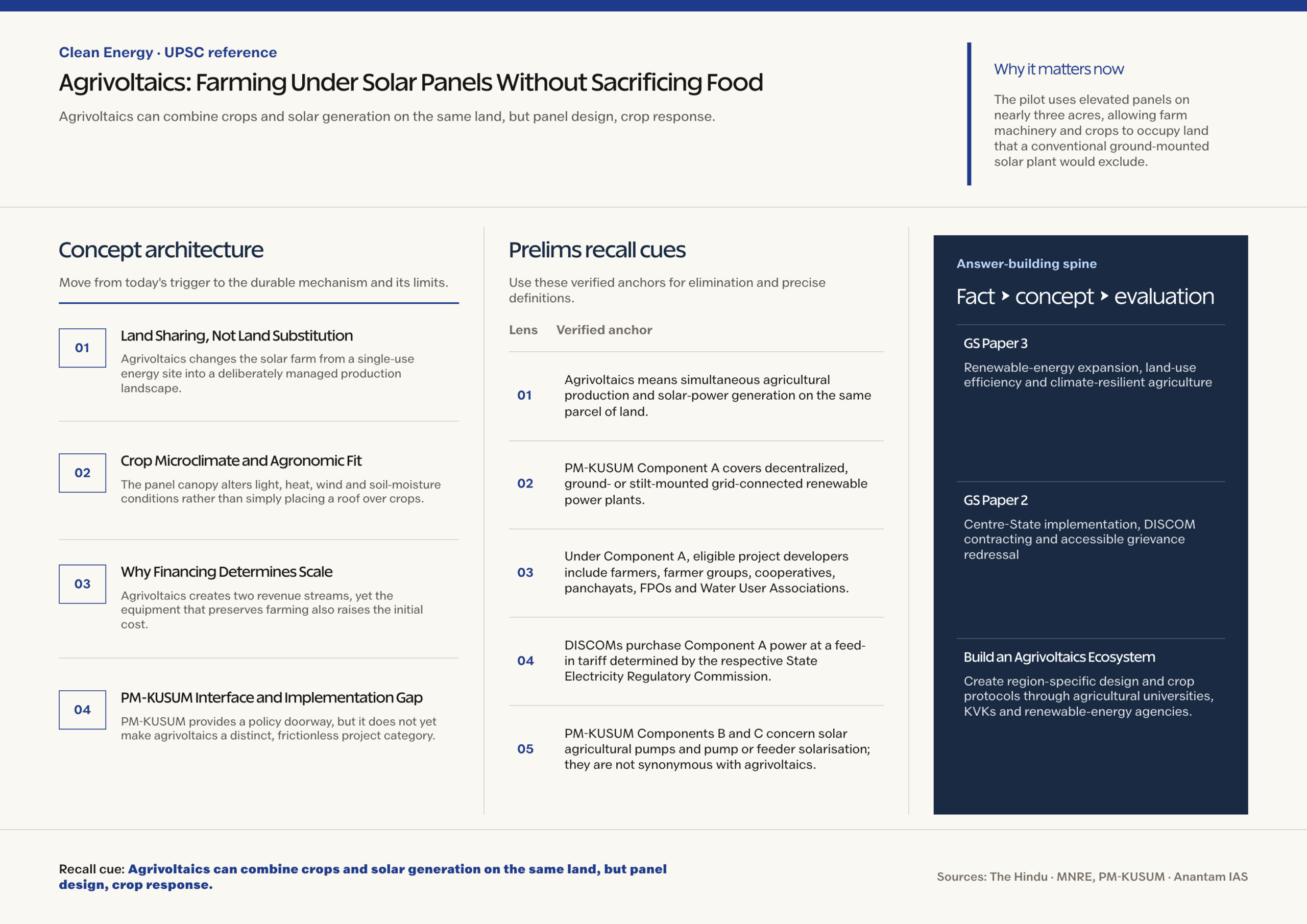
- The pilot uses elevated panels on nearly three acres, allowing farm machinery and crops to occupy land that a conventional ground-mounted solar plant would exclude.
- Its 600 kW plant supplies the local grid while maize is cultivated beneath the array, making land-sharing rather than land conversion the central design choice.
- The field account links partial shade with a cooler crop environment and lower water use, but these results remain site- and crop-specific evidence.
- Retrofitting added ₹35.3 lakh to the project, showing why farmer interest does not automatically translate into adoption without suitable credit and procurement support.
- Agrivoltaics can reduce the land-use conflict between food production and utility-scale renewable energy, especially where cultivable land and solar resources overlap.
- Its value comes from combined output: electricity revenue can steady farm income, while continued cultivation protects the agricultural function of the land.
- The model succeeds only when engineering, crop choice, grid capacity, contracts and finance work together; installing pumps or panels alone does not create an agrivoltaic system.
UPSC Relevance
Prelims Relevance
- Agrivoltaics means simultaneous agricultural production and solar-power generation on the same parcel of land.
- PM-KUSUM Component A covers decentralized, ground- or stilt-mounted grid-connected renewable power plants.
- Under Component A, eligible project developers include farmers, farmer groups, cooperatives, panchayats, FPOs and Water User Associations.
- DISCOMs purchase Component A power at a feed-in tariff determined by the respective State Electricity Regulatory Commission.
- PM-KUSUM Components B and C concern solar agricultural pumps and pump or feeder solarisation; they are not synonymous with agrivoltaics.
Mains Relevance
GS Paper 3
- Renewable-energy expansion, land-use efficiency and climate-resilient agriculture
- Farm-income diversification, rural credit and decentralized electricity
GS Paper 2
- Centre-State implementation, DISCOM contracting and accessible grievance redressal
Essay
- The energy transition is durable when infrastructure adapts to livelihoods rather than displacing them.
Background and Context
Land Sharing, Not Land Substitution
Agrivoltaics changes the solar farm from a single-use energy site into a deliberately managed production landscape.
- Panels are raised and spaced so sunlight, rainfall, workers and machinery can reach the crop area; the correct geometry depends on local farming operations.
- A conventional array usually optimizes electricity per unit of land, while agrivoltaics optimizes the combined value of electricity, crops and ecosystem services.
- Panel height, row spacing and orientation affect both power yield and cultivation; copying one pilot design across agro-climatic regions can produce poor results.
- Land-sharing can protect productive farmland from complete conversion, but enforceable cultivation conditions are needed to prevent an agricultural label from masking an ordinary solar park.
Crop Microclimate and Agronomic Fit
The panel canopy alters light, heat, wind and soil-moisture conditions rather than simply placing a roof over crops.
- Partial shade can reduce heat stress and evaporation in hot, dry settings, creating a more stable microclimate beneath and between panel rows.
- The same shade can reduce photosynthesis for light-demanding crops, so crop selection, seasonal timing and panel density must follow field trials instead of assumption.
- Water savings are not automatic: irrigation scheduling must respond to soil moisture, and cheap daytime power must not encourage unsustainable groundwater extraction.
- The Rajasthan maize result shows practical promise, including off-season cultivation, but one farm cannot establish universal yield effects across soils, crops and rainfall regimes.
Why Financing Determines Scale
Agrivoltaics creates two revenue streams, yet the equipment that preserves farming also raises the initial cost.
- Elevated structures, wider spacing, stronger foundations and machinery clearance cost more than low-mounted solar, while revenue arrives gradually through crops and electricity sales.
- A farmer faces construction risk, crop risk, interest payments and the possibility of delayed grid connection; collateral and long loan tenures can exclude smallholders.
- The Rajasthan pilot’s modelling cut payback from nearly 12 years to just over six with viability-gap support, illustrating how capital support changes bankability.
- FPO aggregation, partial credit guarantees, standardized project appraisal and payment security can spread risk without treating every project as a grant-funded demonstration.
PM-KUSUM Interface and Implementation Gap
PM-KUSUM provides a policy doorway, but it does not yet make agrivoltaics a distinct, frictionless project category.
- Component A permits decentralized grid-connected plants by farmers and collectives, while DISCOMs notify available substation capacity and procure power under State-regulated tariffs.
- Agrivoltaic projects may still compete in procurement with cheaper conventional solar even though elevated structures preserve cultivation and create additional public benefits.
- State agencies control approvals, grid access and contracts, so uneven procedures, weak rural networks and delayed power-purchase agreements can defeat a sound central scheme.
- A credible interface needs agronomic standards, time-bound approvals, transparent grid-capacity data, model contracts and a grievance channel that farmers can actually reach.
Way Forward
Build an Agrivoltaics Ecosystem
- Create region-specific design and crop protocols through agricultural universities, KVKs and renewable-energy agencies, with multi-season yield and water measurements.
- Establish a distinct PM-KUSUM pathway for genuine dual-use projects, tied to continued cultivation and suitable procurement valuation.
- Use NABARD-linked credit guarantees, FPO aggregation and standard bankable contracts to reduce collateral, appraisal and transaction barriers for smaller farmers.
- Coordinate solar expansion with feeder capacity, metering, groundwater safeguards and predictable DISCOM payments before inviting farmer investment.
Conclusion
- Agrivoltaics is not a solar pump scheme with crops nearby; it is a co-designed land system whose engineering must preserve farm production while generating power.
- In a Mains answer, connect its promise to three conditions: crop-specific evidence, affordable long-term finance and State institutions capable of procuring and absorbing decentralized electricity.
UPSC Practice Questions
Prelims MCQ 1
With reference to agrivoltaics, consider the following statements:
- It combines agricultural production and solar-power generation on the same parcel of land.
- Partial shading invariably increases the yield of every crop.
- Panel height and spacing can affect both cultivation and electricity generation.
How many of the above statements are correct?
(a) Only one (b) Only two (c) All three (d) None
Answer: (b) Only two
Explanation:
Statements 1 and 3 are correct. Crop response to shade varies with species, season, climate and system design, so statement 2 is incorrect.
Prelims MCQ 2
Which PM-KUSUM component most directly provides for decentralized grid-connected renewable power plants by farmers, farmer groups and eligible rural institutions?
(a) Component A (b) Component B (c) Component C only (d) None of the components
Answer: (a) Component A
Explanation:
Component A covers decentralized ground- or stilt-mounted grid-connected renewable power plants. Components B and C focus on standalone pumps and pump or feeder solarisation.
UPSC Mains Questions
- Agrivoltaics can reduce the conflict between India’s food and renewable-energy goals, but its success depends on design rather than land use alone. Discuss.
- Examine the financial and institutional changes required to connect farmer-owned agrivoltaics with the PM-KUSUM framework.
Sources: The Hindu and MNRE, PM-KUSUM.
Frequently Asked Questions
What is agrivoltaics?
Agrivoltaics is the planned use of the same land for crop or livestock production and solar-power generation, using panel height, spacing and management that preserve agricultural activity.
How can solar panels help crops?
In hot, dry conditions, partial shade may reduce heat stress and evaporation. Benefits depend on crop, season, soil, water management and panel geometry; yield gains are not automatic.
Why is agrivoltaics more expensive than conventional solar?
Elevated structures, wider spacing, stronger foundations and access for farm machinery add capital costs. Farmers also face lending, grid-connection and power-purchase risks before revenues stabilize.
How does PM-KUSUM relate to agrivoltaics?
Component A can support decentralized grid-connected projects by farmers and rural collectives, but agrivoltaics still needs suitable State procurement, agronomic standards and finance tailored to dual use.
What is the main policy safeguard for agrivoltaics?
Support should be conditional on continued, measurable agricultural production, preventing ordinary solar parks from claiming dual-use benefits while productive farmland is effectively removed from cultivation.
Tell Google you want more of this.
Add Anantam IAS as a preferred sourceOne tap, and this site shows up more often in your own Top Stories, AI Overviews and AI Mode. Remove it any time.




