Daily Digest
UPSC · Civil Services Examination
Current Affairs · Wednesday, 24 June 2026
Current affairs curated and edited by Anantam IAS faculty — pulled from The Hindu, PIB, IDSA, Foreign Affairs and the ministries. Read, annotate, revise.
Old Rajinder Nagar · Delhi 110005 · anantamias.com
India-US Interim Trade Deal: What Is at Stake as Talks Near the Finish
Why in News?
India and the United States are reported to be closing the open ends of an interim trade agreement, with negotiators aiming to lock the first tranche before a tariff deadline of 24 July 2026, when a temporary 10 per cent United States tariff on goods from several trading partners is set to expire. Commerce and Industry Minister Piyush Goyal and United States Trade Representative Jamieson Greer have held repeated rounds, and Indian officials have described the first phase of a Bilateral Trade Agreement as close to execution.
The talks matter because they would roll back a punishing tariff escalation: United States reciprocal tariffs on Indian goods had climbed to roughly 50 per cent, and the interim understanding under discussion would bring the headline rate down to about 18 per cent. In exchange, India is reported to be shielding politically sensitive farm sectors while granting limited access to selected United States agricultural goods, making this a live test of India’s trade strategy and its agricultural red lines.
- Negotiators target the 24 July 2026 deadline, when a temporary 10 per cent United States tariff window expires.
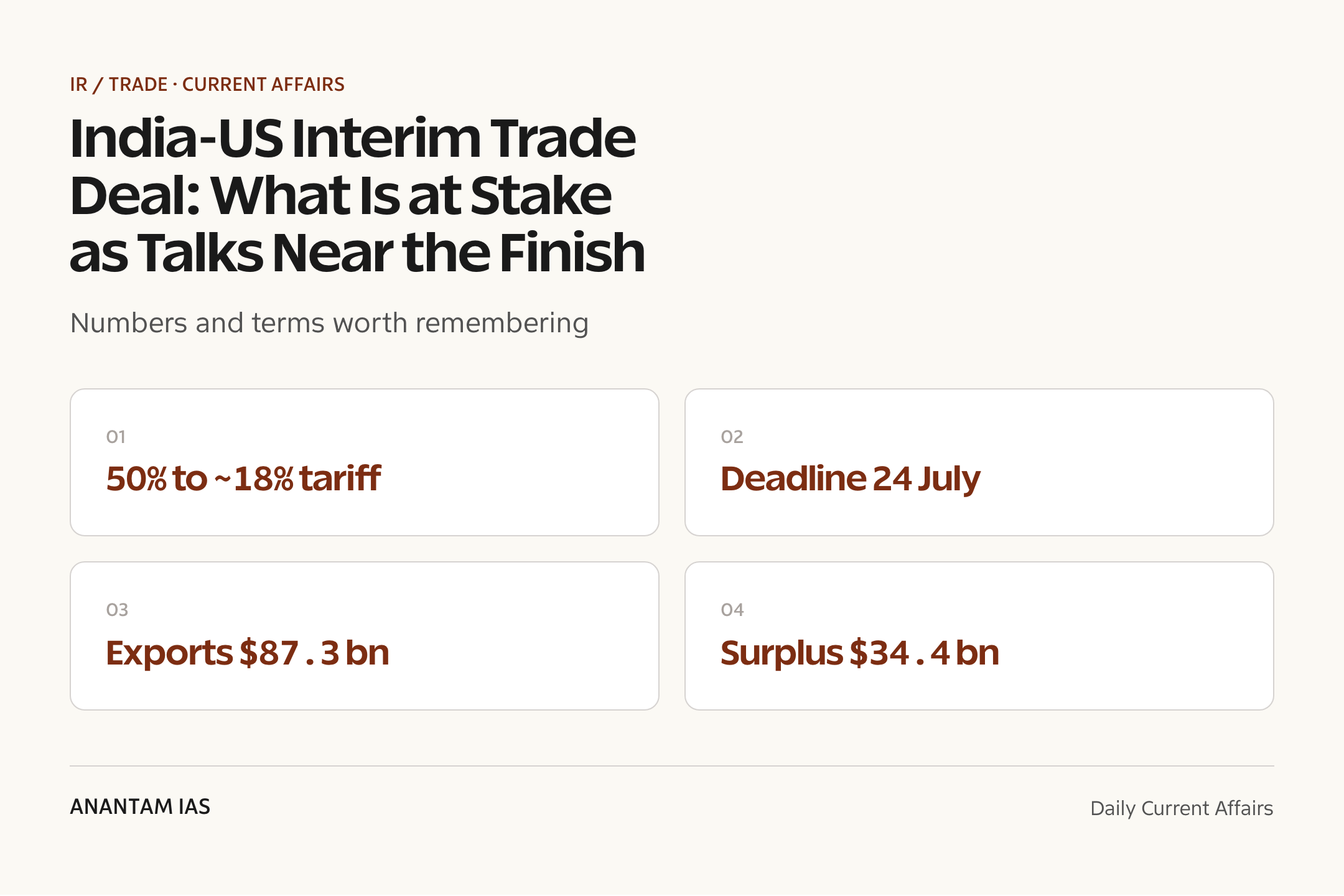
- United States reciprocal tariffs on Indian goods had risen to about 50 per cent; the interim deal would cut the headline rate to roughly 18 per cent.
- Talks led on the Indian side by Commerce Minister Piyush Goyal and on the United States side by USTR Jamieson Greer.
- The pact is framed as a first tranche, feeding into a wider Bilateral Trade Agreement (BTA) still under negotiation.
- India is reported to be protecting dairy, rice and millets while opening limited access for United States farm goods such as DDGs, soybean oil and tree nuts.
The development matters in the context of:
- The standoff followed United States reciprocal tariffs first announced in April 2025 and escalated through 2025, straining a long-standing trade relationship.
- The United States was India’s second-largest trading partner in 2025-26, making the dispute consequential for export-heavy sectors like textiles, gems and pharmaceuticals.
UPSC Relevance
Prelims Relevance
- Reciprocal tariffs: a tariff set to mirror or counter the duties and barriers another country imposes; central to the recent United States trade approach.
- Bilateral Trade Agreement (BTA): a negotiated pact between two countries to lower tariffs and trade barriers, distinct from a multilateral WTO round.
- Headline tariff arc in this dispute: escalation to about 50 per cent on Indian goods, interim target near 18 per cent.
- India’s farm red lines: dairy, rice, wheat, maize and millets kept outside tariff concessions.
- United States farm goods under limited-access discussion: DDGs (dried distillers’ grains), red sorghum, soybean oil, tree nuts, fruit, wine and spirits.
- India-United States goods trade 2025-26: Indian exports about USD 87.3 billion, imports about USD 52.9 billion.
- India’s goods trade surplus with the United States narrowed to about USD 34.4 billion in 2025-26 from roughly USD 40.9 billion the year before.
- GSP (Generalised System of Preferences): the United States duty-free scheme from which India was removed in 2019, part of the earlier friction.
- Non-tariff barriers: regulatory hurdles such as standards and approvals, flagged alongside tariffs in the talks.
- Rules of origin: criteria that decide a product’s economic nationality, used to ensure benefits accrue to the partner countries.
Mains Relevance
GS Paper 2
- India-United States bilateral relations: trade as a pillar of a broader strategic partnership spanning defence, technology and Indo-Pacific cooperation.
- Effect of policies of developed countries on India’s interests: how United States tariff actions shape India’s external economic environment.
- Negotiation as statecraft: balancing market access demands against domestic political economy and farmer interests.
GS Paper 3
- External sector and trade policy: managing tariff shocks, export competitiveness and the trade balance with a major partner.
- Agriculture and food security: protecting dairy, rice and millet producers while selectively opening to imports like soybean oil and tree nuts.
- Issues of buffer stocks, subsidies and the WTO context that frame India’s agricultural defensive lines.
Essay
- Globalisation and self-reliance: can a country open to trade while guarding its most vulnerable producers?
- Negotiating from strength: the ethics and economics of protecting livelihoods in a deal-making world.
Background and Context
How the tariff standoff built up
The interim talks are an attempt to unwind an escalation that disrupted a major trade corridor.
- United States reciprocal tariffs on several partners were first announced in 2025, with India among those facing steep rates.
- Duties on Indian goods escalated to roughly 50 per cent, hitting labour-intensive exports such as textiles, leather and gems.
- A temporary 10 per cent tariff window is set to expire on 24 July 2026, giving the talks their urgency.
- Both governments framed an interim understanding as a way to halt escalation while a fuller agreement is negotiated.
What the interim deal would change on tariffs
The headline shift is a sharp reduction in the rate facing Indian exporters.
- The interim target is to bring the United States reciprocal rate on Indian goods down to about 18 per cent from roughly 50 per cent.
- Sectors cited for relief include textiles and apparel, leather and footwear, organic chemicals and certain machinery.
- The United States is reported to be weighing removal of duties on items like generic pharmaceuticals, gems and aircraft parts as the deal completes.
- The pact is described as a first tranche, with a wider Bilateral Trade Agreement to follow.
India's agricultural red lines
Farm policy is the hardest constraint India brings to the table.
- India is reported to keep dairy, rice, wheat, maize and millets outside tariff concessions, citing livelihoods of small producers.
- Dairy is especially sensitive given the scale of small and marginal milk producers and cultural concerns over feed sourcing.
- Protecting staple grains aligns with food-security priorities and the public procurement system.
- These red lines reflect a recurring tension in India’s trade talks, also visible in stalled negotiations with other partners.
What the United States gains in farm access
India is reported to offer limited, calibrated openings rather than blanket access.
- Items under limited-access discussion include DDGs (dried distillers’ grains) and red sorghum used as animal feed.
- Other goods cited are soybean oil, tree nuts, fresh and processed fruit, and wine and spirits.
- The United States has also pressed India on non-tariff barriers affecting food, medical devices and information-technology goods.
- India has separately signalled large purchases of United States energy, aircraft and technology over coming years as part of rebalancing.
The trade numbers behind the talks
The scale of the relationship explains why both sides want a deal.
- The United States was India’s second-largest trading partner in 2025-26.
- Indian goods exports to the United States were about USD 87.3 billion, up marginally over the year.
- Indian imports from the United States rose to about USD 52.9 billion, led by mineral fuels and oils.
- India’s goods trade surplus narrowed to roughly USD 34.4 billion in 2025-26 from about USD 40.9 billion a year earlier.
The longer history: GSP, mini-deal and the WTO frame
The current talks sit on a decade of stop-start engagement.
- The United States withdrew India’s GSP duty-free benefits in 2019, an early flashpoint in the trade ties.
- An earlier limited or mini-deal was discussed in the prior United States administration but never concluded.
- India also defends its farm support and stockholding positions in the WTO, shaping its caution on agriculture.
- The present effort marks the most concrete attempt yet to convert friction into a structured Bilateral Trade Agreement.
Way Forward
Lock the first tranche, protect the floor
- Close the interim pact before the deadline to give exporters tariff certainty, while keeping dairy and staple grains off the table.
- Sequence concessions so that limited farm openings come paired with credible safeguards and review clauses.
Build toward a durable BTA
- Use the interim deal as a confidence-building step toward a comprehensive Bilateral Trade Agreement covering services and digital trade.
- Address non-tariff barriers transparently and invest in standards and testing so Indian exporters can use the lower tariff.
Cushion the farm sector
- Strengthen domestic competitiveness in dairy and edible oils so selective imports do not destabilise producers.
- Diversify export markets through deals with other partners to reduce single-market dependence.
Conclusion
An interim India-United States trade deal would convert a damaging tariff escalation into a managed reduction, cutting the headline rate on Indian goods from around 50 per cent toward 18 per cent and restoring some predictability for exporters. The deadline of 24 July gives the talks momentum, but the substance lies in how carefully India trades limited farm access for that relief.
For aspirants, the episode is a compact case study in modern trade statecraft: reciprocal tariffs as leverage, agricultural red lines as the hardest domestic constraint, and a phased Bilateral Trade Agreement as the institutional vehicle. The test of the deal will be whether tariff relief reaches exporters without eroding the livelihoods the red lines were drawn to protect.
UPSC Practice Questions
Prelims MCQ 1
With reference to the India-United States interim trade agreement under negotiation, consider the following statements:
- India is reported to keep dairy, rice and millets outside its tariff concessions.
- The interim understanding aims to bring the United States reciprocal tariff on Indian goods down to about 18 per cent.
- India is reported to grant limited access to United States goods such as dried distillers’ grains, soybean oil and tree nuts.
How many of the above statements are correct?
Only one Only two All three None
Answer: All three
Explanation:
All three reflect the reported terms: India shields dairy, rice and millets; the interim deal targets a headline rate near 18 per cent (down from roughly 50 per cent); and India offers limited access to United States farm goods including DDGs, soybean oil and tree nuts.
Prelims MCQ 2
In the context of trade policy, the term ‘reciprocal tariff’ is best described as:
A tariff set to mirror or counter the duties and barriers another country imposes on one’s exports A uniform tariff applied equally to all imports regardless of source A duty-free preference granted to developing countries unilaterally A tax levied only on re-exported goods
Answer: A tariff set to mirror or counter the duties and barriers another country imposes on one's exports
Explanation:
A reciprocal tariff is designed to match or offset the tariffs and barriers a trading partner applies. The unilateral duty-free preference for developing countries describes a scheme like the GSP, not a reciprocal tariff.
UPSC Mains Questions
- The India-United States interim trade talks show that agriculture remains India’s hardest red line in external negotiations. Examine why dairy and staple grains are treated as non-negotiable, and assess how India can protect producers while expanding trade. (GS3)
- Reciprocal tariffs have become a prominent instrument in contemporary trade diplomacy. Discuss their impact on India’s external sector and the strategy India should adopt to safeguard exporters and the trade balance. (GS3)
- Trade is increasingly central to the India-United States strategic partnership. Critically analyse how an interim deal and a wider Bilateral Trade Agreement could reshape the bilateral relationship. (GS2)
Sources: Indian Express Explained and India Briefing.
Frequently Asked Questions
What is the India-US interim trade deal about?
It is a reported first-tranche understanding under which the United States would cut its reciprocal tariff on Indian goods from about 50 per cent to roughly 18 per cent. In return, India would shield sensitive farm sectors while opening limited access to selected United States agricultural goods. It feeds into a wider Bilateral Trade Agreement still being negotiated.
Why is the 24 July deadline important?
A temporary 10 per cent United States tariff applied to several trading partners is set to expire on 24 July 2026. Negotiators want to lock the interim pact before that date so Indian exporters gain tariff certainty and avoid a fresh escalation. Indian officials have described the first phase as close to execution around that window.
Which Indian farm products are being protected?
India is reported to keep dairy, rice, wheat, maize and millets outside its tariff concessions. These sectors involve large numbers of small and marginal producers and are tied to food security and public procurement, making them politically and socially sensitive red lines that India has long defended in trade talks.
What access would the United States get to Indian agriculture?
India is reported to offer limited, calibrated access rather than blanket entry. The goods under discussion include dried distillers’ grains and red sorghum for animal feed, soybean oil, tree nuts, fresh and processed fruit, and wine and spirits. The United States has also raised non-tariff barriers affecting food and other products.
How large is India-US trade?
The United States was India’s second-largest trading partner in 2025-26. Indian goods exports were about USD 87.3 billion and imports about USD 52.9 billion, leaving a surplus of roughly USD 34.4 billion, narrower than the previous year. The scale of this relationship is a key reason both sides want to resolve the tariff standoff.
What is a Bilateral Trade Agreement (BTA)?
A BTA is a negotiated pact between two countries to lower tariffs and trade barriers and set rules for trade between them. The current interim understanding is described as a first tranche that builds toward a fuller India-United States BTA, which would aim to cover wider goods, services and other trade rules over time.
Source: https://anantamias.com/current-affairs/india-us-interim-trade-deal-2026/
Western Ghats ESA: Sixth Draft Notification and the States’ Standoff
Why in News?
The Union Ministry of Environment, Forest and Climate Change has issued a fresh draft notification proposing to declare over 56,800 sq km of the Western Ghats as an Ecologically Sensitive Area (ESA) across six states, inviting public suggestions and objections within 60 days. As reported by News on AIR (Akashvani), the area spans Gujarat, Maharashtra, Goa, Karnataka, Kerala and Tamil Nadu.
This is the sixth draft in a saga that began in 2014, repeatedly stalled by state objections. The Indian Express notes that the protected area, classifying roughly 37% of the Western Ghats as ESA, rests on the diluted Kasturirangan (HLWG) formula rather than the wider Gadgil panel proposal, keeping the conservation-versus-livelihood debate alive.
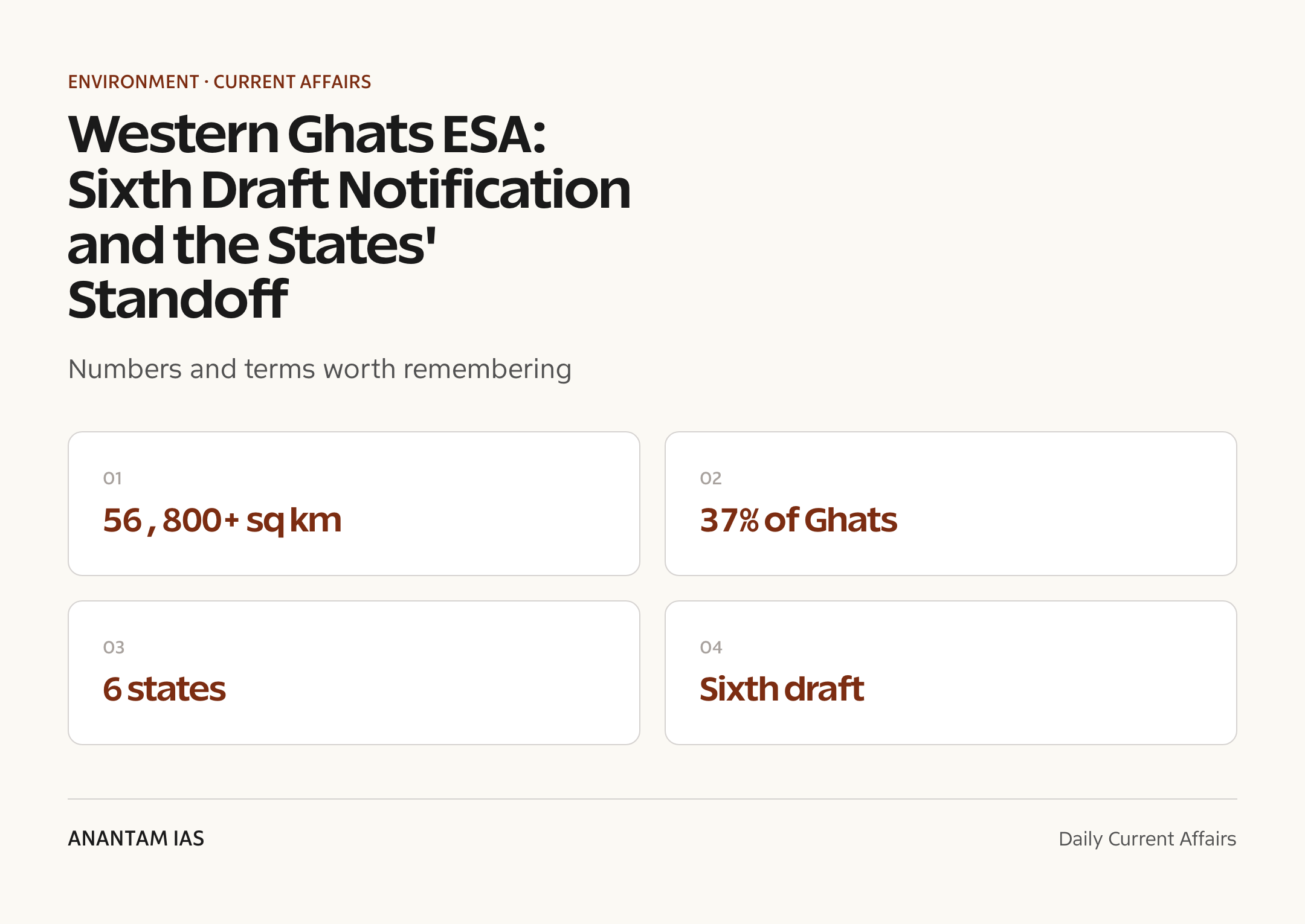
- Sixth draft ESA notification covers over 56,800 sq km (about 37% of the Western Ghats) across six states.
- Issued under the Environment (Protection) Act, 1986; public objections invited within a 60-day window.
- Rests on the Kasturirangan (HLWG) formula, not the broader Gadgil (WGEEP) recommendations.
- Gujarat is the only state to grant final consent; other states have raised reservations or opposed.
- ESA status restricts mining, quarrying and large-scale infrastructure in the demarcated zone.
The development matters in the context of:
- The trigger for the original review was the 2018 Kerala floods and recurring landslides, which sharpened the ecological case for protection.
- Previous drafts repeatedly lapsed without final notification, forcing the Centre to re-issue the proposal.
UPSC Relevance
Prelims Relevance
- The Western Ghats is one of India’s two mainland biodiversity hotspots (the other being the Himalaya) and a UNESCO World Heritage natural site.
- The range runs across six states: Gujarat, Maharashtra, Goa, Karnataka, Kerala and Tamil Nadu.
- Ecologically Sensitive Areas (ESAs) are notified under the Environment (Protection) Act, 1986.
- The Gadgil Committee (WGEEP, 2011) recommended treating a large share (about two-thirds) of the Ghats as ecologically sensitive in graded zones.
- The Kasturirangan Committee (HLWG, 2013) diluted this to roughly 37% of the Ghats as a single ESA.
- The current draft proposes about 56,800 sq km as ESA, based on the Kasturirangan formula.
- The Western Ghats predate the Himalaya and are older than the formation of the present land mass of the subcontinent.
- Key rivers such as the Godavari, Krishna, Kaveri and others originate in the Western Ghats.
Mains Relevance
GS Paper 3
- ESA notification as a tool of conservation under the Environment (Protection) Act, 1986, and its limits.
- Conservation-versus-livelihood trade-offs in ecologically fragile regions.
- Disaster vulnerability: how ecological degradation in the Ghats links to floods and landslides.
GS Paper 2
- Centre-state friction in environmental governance and the working of cooperative federalism.
- Role of expert committees and public consultation in environmental policymaking.
Essay
- Sustainable development and the ecology-versus-economy balance
- “Development must be in harmony with nature”
- Conservation, federalism and the rights of local communities
Background and Context
The Western Ghats: why they matter
A narrow, ancient mountain chain that anchors peninsular India’s ecology and water security.
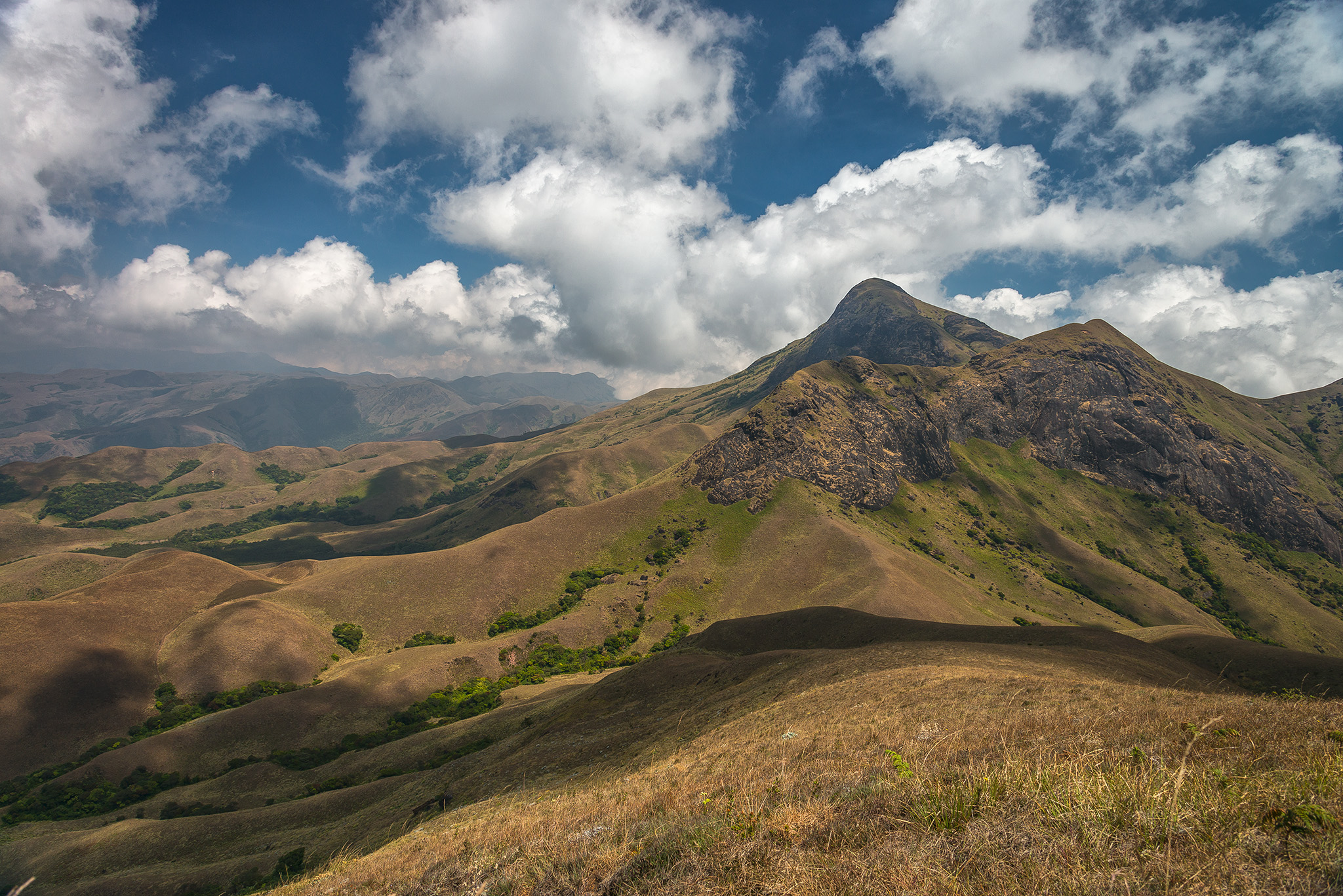
- Stretch roughly 1,600 km along the western coast across six states, recognised as a UNESCO World Heritage site.
- One of the world’s biodiversity hotspots, with very high endemism in plants, amphibians and freshwater fish.
- Source of major peninsular rivers feeding agriculture and drinking water for millions.
- Influence the southwest monsoon by intercepting rain-bearing winds along the coast.
Gadgil (WGEEP) versus Kasturirangan (HLWG)
Two expert panels reached very different conclusions on how much of the Ghats to protect.
- The Western Ghats Ecology Expert Panel under Madhav Gadgil (2011) recommended treating a large share of the Ghats as ecologically sensitive, with graded ESZ-1, ESZ-2 and ESZ-3 zones and strong local-body (gram sabha) say.
- States and industry called the Gadgil report too restrictive, fearing curbs on farming, plantations and development.
- The High Level Working Group under K. Kasturirangan (2013) diluted this, proposing roughly 37% of the Ghats (largely natural landscape) as a single ESA while leaving cultural landscapes out.
- Critics argue the Kasturirangan approach weakened protection; many states still found even this version unacceptable.
The draft-notification saga
A demarcation exercise that has been re-issued repeatedly without ever being finalised.
- The first draft ESA notification was issued in 2014 on the Kasturirangan basis.
- It has since gone through several revisions as successive drafts lapsed without final notification, the latest being the sixth.
- The current draft proposes over 56,800 sq km as ESA and reopens a 60-day window for public objections.
- Inside the ESA, activities such as mining, quarrying and large infrastructure face restrictions, while existing villages and farming are largely accommodated.
The states' standoff
Consensus across six states has proved elusive for more than a decade.
- Gujarat is the only state to have granted final consent to the ESA within its jurisdiction.
- Other states have raised reservations or opposition, seeking exclusion of inhabited and plantation areas.
- Opposition is rooted in fears over livelihoods, mining and quarrying revenue, and local development.
- The Indian Express reports that states have at times called both the Gadgil and Kasturirangan reports ‘unscientific’.
Federalism and the livelihood question
The dispute is a textbook case of central environmental authority meeting state-level economic anxiety.
- Environment is on the Concurrent List, but land and local development are largely state subjects, creating friction.
- Communities in the Ghats depend on agriculture, plantations, tourism and small-scale extraction.
- Ecologists warn that unchecked construction and quarrying worsen landslides and flash floods, as seen in Kerala.
- The core challenge is designing protection that secures the ecosystem without pushing local livelihoods into crisis.
Way Forward
Resolve the standoff through genuine cooperative federalism: ground-truthed, village-level demarcation done jointly with state governments rather than imposed from above.
Pair restrictions with livelihood support for affected communities, such as eco-tourism, sustainable plantation practices and payments for ecosystem services, so conservation is not seen as anti-people.
Conclusion
The sixth draft notification underlines a hard truth: protecting the Western Ghats is less a scientific problem than a problem of trust and federal bargaining. The ecology is unambiguous, yet a workable map has eluded the Centre and six states for over a decade.
A durable settlement will rest on transparent demarcation, credible compensation for those who bear the cost of conservation, and the recognition that the Ghats’ rivers, rains and resilience underpin the very livelihoods the dispute is meant to protect.
UPSC Practice Questions
Prelims MCQ 1
With reference to the Western Ghats, consider the following statements: 1. The Western Ghats run across six Indian states. 2. The Western Ghats are recognised as a UNESCO World Heritage natural site. 3. They are one of India’s biodiversity hotspots. Which of the statements given above are correct?
1 and 2 only 2 and 3 only 1 and 3 only 1, 2 and 3
Answer: 1, 2 and 3
Explanation:
The Western Ghats span Gujarat, Maharashtra, Goa, Karnataka, Kerala and Tamil Nadu, are a UNESCO World Heritage site, and are a recognised global biodiversity hotspot. All three statements are correct.
Prelims MCQ 2
Consider the following statements about the Ecologically Sensitive Area (ESA) proposal for the Western Ghats: 1. The current draft notification is based on the recommendations of the Kasturirangan (High Level Working Group). 2. ESAs are notified under the Environment (Protection) Act, 1986. 3. The Gadgil Committee recommended a smaller protected area than the Kasturirangan Committee. Which of the statements given above are correct?
1 and 2 only 2 and 3 only 1 and 3 only 1, 2 and 3
Answer: 1 and 2 only
Explanation:
The draft rests on the Kasturirangan formula (about 37% of the Ghats) and ESAs are notified under the Environment (Protection) Act, 1986. Statement 3 is wrong: the Gadgil panel recommended a far larger protected area than Kasturirangan, not a smaller one.
UPSC Mains Questions
- The repeated failure to notify the Western Ghats Ecologically Sensitive Area reflects a deeper crisis in India’s environmental federalism. Critically examine. (250 words)
- Compare the recommendations of the Gadgil and Kasturirangan committees on the Western Ghats. Which approach better balances conservation with livelihoods? (250 words)
- ‘Protecting ecologically fragile regions cannot succeed without securing the livelihoods of those who live there.’ Discuss in the context of the Western Ghats ESA. (150 words)
Sources: DD News / Akashvani (News on AIR) and The Indian Express (Explained).
Frequently Asked Questions
What is the Western Ghats ESA notification about?
It is a draft notification by the Union environment ministry proposing to declare over 56,800 sq km of the Western Ghats across six states as an Ecologically Sensitive Area, restricting activities like mining and quarrying. It is the sixth such draft.
Which six states are covered?
Gujarat, Maharashtra, Goa, Karnataka, Kerala and Tamil Nadu.
What is the difference between the Gadgil and Kasturirangan reports?
The Gadgil panel (2011) recommended protecting a large share of the Ghats in graded zones with strong local-body powers. The Kasturirangan panel (2013) diluted this to roughly 37% of the Ghats as a single ESA, which states still found hard to accept.
Why are states opposing the ESA?
States fear that restrictions on mining, quarrying, construction and development will hurt local livelihoods and revenue. So far, only Gujarat has given final consent within its jurisdiction.
Under which law are ESAs notified?
Ecologically Sensitive Areas are notified under the Environment (Protection) Act, 1986.
What restrictions apply inside an ESA?
Activities such as mining, quarrying and large-scale infrastructure or construction are restricted, while existing villages, farming and plantations are generally accommodated.
Source: https://anantamias.com/current-affairs/western-ghats-esa-sixth-draft-notification/
Deficit Monsoon: Why Bajra Is Emerging as the Kharif Crop of Choice
Why in News?
The India Meteorological Department (IMD) reported that all-India cumulative monsoon rainfall was running about 43 per cent below normal as of June 22, 2026, with the southwest monsoon stalled over southern Maharashtra and large rain deficits across central, eastern, northwestern India and the southern peninsula. Government and media accounts (Indian Express) flag that the slow advance has compressed the kharif sowing window in rainfed districts.
As farmers wait for reliable rain, an Indian Express Explained piece notes a growing pivot to bajra (pearl millet) — a short-duration, drought-tolerant cereal that can be sown late and still mature on limited moisture. The shift sits at the intersection of monsoon dynamics, food security, the government’s millet push (Shree Anna), minimum support prices and the inflation-growth risks the RBI has flagged.
- IMD pegged the all-India season-to-date rainfall deficit at about 43 per cent as of June 22, 2026, with the monsoon’s northward advance stalled.
- The shortfall narrows the kharif sowing window, and several states have advised farmers not to rush sowing until rain stabilises.
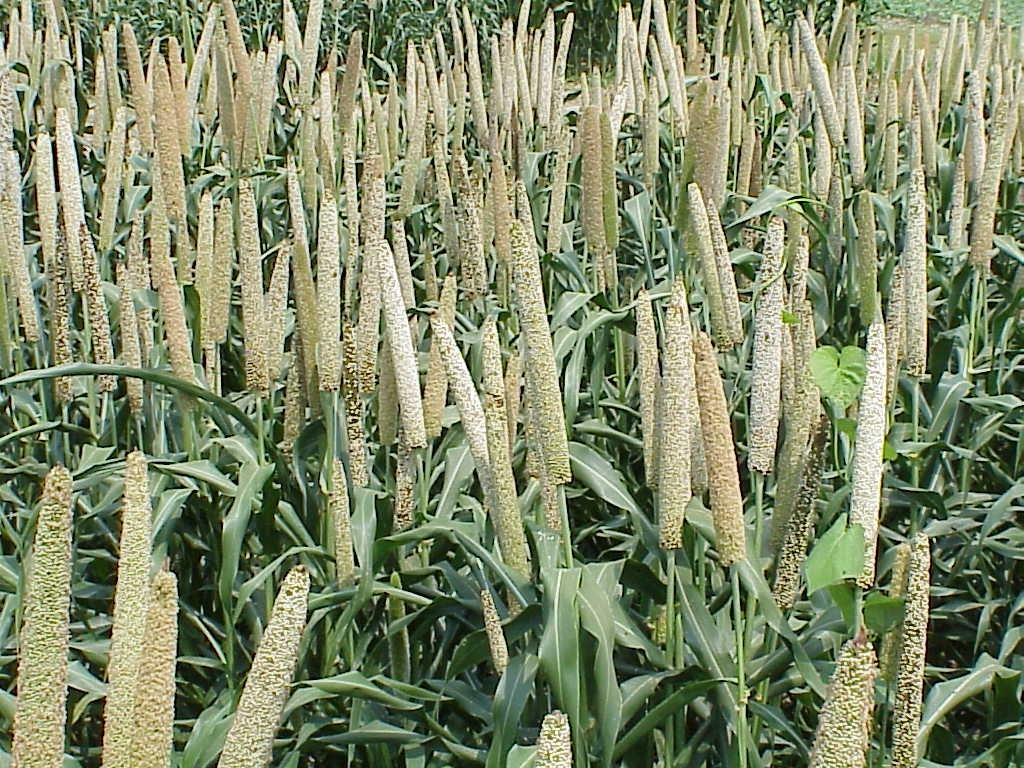
- Rainfed belts are turning to bajra (pearl millet), valued for short duration and drought tolerance, as the kharif crop of choice.
- IMD had confirmed an El Nino onset over the equatorial Pacific on June 12, raising the risk of a weak-to-erratic monsoon.
- Because food carries roughly two-fifths of the CPI basket, a deficient monsoon quickly becomes a growth-and-inflation concern for the RBI.
The development matters in the context of:
- The southwest monsoon normally delivers the bulk of India’s annual rainfall between June and September and underwrites the kharif harvest.
- Roughly half of India’s net sown area remains rainfed, so the timing and spread of monsoon rain — not just the seasonal total — shapes sowing decisions.
- Coarse cereals such as bajra, jowar and ragi are climate-resilient fallbacks when rains are late or scanty.
UPSC Relevance
Prelims Relevance
- Southwest monsoon: onset over Kerala (around June 1), northward advance, role of the Long Period Average (LPA) in defining ‘normal’ rainfall.
- IMD rainfall categories: normal rainfall is 96-104 per cent of LPA; below 90 per cent is ‘deficient’.
- Kharif vs rabi: kharif crops are sown with the monsoon (June-July) and harvested in autumn; rabi crops are winter-sown.
- Bajra (pearl millet): a kharif coarse cereal, drought- and heat-tolerant, grown largely in arid and semi-arid rainfed soils.
- El Nino: an abnormal warming of the central-eastern equatorial Pacific, generally associated with weaker Indian monsoons.
- Major bajra-growing states include Rajasthan, Maharashtra, Gujarat, Uttar Pradesh and Haryana.
- Shree Anna is the government’s branding for millets; 2023 was observed as the International Year of Millets.
- Minimum Support Price (MSP) is recommended by the Commission for Agricultural Costs and Prices (CACP) and covers bajra among the kharif crops.
- Food articles carry close to two-fifths weight in the Consumer Price Index (CPI), linking rainfall to retail inflation.
- Millets are nutri-cereals: bajra is rich in iron, protein and fibre and has a relatively low water footprint.
Mains Relevance
GS Paper 3
- Cropping pattern shifts under monsoon variability and climate stress, and the case for crop diversification toward resilient cereals.
- Food security and buffer-stock management when a deficient monsoon threatens kharif output.
- Transmission from rainfall shocks to food inflation and monetary policy under the RBI’s flexible inflation-targeting mandate.
- Effectiveness of MSP, procurement and the millet mission in incentivising drought-hardy crops.
Essay
- Resilience over yield: rethinking what India grows in an age of erratic rainfall.
- Water, climate and the politics of the plate.
Background and Context
The monsoon picture: a slow, deficient advance
The early-season shortfall is the trigger event behind the kharif anxiety.
- IMD reported an all-India deficit of about 43 per cent as of June 22, 2026, with the monsoon stalled over southern Maharashtra.
- ‘Normal’ is benchmarked against the Long Period Average (LPA) — the multi-decadal mean of seasonal rainfall — so a 43 per cent gap means cumulative rain is far short of that mean to date.
- Deficits were spread across central India, the east and northeast, the southern peninsula and northwest India, hitting precisely the rainfed sowing belts.
- IMD had confirmed an El Nino onset on June 12, a pattern historically linked to weaker or more erratic Indian monsoons.
- It is the spread and timing of rain, not only the seasonal total, that governs whether farmers can sow on schedule.
Why bajra becomes the crop of choice
Pearl millet’s agronomy makes it the natural hedge when rains fail or arrive late.
- Bajra (pearl millet) is a hardy kharif coarse cereal that thrives in hot, dry, sandy and low-fertility soils where rice and maize struggle.
- It is short-duration and can be sown later in the window, so farmers can wait out a delayed monsoon and still get a crop.
- Deep roots and efficient water use give it strong drought tolerance, with a far smaller water footprint than paddy.
- Major producing states — Rajasthan, Maharashtra, Gujarat, Haryana and Uttar Pradesh — overlap with the arid and semi-arid zones most exposed to rain failure.
- The grain doubles as food and fodder, adding a livelihood cushion in dryland farming systems.
The kharif basket under pressure
A compressed window forces a reshuffle across the whole rainfed crop mix.
- Kharif crops — paddy, maize, pulses, oilseeds, cotton, sugarcane and coarse cereals — are sown with the monsoon and depend on its early spread.
- Several states advised farmers not to rush sowing until rainfall stabilises, to avoid germination failure and re-sowing costs.
- Water-intensive crops like paddy and sugarcane carry the highest risk when reservoirs and soil moisture run low.
- A pivot toward bajra and other coarse cereals trades headline yield for reliability and lower input risk.
- Late or patchy sowing can shrink acreage and delay the harvest, with knock-on effects for rural incomes.
Millet policy and Shree Anna
A weak monsoon meets an existing policy push to mainstream millets.
- The government brands millets as Shree Anna and has promoted them through a dedicated mission and procurement support.
- 2023 was the International Year of Millets, championed by India at the United Nations, which lifted the profile of bajra, jowar and ragi.
- Bajra is covered under the Minimum Support Price (MSP) regime for kharif crops, giving farmers a price floor.
- Millets are positioned as nutri-cereals — bajra is high in iron, protein and fibre — supporting nutrition-security goals.
- Their climate resilience and low water need align millet promotion with sustainable agriculture in dryland regions.
The macro link: food security and inflation
Rainfall shocks travel quickly from the field to monetary policy.
- Food articles carry close to two-fifths of the weight in the Consumer Price Index, so a monsoon shortfall can stoke retail inflation.
- The RBI operates under flexible inflation targeting (a 4 per cent target with a 2-6 per cent band), making food-price spikes a central policy concern.
- A weak kharif can dent rural demand and farm incomes, weighing on broader growth.
- Buffer stocks of rice and wheat and timely imports of pulses and edible oils are the standard food-security buffers.
- A resilient crop mix and assured procurement of millets can soften the blow when the monsoon underperforms.
Way Forward
Use real-time IMD advisories and contingency cropping plans to steer farmers toward short-duration, drought-hardy crops in deficit districts.
Strengthen millet procurement, storage and market linkages so the pivot to bajra is backed by assured offtake, not just survival sowing.
Expand micro-irrigation, watershed development and soil-moisture conservation to cut the rainfed sector’s exposure to monsoon swings.
Keep buffer stocks and import windows ready to anchor food prices and shield the inflation outlook.
Conclusion
A 43 per cent early-season rainfall gap turns an abstract weather statistic into a hard farm-gate decision: what to sow when the rains do not arrive on time. The pivot to bajra is the rational answer, marrying agronomy with risk management in India’s rainfed heartland.
It also shows why climate resilience now belongs at the centre of agricultural policy. Millets like bajra, backed by MSP and the Shree Anna push, offer a template for an India that must grow food on a less predictable monsoon while keeping inflation and rural incomes in check.
UPSC Practice Questions
Prelims MCQ 1
With reference to the southwest monsoon and India’s crop calendar, consider the following statements: 1. The southwest monsoon normally sets in over Kerala around the beginning of June. 2. Kharif crops are sown at the onset of the monsoon and harvested in autumn. 3. The India Meteorological Department defines ‘normal’ monsoon rainfall with reference to the Long Period Average (LPA). How many of the above statements are correct?
Only one Only two All three None
Answer: All three
Explanation:
The southwest monsoon typically reaches Kerala around June 1 and advances northward. Kharif crops are monsoon-sown (June-July) and harvested in autumn, unlike winter-sown rabi crops. IMD benchmarks ‘normal’ rainfall against the LPA, with 96-104 per cent of LPA counted as normal.
Prelims MCQ 2
Bajra (pearl millet) is increasingly favoured during a deficient monsoon. Which of the following best explains why?
It requires standing water through its growth cycle like paddy It is short-duration, drought-tolerant and suited to hot, dry rainfed soils It can only be grown in high-rainfall coastal regions It is a rabi crop sown after the monsoon withdraws
Answer: It is short-duration, drought-tolerant and suited to hot, dry rainfed soils
Explanation:
Bajra is a kharif coarse cereal that matures quickly, tolerates drought and heat, and grows in arid and semi-arid sandy soils with a low water footprint. This makes it a reliable fallback when the monsoon is late or scanty, unlike water-intensive paddy.
UPSC Mains Questions
- A deficient monsoon repeatedly exposes the vulnerability of India’s rainfed agriculture. Examine how a shift toward drought-resilient crops such as bajra, supported by appropriate policy, can strengthen food security. (250 words)
- Discuss the transmission of monsoon and rainfall shocks to food inflation in India, and assess the policy options available to the government and the RBI to manage the resulting growth-inflation trade-off. (250 words)
- Evaluate the role of the millet mission (Shree Anna) and the MSP framework in promoting climate-resilient cropping patterns in India’s arid and semi-arid regions. (150 words)
Sources: Indian Express and Indian Express Explained.
Frequently Asked Questions
How large is the monsoon rainfall deficit this season?
The India Meteorological Department reported that all-India cumulative rainfall was running about 43 per cent below normal as of June 22, 2026, with the monsoon’s northward advance stalled over southern Maharashtra and deficits spread across most regions.
Why are farmers turning to bajra during a deficient monsoon?
Bajra (pearl millet) is a short-duration, drought- and heat-tolerant kharif cereal that grows well in hot, dry, sandy soils. It can be sown later in the season and still mature on limited moisture, making it a reliable choice when rains are delayed or scanty.
What is the difference between kharif and rabi crops?
Kharif crops are sown at the onset of the southwest monsoon (around June-July) and harvested in autumn; examples include paddy, maize, bajra and cotton. Rabi crops are winter-sown (around October-December) and harvested in spring, such as wheat and gram.
What is Shree Anna and how does it relate to millets?
Shree Anna is the government’s branding for millets such as bajra, jowar and ragi, promoted through a dedicated mission and procurement support. The push gained momentum after 2023, observed globally as the International Year of Millets at India’s initiative.
How does a weak monsoon affect inflation and the RBI?
Food articles carry close to two-fifths of the weight in the Consumer Price Index, so a deficient monsoon can push up food prices and stoke retail inflation. Under flexible inflation targeting, this makes a poor monsoon a direct concern for the RBI’s policy outlook.
Which states are the main producers of bajra in India?
Bajra is grown largely in arid and semi-arid rainfed zones, with Rajasthan, Maharashtra, Gujarat, Haryana and Uttar Pradesh among the leading producing states.
Source: https://anantamias.com/current-affairs/monsoon-deficit-kharif-bajra-2026/
Jonnagiri Gold Fields: India’s First Large Private Gold Mine in 70 Years
Why in News?
The Jonnagiri gold project in Kurnool district of Andhra Pradesh has begun commercial operations and is being reported as India’s first large private-sector gold mine with an integrated processing facility since Independence. Developed by Geomysore Services India Pvt Ltd, backed by Deccan Gold Mines Ltd and Thriveni Earthmovers, the venture has drawn attention because domestic gold output has long been dominated by a single state producer, Hutti Gold Mines in Karnataka.
The story matters for the economy because India imports the bulk of its gold, with imports reaching record value in 2025-26 even as volumes eased. Any meaningful domestic mine output is framed as a small step toward reducing the gold component of the import bill, which weighs on the current account. The Jonnagiri figures, however, vary across reports and should be read as reported estimates rather than confirmed final numbers.
- Jonnagiri, in Kurnool district of Andhra Pradesh, is reported as India’s first large private gold mine with integrated processing in about 70 years.
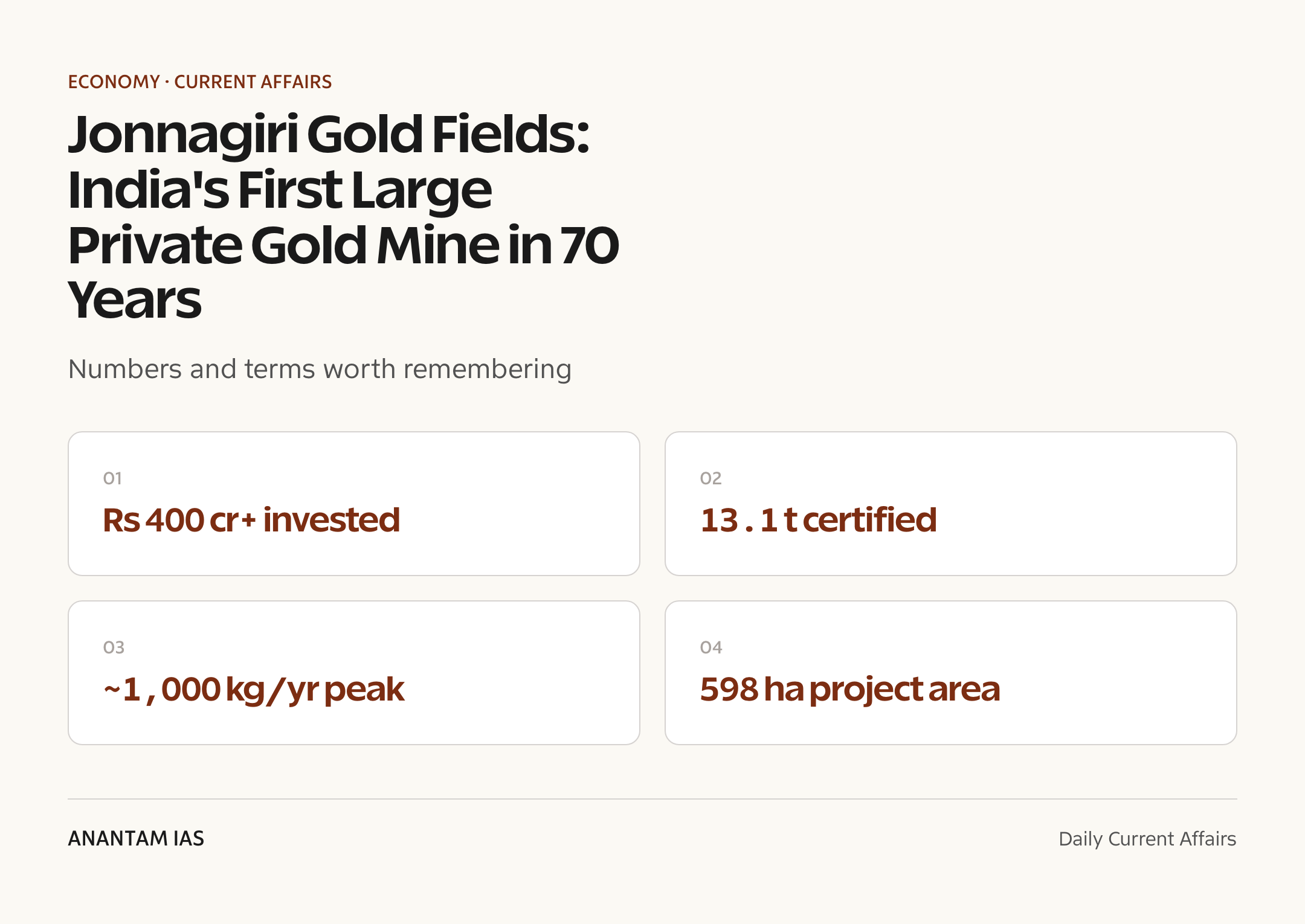
- Investment of over Rs 400 crore has gone into the mine, ore-handling and on-site processing infrastructure.
- Certified gold resource is put at roughly 13.1 tonnes, with exploration potential cited up to about 42.5 tonnes.
- Peak annual output is projected near 1,000 kg of refined gold; first-year output is reported lower (around 600 kg), so the 1,000 kg figure is a peak target.
- Until now, Hutti Gold Mines in Karnataka has been India’s only significant operating gold producer.
The development matters in the context of:
- The project area spans nearly 598 hectares across Jonnagiri, Erragudi and Pagidirayi villages.
- Reports describe the geology as part of the Dharwar craton greenstone-belt terrain of the Rayalaseema region, which hosts known gold occurrences.
- Gold imports remain one of India’s largest non-energy import lines, linking this mineral story to forex and the rupee.
UPSC Relevance
Prelims Relevance
- Jonnagiri gold project lies in Kurnool district, Andhra Pradesh (Rayalaseema region).
- Hutti Gold Mines (Karnataka, Raichur district) is India’s main operating gold producer, in the Hutti-Maski schist belt.
- Kolar Gold Fields (KGF) in Karnataka, once a leading deep gold mine, was closed around 2000-01.
- Indian gold-bearing terrains sit largely in the Dharwar craton greenstone belts of peninsular India.
- India is among the world’s largest gold importers; FY26 gold imports were around 721 tonnes by volume and near USD 72 billion by value (reported).
- Mineral concessions and auctions are governed by the Mines and Minerals (Development and Regulation) Act, 1957 (MMDR Act).
- Gold is a major mineral, with mineral administration shared between the Union (Ministry of Mines, Geological Survey of India) and states.
- High gold imports widen the trade deficit and feed into the current account deficit (CAD), pressuring the rupee.
Mains Relevance
GS Paper 3
- Mineral resources and domestic value addition: how a private gold mine fits India’s mineral-sector reforms and import-substitution goals.
- External sector linkage: gold imports, the current account deficit and exch-rate management as a policy challenge.
- Private participation in mining after MMDR auction reforms, and the balance between investment, environment and local livelihoods.
- Regional development: mineral-led employment and infrastructure in the Rayalaseema region of Andhra Pradesh.
Essay
- Self-reliance and the limits of import substitution: what a single gold mine can and cannot do for a 700-800 tonne-a-year appetite.
- Mineral wealth, regional growth and the duty of sustainable extraction.
Background and Context
The Jonnagiri project: what is reported
A framing of the mine’s scale, ownership and output, treating contested numbers as reported estimates.
- Location: Jonnagiri, with adjoining Erragudi and Pagidirayi villages, in Kurnool district, Andhra Pradesh, across nearly 598 hectares.
- Developer: Geomysore Services India Pvt Ltd, backed by Deccan Gold Mines Ltd and Thriveni Earthmovers.
- Investment: over Rs 400 crore reported across mining, ore handling and an on-site processing plant.
- Resource: about 13.1 tonnes of certified gold resource, with exploration potential cited up to roughly 42.5 tonnes.
- Output: a peak target near 1,000 kg of refined gold a year; early-year output is reported lower, so treat 1,000 kg as a peak rather than launch figure.
- Significance claim: described in reports as India’s first large private-sector gold mine with integrated processing since Independence.
India's gold-mining landscape: Hutti and KGF
Domestic mined gold has been thin and concentrated, which is why a new mine draws notice.
- Hutti Gold Mines Ltd (a Karnataka state undertaking) in Raichur district has been the only significant operating gold producer, with reported annual output in the low single-digit tonnes.
- Kolar Gold Fields (KGF), once among the world’s deepest gold mines, closed around 2000-01 as ore grades fell and costs rose.
- Domestic mined gold is a tiny fraction of national demand, which runs to several hundred tonnes a year met mostly by imports.
- India’s gold-bearing rocks lie largely in the greenstone belts of the Dharwar craton in peninsular India.
Gold imports and the current account
Gold is both a household savings habit and a macroeconomic headache.
- India is among the world’s top gold importers, with annual demand commonly cited around 700-800 tonnes.
- In FY 2025-26, gold imports were reported near 721 tonnes by volume, with value at a record around USD 72 billion as prices surged.
- Heavy gold imports widen the trade deficit and feed the current account deficit, adding pressure on the rupee.
- Policy levers have included import-duty changes and gold-monetisation and sovereign-bond schemes to curb physical imports.
Mining regulation and private entry
A private gold mine reflects the post-reform mineral concession regime.
- The MMDR Act, 1957 governs grant of mineral concessions; amendments shifted major-mineral allocation toward transparent auctions.
- Gold is a major mineral; the Union (Ministry of Mines, Geological Survey of India) and states share regulatory roles.
- Auction-based allocation and exploration incentives were designed to attract private capital and modern processing.
- On-site integrated processing (mining plus extraction and refining) is what distinguishes Jonnagiri from mere ore extraction.
Why it matters
Place the mine in proportion before reading too much into one project.
- A peak output near 1 tonne a year is small against national demand of several hundred tonnes, so import substitution is marginal at this scale.
- The symbolic and demonstration value is larger: it shows private capital can run a viable gold mine with processing in India.
- Industry voices cited in reports aspire to 50-100 tonnes a year of domestic output over the next decade if more deposits are developed.
- Local effects include employment and infrastructure in a part of Rayalaseema that has lagged on industrial investment.
Way Forward
Treat Jonnagiri as a proof of concept: encourage further exploration of Dharwar-craton greenstone belts so domestic output can scale beyond a single mine.
Pair private mining with strict environmental safeguards, tailings management and community benefit-sharing so mineral wealth does not become a local burden.
Conclusion
Jonnagiri is a genuine milestone for India’s mineral sector, the first large private gold mine with integrated processing in about seven decades, but its near-1,000 kg peak target sits against national demand running into hundreds of tonnes a year.
Its real worth lies in signalling that private capital can mine and process gold viably at home; whether that translates into a meaningful dent in gold imports and the current account depends on many more deposits being found, financed and worked responsibly.
UPSC Practice Questions
Prelims MCQ 1
With reference to the Jonnagiri gold project recently in the news, consider the following statements: 1. It is located in the Kurnool district of Andhra Pradesh. 2. It is reported as India’s first large private-sector gold mine with integrated processing since Independence. 3. It is owned and operated by the Geological Survey of India. Which of the statements given above is/are correct?
1 and 2 only 2 and 3 only 1 and 3 only 1, 2 and 3
Answer: 1 and 2 only
Explanation:
Jonnagiri is in Kurnool district, Andhra Pradesh, and is reported as India’s first large private gold mine with integrated processing since Independence. It is developed by a private company (Geomysore Services India Pvt Ltd), not the Geological Survey of India, so statement 3 is wrong.
Prelims MCQ 2
Consider the following statements regarding gold mining in India: 1. Hutti Gold Mines in Karnataka has been India’s principal operating gold producer. 2. The Kolar Gold Fields are currently India’s largest producing gold mine. 3. India’s gold-bearing terrains lie largely in the greenstone belts of the Dharwar craton. Which of the statements given above is/are correct?
1 and 2 only 1 and 3 only 2 and 3 only 1, 2 and 3
Answer: 1 and 3 only
Explanation:
Hutti Gold Mines is India’s principal operating producer and Indian gold occurs largely in Dharwar-craton greenstone belts, so 1 and 3 are correct. Kolar Gold Fields closed around 2000-01 and is no longer producing, so statement 2 is wrong.
UPSC Mains Questions
- India imports the bulk of its gold even as it widens the current account deficit. Examine the role domestic gold mining can play in this context, using the Jonnagiri project to illustrate both its promise and its limits.
- Discuss how the auction-based regime under the Mines and Minerals (Development and Regulation) Act has shaped private participation in India’s mineral sector. What safeguards are needed to balance investment with environmental and community interests?
- Mineral-led development can transform lagging regions but also impose ecological and social costs. Critically analyse this trade-off with reference to gold mining in the Rayalaseema region of Andhra Pradesh.
Sources: Swarajya and The Federal.
Frequently Asked Questions
Where is the Jonnagiri gold project located?
It is in Kurnool district of Andhra Pradesh, spread across Jonnagiri, Erragudi and Pagidirayi villages over nearly 598 hectares, in the Rayalaseema region.
Why is Jonnagiri called India’s first private gold mine since Independence?
Reports describe it as the first large private-sector gold mine with an integrated processing facility to come up in roughly 70 years. India’s main producer, Hutti Gold Mines, is a Karnataka state undertaking, so a private operator at this scale is treated as a first. The claim is as reported.
How much gold will Jonnagiri produce?
The project carries a certified resource of about 13.1 tonnes, with exploration potential cited up to around 42.5 tonnes. Peak annual output is projected near 1,000 kg of refined gold, though early-year output is reported lower, so 1,000 kg is a peak target rather than a launch figure.
How does gold mining connect to India’s current account deficit?
India imports several hundred tonnes of gold a year, with FY26 value reported near USD 72 billion. Such large imports widen the trade and current account deficits and pressure the rupee, so any rise in domestic output is seen as helpful, even if marginal at present scales.
What law governs gold mining in India?
The Mines and Minerals (Development and Regulation) Act, 1957 governs mineral concessions. Amendments shifted major-mineral allocation toward transparent auctions, which the Union (Ministry of Mines and Geological Survey of India) and states administer together.
What was Kolar Gold Fields?
Kolar Gold Fields in Karnataka was once among the world’s deepest gold mines and a major Indian producer. It was shut down around 2000-01 as ore grades declined and mining costs became unviable.
Source: https://anantamias.com/current-affairs/jonnagiri-first-private-gold-mine-india/
FCRA Rules 2026: Tighter Foreign-Funding Norms and Revised Penalties for NGOs
Why in News?
The Union Ministry of Home Affairs (MHA) notified the Foreign Contribution (Regulation) Amendment Rules, 2026 on or around 22 June 2026, tightening the operational, disclosure and penalty regime for NGOs that receive foreign funds. As reported by Business Standard and Deccan Herald, the changes touch every stage of an NGO’s foreign-funding lifecycle — application, renewal, utilisation and reporting.
These are amended RULES under the existing FCRA, 2010 framework, and are distinct from the separately pending FCRA Amendment Bill, 2026. Their net effect is to raise the compliance burden on civil-society bodies and sharpen the state’s ability to monitor how foreign money is spent inside India.
- MHA notified the FCRA Amendment Rules, 2026 tightening norms for foreign-funded NGOs (Business Standard).
- NGOs must now disclose social-media accounts at the time of registration or renewal.
- Applicants must specify the exact purpose of foreign funds and the states or Union Territories where they will operate (Deccan Herald).
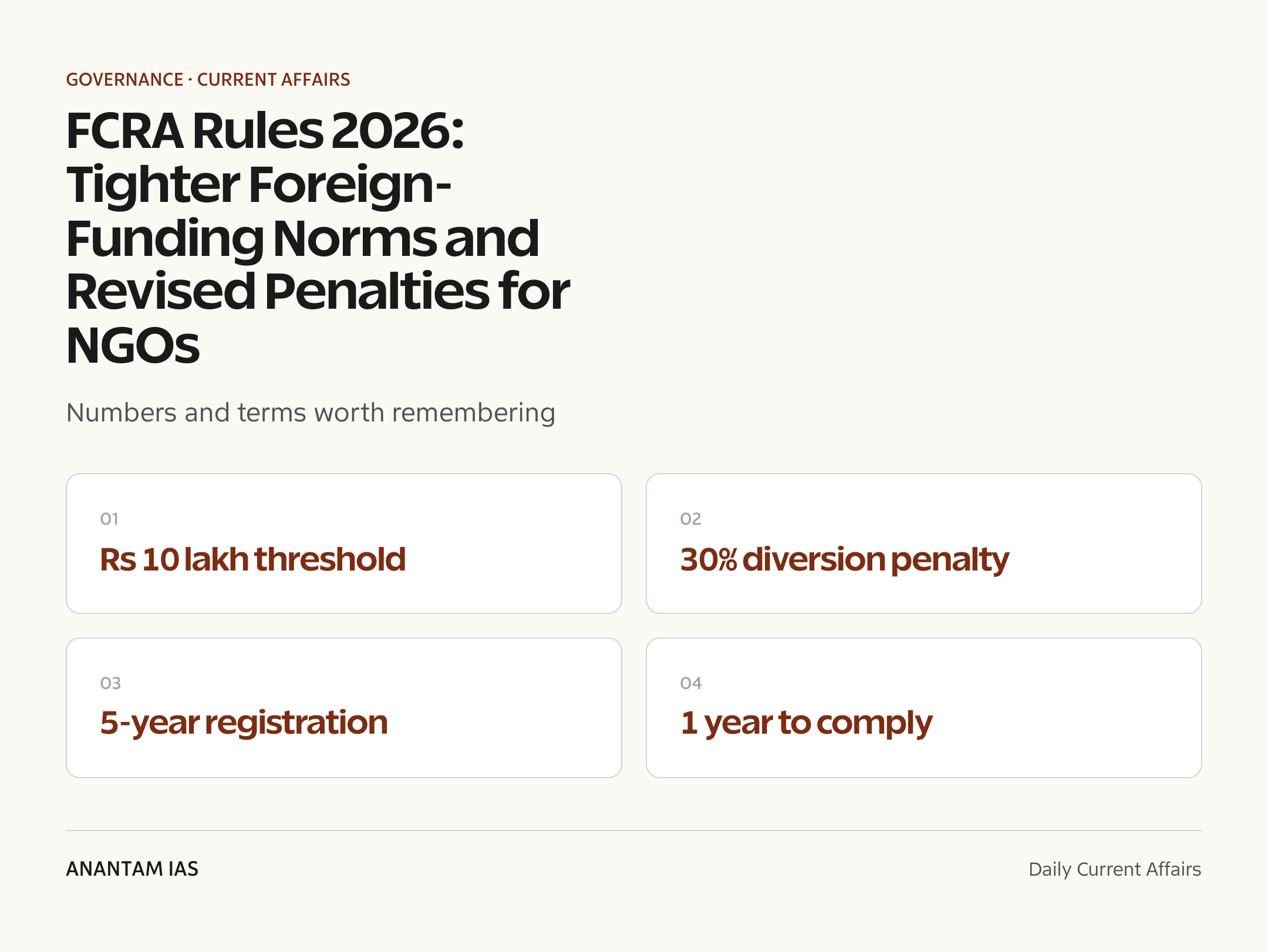
- A minimum spending threshold of Rs 10 lakh over the previous two financial years is required to retain registration.
- Diversion of funds now attracts a penalty of Rs 1 lakh or 30% of the diverted amount, whichever is higher.
- Existing FCRA-registered NGOs get one year to submit the new details to the government.
The development matters in the context of:
- FCRA registration is granted by the MHA and is valid for five years, after which it must be renewed.
- All FCRA receipts must be routed through the designated SBI New Delhi Main Branch account since the 2020 amendment.
- The rules sit within the larger debate over regulating civil society versus protecting associational freedom under Article 19(1)(c).
UPSC Relevance
Prelims Relevance
- FCRA, 2010 regulates the acceptance and utilisation of foreign contribution and foreign hospitality by individuals and associations; it is administered by the Ministry of Home Affairs, not the Finance Ministry.
- FCRA registration is valid for five years; bodies can also receive funds under prior permission for a specific project and donor.
- Since the FCRA (Amendment) Act, 2020, all foreign contribution must be received in a designated account at the State Bank of India, New Delhi Main Branch.
- The 2020 amendment barred sub-granting (transfer of foreign funds to other FCRA holders) and capped administrative expenses from foreign funds.
- Under the 2026 rules, NGOs must declare social-media accounts and name the states/UTs of operation at application or renewal.
- A retention condition now requires spending at least Rs 10 lakh of foreign contributions on declared activities over the previous two financial years.
- Diversion of funds and speculative investment each attract a penalty of Rs 1 lakh or 30% of the amount, whichever is higher.
- Foreign nationals (other than Persons of Indian Origin) as key functionaries can ordinarily disqualify an organisation from registration.
Mains Relevance
GS Paper 2
- Tests the regulation of civil society and the role of NGOs in development, service delivery and accountability under the governance syllabus.
- Links the state-versus-civil-society regulatory debate with constitutional freedoms of association and expression.
- Connects domestic regulation of foreign funding to sovereignty and national-security concerns under international relations.
- Illustrates the trade-off between transparency/anti-misuse safeguards and the compliance burden that can shrink the space for genuine non-profits.
Essay
- Useful for essays on civil society and democracy, the balance between security and liberty, and the changing role of the state in regulating private and voluntary action.
Background and Context
The FCRA, 2010 framework
FCRA is the master law governing how foreign money enters and is spent by associations in India.
- The Foreign Contribution (Regulation) Act, 2010 regulates acceptance and use of foreign contribution and foreign hospitality to ensure they do not prejudice national interest.
- It is administered by the Ministry of Home Affairs, reflecting the law’s framing as a security-and-sovereignty instrument rather than a charity-finance one.
- Associations must obtain registration (valid five years) or prior permission for a specific project before receiving foreign contribution; applications and returns are filed on the MHA’s FCRA Online portal.
- Election candidates, judges, government servants, legislators and media houses are generally barred from accepting foreign contribution.
- Registered bodies must file annual returns of receipts and utilisation; the 2026 rules now require a detailed activity report alongside the financial statements.
What the 2026 rules change
The amended rules add disclosure, utilisation and operational conditions across the funding cycle.
- NGOs must declare their social-media accounts while applying for registration or renewal, extending scrutiny to an organisation’s public communications.
- Applicants must specify the exact purpose of foreign funds and the states/UTs in which they will be used; deploying funds in unregistered states attracts a penalty.
- To retain registration, an organisation must have spent at least Rs 10 lakh of foreign contributions on declared activities over the previous two financial years.
- When funds arrive through intermediaries or donor-advised vehicles, the NGO must disclose the ultimate donor in its application.
- Under prior permission, at least 75% of an instalment must be utilised before the next tranche is released.
- Existing registered NGOs have one year to file the new purpose and disclosure details, per Deccan Herald.
Revised compounding penalties
The rules sharply revise the schedule of fines for common violations.
- Diversion of funds to purposes other than declared attracts Rs 1 lakh or 30% of the diverted amount, whichever is higher.
- Speculative investment of foreign funds attracts Rs 1 lakh or 30% of the invested amount, whichever is higher, plus recovery of returns earned.
- Exceeding the administrative-expense cap attracts Rs 1 lakh or 5% of the excess, whichever is higher (Business Standard).
- Using funds in unregistered states/UTs carries the same diversion-style penalty, tying the geographic-disclosure rule to a financial consequence.
Prior tightening: the 2020 amendment
The 2026 rules build on a decade of progressively stricter control.
- The FCRA (Amendment) Act, 2020 mandated that all foreign contribution be received in a single designated account at the SBI New Delhi Main Branch.
- It prohibited sub-granting — the transfer of foreign funds from one FCRA holder to another — disrupting the funder-to-grassroots chain.
- It tightened the cap on administrative expenses met from foreign contribution and mandated Aadhaar of office-bearers.
- Thousands of NGOs have since seen registrations lapse, be refused renewal or cancelled, shrinking the foreign-funded non-profit base.
The regulation-versus-freedom debate
The rules sit at the heart of a contested question about the space for civil society.
- Government view: stricter norms curb misuse, money-laundering and opaque foreign influence and improve the accountability of public-interest money.
- Critics’ view: cumulative tightening chokes legitimate NGOs, especially smaller and grassroots bodies, and chills advocacy that questions the state.
- The freedom to form associations is protected under Article 19(1)(c), subject to reasonable restrictions including sovereignty, public order and morality.
- The Supreme Court, in upholding the 2020 amendments, accepted that foreign funding can be regulated in the national interest, while noting that NGOs have no fundamental right to receive foreign money.
- International observers have flagged concern that disclosure and threshold conditions can be used to narrow dissent and advocacy space.
The sovereignty and IR rationale
FCRA is framed as a national-security and foreign-relations instrument.
- By housing the law in the MHA, the state treats foreign funding as a potential channel of external influence over domestic affairs.
- Disclosure of ultimate donors and social-media handles aims to map foreign linkages and messaging of funded bodies.
- Restrictions seek to insulate electoral, religious and policy processes from foreign money, echoing concerns common to many democracies.
- The challenge is to draw the line so that anti-influence safeguards do not become a blanket barrier to legitimate cross-border philanthropy.
Way Forward
Adopt a risk-based, graded approach so that small, compliant NGOs face proportionate paperwork while genuinely suspect flows draw close scrutiny.
Pair tighter rules with a transparent, time-bound registration and renewal process, clear appeal routes, and published reasons for refusal or cancellation.
Build a single, searchable FCRA disclosure portal so that compliance is digital-first and the public can see who funds whom, reducing arbitrariness.
Calibrate penalties to intent and scale of violation, distinguishing inadvertent reporting lapses from deliberate diversion, to preserve the space for legitimate civil society.
Conclusion
The FCRA Amendment Rules, 2026 deepen a decade-long shift toward treating foreign funding of NGOs as a question of sovereignty and security as much as of charity finance. Mandatory social-media and donor disclosure, purpose-and-state specification, a spending threshold and steeper compounding penalties together raise the cost of being a foreign-funded non-profit in India.
The durable governance test is balance: rules must deter genuine misuse and opaque foreign influence without hollowing out the constitutionally protected space for association and advocacy. How fairly and predictably the MHA applies these conditions will decide whether the regime reads as accountability or as a squeeze on civil society.
UPSC Practice Questions
Prelims MCQ 1
With reference to the Foreign Contribution (Regulation) Act, 2010, consider the following statements: 1. It is administered by the Ministry of Finance. 2. Since 2020, all foreign contribution must be received in a designated account at the State Bank of India, New Delhi Main Branch. 3. Registration under the Act is valid for five years and is renewable. Which of the statements given above are correct?
1 and 2 only 2 and 3 only 1 and 3 only 1, 2 and 3
Answer: 2 and 3 only
Explanation:
FCRA is administered by the Ministry of Home Affairs, not the Ministry of Finance, so statement 1 is wrong. The 2020 amendment mandated the designated SBI New Delhi Main Branch account, and registration is valid for five years and renewable, so statements 2 and 3 are correct.
Prelims MCQ 2
Consider the following provisions reportedly introduced by the Foreign Contribution (Regulation) Amendment Rules, 2026: 1. NGOs must disclose their social-media accounts at registration or renewal. 2. Applicants must specify the states or Union Territories where foreign funds will be used. 3. Diversion of foreign funds attracts a penalty of Rs 1 lakh or 30% of the diverted amount, whichever is higher. How many of the statements given above are correct?
Only one Only two All three None
Answer: All three
Explanation:
As reported by Business Standard and Deccan Herald, the 2026 rules require disclosure of social-media accounts, specification of the states/UTs of operation, and impose a diversion penalty of Rs 1 lakh or 30% of the diverted amount, whichever is higher. All three statements are correct.
UPSC Mains Questions
- The Foreign Contribution (Regulation) Amendment Rules, 2026 tighten disclosure, utilisation and penalty norms for foreign-funded NGOs. Examine the implications of this regime for the space available to civil society in India. (250 words)
- Foreign funding of voluntary organisations raises both sovereignty and accountability concerns. Critically evaluate India’s evolving FCRA framework in balancing national interest with the freedom of association. (250 words)
- Discuss the role of non-governmental organisations in India’s development and the challenges that progressively stricter FCRA regulation poses to their functioning. (150 words)
Sources: Business Standard and Deccan Herald.
Frequently Asked Questions
What are the FCRA Amendment Rules, 2026?
They are rules notified by the Ministry of Home Affairs in June 2026 under the existing Foreign Contribution (Regulation) Act, 2010, tightening disclosure, utilisation and penalty norms for NGOs that receive foreign funds. They are distinct from the separately pending FCRA Amendment Bill.
What new disclosures must NGOs make?
NGOs must declare their social-media accounts and specify the exact purpose of the foreign funds and the states or Union Territories where they will operate, at the time of registration or renewal. They must also disclose the ultimate donor when money comes through intermediaries.
What is the Rs 10-lakh spending threshold?
To retain or renew registration, an organisation must have spent at least Rs 10 lakh of foreign contributions on its declared activities over the previous two financial years, a condition meant to weed out dormant registrations.
What are the revised penalties?
Diversion of funds and speculative investment each attract Rs 1 lakh or 30% of the amount involved, whichever is higher, with recovery of returns in the investment case. Exceeding the administrative-expense cap attracts Rs 1 lakh or 5% of the excess, whichever is higher.
How do these rules relate to the FCRA Amendment Bill?
The 2026 rules amend procedure and penalties under the current Act, while the pending FCRA Amendment Bill is a separate legislative proposal. You can read more in the Anantam IAS note on the FCRA Amendment Bill.
How long do existing NGOs have to comply?
FCRA-registered NGOs are given one year to submit the new purpose and disclosure details to the government, as reported by Deccan Herald.
Source: https://anantamias.com/current-affairs/fcra-rules-amended-2026-ngo-foreign-funding/
Doval-Wang Yi Talks: India-China Reset Ahead of the SCO Calendar
Why in News?
National Security Adviser Ajit Doval met Chinese Foreign Minister Wang Yi in Beijing, on the sidelines of the Shanghai Cooperation Organisation (SCO) Security Council Secretaries’ meeting, in a fresh round of high-level India-China engagement. Doval is India’s designated Special Representative (SR) on the boundary question and Wang Yi is his Chinese counterpart, so the talks doubled as a stocktaking of the SR boundary mechanism alongside the broader bilateral relationship.
Both sides used the familiar language of respecting each other’s core interests and properly handling sensitive issues so that differences on the boundary do not derail the wider relationship. The meeting matters because it marks the slow, guarded normalisation of ties after the deadly 2020 Galwan clash, the multi-year military standoff along the Line of Actual Control (LAC), and the October 2024 understanding on patrolling that allowed a partial thaw. It also sets the tone as the SCO season and a planned new round of SR talks loom.
- NSA Ajit Doval, India’s Special Representative on the boundary question, met Chinese FM Wang Yi, his SR counterpart.
- The meeting took place on the sidelines of the SCO Security Council Secretaries’ meeting in Beijing.
- Both sides stressed respect for core interests and handling sensitive boundary issues so they do not derail overall ties.
- India flagged the need for mutual sensitivity on matters of concern, and counter-terrorism as a regional priority.
- Talks reaffirmed the Special Representatives (SR) mechanism and pointed toward a further round of SR boundary talks.
- The engagement extends the cautious post-Galwan normalisation that the October 2024 patrolling understanding reopened.
The development matters in the context of:
- The exchange is bilateral and boundary-focused, distinct from the multilateral BRICS and SCO summit tracks where the two countries also interact.
- India has stayed measured on the SCO’s rotating summit calendar, keeping cooperation on counter-terrorism and connectivity separate from its bilateral concerns with both China and Pakistan.
UPSC Relevance
Prelims Relevance
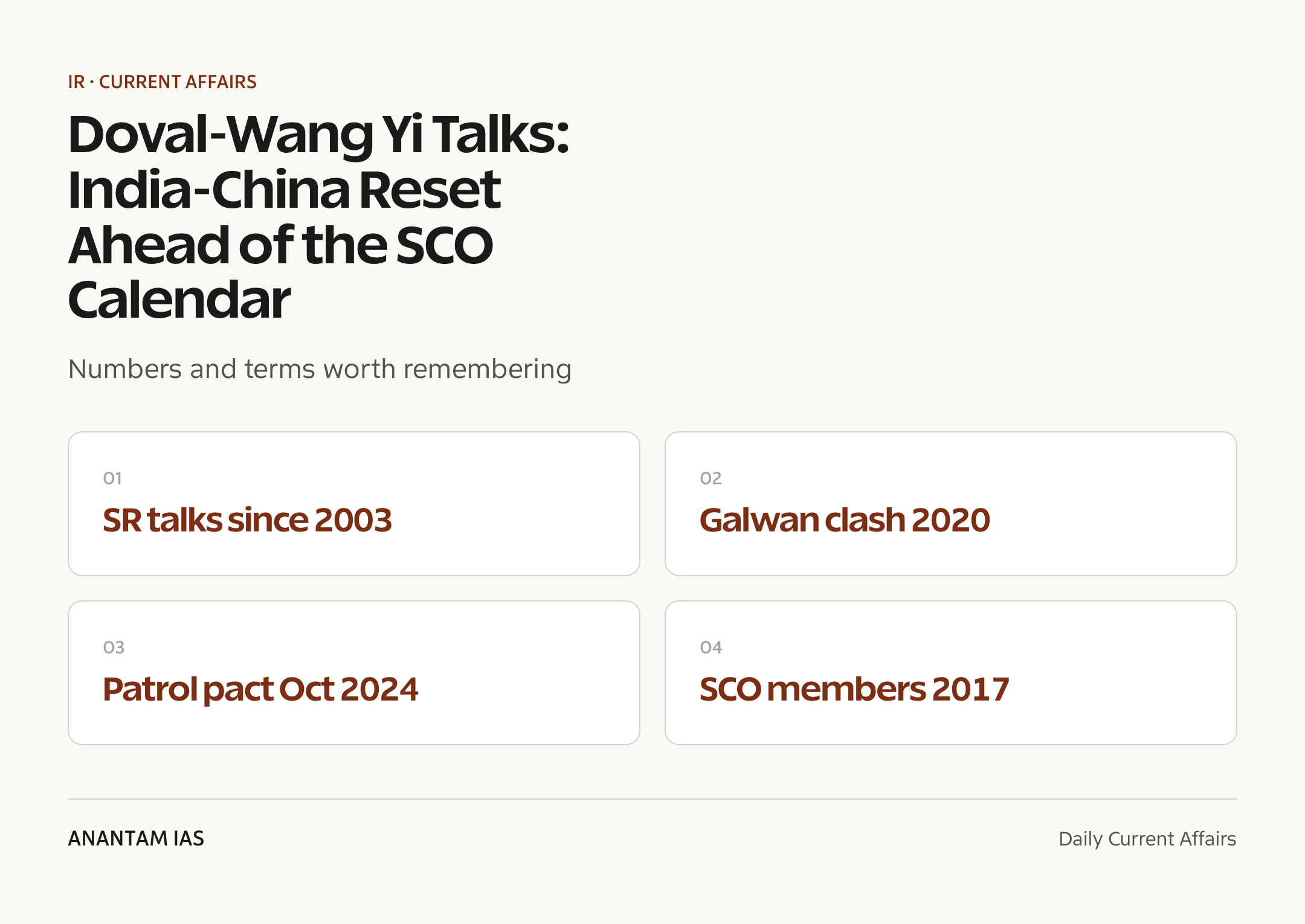
- Special Representatives (SR) mechanism: the India-China dialogue on the boundary question set up in 2003 to seek a political settlement, distinct from military and diplomatic channels.
- Line of Actual Control (LAC): the effective, undemarcated boundary between India and China, divided into Western, Middle and Eastern sectors.
- Galwan Valley: site of the June 2020 clash in eastern Ladakh that triggered the longest India-China military standoff in decades.
- October 2024 patrolling understanding: an arrangement on resumed patrolling at friction points reported to include Depsang and Demchok in eastern Ladakh.
- 2005 political parameters and guiding principles: the agreed framework that is meant to guide a fair, reasonable and mutually acceptable boundary settlement.
- Disengagement, de-escalation, de-induction: the three sequential steps of pulling back troops, lowering force levels and withdrawing build-ups along the LAC.
- Shanghai Cooperation Organisation (SCO): a Eurasian security and economic grouping; India and Pakistan joined as full members in 2017, with Iran admitted later.
- SCO architecture: a rotating chair and annual summit, with bodies such as the Council of Heads of State and the Regional Anti-Terrorist Structure (RATS).
- 1993 and 1996 agreements: pacts on maintaining peace and tranquillity and on confidence-building measures along the LAC that underpin border management.
- WMCC: the Working Mechanism for Consultation and Coordination on India-China border affairs, the diplomatic-military channel that complements the SR talks.
Mains Relevance
GS Paper 2
- India-China bilateral relations: managing a contested boundary while keeping space for trade, multilateral cooperation and crisis stability.
- Border management mechanisms: the role of the Special Representatives track, the WMCC and confidence-building agreements in preventing escalation.
- India’s strategic balancing: engaging China and the SCO without diluting concerns on sovereignty, terrorism and connectivity projects.
GS Paper 3
- Security challenges along borders: lessons from the Galwan standoff for force posture, infrastructure and surveillance on the LAC.
- Linkages between external relations and internal security: how a contested frontier shapes India’s defence preparedness and counter-terrorism stance.
- The interplay of diplomacy and deterrence in securing a long, undemarcated land boundary.
Essay
- Trust and verification: can adversaries build peace through mechanisms while the core dispute remains unresolved?
- The long game of diplomacy: patience, red lines and the management of a contested frontier.
Background and Context
The Special Representatives mechanism on the boundary
The SR talks are the dedicated political channel for the India-China boundary question.
- The Special Representatives dialogue was established in 2003 to seek a political settlement of the boundary question above the technical and military levels.
- It produced the 2005 agreement on political parameters and guiding principles, the agreed basis for a fair and mutually acceptable solution.
- On the Indian side the SR is the National Security Adviser; on the Chinese side it has been a senior leader, currently Foreign Minister Wang Yi.
- The mechanism runs in rounds and works alongside the diplomatic-military WMCC channel on day-to-day border affairs.
The LAC and the sectors of the dispute
The boundary remains undemarcated, which is the root of recurring friction.
- The Line of Actual Control (LAC) separates the two armies but is not a settled, mapped boundary.
- It is conventionally divided into the Western sector (Ladakh), the Middle sector and the Eastern sector (Arunachal Pradesh).
- Differing perceptions of where the LAC lies lead to face-offs, particularly in the Western sector.
- Peace had been managed through the 1993 and 1996 agreements until the 2020 standoff exposed their limits.
Galwan 2020 and the long standoff
The 2020 clash reset the relationship and froze normal engagement.
- The June 2020 Galwan clash in eastern Ladakh caused casualties on both sides, the first combat deaths on the boundary in decades.
- It triggered a prolonged military standoff with heavy force build-ups at multiple friction points.
- India linked the overall relationship to peace and tranquillity on the border, freezing business as usual.
- Rounds of military commander-level talks achieved disengagement at several points over the following years.
The October 2024 patrolling understanding
A 2024 arrangement reopened space for political engagement.
- In October 2024 the two sides announced an understanding on resumed patrolling at remaining friction points.
- It was reported to cover Depsang and Demchok in eastern Ladakh, among the most contested areas.
- The understanding enabled a higher-level meeting between the two countries’ leaders on the margins of a multilateral summit.
- It restarted the SR talks and other dialogue channels that had been largely dormant since 2020.
The SCO and India's role
The grouping is a key venue where India engages both China and the wider region.
- The Shanghai Cooperation Organisation is a Eurasian grouping focused on security, counter-terrorism and economic cooperation.
- India and Pakistan became full members in 2017; the chair and annual summit rotate among members.
- The grouping hosts a Security Council Secretaries’ meeting, the forum on whose sidelines the Doval-Wang Yi talks took place.
- India has used the SCO to press counter-terrorism and connectivity sovereignty while keeping its bilateral disputes on a separate track.
Core interests and India's balancing act
The diplomatic vocabulary signals both engagement and limits.
- The phrase respect for core interests is shorthand for not crossing each other’s sovereignty and security red lines.
- India has paired this with calls for mutual sensitivity, signalling that concessions must run both ways.
- Normalisation is being sequenced cautiously: dialogue and limited steps without abandoning border vigilance or strategic hedging.
- India continues to balance China engagement with its partnerships in the Indo-Pacific and its concerns on terrorism.
Way Forward
Move from disengagement to de-escalation
- Convert patrolling understandings into verifiable de-escalation and de-induction so that force levels along the LAC actually fall.
- Keep the SR and WMCC channels active to lock in gains and prevent fresh face-offs at unresolved points.
Anchor talks in agreed principles
- Use the 2005 political parameters as the reference point for any boundary progress rather than ad hoc, point-by-point bargains.
- Insist on reciprocity, so that respect for core interests and mutual sensitivity translate into concrete, two-way restraint.
Engage without lowering guard
- Sustain border infrastructure, surveillance and military readiness even as diplomacy resumes.
- Keep cooperation in multilateral forums like the SCO distinct from bilateral red lines on sovereignty and terrorism.
Conclusion
The Doval-Wang Yi meeting is best read not as a breakthrough but as evidence of a managed, step-by-step normalisation after Galwan. The Special Representatives mechanism, the LAC agreements and the October 2024 patrolling understanding together form the scaffolding that lets the two sides talk while the underlying boundary dispute stays unresolved. The shared language of core interests and mutual sensitivity captures both the appetite for stability and the caution on each side.
For aspirants, this is a compact case in how India manages a difficult neighbour: keep dedicated channels open, anchor talks in agreed principles, sequence trust-building carefully, and never decouple engagement from border preparedness. The test ahead is whether resumed patrolling can mature into genuine de-escalation, and whether the SR track can move from crisis management toward a durable settlement.
UPSC Practice Questions
Prelims MCQ 1
With reference to the Special Representatives (SR) mechanism between India and China, consider the following statements:
- It was established in 2003 to address the India-China boundary question at the political level.
- On the Indian side, the National Security Adviser serves as the Special Representative.
- It produced the 2005 agreement on political parameters and guiding principles for a boundary settlement.
How many of the above statements are correct?
Only one Only two All three None
Answer: All three
Explanation:
The SR mechanism was set up in 2003 as the political channel on the boundary question, the NSA is India’s SR, and the track produced the 2005 agreement on political parameters and guiding principles.
Prelims MCQ 2
With reference to the Shanghai Cooperation Organisation (SCO), consider the following statements:
- India and Pakistan became full members of the SCO in 2017.
- The SCO has a rotating chair and an annual summit of heads of state.
- It includes a security cooperation body focused on counter-terrorism.
How many of the above statements are correct?
Only one Only two All three None
Answer: All three
Explanation:
India and Pakistan joined as full members in 2017, the chair and summit rotate among members, and the SCO runs a Regional Anti-Terrorist Structure focused on counter-terrorism cooperation.
UPSC Mains Questions
- The Special Representatives mechanism has been the central political channel on the India-China boundary question since 2003. Examine its role in managing the relationship after the 2020 standoff and the limits it still faces. (GS2)
- India’s engagement with China combines dialogue with deterrence. Critically analyse how India balances normalisation along the Line of Actual Control with its wider strategic and security interests. (GS2)
- A contested land frontier links external relations with internal security. Discuss the lessons of the post-Galwan period for India’s border management and preparedness. (GS3)
Sources: Indian Express and Ministry of External Affairs.
Frequently Asked Questions
Who are the Special Representatives in India-China talks?
On the Indian side the Special Representative on the boundary question is the National Security Adviser, currently Ajit Doval. On the Chinese side the role is held by a senior leader, currently Foreign Minister Wang Yi. The two meet in rounds to seek a political settlement of the boundary above the military and diplomatic levels.
What is the Special Representatives mechanism?
It is a dedicated India-China dialogue created in 2003 to address the boundary question at the political level. It works alongside the diplomatic-military channel known as the WMCC and produced the 2005 agreement on political parameters and guiding principles, which remains the agreed basis for any boundary solution.
What was the October 2024 patrolling understanding?
It was an arrangement announced in October 2024 on resumed patrolling at remaining friction points along the Line of Actual Control, reported to cover areas such as Depsang and Demchok in eastern Ladakh. It reopened space for high-level engagement and helped restart the Special Representatives talks that had been largely frozen since 2020.
Why does Galwan still matter for India-China ties?
The June 2020 Galwan clash in eastern Ladakh was the first combat death on the boundary in decades and triggered a long military standoff. India tied the overall relationship to peace and tranquillity on the border, so normalisation since then has been slow and conditional on disengagement and de-escalation along the LAC.
What is the SCO and what is India’s role in it?
The Shanghai Cooperation Organisation is a Eurasian grouping focused on security, counter-terrorism and economic cooperation. India and Pakistan became full members in 2017, and the chair and summit rotate among members. India uses the forum to press counter-terrorism and connectivity concerns while keeping its bilateral disputes on a separate track.
What do ‘core interests’ and ‘mutual sensitivity’ mean here?
Respect for core interests is diplomatic shorthand for not crossing each other’s sovereignty and security red lines. India has paired this with calls for mutual sensitivity, signalling that restraint must run both ways. The terms capture a relationship that wants stability while leaving the underlying boundary dispute unresolved.
Source: https://anantamias.com/current-affairs/india-china-doval-wang-yi-sco-ties/
Grid Stability: The Plan to Repurpose Underused Thermal Plants
Why in News?
The Grid Controller of India (Grid-India), the national agency that operates the country’s power system in real time, has identified nine thermal power units with a combined capacity of about 1.8 gigawatts (GW) that can be repurposed as synchronous condensers. The idea is to keep the heavy spinning machinery of these plants running on the grid for stability, without burning fuel to produce electricity, as India absorbs record additions of solar and wind power.
The proposal, reported by The Indian Express, flows from an April 2026 review meeting on summer power preparedness chaired by the Union Power Secretary. Eight of the nine units are coal- or lignite-based and one is gas-based, all either under prolonged outage or running at very low utilisation. The plan reframes ageing fossil assets as grid-support infrastructure rather than power generators, a theme central to managing India’s energy transition.
- Grid-India shortlisted nine thermal units totalling about 1.8 GW for conversion into synchronous condensers (SYNCONs).
- The plants span five states; Rajasthan has three, Gujarat two, with units also in Maharashtra, Karnataka and Tamil Nadu.
- A synchronous condenser is a generator that spins freely without producing electricity, supplying inertia, reactive power and voltage support.
- The trigger is rising renewable penetration: solar and wind are inverter-based and reduce the grid’s natural stabilising inertia.
- Grid-India cited the June 2024 Champa-Kurukshetra HVDC tripping and the April 2025 Spain-Portugal blackout as warnings on system strength.
The development matters in the context of:
- India targets 500 GW of non-fossil capacity by 2030; installed renewable capacity crossed 220 GW by early 2026.
- Renewable clusters sit in remote, electrically weak regions (Rajasthan, Gujarat, Tamil Nadu, Karnataka, Andhra Pradesh) far from synchronous machines.
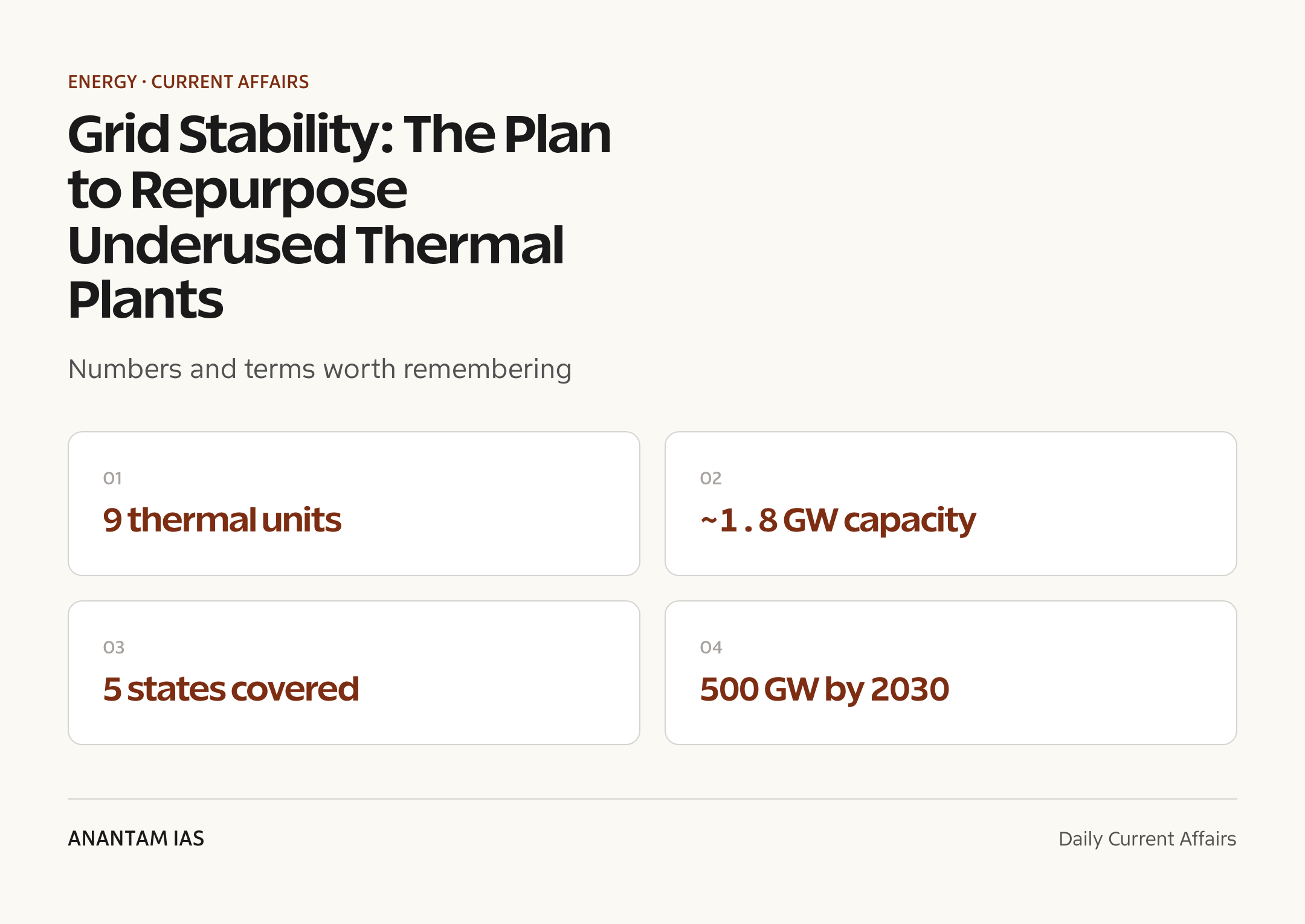
UPSC Relevance
Prelims Relevance
- Grid Controller of India (Grid-India): formerly POSOCO, the central agency that operates the National Grid and balances supply with demand in real time.
- Synchronous condenser (SYNCON): a rotating machine connected to the grid that provides reactive power and inertia but generates no active power.
- Grid frequency: India’s grid runs at a nominal 50 hertz (Hz); frequency falls when demand exceeds supply and rises when supply exceeds demand.
- Inertia: the stored kinetic energy in large spinning generators that resists sudden frequency changes; inverter-based solar and wind supply little of it.
- Reactive power: power that supports voltage levels across the network, measured in VAR, distinct from the active power (in watts) that does useful work.
- Inverter-based resources (IBR): solar PV and most modern wind connect through power electronics rather than rotating mass, lowering system inertia.
- Duck curve: the daily net-demand shape created when midday solar floods the grid and demand spikes after sunset as solar fades.
- 500 GW non-fossil target by 2030: India’s pledge for 50% of installed capacity from non-fossil sources, anchoring its energy-transition policy.
- Alternatives for flexibility: battery energy storage, pumped-storage hydro, STATCOMs and SVCs for voltage support.
- Grid disturbances cited: the June 2024 Champa-Kurukshetra HVDC tripping (about 16.5 GW load loss in the North) and the April 2025 Iberian blackout.
Mains Relevance
GS Paper 3
- Energy security and the technical economics of integrating high renewable penetration into a low-inertia grid.
- Infrastructure repurposing: converting end-of-life or idle thermal assets into grid-support services as a least-cost transition tool.
- Trade-offs between battery storage, pumped hydro and synchronous condensers for grid flexibility and reliability.
- Linking the 500 GW non-fossil goal with transmission planning, system strength and stranded-asset risk in coal.
Essay
- Managing transitions: how a fossil-fuel system can be retired gracefully rather than abruptly, retaining value from old machines.
- Technology and trade-offs: the hidden engineering costs of clean energy that headline capacity figures conceal.
Background and Context
Why a high-renewable grid becomes harder to stabilise
A power grid must hold its frequency and voltage within tight bands every second. Renewables change the physics of that balancing act.
- The Indian grid runs at a nominal 50 Hz; if generation and demand drift apart even briefly, frequency moves and protective relays can trip equipment to prevent damage.
- Large coal, gas and hydro generators have heavy spinning rotors that store inertia, kinetic energy that cushions sudden shocks and slows the rate at which frequency falls when supply is lost.
- Solar PV and most wind are inverter-based: they connect through power electronics with little rotating mass, so they add generating capacity but almost no inertia.
- As their share grows, the grid loses inertia and local reactive power support, leaving it weaker and more prone to voltage and frequency excursions during a disturbance.
- Grid-India flagged that the problem is sharpest at peak solar hours, when inverter plants supply a large share of power but little stabilising support, so the grid can hold surplus active power yet still lack reactive power and inertia where it is needed.
What a synchronous condenser actually does
Grid operators call it an electrical shock absorber. It is an old idea being revived for a new problem.
- A synchronous condenser is a generator spinning freely, synchronised to the grid but disconnected from any fuel-burning turbine.
- Because its rotor keeps spinning, it supplies real inertia and short-circuit current that strengthen the grid during disturbances.
- It injects or absorbs reactive power on demand, propping up voltage at weak points in the network.
- It provides primary response and transient stability support that inverter-based resources cannot easily replicate.
- Converting a plant means decoupling the generator from its boiler or turbine and adding control gear, so the rotor can be driven up to grid speed and kept spinning.
- Crucially it consumes very little fuel and emits almost nothing, since it is not generating active power, only exchanging reactive power with the network.
The repurposing plan, plant by plant
Grid-India’s shortlist targets idle or barely-used units sitting near renewable hubs and load centres.
- Nine units totalling about 1.8 GW; eight coal/lignite and one gas-based, all idle or running sub-optimally.
- Rajasthan has three: Giral, Kota Super Thermal and Dholpur Gas; Gujarat has Akrimota and Kutch lignite stations.
- Maharashtra (GEPL Phase-I, Mihan), Karnataka (Raichur) and Tamil Nadu (Tuticorin) complete the list.
- Grid-India wants SYNCONs sited at load centres and near large renewable energy complexes where system strength is low and synchronous machines are scarce.
- The agency pointed to the June 2024 Champa-Kurukshetra HVDC tripping, which shed about 16.5 GW of load in the Northern Region and exposed voltage-stability gaps.
- It also cited the Northern Regional Power Committee’s assessment of the Rajasthan Renewable Energy Complex, which called for SYNCONs at multiple sites.
- It cited the US, UK and Mexico, where retired thermal units have already been converted into condensers, as proof the approach is technically viable.
The energy-transition context
The case for SYNCONs sits inside India’s larger push toward 500 GW of non-fossil capacity.
- India aims for 500 GW of non-fossil capacity by 2030, with renewables crossing 220 GW by early 2026; the solar energy push drives much of this.
- Rapid additions have clustered solar and wind in renewable-rich states, often in remote areas with weak transmission links.
- Building brand-new thermal plants for stability is hard to justify, as forced generation adds active-power imbalance and cost.
- Repurposing existing machinery is pitched as a pragmatic, lower-cost way to retain reliability services from synchronous machines.
- It also offers a softer landing for ageing coal assets, echoing India’s broader just transition debate.
Alternatives: storage and power electronics
Synchronous condensers are one tool among several for a flexible, stable grid.
- Battery energy storage can shift surplus solar to evening peaks and respond fast, though it supplies synthetic, not true, inertia.
- Pumped-storage hydro pumps water uphill in surplus hours and releases it at peak, offering large-scale, long-duration balancing and some inertia from its turbines.
- STATCOMs and SVCs are power-electronic devices that regulate voltage and reactive power fast, without rotating mass, but supply no true inertia.
- Grid forecasting bodies such as the Regional Energy Management Centres help operators anticipate renewable swings and schedule balancing resources.
- Newer inverters can offer grid-forming behaviour that mimics inertia synthetically, though field deployment at scale is still maturing.
- A resilient grid likely needs a mix of all of these, with SYNCONs filling the inertia-and-voltage gap that inverters leave, a theme central to India’s wider energy security debate.
Way Forward
Grid-India proposes evaluating idle thermal units through detailed technical studies, including power-system simulations, short-circuit level assessment, voltage stability analysis and cost-benefit evaluation before any conversion.
A clear compensation mechanism for plant owners, transparent siting near weak grid nodes, and pairing SYNCONs with storage and forecasting would let India scale renewables without sacrificing reliability.
Conclusion
India’s clean-energy story is usually told in gigawatts of solar and wind, but the harder engineering challenge is keeping a low-inertia grid stable second by second. Repurposing idle coal and gas units as synchronous condensers is a quiet, pragmatic fix that extracts stability from machines once destined for retirement.
Whether it scales will depend on honest cost-benefit studies, fair compensation and treating SYNCONs as one piece of a flexibility toolkit that also includes storage, pumped hydro and smarter forecasting. The 500 GW target will only hold up if the wires and machines behind it stay in balance.
UPSC Practice Questions
Prelims MCQ 1
With reference to a synchronous condenser in the context of grid management, consider the following statements: 1. It is a rotating machine that supplies active power to the grid as its primary function. 2. It can provide inertia and reactive power support to help maintain grid stability. 3. It is being proposed by Grid-India as a use for certain underutilised thermal units. Which of the statements given above is/are correct?
1 and 2 only 2 and 3 only 1 and 3 only 1, 2 and 3
Answer: 2 and 3 only
Explanation:
A synchronous condenser spins freely and does not supply active power; it supplies reactive power, inertia and voltage support. Grid-India has proposed converting underutilised thermal units into such condensers, so statements 2 and 3 are correct while 1 is wrong.
Prelims MCQ 2
Increasing penetration of inverter-based solar and wind generation tends to affect the power grid in which of the following ways? 1. It reduces the system inertia available to resist sudden frequency changes. 2. It can create local shortfalls in reactive power and voltage support. 3. It raises the grid’s nominal operating frequency above 50 Hz. Select the correct answer using the code given below.
1 only 1 and 2 only 2 and 3 only 1, 2 and 3
Answer: 1 and 2 only
Explanation:
Inverter-based resources add capacity but little rotating mass, lowering inertia, and can leave local deficits in reactive power and voltage support. The nominal grid frequency stays at 50 Hz; high renewables do not raise the nominal frequency, so statement 3 is incorrect.
UPSC Mains Questions
- Define grid inertia and explain why rising shares of inverter-based renewable generation make a power system harder to stabilise. How can synchronous condensers help? (250 words)
- “India’s energy transition is as much a grid-management problem as a generation problem.” Discuss with reference to the proposal to repurpose underutilised thermal plants. (250 words)
- Compare synchronous condensers, battery energy storage and pumped-storage hydro as tools for ensuring grid flexibility and reliability in a high-renewable grid. (150 words)
Sources: The Indian Express (Explained) and Ministry of Power.
Frequently Asked Questions
What is a synchronous condenser in simple terms?
It is a generator that spins on the grid without burning fuel or producing electricity. By spinning, it supplies inertia, reactive power and voltage support, acting like an electrical shock absorber that helps keep the grid stable.
Why does Grid-India want to convert old thermal plants?
Eight coal/lignite and one gas unit, about 1.8 GW in total, are idle or barely used. Instead of scrapping them or forcing them to generate uneconomically, Grid-India proposes spinning their machinery as synchronous condensers to provide stability services near renewable hubs.
Why do solar and wind weaken grid stability?
Solar and most wind are inverter-based, connecting through electronics rather than heavy spinning rotors. They add power capacity but little inertia and reactive power, so as their share grows the grid loses its natural cushion against sudden frequency and voltage swings.
What is grid inertia and why does it matter?
Inertia is the kinetic energy stored in large spinning generators. It resists sudden changes in grid frequency, buying time for control systems to respond. Low inertia makes a grid fragile, as seen in events like the April 2025 Spain-Portugal blackout.
How does this connect to India’s 500 GW target?
India aims for 500 GW of non-fossil capacity by 2030. Adding that much inverter-based renewable power lowers system strength, so tools like synchronous condensers, storage and pumped hydro are needed to keep the grid reliable as the share of solar and wind rises.
Are synchronous condensers the only solution?
No. Battery storage, pumped-storage hydro, STATCOMs and SVCs, and better forecasting all help. Synchronous condensers are valuable mainly for the true inertia and voltage support that inverter-based resources struggle to provide.
Source: https://anantamias.com/current-affairs/grid-stability-repurposing-thermal-power-plants/
QS World Future Skills Index: India’s Standing on AI-Economy Readiness
Why in News?
The QS World Future Skills Index, published by global higher-education analytics firm QS Quacquarelli Symonds, has put fresh focus on how prepared national economies and education systems are for an AI-driven, skills-led future. The index benchmarks more than 190 countries on the skills the labour market will demand next, rather than on past educational attainment alone.
For India, the findings are a double-edged signal. QS reported that India scored highly on labour-market demand for future skills yet lagged on the supply-side measures of skills fit and economic transformation. That gap is exactly the policy space that NEP 2020, Skill India and the FutureSkills ecosystem are meant to close, making the index a useful frame for the education, skilling and emerging-tech sections of the syllabus.
- QS Quacquarelli Symonds released the QS World Future Skills Index, a global benchmark of future-skills readiness built on job-posting, employer-survey and economic data.
- The index ranks countries on four equally weighted pillars — Skills Fit, Academic Readiness, Future of Work and Economic Transformation.
- QS reported India in the band of ‘future skills contenders’, ranking 25th overall with an aggregate score of 76.6.
- India’s standout result was on Future of Work, where QS placed it second globally behind the United States, reflecting strong employer demand for AI, digital and green skills.
- India ranked lower on Skills Fit and Economic Transformation, pointing to a mismatch between labour-market demand and the skills graduates actually bring.
The development matters in the context of:
- The inaugural edition was led by the United States, followed by the United Kingdom, Germany, Australia and Canada among the top performers.
- QS analysed data spanning over 280 million job postings, around 5,000 universities and millions of employer skill requirements to build the rankings.
- The index reframes competitiveness around future readiness, not legacy reputation, which is why a young-workforce economy like India scores unevenly across the four pillars.
UPSC Relevance
Prelims Relevance
- Publisher: the index is produced by QS Quacquarelli Symonds, the British firm also known for the QS World University Rankings.
- Four pillars: Skills Fit, Academic Readiness, Future of Work and Economic Transformation, each weighted at 25%.
- Future of Work measures a job market’s readiness to recruit for AI, digital and green skills, drawn largely from live job-posting volumes.
- Skills Fit captures the gap between what employers value and how satisfied they are with graduate skills.
- Data engine: QS used job-posting analytics, the QS Global Employer Survey and World Bank economic and demographic statistics.
- India’s national skilling architecture includes Skill India Mission, the National Skill Development Corporation (NSDC) and the Pradhan Mantri Kaushal Vikas Yojana (PMKVY).
- NEP 2020 mandates vocational exposure from school and a credit-based Academic Bank of Credits to support flexible, multidisciplinary learning.
- The FutureSkills Prime programme, run with NASSCOM and MeitY, targets reskilling in emerging technologies such as AI, cloud and cybersecurity.
Mains Relevance
GS Paper 2
- Use the index to discuss education reform and the alignment of higher education with labour-market needs under NEP 2020.
- Frame the skills gap as a governance and human-development challenge — quality of schooling, teacher capacity and equitable access.
- Link to employability and social justice: weak Skills Fit hits first-generation learners and rural youth hardest.
GS Paper 3
- Connect future-skills readiness to economic growth, the demographic dividend and the risk of jobless growth.
- Examine AI, digital and green skills as drivers of the next industrial wave and India’s Economic Transformation score.
- Argue for industry-academia linkages, apprenticeships and reskilling to convert demand-side strength into supply-side capacity.
Essay
- Education and skilling themes: ‘Skills define a nation’s future more than degrees’ or the demographic dividend as opportunity versus liability.
Background and Context
The index and its methodology
The QS World Future Skills Index is built to answer one question — how ready is a country to supply and absorb the skills of the future.
- Published by QS Quacquarelli Symonds, the index benchmarks more than 190 countries on forward-looking skills demand.
- It rests on four equally weighted pillars: Skills Fit, Academic Readiness, Future of Work and Economic Transformation, powered by 13 sub-indicators.
- The evidence base is large and live — over 280 million job postings, the QS Global Employer Survey and World Bank economic data.
- By weighting live demand signals, the index rewards economies that are actively hiring for AI, digital and green roles, not just those with strong legacy universities.
India's standing on the index
India’s profile is sharply uneven, with a clear strength on demand and clear weakness on supply.
- QS reported India in the ‘future skills contenders’ tier, ranking 25th overall with a score around 76.6.
- Its strongest pillar was Future of Work, where it placed second globally behind the United States on a score close to 99.
- India ranked far lower on Skills Fit and Economic Transformation, signalling that supply of job-ready skills trails employer demand.
- The top of the table was led by the United States, the United Kingdom, Germany, Australia and Canada — mature, high-income skills economies.
The AI-economy and future-skills context
The index lands amid a structural shift in what work requires across the global economy.
- Demand is moving fast toward artificial intelligence, data, cloud and cybersecurity competencies across sectors.
- Green skills tied to the energy transition and sustainability are emerging as a parallel growth area.
- India’s large, young workforce gives it a strong demand-side signal — employers are actively posting for these roles.
- The challenge is converting that demand into a steady supply of trained, employable graduates and workers.
India's skilling ecosystem
A web of national programmes already targets the supply-side gap the index exposes.
- Skill India Mission, through NSDC and PMKVY, anchors short-term vocational training and certification.
- NEP 2020 embeds vocational exposure from school and pushes multidisciplinary, credit-based learning.
- FutureSkills Prime, run with NASSCOM and MeitY, focuses on reskilling in emerging technologies.
- Apprenticeship schemes and the Academic Bank of Credits aim to make learning modular and industry-linked. See the anantamias.com guide on National Education Policy 2020 (NEP).
The gaps that remain
Headline schemes have not yet closed the quality and alignment gap.
- Persistent skills mismatch means many graduates are not seen as job-ready by employers, despite high enrolment numbers.
- Uneven quality of training, weak certification credibility and thin industry linkages limit real-world outcomes.
- Regional and gender disparities in access to quality skilling deepen inequality of opportunity, especially for rural and first-generation learners.
- Slow economic transformation toward high-value, skills-led industries caps how much trained talent the domestic economy can absorb.
Why the index matters for India
Beyond a rank, the index offers a diagnostic frame for India’s growth strategy and its place in the global skills race.
- It reframes national competitiveness around future readiness rather than legacy university reputation, where India has long trailed.
- India’s demand-side strength shows global employers already see the country as a hub for AI, digital and green hiring.
- The supply-side weakness is a direct test of whether NEP 2020 and Skill India can deliver outcomes, not just enrolment.
- Compared with the top-ranked economies — the United States, the United Kingdom and Germany — India’s challenge is depth and quality of skilling at scale.
- For aspirants, the index ties together education policy, employment, the demographic dividend and emerging technology in a single, examinable theme.
Way Forward
Strengthen industry-academia linkages so curricula, apprenticeships and certifications track live employer demand rather than legacy syllabi.
Scale quality assurance in skilling — credible certification, trainer capacity and outcome tracking — to lift the Skills Fit pillar.
Prioritise AI, digital and green-skill pathways for first-generation learners, rural youth and women to make the demographic dividend inclusive.
Pair skilling with economic transformation — investment in high-value manufacturing and services so trained workers find domestic roles.
Conclusion
The QS World Future Skills Index captures India’s central skilling paradox: a labour market hungry for future skills sitting atop an education and training system that does not yet supply them at scale or quality. Its near-top finish on Future of Work is a genuine strength, but the lower Skills Fit and Economic Transformation scores are the warning lights.
For policymakers, the index is less a verdict than a map. Converting India’s demographic dividend into durable growth will depend on closing the supply-side gap — through quality skilling, tighter industry linkages and an economy that can absorb a future-ready workforce.
UPSC Practice Questions
Prelims MCQ 1
With reference to the QS World Future Skills Index, consider the following statements: 1. It is published by QS Quacquarelli Symonds. 2. It assesses countries on four equally weighted pillars including Future of Work and Skills Fit. 3. It ranks countries solely on the number of universities in the global top 500. Which of the statements given above are correct?
1 and 2 only 2 and 3 only 1 and 3 only 1, 2 and 3
Answer: 1 and 2 only
Explanation:
QS Quacquarelli Symonds publishes the index, which uses four equally weighted pillars — Skills Fit, Academic Readiness, Future of Work and Economic Transformation. It is built on job-posting, employer-survey and economic data, not on university counts alone, so statement 3 is incorrect.
Prelims MCQ 2
Consider the following programmes: 1. FutureSkills Prime 2. Pradhan Mantri Kaushal Vikas Yojana 3. Academic Bank of Credits Which of the above are associated with India’s skilling and education reform ecosystem?
1 and 2 only 2 and 3 only 1 and 3 only 1, 2 and 3
Answer: 1, 2 and 3
Explanation:
FutureSkills Prime (NASSCOM-MeitY reskilling), PMKVY (Skill India flagship training scheme) and the Academic Bank of Credits (introduced under NEP 2020) are all part of India’s skilling and education-reform architecture.
UPSC Mains Questions
- The QS World Future Skills Index shows India’s labour-market demand for future skills outpacing its supply. Examine the structural reasons for this gap and suggest measures to bridge it. (GS2, 250 words)
- “India’s demographic dividend will be realised only if skilling matches the demands of an AI-led economy.” Discuss in the light of recent global future-skills assessments. (GS3, 250 words)
- Evaluate the role of NEP 2020 and the Skill India Mission in improving the employability of Indian graduates. (GS2, 150 words)
Sources: QS Quacquarelli Symonds and The Pie News.
Frequently Asked Questions
What is the QS World Future Skills Index?
It is a global benchmark, published by QS Quacquarelli Symonds, that ranks countries on how ready they are for an AI-driven, skills-led economy. It assesses more than 190 countries using job-posting analytics, employer surveys and economic data.
What are the four pillars of the index?
The index rests on four equally weighted pillars — Skills Fit, Academic Readiness, Future of Work and Economic Transformation — each contributing 25% to a country’s overall score.
Where did India rank on the index?
QS reported India in the ‘future skills contenders’ tier, ranking 25th overall with an aggregate score of around 76.6. Its strongest pillar was Future of Work, where it placed second globally behind the United States.
Why did India score lower on some pillars?
India ranked lower on Skills Fit and Economic Transformation. This reflects a mismatch between strong employer demand for future skills and the supply of job-ready graduates, along with a slower shift toward high-value, skills-led industries.
Which country topped the index?
The United States led the inaugural edition, followed by the United Kingdom, Germany, Australia and Canada among the top performers — mature, high-income skills economies.
How does this connect to India’s skilling policy?
The supply-side gap the index exposes is the policy space targeted by NEP 2020, the Skill India Mission, PMKVY and FutureSkills Prime, all of which aim to make Indian learning more job-ready and industry-linked.
Source: https://anantamias.com/current-affairs/qs-world-future-skills-index-india/