

Why in News?
The Union Ministry of Home Affairs (MHA) notified the Foreign Contribution (Regulation) Amendment Rules, 2026 on or around 22 June 2026, tightening the operational, disclosure and penalty regime for NGOs that receive foreign funds. As reported by Business Standard and Deccan Herald, the changes touch every stage of an NGO’s foreign-funding lifecycle — application, renewal, utilisation and reporting.
These are amended RULES under the existing FCRA, 2010 framework, and are distinct from the separately pending FCRA Amendment Bill, 2026. Their net effect is to raise the compliance burden on civil-society bodies and sharpen the state’s ability to monitor how foreign money is spent inside India.
- MHA notified the FCRA Amendment Rules, 2026 tightening norms for foreign-funded NGOs (Business Standard).
- NGOs must now disclose social-media accounts at the time of registration or renewal.
- Applicants must specify the exact purpose of foreign funds and the states or Union Territories where they will operate (Deccan Herald).
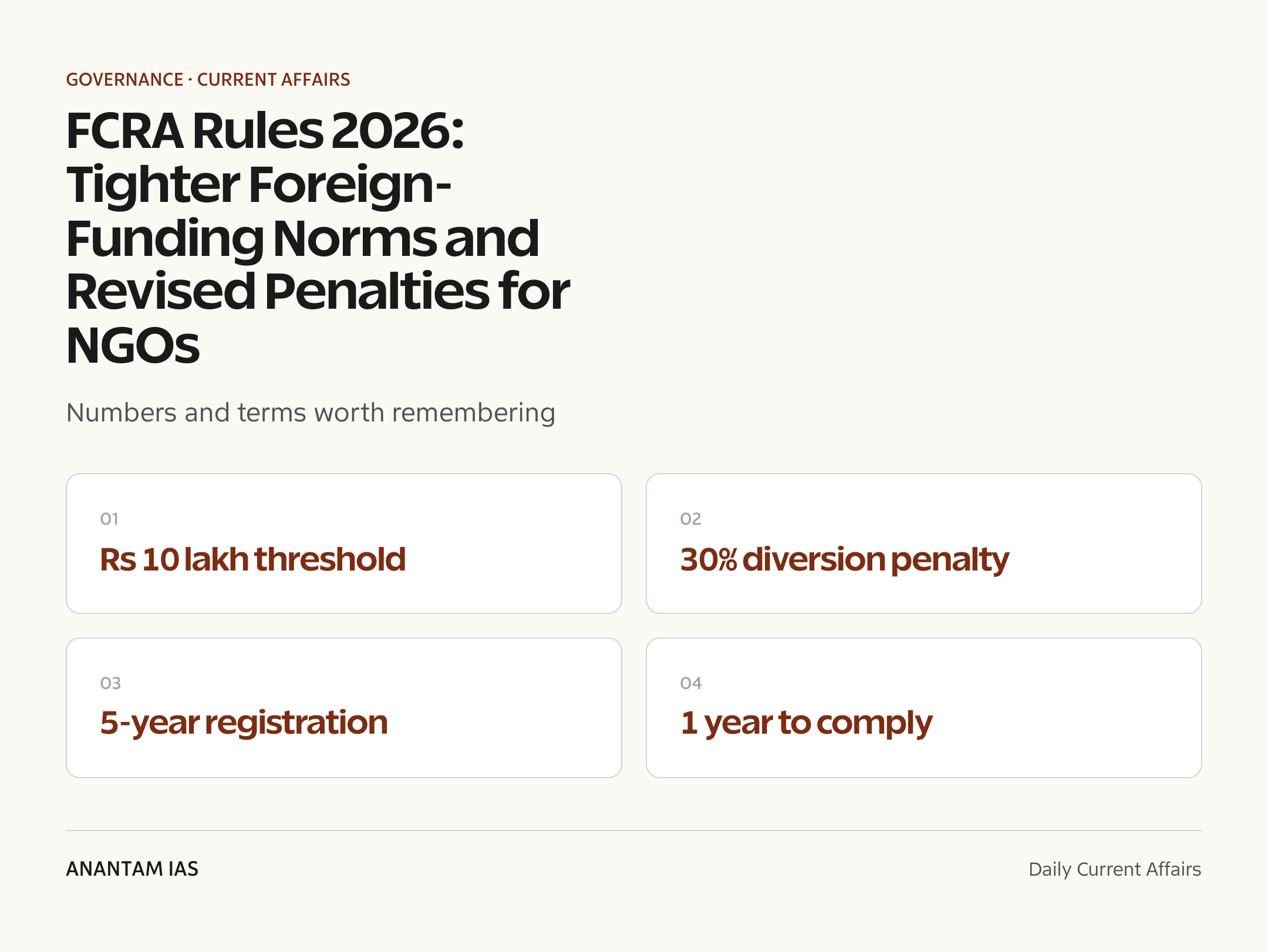
- A minimum spending threshold of Rs 10 lakh over the previous two financial years is required to retain registration.
- Diversion of funds now attracts a penalty of Rs 1 lakh or 30% of the diverted amount, whichever is higher.
- Existing FCRA-registered NGOs get one year to submit the new details to the government.
The development matters in the context of:
- FCRA registration is granted by the MHA and is valid for five years, after which it must be renewed.
- All FCRA receipts must be routed through the designated SBI New Delhi Main Branch account since the 2020 amendment.
- The rules sit within the larger debate over regulating civil society versus protecting associational freedom under Article 19(1)(c).
UPSC Relevance
Prelims Relevance
- FCRA, 2010 regulates the acceptance and utilisation of foreign contribution and foreign hospitality by individuals and associations; it is administered by the Ministry of Home Affairs, not the Finance Ministry.
- FCRA registration is valid for five years; bodies can also receive funds under prior permission for a specific project and donor.
- Since the FCRA (Amendment) Act, 2020, all foreign contribution must be received in a designated account at the State Bank of India, New Delhi Main Branch.
- The 2020 amendment barred sub-granting (transfer of foreign funds to other FCRA holders) and capped administrative expenses from foreign funds.
- Under the 2026 rules, NGOs must declare social-media accounts and name the states/UTs of operation at application or renewal.
- A retention condition now requires spending at least Rs 10 lakh of foreign contributions on declared activities over the previous two financial years.
- Diversion of funds and speculative investment each attract a penalty of Rs 1 lakh or 30% of the amount, whichever is higher.
- Foreign nationals (other than Persons of Indian Origin) as key functionaries can ordinarily disqualify an organisation from registration.
Mains Relevance
GS Paper 2
- Tests the regulation of civil society and the role of NGOs in development, service delivery and accountability under the governance syllabus.
- Links the state-versus-civil-society regulatory debate with constitutional freedoms of association and expression.
- Connects domestic regulation of foreign funding to sovereignty and national-security concerns under international relations.
- Illustrates the trade-off between transparency/anti-misuse safeguards and the compliance burden that can shrink the space for genuine non-profits.
Essay
- Useful for essays on civil society and democracy, the balance between security and liberty, and the changing role of the state in regulating private and voluntary action.
Background and Context
The FCRA, 2010 framework
FCRA is the master law governing how foreign money enters and is spent by associations in India.
- The Foreign Contribution (Regulation) Act, 2010 regulates acceptance and use of foreign contribution and foreign hospitality to ensure they do not prejudice national interest.
- It is administered by the Ministry of Home Affairs, reflecting the law’s framing as a security-and-sovereignty instrument rather than a charity-finance one.
- Associations must obtain registration (valid five years) or prior permission for a specific project before receiving foreign contribution; applications and returns are filed on the MHA’s FCRA Online portal.
- Election candidates, judges, government servants, legislators and media houses are generally barred from accepting foreign contribution.
- Registered bodies must file annual returns of receipts and utilisation; the 2026 rules now require a detailed activity report alongside the financial statements.
What the 2026 rules change
The amended rules add disclosure, utilisation and operational conditions across the funding cycle.
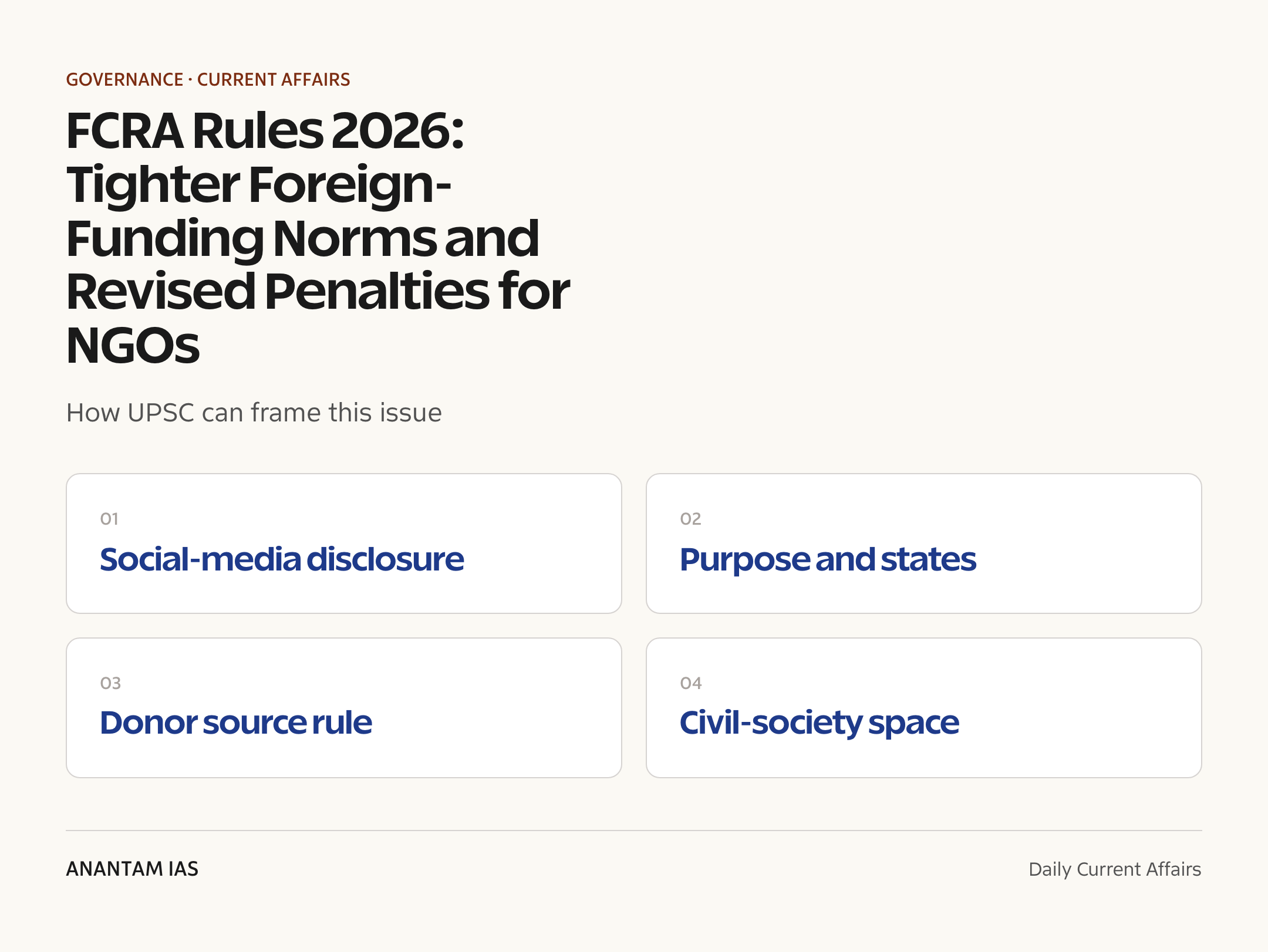
- NGOs must declare their social-media accounts while applying for registration or renewal, extending scrutiny to an organisation’s public communications.
- Applicants must specify the exact purpose of foreign funds and the states/UTs in which they will be used; deploying funds in unregistered states attracts a penalty.
- To retain registration, an organisation must have spent at least Rs 10 lakh of foreign contributions on declared activities over the previous two financial years.
- When funds arrive through intermediaries or donor-advised vehicles, the NGO must disclose the ultimate donor in its application.
- Under prior permission, at least 75% of an instalment must be utilised before the next tranche is released.
- Existing registered NGOs have one year to file the new purpose and disclosure details, per Deccan Herald.
Revised compounding penalties
The rules sharply revise the schedule of fines for common violations.
- Diversion of funds to purposes other than declared attracts Rs 1 lakh or 30% of the diverted amount, whichever is higher.
- Speculative investment of foreign funds attracts Rs 1 lakh or 30% of the invested amount, whichever is higher, plus recovery of returns earned.
- Exceeding the administrative-expense cap attracts Rs 1 lakh or 5% of the excess, whichever is higher (Business Standard).
- Using funds in unregistered states/UTs carries the same diversion-style penalty, tying the geographic-disclosure rule to a financial consequence.
Prior tightening: the 2020 amendment
The 2026 rules build on a decade of progressively stricter control.
- The FCRA (Amendment) Act, 2020 mandated that all foreign contribution be received in a single designated account at the SBI New Delhi Main Branch.
- It prohibited sub-granting — the transfer of foreign funds from one FCRA holder to another — disrupting the funder-to-grassroots chain.
- It tightened the cap on administrative expenses met from foreign contribution and mandated Aadhaar of office-bearers.
- Thousands of NGOs have since seen registrations lapse, be refused renewal or cancelled, shrinking the foreign-funded non-profit base.
The regulation-versus-freedom debate
The rules sit at the heart of a contested question about the space for civil society.
- Government view: stricter norms curb misuse, money-laundering and opaque foreign influence and improve the accountability of public-interest money.
- Critics’ view: cumulative tightening chokes legitimate NGOs, especially smaller and grassroots bodies, and chills advocacy that questions the state.
- The freedom to form associations is protected under Article 19(1)(c), subject to reasonable restrictions including sovereignty, public order and morality.
- The Supreme Court, in upholding the 2020 amendments, accepted that foreign funding can be regulated in the national interest, while noting that NGOs have no fundamental right to receive foreign money.
- International observers have flagged concern that disclosure and threshold conditions can be used to narrow dissent and advocacy space.
The sovereignty and IR rationale
FCRA is framed as a national-security and foreign-relations instrument.
- By housing the law in the MHA, the state treats foreign funding as a potential channel of external influence over domestic affairs.
- Disclosure of ultimate donors and social-media handles aims to map foreign linkages and messaging of funded bodies.
- Restrictions seek to insulate electoral, religious and policy processes from foreign money, echoing concerns common to many democracies.
- The challenge is to draw the line so that anti-influence safeguards do not become a blanket barrier to legitimate cross-border philanthropy.
Way Forward
Adopt a risk-based, graded approach so that small, compliant NGOs face proportionate paperwork while genuinely suspect flows draw close scrutiny.
Pair tighter rules with a transparent, time-bound registration and renewal process, clear appeal routes, and published reasons for refusal or cancellation.
Build a single, searchable FCRA disclosure portal so that compliance is digital-first and the public can see who funds whom, reducing arbitrariness.
Calibrate penalties to intent and scale of violation, distinguishing inadvertent reporting lapses from deliberate diversion, to preserve the space for legitimate civil society.
Conclusion
The FCRA Amendment Rules, 2026 deepen a decade-long shift toward treating foreign funding of NGOs as a question of sovereignty and security as much as of charity finance. Mandatory social-media and donor disclosure, purpose-and-state specification, a spending threshold and steeper compounding penalties together raise the cost of being a foreign-funded non-profit in India.
The durable governance test is balance: rules must deter genuine misuse and opaque foreign influence without hollowing out the constitutionally protected space for association and advocacy. How fairly and predictably the MHA applies these conditions will decide whether the regime reads as accountability or as a squeeze on civil society.
UPSC Practice Questions
Prelims MCQ 1
With reference to the Foreign Contribution (Regulation) Act, 2010, consider the following statements: 1. It is administered by the Ministry of Finance. 2. Since 2020, all foreign contribution must be received in a designated account at the State Bank of India, New Delhi Main Branch. 3. Registration under the Act is valid for five years and is renewable. Which of the statements given above are correct?
1 and 2 only 2 and 3 only 1 and 3 only 1, 2 and 3
Answer: 2 and 3 only
Explanation:
FCRA is administered by the Ministry of Home Affairs, not the Ministry of Finance, so statement 1 is wrong. The 2020 amendment mandated the designated SBI New Delhi Main Branch account, and registration is valid for five years and renewable, so statements 2 and 3 are correct.
Prelims MCQ 2
Consider the following provisions reportedly introduced by the Foreign Contribution (Regulation) Amendment Rules, 2026: 1. NGOs must disclose their social-media accounts at registration or renewal. 2. Applicants must specify the states or Union Territories where foreign funds will be used. 3. Diversion of foreign funds attracts a penalty of Rs 1 lakh or 30% of the diverted amount, whichever is higher. How many of the statements given above are correct?
Only one Only two All three None
Answer: All three
Explanation:
As reported by Business Standard and Deccan Herald, the 2026 rules require disclosure of social-media accounts, specification of the states/UTs of operation, and impose a diversion penalty of Rs 1 lakh or 30% of the diverted amount, whichever is higher. All three statements are correct.
UPSC Mains Questions
- The Foreign Contribution (Regulation) Amendment Rules, 2026 tighten disclosure, utilisation and penalty norms for foreign-funded NGOs. Examine the implications of this regime for the space available to civil society in India. (250 words)
- Foreign funding of voluntary organisations raises both sovereignty and accountability concerns. Critically evaluate India’s evolving FCRA framework in balancing national interest with the freedom of association. (250 words)
- Discuss the role of non-governmental organisations in India’s development and the challenges that progressively stricter FCRA regulation poses to their functioning. (150 words)
Sources: Business Standard and Deccan Herald.
Frequently Asked Questions
What are the FCRA Amendment Rules, 2026?
They are rules notified by the Ministry of Home Affairs in June 2026 under the existing Foreign Contribution (Regulation) Act, 2010, tightening disclosure, utilisation and penalty norms for NGOs that receive foreign funds. They are distinct from the separately pending FCRA Amendment Bill.
What new disclosures must NGOs make?
NGOs must declare their social-media accounts and specify the exact purpose of the foreign funds and the states or Union Territories where they will operate, at the time of registration or renewal. They must also disclose the ultimate donor when money comes through intermediaries.
What is the Rs 10-lakh spending threshold?
To retain or renew registration, an organisation must have spent at least Rs 10 lakh of foreign contributions on its declared activities over the previous two financial years, a condition meant to weed out dormant registrations.
What are the revised penalties?
Diversion of funds and speculative investment each attract Rs 1 lakh or 30% of the amount involved, whichever is higher, with recovery of returns in the investment case. Exceeding the administrative-expense cap attracts Rs 1 lakh or 5% of the excess, whichever is higher.
How do these rules relate to the FCRA Amendment Bill?
The 2026 rules amend procedure and penalties under the current Act, while the pending FCRA Amendment Bill is a separate legislative proposal. You can read more in the Anantam IAS note on the FCRA Amendment Bill.
How long do existing NGOs have to comply?
FCRA-registered NGOs are given one year to submit the new purpose and disclosure details to the government, as reported by Deccan Herald.
Tell Google you want more of this.
Add Anantam IAS as a preferred sourceOne tap, and this site shows up more often in your own Top Stories, AI Overviews and AI Mode. Remove it any time.






