Why in News?
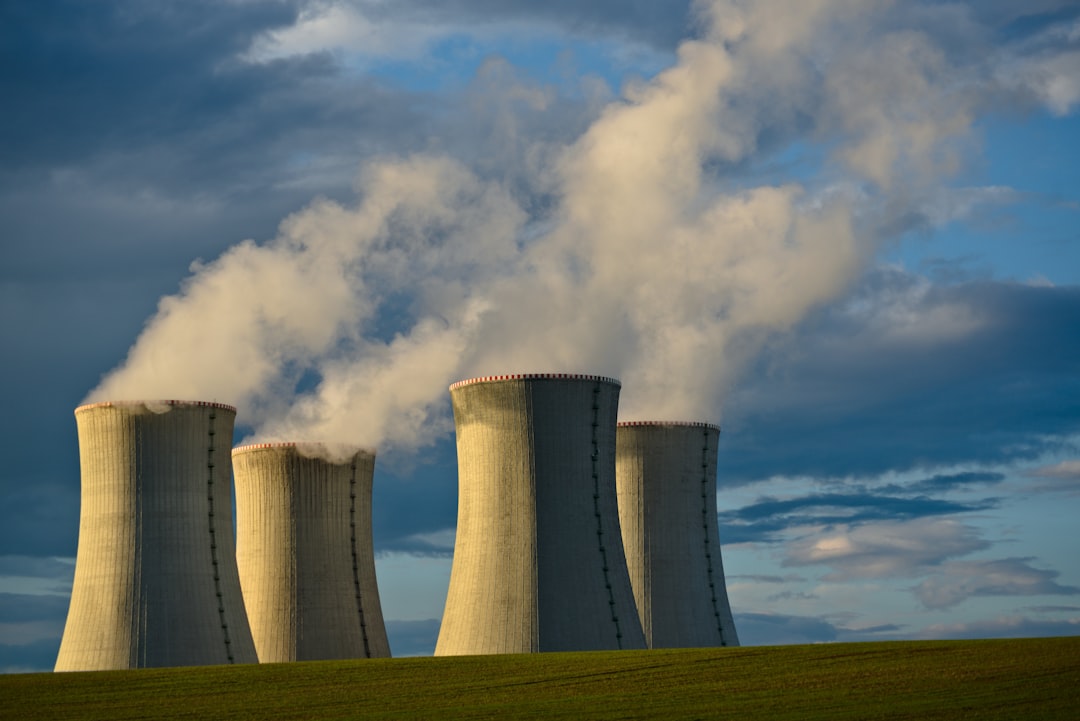
The Grid Controller of India (Grid-India), the national agency that operates the country’s power system in real time, has identified nine thermal power units with a combined capacity of about 1.8 gigawatts (GW) that can be repurposed as synchronous condensers. The idea is to keep the heavy spinning machinery of these plants running on the grid for stability, without burning fuel to produce electricity, as India absorbs record additions of solar and wind power.
The proposal, reported by The Indian Express, flows from an April 2026 review meeting on summer power preparedness chaired by the Union Power Secretary. Eight of the nine units are coal- or lignite-based and one is gas-based, all either under prolonged outage or running at very low utilisation. The plan reframes ageing fossil assets as grid-support infrastructure rather than power generators, a theme central to managing India’s energy transition.
- Grid-India shortlisted nine thermal units totalling about 1.8 GW for conversion into synchronous condensers (SYNCONs).
- The plants span five states; Rajasthan has three, Gujarat two, with units also in Maharashtra, Karnataka and Tamil Nadu.
- A synchronous condenser is a generator that spins freely without producing electricity, supplying inertia, reactive power and voltage support.
- The trigger is rising renewable penetration: solar and wind are inverter-based and reduce the grid’s natural stabilising inertia.
- Grid-India cited the June 2024 Champa-Kurukshetra HVDC tripping and the April 2025 Spain-Portugal blackout as warnings on system strength.
The development matters in the context of:
- India targets 500 GW of non-fossil capacity by 2030; installed renewable capacity crossed 220 GW by early 2026.
- Renewable clusters sit in remote, electrically weak regions (Rajasthan, Gujarat, Tamil Nadu, Karnataka, Andhra Pradesh) far from synchronous machines.
UPSC Relevance
Prelims Relevance
- Grid Controller of India (Grid-India): formerly POSOCO, the central agency that operates the National Grid and balances supply with demand in real time.
- Synchronous condenser (SYNCON): a rotating machine connected to the grid that provides reactive power and inertia but generates no active power.
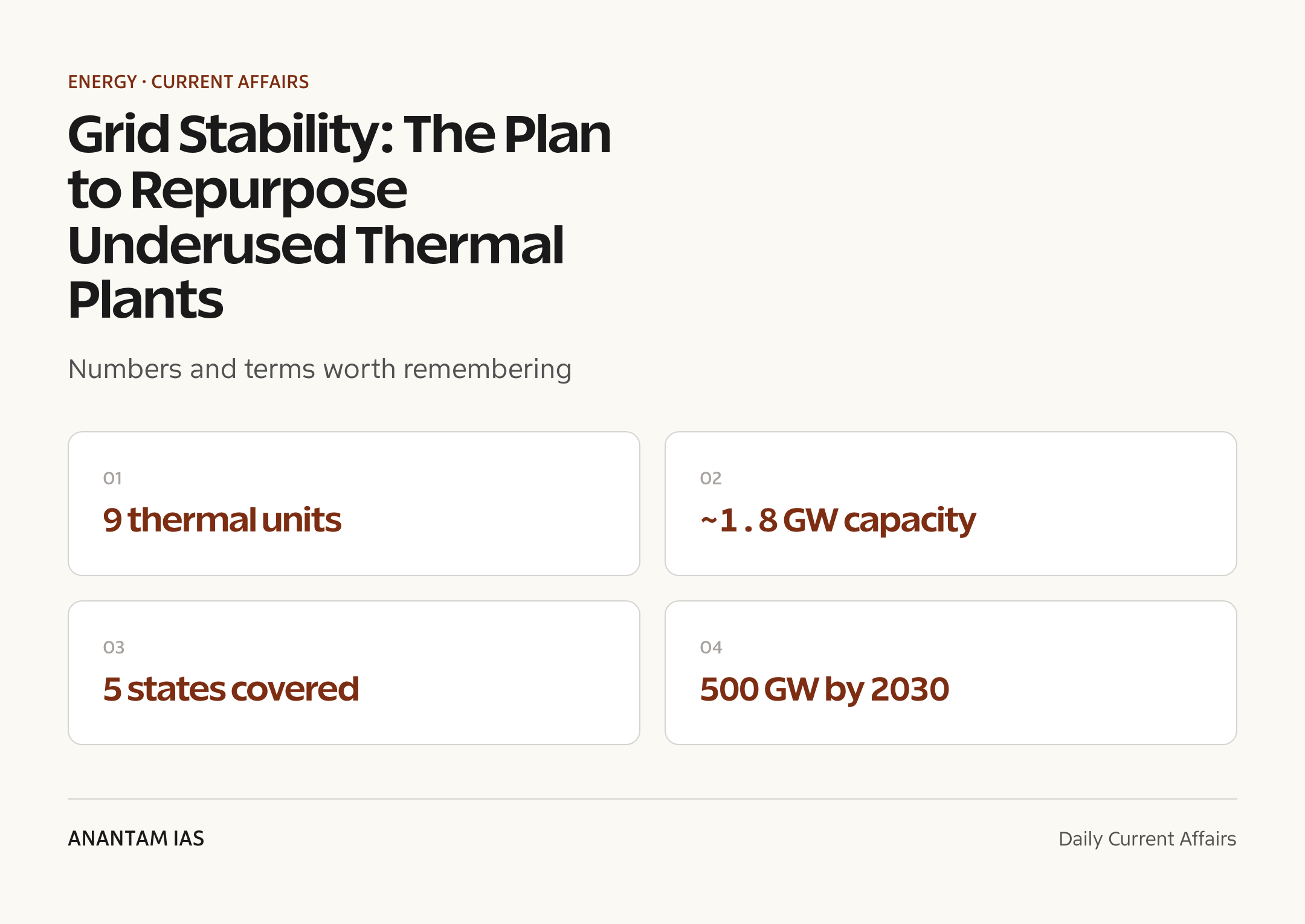
- Grid frequency: India’s grid runs at a nominal 50 hertz (Hz); frequency falls when demand exceeds supply and rises when supply exceeds demand.
- Inertia: the stored kinetic energy in large spinning generators that resists sudden frequency changes; inverter-based solar and wind supply little of it.
- Reactive power: power that supports voltage levels across the network, measured in VAR, distinct from the active power (in watts) that does useful work.
- Inverter-based resources (IBR): solar PV and most modern wind connect through power electronics rather than rotating mass, lowering system inertia.
- Duck curve: the daily net-demand shape created when midday solar floods the grid and demand spikes after sunset as solar fades.
- 500 GW non-fossil target by 2030: India’s pledge for 50% of installed capacity from non-fossil sources, anchoring its energy-transition policy.
- Alternatives for flexibility: battery energy storage, pumped-storage hydro, STATCOMs and SVCs for voltage support.
- Grid disturbances cited: the June 2024 Champa-Kurukshetra HVDC tripping (about 16.5 GW load loss in the North) and the April 2025 Iberian blackout.
Mains Relevance
GS Paper 3
- Energy security and the technical economics of integrating high renewable penetration into a low-inertia grid.
- Infrastructure repurposing: converting end-of-life or idle thermal assets into grid-support services as a least-cost transition tool.
- Trade-offs between battery storage, pumped hydro and synchronous condensers for grid flexibility and reliability.
- Linking the 500 GW non-fossil goal with transmission planning, system strength and stranded-asset risk in coal.
Essay
- Managing transitions: how a fossil-fuel system can be retired gracefully rather than abruptly, retaining value from old machines.
- Technology and trade-offs: the hidden engineering costs of clean energy that headline capacity figures conceal.
Background and Context
Why a high-renewable grid becomes harder to stabilise
A power grid must hold its frequency and voltage within tight bands every second. Renewables change the physics of that balancing act.
- The Indian grid runs at a nominal 50 Hz; if generation and demand drift apart even briefly, frequency moves and protective relays can trip equipment to prevent damage.
- Large coal, gas and hydro generators have heavy spinning rotors that store inertia, kinetic energy that cushions sudden shocks and slows the rate at which frequency falls when supply is lost.
- Solar PV and most wind are inverter-based: they connect through power electronics with little rotating mass, so they add generating capacity but almost no inertia.
- As their share grows, the grid loses inertia and local reactive power support, leaving it weaker and more prone to voltage and frequency excursions during a disturbance.
- Grid-India flagged that the problem is sharpest at peak solar hours, when inverter plants supply a large share of power but little stabilising support, so the grid can hold surplus active power yet still lack reactive power and inertia where it is needed.
What a synchronous condenser actually does
Grid operators call it an electrical shock absorber. It is an old idea being revived for a new problem.
- A synchronous condenser is a generator spinning freely, synchronised to the grid but disconnected from any fuel-burning turbine.
- Because its rotor keeps spinning, it supplies real inertia and short-circuit current that strengthen the grid during disturbances.
- It injects or absorbs reactive power on demand, propping up voltage at weak points in the network.
- It provides primary response and transient stability support that inverter-based resources cannot easily replicate.
- Converting a plant means decoupling the generator from its boiler or turbine and adding control gear, so the rotor can be driven up to grid speed and kept spinning.
- Crucially it consumes very little fuel and emits almost nothing, since it is not generating active power, only exchanging reactive power with the network.
The repurposing plan, plant by plant
Grid-India’s shortlist targets idle or barely-used units sitting near renewable hubs and load centres.
- Nine units totalling about 1.8 GW; eight coal/lignite and one gas-based, all idle or running sub-optimally.
- Rajasthan has three: Giral, Kota Super Thermal and Dholpur Gas; Gujarat has Akrimota and Kutch lignite stations.
- Maharashtra (GEPL Phase-I, Mihan), Karnataka (Raichur) and Tamil Nadu (Tuticorin) complete the list.
- Grid-India wants SYNCONs sited at load centres and near large renewable energy complexes where system strength is low and synchronous machines are scarce.
- The agency pointed to the June 2024 Champa-Kurukshetra HVDC tripping, which shed about 16.5 GW of load in the Northern Region and exposed voltage-stability gaps.
- It also cited the Northern Regional Power Committee’s assessment of the Rajasthan Renewable Energy Complex, which called for SYNCONs at multiple sites.
- It cited the US, UK and Mexico, where retired thermal units have already been converted into condensers, as proof the approach is technically viable.
The energy-transition context
The case for SYNCONs sits inside India’s larger push toward 500 GW of non-fossil capacity.
- India aims for 500 GW of non-fossil capacity by 2030, with renewables crossing 220 GW by early 2026; the solar energy push drives much of this.
- Rapid additions have clustered solar and wind in renewable-rich states, often in remote areas with weak transmission links.
- Building brand-new thermal plants for stability is hard to justify, as forced generation adds active-power imbalance and cost.
- Repurposing existing machinery is pitched as a pragmatic, lower-cost way to retain reliability services from synchronous machines.
- It also offers a softer landing for ageing coal assets, echoing India’s broader just transition debate.
Alternatives: storage and power electronics
Synchronous condensers are one tool among several for a flexible, stable grid.
- Battery energy storage can shift surplus solar to evening peaks and respond fast, though it supplies synthetic, not true, inertia.
- Pumped-storage hydro pumps water uphill in surplus hours and releases it at peak, offering large-scale, long-duration balancing and some inertia from its turbines.
- STATCOMs and SVCs are power-electronic devices that regulate voltage and reactive power fast, without rotating mass, but supply no true inertia.
- Grid forecasting bodies such as the Regional Energy Management Centres help operators anticipate renewable swings and schedule balancing resources.
- Newer inverters can offer grid-forming behaviour that mimics inertia synthetically, though field deployment at scale is still maturing.
- A resilient grid likely needs a mix of all of these, with SYNCONs filling the inertia-and-voltage gap that inverters leave, a theme central to India’s wider energy security debate.
Way Forward
Grid-India proposes evaluating idle thermal units through detailed technical studies, including power-system simulations, short-circuit level assessment, voltage stability analysis and cost-benefit evaluation before any conversion.
A clear compensation mechanism for plant owners, transparent siting near weak grid nodes, and pairing SYNCONs with storage and forecasting would let India scale renewables without sacrificing reliability.
Conclusion
India’s clean-energy story is usually told in gigawatts of solar and wind, but the harder engineering challenge is keeping a low-inertia grid stable second by second. Repurposing idle coal and gas units as synchronous condensers is a quiet, pragmatic fix that extracts stability from machines once destined for retirement.
Whether it scales will depend on honest cost-benefit studies, fair compensation and treating SYNCONs as one piece of a flexibility toolkit that also includes storage, pumped hydro and smarter forecasting. The 500 GW target will only hold up if the wires and machines behind it stay in balance.
UPSC Practice Questions
Prelims MCQ 1
With reference to a synchronous condenser in the context of grid management, consider the following statements: 1. It is a rotating machine that supplies active power to the grid as its primary function. 2. It can provide inertia and reactive power support to help maintain grid stability. 3. It is being proposed by Grid-India as a use for certain underutilised thermal units. Which of the statements given above is/are correct?
1 and 2 only 2 and 3 only 1 and 3 only 1, 2 and 3
Answer: 2 and 3 only
Explanation:
A synchronous condenser spins freely and does not supply active power; it supplies reactive power, inertia and voltage support. Grid-India has proposed converting underutilised thermal units into such condensers, so statements 2 and 3 are correct while 1 is wrong.
Prelims MCQ 2
Increasing penetration of inverter-based solar and wind generation tends to affect the power grid in which of the following ways? 1. It reduces the system inertia available to resist sudden frequency changes. 2. It can create local shortfalls in reactive power and voltage support. 3. It raises the grid’s nominal operating frequency above 50 Hz. Select the correct answer using the code given below.
1 only 1 and 2 only 2 and 3 only 1, 2 and 3
Answer: 1 and 2 only
Explanation:
Inverter-based resources add capacity but little rotating mass, lowering inertia, and can leave local deficits in reactive power and voltage support. The nominal grid frequency stays at 50 Hz; high renewables do not raise the nominal frequency, so statement 3 is incorrect.
UPSC Mains Questions
- Define grid inertia and explain why rising shares of inverter-based renewable generation make a power system harder to stabilise. How can synchronous condensers help? (250 words)
- “India’s energy transition is as much a grid-management problem as a generation problem.” Discuss with reference to the proposal to repurpose underutilised thermal plants. (250 words)
- Compare synchronous condensers, battery energy storage and pumped-storage hydro as tools for ensuring grid flexibility and reliability in a high-renewable grid. (150 words)
Sources: The Indian Express (Explained) and Ministry of Power.
Frequently Asked Questions
What is a synchronous condenser in simple terms?
It is a generator that spins on the grid without burning fuel or producing electricity. By spinning, it supplies inertia, reactive power and voltage support, acting like an electrical shock absorber that helps keep the grid stable.
Why does Grid-India want to convert old thermal plants?
Eight coal/lignite and one gas unit, about 1.8 GW in total, are idle or barely used. Instead of scrapping them or forcing them to generate uneconomically, Grid-India proposes spinning their machinery as synchronous condensers to provide stability services near renewable hubs.
Why do solar and wind weaken grid stability?
Solar and most wind are inverter-based, connecting through electronics rather than heavy spinning rotors. They add power capacity but little inertia and reactive power, so as their share grows the grid loses its natural cushion against sudden frequency and voltage swings.
What is grid inertia and why does it matter?
Inertia is the kinetic energy stored in large spinning generators. It resists sudden changes in grid frequency, buying time for control systems to respond. Low inertia makes a grid fragile, as seen in events like the April 2025 Spain-Portugal blackout.
How does this connect to India’s 500 GW target?
India aims for 500 GW of non-fossil capacity by 2030. Adding that much inverter-based renewable power lowers system strength, so tools like synchronous condensers, storage and pumped hydro are needed to keep the grid reliable as the share of solar and wind rises.
Are synchronous condensers the only solution?
No. Battery storage, pumped-storage hydro, STATCOMs and SVCs, and better forecasting all help. Synchronous condensers are valuable mainly for the true inertia and voltage support that inverter-based resources struggle to provide.
Tell Google you want more of this.
Add Anantam IAS as a preferred sourceOne tap, and this site shows up more often in your own Top Stories, AI Overviews and AI Mode. Remove it any time.