Daily Digest
UPSC · Civil Services Examination
Current Affairs · Thursday, 25 June 2026
Current affairs curated and edited by Anantam IAS faculty — pulled from The Hindu, PIB, IDSA, Foreign Affairs and the ministries. Read, annotate, revise.
Old Rajinder Nagar · Delhi 110005 · anantamias.com
BRICS Energy Ministers’ Meeting: India Hosts the 11th Edition Under Its 2026 Chairship
Why in News?
India is hosting the 11th BRICS Energy Ministers’ Meeting in Gurugram, Haryana, on 25-26 June 2026, under its BRICS Chairship 2026. According to the Ministry of Power (PIB) and DD News, the meeting brings together energy ministers and senior officials from all BRICS members to deepen cooperation on energy security, sustainability and innovation.
The Energy Track runs under the Sanskrit theme ‘सर्वेषां ऊर्जम्’ (Energy for All), nested within India’s overarching Chairship theme — ‘Building for Resilience, Innovation, Cooperation and Sustainability (BRICS)’. It is India’s fourth BRICS Chairship, after 2012, 2016 and 2021, and lets New Delhi showcase its clean-energy record and platforms such as the International Solar Alliance and the Global Biofuels Alliance.
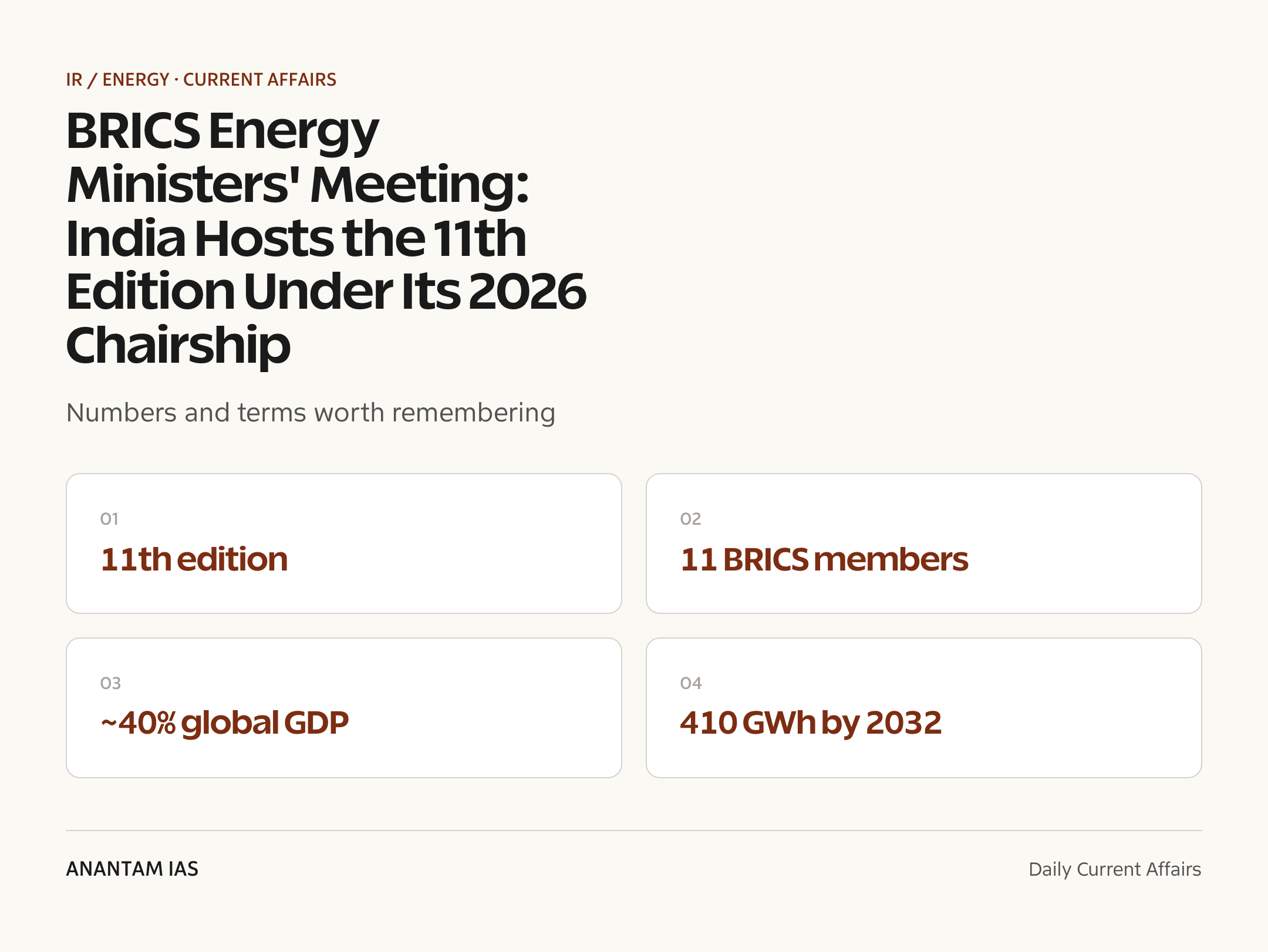
- 11th edition of the BRICS Energy Ministers’ Meeting, hosted by India at Gurugram (25-26 June 2026).
- Held under India’s BRICS Chairship 2026 — its fourth after 2012, 2016 and 2021.
- Energy Track theme: ‘Energy for All’ (‘सर्वेषां ऊर्जम्’); umbrella theme stresses resilience, innovation, cooperation, sustainability.
- Agenda built on three priorities — energy security and sustainability, energy access and equity, and technology and innovation.
- Platform to project the International Solar Alliance and the Global Biofuels Alliance and advance the Global South.
The development matters in the context of:
- Preceded by three virtual meetings of Senior Energy Officials and two seminars — on AI in the energy sector and Carbon Capture, Utilization and Storage (CCUS).
- The Fourth Meeting of the BRICS Committee of Senior Energy Officials ran on 22-24 June 2026 in Gurugram, just ahead of the ministerial.
- A BRICS Youth Energy Summit (virtual) is scheduled for 17-18 August 2026.
UPSC Relevance
Prelims Relevance
- BRICS now has 11 members: Brazil, Russia, India, China, South Africa plus Egypt, Ethiopia, Iran, the UAE and Indonesia (added in the 2024-25 expansion) — together about half the world’s population and roughly 40% of global GDP.
- The bloc began as BRIC (first summit 2009), became BRICS when South Africa joined in 2010, and expanded sharply from 2024.
- India’s 2026 Chairship theme abbreviation spells BRICS — Building for Resilience, Innovation, Cooperation and Sustainability.
- The International Solar Alliance (ISA) was launched by India and France at the 2015 Paris climate conference; it is headquartered at Gurugram.
- The Global Biofuels Alliance (GBA) was launched on the sidelines of the G20 Summit in New Delhi in 2023.
- One Sun One World One Grid (OSOWOG) is India’s initiative for inter-regional green-grid interconnection.
- India targets 410 GWh of energy storage capacity by 2032 and has deployed over 60 million smart meters.
- India has reached 20% ethanol blending in petrol and introduced E85 fuel (80-85% ethanol).
- The Revamped Distribution Sector Scheme (RDSS) and Green Energy Corridors are flagship power-sector reforms.
- India is the world’s third-largest producer and consumer of electricity.
Mains Relevance
GS Paper 2
- BRICS as a vehicle of plurilateral and Global South diplomacy — how the 2024-25 expansion reshapes the bloc’s weight and India’s role as a balancer.
- India’s fourth Chairship as an exercise in agenda-setting on energy access, equity and resilient supply chains.
- Use of ISA and GBA as instruments of India’s energy-transition diplomacy and soft power among developing economies.
GS Paper 3
- The trilemma of energy security, affordability and sustainability amid rising demand and climate pressure.
- India’s clean-energy record — 50x solar growth, smart metering, storage targets, ethanol blending — as a model of a just transition.
- Roles of grid resilience, OSOWOG, Green Energy Corridors and CCUS in integrating renewables at scale.
Essay
- A just energy transition: balancing growth, equity and the climate for the Global South.
- Multilateralism reimagined: can plurilateral blocs like an expanded BRICS deliver shared public goods?
Background and Context
BRICS and its 2024-25 expansion
The bloc has grown from an emerging-market acronym into an eleven-nation grouping with substantial demographic and economic heft.
- Originated as BRIC (Brazil, Russia, India, China) with its first summit in 2009; South Africa joined in 2010 to make BRICS.
- From January 2024 the bloc admitted new members; per PIB and DD News it now comprises 11 countries — adding Egypt, Ethiopia, Iran, the UAE and Indonesia.
- The expanded bloc accounts for nearly half of the world’s population and around 40% of global GDP.
- Its enlargement deepens BRICS’ claim to speak for the Global South on energy, finance and development.

India's BRICS Chairship 2026
India holds the rotating Chairship for the fourth time and has framed it around resilience and inclusion.
- This is India’s fourth Chairship, after 2012, 2016 and 2021.
- Overarching theme: ‘Building for Resilience, Innovation, Cooperation and Sustainability (BRICS)’ — the acronym itself spells the bloc’s name.
- The Energy Track carries the theme ‘सर्वेषां ऊर्जम्’ (Energy for All), signalling universal energy access as a shared goal.
- As Chair, India says it will advance Global South priorities, resilient supply chains and practical energy cooperation.
The ministerial agenda and run-up meetings
The Gurugram meeting is the apex of a structured Energy Track built through prior official-level consultations.
- India structured the BRICS Energy Agenda around three priorities: energy security and sustainability, energy access and equity, and technology and innovation.
- Three virtual meetings of Senior Energy Officials were held to build consensus and draft recommendations for ministers.
- Two technical seminars preceded the meeting — on the role of Artificial Intelligence in energy and on Carbon Capture, Utilization and Storage (CCUS).
- The Fourth Meeting of the BRICS Committee of Senior Energy Officials ran on 22-24 June 2026 in Gurugram, followed by a virtual Youth Energy Summit on 17-18 August 2026.
ISA and GBA: India's clean-energy platforms
Two India-driven coalitions anchor its pitch as a convenor of global clean-energy cooperation.
- The International Solar Alliance (ISA) — launched by India and France at the 2015 Paris climate conference and headquartered in Gurugram — promotes solar deployment across sun-rich countries.
- The Global Biofuels Alliance (GBA) was launched on the sidelines of the 2023 G20 Summit in New Delhi to scale sustainable biofuels and trade.
- PIB and DD News position both as evidence of India’s role as a leading advocate of clean-energy cooperation.
- Both feed naturally into a BRICS energy agenda focused on access, equity and a diversified energy mix.
India's energy transformation showcased
The Ministry of Power frames the meeting as a window to display a decade of power-sector gains toward Viksit Bharat 2047.
- Solar power capacity expanded more than 50 times over the past decade; over 60 million smart meters deployed.
- India targets 410 GWh of energy storage capacity by 2032 to firm up renewables.
- Reforms include Green Energy Corridors, the Revamped Distribution Sector Scheme (RDSS), expanded transmission and regional grid links via OSOWOG.
- In biofuels, India has reached 20% ethanol blending and rolled out E85 fuel (80-85% ethanol), framed around its Viksit Bharat 2047 vision.
Energy-transition diplomacy and the just transition
The meeting sits at the intersection of geopolitics, climate and development for emerging economies.
- BRICS members face a common trilemma — securing supply, keeping energy affordable, and decarbonising amid rising demand.
- A just transition stresses equitable access and shielding developing economies from disruptive shifts.
- India uses platforms like ISA, GBA and OSOWOG to convert climate commitments into diplomatic leverage with the Global South.
- Stronger BRICS cooperation on resilient supply chains and clean technology matters in an uncertain global energy environment.
Way Forward
Translate priorities into deliverables
- Convert the three-pillar agenda into concrete technology-sharing and finance commitments rather than declaratory text.
- Use BRICS to build resilient clean-energy supply chains for solar, storage and critical minerals.
- Link ISA, GBA and OSOWOG work streams so they reinforce one another across member states.
Centre equity and the Global South
- Keep energy access and affordability central so the transition does not deepen development gaps.
- Channel BRICS cooperation toward financing clean energy in lower-income members and partners.
- Sustain youth and technical tracks (Youth Energy Summit, AI and CCUS seminars) to institutionalise cooperation.
Conclusion
The 11th BRICS Energy Ministers’ Meeting in Gurugram lets India pair a credible domestic clean-energy record with an expanded bloc that now speaks for nearly half of humanity. By framing the Energy Track as ‘Energy for All’, New Delhi seeks to make access and equity, not just decarbonisation, the organising idea of the agenda.
Whether the meeting produces durable cooperation will depend on moving from shared themes to shared deliverables — financing, technology transfer and resilient supply chains. For India, it is a test of energy-transition diplomacy and of its ability to convene the Global South around a secure, affordable and sustainable energy future.
UPSC Practice Questions
Prelims MCQ 1
With reference to BRICS as it stands in 2026, consider the following statements:
- Egypt, Ethiopia, Iran and the United Arab Emirates are among the countries added to the bloc in its recent expansion.
- The bloc today accounts for around 40% of global GDP.
- South Africa was a founding member of the original BRIC grouping at its first summit.
How many of the above statements are correct?
Only one Only two All three None
Answer: Only two
Explanation:
Statements 1 and 2 are correct: the 2024-25 expansion added Egypt, Ethiopia, Iran, the UAE and Indonesia, and BRICS now accounts for around 40% of global GDP (and nearly half the world’s population). Statement 3 is wrong — the original grouping was BRIC (Brazil, Russia, India, China); South Africa joined only in 2010 to make it BRICS.
Prelims MCQ 2
The Global Biofuels Alliance (GBA), often discussed alongside India’s energy diplomacy, was launched on the sidelines of which event?
The 2023 G20 Summit in New Delhi The 2015 Paris Climate Conference (COP21) The 2021 Glasgow Climate Conference (COP26) The 11th BRICS Energy Ministers’ Meeting in Gurugram
Answer: The 2023 G20 Summit in New Delhi
Explanation:
The Global Biofuels Alliance was launched on the sidelines of the G20 Summit in New Delhi in 2023. The International Solar Alliance, by contrast, was launched at the 2015 Paris climate conference (COP21) and is headquartered in Gurugram.
UPSC Mains Questions
- India’s 2026 BRICS Chairship places ‘Energy for All’ at the heart of its Energy Track. Examine how an expanded BRICS can advance energy security and equity for the Global South. (250 words)
- Discuss how India is using platforms such as the International Solar Alliance and the Global Biofuels Alliance as instruments of energy-transition diplomacy. (150 words)
- A just energy transition must reconcile security, affordability and sustainability. Evaluate India’s domestic record against this trilemma. (250 words)
Sources: PIB, Ministry of Power and DD News.
Frequently Asked Questions
What is the BRICS Energy Ministers’ Meeting being held in Gurugram?
It is the 11th BRICS Energy Ministers’ Meeting, hosted by India on 25-26 June 2026 in Gurugram, Haryana, under its BRICS Chairship 2026. As per PIB and DD News, energy ministers and senior officials from all member countries gather to strengthen cooperation on energy security, sustainability and innovation.
Why is the meeting significant for India?
It marks India’s fourth BRICS Chairship after 2012, 2016 and 2021. It lets India set the energy agenda for a bloc of 11 nations, showcase its clean-energy record, and promote platforms like the International Solar Alliance and the Global Biofuels Alliance while championing Global South priorities.
What is the theme of the 2026 Chairship and Energy Track?
India’s overarching theme is ‘Building for Resilience, Innovation, Cooperation and Sustainability (BRICS)’, whose initials spell the bloc’s name. The Energy Track carries the Sanskrit theme ‘सर्वेषां ऊर्जम्’ (Energy for All), underlining universal energy access as a shared BRICS goal.
Which countries are now part of BRICS?
BRICS now comprises 11 countries: Brazil, Russia, India, China and South Africa, plus Egypt, Ethiopia, Iran, the United Arab Emirates and Indonesia added in the 2024-25 expansion. Together they account for nearly half the world’s population and around 40% of global GDP.
What are the three priorities of India’s BRICS Energy Agenda?
India structured the agenda around three priorities: energy security and sustainability; energy access and equity; and technology and innovation. Run-up events included three Senior Energy Officials meetings and seminars on Artificial Intelligence in energy and on Carbon Capture, Utilization and Storage.
How are the ISA and GBA linked to this meeting?
The International Solar Alliance (launched 2015, headquartered in Gurugram) and the Global Biofuels Alliance (launched at the 2023 G20 Summit) are India-driven clean-energy coalitions. They underpin India’s pitch as a convenor of global clean-energy cooperation and feed into the BRICS focus on access, equity and a diversified energy mix.
Source: https://anantamias.com/current-affairs/brics-energy-ministers-meeting-gurugram-2026/
From Fingerprint to Conviction: NCRB’s Four New Apps and the Digital Criminal-Justice Chain
Why in News?
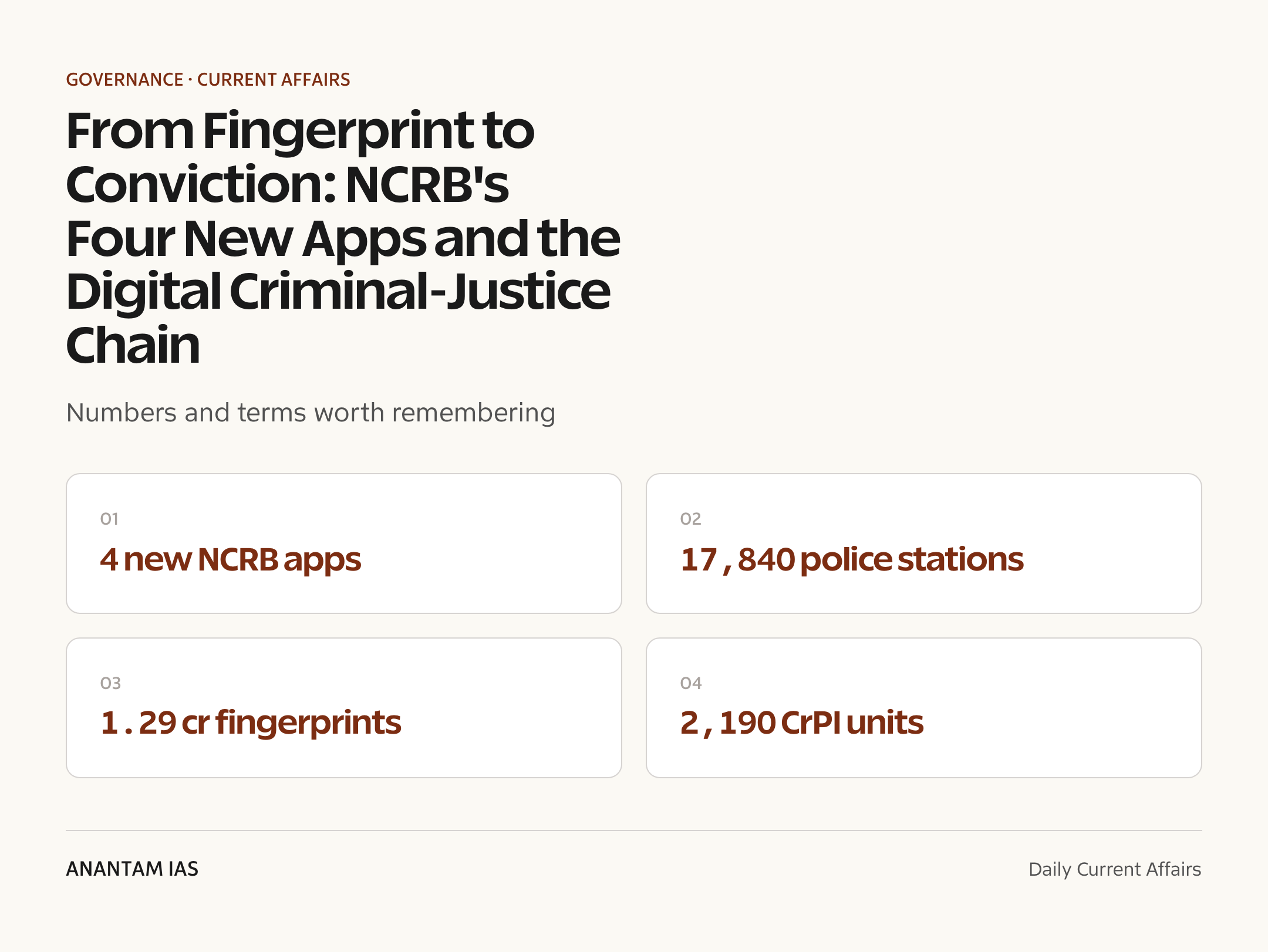
On 19 June 2026, at the 26th All India Fingerprint Conference in New Delhi, Union Home Minister Amit Shah launched four National Crime Records Bureau (NCRB) applications — Abhigyan, CrPI, e-Forensics 2.0 and e-Prosecution 2.0 — designed, the PIB release says, to speed up disposal of pending cases and deliver justice within three years from FIR to conviction.
The four apps are meant to operate as a single digital chain: the National Automated Fingerprint Identification System (NAFIS) and CrPI identify the offender, CCTNS and Cri-MAC support the investigation, e-Forensics strengthens the evidence, and e-Prosecution drives the case to conviction — all stitched into the Integrated Criminal Justice System (ICJS). The rollout has also renewed concern, voiced by outlets such as MediaNama and NewsDrum, over street-level biometric scanning and whether it will withstand legal scrutiny.
- NCRB-Abhigyan is a mobile app that lets field police search the National Fingerprint Database from any location using a certified scanner to identify a suspect — moving fingerprint checks from the lab to the street.
- CrPI adds multi-modal biometrics — facial recognition, iris matching and DNA matching — aimed at repeat-offender and CCTV-based identification; per PIB, 2,190 CrPI units have been distributed and over 5.53 lakh enrollments completed.
- e-Forensics 2.0 digitally links forensic laboratories with investigating agencies, covering sample registration, lab workflow, report generation and the chain of custody.
- e-Prosecution 2.0 builds digital coordination among police, prosecution and the judiciary so that once an offender is identified, timely prosecution can follow.
- MediaNama reports the Abhigyan fingerprint check is pitched as returning a match in roughly 35 seconds at the field level — a claim not specified in the PIB release itself.
- The launch is framed as part of the shift from force-based policing toward scientific, evidence-based investigation, with AI and machine learning flagged for future predictive policing.
The development matters in the context of:
- The apps sit on top of the three new criminal laws that took effect on 1 July 2024 — the Bharatiya Nyaya Sanhita (BNS), Bharatiya Nagarik Suraksha Sanhita (BNSS) and Bharatiya Sakshya Adhiniyam (BSA), 2023 — which replaced the IPC, CrPC and Indian Evidence Act and expand the role of forensic and digital evidence.
- Per the PIB release, CCTNS now covers all 17,840 police stations, the country holds about 1.29 crore fingerprint records, and the e-Forensics database carries data on about 34.48 lakh cases.
UPSC Relevance
Prelims Relevance
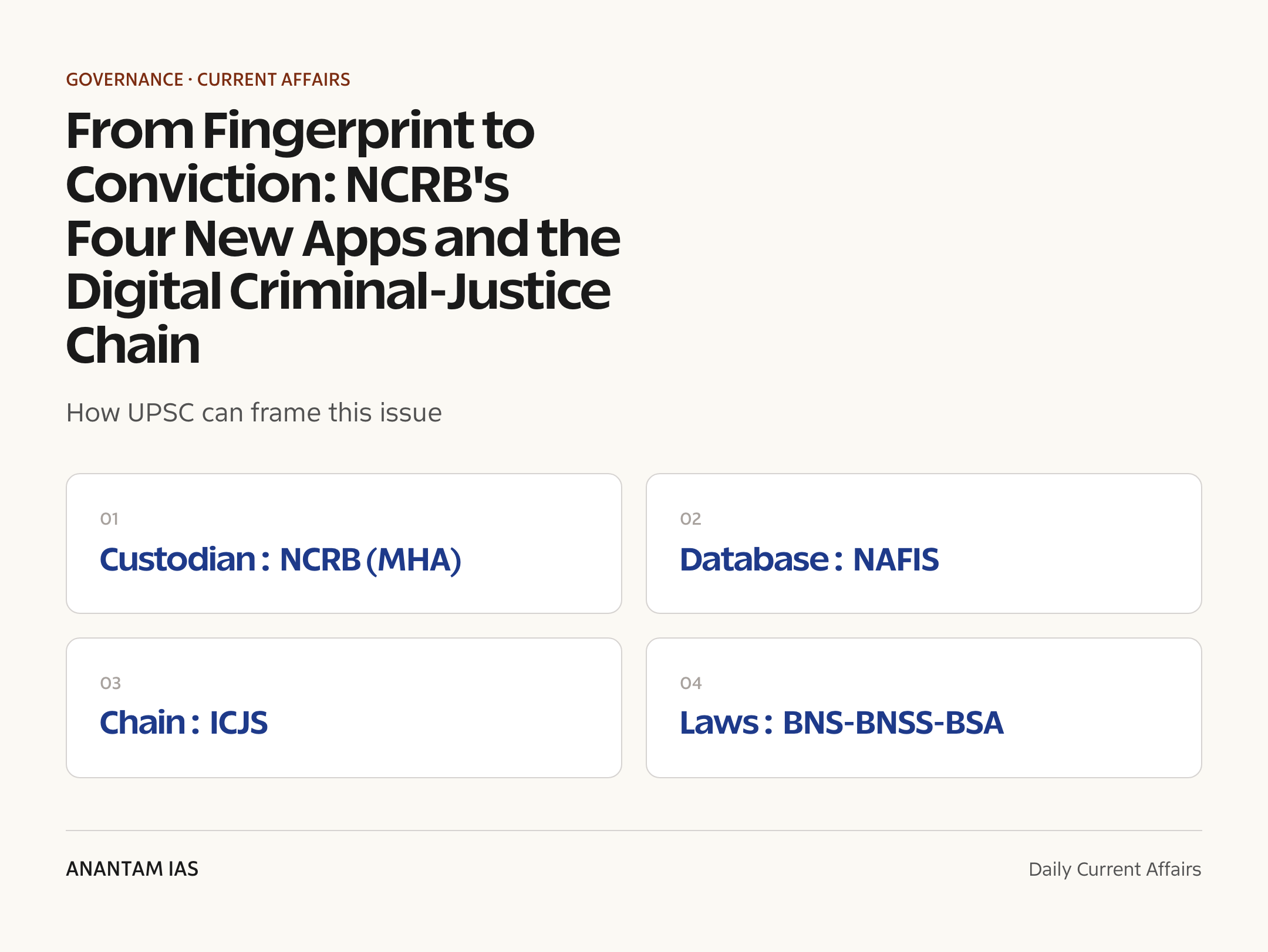
- NCRB: set up in 1986 under the Ministry of Home Affairs (MHA); custodian of national crime data and the NAFIS database; merged the erstwhile Central Fingerprint Bureau functions.
- NAFIS: National Automated Fingerprint Identification System — a centralised, searchable fingerprint database maintained by NCRB that assigns each record a unique 10-digit National Fingerprint Number.
- CCTNS: Crime and Criminal Tracking Network and Systems — links police stations on a common platform; per PIB it now covers all 17,840 stations.
- ICJS: Integrated Criminal Justice System — connects the five pillars: police, forensics, prosecution, courts (e-Courts) and prisons (e-Prisons).
- New criminal laws: BNS replaced the IPC, BNSS replaced the CrPC, and BSA replaced the Indian Evidence Act; all three came into force on 1 July 2024.
- Cri-MAC: Crime Multi-Agency Centre under NCRB, used to share crime alerts across agencies.
- K.S. Puttaswamy v. Union of India (2017): held privacy a fundamental right under Article 21 and laid down the legality–necessity–proportionality test for state intrusion.
- DPDP Act, 2023: Digital Personal Data Protection Act — governs processing of digital personal data; carries exemptions for state agencies notified in the interest of, among others, prevention of offences.
- BPR&D: Bureau of Police Research and Development — works with NCRB on police modernisation and training.
- Modus Operandi Bureau: an NCRB unit, set up four years before this conference, for crime-pattern analysis.
Mains Relevance
GS Paper 2
- e-governance and digital delivery of justice: how the ICJS integrates police, forensics, prosecution, courts and prisons, and the governance gains of a single digital chain.
- Government policies and institutions: NCRB and BPR&D evolving from record-keeping bodies into intelligence-driven crime-prevention organisations under the new criminal laws.
- Rights and accountability: balancing real-time biometric policing with the Puttaswamy proportionality test and the absence of a dedicated facial-recognition or biometric-data statute.
GS Paper 3
- Science and technology in internal security: use of NAFIS, multi-modal biometrics (face, iris, DNA), AI and machine learning for crime detection and predictive policing.
- Data governance and cybersecurity: securing large biometric and criminal databases through access logs, audits, SOP-based use and penalties for misuse, as flagged in the release.
- Challenges of predictive policing: risk of profiling, false positives in field-level biometric matching, and the need for legal safeguards before pre-emptive identification.
Essay
- Technology can make justice faster, but speed without safeguards can erode the very rights the criminal-justice system exists to protect.
- The line between a smarter state and a surveillance state is drawn not by the tools it builds but by the limits it accepts on their use.
Background and Context
The Four New Applications
The Home Minister launched four NCRB applications, each owning one link in the journey from a crime scene to a conviction.
- NCRB-Abhigyan: a mobile app letting field officers search the National Fingerprint Database from any location with a certified scanner, identifying a suspect by fingerprint match and making field policing more responsive.
- CrPI: a multi-modal biometric system combining facial recognition, iris matching and DNA matching, used mainly for repeat-offender and CCTV-based identification; PIB notes 2,190 units distributed and over 5.53 lakh enrollments.
- e-Forensics 2.0: digitally connects forensic labs and investigating agencies — sample registration, lab workflow, report generation and a strengthened chain of custody.
- e-Prosecution 2.0: links police, prosecution and the judiciary so prosecution follows quickly once an offender is identified.
How NAFIS and ICJS Knit the Chain Together
The apps are not standalone tools; they plug into databases that already span the criminal-justice system.
- NAFIS, run by NCRB, is the searchable national fingerprint database that Abhigyan queries; the release stresses it is a ‘two-way’ system that must be continuously fed with crime-scene prints to stay useful.
- CCTNS now reaches all 17,840 police stations and holds legacy data including about 37.68 crore FIRs, per the PIB figures.
- The ICJS connects police, forensics, prosecution, the e-Courts system (about 22,000 courts linked) and the e-Prisons system (data on about 2.29 crore prisoners).
- The intended flow, as the release puts it: NAFIS and CrPI identify the offender, CCTNS and Cri-MAC connect the investigation, e-Forensics strengthens the evidence, and e-Prosecution drives the case to conviction.
The New Criminal Laws as Backdrop
These tools were built for a legal framework rewritten in 2023 and enforced from mid-2024.
- Bharatiya Nyaya Sanhita (BNS), 2023 replaced the Indian Penal Code as the substantive criminal code.
- Bharatiya Nagarik Suraksha Sanhita (BNSS), 2023 replaced the Code of Criminal Procedure and pushes mandatory forensic investigation for serious offences and digital case management.
- Bharatiya Sakshya Adhiniyam (BSA), 2023 replaced the Indian Evidence Act and broadens the admissibility of electronic and digital records.
- All three came into force on 1 July 2024; the stated goal of completing the process from FIR to conviction within three years rests heavily on this digital evidence backbone.
The Privacy and Legal-Scrutiny Debate
Real-time, street-level biometric identification reopens questions the courts have only partly answered.
- The proportionality argument: under K.S. Puttaswamy (2017), any state intrusion into privacy must satisfy legality, necessity and proportionality — critics ask whether routine field fingerprint and face checks meet this bar absent a dedicated law.
- The data-protection gap: the DPDP Act, 2023 governs digital personal data but carries broad exemptions for state agencies, and India still has no specific statute governing facial recognition or large biometric databases.
- Reliability and error: civil-liberties commentators (cited by MediaNama and NewsDrum) flag false-positive risk in field biometric matching and the danger of profiling and function creep toward predictive policing.
- The state’s case: the government argues that scientific, time-bound investigation strengthens convictions and that safeguards — access logs, SOP-based usage, third-party audits and penalties for misuse — were explicitly stressed at the conference, with database security framed as a state responsibility.
Why It Matters
The launch is a marker in how India is re-architecting policing around data rather than manpower.
- It signals a shift from a force-based model to an evidence-and-intelligence-driven one, with NCRB and BPR&D recast as crime-prevention bodies.
- It pairs ambitious efficiency goals — three-year FIR-to-conviction timelines — with an expanding biometric state, making the safeguards question central rather than peripheral.
- For aspirants, it is a clean case study linking governance reform, technology in justice and fundamental rights in a single story.
Way Forward
Legislate the Safeguards
- Enact a dedicated framework governing facial recognition and biometric databases, with clear purpose limitation, retention limits and independent oversight, rather than relying on exemptions under the DPDP Act.
- Codify the Puttaswamy proportionality test into operating procedures for field-level biometric checks — defining when an officer may scan, on what suspicion, and with what record.
Build Accountability into the Tech
- Operationalise the audit measures named at the conference — access logs, SOP-based usage, third-party audits and penalties for misuse — and publish periodic transparency reports on match accuracy and false positives.
- Invest in data quality and security at the state level so that databases like NAFIS and CrPI are accurate, secure and not vehicles for wrongful identification.
Train the Whole Chain
- Extend training beyond app use to evidence collection, preservation and concise charge-sheeting, involving prosecutors, forensic experts and the judiciary as the release urges.
- Pilot grievance and redressal mechanisms for individuals wrongly flagged by biometric matching before scaling field deployment.
Conclusion
NCRB’s four apps are, on paper, an elegant solution to a real problem: India’s criminal-justice system has long been slowed by paper files, disconnected databases and evidence that decays before it reaches a courtroom. Stitching NAFIS, CrPI, e-Forensics and e-Prosecution into one ICJS chain promises faster, more scientific convictions under the new criminal laws.
The harder question is institutional, not technical. Real-time biometric policing from a constable’s phone is exactly the kind of intrusion the Supreme Court asked the state to justify in Puttaswamy. Whether this digital chain becomes a model of efficient justice or a quietly expanding surveillance grid will depend less on the apps and more on the laws, audits and limits the country is willing to build around them.
UPSC Practice Questions
Prelims MCQ 1
With reference to the National Automated Fingerprint Identification System (NAFIS), consider the following statements: 1. It is maintained by the National Crime Records Bureau under the Ministry of Home Affairs. 2. It assigns each enrolled record a unique National Fingerprint Number. Which of the statements given above is/are correct?
1 only 2 only Both 1 and 2 Neither 1 nor 2
Answer: Both 1 and 2
Explanation:
NAFIS is maintained by the NCRB, which functions under the MHA, and it assigns a unique 10-digit National Fingerprint Number to each record. Both statements are correct.
Prelims MCQ 2
Which of the following correctly pairs the three new criminal laws of 2023 with the older statutes they replaced? 1. Bharatiya Nyaya Sanhita — Indian Penal Code. 2. Bharatiya Nagarik Suraksha Sanhita — Code of Criminal Procedure. 3. Bharatiya Sakshya Adhiniyam — Indian Evidence Act. Select the correct answer:
1 and 2 only 2 and 3 only 1 and 3 only 1, 2 and 3
Answer: 1, 2 and 3
Explanation:
BNS replaced the IPC, BNSS replaced the CrPC, and BSA replaced the Indian Evidence Act. All three pairings are correct; the laws came into force on 1 July 2024.
UPSC Mains Questions
- The integration of policing, forensics, prosecution and courts into a single digital chain promises faster justice but raises fresh privacy concerns. Examine the governance gains and the rights-related risks of NCRB’s new criminal-justice applications. (250 words)
- Real-time biometric identification by field police must satisfy the proportionality test laid down in K.S. Puttaswamy. Critically discuss the adequacy of India’s current legal framework, including the DPDP Act 2023, to regulate such technologies. (250 words)
- Scientific, evidence-based investigation is increasingly seen as more effective than a force-based policing model. Discuss with reference to the new criminal laws and the Integrated Criminal Justice System. (150 words)
Sources: PIB, Ministry of Home Affairs and MediaNama.
Frequently Asked Questions
What are the four new NCRB applications launched in June 2026?
They are NCRB-Abhigyan (field fingerprint search against the national database), CrPI (facial, iris and DNA matching), e-Forensics 2.0 (linking forensic labs and investigators) and e-Prosecution 2.0 (coordinating police, prosecution and courts). They were launched by Home Minister Amit Shah at the 26th All India Fingerprint Conference on 19 June 2026.
What is NAFIS and how does Abhigyan use it?
NAFIS (National Automated Fingerprint Identification System) is NCRB’s centralised, searchable fingerprint database. The Abhigyan app lets field police query NAFIS from any location using a certified scanner, so a suspect can be checked against the national database at the spot rather than only in a lab.
What are the three new criminal laws referenced here?
The Bharatiya Nyaya Sanhita (BNS), Bharatiya Nagarik Suraksha Sanhita (BNSS) and Bharatiya Sakshya Adhiniyam (BSA), 2023, which replaced the IPC, CrPC and Indian Evidence Act respectively and came into force on 1 July 2024. They expand the role of forensic and digital evidence.
What is the Integrated Criminal Justice System (ICJS)?
The ICJS connects the pillars of the justice system — police (CCTNS), forensics (e-Forensics), prosecution (e-Prosecution), courts (e-Courts) and prisons (e-Prisons) — on a shared digital platform, so information flows from a crime scene through investigation to conviction.
Why are privacy advocates concerned about these apps?
Critics, including outlets like MediaNama and NewsDrum, argue that real-time, street-level fingerprint and face checks may not satisfy the Puttaswamy proportionality test, that India lacks a dedicated facial-recognition or biometric-data law, and that the DPDP Act 2023 carries broad state exemptions. They also flag false-positive and profiling risks.
How does this fit the goal of justice within three years?
The government wants the process from FIR to conviction completed within three years. Faster identification (Abhigyan, CrPI), digitally managed forensic evidence (e-Forensics) and coordinated prosecution (e-Prosecution) are meant to cut delays, supported by the BNSS’s emphasis on time-bound, forensic-led investigation.
Source: https://anantamias.com/current-affairs/ncrb-digital-policing-apps-criminal-justice/
GRSE Becomes the 29th Navratna: How CPSE Classification Works and Why It Matters
Why in News?
The Department of Public Enterprises (DPE) conferred Navratna status on Garden Reach Shipbuilders & Engineers (GRSE) through an Office Memorandum dated 19 June 2026, as reported by Business Standard and PSU Watch.
GRSE, a defence shipyard under the Department of Defence Production (Ministry of Defence), becomes the 29th Navratna among India’s central public sector enterprises (CPSEs) — a recognition that brings sharper financial and operational autonomy to the warship builder.
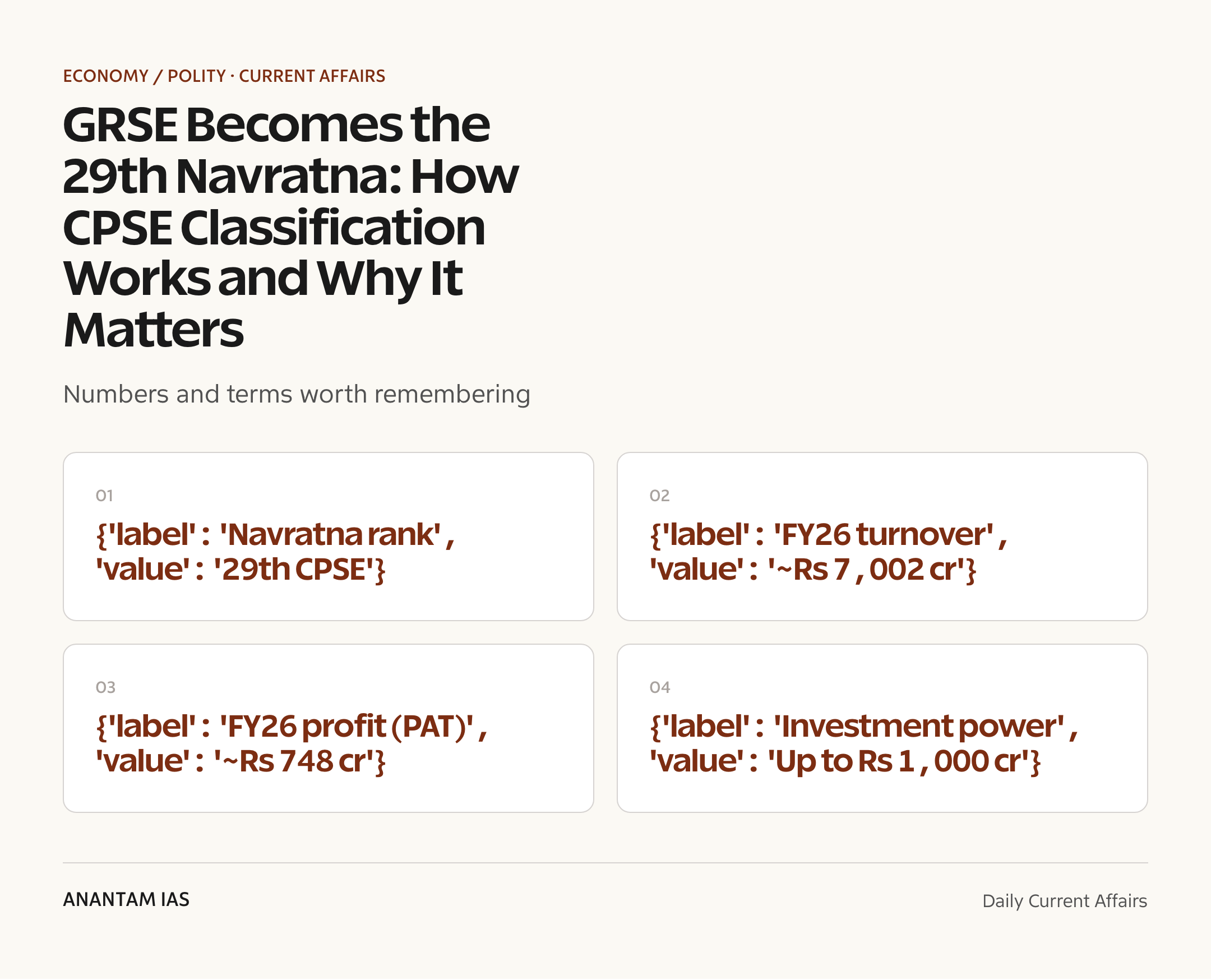
- GRSE reported an annual turnover of about Rs 7,002 crore in FY 2025-26, up from roughly Rs 1,754 crore in 2021-22 — a near-fourfold rise that anchored its case for the upgrade.
- Profit after tax rose from about Rs 190 crore (2021-22) to roughly Rs 748 crore (2025-26), as cited in the Business Standard report.
- The shipyard’s chairman and managing director called the conferral a defining moment for the company, per PSU Watch.
- Navratna status lets GRSE invest larger sums in projects and form joint ventures with greater speed — useful for scaling indigenous warship orders.
- The upgrade fits the wider push for self-reliance in defence (Atmanirbhar Bharat), where domestic shipyards are central to naval modernisation.
- Before this, the publicly cited count stood at 26 Navratnas; GRSE’s addition (the 29th, by the count attributed in news reports) reflects a phase of rapid CPSE upgrades.
The development matters in the context of:
- The DPE is the nodal body for CPSE policy and grants the Maharatna, Navratna and Miniratna tags based on financial performance and governance benchmarks.
- The Navratna scheme dates to 1997, when the government created it to give well-performing CPSEs the autonomy to compete in a liberalised economy.
- A high-level committee under the Cabinet Secretary has been reviewing the CPSE grading framework, with proposals for new performance categories under discussion — so the classification itself is a live policy theme.
UPSC Relevance
Prelims Relevance
- The Department of Public Enterprises (DPE) is the nodal agency for CPSE classification — Maharatna, Navratna, Miniratna (Category I & II).
- Maharatna criteria: Navratna status, listed on an Indian stock exchange, average annual turnover above Rs 25,000 crore, average net worth above Rs 15,000 crore, and average net profit above Rs 5,000 crore (3-year averages), with significant global presence.
- Navratna criteria: must be a Miniratna Category-I and a Schedule ‘A’ CPSE, hold an ‘Excellent’ or ‘Very Good’ MoU rating in 3 of the last 5 years, and score 60 or above on a composite of six performance parameters.
- Miniratna Category-I: profit in each of the last 3 years and pre-tax profit of Rs 30 crore or more in at least one of those years, with positive net worth.
- Miniratna Category-II: profit in each of the last 3 years with positive net worth (lower threshold than Category-I).
- Navratna autonomy: the board can invest up to Rs 1,000 crore (or 15% of net worth in a single project, capped at 30% of net worth in a year) without central government approval.
- GRSE is a defence-PSU shipyard under the Department of Defence Production, Ministry of Defence, headquartered in Kolkata.
- Indigenous warship building ties to Atmanirbhar Bharat in defence and the Navy’s ‘float, move, fight’ indigenisation push.
Mains Relevance
GS Paper 3
- Public sector reform: how the Ratna grading system grants graded autonomy to CPSEs and what it reveals about the state’s evolving role in the economy.
- Defence indigenisation: the place of public-sector shipyards like GRSE, MDL and CSL in building self-reliance and reducing import dependence.
- Capital and governance: how delegated financial powers help CPSEs scale investment, enter joint ventures, and compete without routine government clearance.
Essay
- Autonomy with accountability: can public enterprises behave like competitive firms while serving national goals?
- Self-reliance as strategy: the economics and security logic of building warships at home
Background and Context
The GRSE Upgrade: What Happened
GRSE’s elevation to Navratna is the result of a sustained climb in its financials and a strong governance track record.
- GRSE is a Kolkata-based defence shipyard that builds warships and patrol vessels for the Indian Navy and Coast Guard, operating under the Department of Defence Production.
- Its turnover rose to about Rs 7,002 crore in FY 2025-26 from roughly Rs 1,754 crore in 2021-22, while profit after tax climbed to about Rs 748 crore — the kind of performance the Navratna grade rewards.
- The DPE issued the conferral via an Office Memorandum dated 19 June 2026, as reported in the press; GRSE described it as recognition of decades of engineering depth.
- The grade gives the GRSE board enlarged powers to commit capital and structure partnerships, easing the path to larger and more complex shipbuilding orders.

CPSE Classification: Maharatna, Navratna, Miniratna
The DPE sorts profitable, well-governed CPSEs into three tiers, each unlocking a wider band of decision-making freedom.
- Maharatna is the top tier for large, globally active CPSEs; it requires Navratna status, a stock-exchange listing, and high thresholds on turnover, net worth and net profit.
- Navratna sits in the middle, reserved for strong Schedule ‘A’ performers that meet MoU-rating and composite-score benchmarks.
- Miniratna is split into Category-I and Category-II, recognising consistently profitable CPSEs with positive net worth, at differing profit thresholds.
- The grades are not permanent: a CPSE can be promoted as it grows or reviewed if performance slips, keeping the system performance-linked.
Navratna Eligibility and the Autonomy It Confers
Navratna status is earned through a layered test of profitability, governance rating, and a composite performance score.
- To qualify, a CPSE must already be a Miniratna Category-I and a Schedule ‘A’ company, signalling both profitability and scale of operations.
- It must hold an ‘Excellent’ or ‘Very Good’ MoU rating in at least three of the previous five years — the MoU is the annual performance contract between a CPSE and its administrative ministry.
- It must score 60 or more on a composite of six parameters, covering metrics such as net profit to net worth, manpower cost to cost of production, and earnings to capital employed.
- Once granted, the board can sanction capital investment up to Rs 1,000 crore in a project without central government approval, and may form joint ventures and subsidiaries within set limits — the core practical benefit of the grade.
GRSE, Indigenous Shipbuilding and Atmanirbhar Bharat
GRSE’s rise mirrors a national bet on building warships at home rather than importing them.
- Domestic shipyards — GRSE, Mazagon Dock Shipbuilders (MDL), Cochin Shipyard (CSL) and Goa Shipyard — are the backbone of the Navy’s plan to build most new platforms in India.
- Indigenous construction keeps spending, jobs and technology within the country and lowers reliance on foreign suppliers for sensitive defence assets.
- GRSE has delivered a large number of vessels over its history, from anti-submarine warfare corvettes to survey ships and fast patrol craft, building a deep base of design and integration skills.
- A high indigenisation content in each warship means orders ripple through hundreds of domestic vendors supplying steel, machinery, electronics and fittings, widening the manufacturing base.
- Navratna autonomy helps such yards bid for and execute bigger order books — aligning corporate freedom with the strategic aim of self-reliance in defence.
Why the Classification Matters for Governance
The Ratna framework is a study in balancing enterprise freedom against public accountability.
- Graded autonomy lets profitable CPSEs act with commercial speed while the state retains ownership and broad oversight.
- Performance-linked grading creates an incentive: better MoU ratings and stronger finances translate into more freedom, nudging CPSEs toward efficiency.
- The framework is under active review by a Cabinet Secretary-led committee, with new performance categories being weighed — making CPSE reform a recurring policy debate.
- Autonomy without scrutiny risks weak capital discipline, so delegated powers come with board-level checks, audit by the Comptroller and Auditor General, and parliamentary oversight of public money.
- For UPSC, GRSE is a concrete peg to discuss disinvestment policy, public-sector reform, and the interface between economic autonomy and national security.
Way Forward
Convert Autonomy into Capability
- GRSE should use its enlarged investment powers to deepen design capacity and yard modernisation, not just to fund existing orders.
- Faster joint ventures with private and foreign technology partners can plug gaps in propulsion, sensors and weapon integration.
Keep the Grading System Credible
- Any new CPSE performance categories should reward genuine commercial and operational outcomes, not merely size.
- Tighter MoU evaluation and transparent composite scoring will keep the Navratna tag a mark of performance rather than a routine promotion.
Conclusion
GRSE’s elevation to the 29th Navratna is more than a corporate milestone — it is a window into how India grades, rewards and frees its public enterprises. The Ratna ladder ties autonomy to performance, letting a profitable shipyard commit larger capital and move faster while the state keeps ownership and oversight.
For the aspirant, the durable takeaways are the eligibility rules and delegated powers of each tier, and the larger point that public-sector reform and defence self-reliance increasingly pull in the same direction. A stronger, freer GRSE is both an economic and a strategic asset.
UPSC Practice Questions
Prelims MCQ 1
With reference to the classification of Central Public Sector Enterprises (CPSEs) in India, consider the following statements: 1. The Department of Public Enterprises grants the Maharatna, Navratna and Miniratna statuses. 2. To be eligible for Navratna status, a CPSE must already be a Miniratna Category-I and a Schedule ‘A’ company. 3. A Navratna CPSE board can invest up to Rs 1,000 crore in a project without central government approval. Which of the statements given above are correct?
1 and 2 only 2 and 3 only 1 and 3 only 1, 2 and 3
Answer: 1, 2 and 3
Explanation:
The DPE is the nodal body that confers the Ratna grades. Navratna eligibility requires Miniratna Category-I and Schedule ‘A’ status, an ‘Excellent’/’Very Good’ MoU rating in 3 of 5 years, and a composite score of 60 or more. A Navratna board can sanction project investment up to Rs 1,000 crore without government approval. All three statements are correct.
Prelims MCQ 2
Garden Reach Shipbuilders & Engineers (GRSE), recently conferred Navratna status, operates under which of the following?
Department of Heavy Industry Department of Defence Production, Ministry of Defence Ministry of Ports, Shipping and Waterways Department of Public Enterprises, Ministry of Finance
Answer: Department of Defence Production, Ministry of Defence
Explanation:
GRSE is a defence-PSU shipyard under the Department of Defence Production, Ministry of Defence. The DPE only classifies CPSEs; it is not the administrative ministry for GRSE.
UPSC Mains Questions
- The Ratna classification of CPSEs links autonomy to performance. Examine how the Maharatna, Navratna and Miniratna framework balances commercial freedom with public accountability, using a recent upgrade as an illustration. (250 words)
- Indigenous warship building is central to India’s quest for self-reliance in defence. Discuss the role of public-sector shipyards and the policy support they need to scale. (150 words)
- “Granting financial autonomy to public enterprises is necessary but not sufficient for their performance.” Critically analyse with reference to CPSE reform. (150 words)
Sources: Business Standard and PSU Watch.
Frequently Asked Questions
What is the Navratna status, and what did GRSE achieve?
Navratna is a grade conferred by the Department of Public Enterprises on strong, well-governed central public sector enterprises, giving them greater financial and operational autonomy. GRSE, a Kolkata-based defence shipyard, was conferred Navratna status in June 2026, reportedly becoming the 29th Navratna among CPSEs.
How are Maharatna, Navratna and Miniratna different?
Maharatna is the top tier for large, globally active CPSEs with very high turnover, net worth and profit. Navratna is for strong Schedule ‘A’ performers meeting MoU-rating and composite-score tests. Miniratna (Category I and II) recognises consistently profitable CPSEs at lower thresholds. Each higher tier brings more delegated decision-making powers.
What are the eligibility criteria for Navratna status?
A CPSE must already be a Miniratna Category-I and a Schedule ‘A’ company, hold an ‘Excellent’ or ‘Very Good’ MoU rating in at least three of the last five years, and score 60 or more on a composite of six performance parameters.
What financial powers does Navratna status confer?
A Navratna board can sanction capital investment up to Rs 1,000 crore in a single project without central government approval (subject to net-worth-linked ceilings), and can form joint ventures and subsidiaries within prescribed limits.
Why does GRSE’s upgrade matter for defence self-reliance?
Greater autonomy lets GRSE commit larger capital and form partnerships faster, helping it take on bigger indigenous warship orders. This supports the Navy’s plan to build most new platforms at home under Atmanirbhar Bharat.
Is the CPSE classification framework being changed?
A high-level committee led by the Cabinet Secretary has been reviewing the CPSE grading and performance-assessment framework, with proposals for new performance categories under discussion. The existing Maharatna/Navratna/Miniratna tiers remain in place.
Source: https://anantamias.com/current-affairs/grse-navratna-status-cpse-classification/
RBI Overhauls TReDS: Easier MSME Onboarding and Credit-Guarantee Cover for Financiers
Why in News?
The Reserve Bank of India has issued revised directions consolidating the rules that govern the Trade Receivables Discounting System (TReDS) — an RBI-regulated electronic platform on which Micro, Small and Medium Enterprises (MSMEs) sell their unpaid invoices to lenders for early cash. The new framework folds scattered instructions into a single Master Direction and reworks how sellers join, who can lend, and who can stand guarantee.
The overhaul matters because delayed payments are a chronic drain on MSME working capital. By simplifying onboarding, permitting credit-guarantee and insurance cover for financiers, and admitting government-notified guarantee funds and insurers onto the platform, the RBI is trying to deepen trade-receivables financing and pull more small firms into the formal credit system.
- The RBI has consolidated existing TReDS instructions into a single Master Direction, replacing a patchwork of earlier circulars.
- MSME onboarding is simplified; operators must build validation checks so only genuine MSMEs participate and dues are credited to the seller’s own bank account.
- Financiers may now obtain credit-guarantee cover and insurance for factoring units financed on the platform.
- Insurance companies and government-notified credit guarantee fund trusts are allowed to participate on TReDS.
- The minimum net-worth floor for TReDS operators is aligned at Rs 25 crore, matching other non-bank payment system operators.
The development matters in the context of:
- TReDS platforms have operated since 2017 (RXIL, M1xchange, Invoicemart) under RBI’s 2014 guidelines and the Payment and Settlement Systems Act, 2007.
- Mandatory onboarding of large companies and CPSEs above turnover thresholds was earlier pushed to widen the buyer base.

UPSC Relevance
Prelims Relevance
- TReDS: an RBI-regulated electronic platform for financing/discounting MSME trade receivables through multiple financiers via factoring and bill discounting.
- Factoring: a financier buys a business’s receivables (invoices) at a discount, giving the seller immediate cash and assuming collection.
- Factoring Regulation Act, 2011, amended in 2021 to widen the pool of eligible lenders (allowing non-NBFC entities to undertake factoring).
- MSMED Act, 2006: governs MSME definition and the delayed-payment provisions, including the 45-day payment rule.
- 45-day rule: buyers must pay MSME suppliers within 45 days of acceptance, with compound interest at three times the bank rate on delay.
- TReDS is authorised as a payment system under the Payment and Settlement Systems Act, 2007, supervised by the RBI.
- Revised operator net-worth floor: Rs 25 crore, aligned with other non-bank payment system operators.
- Participants now include sellers (MSMEs), buyers, financiers, insurers and government-notified credit guarantee funds.
- Financial inclusion: bringing underserved small firms into the formal financial system at affordable cost.
Mains Relevance
GS Paper 3
- Demonstrates how regulatory design can ease the working-capital squeeze on MSMEs, a sector contributing roughly a third of GDP and the bulk of non-farm employment.
- Illustrates the link between financial inclusion, credit-risk sharing through guarantees, and formalisation of small enterprises.
- Shows the role of digital public infrastructure (electronic discounting platforms) in widening access to institutional credit.
- Ties to the broader delayed-payments problem and the MSMED Act enforcement gap that TReDS partly addresses.
Essay
- Small enterprises and the architecture of trust: how guarantees and digital platforms can unlock credit for those at the margins of formal finance.
- Reform is incremental — institutions matter more than slogans in fixing the delayed-payment burden on India’s small businesses.
Background and Context
What TReDS is and why it exists
TReDS is the RBI’s answer to a simple but stubborn problem: small suppliers wait too long to be paid.
- The Trade Receivables Discounting System is an electronic platform where MSMEs upload invoices owed by their corporate or government buyers and auction them to multiple financiers for early payment.
- It works through factoring and bill discounting — the financier advances cash against the invoice at a discount, recovering the full amount from the buyer on the due date.
- Competitive bidding among financiers is meant to lower the discount rate, giving MSMEs cheaper, collateral-light working capital.
- Three RBI-authorised platforms — RXIL, M1xchange and Invoicemart — have run since 2017 under the Payment and Settlement Systems Act, 2007.

The MSME delayed-payments problem
TReDS sits on top of a long-standing structural weakness in how MSMEs get paid.
- MSMEs depend on larger buyers who often stretch payment cycles, locking up the small firm’s working capital and forcing costly informal borrowing.
- The MSMED Act, 2006 mandates payment within 45 days of acceptance, with penal compound interest on delay, but enforcement through MSE Facilitation Councils remains slow.
- By converting an unpaid invoice into immediate cash, TReDS offers a market route around the enforcement gap.
- Thin participation and onboarding friction have limited TReDS volumes relative to the size of MSME receivables outstanding.
The factoring framework behind the platform
TReDS rests on India’s factoring law, which was widened to bring in more lenders.
- The Factoring Regulation Act, 2011 created the legal basis for assignment of receivables and registration of factoring transactions.
- The 2021 amendment removed restrictive thresholds and let entities beyond a narrow set of NBFCs undertake factoring, expanding the lender pool.
- A wider lender base on TReDS is meant to raise competition for invoices and improve pricing for sellers.
- The revised directions build on this by inviting insurers and government credit guarantee funds into the same ecosystem.
What the revised directions change
The RBI’s overhaul touches onboarding, risk cover, participants and operator strength.
- Simpler onboarding: operators must run validation mechanisms to confirm a seller is a genuine MSME and ensure proceeds reach only the seller’s bank account.
- Guarantee cover for financiers: lenders may obtain credit-guarantee cover for factoring units from any government-set-up credit guarantee fund trust, plus insurance.
- New participants: insurance companies and government-notified credit guarantee funds are permitted to operate on TReDS.
- Operator net worth: aligned at Rs 25 crore with other non-bank payment system operators, with existing entities given time to comply.
- Consolidation: scattered earlier instructions are merged into one Master Direction for clarity.
Why it matters for financial inclusion
Guarantees and a broader participant base are designed to coax more lending toward small firms.
- Credit-guarantee and insurance cover reduce the financier’s downside, encouraging lending to MSMEs that might otherwise be seen as risky.
- Admitting insurers and guarantee funds spreads risk across more institutions, a classic financial-inclusion lever.
- Cleaner onboarding rules protect against misuse while lowering the entry barrier for genuine small suppliers.
- A stronger operator net-worth floor improves the resilience of the platforms handling these transactions.
Way Forward
Pair the eased onboarding with active outreach so that the smallest and informal MSMEs — not just larger ones already on the platform — actually use TReDS.
Tighten enforcement of the MSMED Act 45-day rule alongside market routes, so TReDS complements rather than substitutes for the buyer’s legal obligation to pay on time.
Track whether guarantee cover translates into lower discount rates for sellers, and calibrate guarantee-fund parameters to avoid moral hazard among financiers.
Conclusion
The revised TReDS directions are an incremental but meaningful step: by easing onboarding, sharing risk through guarantees and insurers, and strengthening operators, the RBI is trying to make trade-receivables financing a genuine working-capital lifeline for small firms.
The test will be uptake. A simpler platform with deeper risk-cover only delivers if more MSMEs sell invoices on it and see cheaper, faster cash — the real measure of whether the reform dents the delayed-payment problem.
UPSC Practice Questions
Prelims MCQ 1
With reference to the Trade Receivables Discounting System (TReDS), consider the following statements: 1. It is an electronic platform regulated by the Reserve Bank of India for financing MSME trade receivables. 2. It operates as an authorised payment system under the Payment and Settlement Systems Act, 2007. 3. Only banks are permitted to act as financiers on the platform. Which of the statements given above is/are correct?
1 and 2 only 2 and 3 only 1 and 3 only 1, 2 and 3
Answer: 1 and 2 only
Explanation:
TReDS is an RBI-regulated electronic platform authorised under the Payment and Settlement Systems Act, 2007 (statements 1 and 2 correct). Multiple financiers — not just banks — participate, and the revised directions further widen participation to insurers and government credit guarantee funds, so statement 3 is incorrect.
Prelims MCQ 2
Consider the following statements regarding the legal framework for MSME receivables financing in India: 1. The MSMED Act, 2006 requires buyers to pay MSME suppliers within 45 days of acceptance of goods or services. 2. The Factoring Regulation (Amendment) Act, 2021 narrowed the set of entities permitted to undertake factoring. Which of the statements given above is/are correct?
1 only 2 only Both 1 and 2 Neither 1 nor 2
Answer: 1 only
Explanation:
The MSMED Act, 2006 sets a 45-day payment limit with penal interest on delay (statement 1 correct). The 2021 amendment to the Factoring Regulation Act widened, not narrowed, the pool of eligible lenders by removing restrictive thresholds, so statement 2 is incorrect.
UPSC Mains Questions
- Delayed payments remain a chronic drain on MSME working capital. Examine how the Trade Receivables Discounting System (TReDS) and the recent revisions to its framework address this problem, and what limits their effectiveness. (250 words)
- “Risk-sharing instruments such as credit guarantees can widen the flow of formal credit to small enterprises.” Critically analyse this statement in the light of the RBI’s revised TReDS directions. (250 words)
- Discuss the role of digital platforms and the factoring framework in advancing financial inclusion for MSMEs in India. (150 words)
Sources: Reserve Bank of India and Business Standard.
Frequently Asked Questions
What is TReDS in simple terms?
TReDS, the Trade Receivables Discounting System, is an RBI-regulated electronic platform where MSMEs sell their unpaid invoices to financiers for immediate cash, instead of waiting for the buyer to pay. Multiple financiers bid for the invoice, which helps the small firm get cheaper working capital.
What has the RBI changed in the revised TReDS directions?
The RBI consolidated scattered rules into a single Master Direction, simplified how MSMEs join the platform, allowed financiers to obtain credit-guarantee and insurance cover, permitted insurers and government credit guarantee funds to participate, and aligned the minimum net-worth of operators at Rs 25 crore with other non-bank payment system operators.
How does TReDS help with the MSME delayed-payments problem?
Small suppliers often wait months for large buyers to pay, locking up their cash. TReDS converts an unpaid invoice into immediate funds, offering a market route around the slow enforcement of the MSMED Act’s 45-day payment rule. It complements, but does not replace, the buyer’s legal duty to pay on time.
What is factoring and how is it linked to TReDS?
Factoring is when a financier buys a business’s receivables (invoices) at a discount, giving the seller cash now and collecting from the buyer later. TReDS runs on factoring and bill discounting. The Factoring Regulation Act, 2011, amended in 2021, widened the pool of lenders allowed to do factoring, deepening the platform’s financier base.
Why does the Rs 25 crore net-worth requirement matter?
Aligning the minimum net worth of TReDS operators at Rs 25 crore — the same floor as other non-bank payment system operators — strengthens the financial resilience of the platforms handling MSME transactions. Existing operators are given a transition window to meet the requirement.
Who can participate on TReDS after the revision?
Sellers (MSMEs), buyers (corporates, CPSEs and government entities), and financiers participate, and the revised directions additionally admit insurance companies and government-notified credit guarantee fund trusts. This broadens the base of institutions sharing the credit risk of MSME lending.
Source: https://anantamias.com/current-affairs/rbi-treds-revised-directions-msme-finance/
CAG-Israel Audit MoU: AI and Data Analytics Enter Public-Sector Auditing
Why in News?
On 24 June 2026 the Comptroller and Auditor General (CAG) of India, K. Sanjay Murthy, and Israel’s State Comptroller and Ombudsman, Matanyahu Englman, signed a Memorandum of Understanding (MoU) to strengthen cooperation in public-sector auditing. As reported by The Tribune and ANI, the pact frames a structured exchange of professional knowledge, audit methodologies, technical expertise, training and best practices between the two Supreme Audit Institutions.
The engagement leaned heavily on technology. Englman delivered a lecture titled “Artificial Intelligence in Public Sector Auditing,” stressing how AI, data analytics and digital audit tools can sharpen the effectiveness, efficiency and impact of audit. For aspirants, the development is a ready hook to revise the CAG’s constitutional position under Articles 148-151 and to track how analytics is reshaping performance and compliance audit.
- The CAG of India and Israel’s State Comptroller and Ombudsman signed an MoU on 24 June 2026 on public-sector auditing cooperation.
- Signatories were K. Sanjay Murthy (CAG of India) and Matanyahu Englman (State Comptroller of Israel), per The Tribune and ANI.
- The MoU covers exchange of methodologies, technical expertise, training and best practices, with bilateral seminars held alternately in both countries.
- Its technology core is the use of Artificial Intelligence, data analytics and digital audit tools to strengthen public oversight.
- Both institutions reaffirmed a shared commitment to transparency, accountability and good governance in public administration.
The development matters in the context of:
- The CAG is the Supreme Audit Institution (SAI) of India; Israel’s parallel body is its State Comptroller, also functioning as the national Ombudsman.
- SAIs worldwide coordinate through INTOSAI (International Organisation of Supreme Audit Institutions), which has been pushing technology-led audit standards.
- The pact sits within the broader India-Israel cooperation, here extended into governance and audit institutions rather than defence or agriculture.
UPSC Relevance
Prelims Relevance
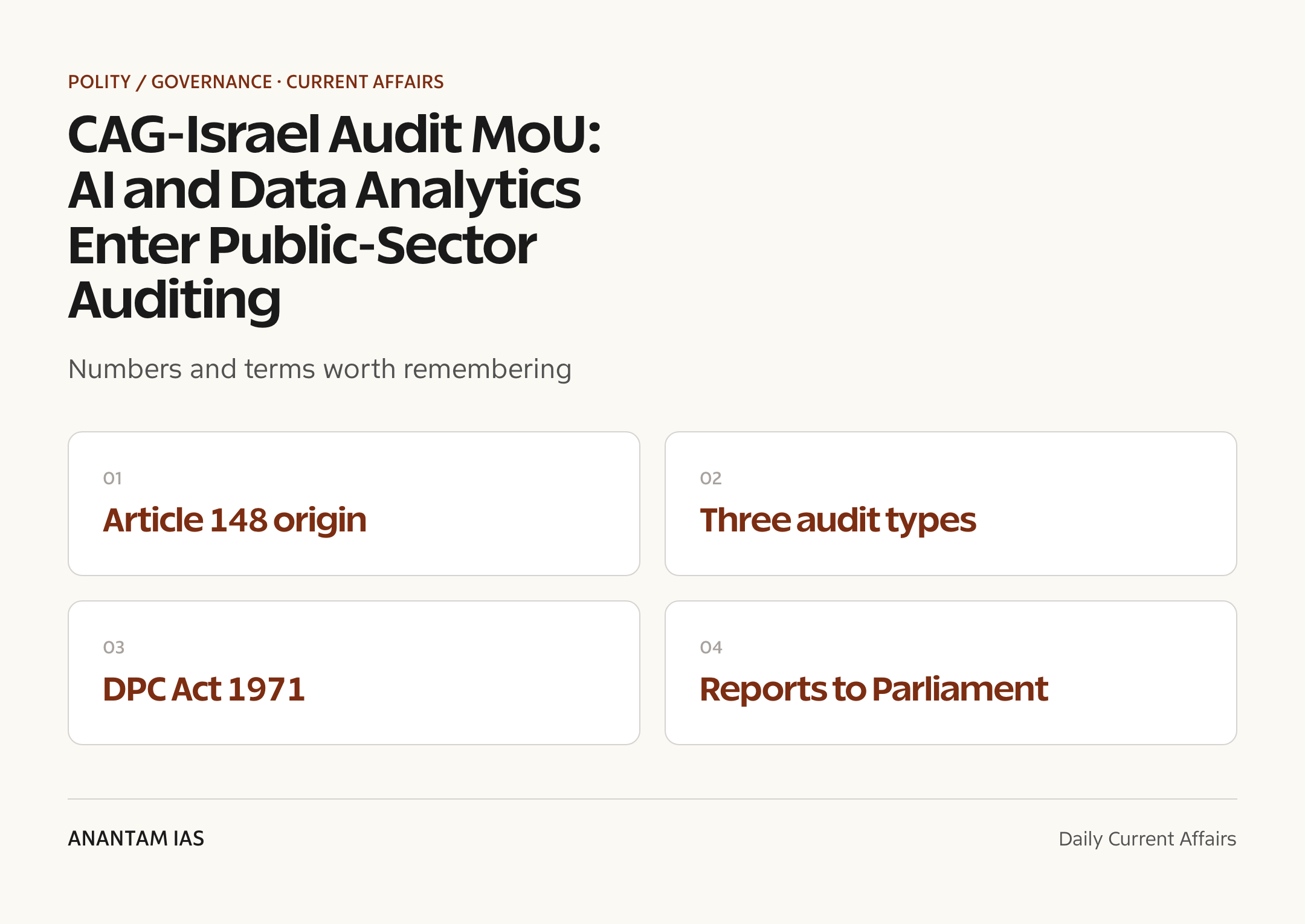
- The CAG is established under Article 148; the office is a constitutional, not statutory, body.
- Article 149 lays down the duties and powers of the CAG; Article 150 concerns the form of accounts of the Union and States.
- Article 151 requires CAG reports on Union accounts to be laid before Parliament and State reports before the respective legislature.
- The CAG is appointed by the President and can be removed only in the manner and on the grounds of a Supreme Court judge (proved misbehaviour or incapacity).
- The detailed mandate flows from the CAG’s (Duties, Powers and Conditions of Service) Act, 1971 (DPC Act).
- The CAG conducts three broad audits: financial, compliance and performance audit.
- CAG reports are examined by the Public Accounts Committee (PAC) of Parliament; the CAG acts as a “friend, philosopher and guide” to the PAC.
- Salary and service conditions of the CAG are charged on the Consolidated Fund of India, an independence safeguard.
- INTOSAI is the global body of Supreme Audit Institutions; the CAG of India has chaired several INTOSAI working groups.
- Continuous auditing and red-flag analytics are emerging AI-enabled techniques to detect anomalies in large data sets in near real time.
Mains Relevance
GS Paper 2
- Examine the CAG’s constitutional role under Articles 148-151 and the safeguards that protect its independence from the executive.
- Assess how the PAC-CAG relationship operationalises legislative control over public finance and executive accountability.
- Evaluate the institutional value of SAI-to-SAI cooperation (such as the India-Israel MoU) for capacity building and audit modernisation.
- Discuss whether the shift from financial and compliance audit toward performance audit strengthens outcome-based governance.
GS Paper 3
- Analyse how AI and data analytics can improve fraud detection, anomaly flagging and continuous auditing in public expenditure.
- Weigh the risks of algorithmic audit, including data quality, bias and auditor accountability, against efficiency gains.
Essay
- Accountability is the price a democracy pays for the trust it places in those who spend public money.
- Technology widens the auditor’s vision but cannot replace the auditor’s judgement.
- Independent institutions, not louder slogans, are the real guardians of public integrity.
Background and Context
The CAG as a constitutional sentinel
The office is designed to audit the public purse without fear of the government it scrutinises.
- Established under Article 148, the CAG is appointed by the President and holds a fixed tenure (six years or up to age 65, whichever is earlier).
- Removal mirrors that of a Supreme Court judge — only by Parliament, on proved misbehaviour or incapacity — insulating the office from arbitrary dismissal.
- B. R. Ambedkar called the CAG the most important officer under the Constitution, on par with the judiciary in guarding constitutional government.
- After demitting office, the CAG is barred from further office under the Union or State governments, reducing the temptation of post-retirement reward.

Independence safeguards
Several structural guarantees keep the auditor free of executive pressure.
- Salary and administrative expenses are charged on the Consolidated Fund of India, so they are not subject to annual vote.
- Service conditions cannot be varied to the CAG’s disadvantage after appointment.
- Audit staff and the Indian Audit and Accounts Department work under the CAG, not under the executive being audited.
- Reports go directly to the legislature under Article 151, bypassing executive gatekeeping.
The three audits and the DPC Act
The CAG’s mandate is statutory in detail though constitutional in origin.
- The CAG’s (DPC) Act, 1971 spells out duties, powers and conditions of service flowing from Article 149.
- Financial audit verifies that accounts fairly present the financial position.
- Compliance audit checks whether spending followed rules, laws and sanctions.
- Performance audit asks the harder question of economy, efficiency and effectiveness — whether public money achieved value for money.
The MoU and AI in audit
The India-Israel pact turns audit cooperation toward digital tools.
- Signed on 24 June 2026 by CAG K. Sanjay Murthy and Israel’s State Comptroller Matanyahu Englman, per The Tribune and ANI.
- It frames exchange of methodologies, technical expertise, training and best practices, with seminars held alternately in both countries.
- Englman’s lecture on AI in public-sector auditing highlighted analytics for detecting anomalies and lifting audit impact.
- Continuous auditing and red-flag analytics can scan entire transaction populations rather than the small samples traditional audit relied on.
Why it matters for governance
Audit modernisation feeds directly into accountability outcomes.
- Data-driven audit can shorten the gap between an irregularity and its detection, strengthening the deterrent value of oversight.
- SAI-to-SAI learning builds capacity that no single institution can develop alone.
- It dovetails with the work of the PAC, which depends on sharp, timely CAG findings to question the executive.
- Adopting AI also raises new accountability questions about data quality, model bias and auditor responsibility for machine-flagged findings.
Way Forward
Build in-house data analytics capacity within the Indian Audit and Accounts Department so AI tools augment, not outsource, the auditor’s judgement.
Adopt clear protocols on data quality, model validation and auditor sign-off so machine-flagged anomalies are independently verified before they reach reports.
Use SAI partnerships to shorten reporting cycles and move further toward real-time, continuous performance audit of large schemes.
Strengthen the PAC’s capacity to act on data-rich CAG findings, since detection without legislative follow-up blunts accountability.
Conclusion
The India-Israel audit MoU is a small administrative agreement with an outsized teaching value: it pins the durable syllabus on the CAG’s constitutional role under Articles 148-151 to a live, current peg about technology in governance.
The deeper lesson is that independence and innovation must travel together. AI can scan more, faster, but the constitutional design that makes the CAG fearless still does the heavy lifting; the tool sharpens the sentinel, it does not replace it.
UPSC Practice Questions
Prelims MCQ 1
With reference to the Comptroller and Auditor General (CAG) of India, consider the following statements: 1. The CAG is appointed by the President and can be removed in the same manner as a judge of the Supreme Court. 2. The CAG’s reports relating to the accounts of the Union are laid before Parliament under Article 151. 3. The salary of the CAG is charged on the Consolidated Fund of India. Which of the statements given above are correct?
1 and 2 only 2 and 3 only 1 and 3 only 1, 2 and 3
Answer: 1, 2 and 3
Explanation:
The CAG is appointed by the President (Article 148) and removable only like a Supreme Court judge; reports on Union accounts go to Parliament under Article 151; and the salary is charged on the Consolidated Fund of India as an independence safeguard. All three statements are correct.
Prelims MCQ 2
Which of the following best describes a ‘performance audit’ as conducted by the CAG?
An audit confirming that accounts fairly present the financial position An audit checking whether expenditure complied with applicable rules and sanctions An audit assessing the economy, efficiency and effectiveness with which public resources were used An audit verifying the authenticity of vouchers and receipts only
Answer: An audit assessing the economy, efficiency and effectiveness with which public resources were used
Explanation:
Performance audit evaluates value for money — the economy, efficiency and effectiveness of programmes. The first option describes financial audit and the second describes compliance audit.
UPSC Mains Questions
- The Comptroller and Auditor General has been called the most important officer under the Constitution. In light of Articles 148-151, examine the safeguards that secure the independence of the CAG and assess whether they remain adequate. (250 words)
- Discuss how Artificial Intelligence and data analytics are reshaping public-sector auditing. What governance benefits and accountability risks does algorithmic audit carry? (250 words)
- Supreme Audit Institutions increasingly cooperate across borders. Evaluate the significance of SAI-to-SAI partnerships, such as the India-Israel audit MoU, for strengthening accountability in public administration. (150 words)
Sources: The Tribune and ANI.
Frequently Asked Questions
Under which Articles is the CAG of India established and governed?
The CAG is established under Article 148. Article 149 sets out duties and powers, Article 150 deals with the form of Union and State accounts, and Article 151 requires CAG reports to be laid before Parliament or the State legislature.
Who signed the India-Israel public-sector auditing MoU and when?
It was signed on 24 June 2026 by K. Sanjay Murthy, Comptroller and Auditor General of India, and Matanyahu Englman, State Comptroller and Ombudsman of Israel, as reported by The Tribune and ANI.
How is the independence of the CAG protected?
The CAG is appointed by the President, can be removed only like a Supreme Court judge, has salary and expenses charged on the Consolidated Fund of India, cannot have service conditions varied to disadvantage, and is barred from further government office after retirement.
What are the three types of audit conducted by the CAG?
Financial audit checks that accounts fairly present the financial position, compliance audit checks adherence to rules and sanctions, and performance audit assesses the economy, efficiency and effectiveness of public spending.
What role do AI and data analytics play in the new audit cooperation?
The MoU emphasises AI, data analytics and digital audit tools to improve audit effectiveness. Techniques such as continuous auditing and red-flag analytics let auditors scan entire transaction populations and detect anomalies faster than traditional sampling.
What is INTOSAI and how does it relate to the CAG?
INTOSAI is the International Organisation of Supreme Audit Institutions, the global body that frames audit standards and shares best practices. The CAG of India is an active INTOSAI member and has led several of its working groups.
Source: https://anantamias.com/current-affairs/cag-israel-audit-mou-ai-public-auditing/
NHAI-NCAER Centre: India Gets Its First Institute for Transport Economics and Logistics
Why in News?
The National Highways Authority of India (NHAI) has signed a Memorandum of Understanding with the National Council of Applied Economic Research (NCAER) to establish the NHAI Centre for Economics of Transportation, Mobility and Logistics. As reported by The Statesman and The Tribune, the centre will be India’s first permanent and independent research institution focused exclusively on the economics of transportation, mobility and logistics, and will be supported by NHAI for the next ten years.
The move places hard economic analysis at the heart of highway planning. Rather than treating road-building as an engineering exercise alone, the centre is meant to study the returns, costs and wider effects of national-highway spending, feeding evidence into toll policy, freight movement and the national push to lower logistics costs as a share of output.
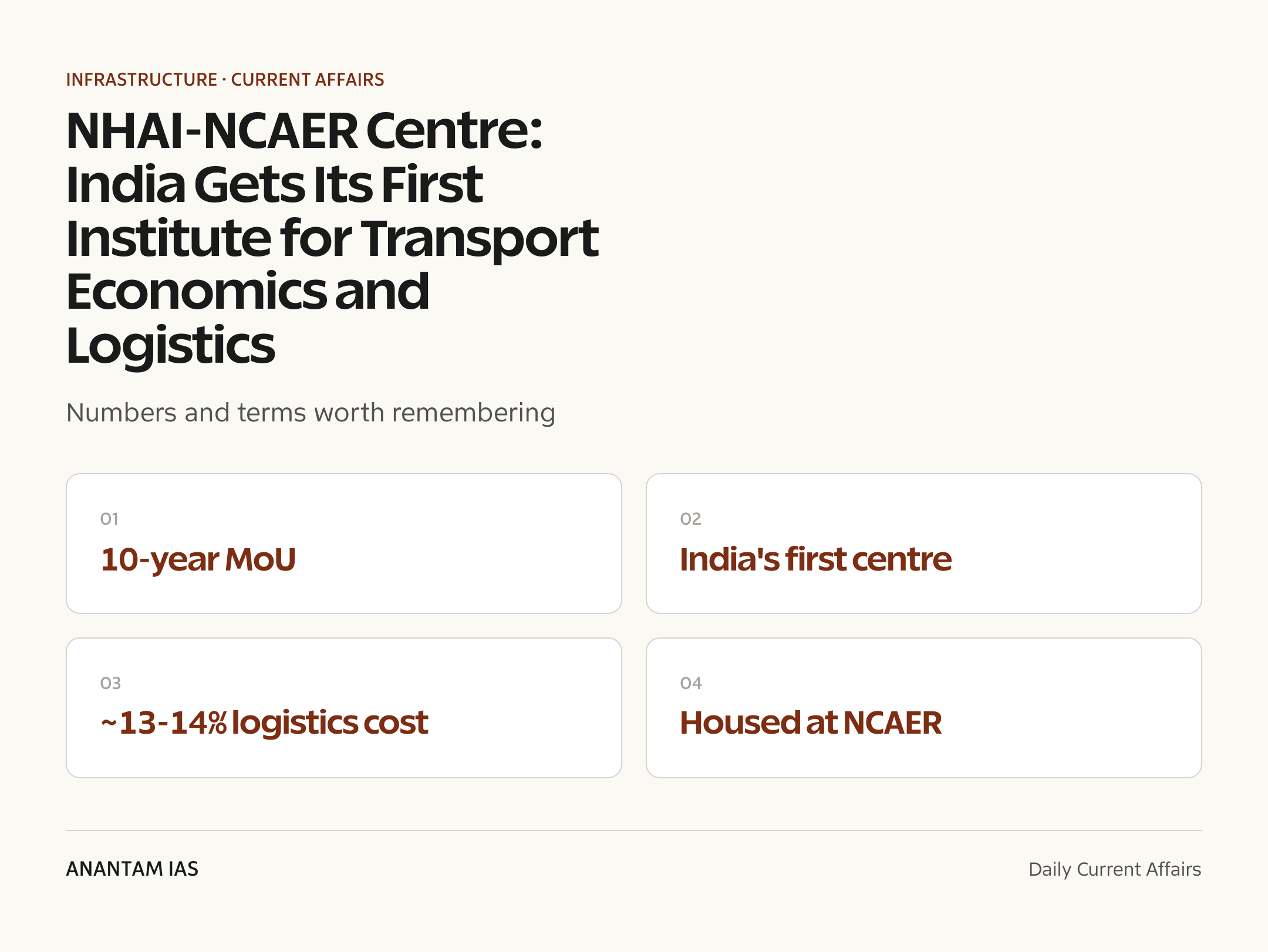
- NHAI and NCAER signed a 10-year MoU to set up the NHAI Centre for Economics of Transportation, Mobility and Logistics, housed at NCAER.
- It is described as India’s first permanent, independent research centre dedicated to transport, mobility and logistics economics.
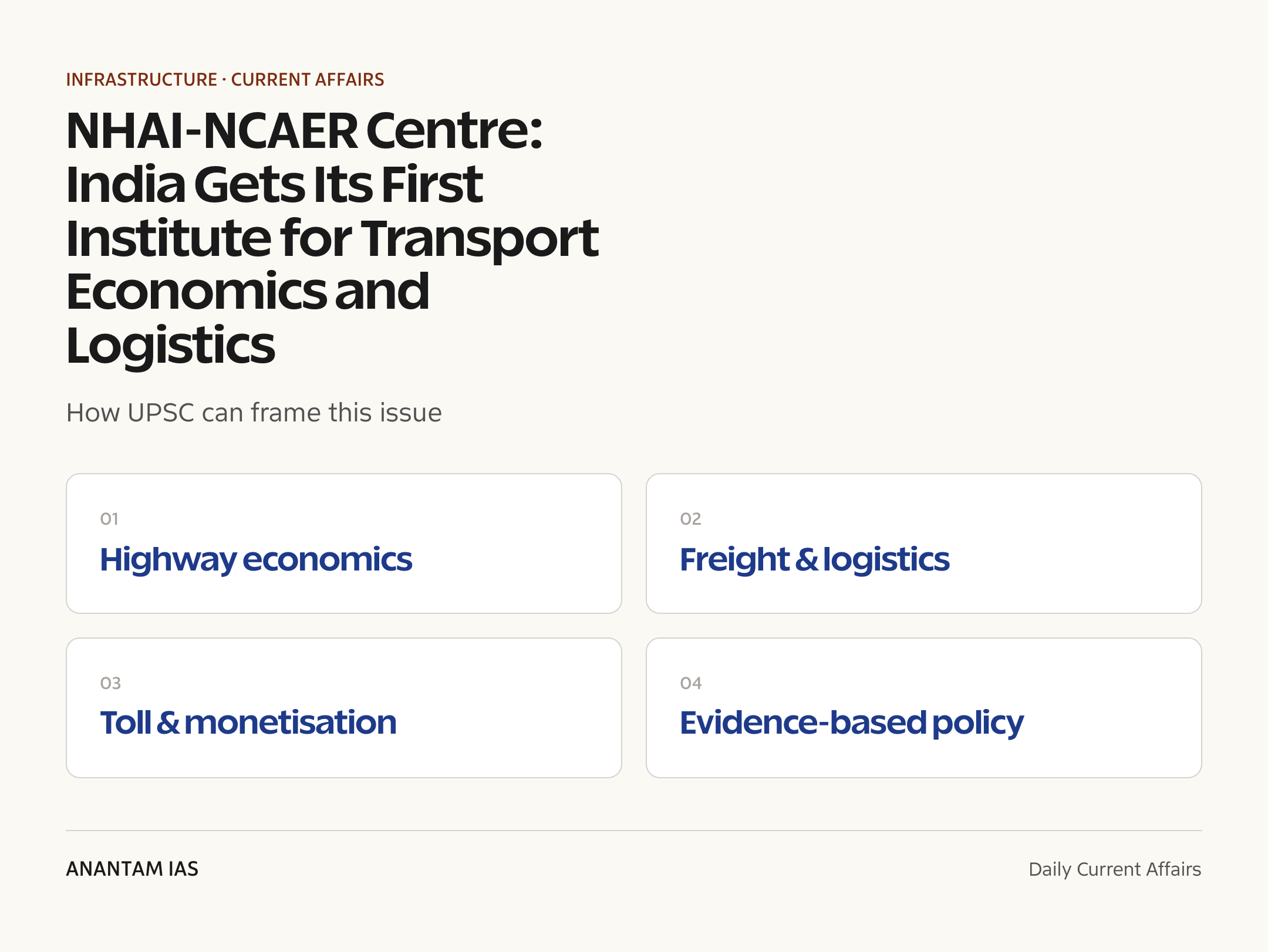
- Research themes span national-highway economics, freight logistics, modal integration, toll policy, asset monetisation and road-safety interventions.
- The centre will also act as a knowledge hub, publishing policy briefs, working papers and flagship reports and running stakeholder consultations.
- The tie-up links highway investment to evidence-based policymaking and the wider logistics-cost-reduction agenda.
The development matters in the context of:
- NHAI builds and manages most of India’s national highways and operates the country’s main tolling and highway asset-monetisation programmes.
- NCAER, founded in 1956, is one of India’s oldest independent economic think-tanks, giving the centre arm’s-length analytical credibility.
UPSC Relevance
Prelims Relevance
- NHAI is a statutory body under the Ministry of Road Transport and Highways (MoRTH), set up under the National Highways Authority of India Act, 1988.
- NCAER (National Council of Applied Economic Research), established in 1956, is an autonomous, non-profit economic research institute, not a government department.
- The National Logistics Policy 2022 aims to cut logistics costs and improve India’s ranking on the Logistics Performance Index.
- PM GatiShakti (2021) is a national master plan for multi-modal infrastructure integration through a GIS-based digital platform.
- Asset monetisation of highways is largely routed through Infrastructure Investment Trusts (InvITs) under the National Monetisation Pipeline.
- Bharatmala Pariyojana is the umbrella programme for highway corridor and economic-corridor development.
- FASTag enables electronic toll collection; India is moving towards GNSS-based (satellite) tolling for distance-based charges.
- Logistics cost in India is commonly debated at roughly 13-14% of GDP, against a stated ambition to bring it closer to single digits.
Mains Relevance
GS Paper 3
- Infrastructure-economy linkage: how dedicated transport-economics research can improve the returns on national-highway and logistics investment.
- Evaluating toll policy, asset monetisation and InvIT-based financing as tools to fund and sustain highway assets.
- The role of the National Logistics Policy and PM GatiShakti in lowering logistics costs and boosting export competitiveness.
- Institutionalising evidence-based policymaking in infrastructure through independent think-tank partnerships.
Essay
- Building physical infrastructure is the easy half; building the evidence to use it well is the harder one.
- Roads carry goods, but data carries policy: why the economics of mobility shapes a nation’s growth.
Background and Context
What the MoU sets up
The agreement creates a standing research home for the economics of how India moves goods and people.
- NHAI and NCAER signed an MoU to establish the NHAI Centre for Economics of Transportation, Mobility and Logistics, located at NCAER.
- NHAI will support the centre for ten years, giving it durable funding rather than project-by-project commissions.
- It is positioned as India’s first permanent, independent research centre in this specific field, as reported by The Statesman and The Tribune.
- Beyond research, it will publish policy briefs, working papers and flagship reports and convene workshops and stakeholder consultations.
Who the partners are
The tie-up pairs the country’s main highway builder with an arm’s-length economic think-tank.
- NHAI is a statutory authority under MoRTH, responsible for building, maintaining and tolling national highways.
- NCAER, founded in 1956, is one of India’s oldest and most respected independent economic research institutions.
- Housing the centre at NCAER is meant to keep its analysis analytically independent of day-to-day project pressures.
- The partnership is designed to convert NHAI’s operational data into peer-quality economic research.
The logistics-cost agenda it feeds
The centre slots into a larger national effort to make moving goods cheaper and faster.
- India’s logistics cost is widely debated at around 13-14% of GDP, seen as higher than in many competitor economies.
- The National Logistics Policy 2022 targets lower logistics costs and a better Logistics Performance Index ranking.
- PM GatiShakti seeks multi-modal integration so road, rail, ports and warehousing are planned together.
- Better evidence on freight logistics and modal integration can guide where highway spending yields the biggest economic gains.
Toll policy and asset monetisation
Two of the centre’s research themes touch directly on how highways are financed and priced.
- Toll policy research can inform the shift from plaza-based collection towards FASTag and GNSS-based distance tolling.
- Asset monetisation recycles capital by leasing operational highways, largely through InvITs under the National Monetisation Pipeline.
- Independent analysis can test whether toll rates and monetisation deals are fair to users and viable for investors.
- Studying the regional economic impact of highway investment helps justify and prioritise future corridors under Bharatmala.
Why it matters
The deeper significance lies in institutionalising economics inside infrastructure decisions.
- It signals a move from building roads to measuring what roads deliver for the economy.
- A permanent centre creates continuity of expertise instead of one-off consultancy studies.
- Credible, public research can improve transparency and accountability in toll and monetisation decisions.
- It strengthens the data backbone for India’s logistics-cost-reduction and competitiveness goals.
Way Forward
Publish the centre’s research openly so that policy briefs and working papers are available to states, investors and citizens, not just NHAI.
Use the centre’s findings to refine toll-pricing and asset-monetisation design, balancing user affordability with investor returns.
Connect its outputs to PM GatiShakti and the National Logistics Policy so that highway spending is sequenced for maximum economic and modal-integration gains.
Build genuine independence into the centre’s governance so its analysis can challenge, not merely endorse, NHAI’s plans.
Conclusion
The NHAI-NCAER centre marks a quiet but meaningful shift: India is starting to treat the economics of transport as a discipline worth a permanent institutional home. For a country spending heavily on highways while chasing lower logistics costs, that evidence base could decide whether the spending pays off.
Its real test will be independence and influence. If the centre’s research genuinely shapes toll policy, monetisation design and corridor choices, rather than ratifying decisions already taken, it could become one of the more useful additions to India’s infrastructure-policy machinery.
UPSC Practice Questions
Prelims MCQ 1
With reference to the National Council of Applied Economic Research (NCAER), consider the following statements: 1. It is a department directly under the Ministry of Finance. 2. It is one of India’s oldest independent, non-profit economic research institutions. 3. The proposed NHAI Centre for Economics of Transportation, Mobility and Logistics is to be housed at NCAER. Which of the statements given above are correct?
1 and 2 only 2 and 3 only 1 and 3 only 1, 2 and 3
Answer: 2 and 3 only
Explanation:
NCAER, founded in 1956, is an autonomous, non-profit economic research institute, not a government department, so statement 1 is wrong. It is among India’s oldest independent think-tanks (2) and the new NHAI centre is to be set up at NCAER (3).
Prelims MCQ 2
Consider the following pairs of programmes/initiatives and their primary focus: 1. PM GatiShakti — multi-modal infrastructure integration 2. National Logistics Policy 2022 — reducing logistics costs 3. Bharatmala Pariyojana — highway and economic-corridor development How many of the above pairs are correctly matched?
Only one Only two All three None
Answer: All three
Explanation:
PM GatiShakti is a master plan for multi-modal infrastructure integration; the National Logistics Policy 2022 targets lower logistics costs and a better Logistics Performance Index ranking; Bharatmala Pariyojana is the umbrella highway and economic-corridor programme. All three pairs are correctly matched.
UPSC Mains Questions
- “Building highways is an engineering task; getting value from them is an economic one.” In light of the NHAI-NCAER transport-economics centre, discuss how evidence-based research can improve returns on India’s infrastructure investment. (250 words)
- Examine the tools available to India for financing and sustaining its national-highway assets, including toll policy and asset monetisation through InvITs. What role can independent research play in making these tools fairer and more effective? (250 words)
- India’s logistics costs are seen as a drag on its competitiveness. Analyse how the National Logistics Policy and PM GatiShakti, supported by dedicated economic research, can help lower these costs. (150 words)
Sources: The Statesman and The Tribune.
Frequently Asked Questions
What is the NHAI-NCAER centre?
It is the NHAI Centre for Economics of Transportation, Mobility and Logistics, a research institution to be set up at NCAER under a 10-year MoU with NHAI, focused on the economics of transport, mobility and logistics.
Why is it called India’s first such centre?
Reports describe it as India’s first permanent and independent research centre dedicated exclusively to the economics of transportation, mobility and logistics, rather than to engineering or general infrastructure.
What will the centre research?
Its themes include national-highway economics, freight logistics, modal integration, the regional economic impact of highway investment, toll policy, asset monetisation, road safety and technology adoption in highway operations.
How does this connect to logistics costs?
India’s logistics cost is widely debated at around 13-14% of GDP. The centre’s research is meant to support the National Logistics Policy 2022 and PM GatiShakti in bringing those costs down.
What is NHAI’s role in tolling and asset monetisation?
NHAI builds and maintains national highways, collects tolls (increasingly via FASTag and moving towards GNSS-based tolling), and recycles capital by monetising operational highways, largely through InvITs.
Who are NHAI and NCAER?
NHAI is a statutory body under the Ministry of Road Transport and Highways that manages national highways. NCAER, founded in 1956, is one of India’s oldest independent, non-profit economic think-tanks.
Source: https://anantamias.com/current-affairs/nhai-ncaer-transport-economics-research-centre/
Project Cheetah at a New Phase: Population Past 50 and Gandhi Sagar as the Second Home
Why in News?
Project Cheetah, India’s flagship intercontinental species-reintroduction programme, has entered a new phase. The total cheetah count in the country has crossed 50 individuals — a mix of imported Namibian and South African adults plus a growing cohort of India-born cubs — and the programme has formally moved beyond its single founding site at Kuno National Park.
The decisive shift is the activation of Gandhi Sagar Wildlife Sanctuary in Madhya Pradesh as a second home for cheetahs. With the first animals shifted there in April 2025 and a contiguous Kuno-Gandhi Sagar-Mukundra corridor being planned across Madhya Pradesh and Rajasthan, the programme is now pivoting from a single-site experiment toward a managed metapopulation spread over a larger landscape.
- India’s cheetah population has crossed the 50-individual threshold, combining Namibian and South African founders with India-born cubs.
- Gandhi Sagar Wildlife Sanctuary (Mandsaur-Neemuch districts, Madhya Pradesh) is now the programme’s second home after Kuno National Park.
- The first cheetahs were translocated to Gandhi Sagar in April 2025, ending the single-site phase of the project.
- Authorities are developing a Kuno-Gandhi Sagar-Mukundra conservation landscape spanning Madhya Pradesh and Rajasthan.
- The long-term design follows the metapopulation model, in which several linked sub-populations are managed as one viable whole.
The development matters in the context of:
- Project Cheetah was launched in September 2022 as the world’s first intercontinental translocation of a large carnivore.
- The cheetah was declared extinct in India in 1952, making this a true reintroduction rather than a population top-up.
- The programme is implemented by the National Tiger Conservation Authority (NTCA) under the Ministry of Environment, Forest and Climate Change.

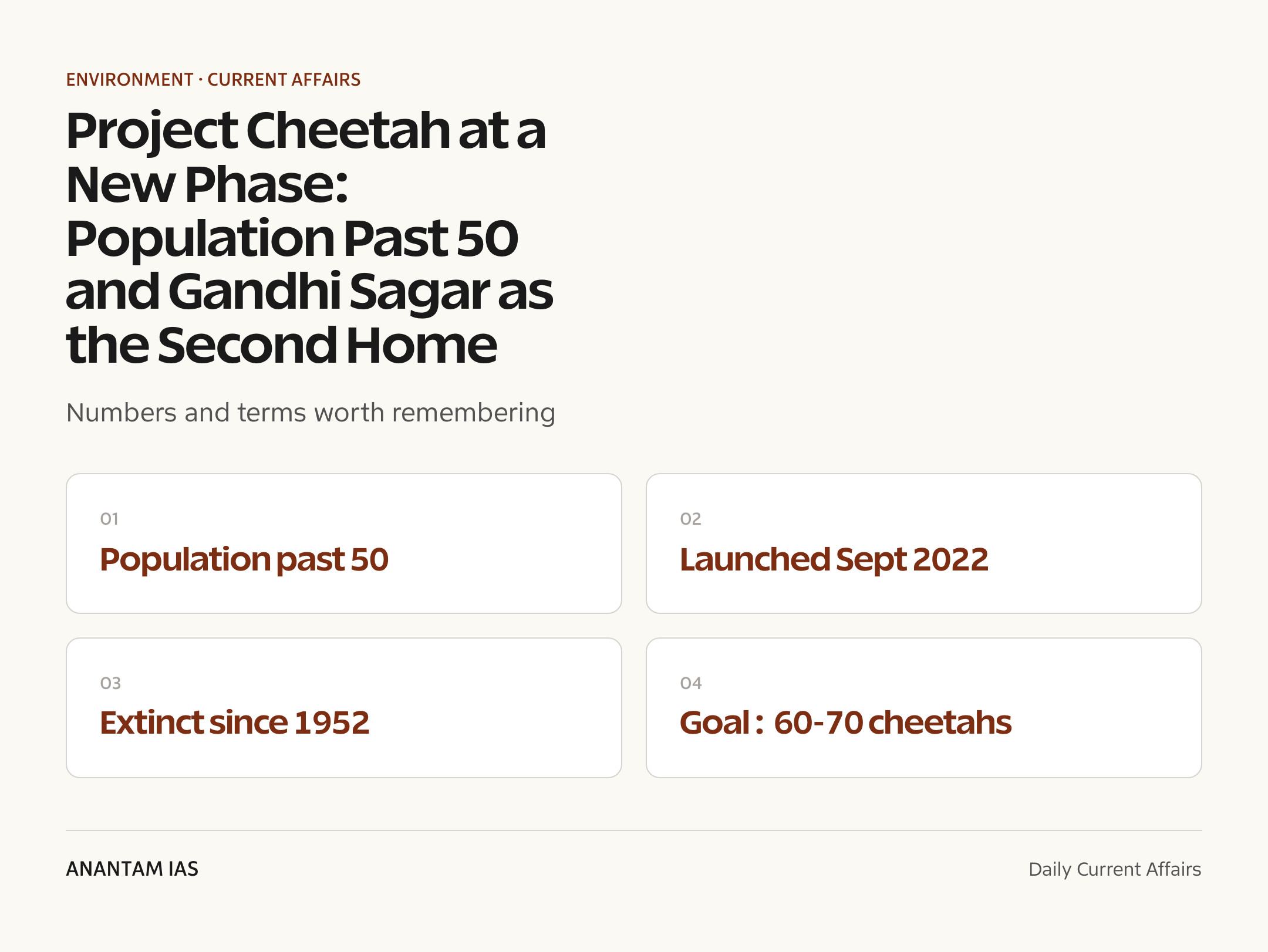
UPSC Relevance
Prelims Relevance
- Project Cheetah began in September 2022; 8 cheetahs from Namibia were released at Kuno on 17 September 2022 and 12 from South Africa on 18 February 2023.
- Kuno National Park lies in Sheopur district, Madhya Pradesh, on the Kuno river, a tributary of the Chambal.
- Gandhi Sagar Wildlife Sanctuary straddles the Mandsaur and Neemuch districts of north-western Madhya Pradesh, bordering Rajasthan, and is bisected by the Chambal river.
- The cheetah was officially declared extinct in India in 1952; the last individuals were recorded in present-day Chhattisgarh.
- Project Cheetah is implemented by the NTCA under the Ministry of Environment, Forest and Climate Change (MoEFCC).
- The Kuno-Gandhi Sagar landscape is an interstate complex of roughly 17,000 sq km across Madhya Pradesh and Rajasthan, mostly within the Chambal basin.
- Connectivity to Rajasthan’s Mukundra Hills Tiger Reserve and conservation reserves in Kota and Baran is central to the corridor plan.
- The cheetah (Acinonyx jubatus) is the world’s fastest land animal and an inhabitant of open grassland and savannah ecosystems.
- A planned cheetah metapopulation of 60-70 individuals across the Kuno-Gandhi Sagar landscape is the stated long-term goal.
- Cheetahs at Kuno that crossed into Rajasthan were described by the NTCA as displaying natural territorial dispersal rather than straying.
Mains Relevance
GS Paper 3
- Project Cheetah as a case study in species reintroduction, intercontinental translocation, and the scientific risks of restoring a locally extinct large carnivore.
- The shift from a single site to a metapopulation across linked habitats illustrates landscape-level conservation and the value of ecological corridors.
- Establishing Gandhi Sagar as a second home raises questions of prey-base preparation, habitat carrying capacity, and disease/genetic risk that the syllabus treats under conservation of biodiversity.
Essay
- Restoring a species erased from the land seven decades ago tests whether human ambition can repair what human action destroyed.
- A second home for the cheetah is a reminder that conservation succeeds not at single points but across connected landscapes.
Background and Context
The new phase: population past 50 and a second site
The headline development is twofold — a numerical milestone and a spatial one.
- The total cheetah count in India has crossed 50, drawing on imported Namibian and South African adults together with India-born cubs.
- Several cubs born on Indian soil have survived past the vulnerable early months, a marker the project treats as proof of breeding success in a reintroduced founder stock.
- The first births of Namibian cheetah cubs in India after roughly seven decades, noted by Drishti IAS, signalled that the species could reproduce in Indian conditions.
- Crucially, the programme is no longer confined to one park — the activation of a second home marks its transition from pilot to landscape-scale effort.

Gandhi Sagar Wildlife Sanctuary as the second home
Gandhi Sagar was chosen to spread risk and expand the programme’s footprint.
- The sanctuary lies in the Mandsaur and Neemuch districts of north-western Madhya Pradesh, on the boundary with Rajasthan, and is bisected by the Chambal river.
- It sits within dry deciduous forest and open grassland terrain broadly suited to cheetahs, which hunt by sight and speed across open ground.
- The first cheetahs were shifted to Gandhi Sagar in April 2025, opening the second site after extensive prey-base and enclosure preparation.
- A dedicated NTCA action plan for cheetah introduction at Gandhi Sagar (2024) framed the sanctuary as the natural next step after Kuno.
- Establishing a second population guards against a single catastrophic event — disease, drought or flood — wiping out the entire founder stock at one location.
The Kuno-Gandhi Sagar-Mukundra corridor
The two sites are meant to function as parts of one connected landscape, not as isolated islands.
- Authorities envisage a contiguous cheetah conservation landscape linking Kuno and Gandhi Sagar across Madhya Pradesh and Rajasthan.
- The landscape, largely within the Chambal basin, is estimated at around 17,000 sq km, with the majority in Madhya Pradesh and the remainder in Rajasthan.
- Connectivity runs through territorial forest divisions of Kota, Baran, Jhalawar and Chittorgarh and links to Rajasthan’s Mukundra Hills Tiger Reserve.
- The NTCA has described cheetahs crossing from Kuno into Rajasthan as showing natural territorial behaviour, underlining why a planned corridor matters.
- The stated long-term target is a metapopulation of 60-70 cheetahs across this Kuno-Gandhi Sagar landscape.
Project Cheetah: a brief recap
The current phase builds on a programme launched only a few years ago.
- Project Cheetah was launched in September 2022 and is billed as the world’s first intercontinental translocation of a large carnivore.
- On 17 September 2022, 8 cheetahs from Namibia were released at Kuno; on 18 February 2023, 12 from South Africa followed.
- The cheetah was declared extinct in India in 1952, so the effort is a reintroduction of a species absent for over seven decades.
- The programme is run by the NTCA under the MoEFCC, with the Wildlife Institute of India and African partners providing technical support.
- Anantam IAS has covered the founding site separately in its note on Kuno National Park and the new site in its note on the Gandhi Sagar Wildlife Sanctuary.
Why a metapopulation approach
The science of small-population persistence drives the design.
- IUCN reintroduction guidance favours managing a species across several linked sub-populations rather than a single isolated one.
- A metapopulation allows managers to move individuals between sites to maintain genetic diversity and replace local losses.
- Population viability analyses cited for the project suggest a higher chance of long-term persistence when numbers exceed 50 individuals or when smaller groups are managed as a connected whole.
- Spreading animals across Kuno, Gandhi Sagar and the wider landscape reduces dependence on the carrying capacity of any one park.
Challenges that persist
The new phase does not erase the programme’s known stress points.
- Prey density and habitat readiness at each new site must be built up before cheetahs can range freely and hunt unaided.
- Cheetah mortality — from infections, injuries and inter-cheetah conflict — has dogged the project and demands close veterinary monitoring.
- Long periods in fenced enclosures raise debate over whether the animals are truly free-ranging or intensively managed.
- Dispersal into human-use areas around the parks creates potential for human-wildlife conflict that the corridor plan must manage.
- Some ecologists question whether African cheetahs are an ecological match for India’s historically present Asiatic cheetah and savannah-type habitats.
Significance for India
Beyond the cheetah itself, the project carries wider weight.
- Success would make India the first country to host a self-sustaining intercontinentally reintroduced big-cat-class predator.
- Restoring an apex predator can help revive grassland and savannah ecology, habitats often neglected in a forest-focused conservation system.
- The corridor model offers a template for landscape-level conservation that prioritises connectivity over isolated protected areas.
- The programme strengthens India’s standing in global biodiversity diplomacy through cooperation with Namibia, South Africa and other range states.
Way Forward
The immediate priority is to consolidate Gandhi Sagar as a functioning second home — building prey density, monitoring the translocated animals, and steadily moving from enclosures toward free-ranging conditions. Genetic management across sites should begin early so that the emerging population avoids the inbreeding traps that shrink small founder stocks.
Over the longer run, the corridor linking Kuno, Gandhi Sagar and Mukundra needs legal and ecological protection so that natural dispersal is an asset rather than a conflict trigger. Transparent reporting of births, deaths and ranging behaviour, alongside community engagement in fringe villages, will determine whether the metapopulation goal of 60-70 cheetahs is realistic.
Conclusion
Crossing the 50-cheetah mark and opening Gandhi Sagar as a second home together mark the most substantive checkpoint for Project Cheetah since its 2022 launch. The programme has moved from a high-profile single-site experiment toward the harder, slower work of building a connected, self-sustaining population across a real landscape.
Whether that landscape becomes a durable cheetah range or remains a managed showcase will hinge on prey bases, corridor protection and honest accounting of losses. For now, the milestone confirms that reintroducing a species lost in 1952 is biologically possible — and that the next chapter is about ecology and connectivity, not just arrivals.
UPSC Practice Questions
Prelims MCQ 1
With reference to Project Cheetah, consider the following statements: 1. The first batch of cheetahs introduced under the project came from Namibia. 2. The project is implemented by the National Tiger Conservation Authority under the Ministry of Environment, Forest and Climate Change. 3. The cheetah was declared extinct in India in 1952. Which of the statements given above are correct?
1 and 2 only 2 and 3 only 1 and 3 only 1, 2 and 3
Answer: 1, 2 and 3
Explanation:
All three are correct. Eight Namibian cheetahs were released at Kuno in September 2022; the NTCA under the MoEFCC implements the project; and the cheetah was declared extinct in India in 1952.
Prelims MCQ 2
Gandhi Sagar Wildlife Sanctuary, recently designated a second home for cheetahs, is located in which state and is associated with which river?
Rajasthan; Banas river Madhya Pradesh; Chambal river Gujarat; Sabarmati river Maharashtra; Tapi river
Answer: Madhya Pradesh; Chambal river
Explanation:
Gandhi Sagar Wildlife Sanctuary lies in the Mandsaur and Neemuch districts of north-western Madhya Pradesh, bordering Rajasthan, and is bisected by the Chambal river.
UPSC Mains Questions
- Project Cheetah has entered a new phase with the opening of Gandhi Sagar as a second home and a population crossing 50. Examine the ecological rationale for a metapopulation approach to cheetah reintroduction in India. (250 words)
- Discuss the challenges of reintroducing a locally extinct large carnivore, using Project Cheetah as a case study. How can a landscape-level corridor strategy address these challenges? (250 words)
- “Restoring grassland predators is as important as protecting forests.” Critically analyse this statement in the context of Project Cheetah and India’s neglect of savannah ecosystems. (150 words)
Sources: Drishti IAS and National Tiger Conservation Authority (NTCA).
Frequently Asked Questions
Why is Gandhi Sagar Wildlife Sanctuary in the news?
It has been activated as the second home for cheetahs under Project Cheetah after Kuno National Park, with the first animals translocated there in April 2025.
Where is Gandhi Sagar Wildlife Sanctuary located?
It lies in the Mandsaur and Neemuch districts of north-western Madhya Pradesh, on the border with Rajasthan, and is bisected by the Chambal river.
How many cheetahs are there in India now?
The total count has crossed 50 individuals, combining the imported Namibian and South African founders with cubs born in India; exact figures are revised periodically by the NTCA.
What is the Kuno-Gandhi Sagar-Mukundra corridor?
It is a planned contiguous conservation landscape linking Kuno and Gandhi Sagar with Rajasthan’s Mukundra Hills Tiger Reserve, allowing cheetahs to be managed as a single connected metapopulation.
When was Project Cheetah launched and by whom?
It was launched in September 2022 and is implemented by the National Tiger Conservation Authority under the Ministry of Environment, Forest and Climate Change.
Why is a metapopulation approach used for cheetahs?
Managing several linked sub-populations across sites helps maintain genetic diversity, replace local losses, and improve the long-term survival odds of a small reintroduced population.
Source: https://anantamias.com/current-affairs/project-cheetah-kuno-gandhi-sagar-second-home/
ePlane’s e200X: India’s First Full-Scale eVTOL Air Taxi Moves to Testing
Why in News?
The Chennai-based ePlane Company, a deep-tech startup incubated at IIT Madras, has completed full-scale assembly of its prototype e200X (PT-01) — a compact electric vertical take-off and landing (eVTOL) aircraft — as reported by Business Today and Urban Air Mobility News.
The milestone moves the aircraft from design and simulation into physical testing: ground trials of the structure and onboard systems will be followed by flight tests, before the company seeks Type Certification from the DGCA. The e200X is built for three roles from one airframe — air taxi, urban cargo and air ambulance — making it a concrete peg for urban air mobility and India’s deep-tech ecosystem.
- ePlane has completed assembly of the full-scale PT-01 prototype, marking the shift from simulation to a physical, testable aircraft, per the company’s announcement.
- Next steps are ground testing — subjecting the airframe and systems to aerodynamic and mechanical loads — followed by flight testing, building on subscale prototypes already flown.
- The company plans to seek Type Certification from the DGCA and later pursue international validations for export markets, as reported.
- Founder Prof. Satya Chakravarthy framed the design’s appeal as one airframe serving three markets: “move people as an air taxi, carry goods as a cargo aircraft, and save lives as an air ambulance.”
- Major systems — propellers, airframe, landing gear and battery pack — were developed in-house rather than imported, underscoring a vertically integrated, indigenous build.
- The project has reportedly raised about USD 21 million to date, modest compared with several international eVTOL programmes — a notable point for India’s frugal deep-tech story.
- Importantly, the e200X is in pre-certification testing, not commercial flight; certified air-taxi operations would follow only after the test and approval milestones are met.
The development matters in the context of:
- eVTOL aircraft sit at the centre of Urban Air Mobility (UAM) and the broader Advanced Air Mobility (AAM) vision of short, electric, low-emission air hops over congested cities.
- India is positioned as one of the first jurisdictions to take an eVTOL into a formal certification process, putting the DGCA in the role of a frontier aviation regulator.
- Globally, firms such as Joby Aviation and Archer Aviation in the United States are racing toward certified air-taxi services, giving the e200X a clear international frame of reference.
UPSC Relevance
Prelims Relevance
- eVTOL stands for electric Vertical Take-Off and Landing — an aircraft that lifts off and lands vertically (like a helicopter) using electric motors and multiple rotors, then cruises like a fixed-wing plane.
- Urban Air Mobility (UAM) is the concept of safe, low-altitude air transport of people and cargo within and around cities; Advanced Air Mobility (AAM) is the wider umbrella including regional and cargo operations.
- The Directorate General of Civil Aviation (DGCA) is India’s civil aviation regulator under the Ministry of Civil Aviation; Type Certification is the approval that a new aircraft design meets airworthiness and safety standards before it can be produced and operated.
- The ePlane Company is a startup incubated at IIT Madras, founded by Prof. Satya Chakravarthy; its prototype is the e200X (PT-01).
- The e200X is designed as a multi-role platform for passenger air taxi, urban cargo and air ambulance use from a single airframe.
- Vertiports are the dedicated take-off, landing and charging pads that eVTOL air-taxi networks need — the equivalent of small electric heliports.
- eVTOLs rely on distributed electric propulsion (many small motors) and high-density batteries, linking the topic to advances in battery technology and electric mobility.
- Indigenous deep-tech builds like the e200X connect to Make in India and Atmanirbhar Bharat in high-technology manufacturing.
- Internationally, Joby Aviation and Archer Aviation are leading eVTOL developers, useful as comparison points.
Mains Relevance
GS Paper 3
- Science & technology indigenisation: how an IIT-incubated startup building an eVTOL largely in-house illustrates India’s growing deep-tech and design capability.
- Emerging technology and the economy: the potential of urban air mobility to ease congestion, speed emergency medical transport and create a new aerospace value chain.
- Technology regulation and infrastructure: the role of the DGCA in certifying a frontier aircraft class, and the vertiport, airspace-management and safety ecosystem such mobility needs.
- Innovation ecosystem: the contribution of academic incubation (IIT Madras), venture funding and frugal engineering to India’s startup and Atmanirbhar Bharat goals.
Essay
- Frugal innovation as a national strategy: doing more, and flying higher, with less
- From road to sky: how emerging mobility technologies reshape the way cities move
Background and Context
The e200X Milestone: What Happened
ePlane’s completion of the full-scale PT-01 marks the point where a long-running design effort becomes a real, testable aircraft.
- The e200X (PT-01) is a compact eVTOL whose full-scale assembly is now complete, moving the programme from simulation into the physical testing phase, as reported by Business Today and Urban Air Mobility News.
- The company built major subsystems — propellers, airframe, landing gear and battery pack — in-house, an unusually vertically integrated approach for a startup.
- Immediate next steps are ground testing of the structure and onboard systems under aerodynamic and mechanical loads, then flight testing that builds on smaller subscale prototypes already flown.
- The aircraft is designed for three missions from one airframe — passenger air taxi, urban cargo and air ambulance — which the founder presents as the core commercial logic.
- The programme has reportedly attracted around USD 21 million in funding, a frugal figure beside many international eVTOL projects.
What eVTOL and Urban Air Mobility Mean
The e200X belongs to a new class of aircraft built to make short electric air journeys over cities practical.
- eVTOL — electric Vertical Take-Off and Landing — describes aircraft that take off and land vertically using electric motors and multiple rotors, removing the need for runways.
- Most designs use distributed electric propulsion, spreading thrust across many small motors for redundancy and quieter, lower-emission flight than helicopters.
- Urban Air Mobility (UAM) is the vision of using such aircraft for short city hops — airport-to-downtown transfers, intra-city taxis and rapid medical evacuation.
- Advanced Air Mobility (AAM) is the broader umbrella, extending the idea to regional routes and autonomous cargo delivery.
- The promise is faster point-to-point travel above congested roads; the constraint is that battery energy density currently limits range and payload, keeping early use cases short-haul.
The Certification Path and the DGCA's Role
Before any air taxi carries passengers, its design must clear a demanding airworthiness review.
- Type Certification is the regulator’s sign-off that a new aircraft design meets safety and airworthiness standards — a prerequisite for series production and commercial operation.
- ePlane intends to seek Type Certification from the DGCA, India’s civil aviation regulator under the Ministry of Civil Aviation, before pursuing approvals in export markets.
- Certifying a wholly new aircraft class is itself a frontier task: regulators must frame airworthiness criteria, pilot and operations rules, and noise and safety norms for vehicles unlike conventional planes or helicopters.
- Because the e200X is in pre-certification testing, the realistic timeline to passenger service runs through extensive ground and flight trials, not a near-term launch.
- A credible domestic certification pathway would give Indian eVTOL builders a head start and shape standards for the wider region.
India's Deep-Tech Startup Ecosystem
The e200X is as much a story about how India is building hard-technology firms as about the aircraft itself.
- The ePlane Company was incubated at IIT Madras, illustrating how elite academic institutions are seeding capital-intensive, research-heavy ventures.
- Building propulsion, airframe and battery systems in-house deepens domestic aerospace and electric-propulsion know-how rather than relying on imports.
- Doing this on a comparatively small funding base reflects a frugal-engineering tradition that has marked several Indian deep-tech and space efforts.
- Such ventures align with Make in India and Atmanirbhar Bharat ambitions to move up the value chain in high-technology manufacturing.
- A successful eVTOL programme can anchor a new supplier base — in motors, batteries, avionics and composites — widening the country’s advanced-manufacturing footprint.
Challenges: Batteries, Vertiports and Regulation
The gap between a flying prototype and a working air-taxi network is filled with hard engineering and policy problems.
- Battery technology is the central constraint: energy density caps range and payload, while charging speed and battery life shape how often an aircraft can fly profitably.
- Vertiports — landing pads with charging and passenger handling — must be planned, funded and integrated into crowded urban land, a major infrastructure and real-estate challenge.
- Airspace management for many low-altitude electric aircraft over cities demands new traffic-control and detect-and-avoid systems.
- Public safety and acceptance hinge on a strong certification record, low noise, and confidence that vehicles are as safe as established aviation.
- Affordability and demand remain open: early air taxis are likely premium services, and scaling to mass mobility will need cost reductions over time.
Global Context and Significance
Placing the e200X against international efforts clarifies both how far it has come and how much remains.
- US developers Joby Aviation and Archer Aviation are among the most advanced eVTOL firms, working through certification toward commercial air-taxi services — the benchmark the e200X is measured against.
- An Indian entrant building largely in-house signals that the country can participate in, not just import from, this emerging aerospace segment.
- If the e200X clears testing and certification, it could support emergency medical transport, congestion relief and last-mile cargo in India’s dense cities.
- For now the realistic message is one of capability demonstrated, commercialisation pending — a promising prototype in testing rather than a flying taxi service.
Way Forward
Build the Rules and the Pads Alongside the Aircraft
- The DGCA can develop clear, internationally aligned certification, operations and noise standards for eVTOLs so that approval keeps pace with engineering progress.
- Cities and aviation authorities should begin planning vertiport locations and low-altitude airspace corridors early, since infrastructure lead times are long.
Strengthen the Deep-Tech Pipeline
- Sustained funding, indigenous battery and motor research, and academia-industry incubation can help startups like ePlane move from prototype to certified product.
- Pilot programmes — for instance air-ambulance use in a defined corridor — can prove safety and value before any wider passenger rollout.
Conclusion
The completed assembly of the e200X is a genuine milestone for Indian aerospace: a full-scale, largely indigenous eVTOL built by an IIT Madras-incubated startup on a frugal budget, now entering the ground and flight tests that decide its future. It puts urban air mobility, electric propulsion and the DGCA’s role as a frontier regulator onto the live current-affairs map.
For the aspirant, the durable lessons are the definitions — eVTOL, UAM and Type Certification — and the systemic picture: technology, regulation, vertiport infrastructure and battery progress must advance together. The honest framing is that India has demonstrated capability with a prototype in testing, while commercial air-taxi flight still lies on the far side of certification.
UPSC Practice Questions
Prelims MCQ 1
With reference to eVTOL aircraft and urban air mobility, consider the following statements: 1. An eVTOL aircraft takes off and lands vertically using electric propulsion and does not require a conventional runway. 2. In India, the Directorate General of Civil Aviation (DGCA) is the authority that grants Type Certification to a new aircraft design. 3. Vertiports are the dedicated take-off, landing and charging facilities required for eVTOL air-taxi operations. Which of the statements given above are correct?
1 and 2 only 2 and 3 only 1 and 3 only 1, 2 and 3
Answer: 1, 2 and 3
Explanation:
eVTOL (electric Vertical Take-Off and Landing) aircraft lift off and land vertically using electric motors and rotors, so they need no runway. The DGCA, India’s civil aviation regulator, grants Type Certification certifying that an aircraft design meets airworthiness standards. Vertiports are the landing, charging and passenger-handling pads an eVTOL network depends on. All three statements are correct.
Prelims MCQ 2
Consider the following statements about the e200X recently in the news: 1. It is an eVTOL prototype developed by a startup incubated at IIT Madras. 2. It is designed as a multi-role platform usable as an air taxi, a cargo carrier and an air ambulance. 3. It has already received Type Certification and begun commercial passenger operations. Which of the statements given above are correct?
1 and 2 only 2 and 3 only 1 and 3 only 1, 2 and 3
Answer: 1 and 2 only
Explanation:
The e200X (PT-01) is an eVTOL prototype from The ePlane Company, incubated at IIT Madras, and is designed for passenger, cargo and air-ambulance use from one airframe. Statement 3 is incorrect: the aircraft is in pre-certification ground and flight testing and has not received Type Certification or begun commercial passenger operations.
UPSC Mains Questions
- Electric vertical take-off and landing (eVTOL) aircraft are emerging as a frontier of urban air mobility. Discuss their potential applications and the technological, regulatory and infrastructure challenges to their adoption in India. (250 words)
- Academic incubation and frugal engineering have become hallmarks of India’s deep-tech startups. Examine this with reference to a recent indigenous high-technology venture. (150 words)
- “Regulation must keep pace with innovation without compromising safety.” Analyse this proposition in the context of certifying a new class of aircraft such as eVTOLs. (150 words)
Sources: Business Today and Urban Air Mobility News.
Frequently Asked Questions
What is the e200X and why is it in the news?
The e200X (PT-01) is a compact eVTOL prototype built by The ePlane Company, a startup incubated at IIT Madras. It is in the news because the company has completed its full-scale assembly, moving the aircraft from design into ground and flight testing ahead of seeking DGCA Type Certification.
What does eVTOL mean?
eVTOL stands for electric Vertical Take-Off and Landing. These aircraft use electric motors and multiple rotors to lift off and land vertically like a helicopter — needing no runway — and then cruise more like a plane, with lower noise and emissions than conventional helicopters.
Is the e200X already flying as an air taxi?
No. The aircraft is in pre-certification testing. It must pass ground tests of its structure and systems, then flight tests, and obtain Type Certification from the DGCA before any commercial passenger or cargo operations can begin.
What is Type Certification and who grants it in India?
Type Certification is the regulator’s approval that a new aircraft design meets airworthiness and safety standards, a step required before it can be produced and operated. In India it is granted by the Directorate General of Civil Aviation (DGCA), under the Ministry of Civil Aviation.
What are the main challenges to urban air mobility?
Key challenges are the limits of current battery technology (range, payload and charging), building vertiport infrastructure in crowded cities, managing low-altitude airspace safely, securing certification and public trust, and bringing costs down enough for wider use.
How does the e200X compare with global eVTOL players?
International firms such as Joby Aviation and Archer Aviation in the US are further along toward certified air-taxi services. The e200X stands out for being built largely in-house on a comparatively modest budget, showing that India can participate in this emerging aerospace segment.
Source: https://anantamias.com/current-affairs/eplane-e200x-evtol-urban-air-mobility-india/