Why in News?
India is hosting the 11th BRICS Energy Ministers’ Meeting in Gurugram, Haryana, on 25-26 June 2026, under its BRICS Chairship 2026. According to the Ministry of Power (PIB) and DD News, the meeting brings together energy ministers and senior officials from all BRICS members to deepen cooperation on energy security, sustainability and innovation.
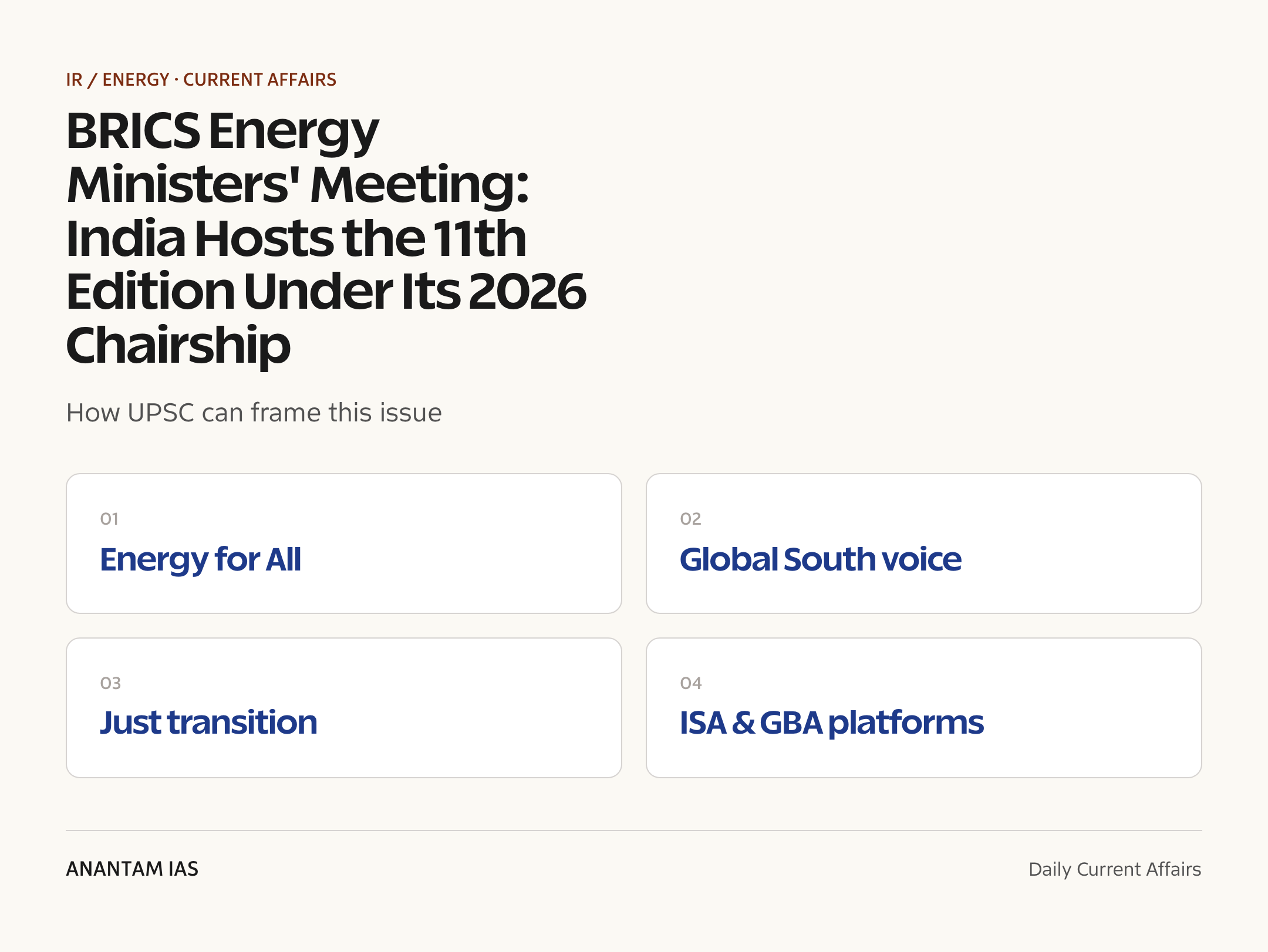
The Energy Track runs under the Sanskrit theme ‘सर्वेषां ऊर्जम्’ (Energy for All), nested within India’s overarching Chairship theme — ‘Building for Resilience, Innovation, Cooperation and Sustainability (BRICS)’. It is India’s fourth BRICS Chairship, after 2012, 2016 and 2021, and lets New Delhi showcase its clean-energy record and platforms such as the International Solar Alliance and the Global Biofuels Alliance.
- 11th edition of the BRICS Energy Ministers’ Meeting, hosted by India at Gurugram (25-26 June 2026).
- Held under India’s BRICS Chairship 2026 — its fourth after 2012, 2016 and 2021.
- Energy Track theme: ‘Energy for All’ (‘सर्वेषां ऊर्जम्’); umbrella theme stresses resilience, innovation, cooperation, sustainability.
- Agenda built on three priorities — energy security and sustainability, energy access and equity, and technology and innovation.
- Platform to project the International Solar Alliance and the Global Biofuels Alliance and advance the Global South.
The development matters in the context of:
- Preceded by three virtual meetings of Senior Energy Officials and two seminars — on AI in the energy sector and Carbon Capture, Utilization and Storage (CCUS).
- The Fourth Meeting of the BRICS Committee of Senior Energy Officials ran on 22-24 June 2026 in Gurugram, just ahead of the ministerial.
- A BRICS Youth Energy Summit (virtual) is scheduled for 17-18 August 2026.
UPSC Relevance
Prelims Relevance
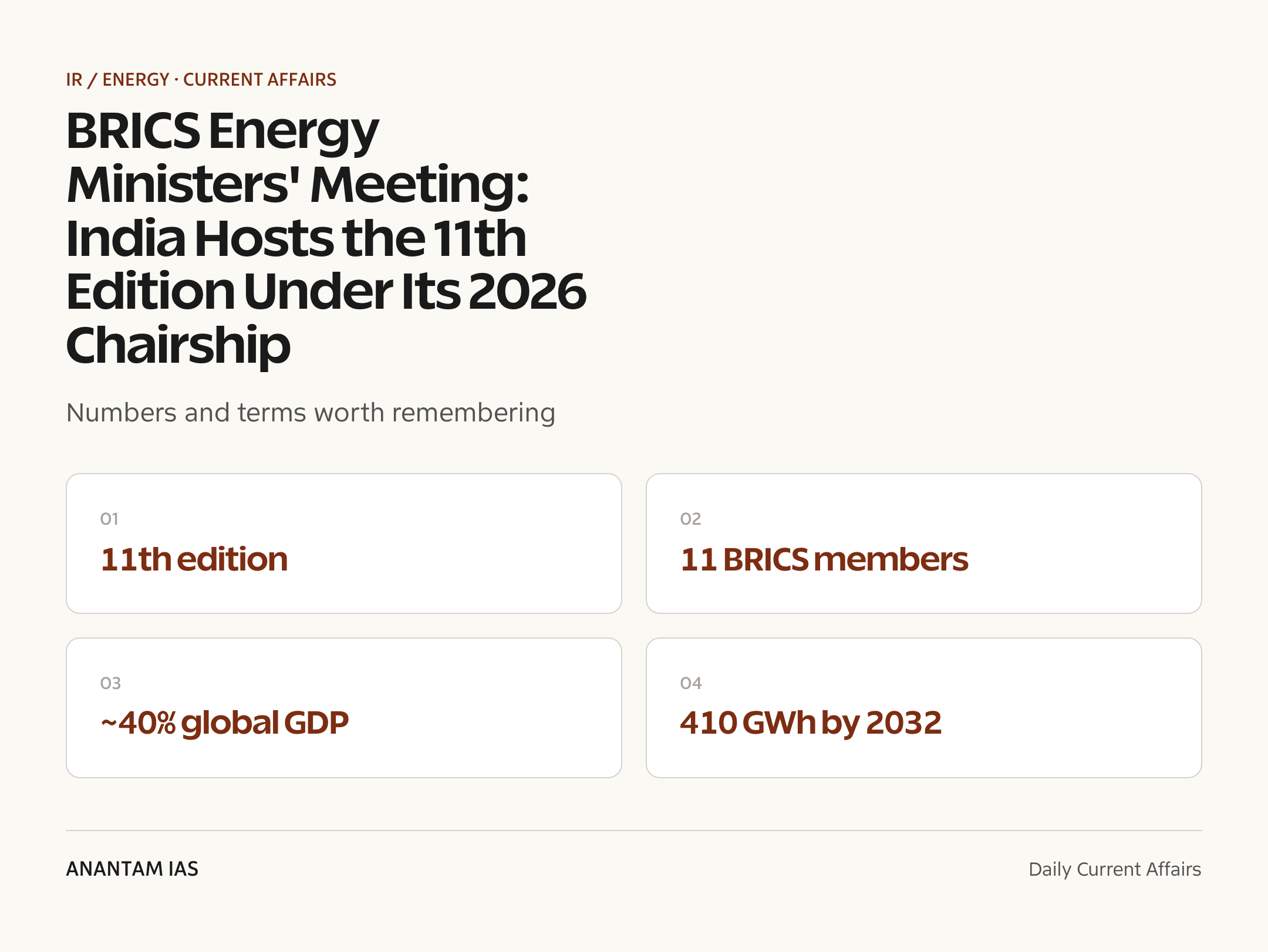
- BRICS now has 11 members: Brazil, Russia, India, China, South Africa plus Egypt, Ethiopia, Iran, the UAE and Indonesia (added in the 2024-25 expansion) — together about half the world’s population and roughly 40% of global GDP.
- The bloc began as BRIC (first summit 2009), became BRICS when South Africa joined in 2010, and expanded sharply from 2024.
- India’s 2026 Chairship theme abbreviation spells BRICS — Building for Resilience, Innovation, Cooperation and Sustainability.
- The International Solar Alliance (ISA) was launched by India and France at the 2015 Paris climate conference; it is headquartered at Gurugram.
- The Global Biofuels Alliance (GBA) was launched on the sidelines of the G20 Summit in New Delhi in 2023.
- One Sun One World One Grid (OSOWOG) is India’s initiative for inter-regional green-grid interconnection.
- India targets 410 GWh of energy storage capacity by 2032 and has deployed over 60 million smart meters.
- India has reached 20% ethanol blending in petrol and introduced E85 fuel (80-85% ethanol).
- The Revamped Distribution Sector Scheme (RDSS) and Green Energy Corridors are flagship power-sector reforms.
- India is the world’s third-largest producer and consumer of electricity.
Mains Relevance
GS Paper 2
- BRICS as a vehicle of plurilateral and Global South diplomacy — how the 2024-25 expansion reshapes the bloc’s weight and India’s role as a balancer.
- India’s fourth Chairship as an exercise in agenda-setting on energy access, equity and resilient supply chains.
- Use of ISA and GBA as instruments of India’s energy-transition diplomacy and soft power among developing economies.
GS Paper 3
- The trilemma of energy security, affordability and sustainability amid rising demand and climate pressure.
- India’s clean-energy record — 50x solar growth, smart metering, storage targets, ethanol blending — as a model of a just transition.
- Roles of grid resilience, OSOWOG, Green Energy Corridors and CCUS in integrating renewables at scale.
Essay
- A just energy transition: balancing growth, equity and the climate for the Global South.
- Multilateralism reimagined: can plurilateral blocs like an expanded BRICS deliver shared public goods?
Background and Context
BRICS and its 2024-25 expansion
The bloc has grown from an emerging-market acronym into an eleven-nation grouping with substantial demographic and economic heft.
- Originated as BRIC (Brazil, Russia, India, China) with its first summit in 2009; South Africa joined in 2010 to make BRICS.
- From January 2024 the bloc admitted new members; per PIB and DD News it now comprises 11 countries — adding Egypt, Ethiopia, Iran, the UAE and Indonesia.
- The expanded bloc accounts for nearly half of the world’s population and around 40% of global GDP.
- Its enlargement deepens BRICS’ claim to speak for the Global South on energy, finance and development.
India's BRICS Chairship 2026
India holds the rotating Chairship for the fourth time and has framed it around resilience and inclusion.
- This is India’s fourth Chairship, after 2012, 2016 and 2021.
- Overarching theme: ‘Building for Resilience, Innovation, Cooperation and Sustainability (BRICS)’ — the acronym itself spells the bloc’s name.
- The Energy Track carries the theme ‘सर्वेषां ऊर्जम्’ (Energy for All), signalling universal energy access as a shared goal.
- As Chair, India says it will advance Global South priorities, resilient supply chains and practical energy cooperation.
The ministerial agenda and run-up meetings
The Gurugram meeting is the apex of a structured Energy Track built through prior official-level consultations.
- India structured the BRICS Energy Agenda around three priorities: energy security and sustainability, energy access and equity, and technology and innovation.
- Three virtual meetings of Senior Energy Officials were held to build consensus and draft recommendations for ministers.
- Two technical seminars preceded the meeting — on the role of Artificial Intelligence in energy and on Carbon Capture, Utilization and Storage (CCUS).
- The Fourth Meeting of the BRICS Committee of Senior Energy Officials ran on 22-24 June 2026 in Gurugram, followed by a virtual Youth Energy Summit on 17-18 August 2026.
ISA and GBA: India's clean-energy platforms
Two India-driven coalitions anchor its pitch as a convenor of global clean-energy cooperation.
- The International Solar Alliance (ISA) — launched by India and France at the 2015 Paris climate conference and headquartered in Gurugram — promotes solar deployment across sun-rich countries.
- The Global Biofuels Alliance (GBA) was launched on the sidelines of the 2023 G20 Summit in New Delhi to scale sustainable biofuels and trade.
- PIB and DD News position both as evidence of India’s role as a leading advocate of clean-energy cooperation.
- Both feed naturally into a BRICS energy agenda focused on access, equity and a diversified energy mix.
India's energy transformation showcased
The Ministry of Power frames the meeting as a window to display a decade of power-sector gains toward Viksit Bharat 2047.
- Solar power capacity expanded more than 50 times over the past decade; over 60 million smart meters deployed.
- India targets 410 GWh of energy storage capacity by 2032 to firm up renewables.
- Reforms include Green Energy Corridors, the Revamped Distribution Sector Scheme (RDSS), expanded transmission and regional grid links via OSOWOG.
- In biofuels, India has reached 20% ethanol blending and rolled out E85 fuel (80-85% ethanol), framed around its Viksit Bharat 2047 vision.
Energy-transition diplomacy and the just transition
The meeting sits at the intersection of geopolitics, climate and development for emerging economies.
- BRICS members face a common trilemma — securing supply, keeping energy affordable, and decarbonising amid rising demand.
- A just transition stresses equitable access and shielding developing economies from disruptive shifts.
- India uses platforms like ISA, GBA and OSOWOG to convert climate commitments into diplomatic leverage with the Global South.
- Stronger BRICS cooperation on resilient supply chains and clean technology matters in an uncertain global energy environment.
Way Forward
Translate priorities into deliverables
- Convert the three-pillar agenda into concrete technology-sharing and finance commitments rather than declaratory text.
- Use BRICS to build resilient clean-energy supply chains for solar, storage and critical minerals.
- Link ISA, GBA and OSOWOG work streams so they reinforce one another across member states.
Centre equity and the Global South
- Keep energy access and affordability central so the transition does not deepen development gaps.
- Channel BRICS cooperation toward financing clean energy in lower-income members and partners.
- Sustain youth and technical tracks (Youth Energy Summit, AI and CCUS seminars) to institutionalise cooperation.
Conclusion
The 11th BRICS Energy Ministers’ Meeting in Gurugram lets India pair a credible domestic clean-energy record with an expanded bloc that now speaks for nearly half of humanity. By framing the Energy Track as ‘Energy for All’, New Delhi seeks to make access and equity, not just decarbonisation, the organising idea of the agenda.
Whether the meeting produces durable cooperation will depend on moving from shared themes to shared deliverables — financing, technology transfer and resilient supply chains. For India, it is a test of energy-transition diplomacy and of its ability to convene the Global South around a secure, affordable and sustainable energy future.
UPSC Practice Questions
Prelims MCQ 1
With reference to BRICS as it stands in 2026, consider the following statements:
- Egypt, Ethiopia, Iran and the United Arab Emirates are among the countries added to the bloc in its recent expansion.
- The bloc today accounts for around 40% of global GDP.
- South Africa was a founding member of the original BRIC grouping at its first summit.
How many of the above statements are correct?
Only one Only two All three None
Answer: Only two
Explanation:
Statements 1 and 2 are correct: the 2024-25 expansion added Egypt, Ethiopia, Iran, the UAE and Indonesia, and BRICS now accounts for around 40% of global GDP (and nearly half the world’s population). Statement 3 is wrong — the original grouping was BRIC (Brazil, Russia, India, China); South Africa joined only in 2010 to make it BRICS.
Prelims MCQ 2
The Global Biofuels Alliance (GBA), often discussed alongside India’s energy diplomacy, was launched on the sidelines of which event?
The 2023 G20 Summit in New Delhi The 2015 Paris Climate Conference (COP21) The 2021 Glasgow Climate Conference (COP26) The 11th BRICS Energy Ministers’ Meeting in Gurugram
Answer: The 2023 G20 Summit in New Delhi
Explanation:
The Global Biofuels Alliance was launched on the sidelines of the G20 Summit in New Delhi in 2023. The International Solar Alliance, by contrast, was launched at the 2015 Paris climate conference (COP21) and is headquartered in Gurugram.
UPSC Mains Questions
- India’s 2026 BRICS Chairship places ‘Energy for All’ at the heart of its Energy Track. Examine how an expanded BRICS can advance energy security and equity for the Global South. (250 words)
- Discuss how India is using platforms such as the International Solar Alliance and the Global Biofuels Alliance as instruments of energy-transition diplomacy. (150 words)
- A just energy transition must reconcile security, affordability and sustainability. Evaluate India’s domestic record against this trilemma. (250 words)
Sources: PIB, Ministry of Power and DD News.
Frequently Asked Questions
What is the BRICS Energy Ministers’ Meeting being held in Gurugram?
It is the 11th BRICS Energy Ministers’ Meeting, hosted by India on 25-26 June 2026 in Gurugram, Haryana, under its BRICS Chairship 2026. As per PIB and DD News, energy ministers and senior officials from all member countries gather to strengthen cooperation on energy security, sustainability and innovation.
Why is the meeting significant for India?
It marks India’s fourth BRICS Chairship after 2012, 2016 and 2021. It lets India set the energy agenda for a bloc of 11 nations, showcase its clean-energy record, and promote platforms like the International Solar Alliance and the Global Biofuels Alliance while championing Global South priorities.
What is the theme of the 2026 Chairship and Energy Track?
India’s overarching theme is ‘Building for Resilience, Innovation, Cooperation and Sustainability (BRICS)’, whose initials spell the bloc’s name. The Energy Track carries the Sanskrit theme ‘सर्वेषां ऊर्जम्’ (Energy for All), underlining universal energy access as a shared BRICS goal.
Which countries are now part of BRICS?
BRICS now comprises 11 countries: Brazil, Russia, India, China and South Africa, plus Egypt, Ethiopia, Iran, the United Arab Emirates and Indonesia added in the 2024-25 expansion. Together they account for nearly half the world’s population and around 40% of global GDP.
What are the three priorities of India’s BRICS Energy Agenda?
India structured the agenda around three priorities: energy security and sustainability; energy access and equity; and technology and innovation. Run-up events included three Senior Energy Officials meetings and seminars on Artificial Intelligence in energy and on Carbon Capture, Utilization and Storage.
How are the ISA and GBA linked to this meeting?
The International Solar Alliance (launched 2015, headquartered in Gurugram) and the Global Biofuels Alliance (launched at the 2023 G20 Summit) are India-driven clean-energy coalitions. They underpin India’s pitch as a convenor of global clean-energy cooperation and feed into the BRICS focus on access, equity and a diversified energy mix.
Tell Google you want more of this.
Add Anantam IAS as a preferred sourceOne tap, and this site shows up more often in your own Top Stories, AI Overviews and AI Mode. Remove it any time.