Why in News?
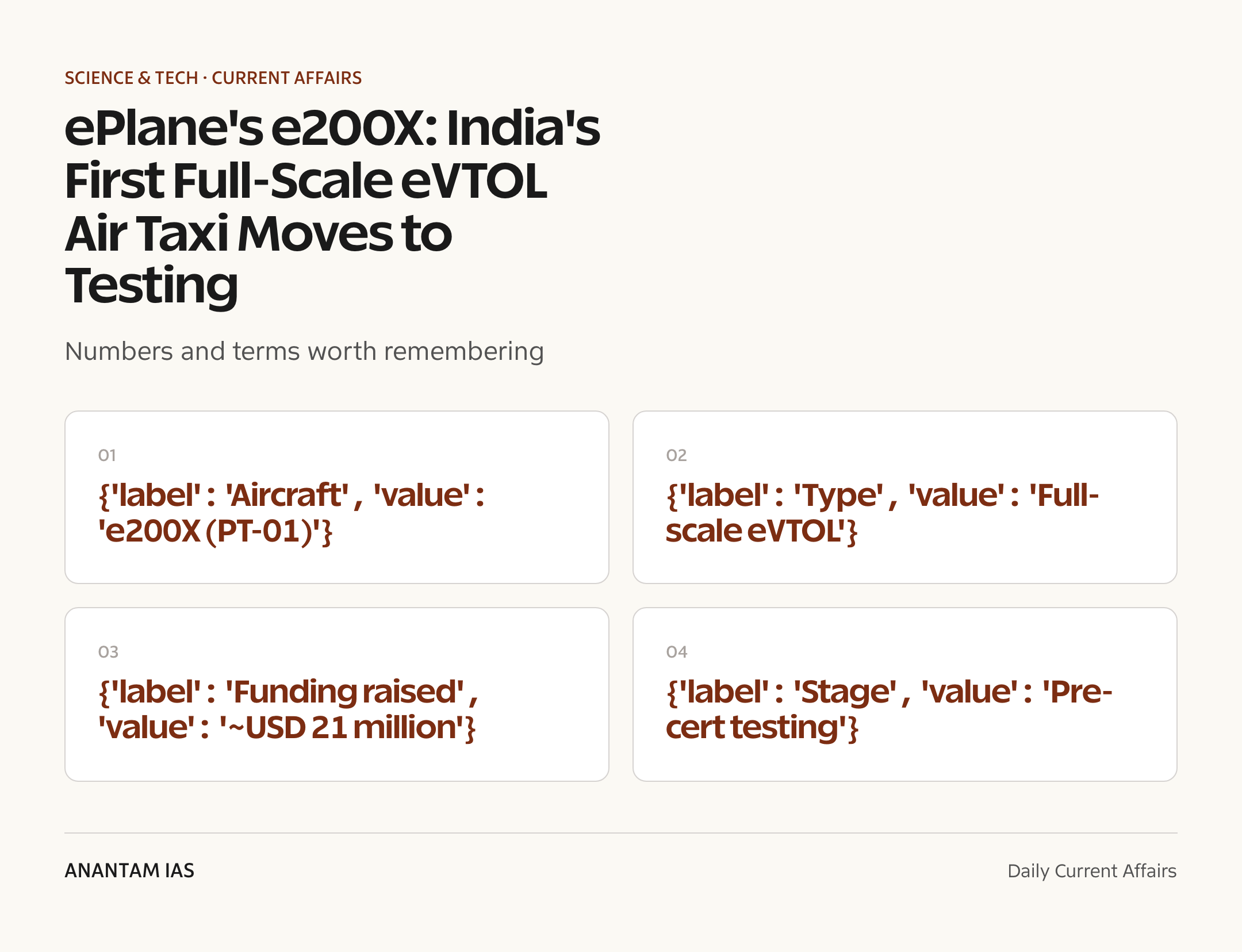
The Chennai-based ePlane Company, a deep-tech startup incubated at IIT Madras, has completed full-scale assembly of its prototype e200X (PT-01) — a compact electric vertical take-off and landing (eVTOL) aircraft — as reported by Business Today and Urban Air Mobility News.
The milestone moves the aircraft from design and simulation into physical testing: ground trials of the structure and onboard systems will be followed by flight tests, before the company seeks Type Certification from the DGCA. The e200X is built for three roles from one airframe — air taxi, urban cargo and air ambulance — making it a concrete peg for urban air mobility and India’s deep-tech ecosystem.
- ePlane has completed assembly of the full-scale PT-01 prototype, marking the shift from simulation to a physical, testable aircraft, per the company’s announcement.
- Next steps are ground testing — subjecting the airframe and systems to aerodynamic and mechanical loads — followed by flight testing, building on subscale prototypes already flown.
- The company plans to seek Type Certification from the DGCA and later pursue international validations for export markets, as reported.
- Founder Prof. Satya Chakravarthy framed the design’s appeal as one airframe serving three markets: “move people as an air taxi, carry goods as a cargo aircraft, and save lives as an air ambulance.”
- Major systems — propellers, airframe, landing gear and battery pack — were developed in-house rather than imported, underscoring a vertically integrated, indigenous build.
- The project has reportedly raised about USD 21 million to date, modest compared with several international eVTOL programmes — a notable point for India’s frugal deep-tech story.
- Importantly, the e200X is in pre-certification testing, not commercial flight; certified air-taxi operations would follow only after the test and approval milestones are met.
The development matters in the context of:
- eVTOL aircraft sit at the centre of Urban Air Mobility (UAM) and the broader Advanced Air Mobility (AAM) vision of short, electric, low-emission air hops over congested cities.
- India is positioned as one of the first jurisdictions to take an eVTOL into a formal certification process, putting the DGCA in the role of a frontier aviation regulator.
- Globally, firms such as Joby Aviation and Archer Aviation in the United States are racing toward certified air-taxi services, giving the e200X a clear international frame of reference.
UPSC Relevance
Prelims Relevance
- eVTOL stands for electric Vertical Take-Off and Landing — an aircraft that lifts off and lands vertically (like a helicopter) using electric motors and multiple rotors, then cruises like a fixed-wing plane.
- Urban Air Mobility (UAM) is the concept of safe, low-altitude air transport of people and cargo within and around cities; Advanced Air Mobility (AAM) is the wider umbrella including regional and cargo operations.
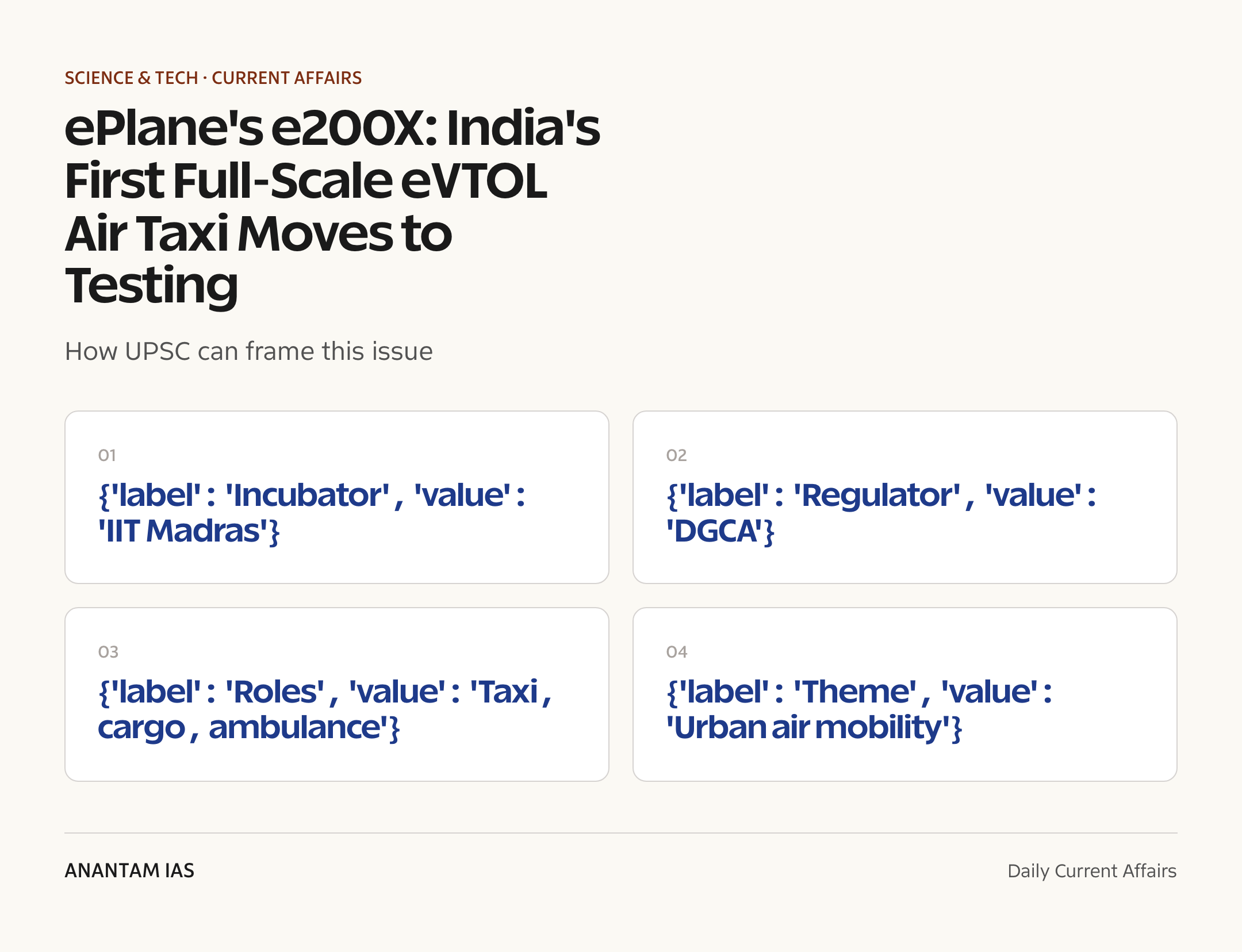
- The Directorate General of Civil Aviation (DGCA) is India’s civil aviation regulator under the Ministry of Civil Aviation; Type Certification is the approval that a new aircraft design meets airworthiness and safety standards before it can be produced and operated.
- The ePlane Company is a startup incubated at IIT Madras, founded by Prof. Satya Chakravarthy; its prototype is the e200X (PT-01).
- The e200X is designed as a multi-role platform for passenger air taxi, urban cargo and air ambulance use from a single airframe.
- Vertiports are the dedicated take-off, landing and charging pads that eVTOL air-taxi networks need — the equivalent of small electric heliports.
- eVTOLs rely on distributed electric propulsion (many small motors) and high-density batteries, linking the topic to advances in battery technology and electric mobility.
- Indigenous deep-tech builds like the e200X connect to Make in India and Atmanirbhar Bharat in high-technology manufacturing.
- Internationally, Joby Aviation and Archer Aviation are leading eVTOL developers, useful as comparison points.
Mains Relevance
GS Paper 3
- Science & technology indigenisation: how an IIT-incubated startup building an eVTOL largely in-house illustrates India’s growing deep-tech and design capability.
- Emerging technology and the economy: the potential of urban air mobility to ease congestion, speed emergency medical transport and create a new aerospace value chain.
- Technology regulation and infrastructure: the role of the DGCA in certifying a frontier aircraft class, and the vertiport, airspace-management and safety ecosystem such mobility needs.
- Innovation ecosystem: the contribution of academic incubation (IIT Madras), venture funding and frugal engineering to India’s startup and Atmanirbhar Bharat goals.
Essay
- Frugal innovation as a national strategy: doing more, and flying higher, with less
- From road to sky: how emerging mobility technologies reshape the way cities move
Background and Context
The e200X Milestone: What Happened
ePlane’s completion of the full-scale PT-01 marks the point where a long-running design effort becomes a real, testable aircraft.
- The e200X (PT-01) is a compact eVTOL whose full-scale assembly is now complete, moving the programme from simulation into the physical testing phase, as reported by Business Today and Urban Air Mobility News.
- The company built major subsystems — propellers, airframe, landing gear and battery pack — in-house, an unusually vertically integrated approach for a startup.
- Immediate next steps are ground testing of the structure and onboard systems under aerodynamic and mechanical loads, then flight testing that builds on smaller subscale prototypes already flown.
- The aircraft is designed for three missions from one airframe — passenger air taxi, urban cargo and air ambulance — which the founder presents as the core commercial logic.
- The programme has reportedly attracted around USD 21 million in funding, a frugal figure beside many international eVTOL projects.
What eVTOL and Urban Air Mobility Mean
The e200X belongs to a new class of aircraft built to make short electric air journeys over cities practical.
- eVTOL — electric Vertical Take-Off and Landing — describes aircraft that take off and land vertically using electric motors and multiple rotors, removing the need for runways.
- Most designs use distributed electric propulsion, spreading thrust across many small motors for redundancy and quieter, lower-emission flight than helicopters.
- Urban Air Mobility (UAM) is the vision of using such aircraft for short city hops — airport-to-downtown transfers, intra-city taxis and rapid medical evacuation.
- Advanced Air Mobility (AAM) is the broader umbrella, extending the idea to regional routes and autonomous cargo delivery.
- The promise is faster point-to-point travel above congested roads; the constraint is that battery energy density currently limits range and payload, keeping early use cases short-haul.
The Certification Path and the DGCA's Role
Before any air taxi carries passengers, its design must clear a demanding airworthiness review.
- Type Certification is the regulator’s sign-off that a new aircraft design meets safety and airworthiness standards — a prerequisite for series production and commercial operation.
- ePlane intends to seek Type Certification from the DGCA, India’s civil aviation regulator under the Ministry of Civil Aviation, before pursuing approvals in export markets.
- Certifying a wholly new aircraft class is itself a frontier task: regulators must frame airworthiness criteria, pilot and operations rules, and noise and safety norms for vehicles unlike conventional planes or helicopters.
- Because the e200X is in pre-certification testing, the realistic timeline to passenger service runs through extensive ground and flight trials, not a near-term launch.
- A credible domestic certification pathway would give Indian eVTOL builders a head start and shape standards for the wider region.
India's Deep-Tech Startup Ecosystem
The e200X is as much a story about how India is building hard-technology firms as about the aircraft itself.
- The ePlane Company was incubated at IIT Madras, illustrating how elite academic institutions are seeding capital-intensive, research-heavy ventures.
- Building propulsion, airframe and battery systems in-house deepens domestic aerospace and electric-propulsion know-how rather than relying on imports.
- Doing this on a comparatively small funding base reflects a frugal-engineering tradition that has marked several Indian deep-tech and space efforts.
- Such ventures align with Make in India and Atmanirbhar Bharat ambitions to move up the value chain in high-technology manufacturing.
- A successful eVTOL programme can anchor a new supplier base — in motors, batteries, avionics and composites — widening the country’s advanced-manufacturing footprint.
Challenges: Batteries, Vertiports and Regulation
The gap between a flying prototype and a working air-taxi network is filled with hard engineering and policy problems.
- Battery technology is the central constraint: energy density caps range and payload, while charging speed and battery life shape how often an aircraft can fly profitably.
- Vertiports — landing pads with charging and passenger handling — must be planned, funded and integrated into crowded urban land, a major infrastructure and real-estate challenge.
- Airspace management for many low-altitude electric aircraft over cities demands new traffic-control and detect-and-avoid systems.
- Public safety and acceptance hinge on a strong certification record, low noise, and confidence that vehicles are as safe as established aviation.
- Affordability and demand remain open: early air taxis are likely premium services, and scaling to mass mobility will need cost reductions over time.
Global Context and Significance
Placing the e200X against international efforts clarifies both how far it has come and how much remains.
- US developers Joby Aviation and Archer Aviation are among the most advanced eVTOL firms, working through certification toward commercial air-taxi services — the benchmark the e200X is measured against.
- An Indian entrant building largely in-house signals that the country can participate in, not just import from, this emerging aerospace segment.
- If the e200X clears testing and certification, it could support emergency medical transport, congestion relief and last-mile cargo in India’s dense cities.
- For now the realistic message is one of capability demonstrated, commercialisation pending — a promising prototype in testing rather than a flying taxi service.
Way Forward
Build the Rules and the Pads Alongside the Aircraft
- The DGCA can develop clear, internationally aligned certification, operations and noise standards for eVTOLs so that approval keeps pace with engineering progress.
- Cities and aviation authorities should begin planning vertiport locations and low-altitude airspace corridors early, since infrastructure lead times are long.
Strengthen the Deep-Tech Pipeline
- Sustained funding, indigenous battery and motor research, and academia-industry incubation can help startups like ePlane move from prototype to certified product.
- Pilot programmes — for instance air-ambulance use in a defined corridor — can prove safety and value before any wider passenger rollout.
Conclusion
The completed assembly of the e200X is a genuine milestone for Indian aerospace: a full-scale, largely indigenous eVTOL built by an IIT Madras-incubated startup on a frugal budget, now entering the ground and flight tests that decide its future. It puts urban air mobility, electric propulsion and the DGCA’s role as a frontier regulator onto the live current-affairs map.
For the aspirant, the durable lessons are the definitions — eVTOL, UAM and Type Certification — and the systemic picture: technology, regulation, vertiport infrastructure and battery progress must advance together. The honest framing is that India has demonstrated capability with a prototype in testing, while commercial air-taxi flight still lies on the far side of certification.
UPSC Practice Questions
Prelims MCQ 1
With reference to eVTOL aircraft and urban air mobility, consider the following statements: 1. An eVTOL aircraft takes off and lands vertically using electric propulsion and does not require a conventional runway. 2. In India, the Directorate General of Civil Aviation (DGCA) is the authority that grants Type Certification to a new aircraft design. 3. Vertiports are the dedicated take-off, landing and charging facilities required for eVTOL air-taxi operations. Which of the statements given above are correct?
1 and 2 only 2 and 3 only 1 and 3 only 1, 2 and 3
Answer: 1, 2 and 3
Explanation:
eVTOL (electric Vertical Take-Off and Landing) aircraft lift off and land vertically using electric motors and rotors, so they need no runway. The DGCA, India’s civil aviation regulator, grants Type Certification certifying that an aircraft design meets airworthiness standards. Vertiports are the landing, charging and passenger-handling pads an eVTOL network depends on. All three statements are correct.
Prelims MCQ 2
Consider the following statements about the e200X recently in the news: 1. It is an eVTOL prototype developed by a startup incubated at IIT Madras. 2. It is designed as a multi-role platform usable as an air taxi, a cargo carrier and an air ambulance. 3. It has already received Type Certification and begun commercial passenger operations. Which of the statements given above are correct?
1 and 2 only 2 and 3 only 1 and 3 only 1, 2 and 3
Answer: 1 and 2 only
Explanation:
The e200X (PT-01) is an eVTOL prototype from The ePlane Company, incubated at IIT Madras, and is designed for passenger, cargo and air-ambulance use from one airframe. Statement 3 is incorrect: the aircraft is in pre-certification ground and flight testing and has not received Type Certification or begun commercial passenger operations.
UPSC Mains Questions
- Electric vertical take-off and landing (eVTOL) aircraft are emerging as a frontier of urban air mobility. Discuss their potential applications and the technological, regulatory and infrastructure challenges to their adoption in India. (250 words)
- Academic incubation and frugal engineering have become hallmarks of India’s deep-tech startups. Examine this with reference to a recent indigenous high-technology venture. (150 words)
- “Regulation must keep pace with innovation without compromising safety.” Analyse this proposition in the context of certifying a new class of aircraft such as eVTOLs. (150 words)
Sources: Business Today and Urban Air Mobility News.
Frequently Asked Questions
What is the e200X and why is it in the news?
The e200X (PT-01) is a compact eVTOL prototype built by The ePlane Company, a startup incubated at IIT Madras. It is in the news because the company has completed its full-scale assembly, moving the aircraft from design into ground and flight testing ahead of seeking DGCA Type Certification.
What does eVTOL mean?
eVTOL stands for electric Vertical Take-Off and Landing. These aircraft use electric motors and multiple rotors to lift off and land vertically like a helicopter — needing no runway — and then cruise more like a plane, with lower noise and emissions than conventional helicopters.
Is the e200X already flying as an air taxi?
No. The aircraft is in pre-certification testing. It must pass ground tests of its structure and systems, then flight tests, and obtain Type Certification from the DGCA before any commercial passenger or cargo operations can begin.
What is Type Certification and who grants it in India?
Type Certification is the regulator’s approval that a new aircraft design meets airworthiness and safety standards, a step required before it can be produced and operated. In India it is granted by the Directorate General of Civil Aviation (DGCA), under the Ministry of Civil Aviation.
What are the main challenges to urban air mobility?
Key challenges are the limits of current battery technology (range, payload and charging), building vertiport infrastructure in crowded cities, managing low-altitude airspace safely, securing certification and public trust, and bringing costs down enough for wider use.
How does the e200X compare with global eVTOL players?
International firms such as Joby Aviation and Archer Aviation in the US are further along toward certified air-taxi services. The e200X stands out for being built largely in-house on a comparatively modest budget, showing that India can participate in this emerging aerospace segment.
Tell Google you want more of this.
Add Anantam IAS as a preferred sourceOne tap, and this site shows up more often in your own Top Stories, AI Overviews and AI Mode. Remove it any time.