Why in News?
The Department of Public Enterprises (DPE) conferred Navratna status on Garden Reach Shipbuilders & Engineers (GRSE) through an Office Memorandum dated 19 June 2026, as reported by Business Standard and PSU Watch.
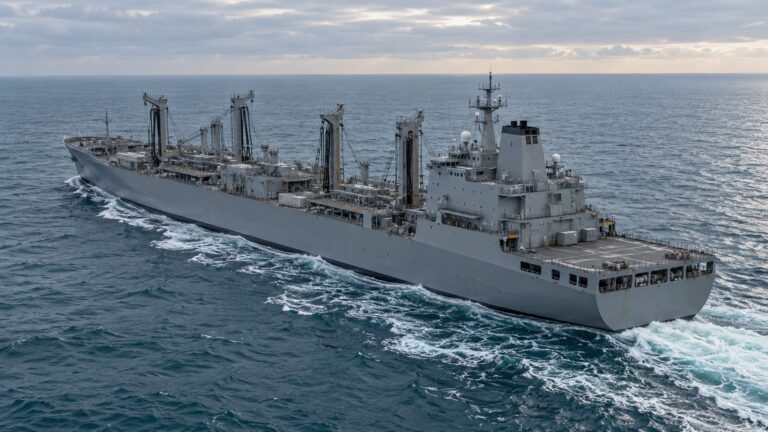
GRSE, a defence shipyard under the Department of Defence Production (Ministry of Defence), becomes the 29th Navratna among India’s central public sector enterprises (CPSEs) — a recognition that brings sharper financial and operational autonomy to the warship builder.
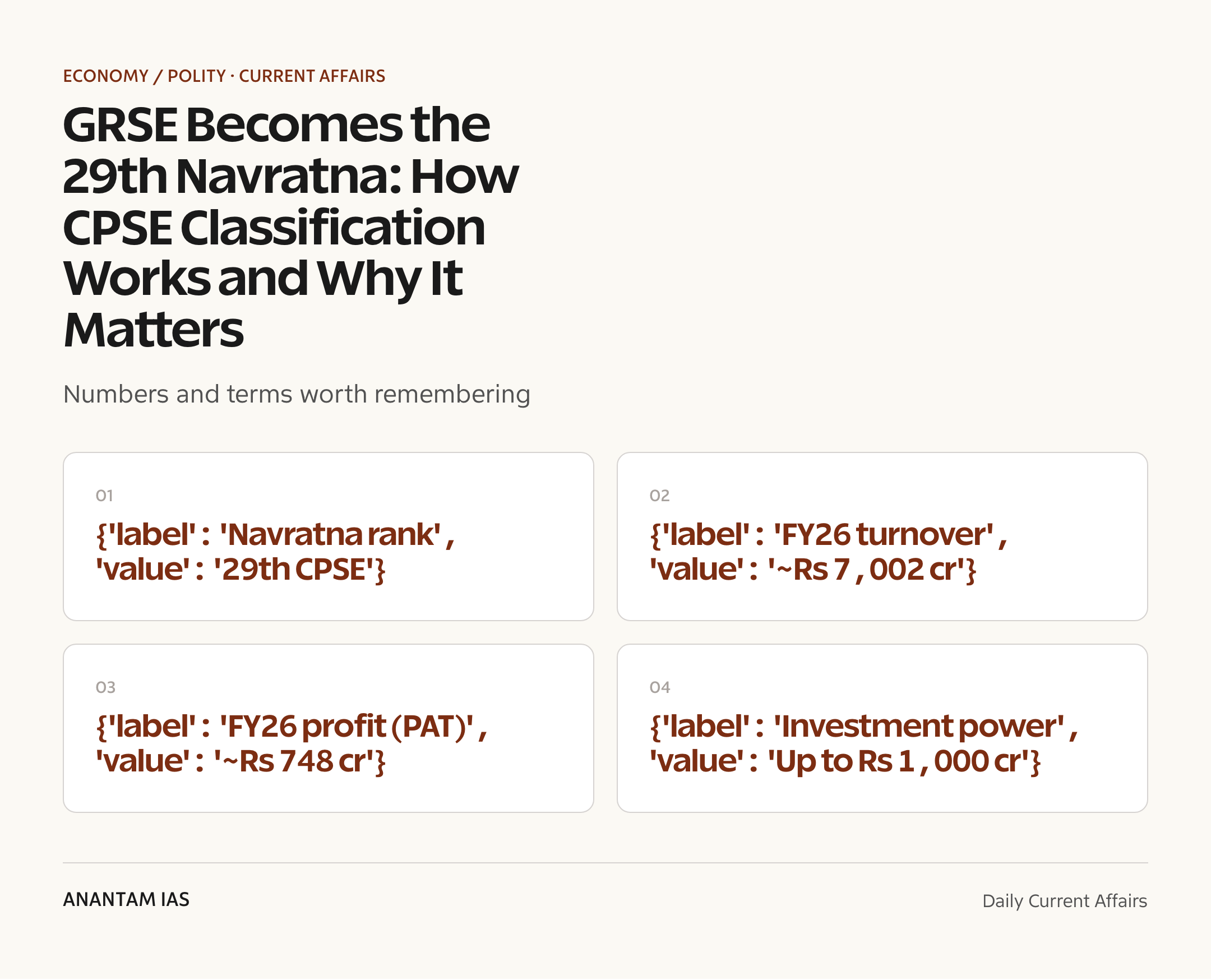
- GRSE reported an annual turnover of about Rs 7,002 crore in FY 2025-26, up from roughly Rs 1,754 crore in 2021-22 — a near-fourfold rise that anchored its case for the upgrade.
- Profit after tax rose from about Rs 190 crore (2021-22) to roughly Rs 748 crore (2025-26), as cited in the Business Standard report.
- The shipyard’s chairman and managing director called the conferral a defining moment for the company, per PSU Watch.
- Navratna status lets GRSE invest larger sums in projects and form joint ventures with greater speed — useful for scaling indigenous warship orders.
- The upgrade fits the wider push for self-reliance in defence (Atmanirbhar Bharat), where domestic shipyards are central to naval modernisation.
- Before this, the publicly cited count stood at 26 Navratnas; GRSE’s addition (the 29th, by the count attributed in news reports) reflects a phase of rapid CPSE upgrades.
The development matters in the context of:
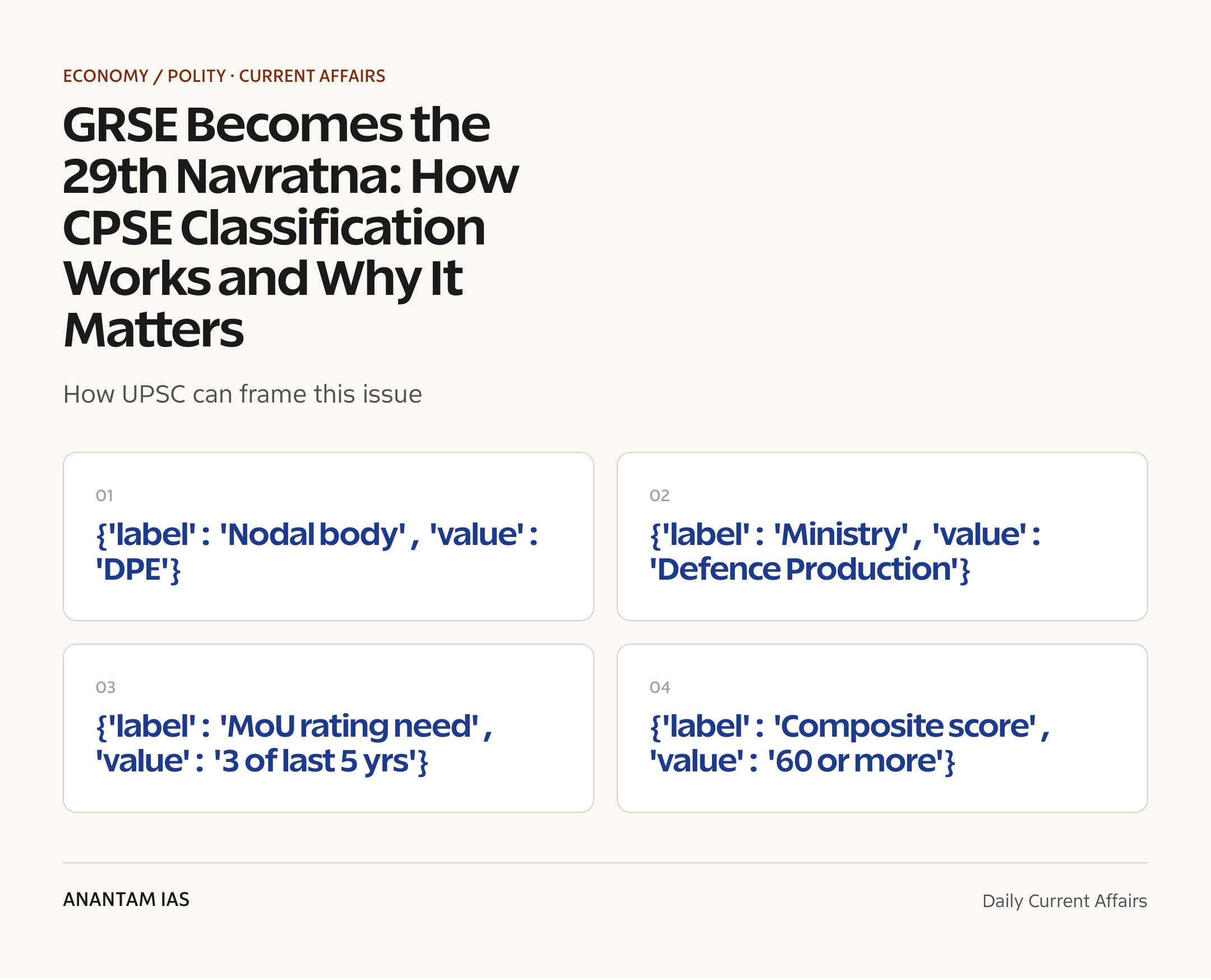
- The DPE is the nodal body for CPSE policy and grants the Maharatna, Navratna and Miniratna tags based on financial performance and governance benchmarks.
- The Navratna scheme dates to 1997, when the government created it to give well-performing CPSEs the autonomy to compete in a liberalised economy.
- A high-level committee under the Cabinet Secretary has been reviewing the CPSE grading framework, with proposals for new performance categories under discussion — so the classification itself is a live policy theme.
UPSC Relevance
Prelims Relevance
- The Department of Public Enterprises (DPE) is the nodal agency for CPSE classification — Maharatna, Navratna, Miniratna (Category I & II).
- Maharatna criteria: Navratna status, listed on an Indian stock exchange, average annual turnover above Rs 25,000 crore, average net worth above Rs 15,000 crore, and average net profit above Rs 5,000 crore (3-year averages), with significant global presence.
- Navratna criteria: must be a Miniratna Category-I and a Schedule ‘A’ CPSE, hold an ‘Excellent’ or ‘Very Good’ MoU rating in 3 of the last 5 years, and score 60 or above on a composite of six performance parameters.
- Miniratna Category-I: profit in each of the last 3 years and pre-tax profit of Rs 30 crore or more in at least one of those years, with positive net worth.
- Miniratna Category-II: profit in each of the last 3 years with positive net worth (lower threshold than Category-I).
- Navratna autonomy: the board can invest up to Rs 1,000 crore (or 15% of net worth in a single project, capped at 30% of net worth in a year) without central government approval.
- GRSE is a defence-PSU shipyard under the Department of Defence Production, Ministry of Defence, headquartered in Kolkata.
- Indigenous warship building ties to Atmanirbhar Bharat in defence and the Navy’s ‘float, move, fight’ indigenisation push.
Mains Relevance
GS Paper 3
- Public sector reform: how the Ratna grading system grants graded autonomy to CPSEs and what it reveals about the state’s evolving role in the economy.
- Defence indigenisation: the place of public-sector shipyards like GRSE, MDL and CSL in building self-reliance and reducing import dependence.
- Capital and governance: how delegated financial powers help CPSEs scale investment, enter joint ventures, and compete without routine government clearance.
Essay
- Autonomy with accountability: can public enterprises behave like competitive firms while serving national goals?
- Self-reliance as strategy: the economics and security logic of building warships at home
Background and Context
The GRSE Upgrade: What Happened
GRSE’s elevation to Navratna is the result of a sustained climb in its financials and a strong governance track record.
- GRSE is a Kolkata-based defence shipyard that builds warships and patrol vessels for the Indian Navy and Coast Guard, operating under the Department of Defence Production.
- Its turnover rose to about Rs 7,002 crore in FY 2025-26 from roughly Rs 1,754 crore in 2021-22, while profit after tax climbed to about Rs 748 crore — the kind of performance the Navratna grade rewards.
- The DPE issued the conferral via an Office Memorandum dated 19 June 2026, as reported in the press; GRSE described it as recognition of decades of engineering depth.
- The grade gives the GRSE board enlarged powers to commit capital and structure partnerships, easing the path to larger and more complex shipbuilding orders.
CPSE Classification: Maharatna, Navratna, Miniratna
The DPE sorts profitable, well-governed CPSEs into three tiers, each unlocking a wider band of decision-making freedom.
- Maharatna is the top tier for large, globally active CPSEs; it requires Navratna status, a stock-exchange listing, and high thresholds on turnover, net worth and net profit.
- Navratna sits in the middle, reserved for strong Schedule ‘A’ performers that meet MoU-rating and composite-score benchmarks.
- Miniratna is split into Category-I and Category-II, recognising consistently profitable CPSEs with positive net worth, at differing profit thresholds.
- The grades are not permanent: a CPSE can be promoted as it grows or reviewed if performance slips, keeping the system performance-linked.
Navratna Eligibility and the Autonomy It Confers
Navratna status is earned through a layered test of profitability, governance rating, and a composite performance score.
- To qualify, a CPSE must already be a Miniratna Category-I and a Schedule ‘A’ company, signalling both profitability and scale of operations.
- It must hold an ‘Excellent’ or ‘Very Good’ MoU rating in at least three of the previous five years — the MoU is the annual performance contract between a CPSE and its administrative ministry.
- It must score 60 or more on a composite of six parameters, covering metrics such as net profit to net worth, manpower cost to cost of production, and earnings to capital employed.
- Once granted, the board can sanction capital investment up to Rs 1,000 crore in a project without central government approval, and may form joint ventures and subsidiaries within set limits — the core practical benefit of the grade.
GRSE, Indigenous Shipbuilding and Atmanirbhar Bharat
GRSE’s rise mirrors a national bet on building warships at home rather than importing them.
- Domestic shipyards — GRSE, Mazagon Dock Shipbuilders (MDL), Cochin Shipyard (CSL) and Goa Shipyard — are the backbone of the Navy’s plan to build most new platforms in India.
- Indigenous construction keeps spending, jobs and technology within the country and lowers reliance on foreign suppliers for sensitive defence assets.
- GRSE has delivered a large number of vessels over its history, from anti-submarine warfare corvettes to survey ships and fast patrol craft, building a deep base of design and integration skills.
- A high indigenisation content in each warship means orders ripple through hundreds of domestic vendors supplying steel, machinery, electronics and fittings, widening the manufacturing base.
- Navratna autonomy helps such yards bid for and execute bigger order books — aligning corporate freedom with the strategic aim of self-reliance in defence.
Why the Classification Matters for Governance
The Ratna framework is a study in balancing enterprise freedom against public accountability.
- Graded autonomy lets profitable CPSEs act with commercial speed while the state retains ownership and broad oversight.
- Performance-linked grading creates an incentive: better MoU ratings and stronger finances translate into more freedom, nudging CPSEs toward efficiency.
- The framework is under active review by a Cabinet Secretary-led committee, with new performance categories being weighed — making CPSE reform a recurring policy debate.
- Autonomy without scrutiny risks weak capital discipline, so delegated powers come with board-level checks, audit by the Comptroller and Auditor General, and parliamentary oversight of public money.
- For UPSC, GRSE is a concrete peg to discuss disinvestment policy, public-sector reform, and the interface between economic autonomy and national security.
Way Forward
Convert Autonomy into Capability
- GRSE should use its enlarged investment powers to deepen design capacity and yard modernisation, not just to fund existing orders.
- Faster joint ventures with private and foreign technology partners can plug gaps in propulsion, sensors and weapon integration.
Keep the Grading System Credible
- Any new CPSE performance categories should reward genuine commercial and operational outcomes, not merely size.
- Tighter MoU evaluation and transparent composite scoring will keep the Navratna tag a mark of performance rather than a routine promotion.
Conclusion
GRSE’s elevation to the 29th Navratna is more than a corporate milestone — it is a window into how India grades, rewards and frees its public enterprises. The Ratna ladder ties autonomy to performance, letting a profitable shipyard commit larger capital and move faster while the state keeps ownership and oversight.
For the aspirant, the durable takeaways are the eligibility rules and delegated powers of each tier, and the larger point that public-sector reform and defence self-reliance increasingly pull in the same direction. A stronger, freer GRSE is both an economic and a strategic asset.
UPSC Practice Questions
Prelims MCQ 1
With reference to the classification of Central Public Sector Enterprises (CPSEs) in India, consider the following statements: 1. The Department of Public Enterprises grants the Maharatna, Navratna and Miniratna statuses. 2. To be eligible for Navratna status, a CPSE must already be a Miniratna Category-I and a Schedule ‘A’ company. 3. A Navratna CPSE board can invest up to Rs 1,000 crore in a project without central government approval. Which of the statements given above are correct?
1 and 2 only 2 and 3 only 1 and 3 only 1, 2 and 3
Answer: 1, 2 and 3
Explanation:
The DPE is the nodal body that confers the Ratna grades. Navratna eligibility requires Miniratna Category-I and Schedule ‘A’ status, an ‘Excellent’/’Very Good’ MoU rating in 3 of 5 years, and a composite score of 60 or more. A Navratna board can sanction project investment up to Rs 1,000 crore without government approval. All three statements are correct.
Prelims MCQ 2
Garden Reach Shipbuilders & Engineers (GRSE), recently conferred Navratna status, operates under which of the following?
Department of Heavy Industry Department of Defence Production, Ministry of Defence Ministry of Ports, Shipping and Waterways Department of Public Enterprises, Ministry of Finance
Answer: Department of Defence Production, Ministry of Defence
Explanation:
GRSE is a defence-PSU shipyard under the Department of Defence Production, Ministry of Defence. The DPE only classifies CPSEs; it is not the administrative ministry for GRSE.
UPSC Mains Questions
- The Ratna classification of CPSEs links autonomy to performance. Examine how the Maharatna, Navratna and Miniratna framework balances commercial freedom with public accountability, using a recent upgrade as an illustration. (250 words)
- Indigenous warship building is central to India’s quest for self-reliance in defence. Discuss the role of public-sector shipyards and the policy support they need to scale. (150 words)
- “Granting financial autonomy to public enterprises is necessary but not sufficient for their performance.” Critically analyse with reference to CPSE reform. (150 words)
Sources: Business Standard and PSU Watch.
Frequently Asked Questions
What is the Navratna status, and what did GRSE achieve?
Navratna is a grade conferred by the Department of Public Enterprises on strong, well-governed central public sector enterprises, giving them greater financial and operational autonomy. GRSE, a Kolkata-based defence shipyard, was conferred Navratna status in June 2026, reportedly becoming the 29th Navratna among CPSEs.
How are Maharatna, Navratna and Miniratna different?
Maharatna is the top tier for large, globally active CPSEs with very high turnover, net worth and profit. Navratna is for strong Schedule ‘A’ performers meeting MoU-rating and composite-score tests. Miniratna (Category I and II) recognises consistently profitable CPSEs at lower thresholds. Each higher tier brings more delegated decision-making powers.
What are the eligibility criteria for Navratna status?
A CPSE must already be a Miniratna Category-I and a Schedule ‘A’ company, hold an ‘Excellent’ or ‘Very Good’ MoU rating in at least three of the last five years, and score 60 or more on a composite of six performance parameters.
What financial powers does Navratna status confer?
A Navratna board can sanction capital investment up to Rs 1,000 crore in a single project without central government approval (subject to net-worth-linked ceilings), and can form joint ventures and subsidiaries within prescribed limits.
Why does GRSE’s upgrade matter for defence self-reliance?
Greater autonomy lets GRSE commit larger capital and form partnerships faster, helping it take on bigger indigenous warship orders. This supports the Navy’s plan to build most new platforms at home under Atmanirbhar Bharat.
Is the CPSE classification framework being changed?
A high-level committee led by the Cabinet Secretary has been reviewing the CPSE grading and performance-assessment framework, with proposals for new performance categories under discussion. The existing Maharatna/Navratna/Miniratna tiers remain in place.
Tell Google you want more of this.
Add Anantam IAS as a preferred sourceOne tap, and this site shows up more often in your own Top Stories, AI Overviews and AI Mode. Remove it any time.