Daily Digest
UPSC · Civil Services Examination
Current Affairs · Saturday, 25 October 2025
Current affairs curated and edited by Anantam IAS faculty — pulled from The Hindu, PIB, IDSA, Foreign Affairs and the ministries. Read, annotate, revise.
Old Rajinder Nagar · Delhi 110005 · anantamias.com
Contempt of Court

Why in the News?
The Supreme Court is scheduled to hear a petition filed by the Supreme Court Bar Association (SCBA) seeking criminal contempt action against advocate Rakesh Kishore.
UPSC Relevance
Important constitutional provisions are often tested in Prelims.
PYQ
2022 Prelims
Consider the following statements:
1. Pursuant to the report of H.N. Sanyal Committee, the Contempt of Courts Act, 1971 was passed.
2. The Constitution of India empowers the Supreme Court and the High Courts to punish for contempt of themselves.
3. The Constitution of India defines Civil Contempt and Criminal Contempt.
4. In India, the Parliament is vested with the powers to make laws on Contempt of Court.
Which of the statements given above is/are correct?
(a) 1 and 2 only
(b) 1, 2 and 4
(c) 3 and 4 only
(d) 3 only
What is Contempt of Court?
Contempt of Court is the offense of being defiant or disrespectful toward a court of law and its officers. It essentially refers to any conduct that tends to undermine the authority and dignity of the court or interferes with the administration of justice.
Provisions and Laws
- Constitutional Provisions: Mentions ‘contempt’ but does not define it or its types.
- Article 129: Confers on the Supreme Court the power to punish for contempt of itself.
- Article 215: Confers a corresponding power on the High Courts to punish for contempt of themselves.
- Article 142(2): Grants the Supreme Court the power to investigate and punish any contempt of itself.
- Article 19(2): Contempt of court is one of the reasonable restrictions placed on the freedom of speech and expression.
- The Contempt of Courts Act, 1971 : defines civil and criminal contempt.
- This Act defines and limits the powers of certain courts in punishing contempt and distinguishes between civil and criminal contempt.
Civil vs Criminal Contempt of Court
| Type of Contempt | Statutory Definition (Section) | Key Action Involved |
|---|---|---|
| Civil Contempt | Defined in Section 2(b) of the Contempt of Courts Act, 1971. | Wilful disobedience to any judgment, decree, direction, order, writ, or other process of a court, or wilful breach of an undertaking given to a court. The focus is on compelling compliance for the benefit of an opposing party. |
| Criminal Contempt | Defined in Section 2(c) of the Contempt of Courts Act, 1971. | Publication (by words, signs, etc.) or the doing of any act which: * Scandalises or lowers the authority of any court; * Prejudices or interferes with the due course of any judicial proceeding; or * Interferes or obstructs the administration of justice in any other manner. The focus is on protecting the dignity and authority of the court and the administration of justice itself. |
The Recent Case in SC
- Advocate Rakesh Kishore is accused of hurling an object (described as a rolled-up sheaf of papers, but the Bar Council of India later noted an attempt to hurl his sports shoes) at Chief Justice of India (CJI) B. R. Gavai on October 6 during court proceedings.
- The Supreme Court Bar Association (SCBA) filed a petition seeking criminal contempt action against the advocate.
- Consent for Action: The Attorney General (AG), R. Venkataramani, consented to the initiation of criminal contempt proceedings, which is typically required under the Contempt of Courts Act, 1971, for a contempt action initiated by a private party or a Bar Association.
- Judiciary’s Initial Stance (CJI & Justice Kant):
- CJI B. R. Gavai himself initially brushed off the incident as “inconsequential” and a “forgotten chapter,” questioning whether further judicial time should be spent on it.
- Justice Kant also observed that the act was “not worth dwelling on” and suggested allowing it to “die a natural death.”
- Institutional Concern: Despite the CJI’s magnanimity, other voices within the Supreme Court judiciary argue the attack was an “affront to the judicial institution itself” and the 71-year-old perpetrator should face serious action.
- The SCBA’s strong push for proceedings, despite the CJI’s initial desire to let it go, highlights the argument that the action is not a personal matter but an attack on the dignity, authority, and institutional integrity of the Supreme Court itself.
- Disciplinary Action by Bar Bodies
- Bar Council of India (BCI) Suspension: The BCI, which governs the legal profession, issued an interim suspension order against Rakesh Kishore (who is enrolled with the Bar Council of Delhi).
- Basis for Suspension: The BCI action was taken under the Advocates Act, 1961 and the BCI Rules on Standards of Professional Conduct and Etiquette, citing grave professional misconduct.
- Punishment under Law: A person found guilty of contempt of court may be punished with simple imprisonment up to six months, or with a fine up to ₹2,000, or both. However, an apology (if bona fide) may be a defence or lead to a remission of the punishment.
Judicial Precedents
| Case Name | Year | Brief Significance |
| E.M.S. Namboodiripad vs. T. Narayanan Nambiar | 1970 | Established that scandalizing the court by casting scurrilous abuse or improper imputations on the integrity, impartiality, and judicial competence of judges constitutes criminal contempt, even if the statements are politically motivated. |
| Arundhati Roy, In Re | 2002 | Reaffirmed the Court’s power to punish for criminal contempt for allegations that strike at the root of the administration of justice and are aimed at scandalizing and lowering the dignity of the Court. The Court held Roy guilty for her comments on judicial proceedings and the Supreme Court. |
| P. N. Duda vs. P. Shivshankar & Others | 1988 | The Supreme Court refused to initiate contempt proceedings against a Law Minister for a critical speech, observing that the Court’s shoulders are broad enough to sustain criticism and that harsh criticism, in some contexts, could be seen as an “opinion” or “historical review” and not an act of criminal contempt. |
| In Re: Prashant Bhushan and Another | 2020 | This was a suo motu (on its own motion) criminal contempt case against an advocate for two tweets criticising the SC and the sitting CJI. It upheld that scandalizing the court remains a form of criminal contempt under the 1971 Act. He was sentenced to a one-rupee fine, which he had to pay by a specific date, or face a potential three-month prison sentence or be debarred from practicing law for three years. |
Source: https://anantamias.com/current-affairs/contempt-of-court/
United Nations @80: Global Governance, Achievements, Challenges and Reforms
The United Nations (UN) is a global intergovernmental organization founded in 1945 with a mission to maintain international peace and security, develop friendly relations among nations, foster international cooperation, and harmonize the actions of nations in pursuit of these goals.
As it approaches its 80th anniversary in 2025, the UN remains the world’s largest multilateral institution, encompassing 193 member states and 2 observer states (Holy See and Palestine). Headquartered in New York City (with major offices in Geneva, Nairobi, Vienna, and The Hague), the UN operates through six principal organs – the General Assembly, Security Council, Economic and Social Council, International Court of Justice, the Secretariat, and the (now inactive) Trusteeship Council. Over eight decades, the UN has expanded from 51 founding members to near universal membership, evolving in scope from collective security to a broad range of roles in development, humanitarian aid, and global governance.
UN Mandate and Organizational Structure
- Mandate: The UN’s founding Charter outlined a broad mandate: prevention of war and collective security; peaceful settlement of disputes; promotion of human rights and fundamental freedoms; international cooperation in solving economic, social, cultural, or humanitarian problems; and acting as a center to harmonize nations’ actions. In practice, the UN’s work spans peace and security (conflict prevention, peacekeeping, disarmament, counter-terrorism), development (poverty alleviation, sustainable development, health, education), humanitarian assistance (disaster relief, refugees), human rights (standard-setting and monitoring), and international law (treaties, adjudication through the ICJ).
- Principal Organs: The UN system is centered on six principal organs established by the Charter:
- General Assembly (UNGA): Universal body where all 193 member states have one vote. It discusses and issues resolutions on a wide array of international issues (peace, development, international law, etc.). While GA resolutions are non-binding, they carry moral and political weight. The GA also controls the UN’s regular budget and elects members to other bodies. (Notably, India’s Vijaya Lakshmi Pandit served as the first woman President of the UNGA in 1953.)
- Security Council (UNSC): 15-member body responsible for international peace and security. It has 5 permanent members (P5: US, Russia (formerly USSR), China, UK, France) with veto power, and 10 non-permanent members elected for 2-year terms (no veto). UNSC decisions (binding resolutions) can authorize sanctions, peacekeeping missions, or even collective military action. The veto power and composition of the Council reflect the power structure of 1945 and have been central to debates on UN reform (discussed later).
- Economic and Social Council (ECOSOC): 54-member organ coordinating economic, social, and development work of the UN and its specialized agencies. ECOSOC facilitates policy review, dialogue, and recommendations on issues like sustainable development, and oversees commissions and forums (e.g. UN Forum on Indigenous Issues, sustainable development forums).
- International Court of Justice (ICJ): The principal judicial organ, seated at The Hague. It settles legal disputes between states that consent to its jurisdiction and gives advisory opinions. The ICJ has 15 judges elected by the UNGA and UNSC. (Separately, there are international tribunals for criminal matters – outside ICJ’s purview – such as the International Criminal Court, which is not a UN organ but cooperates with it).
- UN Secretariat: The administrative arm headed by the Secretary-General (UNSG), currently António Guterres. The Secretariat’s international civil servants carry out the day-to-day work of the UN – from mediating conflicts to organizing humanitarian relief and producing research. The UNSG plays a crucial role as diplomat and spokesperson for the international community, with functions of good offices, mediation, and agenda-setting (e.g. the UNSG can bring issues to the Security Council’s attention). The Secretariat’s effectiveness and neutrality are vital, though it has faced challenges of bureaucracy and resource constraints.
- Trusteeship Council: Established to oversee the administration of trust territories (mostly former colonies being guided to independence). It fulfilled its mandate as all 11 trust territories attained self-government or independence by 1994. The Trusteeship Council suspended operations in 1994, and remains formally in existence but without active dutiesen
- UN System and Agencies: Beyond the core organs, the “UN System” includes a wide network of specialized agencies, funds, and programs that address specialized areas:
- Specialized Agencies (autonomous organizations linked by agreements): e.g. World Health Organization (WHO), World Bank Group (IBRD, IDA) and International Monetary Fund (IMF), Food and Agriculture Organization (FAO), UN Educational, Scientific and Cultural Organization (UNESCO), International Labour Organization (ILO), International Civil Aviation Org (ICAO), World Meteorological Org (WMO), International Atomic Energy Agency (IAEA) (though IAEA reports to UNSC/GA), etc. These have their own member states and budgets, focusing on technical cooperation and setting international standards in their domains.
- Funds and Programs: directly under UN authority and General Assembly: e.g. UN Development Programme (UNDP), UN Children’s Fund (UNICEF), World Food Programme (WFP), UN High Commissioner for Refugees (UNHCR), UN Environment Programme (UNEP), among others. These are financed mostly by voluntary contributions and undertake operational activities (development projects, humanitarian relief, etc.).
- Other bodies: Human Rights Council (HRC) – an intergovernmental body under the GA dealing with human rights (since 2006, replacing the former Human Rights Commission); Peacebuilding Commission; various committees and ad hoc mechanisms.
In summary, the UN is criticized for ineffectiveness whenever it fails to prevent conflict or alleviate crises, and for structural inequities that reflect an old world order. Yet, it remains an indispensable organization as no country alone can tackle global issues. The criticisms have spurred calls for reform, to make the UN more representative, efficient, and fit for purpose in the 21st century.
Role of the United Nations in Global Governance and Multilateralism for UPSC CSE Mains
The United Nations (UN) is a cornerstone of global governance, fostering multilateralism by providing a platform for nearly all sovereign nations to engage in dialogue and address issues that transcend borders. Below is a concise summary of its key roles:
Center of Multilateral Diplomacy: The UN serves as the primary global forum for nations to discuss and resolve transnational challenges. The annual UN General Assembly (UNGA) sessions bring world leaders together to debate critical issues, while UN-led conferences have produced landmark agreements like the Paris Climate Agreement (2015) and the 2030 Agenda for Sustainable Development. These efforts set global norms and mobilize collective action, as seen in the Beijing Declaration for women’s rights and the UN Framework Convention on Climate Change (UNFCCC) COPs for climate action.
Peace and Security: The UN Security Council (UNSC) is tasked with maintaining global peace under the UN Charter. It employs tools like preventive diplomacy, peacekeeping, peace enforcement, and post-conflict peacebuilding. Since 1948, the UN has conducted 71 peacekeeping missions, with 12 active missions in 2021 involving 88,000 personnel from over 120 countries. These “blue helmets” stabilize conflict zones, protect civilians, and implement peace agreements, with studies showing effectiveness in reducing violence. The UN also mediates conflicts (e.g., ending El Salvador’s civil war in 1992) and authorizes sanctions or military actions (e.g., 1991 Gulf War). Additionally, it combats terrorism through the UN Global Counter-Terrorism Strategy, though consensus on definitions remains elusive.
Human Rights and Humanitarian Role: The UN has shaped the global human rights framework, starting with the Universal Declaration of Human Rights (1948), followed by treaties like the ICCPR, ICESCR, and conventions on racial discrimination, women’s rights, and child rights. The Human Rights Council (HRC) monitors abuses, though it faces criticism for politicization. UN agencies like UNHCR, WFP, UNICEF, and OCHA deliver critical humanitarian aid during crises, such as the 2004 Indian Ocean tsunami and the Syrian refugee crisis, while upholding international humanitarian law and supporting war crimes tribunals (e.g., for Yugoslavia and Rwanda).
Development and Global Welfare: The UN prioritizes socio-economic development, especially for the Global South. Through the General Assembly and ECOSOC, it advocates for equitable global economic systems. Programs like UNDP provide technical assistance, while the Millennium Development Goals (MDGs) and Sustainable Development Goals (SDGs) guide global efforts to reduce poverty, hunger, and environmental degradation. Specialized agencies like WHO (smallpox eradication), UNESCO (education and cultural heritage), FAO (food security), and ILO (labor standards) contribute significantly. The UN’s development work supports its peace mission, recognizing their interdependence.
Global Public Goods and Future Challenges: The UN addresses transnational issues like climate change, pandemics, and cybersecurity, providing a platform for negotiations (e.g., IPCC for climate science, Plastics pollution treaty talks). Its universal membership aids in tackling these “global public goods,” though achieving consensus is challenging amid rising geopolitical tensions and “polycrises” as the UN marks its 80th year.
Achievements of the United Nations
The UN has made significant contributions to global peace, development, and humanitarian efforts:
- Preventing Global Conflict: The absence of a world war since 1945 is a key achievement, with the UN facilitating dialogue among rival powers to contain conflicts.
- Peacekeeping Successes: Successful missions in Namibia, Cambodia, Mozambique, Sierra Leone, and East Timor demonstrate the UN’s role in stabilizing post-conflict regions. Preventive diplomacy, like during the Cuban Missile Crisis, has averted escalations.
- Decolonization: The UN supported the post-1945 decolonization wave, supervising 11 trust territories to independence and passing the 1960 Declaration on Granting Independence, giving newly independent nations a global voice.
- Normative Frameworks: The UN has shaped international law through the UDHR, treaties like UNCLOS, and disarmament agreements. The International Court of Justice resolves disputes and provides advisory opinions, strengthening the rules-based order.
- Humanitarian Efforts: Agencies like UNHCR, WFP, and UNICEF have saved millions through refugee aid, food relief, and child health initiatives (e.g., smallpox eradication, polio reduction). UN OCHA coordinates disaster relief, as seen in the 2010 Haiti earthquake and 2014 Ebola outbreak.
- Development Progress: The UN’s SDGs and Human Development Reports have reframed development priorities, while its advocacy has driven initiatives like the Global Fund for AIDS, TB, and malaria.
- Global Recognition: The UN and its entities have received over a dozen Nobel Peace Prizes, including for peacekeeping (1988), nuclear non-proliferation (IAEA, 2005), and Kofi Annan’s leadership (2001).
Challenges and Criticisms
Despite its achievements, the UN faces significant challenges:
- Security Council Paralysis: The veto power of the five permanent members (P5) often stalls action, as seen in Syria and Israel-Palestine conflicts, undermining the UN’s credibility. The UNSC’s 1945 structure excludes emerging powers, reducing its legitimacy.
- Geopolitical Divisions: Great-power rivalries (e.g., U.S.-China, Russia-West) and North-South divides hamper consensus on issues like terrorism or human rights, leading to inaction in crises like Ukraine or Syria.
- Failure to Prevent Atrocities: The UN failed to stop the Rwandan Genocide (1994), Srebrenica massacre (1995), and ongoing conflicts in Syria and Yemen, highlighting limitations in its peace and security mandate.
- Bureaucracy and Scandals: The UN is criticized for inefficiency, overlapping mandates, and scandals like the Oil-for-Food Programme and peacekeeper misconduct, eroding trust. Financial constraints, with delayed dues from major contributors, exacerbate challenges.
- Bias and Credibility: Allegations of bias (e.g., anti-Israel resolutions in the HRC) and the presence of repressive regimes in key bodies undermine credibility. Developing nations see the UN as favoring rich countries, while some Western nations view it as ineffective.
Reform Prospects (Focus on UNSC Reform)
Reforming the UN, particularly the Security Council, is critical but challenging due to entrenched interests.
Need for UNSC Reform: The UNSC’s 1945 structure does not reflect current global realities, with no permanent seats for Africa, Latin America, or major powers like India. This reduces its legitimacy and effectiveness. Proposals include expanding permanent and non-permanent seats and limiting veto use in cases of mass atrocities.
Reform Proposals:
- G4 Proposal: India, Brazil, Germany, and Japan seek 6 new permanent seats (including two for Africa) and additional non-permanent seats.
- African Union’s Ezulwini Consensus: Demands two permanent African seats with veto power.
- Uniting for Consensus (UfC): Opposes new permanent seats, favoring more non-permanent or longer-term elected seats.
- Other ideas include semi-permanent seats or regional representation.
Challenges: Reform requires a two-thirds UNGA vote and P5 ratification, making progress difficult. P5 members, particularly China and Russia, resist changes that dilute their power. Consensus among 193 nations is elusive, with groups like UfC opposing regional rivals’ bids.
India’s Position: As the world’s most populous nation, a major economy, and a top peacekeeping contributor, India strongly advocates for a permanent UNSC seat, supported by the U.S., UK, France, Russia, and many Global South nations. However, opposition from Pakistan and China’s reluctance pose hurdles.
Broader Reforms: Beyond UNSC, efforts include revitalizing the General Assembly, improving Secretariat efficiency, and addressing financial sustainability. The UN80 Initiative (2025) aims to streamline mandates and make the UN more field-oriented. Proposals like a UN Parliamentary Assembly remain conceptual.
Outlook: Momentum for reform is growing, with initiatives like the French-Mexican veto restraint proposal and G4-African coordination. However, political will remains the key obstacle. A reformed UNSC could enhance global governance, but progress depends on overcoming P5 resistance and achieving consensus.
Conclusion: The UN remains indispensable for addressing global challenges through multilateralism, despite its flaws. Its achievements in peace, human rights, and development are significant, but structural inequities, inefficiencies, and geopolitical divisions limit its effectiveness. Reforming the UN, especially the UNSC, is crucial for aligning it with 21st-century realities, but entrenched interests make it a complex task. For India, a permanent UNSC seat is a priority to reflect its global stature and amplify the Global South’s voice.
Prelims Facts at a Glance: The United Nations
Miscellaneous: UN’s specialized agency International Solar Alliance (ISA) is co-founded by India (though not a UN agency, it works closely on climate action). The Gandhi Peace Prize is India’s own award but India has also gifted the UN: e.g., a statue of Gandhi installed at UN HQ in 2023. India often showcases its initiatives (like Climate resilient infrastructure – Coalition for Disaster Resilient Infrastructure (CDRI) launched with UN backing). These facts highlight how India engages with and contributes to the UN system.
Founding and History: Established 24 October 1945 by the UN Charter coming into force. Founding Members: 51 countries (50 original signatories at San Francisco Conference + Poland). Succeeded the League of Nations. 2025 marks the UN’s 80th anniversary. UN Day: 24th October each year.
Membership: 193 Member States (all internationally recognized sovereign countries except Vatican City which is an Observer). 2 Observer States: Holy See (Vatican City) and State of Palestine. Admission of new members is by General Assembly upon Security Council’s recommendation.
Headquarters and Offices: Headquarters in New York City, USA (international territory). Major UN offices in Geneva (Switzerland), Vienna (Austria), Nairobi (Kenya). The International Court of Justice is seated in The Hague, Netherlands. The UN flag (white UN emblem on light blue background) and emblem (world map surrounded by olive branches) are globally recognized symbols.
Official Languages: 6 languages – English, French, Spanish, Russian, Chinese, Arabic – used in UN meetings and official documents. UN working languages of Secretariat: English and French. The UN also has 6 official day languages (scripts) corresponding to those languages.
Key Reports and Indices:
Human Development Report – by UNDP (includes Human Development Index – HDI). Annual; measures health, education, income.
Sustainable Development Goals (SDG) Report – UN’s annual progress report on SDGs.
World Happiness Report – released under UN Sustainable Development Solutions Network (SDSN).
State of the World’s Children – UNICEF’s flagship report on child well-being (annual).
World Health Statistics – WHO’s annual compilation of global health data.
Global Report on Trafficking in Persons – UN Office on Drugs and Crime (UNODC) biennial report.
UNEP Emissions Gap Report – annual report on the gap between projected emissions and levels needed to meet climate targets.
UNCTAD Reports – Trade and Development Report, World Investment Report, etc., by UN Conference on Trade and Development.
(Note: IMF and World Bank reports like World Economic Outlook or Global Economic Prospects are often referenced in UN context but are by Bretton Woods institutions linked to UN.)
India and the UN – Fast Facts:
Founding Member: India joined UN in 1945 (one of original members).
UNSC Membership: India has been elected 8 times as non-permanent member of UNSC (terms in 1950-51, 1967-68, 1972-73, 1977-78, 1984-85, 1991-92, 2011-12, 2021-22). India is actively seeking permanent membership as part of G4 coalition.
UNGA Presidency: India’s Vijaya Lakshmi Pandit was President of the UN General Assembly in 1953, the first ever woman to hold that post.
Peacekeeping Contributions: Over 240,000 Indian personnel have served in 49+ UN Peacekeeping missions to date (as of 2023). India is historically the largest cumulative troop contributor. Currently (~2025), about 5,500 Indian troops/police serve in UN missions (India often ranks in top 3 contributors). Indian peacekeepers have served in UN operations in Korea, Congo, Sudan, Lebanon, Golan Heights, Sierra Leone, and more. India also had prominent Force Commanders (e.g. Lt. Gen. Thimayya in Cyprus, Lt. Gen. Satish Nambiar in former Yugoslavia).
Notable Indian Initiatives: India co-sponsored landmark resolutions like the Declaration on Apartheid (condemning apartheid early on), and more recently, championed the International Day of Yoga (21 June) in the UN, adopted by consensus in 2014. India is a founding member of Group of 77 (G77) developing countries at UN.
International Court of Justice: India has had an ICJ judge nearly continuously for decades (e.g. Justice B. N. Rau was advisor in drafting ICJ statute, Nagendra Singh served as ICJ President in 1985, and currently Justice Dalveer Bhandari is on the bench since 2012 after a famous General Assembly vote win).
India’s UN Peace Awards: Two Indian Secretaries-General of UN operations – Ralph Bunche (although American, negotiated armistice with Indian peacekeeper support) and Kofi Annan – received Nobel Peace Prizes (shared with UN). In 2014, Indian activist Kailash Satyarthi got Nobel (for child rights), reflecting values India supports at UN.
Financial Contributions: India contributes 0.834% of UN regular budget, and about 0.16% of peacekeeping budget (as of a recent scale). Beyond assessed contributions, India gives voluntary aid to UN funds (e.g. UNDP, UNEP). India also set up a “India-UN Development Partnership Fund” in 2017 for projects in fellow developing countries, especially small states.
Current Position on Reform: India’s official line: “Reform of the UN, especially the Security Council, is an urgent necessity.” India’s External Affairs Minister in 2025 reiterated that UN decision-making must reflect today’s membership and realities, not 1945. India is part of G4 and the L.69 group (a diverse grouping for UNSC reform), pushing for concrete movement by 2025, the UN’s 80th year. Indian leadership frequently uses UN platforms to call out terrorism and urge avoiding double standards (indirectly criticizing the politicization in sanctions listings).
Makhana/Foxnut Industry


Context:
Prime Minister Narendra Modi, during a rally in Samastipur, Bihar, inaugurated the National Makhana Board, calling it a “revolution”. Bihar produces nearly 90% of India’s makhana (fox nut) output, mainly concentrated in Mithilanchal (Darbhanga, Madhubani, Purnea, Katihar, Supaul, etc.).
UPSC Relevance:
Economy and Geography
UPSC PYQ:
With reference to the “Tea Board” in India, consider the following statements:
- The Tea Board is a statutory body.
- It is a regulatory body attached to the Ministry of Agriculture and Farmers Welfare.
- The Tea Board’s Head Office is situated in Bengaluru.
- The Board has overseas offices at Dubai and Moscow.
Which of the statements given above are correct?
(a) 1 and 3
(b) 2 and 4
(c) 3 and 4
(d) 1 and 4
About Makhana:
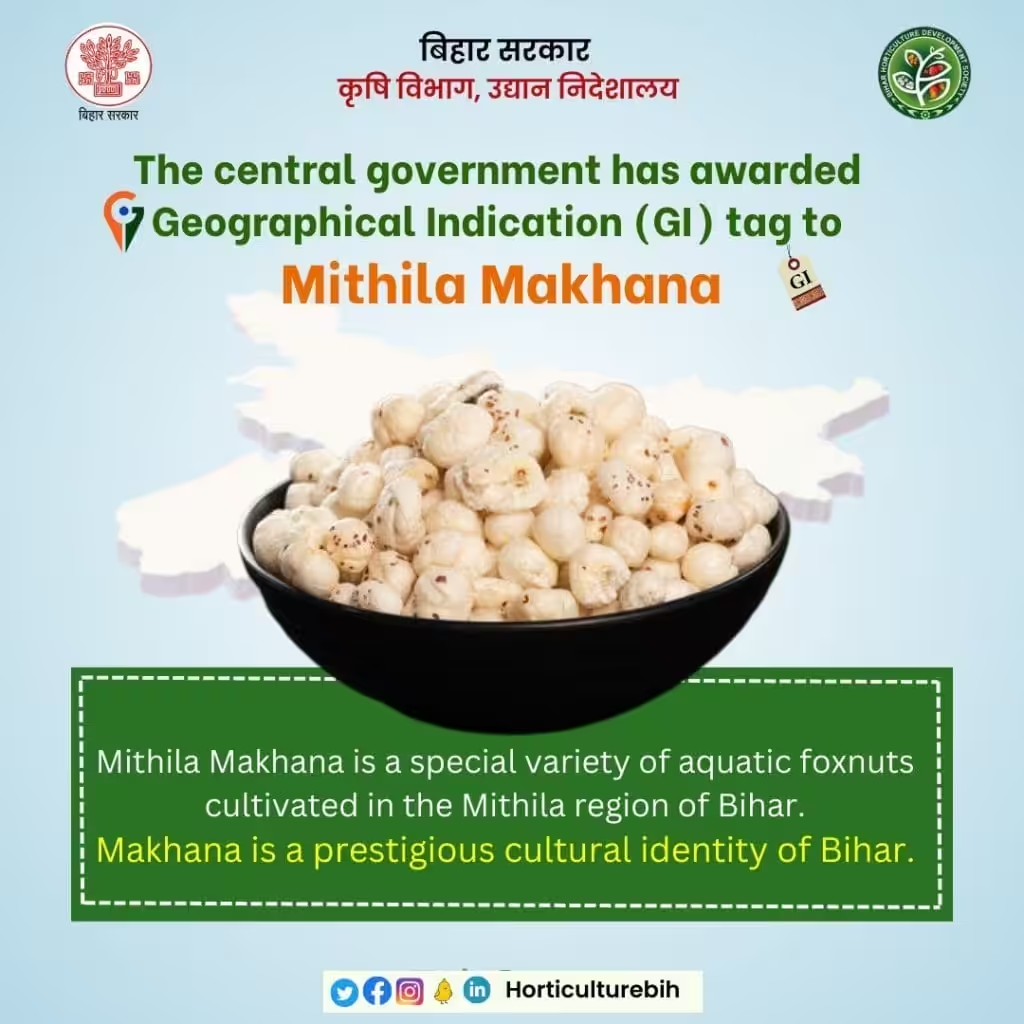
- Makhana: Makhana is a type of seed derived from Euryale ferox plant. They are also sometimes referred to as Fox Nuts or Lotus Seeds.
It is a Aquatic Crop(An aquatic crop is a plant grown in or around water for food or other purposes.)

- Makhana is widely cultivated throughout Asia and often used in Medicine and Cuisine.
- Nearly 90% of world production of Makhana comes from Bihar, Specifically the 10 District of Bihar i.e. Darbhanga, Madhubani, Sitamarhi, Katihar, Purnea, Kishanganj, Araria, Saharsha, Supaul & Madhepura.
Growing Conditions:
- Makhana or Fox nut is a plant that is mostly found and grown in tropical and subtropical climates.
- It requires a conducive range of temperature between 20 to 35 degree Celsius for proper growth and development, along with a relative humidity of 50%-90% and an annual rainfall of 100-250 cm.
- Soil: Smooth loamy soil
- The plant flourishes well in stagnant perennial water bodies (including various ponds, land depressions, oxbow lakes, swampy lands and ditches) with 0.2-2 m depth, with thick rhizomatous stem, deeply rooted in cluster form in sediment.
India is the largest producing country of makhana, accounting for 70-80% of the global yield
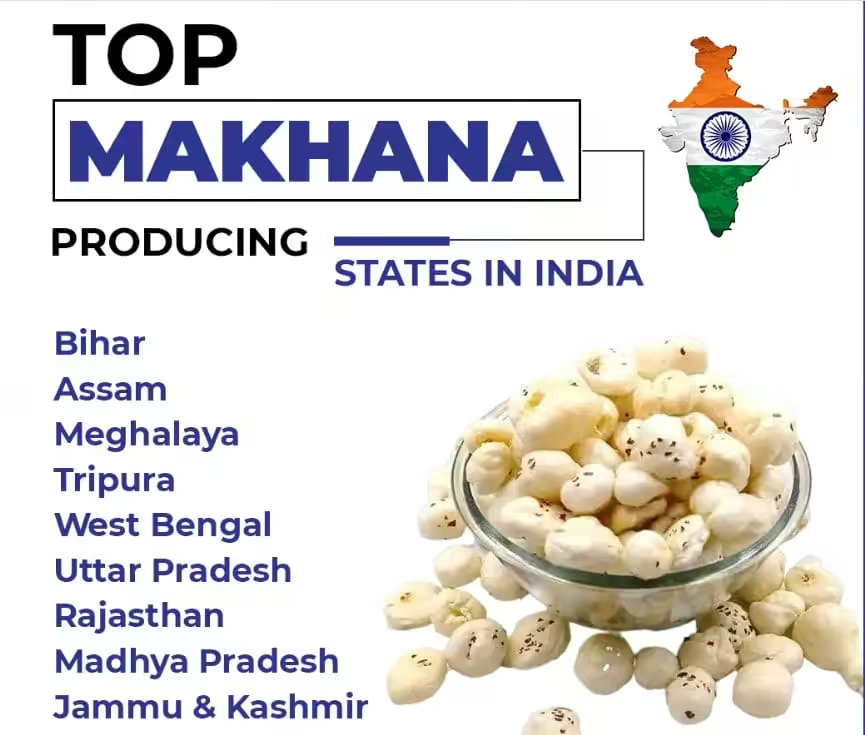
Also known as ‘ Black Diamond’ due to its multi-purpose use in medicine, healthcare, nutrition, the plant can be consumed in various forms. It is also widely consumed by people across the globe as a popular breakfast, evening snack, curries and sweetmeats. The plant has assumed great commercial importance in the last few years with ever increasing export potential to leading countries across the globe.
- Other neighbouring countries such as Nepal, Bangladesh, China, Japan, and Korea come after India in terms of fox nut production. Furthermore, the global Makhana market, which was valued at $43.56 million in 2023, is expected to reach $100 million by 2033.
Makhana Board:
- In Union Budget 2025-26 announced constitution of Makhana Board in Bihar.
- Budget Allocation: Rupee 100 crores.
- Board will be established to improve production, processing, value addition, and marketing of makhana.
- While an official headquarters has not been fully established, the board was launched by Prime Minister Narendra Modi in Purnea, Bihar.
- Ministry – Ministry of Commerce
The National Research Centre for Makhana (NRCM), Darbhanga.
Source: https://anantamias.com/current-affairs/makhana-foxnut-industry/
150th birth anniversary of Sardar Vallabhbhai Patel

As India celebrates the 150th birth anniversary of Sardar Vallabhbhai Patel on October 31, 2025, the country looks back at the life of one of its most determined makers of unity and freedom. Patel was born on October 31, 1875, in Nadiad, Gujarat, to a humble Patidar farmer family. Patel emerged from humble origins to serve as the first Deputy Prime Minister and Home Minister of independent India (1947–1950). Nicknamed as the “Iron Man of India” for his unshakeable courage and strategic wisdom, Patel’s service ranged from the freedom movement, national integration, to administrative reforms.
His legacy is the epitome of unity in diversity, and he remains a recurring subject in UPSC Civil Services Examination (CSE) – factual information for Prelims (e.g., dates of important movements) and analytical information for Mains (e.g., contribution to federalism and secularism under GS-I History and GS-II Polity).
Birth: October 31, 1875 (Nadiad, Gujarat); Death: December 15, 1950 (Mumbai); Title: “Sardar” awarded post-Bardoli Satyagraha (1928); Bharat Ratna: 1991 (posthumous).
Early Life and Education:
Vallabhbhai Jhaverbhai Patel, the fourth of six children, grew up in a rural setting where self-reliance was key. His father, Jhaverbhai Patel, a farmer and veteran of the 1857 Revolt, instilled values of discipline and patriotism. Patel completed his matriculation at 22, self-studying while managing family responsibilities. He pursued law through correspondence, borrowing books and working as a pleader in Godhra and Borsad.
In 1910, Patel went to England when he was 36 years old, passing the bar exams at the Middle Temple Inn within two years (1913), an achievement which underscored his intellectual abilities. Back in Ahmedabad, he established a profitable law practice, leading a Western lifestyle of elegant suits and games of bridge. But loss of his wife Jhaverben in 1909 and interactions with Gandhi changed him. Patel replaced his European clothes with khadi by 1917 and adopted simplicity and public service.
Mains Insight: Patel’s early years illustrate the move away from colonial imitation to native nationalism, in line with larger socio-economic changes in colonial India. His self-taught path highlights education and empowerment as themes in GS-I (Modern History).
Prelims Pointer: Qualified as barrister: 1913 (Middle Temple, London); Early career: Successful lawyer in Ahmedabad (1913–1917).
Entry into Politics and Role in Freedom Struggle:
Patel’s political development started at the hands of Gandhi. In 1917, as a secretary of the Gujarat Sabha (subsequently Gujarat Pradesh Congress Committee), he organized relief during the plague and famine in Gujarat, collecting volunteers and funds.
Key Movements and Leadership
Kheda Satyagraha (1918): Peasants, during famine and plague, were subjected to heavy revenue demands. Patel, along with Gandhi, organized a no-tax movement of 3,000 villages. By petitions, boycotts, and arrest (Patel being imprisoned), the British yielded, suspending the collection and freeing the prisoners. Thus, Patel came into the limelight as a mass leader.
Non-Cooperation Movement (1920–1922): Patel enlisted more than 300,000 members in Gujarat, collected Rs 1.5 million, and espoused swadeshi by incinerating foreign garments. He gave up his legal practice, which was an act of sacrifice.
Bardoli Satyagraha (1928): In response to a 30% tax increase when crops had failed, Patel mobilized 87,000 peasants in a non-violent campaign. Villages mass-resigned from government offices; the British, after a standoff of several weeks, rolled back the increase to 6.03%. Women called him “Sardar,” and the win stimulated Congress morale across the country.
Civil Disobedience Movement (1930): In defense of Gandhi’s Salt March, Patel was pre-emptively arrested but instigated mass defiance.
Quit India Movement (1942): Detained at Ahmednagar Fort along with other leaders, Patel’s pre-detention speech at Gowalia Tank Maidan called for “do or die.” Although quashed, the movement hastened independence.
Congress President (Karachi Session, 1931), Patel moved resolutions on basic rights, economic policy, and minority welfare, previewing the Constitution. He led the Congress Parliamentary Sub-Committee, planning for 1934/1937 elections, resulting in 8 provinces of Congress governments.
Patel’s satyagrahas underlined Gandhian non-violence’s effectiveness in rural mobilization, setting the movements apart from urban-centric movements. His organizational capabilities made Congress a mass party strong enough for post-independence consolidation (GS-I: Post-Independence Consolidation).
Integration of Princely States
With 565 princely states (40% of India’s territory), Patel, Home Minister, integrated them through diplomacy, persuasion, and force. With the help of V.P. Menon, he granted privy purses and privileges.
- Junagadh (1947): Nawab acceded to Pakistan; Patel organized a plebiscite, which saw 99% choose India.
- Hyderabad (1948): Nizam’s armed resistance resulted in Operation Polo; Hyderabad was integrated after a 5-day police action.
- Kashmir (1947–1948): Patel enabled accession after Pakistani invasion, sending troops to capture Srinagar.
By 1949, all but Sikkim had been integrated, forming a unified India.
Administrative and Social Reforms
- All India Services: Formed IAS/IPS as the “steel frame” for unbiased administration.
- Partition Relief: Assisted refugee influx (14 million), restoring order in Punjab/Delhi during communal riots.
- Social Initiatives: Established dairy cooperatives (e.g., Kaira Union, leading to Amul); promoted Somnath Temple reconstruction (1950), encouraging cultural revival.
- Secularism and Unity: RSS was banned briefly after Gandhi’s assassination (1948) but repealed after assurances; stressed national unity.
Patel’s integration prevented balkanization, setting the stage for federalism (Article 370 context). His practical secularism sought balance between unity and diversity, as against Nehru’s idealism – a major contention in GS-II (Polity) and GS-I (History).
Legacy and Contemporary Relevance
Patel’s death on December 15, 1950, from a heart attack marked the end of an era. Honored with Bharat Ratna (1991), his birthday is Rashtriya Ekta Diwas since 2014. The Statue of Unity (2018, Gujarat) – world’s tallest at 182m – symbolizes his vision.
archpaper.comThe Statue of Unity in Gujarat, the world’s tallest statue dedicated to Sardar Patel, commemorating his role in national integration.
Patel’s legacy is relevant to leadership in independence (GS-I), federal nature (GS-II), and economic policy (e.g., cooperative model in GS-III). His focus on “Ek Bharat” chimes in with regionalism and separatism.
“Every Indian should forget that he is a Rajput, a Sikh or a Jat.” (on unity); Comparisons: Bismarck of India. In 2025, with the world in turmoil, Patel’s ideals of discipline and integration guide India’s pursuit of Viksit Bharat.
Source: https://anantamias.com/current-affairs/150th-birth-anniversary-of-sardar-vallabhbhai-patel/
PM SHRI

Why in the News?
Minister for General Education V. Sivankutty on Friday described Kerala’s decision to finally sign up for the PM School for Rising India (PM SHRI) scheme as a “tactical” move to overcome denial of education funds to the State by the Centre.
UPSC Relevance
Schemes in news are often asked in Prelims.
PYQ
2025 Prelims
Consider the following statements about ‘PM Surya Ghar Muft Bijli Yojana’:
I. It targets installation of one crore solar rooftop panels in the residential sector.
II. The Ministry of New and Renewable Energy aims to impart training on installation, operation, maintenance and repairs of solar rooftop systems at grassroot levels.
III. It aims to create more than three lakhs skilled manpower through fresh skilling, and upskilling, under scheme component of capacity building.
Which of the statements given above are correct?
(a) I and II only
(b) I and III only
(c) II and III only
(d) I, II and III
2024 Prelims
With reference to the Digital India Land Records Modernisation Programme, consider the following statements:
1.To implement the scheme, the Central Government provides 100% funding.
2.Under the Scheme, Cadastral Maps are digitised.
3.An initiative has been undertaken to transliterate the Records of Rights from local language to any of the languages recognized by the Constitution of India.
Which of the statements given above are correct?
(a) 1 and 2 only
(b) 2 and 3 only
(c) 1 and 3 only
(d) 1, 2 and 3
PM SHRI Scheme
| Particular | Detail |
| Full Name | Pradhan Mantri Schools for Rising India (PM SHRI) |
| Launch Year | 2022 |
| Duration of Scheme | 5 years (from 2022-23 to 2026-27) |
| Objective | To develop more than 14,500 existing schools as model schools (exemplar schools) that will showcase the full implementation of the National Education Policy (NEP) 2020. |
| Type | Centrally Sponsored Scheme |
| School Types | Schools managed by Central Government, State/UT Governments, local bodies, Kendriya Vidyalaya Sangathan (KVS), and Navodaya Vidyalaya Samiti (NVS). |
| Total Project Cost | ₹27,360 crore (with Central Share of ₹18,128 crore) |
Key Features and Objectives
PM SHRI schools are designed to be modern, exemplar institutions focusing on:
- NEP 2020 Implementation: Showcasing all components of NEP 2020, including a focus on competency-based learning and a 360-degree Holistic Progress Card for assessment.
- Modern Infrastructure: Providing modern and safe infrastructure like Smart Classrooms, well-equipped Science/ICT Labs, and libraries.
- Holistic & Experiential Learning: Adopting a pedagogy that is experiential, inquiry-driven, discovery-oriented, learner-centred, and joyful.
- Green Schools: Incorporating environment-friendly features such as solar panels, LED lights, waste management, water conservation, and a nutrition garden.
- Future-Ready Citizens: Encouraging vocational intervention, digital learning, and enhancing internship/entrepreneurship opportunities, linking students to the local entrepreneurial ecosystem.
- Mentorship: These schools are expected to offer leadership and mentorship to other schools in their vicinity.
Note: All the States and UT’s have signed MoU under PM SHRI except West Bengal and Tamil Nadu. However the KV’s and NV’s in these states are part of PM SHRI.
How is the scheme implemented?
- Financial Linkage: The Centre has linked the release of funds under the Samagra Shiksha scheme (which is funded in a 60:40 ratio by the Centre and States) to the implementation of the PM-SHRI scheme.
- Support for the Right to Education (RTE) Act: The scheme actively supports the implementation of the Right to Education Act.
- Provision of Essentials: It provides uniforms and textbooks to students attending government schools.
- Inclusion Support: It offers support for differently-abled children.
- Economically Weaker Section (EWS) Reimbursement: The scheme covers the reimbursement provided to private schools for student admissions under the Economically Weaker Section (EWS) category.
Why cloud seeding is not a solution to Delhi’s air crisis:

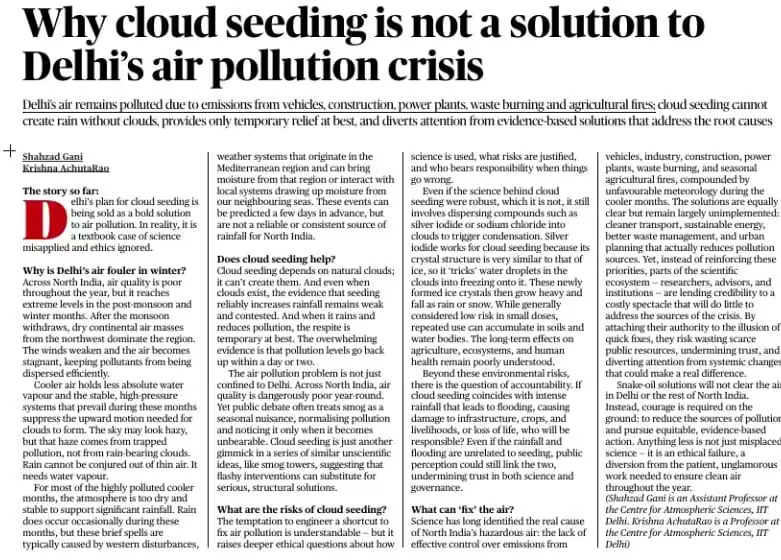
Context – Delhi Chief Minister Rekha Gupta has said that preparations have been completed to induce artificial rain through cloud seeding, marking a significant technological milestone in the capital’s fight against air pollution.
UPSC PYQ 2019
In the context of which of the following do some scientists suggest the use of cirrus cloud thinning technique and the injection of sulphate aerosol into stratosphere?
(a) Creating artificial rains in some regions.
(b) Reducing the frequency and intensity of tropical cyclone
(c) Reducing the adverse effects of solar wind on the Earth
(d) Reducing the global warming
Answer-(d)
What is Cloud seeding?
- It is a weather modification technique that improves a cloud’s ability to produce rain or snow by introducing tiny ice nuclei into certain clouds.
- Silver iodide, potassium iodide, dry ice (solid carbon dioxide), liquid propane or salts are injected into clouds. This is done with an aircraft, which injects the salts into the cloud.
- Injecting the particles makes clouds more capable of creating ice crystals, that gives rise to precipitation. Depending upon the temperature, these crystals fall as snow flake or melt to lead to rains.
- The amount of rains generated from cloud seeding depends on the number of ice nuclei inside the cloud and the amount of water available nearby to grow around it.
- These nuclei provide a base for snowflakes to form which then quickly grow and fall from the clouds back to the surface of the Earth.
What are its merits?
- It can bring artificial rains in water starved and drought prone areas like Rajasthan, Maharashtra, UAE, China etc.
- It can prevent crop failure, boost agricultural productivity and can support rural livelihoods.
- It can help fill dams and recharge groundwater → crucial for drinking water, irrigation, and hydropower generation.
- It can help in reducing air pollution as it helps wash out PM2.5/PM10 and other pollutants → China and UAE use this to clear smog.
- It can help in mitigating hazards; for e.g. used to reduce hail formation (by spreading water droplets more evenly) and to tackle forest fire.
- It can induce artificial snowfall in mountainous regions to maintain snowpack.
What are the issues involved?
- It can’t create new clouds.
- There is a week evidence that seeding reliably increases rainfall.
- Reduction of pollution is also for a very temporary period. The pollution levels go back up within a day or two.
- The long-term effects on agriculture, ecosystems, and human health remain poorly understood as repeated use of silver iodide can accumulate in soils and water bodies.
- If cloud seeding coincides with intense rainfall, it can lead to flooding, causing damage to infrastructure, crops, and livelihoods, or loss of life.
- Political disputes: If one state seeds clouds, neighbouring state may allege theft of their rainfall.
- Lack of accountability and responsibility – No clear legal or global environmental regulation framework.
Important Case Studies
| Case | Location | Objective | Outcome |
| Project Varshadhare (2017–19) | Karnataka (Bengaluru, Malnad) | To tackle drought & augment reservoir levels | Mixed success – rainfall ↑ by 10–15%, but not scientifically conclusive |
| Hyderabad Pollution Control (2023) | Telangana | Reduce air pollution + increase rainfall | Still under study; AI-based cloud prediction deployed |
| Beijing Olympics (2008) | China | Prevent rainfall during opening ceremony | Successfully pushed rain clouds away before event. |
| Dubai / UAE (Ongoing since 2010) | UAE | Create artificial rain using drones & salt flares | Highly successful — 300+ seeding operations per year. |
| Thailand Royal Rainmaking Project. | Thailand | King Bhumibol’s innovation to increase monsoon rains. | Internationally recognized – patented by Thailand. |
Practice Question:
What is cloud seeding? How far do you agree that cloud seeding can help India to resolve its issues of air pollution and water scarcity? (10 Marks, 150 words)
Source: https://anantamias.com/current-affairs/why-cloud-seeding-is-not-a-solution-to-delhis-air-crisis/
Gyan Bharatam Mission
Why in the News?
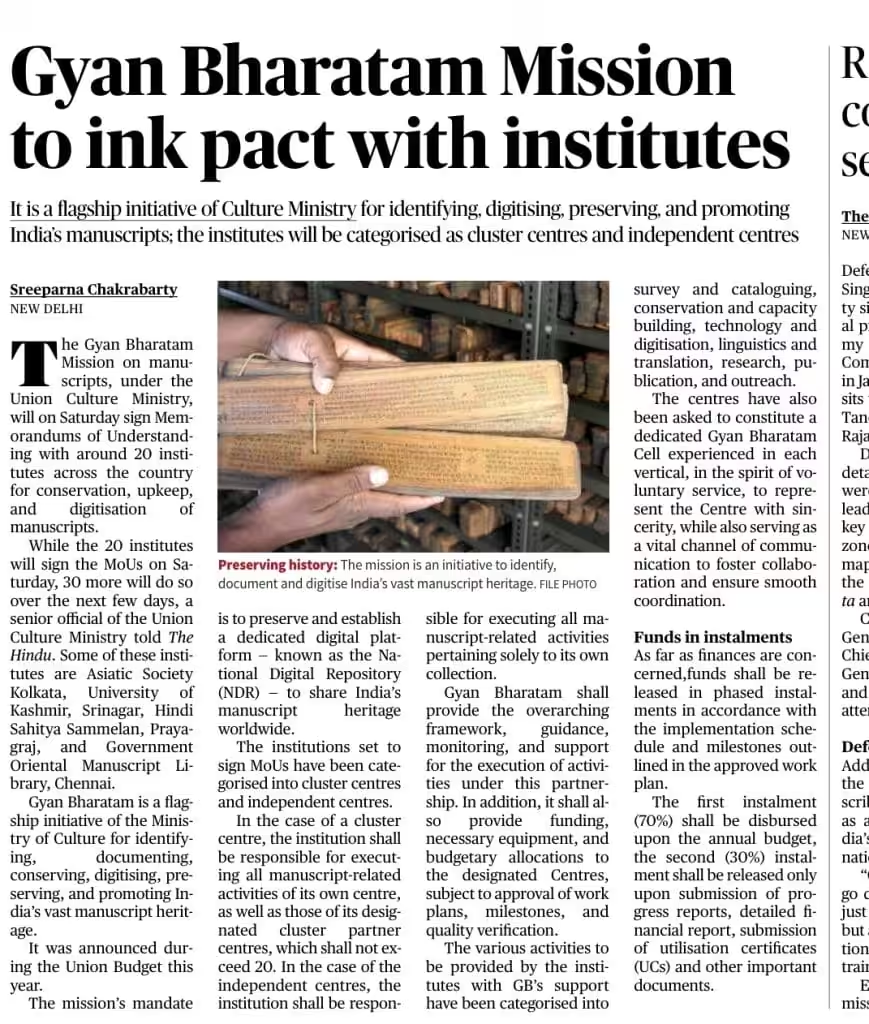
The Gyan Bharatam Mission, under the Union Culture Ministry, will on 25 October sign Memorandums of Understanding with around 20 institutes across the country for conservation, upkeep, and digitisation of manuscripts.
UPSC Relevance
Schemes and initiatives especially digital are often asked in Prelims.
PYQ
2022 Prelims
With reference to Ayushman Bharat Digital Mission, consider the following statements:
1.Private and public hospitals must adopt it.
2.As it aims to achieve universal health coverage, every citizen of India should be part of it ultimately.
3.It has seamless portability across the country.
Which of the statements given above is/are correct?
(a) 1 and 2 only
(b) 3 only
(c) 1 and 3 only
(d) 1, 2 and 3
Gyan Bharatam Mission (GBM)
| Particular | Details |
| Mission Name | Gyan Bharatam Mission (GBM) |
| Nodal Ministry | Ministry of Culture, Government of India |
| Announced | Union Budget 2025-26 for (2024–2031) |
| Total Outlay | ₹482.85 Crores . The first instalment (70%) shall be disbursed upon the annual budget, the second (30%) instalment shall be released only upon submission of progress reports, |
| Type | Central Sector scheme |
| Core Vision | To preserve, digitize, and disseminate India’s vast manuscript heritage and revive its civilizational knowledge traditions for future generations.The Mission is a revival and expansion of the earlier National Mission for Manuscripts (NMM, 2003). |
| Key Target | Digitize and catalog over 1 crore manuscripts across the country. |
Key Components (Pillars):
- Preservation & Conservation: Safeguarding fragile texts using scientific and traditional methods.
- Digitisation & Repository: Creating a National Digital Repository (NDR) using advanced technology like AI, Handwritten Text Recognition (HTR), and cloud metadata for global accessibility. The Mission has been allocated Rs. 482.85 crore (2024–31), with over 44.07 lakh manuscripts already documented in the Kriti Sampada digital repository.
- Capacity-Building: Training a new generation of scholars, conservators, and transcribers.
- Research & Publication: Reviving rare and unpublished manuscripts through critical editions and translations.
- Outreach & Public Engagement: Making manuscripts a living resource through educational modules, AR/VR experiences, and public exhibitions.
- Technological Integration: The mission focuses on the use of cutting-edge digital tools, AI innovations, and a dedicated platform called the Gyan Bharatam Portal for public access.
‘Gyan Bharatam’ International Conference
The Gyan Bharatam Mission was formally launched at the first-ever ‘Gyan Bharatam’ International Conference on “Reclaiming India’s Knowledge Legacy through Manuscript Heritage.”
- Dates: September 11–13, 2025 (The date of the conference’s start, September 11, also marked the anniversary of Swami Vivekananda‘s 1893 Chicago Address).
- Venue: Vigyan Bhawan, New Delhi.
- Theme: “Reclaiming India’s Knowledge Legacy through Manuscript Heritage.”
- Significance: The conference was the launch platform for the Gyan Bharatam Mission and the associated Gyan Bharatam Portal, which was launched by the Prime Minister.
- The Gyan Bharatam Conference is the first international platform that has invited stakeholders from across the country to discuss, deliberate, and chart the way forward for preserving and digitising India’s manuscript heritage.
- Participation: It brought together over 1,100 participants, including scholars, experts, institutions, and cultural practitioners from India and abroad.
- Key Speakers: The event featured addresses by the Prime Minister of India, the Minister of Culture, and other eminent dignitaries.
- Outcome :
- The “Delhi Declaration – Gyan Bharatam Sankalp Patra” was adopted, pledging preservation, globalisation, community outreach, educational integration, and recognition of custodians, with every pledge’s first letter spelling “Gyan Bharatam”.
- The conference featured deliberations across several working groups focusing on areas like script decipherment (including the Harappan script), legal frameworks, conservation, and digitization standards.
- The “Gyan Setu” AI Challenge was also announced to encourage innovation in digital tools for manuscripts.
- The event was hailed as a “Jan Andolan” (people’s movement) and a model for participatory heritage revival.
The mission is seen as a forward-looking step towards the vision of a Viksit Bharat (Developed India) by 2047, positioning India as a Vishwa Guru (World Teacher) by combining its past wisdom with future innovation.
Source: https://anantamias.com/current-affairs/gyan-bharatam-mission-important-details/