Daily Digest
UPSC · Civil Services Examination
Current Affairs · Tuesday, 28 October 2025
Current affairs curated and edited by Anantam IAS faculty — pulled from The Hindu, PIB, IDSA, Foreign Affairs and the ministries. Read, annotate, revise.
Old Rajinder Nagar · Delhi 110005 · anantamias.com
MGNREGA 2025: Promise, Problems and the Path Ahead

At least 1.4 lakh poor rural households had already completed their quota of 100 days of work under MGNREGA in the first three months of a year, and are not eligible for further benefits under the scheme for the rest of the year. Another seven lakh households had completed 80 days and were on the verge of running out of work as well. Now, in recent years the picture has further changed: registrations under MGNREGA rose by 8.6 % in 2024-25, yet actual employment generated fell by 7.1 % and average work-days per household declined by 4.3 %.
UPSC relevance
- Because in the UPSC syllabus for GS II we have:
- “Government policies and interventions for development in various sectors and issues arising out of their design and implementation.”
- Also, MGNREGA is a major scheme of the Government of India, and several mains questions have been asked on it (design, implementation, issues, and way forward).
So our approach will be:
- Steps taken by the government / recent reforms
- Past employment schemes in India
- Issues with those past wage employment programmes
- Benefits of MGNREGA
- Issues with MGNREGA (updated)
The extent of India’s poverty and need for employment
The poverty-reduction journey in India has been significant: according to the Global Multidimensional Poverty Index 2019, 271 million people moved out of poverty between 2005/06 and 2015/16, and the poverty rate nearly halved from 55 % to 28 %. However, a significant part of India’s population still lives below the poverty line (estimates ~21.9% according to Tendulkar Committee).
A major contributor to the persistence of poverty is the lack of adequate employment opportunities in rural areas, hence wage employment guarantees are a crucial policy component. In recent times, though, registered demand under MGNREGA is high (82.4 million people had demanded work as of January 27, 2025) but actual fund release, employment generation and timely wages are major challenges.
Past employment schemes in India (Some quick recap)
- Integrated Rural Development Programme (IRDP)
- Jawahar Rozgar Yojana / Jawahar Gram Samriddhi Yojana
- Sampoorna Gramin Rozgar Yojana (SGRY)
These schemes attempted to provide wage employment or self-employment to the rural poor, but faced serious structural and implementation challenges.
Issues with those past wage employment programmes
- Funds
- Funds were not always fully used; untimely release; states struggled with matching contributions.
- Lack of planning
- Very low coverage (less than 5% of villages in some instances)
- Disproportionate tilt towards capital acquisition rather than wage employment
- Poor project selection affecting asset usability.
- Lack of people’s participation
- Minimal involvement of gram panchayats or local people in planning and implementation
- Panchayats often weak or bypassed.
- Lack of inclusiveness
- Participation of women was low; benefit capture by better‐off households more likely.
Thus a reform was needed in the way we looked at rural wage employment schemes — and that led to MGNREGA.
MGNREGA: A paradigm shift
- The Act legally recognised employment as a right, guaranteeing up to 100 days of unskilled manual work to each rural household.
- The word “GUARANTEE” in MGNREGA marks a major departure from earlier schemes (which were voluntary or ad-hoc).
Benefits
- Poverty and Unemployment reduction
- Direct payment of wages to rural households.
- Indirect effects: In several states, up to half of MGNREGA income was spent on food, thereby improving nutrition; agricultural wages improved; bargaining power of rural poor improved.
- Vulnerable section upliftment
- Women: MGNREGA has been a critical source of income for female‐headed households; reduces gender wage bias.
- Backward classes & ST/SC: Since the scheme is self-targeting (only those rural households which volunteer for work), a substantial share of beneficiaries are from marginalized communities.
- Migration reduction
- By providing local employment, distress migration to urban areas has been curtailed in certain contexts.
- Asset creation & benefit to economy
- Assets created: water conservation, rural roads, sanitation, flood protection, etc — these also reduce vulnerability and contribute to rural infrastructure.
- Multiplicative effect on rural economy via increased purchasing power of rural households.
Hence, MGNREGA promised both short-term income support and long-term asset creation.
Issues with MGNREGA (including updated & recent issues)
Here we examine the problems of MGNREGA — some long-standing, others emerging in recent years.
Structural/Design issues
- Guaranteeing reach vs guaranteeing outcome
- While MGNREGA guarantees up to 100 days work, actual average work‐days delivered have fallen in 2024-25: only about 7 % of households completed 100 days.
- Region‐specific labour demand, seasonality of agricultural cycle, local demand for work — all affect realisation of guarantee.
- Ensuring durable assets & convergence
- The scheme’s dual mandate (employment + durable asset creation) often tilts more to employment, with asset quality and long-term benefit lacking.
- Convergence with other schemes (for example rural roads, sanitation, agriculture) continues to be a challenge.
- Centre-state funding & execution dynamic
- Central funding, state execution: accountability often blurred.
- In 2024-25, there was no revised fund allocation even though demand was high and wages pending: funds for wages alone stood at nearly Rs 6,948.55 crore as of Jan 25, 2025. Down To Earth
- Role of local governments / Panchayats
- Gram panchayats are supposed to plan, implement, monitor (social audits). But many PRIs lack capacity, autonomy or funds.
- Administrative & Institutional issues
- Leakages remain: fake job cards, fabrication of muster rolls.
- Transparency: Beneficiary identification, work identification, estimate preparation often opaque.
- Social audits are weak in many states.
Other pressing issues
The registered households increased, but actual employment generated declined: in 2024-25 only ~7% households got the full 100 days, showing that the guarantee is far from being realised.
Wage delays & inadequate wage rates
- A parliamentary committee (May 2025) pointed out wage delays and recommended raising MGNREGA wages to at least Rs 400/day as current rates don’t meet basic living costs.
- For example: “As recently as January 2025, the government hasn’t been able to release ₹4,315 crore for wages …” Finshots
Declining real fund release & budget mismatch
- Even though budget allocation for FY25 was maintained at ~Rs 86,000 crore, actual funds released fell compared to previous years. Business Standard
- Funds released for 2024-25: ~Rs 85,838.76 crore, less than the Budget Estimate. Business Standard
Mass deletion of job‐cards / exclusions
- In FY 2024-25, 11.6 million job cards were deleted while 13.1 million were reinstated — major concern for access.
- Around 27.5% of total workers were excluded due to Aadhaar‐based payment system non‐compliance.
Inequities (Caste, region, gender)
- A field report (May 2025) finds caste‐based inequities: allocation, planning and benefit capture under MGNREGA vary significantly by social category and geography.
Irregularities / local governance failures
- Example: In Sunkeshwar village, Raichur district, residents blocked the Gram Panchayat office complaining of fake job‐cards, no work but records showing work, and large scale fraud under MGNREGA. The Times of India
- Example: In Gujarat, the son of an agriculture minister was arrested for alleged MGNREGA fraud involving fake job cards. Navbharat Times
State‐specific problems: West Bengal case
- In West Bengal the scheme was suspended for nearly three years (from 2022) owing to alleged irregularities; the Supreme Court of India and the Calcutta High Court have ordered that the scheme be resumed from 1 August 2025. Hindustan Times+2www.ndtv.com+2
Mismatch in labour absorption
- The registered households increased, but actual employment generated declined: in 2024-25 only ~7% households got the full 100 days, showing that the guarantee is far from being realised.
Summary of key recent issues
- State‐specific implementation breakdowns (e.g., West Bengal).
- Persistent wage payment delays, inadequate wage rate relative to rural inflation.
- Declining effective fund release vs. budget estimates.
- Access issues: job card deletion, Aadhaar compliance exclusions.
- Implementation deficits: asset quality, convergence, capacity of Panchayats.
- Social inequalities: caste, region, gender disparities.
- Governance and accountability failures: frauds, fake job cards, local protests.
- Steps taken by the government / recent reforms
- Budget allocations – While allocations have remained at ~Rs 86,000 crore for FY24-25 & 25-26, the discussions on raising wage rates and revisiting indexing have been flagged.
- Use of MIS – The scheme’s Management Information System (MIS) tracks demand for work, wages, person-days generated.
- Proactive disclosure and geotagging – Works under MGNREGA are supposed to be geo-tagged, photographs uploaded, enhancing transparency (though actual compliance varies).
- Linkages with other sectors – For example, the NITI Aayog has noted that MGNREGA can play a role in agriculture: reducing cost of cultivation, diversifying crops, rehabilitating land/assets after disasters. NITI Aayog
- Legal and court orders – For instance, in West Bengal case the court has ordered resumption of MGNREGA, underscoring the legal guarantee dimension.
- Social audit provisions remain in place (though implementation weak) – empowerment of local communities to audit works.
- Capacity building and administrative reforms – Efforts to strengthen Panchayats, decentralise planning, and integrate MGNREGA with livelihood promotion, non-farm employment.
Way forward (what needs to be done)
- Greater focus on livelihood beyond 100 days: While 100 days is guarantee, many households need more. Policy could consider path to sustainable livelihood rather than only wage employment.
- Revision of wage rates and indexing: Link wages to a rural cost‐of‐living index, ensure real value of wages keeps pace with inflation.
- Ensure fund flow and demand-driven capacity: Raise allocation in sync with demand; avoid deletion of job cards unless justified; faster wage payment.
- Strengthen local governance and community participation: Build capacities of Panchayats; make social audits meaningful; ensure people’s involvement in planning & monitoring.
- Improve asset quality and convergence: Works under MGNREGA should create durable assets (water conservation, climate resilience, rural infrastructure) and integrate with agriculture, DRR, livelihood schemes.
- Address inequities: Target marginalised groups effectively; use data to identify caste/region-based disparities; map job card deletions and exclusions.
- Enhance transparency & accountability: Strict action against frauds; e-governance tools (geo-tagging, photograph uploads, payments via bank accounts); grievance redressal mechanisms.
- Seasonality and demand management: Link employment guarantee with off‐farm rural employment, agro‐ecological calendar to align demand for work when there is farm lull.
The MGNREGA continues to be one of India’s most important social protection and rural employment schemes. However, as the recent evidence shows, the scheme is facing serious implementation and structural challenges – delayed wages, inadequate allocation relative to demand, exclusion of eligible workers, asset quality concerns, and regional/social inequities.
For UPSC aspirants, evaluating MGNREGA means not only knowing its design and successes but also critically analysing its current status, recent reforms and lapses. The scheme’s promise of “guaranteed employment” for rural households remains valid on paper — the real test is in its execution on ground.
Source: https://anantamias.com/current-affairs/mgnrega-2025-promise-problems-and-the-path-ahead/
Dogri Language and Linguistic Crisis in India

Why in the News?
In recent years, growing concern has emerged over the gradual decline of the Dogri language in the Jammu region.
UPSC Relevance
Linguistic provisions are often asked in Prelims.
PYQ
2024 Prelims
The Constitution (71st Amendment) Act, 1992 amends the Eighth Schedule to the Constitution to include which of the following languages?
1. Konkani
2. Manipuri
3. Nepali
4. Maithili
Select the correct answer using the code given below:
a) 1, 2 and 3
b) 1, 2 and 4
c) 1, 3 and 4
d) 2, 3 and 4
India’s Linguistic Crisis
- Global Trend: Human society is rapidly moving towards the extinction of its linguistic heritage.
- India’s Rank: According to a UNESCO report, India has the maximum number of dialects on the verge of extinction.
- Recent Losses: Over 220 languages have been lost in India in the last 50 years (according to D.G Rao, former Director of the Central Institute of Languages).
Recently Extinct Regional Languages
- Bo Language (Andaman Islands): The death of the last known speaker, Boa Sr., in 2010, led to the extinction of this ancient language, which belonged to the Great Andamanese language family.
- Ahom (Himalayan Region): A language from the Tai-Kadai family, once spoken in the Brahmaputra valley.
- Andro
- Rangkas
- Sengmai
- Tolcha (These last four are generally cited as extinct languages from the Himalayan region.)
Languages Under Threat of Extinction
UNESCO categorizes over 190 languages in India as endangered. The most threatened languages are typically those with very few speakers (fewer than 10,000) and poor inter-generational transmission. It categorizes these languages into five categories :
| Category of Threat (UNESCO) | Example Languages | Region |
| Critically Endangered (Fewer than 100 speakers) | Majhi | Sikkim |
| Great Andamanese (a family of dialects) | Andaman Islands | |
| Birhor | Jharkhand, Chhattisgarh | |
| Kota, Toda | Tamil Nadu (Nilgiri Hills) | |
| Severely Endangered | Asur | Jharkhand |
| Aiton | Assam | |
| Koro | Arunachal Pradesh | |
| Definitely Endangered | Deori | Assam |
| Juang | Odisha | |
| Kachari | Assam | |
| Vulnerable | Bodo | Assam (Scheduled Language, but vulnerable) |
| Gondi | Central India | |
| Irula | Southern India | |
| Extinct | – | – |
Concerns Over Dogri’s Decline
- Emerging Crisis: There is growing concern over the gradual decline of the Dogri language in the Jammu region.
- Root Causes:
- Socio-Economic Factors: Globalisation, migration, and the pursuit of economic opportunity encourage speakers to prioritise widely used languages, leading to regional ones fading.
- Political and Social Factors: Political choices and a lack of active interest among native speakers deepen the crisis.
- Formal Recognition vs. Ground Reality:
- Late Recognition: Dogri had to wait until 2003 for constitutional recognition, meaning it fell behind languages like Urdu, Kashmiri, and Hindi in institutional backing.
- The J&K Official Languages Bill, 2020, gave Dogri recognition as one of the Union Territory’s five official languages.
- However, this official status has not translated into a meaningful presence on the ground, as Dogri is largely absent from formal education and administrative use.
- Spoken Dogri Usage
- Rural Areas: Approximately 56% of respondents actively speak Dogri.
- Urban Areas: Only 45% of respondents reported speaking Dogri.
- Written Dogri Proficiency
- Rural Areas: Around 15% of respondents demonstrate the ability to write Dogri.
- Urban Areas: Only 4% of respondents had any proficiency in writing it.
The Way Ahead
- Technical Challenge (Data): The 2021 Census is on hold, leading to a lack of updated data on endangered languages. This absence of knowledge hinders awareness and effective policy formation.
- The first linguistic survey of Indian languages was launched in 1894 by George Abraham Grierson, who also prepared the language survey report for the 1901 Census.
- The 1961 Census of India recorded 1,652 mother tongues, of which SPPEL has identified 117 endangered languages. By 2011, this diversity had expanded significantly, with the census recording 2,843 different mother tongues.
- Mindset Challenge (Policy): There is a need to shed the mindset that equates English alone with progress, making the decolonisation of linguistics the larger task.
- Digital Platforms and AI: Utilize advanced technologies like Artificial Intelligence (AI), Natural Language Processing (NLP), and speech recognition to build scalable language solutions.
- Bhashini and BharatGen offer real-time translation and multilingual support across education, governance, and healthcare.
- Adi-Vaani is a dedicated AI-driven system for the preservation and real-time translation of tribal languages.
- Community-Driven Projects: Support local, community-based initiatives that focus on collecting linguistic data, developing learning materials, and promoting cultural activities tied to the language.
- Creative Industries: Encourage the creation of literature, music, and art in the regional languages to make them culturally vibrant and relevant to modern life.
22 Languages in the Eighth Schedule
| S. No. | Language | Year Included | Constitutional Amendment |
| 1-14 | Assamese | 1950 (Initially included) | Original Constitution |
| Bengali | 1950 (Initially included) | Original Constitution | |
| Gujarati | 1950 (Initially included) | Original Constitution | |
| Hindi | 1950 (Initially included) | Original Constitution | |
| Kannada | 1950 (Initially included) | Original Constitution | |
| Kashmiri | 1950 (Initially included) | Original Constitution | |
| Malayalam | 1950 (Initially included) | Original Constitution | |
| Marathi | 1950 (Initially included) | Original Constitution | |
| Odia, Named by the 96th Constitutional Amendment Act of 2011. (Original name: Oriya) | 1950 (Initially included) | Original Constitution | |
| Punjabi | 1950 (Initially included) | Original Constitution | |
| Sanskrit | 1950 (Initially included) | Original Constitution | |
| Tamil | 1950 (Initially included) | Original Constitution | |
| Telugu | 1950 (Initially included) | Original Constitution | |
| Urdu | 1950 (Initially included) | Original Constitution | |
| 15 | Sindhi | 1967 | 21st Amendment Act, 1967 |
| 16 | Konkani | 1992 | 71st Amendment Act, 1992 |
| 17 | Manipuri | 1992 | 71st Amendment Act, 1992 |
| 18 | Nepali | 1992 | 71st Amendment Act, 1992 |
| 19 | Bodo | 2004 | 92nd Amendment Act, 2003 |
| 20 | Dogri | 2004 | 92nd Amendment Act, 2003 |
| 21 | Maithili | 2004 | 92nd Amendment Act, 2003 |
| 22 | Santhali | 2004 | 92nd Amendment Act, 2003 |
Language families in India

Read more on endangered languages and government policies to protect them: Documenting India’s Endangered Languages – PIB
Source: https://anantamias.com/current-affairs/dogri-language-and-linguistic-crisis-in-india/
India–Pakistan Relations 2025: Kashmir, Indus Waters Treaty, Trade Freeze & Ceasefire — Complete GS-II Analysis

The India-Pakistan relationship is one of the most significant and contentious relationships in South Asia. This relationship dates back to the Partition of 1947, and armed conflict in 1947-48, 1965, 1971, and the Kargil conflict in 1999. Today, the relationship between the two countries is complicated with the Kashmir conflict, cross-border-terrorism concerns, the ceasefire along the Line of Control that was agreed to in 2021, the inauguration of the Kartarpur Corridor in 2019 for people-to-people connection, an ongoing trade blockade that has existed since 2019, and negotiations surrounding the Indus Waters Treaty.
Along with security implications, the relationship has also ramifications for SAARC (South Asian Association for Regional Cooperation), SCO (Shanghai Cooperation Organization) and FATF (Financial Action Task Force), nuclear deterrent, along with the diaspora population in the two countries and options for regional connectivity that impacts India’s strategic and economic interests.
Why it matters for GS-II?
- India & its neighbourhood—relations; bilateral, regional & global groupings; effect of policies of other countries on India’s interests, diaspora; international institutions, agencies & fora.
- High salience for Prelims (treaties, dates, institutions) and Mains (security, water, trade, CBMs, third-country roles).
What’s the Big picture (one-glance)?
- Relationship is conflict-prone but crisis-managed; cycles of deterrence, terrorism, diplomacy, and limited engagement.
- Core frictions: Kashmir & cross-border terrorism; water sharing; Siachen; Sir Creek; trade restrictions; information warfare.
- Stabilizers: 2003 LoC ceasefire (reaffirmed Feb 2021), hotlines, Indus Waters Treaty (World Bank-brokered), backchannel diplomacy, people-to-people religious corridors (Kartarpur). Reuters+2giss.org+2
How is the Historical arc (super-brief) ?
- 1947–71: Partition trauma; wars (1947–48, 1965, 1971).
- 1990s–2010s: Insurgency in J&K; 1999 Kargil; 2003 LoC ceasefire; 2004–08 CBMs; 26/11 (2008) stalls outreach.
- 2019 Pulwama–Balakot → India hardens terror-first conditionality; Aug 2019 J&K reorganisation → Pakistan downgrades ties & suspends bilateral trade. Reuters+1
What are the Core dispute issues?
Kashmir & terrorism
- India’s position: terrorism emanating from Pakistan-based groups (e.g., JeM/LeT) is the central barrier to normalisation; dialogue only in an environment free of terror.
- Pakistan’s position: prioritises Kashmir dispute and human-rights framing.
- Crisis-management: Reaffirmed LoC ceasefire on 25 Feb 2021 via a rare joint statement by both militaries; firing incidents dropped markedly after that. Reuters
Water: Indus Waters Treaty (IWT, 1960)
- Long-standing, World Bank-brokered regime managing the Indus basin.
- 2025 reporting indicates India placed aspects of the treaty in suspension, with follow-on coverage noting the status remained suspended despite subsequent de-escalation; Pakistan objected through diplomatic/legal channels. (This remains a live, fast-moving issue—cite recent coverage if asked in exam.) Reuters
Trade & connectivity
- Formal trade frozen since 2019; most exchanges, if any, are indirect (e.g., via Dubai); Wagah-Attari largely shut for bilateral commerce. Al Jazeera+1
Confidence-Building Measures (CBMs) & limited cooperation
- Ceasefire reaffirmation (2021) and DGMO hotlines. Reuters
- Kartarpur Corridor (2019): visa-free pilgrimage for Indian Sikhs to Gurdwara Darbar Sahib, Narowal—symbolic people-to-people bridge. Xinhua+2giss.org+2
- Humanitarian gestures in disasters have occurred intermittently (earthquakes, floods), though they don’t consistently reset ties.
International institutions & third-party influence
FATF
- Pakistan exited the FATF “grey list” in Oct 2022—important for its financial system and narrative on terror finance—but continued scrutiny emphasized in 2025 communications. FATF+1
World Bank & IWT
- WB’s depositary role under the Indus Waters Treaty continues to matter in dispute resolution/neutral expert processes. (Link to “international institutions” line of syllabus.)
Multilaterals/regionals
- SAARC remains moribund; SCO occasionally provides side-meeting optics but little substantive movement.
Economics, society, diaspora
- Trade potential vs political ceiling: Informal/indirect trade persists despite formal freeze; experts estimate several-billion-dollar indirect flows. Al Jazeera
- Culture & diaspora: Shared North-Indian/Punjabi/Hindustani cultural space; diaspora communities can be bridges but also mirror tensions.
Recent timeline (exam-usable)
- Feb 2021: LoC ceasefire reaffirmed—major reduction in cross-LoC firing, crisis risk lowered. Reuters
- Oct 2022: Pakistan off FATF grey list (continued monitoring by APG/FATF ecosystem). FATF
- 2019→: Bilateral trade suspended, diplomatic downgrading after J&K reorganisation; indirect trade via third countries noted by analysts. Al Jazeera+1
- 2019: Kartarpur Corridor opens—limited but symbolically significant. Xinhua
- 2025: Multiple credible outlets report a spring crisis (short, intense phase) followed by de-escalation & renewed ceasefire adherence; also reporting that IWT provisions were suspended and later remained suspended pending political decisions. (If writing for Mains, phrase carefully: “as per Reuters/CRS reporting, the status of the IWT became disputed in 2025”.) Congress.gov+1
India’s objectives & constraints
Objectives
- Zero tolerance to cross-border terror; deterrence without uncontrolled escalation.
- Status quo advantage on Kashmir; water security; limit Chinese leverage via China–Pakistan nexus (CPEC).
- Regional stability to focus on growth & Indo-Pacific priorities.
Constraints
- Terror triggers can derail engagement; low trust; domestic politics on both sides; third-actor dynamics (militant groups; great-power diplomacy).
What works (policy mix going forward)
Security first, crisis management always
- Keep LoC ceasefire intact; strengthen hotlines, de-confliction playbooks; targeted counter-terror posture + info ops.
Legally aware water diplomacy
- If IWT status is in question, maintain a law-first approach (World Bank role, neutral expert) to avoid water weaponisation spirals. Reuters
Smart, surgical engagement
- Terror-insulated corridors (Kartarpur-like), medical visas, pilgrimages, disaster coordination. Xinhua
Trade with guard-rails
- Start with indirect/limited lists (life-saving drugs, agri inputs) once security permits; leverage regional value chains cautiously. Al Jazeera
Leverage institutions
- FATF compliance remains a lever against terror finance; encourage verifiable action—benefits both sides’ financial systems. FATF+1
Narrative & diaspora
- De-escalate information warfare; use diaspora platforms for confidence-building (academic, health, tech).
Prelims boosters (one-liners)
- Indus Waters Treaty (1960)—brokered by World Bank; allocates eastern rivers (Ravi, Beas, Sutlej) to India and western (Indus, Jhelum, Chenab) to Pakistan; long considered one of the most durable water treaties. (Know that its status drew intense scrutiny in 2025 reporting.) Reuters
- LoC ceasefire first in 2003, reaffirmed 2021. Reuters
- Kartarpur Corridor opened Nov 2019 (visa-free pilgrimage). Xinhua
- FATF: Pakistan removed from grey list (Oct 2022); continued follow-up stressed in 2025. FATF+1
Mains answer framers (quick hooks)
- “Cold peace, hot buttons”: Explain why deterrence holds but normalisation lags (terror triggers, domestic incentives, external actors).
- From ‘talks & terror don’t go together’ to ‘terror-insulated micro-engagements’: argue a middle path using Kartarpur as model. Xinhua
- Water as test case: legality, hydrology, climate stress; why institutionalised resolution beats coercive signalling. Reuters
A Start for North-South Carbon Market Cooperation

Why in the News?
The New Strategic EU-India Agenda has been announced which is a critical move to link the Indian Carbon Market (ICM) with the EU’s Carbon Border Adjustment Mechanism (CBAM).
UPSC Relevance
GS3, Conservation, Environmental Pollution and Degradation, Environmental Impact Assessment, Important Climate Change initiatives are asked in Prelims.
PYQ
2021
Describe the major outcomes of the 26th session of the Conference of Parties (COP) to the United Nations Framework Convention on Climate Change (UNFCCC). What are the commitments made by India in this conference? (15 M)
Latest Developments
The New Strategic EU-India Agenda has been announced which is a critical move to link the Indian Carbon Market (ICM) with the EU’s Carbon Border Adjustment Mechanism (CBAM).
- New Strategic EU-India Agenda (September 17, 2025):
- The joint communication sets out a new comprehensive strategic agenda with five pillars, including prosperity and sustainability, technology, security, connectivity, and global issues.
- A key component in the section on clean transition is the commitment for the EU to link the Indian Carbon Market (ICM) with CBAM.
- Significance of the Linkage:
- In plain terms, carbon prices paid in India will be deducted from CBAM levies at the EU border.
- This is a breakthrough that could prevent Indian exporters from being penalized twice and reward early decarbonization.
Major Barriers to Operationalization
Underdeveloped Indian Carbon Market (ICM)
- Evolving Architecture: India’s Carbon Credit Trading Scheme (CCTS), or ICM, is still an evolving architecture with fragmented foundations, unlike the two-decade-old, robust EU Emissions Trading System (ETS).
- Lack of Absolute Caps: Current Indian credits are often based on intensity improvements or project-based offsets, not absolute caps on emissions, which is what the CBAM requires for tonne-for-tonne accounting of embedded carbon.
- Result: Without legally binding caps, EU regulators may treat Indian credits as “second class.”
- Institutional Gap: India currently lacks an institutional equivalent to the EU’s independent regulators and emissions registries that guarantee market integrity.
- Challenge: Bridging this requires a structural redesign of the ICM to mirror the compliance-grade features of the EU’s ETS, a difficult pivot for India’s bureaucracy in the near term.
Misaligned Carbon Prices
- Price Disparity: CBAM relies on a stringent carbon price (EU ETS floats around €60 to €80 per tonne), while initial Indian carbon credit prices hover in the range of €5 and €10.
- Consequence: European regulators will not deduct much unless the price is comparable and enforced across sectors.
- Political Risk: Exporters may face both the Indian compliance cost and the EU’s full CBAM levy, creating a “double burden”.
- This could lead to domestic political resistance from industries, potentially lobbying to water down India’s scheme.
- Bridging the Price Gap: Requires politically difficult options like targeted sectoral carbon contracts or a negotiated floor price.
CBAM : Criticisms and Contradictions

- Controversial Mechanism: India and other developing countries have consistently opposed CBAM at international forums as a unilateral and protectionist measure.
- Political Contradiction: Agreeing to a linkage is a political contradiction, as it implies legitimizing a mechanism India has formally resisted.
- Risk of Disputes: Tensions could resurface if the EU deems India’s carbon price “insufficient,” forcing New Delhi to escalate the issue politically or legally.
- Sovereignty Issue: CBAM effectively gives the EU a say in whether India’s domestic carbon pricing measures are “good enough,” which could be a “red line” for a country guarding its policy space.
- Strategic Risk: The linkage is hostage to domestic political economy and EU-India trust; any domestic political backtracking (e.g., rolling back compliance) would immediately expose exporters to full CBAM costs, destabilizing trade flows.
- Historical Responsibility Not Accounted For: The mechanism is criticized for not considering the historical contributions of developed countries, including the EU, to the stock of greenhouse gas emissions. Developing nations argue that the EU should bear a proportionally greater burden for emission reduction and climate financing, in line with the principle of Common but Differentiated Responsibilities (CBDR).
- Green Investment Re-Routing: Critics argue that the revenue generated from CBAM duties should be re-routed back to the source countries (exporting developing nations). This revenue could then be used for green investments and industrial decarbonization in those countries, supporting their transition rather than simply taxing them at the border.
- Disproportionate Duties vs. Tariffs ( inconsistent with WTO principles): The projected 20-35% CBAM duties on carbon-intensive imports are significantly greater than the average tariffs currently levied by the EU (for instance, the average EU Most-Favored-Nation (MFN) tariff is around 2.2%). This disparity is seen by some as an unjustifiable or disguised restriction on international trade, making it prone to challenge under WTO rules (specifically the principles of Most-Favored-Nation and National Treatment).
- Neglect of Other Industrial Factors: Developing countries contend that their lower production costs and, consequently, their higher attractiveness as an industrial location are not solely due to “relaxed environmental norms” or a lack of carbon pricing. Other legitimate industrial location factors (e.g., cheaper labour, capital, or domestic resource availability) are also responsible, and CBAM unfairly penalizes these factors under the guise of an environmental measure.
- Conflict with Free Trade Agreements (FTAs): CBAM creates a significant challenge for countries that have or are negotiating Free Trade Agreements (FTAs) with the EU for zero or preferential duties. The imposition of a carbon levy, which can be substantial (20-35%), effectively negates the benefit of zero duties promised under an FTA, as a new, higher barrier is introduced under an environmental label.
Optimistic Resolutions and Next Steps
- High Stakes: The linkage is one of the most significant agreements under the strategy agenda; if successful, it accelerates industrial decarbonization and creates a model for North-South cooperation.
- Call for Collaboration: To prevent the breakthrough from remaining “on paper,” there is a case for more comprehensive collaboration where:
- India strengthens its market design.
- The EU offers clarity and technical support for a smooth transition.
Source: https://anantamias.com/current-affairs/a-start-for-north-south-carbon-market-cooperation/
Appointment of Judges in the Higher Judiciary (2025) | Justice Surya Kant Recommended as the 53rd Chief Justice of India | Constitutional Provisions + Memorandum of Procedure Explained
Context: The Chief Justice of India (B.R. Gavai) has officially recommended Justice Surya Kant, the senior-most judge of the Supreme Court, as his successor — paving the way for the appointment of India’s 53rd Chief Justice. Justice Surya Kant, known for his key rulings on Article 370, the Electoral Bonds case, the Pegasus spyware probe, and the suspension of the sedition law, is expected to assume office after Justice Gavai’s retirement on 24 November 2025.
This transition perfectly illustrates how the Constitution of India and the Memorandum of Procedure (MoP) guide appointments in the higher judiciary — balancing executive consultation and judicial independence.

Constitutional & Legal Provisions
- Supreme Court of India – Judges
- Article 124(2) & (3): The CJI and other Judges of the Supreme Court are appointed by the President after consultation with such Judges of the Supreme Court and of the High Courts as the President may deem necessary. doj.gov.in
- Article 127: Provision for appointment of ad-hoc Judges of the Supreme Court. doj.gov.in+1
- Article 128: Provision for Supreme Court to sit any retired Judge of the Supreme Court or a High Court as a Judge of the Supreme Court, by request of the CJI and consent of the President. CoI PDF
- High Courts of India – Judges (including Chief Justices)
- Article 217(1): Every Judge of a High Court is appointed by the President after consultation with the CJI, the Governor of the State, and, in the case of appointment of a Judge other than the Chief Justice, the Chief Justice of the High Court. CoI PDF
- Article 218, 219: Qualifications, tenure etc.
- Article 224A: Additional Judges of High Court.
- Article 222: Transfer of Judges from one High Court to another. CoI PDF
- Memorandum of Procedure (MoP)
- The appointment process is governed by the “Memorandum of Procedure for Appointment of Judges” (MoP) for Supreme Court and for High Courts.
- The MoP was drawn up after the three Judges-cases (First Judges Case 1982; Second Judges Case 1993; Third Judges Case 1998) which established the “collegium system”.
- As per the Department of Justice, “Judges of the Supreme Court of India and High Courts are appointed as per the procedure laid down in the MoP prepared in 1998…” doj.gov.in+1
Appointment of Supreme Court Judges
| Step | Key Actors / Process | Summary |
|---|---|---|
| 1. Vacancy / anticipated vacancy arises | Chief Justice of India (CJI) | The CJI identifies or foresees a vacancy and initiates recommendation. doj.gov.in |
| 2. Collegium consultation | CJI + four seniormost puisne Judges of SC (and possibly next CJI) | They deliberate on merit, seniority, representation and send names. doj.gov.in+1 |
| 3. Government process | Deptt of Justice → Law Minister → Prime Minister → President | The Government takes the recommendation, obtains medical & background clearances, then the President issues appointment warrant. doj.gov.in |
| 4. Notification & appointment | President signs warrant → DoJ notification in Gazette | The process completes with formal notification. doj.gov.in |
| Eligibility criteria | As per Article 124 and MoP | Must be Indian citizen; either judge of High Court for 5 years or advocate 10 years etc. CoI PDF |
Note: Appointment of the Chief Justice of India: Usually the senior-most judge of SC considered fit; if doubt arises, further consultation. doj.gov.in
Appointment of High Court Judges
| Step | Key Actors / Process | Summary |
|---|---|---|
| 1. Initiation of proposal | Chief Justice of the concerned High Court | The process must be initiated sufficiently in advance (e.g., 6 months before vacancy) as per MoP. doj.gov.in+1 |
| 2. High Court Collegium recommendation | CJI (of HC) + two senior Judges of HC | They recommend names to State Governor and Centre with views. |
| 3. Central Collegium / SC Collegium involvement | Supreme Court Collegium gives advice on HC appointments | Names forwarded by Centre are vetted by SC Collegium; only recommended names are appointed. |
| 4. State Government consultation | Governor & State Govt consulted | The Governor’s views are sought; State Government provides inputs. wbja.nic.in |
| 5. Appointment by President | After Centre’s cabinet/PM advice | President issues warrant and DoJ notifies. |
| Eligibility criteria | As per Article 217 | Indian citizen; 10 years practice as advocate or 10 years service as judicial officer etc. |
Why this matters for Prelims?
- Understanding the process is essential for questions on “independence of judiciary”, “executive-judiciary relations”, and appointment reforms.
- Key Articles: Art 124, 127, 128 (SC); Art 217, 222 (HC).
- MoP is an important procedural document frequently referred in current affairs and judicial appointment debates.
- Steps and actors (CJI, Collegium, President, DoJ) form standard schematic questions.
- Recent issues (transparency of MoP, backlog of appointments, vacancy rates) are relevant for higher order questions.
Montha intensifies into severe cyclonic storm; IMD issues red alert

Context – Context – The India Meteorological Department (IMD) has issued a red warning for the coasts of Andhra Pradesh, Odisha and Yanam as the cyclonic storm ‘Montha’ over west central Bay of Bengal has intensified into Severe Cyclonic Storm.
UPSC PYQ:
2024: What is sea surface temperature rise? How does it affect the formation of tropical cyclones?
2022: Discuss the meaning of colour-coded weather warnings for cyclone-prone areas given by the India Meteorological Department.
2014: Tropical cyclones are largely confined to the South China Sea, Bay of Bengal and Gulf of Mexico. Why?
What are Tropical Cyclones?
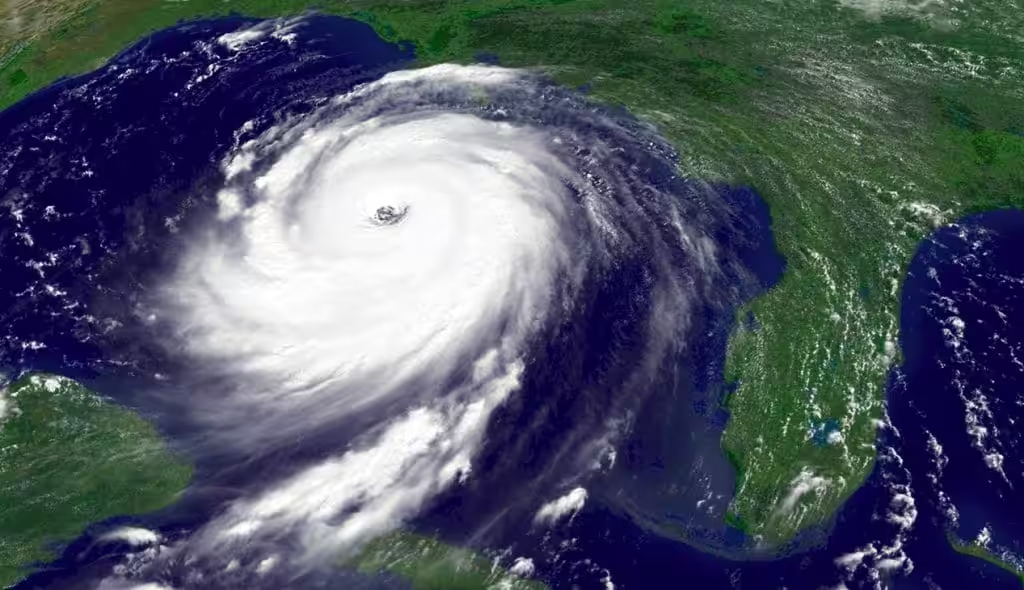
- It is a type of low-pressure weather system that forms over tropical waters.
- They are surrounded by closed isobars having increasing pressure outward.
- The winds move anti-clockwise in northern hemisphere and clockwise in southern hemisphere.
- They are characterized by strong winds, heavy rainfall.
- Tropical cyclones are known by different names depending on their location, such as hurricanes in the Atlantic and north-eastern Pacific, Willy-willy in North West Australia, typhoons in the northwest Pacific, and cyclones in the South Pacific and Indian Ocean.
What are the conditions required for the formation of Tropical Cyclones?
| Conditions | Function |
| Warm water (more than 27 degree celsius) | Warm water → rapid evaporation → moisture-rich air rises → cloud formation. |
| Abundant supply of moisture | When that moist air rises and condenses into clouds, it releases latent heat — this is the fuel of the cyclone. |
| Low wind shear | It keeps the cyclone structure vertical / aligned and hence it allows the stable eye formation and continuous convection. |
| Pre-existing low pressure | It starts rising motion of air and creates a centre for wind to spiral into. |
| Converging winds | It pushes the warm air upwards |
| Coriolis force | It develops cyclonic vorticity and creates cyclone’s spiral shape. |
How the naming of the cyclones is done?
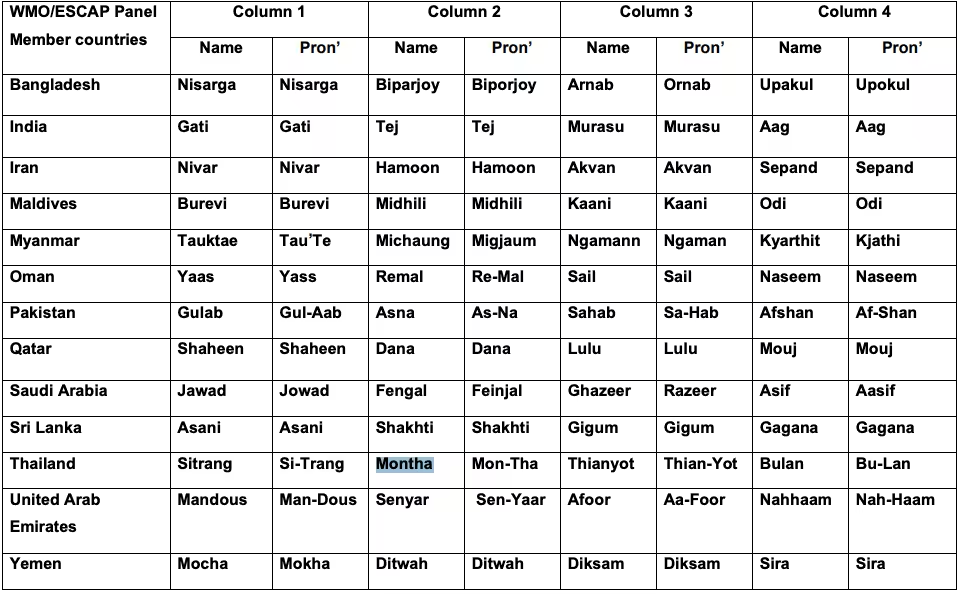
Tropical cyclones are named by regional specialized meteorological centers under the coordination of WMO (World Meteorological Organization). See details.
In the North Indian Ocean Region (India, Bangladesh, Pakistan, Sri Lanka, etc.)
- 13 member countries (India, Pakistan, Bangladesh, Sri Lanka, Maldives, Myanmar, Thailand, Oman, UAE, Yemen, Saudi Arabia, Iran, Qatar)
- Each country submits a list of names in advance.
- These names are used sequentially, one after another.
- Once a name is used, it is not repeated again.
When selecting a new name, consideration is given to certain factors:
- The name should be new. It should not be there in the already existing list of any of the RSMCs worldwide including RSMC New Delhi.
- The proposed name should be neutral to (a) politics and political figures (b) religious believes, (c) cultures and (d) gender
- Name should be chosen in such a way that it does not hurt the sentiments of any group of population over the globe
- It should not be very rude and cruel in nature
- It should be short, easy to pronounce and should not be offensive to any member
- The maximum length of the name will be eight letters
- The proposed name should be provided along with its pronunciation, meaning and voice over
- The Panel reserves the right to reject any name, if any of the criteria above is not satisfied.
Why the East coast of India is more vulnerable to Tropical Cyclones than West coast?
| Factor | East Coast (Bay of Bengal) | West Coast (Arabian Sea) |
| Sea Surface Temperature | Warmer & stable SST → high evaporation | Cooler SST → less evaporation |
| Surrounding Landmasses | Enclosed basin → moisture trapped → cyclones intensify | Open basin → winds disperse → cyclones weaken |
| Freshwater Inflow | Major rivers (Ganga, Godavari etc.) keep surface warm → insulation | Less river inflow → saline mixing → less cyclone support |
| Vertical Wind Shear | Low wind shear → stable cyclone structure | Higher wind shear → cyclone disruption |
| Cyclone Track | Most cyclones move west/northwest → direct India landfall | Many cyclones move toward Oman/Pakistan → avoid India |
| Coastal Shelf | Wide, shallow shelf → high storm surge & flooding | Narrow, steep shelf → lower storm surge impact |
| Frequency | 4–6 cyclones/year (High) | 1–2 cyclones/year (Low) |
“Recent studies by IMD and IITM show that the Arabian Sea is warming faster than the Bay of Bengal — turning into a high-energy heat reservoir due to climate-change–induced heat trapping. This rapid ocean warming, combined with the delayed withdrawal of the southwest monsoon (now extending into October–November), has created ideal conditions for more frequent post-monsoon cyclones. Earlier, strong vertical wind shear in the Arabian Sea used to weaken cyclone formation, but recent research by the IPCC and Nature Climate Change indicates that wind shear has been weakening, allowing cyclones to intensify rapidly into extremely severe categories — as seen in Cyclones Tauktae and Biparjoy. Atmospheric interaction between western disturbances and Arabian Sea cyclones is also shifting landfall zones closer to Gujarat and Maharashtra.”
What are the NDMA Guidelines in this regard?
| Component | Specific NDMA Guidelines |
| Risk Assessment & Mapping | • Coastal districts must have multi-hazard vulnerability maps • Use IMD, INCOIS, NRSC satellite + storm surge modelling • Creation of district-wise Cyclone Risk Atlas |
| Early Warning System (EWS) | • Green / Yellow / Orange / Red alerts • Warning must reach village within 15 minutes • SMS, Sirens, TV, AIR, SATPHONES |
| Evacuation & Shelters | • Zero-fatality policy, forced evacuation allowed • Cyclone shelters every 10 km along coast • Priority: elderly, pregnant, disabled, livestock • Mock drills twice a year |
| Infrastructure & Building Norms | • CRZ norms strictly enforced • Infrastructure must resist 250+ kmph winds • Underground cabling encouraged |
| Preparedness & Capacity Building | • Panchayat-level Disaster Management Committees • Cyclone safety education in schools & communities • Pre-positioning of NDRF, SDRF, Medics |
| Response & Relief | • 72-hour Golden Response Window • Safe water, ORS, sanitation within 24 hrs • Livestock fodder & veterinary support • Damage & Needs Assessment within 48 hrs |
| Post-Cyclone Recovery | • Follow Build Back Better policy • Insurance + crop compensation within 7–10 days • Mangrove & shelterbelt restoration compulsory |
What is the colour coded warning system used by IMD in this regard?
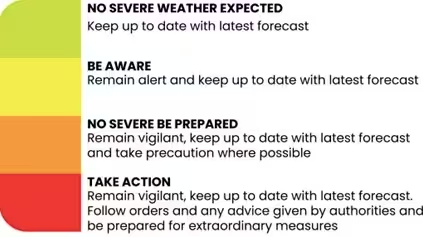
- Green: This color is used for cyclones that are not expected to cause significant damage. The IMD issues a “Green” warning for cyclones that are likely to cause light to moderate rainfall and winds of up to 40 km/h.
- Yellow: This color is used for cyclones that are expected to cause moderate damage. The IMD issues a “Yellow” warning for cyclones that are likely to cause heavy rainfall and winds of 40-60 km/h.
- Orange: This color is used for cyclones that are expected to cause substantial damage. The IMD issues an “Orange” warning for cyclones that are likely to cause very heavy to extremely heavy rainfall and winds of 60-100 km/h.
- Red: This color is used for cyclones that are expected to cause severe damage. The IMD issues a “Red” warning for cyclones that are likely to cause extremely heavy rainfall and winds of more than 100 km/h.
Odisha – A Case Study:
- UN has officially praised Odisha for “World’s Best Practice in Disaster Risk Reduction”. From 10,000 deaths (1999) to nearly 0 deaths today — a revolution in disaster governance. Now being replicated in Bangladesh, Sri Lanka, Myanmar, and Indian coastal states.
- What Odisha Actually Did?
- Built 800+ cyclone shelters along the coast (strong, safe concrete buildings).
- Developed massive evacuation capability — sometimes 10 to 15 lakh people in less than 24 hours
- Created a strong early warning system — alerts reach every village via SMS, sirens, radio, loudspeakers.
- Trained local volunteers (youth, women, fishermen) — called ODRAF & community task forces
- Conducted regular mock drills — so people already knew where to go & what to do.
- Protected natural barriers like mangroves (Bhitarkanika forest) to reduce storm surge.
- Used technology — IMD radar, satellite tracking, control rooms working 24×7