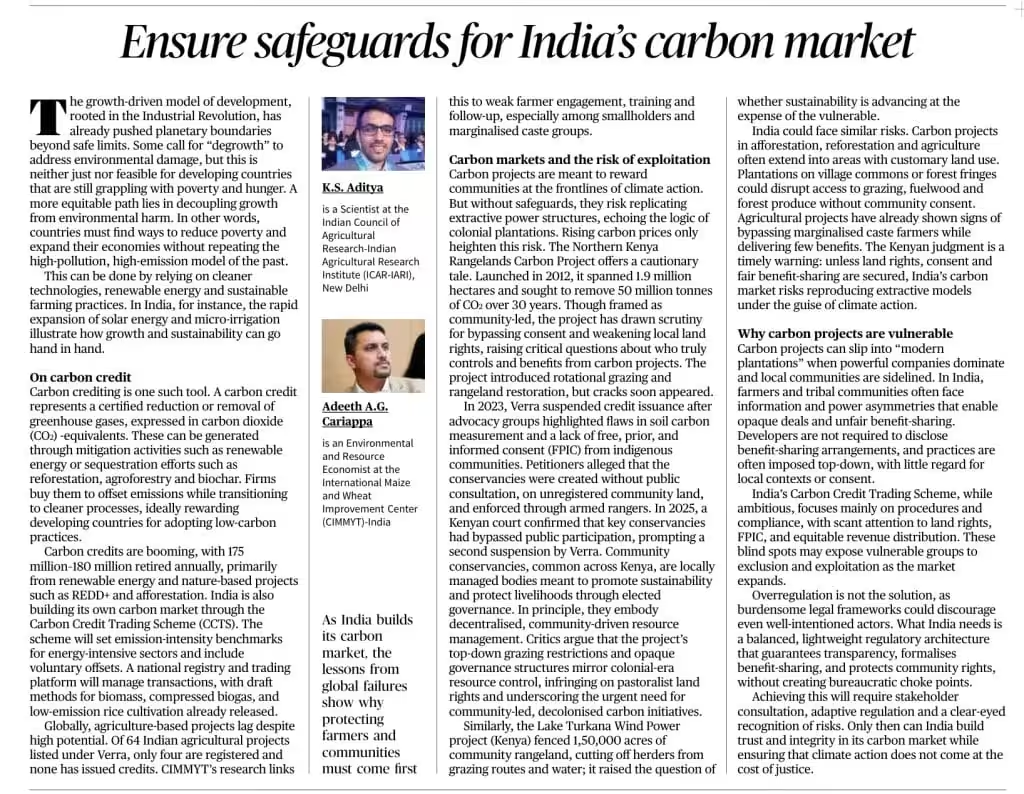
Why in News: India is building its own carbon market through the Carbon Credit Trading Scheme (CCTS) and has already released draft methods for areas including biomass, compressed biogas, and low-emission rice cultivation.
UPSC Relevance: GS3, Conservation, Environmental Pollution and Degradation, Environmental Impact Assessment, Important Climate Change initiatives are asked in Prelims
PYQ:
2025
What is Carbon Capture, Utilization and Storage (CCUS)? What is the potential role of CCUS in tackling climate change? (10 M)
2021
Describe the major outcomes of the 26th session of the Conference of Parties (COP) to the United Nations Framework Convention on Climate Change (UNFCCC). What are the commitments made by India in this conference? (15 M)
What are Carbon Credits?
- A carbon credit represents a certified reduction or removal of greenhouse gases (GHGs), quantified in CO2-equivalents.
- Credits are generated through either mitigation activities (e.g., renewable energy) or sequestration efforts (e.g., reforestation, agroforestry, biochar).
- Firms purchase these credits to offset their emissions during their transition to cleaner processes, ideally serving to reward developing countries for adopting low-carbon practices.
Global Market Boom and India’s CCTS
- The global voluntary carbon market is booming, with 175 million to 180 million credits retired annually, predominantly from renewable energy and nature-based projects (such as REDD+ and afforestation).
- India is establishing its own market through the Carbon Credit Trading Scheme (CCTS).
- The Indian Carbon Market, will in a few years become a full fledged compliance market like EU ETS and aims to be among the top 3 global carbon markets by 2030.
The Carbon Credit Trading Scheme (CCTS), 2023
| Year of Notification | 2023 (The Carbon Credit Trading Scheme, 2023 was officially notified in June 2023). |
| Legal Basis | Energy Conservation (Amendment) Act, 2022. |
| Primary Aim/Objective | To decarbonize the Indian economy by: |
| 1. Pricing GHG emissions to internalize the cost of pollution. | |
| 2. Achieving India’s enhanced Nationally Determined Contributions (NDCs), specifically the target of reducing the emissions intensity of its GDP by 45% by 2030 from 2005 levels. | |
| Compliance Commencement | Expected to begin in Fiscal Year 2025-26 (Transitioning from the existing Perform, Achieve, and Trade (PAT) scheme). |
Controlling and Model Authority
| Role/Body | Controlling/Model Authority |
| Apex Body/Oversight | National Steering Committee for the Indian Carbon Market (NSCICM) |
| Administrator/Scheme Operation | Bureau of Energy Efficiency (BEE) |
| Trading Regulator | Central Electricity Regulatory Commission (CERC) |
| National Registry of Carbon Credits Operator | Grid Controller of India (GCI) |
Two key mechanisms: –
1. Compliance Mechanism (Mandatory)
- This mechanism sets mandatory GHG emission-intensity targets for large, energy-intensive sectors (called “Obligated Entities”).
- It is a gradual transition from the existing PAT scheme.
- Initial 9 Sectors (Phase 1):
- Iron and Steel
- Cement
- Aluminium
- Fertilizers
- Petroleum Refineries
- Pulp and Paper
- Textiles
- Chlor-Alkali
- Petrochemicals
- Note: Entities that overachieve their targets earn CCCs, which can be sold to entities that fall short.
2. Offset Mechanism (Voluntary)
- This mechanism is designed to incentivize GHG reduction actions from sectors not covered under the compliance market and to increase market liquidity.
- The approved sectoral scope for generating voluntary carbon credits is broad and includes:
| Sector (Phase1) | Illustrative Activities/Sub-Sectors |
| Energy | Renewable Energy, Green Hydrogen Production (through electrolysis/Biomass), Compressed Biogas, Industrial Energy Efficiency. |
| Agriculture | Systematic Rice Intensification (SRI), Biochar, Agroforestry. |
| Forestry | Afforestation/Reforestation, Institutional Forestry. |
| Waste | Waste handling and disposal (e.g., Landfill Gas Capture, Biochar). |
| Transport | Modal Shift, Electric Vehicles/Bus. |
| Industries | Manufacturing, Green Ammonia Usage, Chemical Industries. |
| Other (Phase 2) | Construction, Fugitive Emissions, Carbon Capture, Utilisation, and Storage. |
Challenges faced in Carbon Market
- Exploitation of indigenous and local communities : Carbon projects, without strong safeguards, risk making extractive power structures (likened to colonial plantations), at the cost of vulnerable communities’ livelihoods and land rights. especially as carbon prices rise.
- The Northern Kenya Rangelands Carbon Project serves as a major cautionary example:
- Its credit issuance was suspended twice by Verra (in 2023 and 2025) due to flaws in measurement and a lack of Free, Prior, and Informed Consent (FPIC) from indigenous communities even though it was framed as community-led.
- The Northern Kenya Rangelands Carbon Project serves as a major cautionary example:
- Disparities and Inequities b/w Nations: Significant imbalances exist, where wealthier nations (Global North) often source cheap offsets from the Global South. This arrangement can lead to “carbon colonialism,” where the focus is on offsetting in developing countries rather than achieving deep, domestic emission cuts in high-emitting developed nations. It also results in unequal carbon credit pricing and risks increasing local social and economic inequalities.
- Capacity Building of Global South and many G20 Nations: Many countries lack the technical expertise and institutional capacity to effectively design, implement, and govern carbon pricing mechanisms. This includes developing robust Monitoring, Reporting, and Verification (MRV) systems, conducting complex economic analysis, and creating strong regulatory frameworks necessary for credible market operation.
- Stability and Investor Confidence (Crashes in EU-ETS and China’s ETS): Carbon markets are susceptible to price volatility, which discourages long-term investment in low-carbon technologies. The EU-ETS experienced crashes (like after the 2008 financial crisis) due to an oversupply of allowances, needing reforms like the Market Stability Reserve (MSR) to regulate supply and stabilize prices. Emerging markets like China’s ETS face similar challenges in maintaining price signals amidst regulatory uncertainty and government intervention.
- Regulation & Oversight: The market, especially the voluntary segment, suffers from a lack of standardized rules and effective supervision. This leads to poor credit quality and makes it difficult to detect and prevent fraud, ultimately undermining market credibility and investor trust.
- Greenwashing: This is a corporate claim that exaggerates or misrepresents a company’s environmental action. In carbon markets, it occurs when entities rely excessively on low-quality carbon offsets instead of prioritizing actual emission reduction within their own operations. This allows the company to appear climate-friendly while continuing high-polluting activities.
- Additionality Principle: This is the core integrity standard. An emission reduction or removal project is considered “additional” only if it would not have happened without the revenue generated from selling carbon credits.
- It is notoriously difficult to prove this scenario. If a project would have been implemented anyway and is not any new effort (e.g., due to existing regulation or financial viability), the carbon credit it generates is not a genuine environmental benefit, allowing the credit buyer to effectively pollute without a corresponding net reduction.
- Challenges in Agricultural Carbon Projects – Agriculture-based projects, despite having high potential, currently lag significantly on a global scale due to factors like weak farmer engagement, training, and follow-up, which disproportionately affect smallholder farmers and marginalized caste groups.
- In India, only four out of 64 agricultural projects listed under Verra are registered, and none have successfully issued credits.
Risks for India
- Disrupting community access – India faces similar vulnerabilities like Kenya where projects (e.g., afforestation, agriculture) could extend onto customary land, taking away indigenous people’s rights to grazing or fuelwood without proper consent.
- Information and power asymmetry – between powerful developers and local communities, enabling opaque deals and unfair benefit-sharing, as developers are not required to give information on benefit-sharing arrangements to local people.
- Limited scope – The CCTS is currently criticized for focusing too heavily on procedures and compliance while having scant attention to land rights, FPIC, and equitable revenue distribution.
- Technology for Transition – The MoEFCC’s CCTS requires advanced, costly low-carbon technologies (e.g., green hydrogen, CCUS) for compliance. India needs significant financing and technical capacity to build credible MRV (Monitoring, Reporting, and Verification) systems for accurate credit issuance.
- Improper Energy Pricing – Subsidies (especially for agriculture and some consumers) artificially lower the price of high-carbon energy. This weakens the carbon price signal, reducing the financial incentive for industries to invest in deep decarbonization or purchase credits.
- Regional Disparities – Significant variation exists in states’ energy mix (coal vs. renewables), industrial base, and economic status. A uniform national market risks widening economic inequality, as prosperous, renewable-rich states benefit more than coal-dependent, less-developed ones.
- Informal Economy – The large unregulated informal sector (including many MSMEs) is excluded from the compliance mechanism. This limits broad-based participation and the market’s reach, hindering economy-wide emission reductions due to a lack of formal processes and resources.
Way Ahead
- Capacity Building & Tech Transfer – Train regulators and industries on MRV (Monitoring, Reporting, and Verification) standards and facilitate the flow of low-carbon technologies (e.g., CCUS, green hydrogen) to reduce abatement costs.
- Transparency, Accountability & Stakeholder Participation – Ensure clear, public disclosure of emissions, transactions, and project data (often via digital registries/blockchain). Mandate inclusive participation from diverse stakeholders in market design to build trust and legitimacy beyond overregulation.
- Power Sector Reforms – Phase out coal subsidies and liberalize power markets to fully integrate the carbon price signal, making clean energy sources (wind/solar) more competitive and incentivizing the sector’s shift away from fossil fuels.
- Peer Learning – EU & Regional BasisAdopt best practices from established systems like the EU ETS (e.g., Market Stability Reserve). Develop regional linkages between national markets to increase liquidity, lower overall compliance costs, and harmonize standards.
- Integration with Global Markets – Harmonize domestic standards with international frameworks (e.g., Paris Agreement’s Article 6) to allow the seamless transfer of credits, attract global finance, and expand the pool of cost-effective reduction options.
- Revenue Recycling – Earmark carbon auction/tax revenues to fund climate-friendly investments, R&D for new technologies, and compensation for vulnerable households/industries to maintain public and industrial support.
- Dynamic Targeting – Employ a flexible cap or price mechanism that adjusts automatically based on market performance or real-world emissions data, ensuring the market remains effective and aligned with evolving national climate goals.
- Price Stability – Implement mechanisms like a Price Collar (floor and ceiling) or Market Stability Reserves (like in the EU ETS) to prevent price volatility, which provides long-term investment certainty for low-carbon projects.
- Sector-Specific Obligation – Tailor emission reduction mandates and targets for different high-emitting sectors (e.g., cement, steel, aviation) based on their specific abatement potential and competitive exposure to minimize leakage risk.
Tell Google you want more of this.
Add Anantam IAS as a preferred sourceOne tap, and this site shows up more often in your own Top Stories, AI Overviews and AI Mode. Remove it any time.